

|
시장보고서
상품코드
2114982
자성 재료 시장 : 시장 점유율 분석, 업계 동향 및 통계, 성장 예측(2026-2031년)Magnetic Materials - Market Share Analysis, Industry Trends & Statistics, Growth Forecasts (2026 - 2031) |
||||||
 Mordor Intelligence
Mordor Intelligence에 의하면, 자성 재료 시장 규모는 2025년에 3,126만 톤으로 평가되었고, 2026년 3,318만 톤에서 2031년까지 4,468만 톤에 이를 것으로 예측되며, 예측 기간(2026-2031년) CAGR은 6.13%를 나타낼 전망입니다.
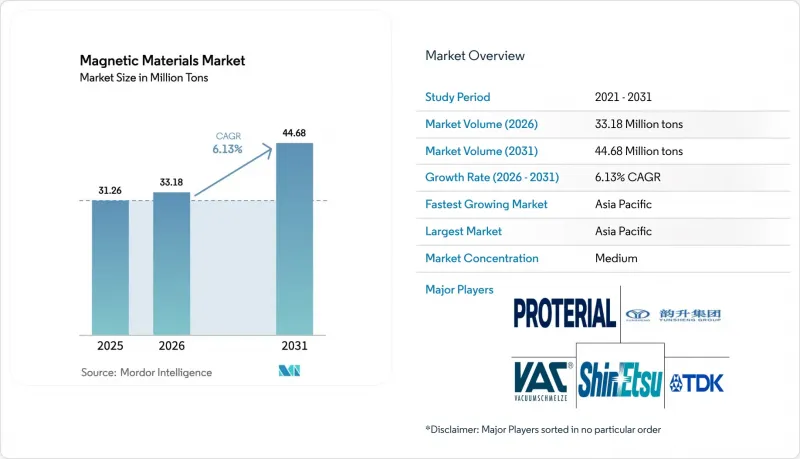
본 보고서는 재료별(네오디뮴·철·붕소, 페라이트, 기타), 유형별(경질/영구 자성 재료, 연자성 재료, 반경질 자성 재료), 용도별(전기 모터·발전기, 변압기·인덕터, 기타), 최종 사용자 산업별(전자기기, 자동차, 기타), 지역별(아시아태평양, 북미, 유럽, 남미, 중동 및 아프리카)로 분류되어 있습니다.
세계의 자성 재료 시장 동향 및 인사이트
전기차 보급 확대가 자성 재료 수요를 견인
2024년, 배터리식 전기차(BEV)의 NdFeB 자석 소비량은 2,800톤이었으나, 전기차 연간 판매 대수가 3,000만 대에 가까워짐에 따라 2030년까지 8,000톤을 넘어설 것으로 예측됩니다. 영구자석 동기 모터는 96% 이상의 최고 효율을 달성하고 있으며, 각 OEM 업체들은 배터리 대형화 없이 주행 거리를 연장하기 위해 희토류 등급에 대한 투자를 추진하고 있습니다. 테슬라의 ‘4680 셀’ 설계와 BYD의 ‘블레이드 팩’은 모두 멀티 모터 레이아웃을 채택하고 있어, 싱글 모터 차량에 비해 대당 자석 사용량이 2배에 달할 전망입니다. 중국에서는 2025년에 950만 대의 EV가 생산되어 국내 소결 자석 생산량의 대부분을 흡수함에 따라 수출 공급이 부족해지고 있습니다. 800볼트 아키텍처로 전환하는 유럽 플랫폼에서는 열에 의한 자력 감소를 견딜 수 있는 고보자력 자석이 필요하며, 이로 인해 자성 재료 시장에서 디스프로슘에 대한 수요가 증가하고 있습니다.
전력망 규모의 풍력 터빈용 기어리스 발전기 채택
직접 드라이브 방식의 풍력 터빈은 기어박스를 제거하여 기계적 손실을 2-3% 포인트 절감함으로써, 유지보수 주기를 6개월에서 18개월로 연장합니다. 골드윈드(Goldwind)사의 16MW 해상용 유닛에는 약 12톤의 NdFeB가 사용되고 있으며, 2026년에 추가될 40GW 규모의 해상 풍력 발전 설비에는 약 3만 톤의 자석이 투입될 가능성이 있습니다. 중국은 전 세계 풍력 터빈의 60%를 공급하고 있기 때문에 해외에 설치되는 프로젝트라 하더라도 자석 수요의 대부분은 국내에서 발생하고 있습니다. 지멘스-가메사나 베스타스는 재생 NdFeB를 시범 도입하고 있지만, 재처리로 인해 자속이 최대 15% 저하되기 때문에 폐쇄 루프 방식에 의한 재료 소비량은 여전히 전체의 5% 이하에 머물고 있습니다. 북해의 사업자들은 현재 내식성 코팅을 사양으로 채택하고 있는데, 이는 1kg당 2-3달러의 비용 증가를 초래하지만, 25년 수명 주기 동안 크레인선을 이용한 수리 비용을 절감할 수 있습니다.
OECD 국가들에서 희토류 광업에 대한 ESG 반발이 거세지고 있습니다.
미국과 호주에서 신규 희토류 광산의 허가를 취득하는 데는 현재 평균 7-10년이 소요되며, 이는 2015년 소요 기간의 2배에 해당합니다. 이는 규제 당국이 광미수 처리에 관한 영구적인 보증금을 요구하고 있기 때문입니다. 라이너스(Linus)사는 잔여물 처리 조건 협상 중에 칼굴리 제련소의 확장 공사를 18개월간 중단했습니다. 이는 기존 시설의 개보수 프로젝트조차 사회적 수용성 문제로 인해 지연될 수 있음을 보여줍니다. 환경 보호 단체들은 마운틴 패스에서 발생한 방사성 핵종 배출을 둘러싸고 MP 머티리얼즈를 상대로 소송을 제기했으며, 이로 인해 자성 재료 시장의 규정 준수 비용이 상승하고 있습니다. EU의 ‘중요 원자재법’은 2030년까지 현지 조달률 10%를 의무화하고 있지만, 유럽에는 신규 광산이 가동되고 있지 않아 EU는 아시아의 위탁 제련에 의존할 수밖에 없는 상황입니다. 이러한 역풍으로 인해 산화네오디뮴 가격이 1kg당 80달러를 초과할 경우, OEM 각사는 효율을 3-5% 희생하더라도 희토류에 대한 의존에서 벗어나는 ‘자석 없는’ 모터 설계로 전환하고 있습니다.
부문 분석
네오디뮴·철·붕소(NdFeB)는 2025년 출하량의 44.21%를 차지했습니다. 이는 토크를 손상시키지 않고 로터의 크기를 절반으로 줄일 수 있는 타의 추종을 불허하는 에너지 밀도를 반영한 것입니다. 이 압도적인 점유율로 인해 고가 대가 유지되고 있지만, 디스프로슘의 비용 상승으로 인해 OEM 각사는 자성 재료 시장에서 대체재를 모색하고 있습니다. 페라이트는 휴대전화 제조업체들이 햅틱 모듈 및 충전 모듈에서 본딩 가공된 NdFeB를 사출 성형 페라이트로 대체함에 따라, 2031년까지 연평균 성장률(CAGR) 6.28%를 나타낼 것으로 예측됩니다. 이를 통해 성능을 20% 희생하는 대신 희토류 리스크를 제로로 억제할 수 있게 됩니다. 사마륨-코발트는 NdFeB가 자속을 잃는 200℃ 이상의 환경에 있는 틈새 시장인 항공우주 및 다운홀 툴 시장에서 활용되고 있습니다. 생산량은 3,000톤 이하로 제한되지만, 가격이 1kg당 100달러를 상회하기 때문에 수익성은 유지되고 있습니다. 알니코는 주로 구형 센서나 악기용 픽업에 유용하며, 한편 전기강판은 변압기나 모터의 적층판 덕분에 높은 수요를 창출하여 자성 재료 시장의 기반을 지탱하고 있습니다. 고급 나노 결정 리본은 데이터센터의 전원 공급 장치(PSU)에서 고주파 용도로 시장 점유율을 확보하고 있으며, 대량 생산되는 범용 제품 중에서도 특히 높은 이익률을 자랑하는 부문입니다.
2025년에는 연자성 재료가 총 출하량의 61.23%를 차지한 것으로 평가되었으며, 이는 1초에 수천 번씩 자화를 반복하는 변압기 코어, 인덕터, 고정자 적층판에 의해 뒷받침되고 있습니다. 전력 회사가 배전 변압기의 무부하 손실 감소를 목표로 하고 있어, 결정립 배향 전자강판에 대한 새로운 투자가 진행되고 있습니다. 한편, 경자성체/영구자석은 2031년까지 연평균 성장률(CAGR) 6.98%로 확대되고 있습니다. 이는 전기자동차, 풍력 터빈, 산업용 로봇 1대당 여러 개의 영구자석 모터가 탑재됨에 따라 자성 재료 시장의 성장이 가속화되고 있기 때문입니다. 중간 정도의 잔류 자력을 가진 반경질 등급은 설계자들이 영구 바이어스용으로 NdFeB로 전환하거나, 전환 가능한 자기장용으로 페라이트로 회귀함에 따라 시장에서 점차 밀려나고 있습니다. 전 세계 효율 규제(IE4/IE5)에서는 규제 기준을 충족하기 위해 거의 영구 자석의 사용이 필수적이며, 이는 경질 소재로의 전환 추세를 뒷받침하고 있습니다. 한편, USB Power Delivery(PD) 충전기는 가전제품용 고자속 인덕터에 대한 연질 페라이트 수요를 더욱 끌어올리고 있습니다.
지역별 분석
아시아태평양은 2025년 총 생산량의 67.23%를 차지한 것으로 평가되었으며, 2031년까지 연평균 성장률(CAGR) 7.77%를 기록할 전망입니다. 이는 중국의 18만 톤에 달하는 NdFeB 생산량, 일본의 고보자력 특수 제품, 한국의 MRAM 생산 확대를 반영한 것입니다. 2025년, 중국은 페라이트, 전자강판, 소결 NdFeB와 같은 주요 자성 소재를 생산하고 있으며, 수직 통합형 대기업들이 산화물 제조부터 가공까지 일관되게 관리함으로써 저비용과 짧은 납기를 유지하고 있습니다. 일본의 신에츠 케미칼(Shin-Etsu Chemical)과 TDK는 50MGOe 이상 및 30kOe 이상의 잔자력을 지닌 프리미엄 등급 시장을 독점하고 있으며, 범용 블록에 비해 30-40%의 가격 프리미엄을 확보하고 있습니다. 인도는 국내 스마트폰 및 이륜차용 페라이트의 거점으로 부상하고 있지만, 희토류 산화물의 95%를 여전히 수입에 의존하고 있어 중국의 정책 전환에 영향을 받기 쉬운 상황입니다.
북미는 적정한 시장 점유율을 유지하고 있으며,MP 머티리얼즈의 2단계 합금 생산 라인을 통해 2027년까지 수입 의존도가 70%까지 낮아질 전망이지만, 캐나다의 시범 분리 능력은 여전히 1,000톤 이하에 그치고 있어 자동차 제조업체 한 곳 수요조차 충당하기에는 부족합니다. 유럽에서는 현지 자석 생산 능력이 수요의 고작 5%만을 충당할 뿐입니다. VACUUMSCHMELZE와 Proterial이 데이터센터용 코어에 공급하는 소재는 여전히 중국산 리본에 의존하고 있어, 공급망 전체의 국내 회귀가 어렵다는 점을 보여줍니다. 남미, 중동 및 아프리카 시장 점유율은 광산 설비 및 송전망 업그레이드에 힘입어 성장하고 있으며, 브라질에서는 철광석 광미에서 희토류를 추출하는 방안이 검토되고 있으나 2028년까지는 상용화되지 않을 가능성이 있습니다.
기타 혜택
- 엑셀 형식 시장 예측(ME) 시트
- 3개월간의 애널리스트 지원
자주 묻는 질문
목차
제1장 서론
제2장 조사 방법
제3장 주요 요약
제4장 시장 구도
제5장 시장 규모 및 성장 예측
제6장 경쟁 구도
제7장 시장 기회 및 향후 전망
AJY 26.08.28According to Mordor Intelligence, the magnetic materials market size was valued at 31.26 Million tons in 2025 and is estimated to grow from 33.18 Million tons in 2026 to reach 44.68 Million tons by 2031, at a CAGR of 6.13% during the forecast period (2026-2031).
This report is Segmented by Material (Neodymium-Iron-Boron, Ferrite, and More), Type (Hard/Permanent Magnetic Materials, Soft Magnetic Materials, and Semi-Hard Magnetic Materials), Application (Motors and Generators, Transformers and Inductors, and More), End-User Industry (Electronics, Automotive, and More), and Geography (Asia-Pacific, North America, Europe, South America, and Middle-East and Africa).
Global Magnetic Materials Market Trends and Insights
Rising Electric Vehicle Adoption Fuels Demand for Magnetic Materials
Battery-electric vehicles consumed 2,800 tons of NdFeB magnets in 2024 and are projected to exceed 8,000 tons by 2030 as annual EV sales approach 30 million units. Permanent-magnet synchronous motors achieve peak efficiencies above 96%, prompting OEMs to spend on rare-earth grades to extend driving range without larger batteries. Tesla's 4680-cell design and BYD's Blade pack both use multi-motor layouts that double magnet content per vehicle versus single-motor cars. China built 9.5 million EVs in 2025, absorbing most domestic sintered-magnet output and tightening export supply. European platforms moving to 800-volt architectures require high-coercivity magnets able to withstand thermal demagnetization, which lifts dysprosium demand in the magnetic materials market.
Grid-Scale Wind-Turbine Gearless Generators Adoption
Direct-drive turbines remove gearboxes and cut mechanical losses by 2-3 percentage points, extending service intervals from six to eighteen months. Goldwind's 16 MW offshore unit contains about 12 tons of NdFeB, and 2026 offshore additions of 40 GW could draw roughly 30,000 tons of magnets. China supplies 60% of global turbines, so most magnet demand originates domestically even for projects installed abroad. Siemens Gamesa and Vestas trial recycled NdFeB, yet closed-loop material remains under 5% of consumption because reprocessing degrades flux up to 15%. North Sea operators now specify corrosion-resistant coatings that add USD 2-3 per kilogram but cut crane-vessel repair costs over 25-year lifecycles.
REE Mining ESG Backlash Intensifies in OECD Nations
Permitting for new rare-earth mines in the United States and Australia now averages 7-10 years, double the 2015 timeline, because regulators require perpetual tailings-water treatment bonds. Lynas paused its Kalgoorlie refinery expansion for 18 months while negotiating residue-disposal terms, proving even brownfield projects face social-license delays. Environmental groups have sued MP Materials over radionuclide discharge at Mountain Pass, elevating compliance costs in the magnetic materials market. The EU's Critical Raw Materials Act demands 10% local supply by 2030, yet no new European mine is online, forcing the bloc to rely on toll refining in Asia. These headwinds are nudging OEMs toward magnet-free motor designs that trade 3-5% efficiency for rare-earth independence when neodymium oxide tops USD 80/kg.
Other drivers and restraints analyzed in the detailed report include:
- AI-Enabled Factory Automation Boosts Sensor Magnets
- High-Frequency Power Electronics Need Nanocrystalline Cores
- China Export-Control Risk on Nd and Dy Oxides
For complete list of drivers and restraints, kindly check the Table Of Contents.
Segment Analysis
Neodymium-Iron-Boron (NdFeB) commanded 44.21% of 2025 volume, reflecting its unmatched energy product that lets motor makers halve rotor size without losing torque. That dominance locks in premium pricing, yet rising dysprosium cost keeps OEMs searching for alternatives in the magnetic materials market. Ferrite is slated to grow at a 6.28% CAGR through 2031 as handset makers replace bonded NdFeB with injection-molded ferrite in haptic and charging modules, trading 20% performance for zero rare-earth risk. Samarium-cobalt serves niche aerospace and downhole-tool markets above 200 °C, where NdFeB loses flux; volumes stay under 3,000 tons, but prices above USD 100/kg keep profitability intact. AlNiCo is useful mainly in legacy sensors and musical pickups, while electrical steel drives high demand thanks to transformers and motor laminations, anchoring the magnetic materials market. Premium nanocrystalline ribbons win high-frequency slots in data-center PSUs, a pocket of outsized margin amid commodity tonnage.
Soft magnetic materials held 61.23% tonnage in 2025, buoyed by transformer cores, inductors, and stator laminations that cycle magnetization thousands of times per second. Grain-oriented electrical steel is enjoying fresh investment because utilities target lower no-load losses in distribution transformers. Hard/permanent magnets, however, are expanding at a 6.98% CAGR through 2031, because each electric vehicle, wind turbine, or industrial robot adds multiple permanent-magnet motors, accelerating growth in the magnetic materials market. Semi-hard grades, with intermediate coercivity, are being squeezed out as designers either jump to NdFeB for permanent bias or retreat to ferrite for switchable fields. Global efficiency rules (IE4/IE5) almost require permanent magnets to meet regulatory thresholds, reinforcing the tilt toward hard materials. Meanwhile, USB Power Delivery chargers drive more soft-ferrite demand for high-flux inductors in consumer electronics.
Complete Report Scope:
- By Material
- Neodymium-Iron-Boron (NdFeB)
- Ferrite
- Samarium-Cobalt (SmCo)
- Aluminum-Nickel-Cobalt (AlNiCo)
- Other Materials (Electrical Steel (GO and NGO), Nanocrystalline and Amorphous Alloys)
- By Type
- Soft Magnetic Materials
- Hard/Permanent Magnetic Materials
- Semi-Hard Magnetic Materials
- By Application
- Electric Motors and Generators
- Transformers and Inductors
- Sensors and Actuators
- Magnetic Storage and MRAM
- Magnetic Refrigeration
- EMI / EMC Components
- By End-user Industry
- Electronics
- Automotive
- Power Generation
- Industrial
- Other End-user Industries (Home Appliances, Healthcare, Aerospace, etc.)
- By Geography
- Asia-Pacific
- China
- India
- Japan
- South Korea
- ASEAN Countries
- Rest of Asia-Pacific
- North America
- United States
- Canada
- Mexico
- Europe
- Germany
- United Kingdom
- Italy
- France
- NORDIC Countries
- Rest of Europe
- South America
- Brazil
- Argentina
- Rest of South America
- Middle-East and Africa
- Saudi Arabia
- South Africa
- Rest of Middle-East and Africa
- Asia-Pacific
Geography Analysis
Asia-Pacific captured 67.23% of 2025 tonnage and is on track for a 7.77% CAGR to 2031, reflecting China's 180,000-ton NdFeB output, Japan's high-coercivity specialties, and South Korea's MRAM scale-up. China produced major magnetic materials in 2025 across ferrite, electrical steel, and sintered NdFeB, with vertically integrated majors controlling oxide through machining, which sustains low cost and rapid lead times. Japan's Shin-Etsu and TDK dominate premium grades above 50 MGOe and 30 kOe coercivity, securing 30-40% price premiums over commodity blocks. India is emerging as a ferrite hub for domestic smartphones and two-wheelers, but still imports 95% of rare-earth oxides, exposing it to Chinese policy shifts.
North America held a moderate share, and MP Materials' Stage II alloy line will shave import dependence to 70% by 2027, yet Canada's pilot separation capacity remains under 1,000 tons, insufficient for even one automaker. In Europe, local magnet capacity covers barely 5% of need; VACUUMSCHMELZE and Proterial feed data-center cores yet rely on Chinese ribbon, showing the difficulty of onshoring full supply chains. South America and the Middle East and Africa's shares are driven by mining equipment and grid upgrades, with Brazil exploring rare-earth extraction from iron-ore tailings that may not commercialize before 2028.
- Adams Magnetic Products
- ArcelorMittal
- Arnold Magnetic Technologies
- Daido Steel Co., Ltd.
- Dexter Magnetic Technologies
- DMEGC Magnetics Co., Ltd.
- Electron Energy Corporation
- GKN Powder Metallurgy
- Hengdian Group Holdings Limited
- Lynas Rare Earths Ltd.
- MP Materials Corp.
- NEO
- Ningbo Yunsheng Co., Ltd.
- Niterra Materials Co., Ltd.
- Proterial, Ltd.
- Quadrant
- Shin-Etsu Chemical Co., Ltd.
- Steward Advanced Materials LLC
- TDK Corporation
- VACUUMSCHMELZE GmbH & Co. KG
Additional Benefits:
- The market estimate (ME) sheet in Excel format
- 3 months of analyst support
TABLE OF CONTENTS
1 Introduction
- 1.1 Study Assumptions and Market Definition
- 1.2 Scope of the Study
2 Research Methodology
3 Executive Summary
4 Market Landscape
- 4.1 Market Overview
- 4.2 Market Drivers
- 4.2.1 Rising Electric Vehicle Adoption Fuels Demand for Magnetic Materials
- 4.2.2 Grid-Scale Wind-Turbine Gearless Generators Adoption
- 4.2.3 AI-Enabled Factory Automation Boosts Sensor Magnets
- 4.2.4 Growing Robotics and Automation Usage Accelerates Magnetic Materials Demand
- 4.2.5 High-Frequency Power Electronics Need Nanocrystalline Cores
- 4.3 Market Restraints
- 4.3.1 REE Mining ESG Backlash Intensifies in OECD Nations
- 4.3.2 China Export-Control Risk on Nd and Dy Oxides
- 4.3.3 Slow Scale-Up Of Closed-Loop NdFeB Recycling
- 4.4 Value Chain Analysis
- 4.5 Regulatory Outlook
- 4.6 Porter's Five Forces
- 4.6.1 Bargaining Power of Suppliers
- 4.6.2 Bargaining Power of Buyers
- 4.6.3 Threat of New Entrants
- 4.6.4 Threat of Substitutes
- 4.6.5 Degree of Competition
5 Market Size and Growth Forecasts (Volume)
- 5.1 By Material
- 5.1.1 Neodymium-Iron-Boron (NdFeB)
- 5.1.2 Ferrite
- 5.1.3 Samarium-Cobalt (SmCo)
- 5.1.4 Aluminum-Nickel-Cobalt (AlNiCo)
- 5.1.5 Other Materials (Electrical Steel (GO and NGO), Nanocrystalline and Amorphous Alloys)
- 5.2 By Type
- 5.2.1 Soft Magnetic Materials
- 5.2.2 Hard/Permanent Magnetic Materials
- 5.2.3 Semi-Hard Magnetic Materials
- 5.3 By Application
- 5.3.1 Electric Motors and Generators
- 5.3.2 Transformers and Inductors
- 5.3.3 Sensors and Actuators
- 5.3.4 Magnetic Storage and MRAM
- 5.3.5 Magnetic Refrigeration
- 5.3.6 EMI / EMC Components
- 5.4 By End-user Industry
- 5.4.1 Electronics
- 5.4.2 Automotive
- 5.4.3 Power Generation
- 5.4.4 Industrial
- 5.4.5 Other End-user Industries (Home Appliances, Healthcare, Aerospace, etc.)
- 5.5 By Geography
- 5.5.1 Asia-Pacific
- 5.5.1.1 China
- 5.5.1.2 India
- 5.5.1.3 Japan
- 5.5.1.4 South Korea
- 5.5.1.5 ASEAN Countries
- 5.5.1.6 Rest of Asia-Pacific
- 5.5.2 North America
- 5.5.2.1 United States
- 5.5.2.2 Canada
- 5.5.2.3 Mexico
- 5.5.3 Europe
- 5.5.3.1 Germany
- 5.5.3.2 United Kingdom
- 5.5.3.3 Italy
- 5.5.3.4 France
- 5.5.3.5 NORDIC Countries
- 5.5.3.6 Rest of Europe
- 5.5.4 South America
- 5.5.4.1 Brazil
- 5.5.4.2 Argentina
- 5.5.4.3 Rest of South America
- 5.5.5 Middle-East and Africa
- 5.5.5.1 Saudi Arabia
- 5.5.5.2 South Africa
- 5.5.5.3 Rest of Middle-East and Africa
- 5.5.1 Asia-Pacific
6 Competitive Landscape
- 6.1 Market Concentration
- 6.2 Strategic Moves
- 6.3 Market Share(%)/Ranking Analysis
- 6.4 Company Profiles (includes Global level Overview, Market level overview, Core Segments, Financials as available, Strategic Information, Products and Services, and Recent Developments)
- 6.4.1 Adams Magnetic Products
- 6.4.2 ArcelorMittal
- 6.4.3 Arnold Magnetic Technologies
- 6.4.4 Daido Steel Co., Ltd.
- 6.4.5 Dexter Magnetic Technologies
- 6.4.6 DMEGC Magnetics Co., Ltd.
- 6.4.7 Electron Energy Corporation
- 6.4.8 GKN Powder Metallurgy
- 6.4.9 Hengdian Group Holdings Limited
- 6.4.10 Lynas Rare Earths Ltd.
- 6.4.11 MP Materials Corp.
- 6.4.12 NEO
- 6.4.13 Ningbo Yunsheng Co., Ltd.
- 6.4.14 Niterra Materials Co., Ltd.
- 6.4.15 Proterial, Ltd.
- 6.4.16 Quadrant
- 6.4.17 Shin-Etsu Chemical Co., Ltd.
- 6.4.18 Steward Advanced Materials LLC
- 6.4.19 TDK Corporation
- 6.4.20 VACUUMSCHMELZE GmbH & Co. KG
7 Market Opportunities and Future Outlook
- 7.1 White-space and Unmet-Need Assessment


