|
시장보고서
상품코드
2114983
잉크 첨가제 시장 : 점유율 분석, 업계 동향과 통계, 성장 예측(2026-2031년)Ink Additives - Market Share Analysis, Industry Trends & Statistics, Growth Forecasts (2026 - 2031) |
||||||
 Mordor Intelligence
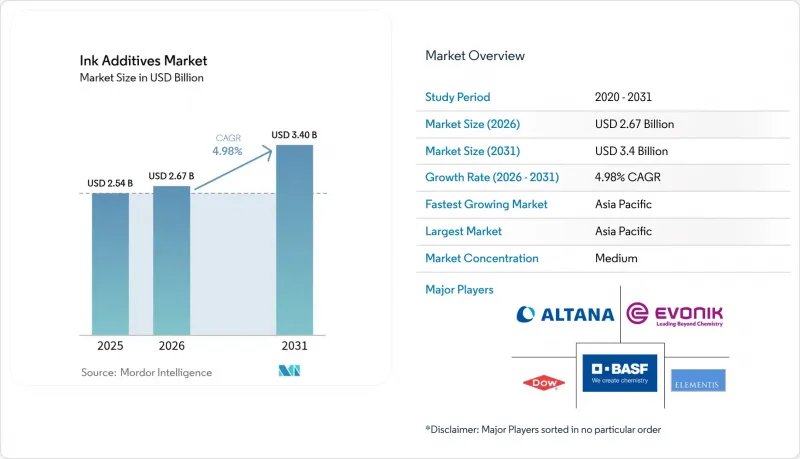
Mordor Intelligence에 의하면, 잉크 첨가제 시장 규모는 2025년 25억 4,000만 달러에서 2026년에는 26억 7,000만 달러로 확대되어 2026년부터 2031년까지 CAGR 4.98%로 성장을 지속하여, 2031년에는 34억 달러에 이를 것으로 예측됩니다.
본 보고서는 첨가제의 유형(분산제·습윤제, 소포제 등), 기술(수성, 용제계 등), 인쇄 공정(오프셋 인쇄, 플렉소 인쇄 등),용도(포장, 인쇄, 기타 용도), 지역(아시아태평양, 북미, 유럽, 남미, 중동 및 아프리카)별로 분류되어 있습니다. 시장 예측은 금액(달러) 기준으로 제시되어 있습니다.
전 세계 잉크 첨가제 시장 동향 및 인사이트
포장 컨버터 수요 증가
각 컨버터 업체들은 다층 필름, 종이·폴리머 라미네이트, 금속화 호일에서 인쇄 농도와 밀착성을 유지하는 첨가제를 지정하고 있습니다. BASF는 낮은 이행성이 요구되는 식품용 연포장재에 대응하기 위해 네덜란드에서 ‘Joncryl’ 및 ‘Acronal Pro’ 수성 분산액 제품 라인을 확충했습니다. 대형 컨버터 그룹은 자동 검사 라인에 대응하기 위해 로트 간 균일성을 강력히 요구하고 있으며, 공급업체에 대해 고순도 원자재와 더욱 엄격한 생산 기준을 요구하고 있습니다. 폐쇄형 색상 관리 및 증강현실(AR)을 활용한 작업 설정에 대한 투자는 인쇄 속도, 습도, 온도의 변동 속에서도 안정성을 유지하는 첨가제의 필요성을 더욱 부각시키고 있습니다. 따라서 2030년까지 전 세계적으로 예상되는 포장 제품 수요 증가는 프리미엄 첨가제 화학제품에 대한 장기적인 성장 여지를 확보해 줄 것입니다.
전자상거래로 인한 골판지 배송량 급증
D2C(소비자 직접 판매) 브랜드들은 배송 상자를 마케팅의 캔버스로 간주하고 있으며, 잉크 도포량 증가를 촉진하는 동시에 고점도 잉크젯 배합에서 분사 안정성을 유지할 수 있는 유변학 조절제를 요구하고 있습니다. 실험실 연구에 따르면, 고형분 분산제를 사용할 경우 노즐 막힘을 유발하지 않으면서 코팅된 화이트 라이너 위에서 최대 67% 더 높은 색상 농도를 얻을 수 있는 것으로 나타났습니다. 도시 지역의 풀필먼트 센터에서는 재고 관리에 적합하고 사용 기한이 긴 잉크가 선호되며, 몇 주간 보관 후에도 상분리가 잘 일어나지 않는 침전 방지 패키지가 권장됩니다. QR 코드, 신선도 표시기, 위조 방지 기능을 통합한 기능성 잉크가 등장하고 있으며, 이를 위해서는 지금까지 골판지 제조 공정에서는 거의 볼 수 없었던 전도성 또는 발광성 첨가제가 필요합니다.
엄격한 식품 접촉 규정 및 VOC 규정
미국 식품의약국(FDA)은 잉크 성분에 대해 계속해서 사례별 접근 방식을 취하고 있으며, 이로 인해 승인 주기가 장기화되어 중소 공급업체의 규정 준수 비용이 증가하고 있습니다. 스위스에서는 2024년 잉크 규정 개정에 따라 미평가 물질의 잠정 목록이 삭제되어, 배합 설계자는 사전에 승인된 화학 물질에만 의존할 수밖에 없게 되었습니다. EU에서는 2025년 9월 REACH 규정 부속서 XVII에 따른 CMR 물질 규제가 강화되어, 추가적인 배합 변경의 물결이 다가오고 있습니다. VOC 상한치는 미국에서는 주마다, EU에서는 회원국마다 다르기 때문에 제품 라인의 합리화가 복잡해지고 있습니다. 대형 다국적 기업들은 사내 규제 대응 팀을 활용하여 이러한 규정에 대응하고 있지만, 지역 밀착형 기업들은 상대적으로 높은 시험 비용에 직면해 있어 혁신 파이프라인이 제약을 받고 있습니다.
부문 분석
2025년에는 분산제 및 습윤제가 매출의 32.10%를 차지하고, 이 물질들이 색상 개발 및 장기 안정성 측면에서 매우 중요한 역할을 하고 있음이 부각되었습니다. BASF사의 ‘Efka PX’ 및 ‘Dispex Ultra PX’ 시리즈는 투명성을 향상시키고 밀 베이스 점도를 낮춤으로써 분쇄 시 에너지 소비를 줄여줍니다. 클라리언트(Clariant)사의 “Dispersogen” 시리즈는 유기, 무기 및 탄소계 안료를 모두 포괄하여, 배합 설계자가 여러 기질에 대응하는 범용 시스템을 구축할 수 있도록 해줍니다. 소포제는 미세 기포의 포획이 결함의 원인이 되는 고속 혼합 및 플렉소 인쇄에서 여전히 필수적입니다. 슬립제 및 레벨링제는 BOPP 등 표면 에너지가 낮은 필름의 습윤성을 향상시키는 반면, BYK사의 유변학 조절제는 전체 전단 프로파일 전반에 걸쳐 침전 방지 효과를 발휘합니다. 스마트 패키징, 고온 세라믹, 옥외 간판 등에서는 용도에 맞는 성능이 요구되기 때문에 특수 조정제 및 접착 촉진제는 연평균 성장률(CAGR) 5.74%로 가장 빠르게 성장하는 하위 그룹이 되었습니다. 이온 액체 및 초분지 폴리머계 첨가제의 개발은 차세대 수성 시스템에 있어 유망한 전개를 보여주고 있습니다.
2025년에는 저VOC 규제 및 인쇄 현장의 화재 보험료 인하가 뒷받침되어 수성 화학제품이 46.80%의 점유율을 차지했습니다. BASF가 네덜란드에서 수성 수지 생산 능력을 확대하고 있는 것은 식품 등급의 무취 플랫폼에 대한 노력을 강조하는 것입니다. 용제형 잉크는 내화학성이 환경적 우려를 상회하는 자동차 내장재, 케이블 마킹 및 산업용 코딩 분야에서 여전히 필수적입니다. 5.62%의 성장률을 보이는 UV 경화형 배합은 즉각적인 경화, 인쇄기 설치 면적 축소 및 LED-UV 램프를 통한 에너지 소비 감소를 실현합니다. 각 공급업체들은 현재 점점 더 엄격해지는 내분비 교란 물질 관련 지침을 준수하기 위해 주석이 포함되지 않은 광개시제 및 APEO가 없는 분산제를 도입하고 있습니다. UV 경화와 전자선 경화를 융합한 하이브리드 화학 기술은 수축 슬리브 및 레토르트용 파우치의 고불투명도 백색층에 대응하며, 기존 기술 간의 성능 격차를 해소하고 있습니다.
지역별 분석
아시아태평양은 2025년에 매출의 46.10%를 차지하며 잉크 첨가제 시장을 주도하고 있으며, 2031년까지 연평균 성장률(CAGR) 5.68%를 나타낼 것으로 예측됩니다. 중국의 식품 접촉용 잉크에 관한 GB 4806.14-2023 규격에 따라, 첨가제 제품 포트폴리오는 저이동성 및 벤조페논 무함유 시스템으로 재구성되고 있습니다. 동남아시아 국가들은 특수 화학제품 생산 능력에 투자하고 있으며, 지방 정부는 그린 케미스트리 프로젝트에 대한 세제 혜택을 확대함으로써 지역의 자급자족을 촉진하고 있습니다. 인도의 인쇄용 잉크에 대한 톨루엔 사용 금지는 계속해서 수요를 수성 배합으로 이동시키고 있는 반면, 일본의 엄격한 유해 물질 규제는 고품질 첨가제의 채택을 촉진하고 있습니다.
북미는 여전히 기술적으로 선진적이며, 규정 준수를 중시하는 자세를 유지하고 있습니다. 워싱턴주가 몇 가지 잉크 분류를 규제하는 제안을 한 것은 환경적 감시가 강화되고 있음을 여실히 보여줍니다. 미국 환경보호청(EPA)은 안료 바이올렛 29를 ‘유해물질 규제법(TSCA)’의 평가 대상으로 지정하여, 안료 및 분산제 배합 전반에 걸친 적극적인 위험 평가를 촉구하고 있습니다. 캐나다의 브랜드 소유주들은 재활용 가능한 단일 소재 포장을 중시하고 있으며, 이로 인해 박리 없이 분리될 수 있도록 돕는 첨가제에 대한 수요가 증가하고 있습니다.
유럽은 지속적으로 지속가능성 관련 규제를 선도하고 있습니다. EU의 ‘제로 오염 행동 계획’은 광물유계 잉크를 대상으로 하고 있으며, 독일 내 친환경 잉크 시장 점유율은 이미 15%를 넘어섰습니다. 프랑스에서는 2025년에 광물유계 잉크 사용 금지가 다가오고 있어, 식물 유래 및 UV-LED 시스템으로의 급속한 전환이 촉진되고 있으며, 바이오 분산제 및 재생 가능 자원에서 유래한 소포제에 대한 수요가 증가하고 있습니다. 오랫동안 ‘크래들 투 크래들(C2C)’ 인증을 추진해 온 북유럽 국가들에서는 가격 프리미엄이 기대되는 초저이동성 첨가제 패키지를 통해 틈새 비즈니스 기회가 생겨나고 있습니다.
라틴아메리카, 중동 및 아프리카는 규모는 작지만 성장세가 뚜렷한 시장입니다. 규제 체계는 아직 성숙하지 않았지만, 세계 브랜드 소유주들은 통일된 배합을 요구하고 있어 규제를 준수하는 첨가제에 대한 수요를 견인하고 있습니다. 멕시코와 튀르키예의 연포장 제조에 대한 인프라 투자가 지역적 수요를 뒷받침하고 있습니다. 남아프리카공화국이 포장 분야에서 확대 생산자 책임(EPR) 제도를 도입함에 따라 수성 잉크로의 전환이 가속화되어, 해당 지역에서 첨가제 채택이 촉진될 가능성이 있습니다.
기타 혜택:
- 엑셀 형식 시장 예측(ME) 시트
- 3개월간의 애널리스트 지원
자주 묻는 질문
목차
제1장 서론
제2장 조사 방법
제3장 주요 요약
제4장 시장 구도
제5장 시장 규모와 성장 예측
제6장 경쟁 구도
제7장 시장 기회와 향후 전망
JHS 26.08.26According to Mordor Intelligence, the ink additives market size is expected to grow from USD 2.54 billion in 2025 to USD 2.67 billion in 2026 and is forecast to reach USD 3.4 billion by 2031 at 4.98% CAGR over 2026-2031.
This report is Segmented by Additive Type (Dispersing and Wetting Agents, Defoamers, and More), Technology (Water-Based, Solvent-Based, and More), Printing Process (Lithographic, Flexographic, and More), Application (Packaging, Printing, Other Applications), and Geography (Asia-Pacific, North America, Europe, South America, Middle East and Africa). The Market Forecasts are Provided in Terms of Value (USD).
Global Ink Additives Market Trends and Insights
Growing Demand from Packaging Converters
Converters are specifying additives that maintain print density and adhesion across multilayer films, paper-poly laminates, and metallized foils. BASF expanded its Joncryl and Acronal Pro waterborne dispersion line in the Netherlands to address food-grade flexibles that require low-migration profiles. Larger converter groups also insist on batch-to-batch consistency to support automated inspection lines, pushing suppliers toward high-purity raw materials and tighter production standards. Investments in closed-loop colour management and augmented-reality job set-up further underscore the need for additives that remain stable under variable press speeds, humidity, and temperature. The expected rise in global packaged-goods demand through 2030 therefore secures a long runway for premium additive chemistries.
Surge in E-commerce Corrugated Volume
Direct-to-consumer brands treat the shipping box as a marketing canvas, driving higher ink laydown and demanding rheology modifiers able to maintain jetting stability in high-viscosity inkjet formulations. Laboratory studies show up to 67% higher colour density on coated white-liners when high-solids dispersants are used, without nozzle clogging. Urban fulfilment centres favour inventory-friendly inks with extended pot life, encouraging anti-settling packages that resist phase separation after weeks of storage. Functional inks that embed QR codes, freshness indicators, or anti-counterfeit features are emerging, requiring conductive or luminescent additives previously uncommon in corrugated workflows.
Stringent Food-Contact and VOC Regulations
The US Food and Drug Administration continues its case-by-case approach to ink components, lengthening approval cycles and raising compliance costs for smaller suppliers. Switzerland's 2024 revision of its inks ordinance removed the provisional list of unevaluated substances, forcing formulators to rely on pre-approved chemistries only. The EU will tighten CMR substance restrictions under REACH Annex XVII in September 2025, compelling another wave of reformulations. VOC caps differ by state in the US and by member state in the EU, thereby complicating product-line rationalisation. Large multinationals exploit in-house regulatory teams to navigate these rules, whereas regional players face higher relative testing costs, constraining innovation pipelines.
Other drivers and restraints analyzed in the detailed report include:
- Regulatory Push Toward Water-based and UV-curable Systems
- Adoption of Functional and Smart-Packaging Inks
- Volatile Specialty-Monomer Supply Chain
For complete list of drivers and restraints, kindly check the Table Of Contents.
Segment Analysis
Dispersing and wetting agents represented 32.10% of revenue in 2025, underscoring their pivotal role in colour development and long-term stability. BASF's Efka PX and Dispex Ultra PX lines improve transparency and lower mill-base viscosities, reducing energy consumption during grinding. Clariant's Dispersogen range covers organic, inorganic, and carbon pigment classes, enabling formulators to build universal systems for multi-substrate workflows. Defoamers remain vital during high-speed mixing and flexographic printing, where micro-bubble entrapment causes defects. Slip and levelling agents enhance wetting on low-surface-energy films such as BOPP, while rheology modifiers from BYK deliver anti-settling benefits across the full shear profile. Specialty modifiers and adhesion promoters are the fastest-growing sub-group at 5.74% CAGR as smart-packaging, high-temperature ceramics, and outdoor signage demand tailored performance. Developments in ionic-liquid and hyper-branched-polymer additives show promise for next-generation water-based systems.
Water-based chemistries commanded 46.80% share in 2025, driven by low-VOC regulations and lower fire-insurance costs in pressrooms. BASF's scale-up of waterborne resin capacity in the Netherlands emphasises the commitment to food-grade, odour-neutral platforms. Solvent-based inks remain essential in automotive interiors, cable marking, and industrial coding where chemical resistance eclipses environmental concerns. UV-curable formulations-growing at 5.62%-offer instant curing, smaller press footprints, and reduced energy use with LED-UV lamps. Suppliers now introduce tin-free photoinitiators and APEO-free dispersants to meet tightening endocrine-disruptor guidelines. Hybrid chemistries that merge UV and electron-beam curing address high-opacity white layers on shrink sleeves and retort-able pouches, bridging performance gaps between existing technologies.
Complete Report Scope:
- By Additive Type
- Dispersing and Wetting Agents
- Defoamers
- Slip and Leveling Agents
- Rheology Modifiers
- Other Additive Types (Adhesion Promoters, etc.)
- By Technology
- Water-based
- Solvent-based
- UV Curable
- Other Technologies (Oil-based, Hybrid)
- By Printing Process
- Lithographic
- Flexographic
- Digital
- Gravure
- Other Printing Process (Screen , etc)
- By Application
- Packaging
- Corrugated
- Flexible
- Food
- Printing
- Ceramics
- Glass
- Paper
- Plastics
- Other Applications (Functional Electronics, etc.)
- Packaging
- By Geography
- Asia-Pacific
- China
- Japan
- India
- South Korea
- ASEAN Countries
- Rest of Asia-Pacific
- North America
- United States
- Canada
- Mexico
- Europe
- Germany
- United Kingdom
- France
- Italy
- Spain
- Russia
- NORDIC Countries
- Rest of Europe
- South America
- Brazil
- Argentina
- Rest of South America
- Middle East and Africa
- Saudi Arabia
- South Africa
- Rest of Middle East and Africa
- Asia-Pacific
Geography Analysis
Asia-Pacific dominated the ink additives market with 46.10% revenue in 2025 and is forecast to exhibit a 5.68% CAGR to 2031. China's GB 4806.14-2023 standard for food-contact inks is reshaping additive portfolios toward low-migration, benzophenone-free systems. Southeast Asian nations invest in specialty-chemical capacity, and local governments extend tax incentives for green-chemistry projects, fostering regional self-sufficiency. India's prohibition of toluene in printing inks continues to steer demand toward water-based formulations, while Japan's stringent toxics control drives premium additive uptake.
North America remains technologically advanced and compliance-focused. Washington State's proposal to restrict several ink classes underscores mounting environmental scrutiny. The US Environmental Protection Agency listed Pigment Violet 29 under Toxic Substances Control Act evaluation, compelling proactive risk assessments across pigment dispersant packages. Canadian brand owners emphasise recyclable mono-material packaging, prompting demand for additives that promote delamination-free separation.
Europe consistently leads sustainability regulation. The EU's Zero-Pollution Action Plan targets mineral-oil-based inks, and Germany's market share in eco inks already exceeds 15%. France's impending 2025 ban on mineral-based inks spurs rapid migration to plant-based and UV-LED systems, escalating demand for bio-based dispersants and renewable-resource defoamers. Nordic countries, long proponents of cradle-to-cradle certification, offer niche opportunities for ultra-low-migration additive packages that command price premiums.
Latin America and the Middle East & Africa represent smaller but rising markets. Regulatory frameworks are less mature, yet global brand owners require harmonised formulations, creating pull-through for compliant additives. Infrastructure investment in flexible packaging manufacturing in Mexico and Turkey augments regional demand. South Africa's adoption of extended producer responsibility schemes for packaging could accelerate the shift to water-based inks, boosting additive uptake in the region.
- ALTANA
- Arkema
- artience Co., Ltd.
- BASF
- Clariant
- Croda International Plc
- DIC Corporation
- Dorf Ketal
- Dow
- Elementis PLC
- Evonik Industries AG
- Hubergroup Deutschland GmbH
- Huntsman International, LLC
- K-TECH (INDIA) LIMITED
- Michelman, Inc.
- Shamrock Technologies
- The Lubrizol Corporation
- Venator Materials PLC
Additional Benefits:
- The market estimate (ME) sheet in Excel format
- 3 months of analyst support
TABLE OF CONTENTS
1 Introduction
- 1.1 Study Assumptions and Market Definition
- 1.2 Scope of the Study
2 Research Methodology
3 Executive Summary
4 Market Landscape
- 4.1 Market Overview
- 4.2 Market Drivers
- 4.2.1 Growing demand from packaging converters
- 4.2.2 Surge in e-commerce corrugated volume
- 4.2.3 Regulatory push toward water-based and UV-curable systems
- 4.2.4 Adoption of functional and smart-packaging inks
- 4.2.5 Digital textile-printing penetration
- 4.3 Market Restraints
- 4.3.1 Stringent food-contact and VOC regulations
- 4.3.2 Volatile specialty-monomer supply chain
- 4.3.3 Post-patent commoditization pressure
- 4.4 Value Chain Analysis
- 4.5 Porter's Five Forces
- 4.5.1 Bargaining Power of Suppliers
- 4.5.2 Bargaining Power of Buyers
- 4.5.3 Threat of New Entrants
- 4.5.4 Threat of Substitutes
- 4.5.5 Degree of Competition
5 Market Size and Growth Forecasts (Value)
- 5.1 By Additive Type
- 5.1.1 Dispersing and Wetting Agents
- 5.1.2 Defoamers
- 5.1.3 Slip and Leveling Agents
- 5.1.4 Rheology Modifiers
- 5.1.5 Other Additive Types (Adhesion Promoters, etc.)
- 5.2 By Technology
- 5.2.1 Water-based
- 5.2.2 Solvent-based
- 5.2.3 UV Curable
- 5.2.4 Other Technologies (Oil-based, Hybrid)
- 5.3 By Printing Process
- 5.3.1 Lithographic
- 5.3.2 Flexographic
- 5.3.3 Digital
- 5.3.4 Gravure
- 5.3.5 Other Printing Process (Screen , etc)
- 5.4 By Application
- 5.4.1 Packaging
- 5.4.1.1 Corrugated
- 5.4.1.2 Flexible
- 5.4.1.3 Food
- 5.4.2 Printing
- 5.4.2.1 Ceramics
- 5.4.2.2 Glass
- 5.4.2.3 Paper
- 5.4.2.4 Plastics
- 5.4.3 Other Applications (Functional Electronics, etc.)
- 5.4.1 Packaging
- 5.5 By Geography
- 5.5.1 Asia-Pacific
- 5.5.1.1 China
- 5.5.1.2 Japan
- 5.5.1.3 India
- 5.5.1.4 South Korea
- 5.5.1.5 ASEAN Countries
- 5.5.1.6 Rest of Asia-Pacific
- 5.5.2 North America
- 5.5.2.1 United States
- 5.5.2.2 Canada
- 5.5.2.3 Mexico
- 5.5.3 Europe
- 5.5.3.1 Germany
- 5.5.3.2 United Kingdom
- 5.5.3.3 France
- 5.5.3.4 Italy
- 5.5.3.5 Spain
- 5.5.3.6 Russia
- 5.5.3.7 NORDIC Countries
- 5.5.3.8 Rest of Europe
- 5.5.4 South America
- 5.5.4.1 Brazil
- 5.5.4.2 Argentina
- 5.5.4.3 Rest of South America
- 5.5.5 Middle East and Africa
- 5.5.5.1 Saudi Arabia
- 5.5.5.2 South Africa
- 5.5.5.3 Rest of Middle East and Africa
- 5.5.1 Asia-Pacific
6 Competitive Landscape
- 6.1 Market Concentration
- 6.2 Strategic Moves
- 6.3 Market Share(%)/Ranking Analysis
- 6.4 Company Profiles (includes Global level Overview, Market level overview, Core Segments, Financials as available, Strategic Information, Market Rank/Share, Products and Services, Recent Developments)
- 6.4.1 ALTANA
- 6.4.2 Arkema
- 6.4.3 artience Co., Ltd.
- 6.4.4 BASF
- 6.4.5 Clariant
- 6.4.6 Croda International Plc
- 6.4.7 DIC Corporation
- 6.4.8 Dorf Ketal
- 6.4.9 Dow
- 6.4.10 Elementis PLC
- 6.4.11 Evonik Industries AG
- 6.4.12 Hubergroup Deutschland GmbH
- 6.4.13 Huntsman International, LLC
- 6.4.14 K-TECH (INDIA) LIMITED
- 6.4.15 Michelman, Inc.
- 6.4.16 Shamrock Technologies
- 6.4.17 The Lubrizol Corporation
- 6.4.18 Venator Materials PLC
7 Market Opportunities and Future Outlook
- 7.1 White-space and Unmet-Need Assessment
- 7.2 Emerging Bio-based Additive Platforms