
|
시장보고서
상품코드
2114984
테트라아세틸에틸렌디아민(TAED) 시장 : 점유율 분석, 업계 동향과 통계, 성장 예측(2026-2031년)Tetraacetylethylenediamine (TAED) - Market Share Analysis, Industry Trends & Statistics, Growth Forecasts (2026 - 2031) |
||||||
 Mordor Intelligence
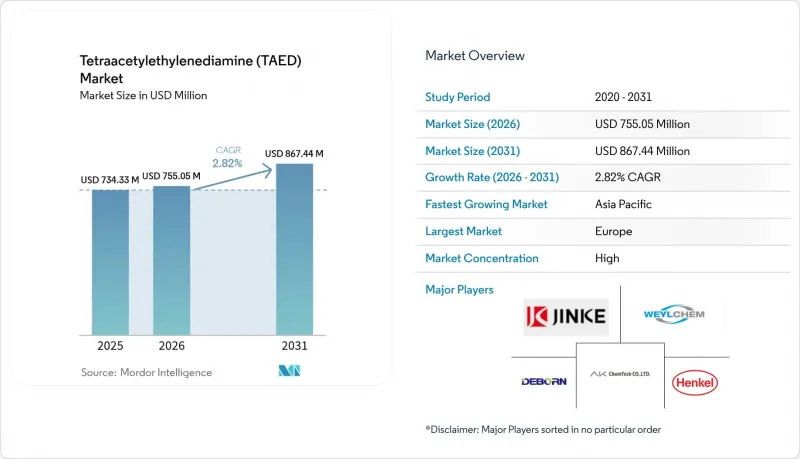
Mordor Intelligence에 의하면, 테트라아세틸에틸렌디아민 시장 규모는 2025년 7억 3,433만 달러에서 2026년에는 7억 5,505만 달러로 확대되어 2026년부터 2031년까지 CAGR 2.82%로 성장을 지속하여, 2031년에는 8억 6,744만 달러에 이를 것으로 예측됩니다.
본 보고서는 제품 유형(과립형 TAED, 정제/압축형 TAED 등),유통 채널(직접 판매, 화학제품 도매업체), 용도(가정용 세탁 세제, 식기세척기용 세제 등), 최종 사용자 산업(소비재 제조업체, 위탁·자사 운영 세탁소 등), 지역(아시아태평양, 북미 등)별로 분류되어 있습니다.
전 세계 테트라아세틸에틸렌디아민(TAED) 시장 동향 및 인사이트
저온 세탁 사이클로의 전환이 진행되고 있습니다.
냉수 세탁의 보급으로 인해 10년 동안 세탁과 관련된 CO₂ 배출량을 2,700만 톤 감축할 수 있으므로, TAED와 같은 저온용 활성화제는 지속가능성 목표 달성에 필수적인 요소가 되고 있습니다. TAED는 더 낮은 온도에서도 효과적인 세탁을 가능하게 함으로써, 에너지 소비가 많은 온수 세탁 주기에 대한 의존도를 낮추고, 에너지 절약과 배출 감축에 직접적으로 기여합니다. ‘Tide Professional Coldwater’는 세탁 온도를 90°F까지 낮추고 에너지 비용을 최대 75% 절감함으로써 상업적 실현 가능성을 입증하고 있습니다. 이러한 상당한 비용 절감 가능성 덕분에 가정용 및 상업용 사용자 모두에게 매력적인 선택지가 되고 있습니다. 이에 따라 가전 제조업체와 세제 제조업체들은 뜨거운 물이 필요 없는 화학 기술에 주력하고 있으며, 이는 TAED에 대한 단기적인 수요를 뒷받침하고 있습니다. 이러한 움직임은 세제 시장에서 지속 가능한 솔루션의 중요성이 높아지고 있음을 여실히 보여줍니다.
아시아태평양의 산업용 세탁 서비스 확대
급속한 도시화와 병원·호텔의 위생 기준 강화로 인해, 아시아태평양의 세탁 업계는 수질이 변동하는 환경에서도 일관된 표백 효과를 보장하는 상업용 세제 시스템으로의 전환을 요구받고 있습니다. 이 지역의 인구 증가와 도시로의 이주 확대에 따라, 특히 위생 관리가 극히 중요한 의료 및 호텔 업계에서 산업용 세탁 서비스 수요가 급증하고 있습니다. 상업용 세탁물의 무게가 20-80파운드 범위인 만큼, 기업들은 높은 청결 기준을 유지하면서 운영 비용을 최적화하는 것을 목표로 하고 있으며, 1사이클당 화학약품 비용이 중요한 지표로 작용하고 있습니다. TAED는 중온 범위에서 예측 가능한 성능을 발휘하며, 수질 변동에 관계없이 일관된 결과를 보장하는 비용 효율적인 솔루션을 제공합니다. 인도의 섬유 생산량 증가는 신뢰할 수 있는 산업용 세탁 서비스가 필수적인 하류 수요의 규모를 여실히 보여줍니다. 지속적으로 확장되는 섬유 산업은 효율적이고 신뢰할 수 있는 세탁 솔루션에 대한 수요를 더욱 높이고 있으며, TAED는 이러한 수요를 충족하기 위한 핵심 요소로서의 입지를 확고히 하고 있습니다.
액체 표백제 활성제로부터의 경쟁적 위협
MnTACN과 같은 망간계 촉매는 자동 식기 세척 용도에서 특히 60°C 미만의 온도 범위에서 TAED에 비해 뛰어난 성능을 발휘합니다. 에너지 효율 기준에 따라 식기 세척 사이클이 더 낮은 온도에서 작동하게 되면서, 이러한 성능상의 우위는 점점 더 중요해지고 있습니다. 또한, 노나노일옥시벤젠설포네이트(NOBS)는 미국 세탁용 캡슐 시장에서 확고한 입지를 다지고 있습니다. 이러한 우위성 덕분에, 특히 투여량의 유연성이나 액상 제제와의 호환성이 중요한 요건이 되는 상황에서 배합 개발자들은 NOBS로의 전환을 검토하고 있습니다. 이러한 변화로 인해 해당 부문에서 TAED 시장 점유율은 서서히 감소하고 있습니다.
부문 분석
2025년, 과립형 등급은 TAED 시장 점유율의 70.65%를 차지하며 TAED 시장 규모의 가장 큰 부분을 차지하고 있습니다. 이는 기존의 분말 세제가 이 유동성이 높은 형태에 의존하고 있기 때문입니다. 확립된 생산 경제성과 분무 건조탑과의 호환성 덕분에 과립형 등급은 대중 시장 브랜드에게 기본 선택지가 되었습니다. 그러나 성숙한 지역에서는 분말 세제의 출하량이 정체되어 있어, 이 부문의 성장률은 한 자릿수 중반에 머물고 있습니다.
연평균 성장률(CAGR) 3.52%로 확대되고 있는 캡슐화 또는 공과립화된 TAED는 고온 다습한 환경에 대한 민감성이라는 과제를 해결하여, 액상 포드나 압축 정제에 배합할 수 있게 해줍니다. 이 기술은 TAED를 과탄산나트륨, 탄산염 완충액 또는 폴리머 쉘과 혼합하고, 물에 잠길 때까지 가수분해를 지연시킴으로써 열대 기후에서도 성능을 확실하게 유지합니다. 다실식 파우치에 관한 특허 동향은 투여량의 정확성과 성분의 분리가 소비자의 편의성을 향상시키는 동시에 TAED의 프리미엄 포맷으로의 확산을 촉진하고 있음을 보여줍니다.
TAED 제조업체와 세제 공장 간의 직접 계약은 2025년 매출의 60.90%를 차지하고 있으며, 이는 공급의 확실성과 로트별 기술 지원을 필요로 하는 대량 생산 분말 제품 라인이 주도하고 있습니다. 과탄산염의 몰비 최적화 등 지속적인 개선 프로젝트는 직접적인 협력 관계 하에서 가장 효율적으로 수행됩니다.
틈새 시장용 배합 제조업체나 지역 위탁 배합 업체들이 소용량 포장 및 적시 납품을 요구하는 가운데, 유통업체을 통한 매출은 연평균 3.10%의 성장률을 보이고 있습니다. 전체 제품군을 취급하는 화학제품 유통업체는 다양한 품목을 갖춘 창고를 활용하여 재고 리스크를 분산시키는 한편, 용도별 문제 해결을 위한 배합 실험실을 제공합니다. 이 판매 경로는 현지 브랜드가 직접 수입할 규모의 역량을 갖추지 못한 동남아시아, 라틴아메리카, 동유럽에서 특히 성장세를 보이고 있습니다.
지역별 분석
유럽은 수십 년에 걸친 인산염 사용 금지로 인해 제조업체들이 TAED를 중심으로 한 산소계 표백 시스템을 채택할 수밖에 없게 된 결과, 2025년에는 세계 수요의 39.85%를 차지했습니다. 독일과 영국은 소매업체들이 포장 문구를 통해 친환경 라벨과 저온 세탁 성능을 강조하고 있어 가장 큰 국내 시장을 형성하고 있습니다. 2025년에 발효될 개정된 EU 세제 규정은 생분해성 시험 및 향료 표시 요건을 강화하여, 간접적으로 TAED의 규제 적합성 우위를 강화하고 있습니다. 소비자들은 지속가능성을 내세우는 제품에 더 높은 가격을 지불하는 경향이 지속되고 있으며, 72%가 세제를 선택할 때 환경 성능을 중요시한다고 응답했습니다.
아시아태평양은 2031년까지 연평균 성장률(CAGR) 3.41%를 기록하며 지역별 가장 높은 성장률을 보이고 있습니다. 중국은 수직 통합형 TAED 공급 체계의 혜택을 받고 있는 반면, 인도에서는 섬유 마감 부문과 확대되는 의료 인프라가 산업용 세탁량 증가를 뒷받침하고 있습니다. 상하이 데본(Shanghai Devon)이나 진케(JINKE)와 같은 현지 공급업체들은 지역 내 위탁 세제 공장을 지원하기 위해 생산 능력을 확대하고 있으며, 이를 통해 리드타임 단축과 관세 비용 절감을 도모하고 있습니다. 일본과 한국의 당국은 세탁 서비스 분야의 에너지 소비 감축을 장려하고 있으며, 이는 TAED 채택을 더욱 촉진하는 요인이 되고 있습니다.
북미 시장은 성숙 단계에 있지만 안정적입니다. ‘캘리포니아주 세정 제품 정보 공개법’에 따라 농도 0.01% 이상의 각 성분 공개가 의무화되어 있기 때문에 다국적 브랜드들은 TAED와 같이 잘 알려져 있고 충분히 검증된 활성제를 계속 사용하고 있습니다. 그러나 소매 채널에서는 액상 유형이 주류를 이루고 있으므로, 캡슐화 기술로 이 격차를 메우지 못하는 한 분말형 TAED의 판매량은 제한될 수밖에 없습니다. 라틴아메리카, 중동 및 아프리카에서는 의료 및 호텔 업계의 위생 관리 현대화가 새로운 세탁 프로젝트를 촉진하고 있지만, 여름철 창고 내 최고 기온이 높기 때문에 배리어 필름이나 건조제 라이너의 사용이 필수적이며, 이는 입고 비용 증가라는 역풍으로 작용하고 있습니다.
기타 혜택:
- 엑셀 형식 시장 예측(ME) 시트
- 3개월간의 애널리스트 지원
자주 묻는 질문
목차
제1장 서론
제2장 조사 방법
제3장 주요 요약
제4장 시장 구도
제5장 시장 규모와 성장 예측
제6장 경쟁 구도
제7장 시장 기회와 향후 전망
JHS 26.08.26According to Mordor Intelligence, the tetraacetylethylenediamine market size is expected to grow from USD 734.33 million in 2025 to USD 755.05 million in 2026 and is forecast to reach USD 867.44 million by 2031 at 2.82% CAGR over 2026-2031.
This report is Segmented by Product Type (Granular TAED, Tablet/Compressed TAED, and More), Distribution Channel (Direct, Chemical Distributors), Application (Household Laundry Detergents, Automatic Dishwashing, and More), End-User Industry (Consumer Goods Manufacturers, Contract & On-Premise Laundries, and More), and Geography (Asia-Pacific, North America, and More).
Global Tetraacetylethylenediamine (TAED) Market Trends and Insights
Rising shift to low-temperature wash cycles
Cold-water adoption can curb laundry-related CO2 emissions by 27 million t over a decade, making low-temperature activators such as TAED integral to sustainability goals. By enabling effective cleaning at lower temperatures, TAED reduces the reliance on energy-intensive hot water cycles, directly contributing to energy conservation and emission reduction. Tide Professional Coldwater shows commercial viability by lowering wash temperatures to 90 °F and cutting energy costs up to 75%. This significant cost-saving potential makes it an attractive option for both residential and commercial users. Appliance makers and detergent formulators therefore align around chemistry that works without hot water, reinforcing near-term demand for TAED. This alignment highlights the growing importance of sustainable solutions in the detergent market.
Expansion of industrial laundry services in APAC
Rapid urbanization and stricter hygiene codes in hospitals and hotels push Asia-Pacific laundries toward professional detergent systems that guarantee consistent bleaching across variable water quality. The increasing population and urban migration in the region have led to a surge in demand for industrial laundry services, particularly in sectors like healthcare and hospitality, where hygiene is critical. With commercial loads ranging 20-80 lb, chemical cost per cycle becomes a critical metric, as businesses aim to optimize operational costs while maintaining high standards of cleanliness. TAED's predictable performance at mid-range temperatures offers a cost-effective solution, ensuring consistent results regardless of water quality variations. India's textile output growth illustrates the scale of downstream demand where reliable commercial laundering is essential. The expanding textile industry further amplifies the need for efficient and dependable laundry solutions, positioning TAED as a key component in meeting these demands.
Competitive threat from liquid bleach activators
Manganese-based catalysts, such as MnTACN, have demonstrated superior performance compared to TAED in automatic dishwashing applications, particularly at temperatures below 60 °C. This performance advantage is becoming increasingly relevant as energy efficiency standards drive dishwashing cycles to operate at lower temperatures. Additionally, Nonanoyloxybenzene sulfonate (NOBS) has established a strong foothold in the U.S. laundry capsule market. Its dominance is prompting formulators to explore switching to NOBS, especially in scenarios where dosage flexibility or compatibility with liquid formulations is a critical requirement. These shifts are gradually eroding TAED's market share in these segments.
Other drivers and restraints analyzed in the detailed report include:
- Consumer preference for phosphate-free eco-labels
- Energy-saving mandates for commercial washers
- Decline of powder detergents in mature markets
For complete list of drivers and restraints, kindly check the Table Of Contents.
Segment Analysis
Granular grades retained 70.65% TAED market share in 2025, underpinning the largest portion of the TAED market size because conventional powder detergents rely on this free-flowing form. Their established production economics and compatibility with spray-dry towers make them the default choice for mass-market brands. Yet the segment's mid-single-digit growth lags because powder volumes plateau in mature regions.
Encapsulated or co-granulated TAED, advancing at a 3.52% CAGR, addresses heat-humidity sensitivity and allows incorporation into liquid pods or compressed tablets. This technology mixes TAED with sodium percarbonate, carbonate buffers, or polymer shells to delay hydrolysis until immersion, safeguarding performance in tropical climates. Patent activity on multi-compartment pouches illustrates how dosage precision and ingredient separation enhance consumer convenience while extending TAED penetration into premium formats.
Direct contracts between TAED producers and detergent plants controlled 60.90% of 2025 revenue, driven by high-volume powder lines that demand supply assurance and lot-specific technical support. Continuous improvement projects, such as optimizing percarbonate molar ratios, occur most efficiently under direct collaboration.
Distributor sales are rising 3.10% annually as niche formulators and regional contract blenders seek smaller pack sizes and just-in-time deliveries. Full-line chemical distributors leverage diversified warehouses to amortize inventory risk and offer formulation labs for application troubleshooting. This channel is gaining particular traction in Southeast Asia, Latin America, and Eastern Europe where local brands lack scale for direct importation.
Complete Report Scope:
- By Product Type
- Granular TAED
- Tablet/Compressed TAED
- Encapsulated/Co-granulated TAED
- Liquid Dispersion TAED
- By Distribution Channel
- Direct (Captive to Detergent Plants)
- Chemical Distributors
- By Application
- Household Laundry Detergents
- Automatic Dishwashing
- Industrial and Institutional Laundry
- Pulp and Paper Bleaching
- Textile Processing
- By End-user Industry
- Consumer Goods Manufacturers
- Contract and On-Premise Laundries
- Food and Beverage Processing
- Healthcare and Hygiene
- By Geography
- Asia-Pacific
- China
- India
- Japan
- South Korea
- Rest of Asia-Pacific
- North America
- United States
- Canada
- Mexico
- Europe
- Germany
- United Kingdom
- France
- Italy
- Rest of Europe
- South America
- Brazil
- Argentina
- Rest of South America
- Middle East and Africa
- Saudi Arabia
- South Africa
- Rest of Middle East and Africa
- Asia-Pacific
Geography Analysis
Europe accounted for 39.85% of global demand in 2025 thanks to decades-old phosphate bans that pushed manufacturers to TAED-centred oxygen bleach systems. Germany and the United Kingdom constitute the largest national markets because retailers emphasize eco-labels and cold-wash performance on pack messaging. The renewed EU Detergent Regulation, effective 2025, tightens biodegradability tests and fragrance disclosures, indirectly reinforcing TAED compliance advantage. Consumers continue to pay a premium for sustainable claims, with 72% citing eco profile when selecting detergents.
Asia-Pacific registers the highest regional growth at a 3.41% CAGR to 2031. China gains from vertically integrated TAED supply, while India's textile finishing sector and its expanding health-care infrastructure lift institutional wash volumes. Local suppliers such as Shanghai Deborn and JINKE ramp capacity to back regional contract detergent plants, shortening lead times and lowering duty costs. Authorities in Japan and South Korea incentivize lower energy use in laundry services, further aligning with TAED adoption.
North America is mature yet stable. The California Cleaning Product Right-to-Know Act compels disclosure of each ingredient at >=0.01% concentration, leading multinational brands to stick with familiar, well-documented activators like TAED. However, liquid formats dominate retail channels, which constrains powder-based TAED volumes unless encapsulation or capsule technology bridges the gap. In Latin America, Middle East, and Africa, hygiene modernization in healthcare and hospitality sparks greenfield laundry projects, but summer-peak warehouse temperatures necessitate barrier films and desiccant liners, adding landed-cost headwinds.
- Acuro Organics Limited
- AK Chemtech Co., Ltd
- Chem-Impex
- Chemsfield Korea Co., Ltd
- Dongyang Tianyu Chemicals Co. Ltd
- Henkel AG and Co. KGaA
- JINKE Company Limited
- MATCO Chemicals
- Shanghai Deborn Co. Ltd
- STPP Group
- Warwick Chemicals
- WeylChem International GmbH
Additional Benefits:
- The market estimate (ME) sheet in Excel format
- 3 months of analyst support
TABLE OF CONTENTS
1 Introduction
- 1.1 Study Assumptions and Market Definition
- 1.2 Scope of the Study
2 Research Methodology
3 Executive Summary
4 Market Landscape
- 4.1 Market Overview
- 4.2 Market Drivers
- 4.2.1 Rising shift to low-temperature detergent formulations
- 4.2.2 Growth of on-premise and industrial laundry services in Asia Pacific
- 4.2.3 Consumer move toward phosphate-free, eco-labels in Europe and North America
- 4.2.4 Energy-saving mandates for commercial washers
- 4.2.5 Emergence of enzyme-TAED hybrid bleach systems
- 4.3 Market Restraints
- 4.3.1 Competitive threat from liquid bleach activators
- 4.3.2 Decline in powder detergents share in mature markets
- 4.3.3 Thermal instability issues in high-humidity tropical storage
- 4.4 Value Chain Analysis
- 4.5 Porter's Five Forces
- 4.5.1 Threat of New Entrants
- 4.5.2 Bargaining Power of Buyers
- 4.5.3 Bargaining Power of Suppliers
- 4.5.4 Threat of Substitute Products
- 4.5.5 Degree of Competition
5 Market Size and Growth Forecasts (Value)
- 5.1 By Product Type
- 5.1.1 Granular TAED
- 5.1.2 Tablet/Compressed TAED
- 5.1.3 Encapsulated/Co-granulated TAED
- 5.1.4 Liquid Dispersion TAED
- 5.2 By Distribution Channel
- 5.2.1 Direct (Captive to Detergent Plants)
- 5.2.2 Chemical Distributors
- 5.3 By Application
- 5.3.1 Household Laundry Detergents
- 5.3.2 Automatic Dishwashing
- 5.3.3 Industrial and Institutional Laundry
- 5.3.4 Pulp and Paper Bleaching
- 5.3.5 Textile Processing
- 5.4 By End-user Industry
- 5.4.1 Consumer Goods Manufacturers
- 5.4.2 Contract and On-Premise Laundries
- 5.4.3 Food and Beverage Processing
- 5.4.4 Healthcare and Hygiene
- 5.5 By Geography
- 5.5.1 Asia-Pacific
- 5.5.1.1 China
- 5.5.1.2 India
- 5.5.1.3 Japan
- 5.5.1.4 South Korea
- 5.5.1.5 Rest of Asia-Pacific
- 5.5.2 North America
- 5.5.2.1 United States
- 5.5.2.2 Canada
- 5.5.2.3 Mexico
- 5.5.3 Europe
- 5.5.3.1 Germany
- 5.5.3.2 United Kingdom
- 5.5.3.3 France
- 5.5.3.4 Italy
- 5.5.3.5 Rest of Europe
- 5.5.4 South America
- 5.5.4.1 Brazil
- 5.5.4.2 Argentina
- 5.5.4.3 Rest of South America
- 5.5.5 Middle East and Africa
- 5.5.5.1 Saudi Arabia
- 5.5.5.2 South Africa
- 5.5.5.3 Rest of Middle East and Africa
- 5.5.1 Asia-Pacific
6 Competitive Landscape
- 6.1 Market Concentration
- 6.2 Strategic Moves
- 6.3 Market Share Analysis
- 6.4 Company Profiles (includes Global level Overview, Market level overview, Core Segments, Financials as available, Strategic Information, Market Rank/Share for key companies, Products and Services, and Recent Developments)
- 6.4.1 Acuro Organics Limited
- 6.4.2 AK Chemtech Co., Ltd
- 6.4.3 Chem-Impex
- 6.4.4 Chemsfield Korea Co., Ltd
- 6.4.5 Dongyang Tianyu Chemicals Co. Ltd
- 6.4.6 Henkel AG and Co. KGaA
- 6.4.7 JINKE Company Limited
- 6.4.8 MATCO Chemicals
- 6.4.9 Shanghai Deborn Co. Ltd
- 6.4.10 STPP Group
- 6.4.11 Warwick Chemicals
- 6.4.12 WeylChem International GmbH
7 Market Opportunities and Future Outlook
- 7.1 White-space and Unmet-need Assessment