

|
시장보고서
상품코드
2114988
하이브리드 패브릭 시장 : 점유율 분석, 업계 동향과 통계, 성장 예측(2026-2031년)Hybrid Fabric - Market Share Analysis, Industry Trends & Statistics, Growth Forecasts (2026 - 2031) |
||||||
 Mordor Intelligence
Mordor Intelligence에 의하면, 하이브리드 패브릭 시장 규모는 2025년 4억 2,819만 달러에서 2026년에는 4억 5,859만 달러로 확대되어 2026년부터 2031년까지 CAGR 7.10%로 성장을 지속하여, 2031년에는 6억 4,620만 달러에 이를 것으로 예측됩니다.
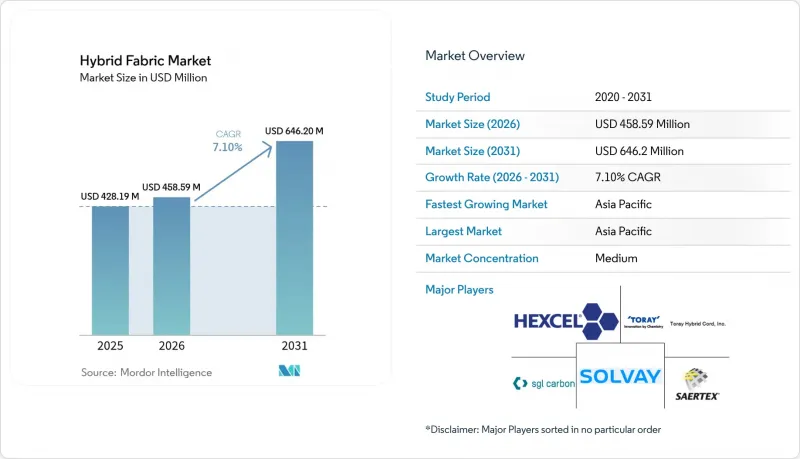
본 보고서는 섬유 유형의 조합(유리 섬유·탄소섬유, 탄소섬유·아라미드 섬유 등), 수지 매트릭스(열경화성 수지, 열가소성 수지), 최종 사용자 산업(자동차 및 항공우주, 산업용, 기타), 제조 기술(프리프레그·오토클레이브, 진공 주입/RTM, 기타), 지역(아시아태평양, 북미, 유럽, 기타)별로 분류되어 있습니다. 시장 전망은 금액(달러) 기준으로 제시되어 있습니다.
세계 하이브리드 패브릭 시장 동향 및 인사이트
자동차 경량화 수요에 따른 유리·탄소 하이브리드 수요
자동차 OEM 업체들은 2027년까지 차량 중량을 15% 감축하도록 의무화하는 유럽연합(EU) 규정을 준수하기 위해 하이브리드 보강재의 채택을 가속화하고 있습니다. 포드의 ‘브롱코 랩터’에 채택된 복합재 C-브레이스는 유리·탄소 복합 섬유가 무게를 줄이면서도 비틀림 강성을 높인다는 점을 보여줍니다. 배터리식 전기차(BEV) 플랫폼에서는 고전압 배터리 팩을 절연하고 충돌 에너지를 흡수해야 하는 구조용 배터리 인클로저 내부에, 이와 유사한 하이브리드 패브릭 시장 솔루션이 채택되고 있습니다. OEM 업체들이 강재에서 모듈식 복합재 아키텍처로 전환함에 따라, 설계 스튜디오는 기존에는 용접되던 복잡한 리브와 노드를 성형할 수 있는 자유도를 얻게 되었으며, 이로 인해 위치 지정 섬유 배열 기술에 대한 수요가 증가하고 있습니다. 이러한 수요를 견인하는 요인은 전기차 보급률이 높고 공공 부문에서 연비 목표가 설정되어 있는 중국과 독일에서 가장 두드러집니다.
풍력 터빈 블레이드 제조 분야 수요 증가
블레이드 제조업체들은 타워 1기당 발전량을 늘리기 위해 더 긴 로터가 필요하지만, 길이가 1미터 늘어날 때마다 공력 하중도 급증합니다. LM Wind Power사는 무게를 과도하게 늘리지 않으면서 강성을 확보하는 카본-유리 하이브리드 스파 캡을 채택한 88.4미터 블레이드로 이 딜레마를 해결했습니다. 해상 설치의 경우, 25년간의 가동 기간 동안 염수 분무와 요 사이클로 인해 표면층이 침식되므로 피로 내성의 필요성이 더욱 높아집니다. 이에 대응하여 SAERTEX사는 H-모듈러스 유리 섬유 직물과 자가 접착성 논크림프 제품군을 개발하여 적층 시간을 30% 단축했습니다. 그 결과, 하이브리드 패브릭의 수주는 몇 분기 앞까지 꽉 차 있으며, 섬유 공급업체의 미래 전망이 밝아져 장쑤성, 구자라트주, 슐레스비히-홀슈타인주에서의 생산 능력 확장이 뒷받침되고 있습니다.
높은 생산 비용 및 인증 비용
하이브리드 패브릭의 제조에는 정밀한 장력 제어, 두 유형의 섬유에 대한 함침, 그리고 다단계 경화 사이클이 필요하며, 이러한 요소들이 설비 투자 수요를 높이고 있습니다. NASA의 조사에 따르면, 항공우주 분야의 인증 획득에는 5년이 소요되며, 패브릭 시스템 1개당 1,500만 달러의 비용이 발생할 수 있습니다. 그 결과, 소규모 공장들은 하이브리드 패브릭 시장 진출을 주저하고 있어 공급업체의 다양성이 제한되고 있습니다. 오토클레이브 장비는 라인당 1,000만 달러의 고정자산을 추가합니다. 오토클레이브를 사용하지 않는 방법도 존재하지만, 그럼에도 불구하고 복잡한 금형과 데이터 수집이 필요합니다. 이러한 경제적 요인으로 인해 중형 승용차 등 가격에 민감한 부문에서는 뚜렷한 경량화 효과가 인정됨에도 불구하고 도입 속도가 더디게 진행되고 있습니다.
부문 분석
2025년, 유리섬유·탄소섬유 하이브리드는 하이브리드 패브릭 시장에서 38.02%의 점유율을 차지하며, 강성, 피로 내구성, 그리고 적정한 원자재 비용이라는 최적의 균형을 두드러지게 보여주고 있습니다. 터빈 스퍼 캡은 여전히 대표적인 이용 사례로, 이는 탄소섬유가 굽힘 강성을 높이고, 유리 섬유가 웹 영역의 반복 하중에 대응하기 때문입니다. 아라미드 섬유·탄소섬유 등의 다른 조합은 충격 흡수가 극히 중요한 방탄 장갑이나 헬리콥터 로터와 같은 틈새 시장 이용 사례에 대응하고 있습니다. 미시간 대학교 연구진은 섬유 표면을 세척하고 거칠게 만드는 초임계 CO2 처리를 통해 아마·탄소 복합재의 탄성 계수를 33% 향상시켰습니다. 이 성과는 전기차 인테리어 분야에서도 주목받고 있습니다. 시장에 진출한 기업들은 동일한 직조 방식으로 여러 섬유 비율을 제공하는 모듈식 제품 카탈로그를 통해 이러한 폭넓은 선택지를 활용하고 있습니다. 가격 전략에서는 직조기 가동 일정과 수지 배합 예측을 안정화시키는 대량 발주를 우대하고 있습니다. 각 OEM 업체는 원단 비용만 따로 따지는 것이 아니라 부품 전체의 총비용을 비교하고 있으며, 경량화를 통해 추진 장치의 소형화나 조립 부품의 단순화 등 다운스트림 공정에서 이점을 얻을 수 있는 경우, 유리섬유와 탄소섬유의 조합이 채택되고 있습니다.
2025년 하이브리드 패브릭 시장 규모 중 열경화성 수지가 61.88%를 차지하며, 그중에서도 항공기용으로 신뢰성 높은 실적과 폭넓은 공급업체공급 체계를 바탕으로 에폭시 수지가 주도적인 위치를 차지하고 있습니다. 이러한 수지는 180°C 미만의 온도에서 경화되며, 생산 턱트 타임에 맞춘 경화 촉진제 사용이 가능합니다. 대조적으로, PEEK나 PEKK 등의 열가소성 매트릭스는 340°C 이상의 용융 가공이 필요하지만, 프레스 사이클을 3분으로 단축할 수 있기 때문에 대량 생산되는 구조 부품에 있어 큰 이점이 됩니다. 또한, 열가소성 수지의 스크랩은 재용융이 가능하여, 제조업체로서는 매립 처리 비용을 절감할 수 있는 재활용의 길이 열립니다. 다만, 적합한 금속 금형이 필요하고, 결정화의 그라데이션을 피하기 위해 부품의 냉각 속도를 조절해야 하기 때문에 도입에는 여전히 금형 비용이라는 장벽이 존재합니다. 그럼에도 불구하고, 유럽의 기가팩토리 배터리 케이스 프로젝트에서는 150°C를 초과하는 내열성으로 인해 열폭주 시 무결성이 확보된다는 점 때문에 열가소성 하이브리드 적층재의 채택이 결정되었습니다. 공정 라인에서는 재현성을 확보하기 위해 유도 가열 및 금형 내 모니터링이 점점 더 도입되고 있으며, 이러한 투자는 예측 기간 동안 선박의 데크 패널 및 철도 차량의 차체 쉘로도 확대될 것입니다.
지역별 분석
2025년, 아시아태평양은 하이브리드 패브릭 시장 점유율의 42.61%를 차지했습니다. 중국은 2024년에 75GW 규모의 풍력 발전 설비를 도입했으며, 블레이드 생산 예정일보다 18개월 앞서 이에 상응하는 양의 유리·탄소 패브릭을 발주했습니다. 베이징 정부의 ‘중국 제조 2025’ 계획에서는 첨단 복합재료 제조가 전략적 축 중 하나로 자리매김하고 있으며, 밸류체인의 현지화를 추진하는 기업에 대해 세제 혜택이 제공되고 있습니다. 인도도 이에 발맞추어 복합재료 수출에 대해 FOB 가격의 4%를 환급하는 생산 연계형 인센티브 제도를 도입했으며, 이에 따라 전 세계 Tier 1 기업들이 구자라트주와 타밀나두주에 공장을 설립하는 움직임이 가속화되고 있습니다. 북미에서는 워싱턴주, 캔자스주, 앨라배마주에 위치한 항공우주 및 방위 산업 거점의 견인 효과로 견실한 수익 창출이 나타나고 있습니다. NASA 랭글리 연구소의 HiCAM 프로젝트는 복합재 기체 제조 속도를 4배로 높이는 것을 목표로 하고 있으며, 도레이의 엔지니어들은 4시간 이내에 경화되는 맞춤형 프리프레그 시스템을 공급하고 있습니다. 캐나다는 파일럿 라인에 공동 출자하는 국가 차원의 첨단 소재 슈퍼클러스터를 통해 협력하고 있는 반면, 멕시코는 USMCA(미국·멕시코·캐나다 협정)에 따른 복합재 부품 관세 면제를 활용하여 자동차 산업의 기반을 강화하고 있으며, 원료 섬유를 수입하는 경우에도 비용 경쟁력을 높이고 있습니다. 유럽은 에너지 가격의 급등에도 불구하고 견고한 입지를 유지하고 있습니다. 북해의 해상 풍력 발전소는 독일과 덴마크의 컨버터에서 출하되는 하이브리드 스퍼 캡에 의존하고 있으며, 지역 자동차 제조업체들은 차세대 배터리 전기자동차(BEV)에 복합재료의 함유율을 평균 10%로할 것을 의무화하고 있습니다. 또한, 브뤼셀은 규제 면에서 선두를 달리고 있으며, 순환 경제에 관한 지침에 따라 OEM 각사는 제품 출시 전에 재활용 경로를 확인해야 할 의무가 있습니다. 이러한 환경은 천연섬유 하이브리드 및 저온 열가소성 수지의 연구 개발을 촉진하고 있으며, 생산량이 아시아로 이전되는 상황에서도 유럽이 지적 재산권 분야에서 입지를 유지할 수 있게 하고 있습니다.
기타 혜택:
- 엑셀 형식 시장 예측(ME) 시트
- 3개월간의 애널리스트 지원
자주 묻는 질문
목차
제1장 서론
제2장 조사 방법
제3장 주요 요약
제4장 시장 구도
제5장 시장 규모와 성장 예측
제6장 경쟁 구도
제7장 시장 기회와 향후 전망
JHS 26.08.26According to Mordor Intelligence, the hybrid fabric market size is expected to grow from USD 428.19 million in 2025 to USD 458.59 million in 2026 and is forecast to reach USD 646.2 million by 2031 at 7.10% CAGR over 2026-2031.
This report is Segmented by Fiber-Type Combination (Glass & Carbon, Carbon & Aramid, and More), Resin Matrix (Thermoset, Thermoplastic), End-User Industry (Automotive & Aerospace, Industrial, and More), Manufacturing Technology (Prepreg & Autoclave, Vacuum Infusion/RTM, and More), and Geography (Asia-Pacific, North America, Europe, and More). The Market Forecasts are Provided in Terms of Value (USD).
Global Hybrid Fabric Market Trends and Insights
Automotive Light-weighting Demand for Glass and Carbon Hybrids
Automotive OEMs are accelerating adoption of hybrid reinforcements to comply with the European Union rule that requires a 15% vehicle mass reduction by 2027. Ford's composite C-brace for the Bronco Raptor shows how a glass-carbon fabric raises torsional rigidity while trimming weight. Battery-electric platforms use the same hybrid fabric market solutions inside structural battery enclosures that must insulate high-voltage packs and absorb crash energy. As OEMs migrate from steel to modular composite architectures, design studios gain freedom to mold complex ribs and nodes that were formerly welded, boosting demand for positional fiber placement technologies. The driver is most pronounced in China and Germany, where high electric-vehicle penetration coincides with public-sector fuel-economy targets.
Rise in Demand from Wind Turbine Blade Manufacturing
Blade makers need longer rotors to extract more energy per tower, yet aerodynamic loads soar with each additional meter. LM Wind Power solved this dilemma with an 88.4 meter blade that uses carbon-glass hybrid spar caps for stiffness without punitive mass. Offshore installations magnify the need for fatigue tolerance because salt spray and yaw cycles erode surface layers over a 25-year duty life. SAERTEX responded with an H-modulus glass fabric and self-adhesive non-crimp product family that cuts lay-up time by 30%. Hybrid fabric market orders are therefore booked several quarters in advance, giving fiber suppliers visibility that supports capacity expansion in Jiangsu, Gujarat, and Schleswig-Holstein.
High Production & Qualification Costs
Hybrid fabric production involves precise tension control, dual-fiber impregnation, and multi-stage cure cycles that raise capital needs. An aerospace qualification campaign can last five years and cost USD 15 million per fabric system according to NASA studies. Smaller mills therefore hesitate to enter the hybrid fabric market, restricting supplier diversity. Autoclave units add USD 10 million of fixed assets per line; out-of-autoclave methods exist yet still require complex tooling and data acquisition. These economics make price-sensitive segments, such as mid-class passenger cars, slower adopters despite evident weight savings.
Other drivers and restraints analyzed in the detailed report include:
- Growing Demand for High Durability and Thermal Resistant Fabrics
- Increasing Applications for Carbon Fiber Fabrics
- Absent Recycling Standards for Multi-Material Fabrics
For complete list of drivers and restraints, kindly check the Table Of Contents.
Segment Analysis
Glass-carbon hybrids held 38.02% hybrid fabric market share in 2025, underscoring their sweet-spot blend of stiffness, fatigue endurance, and moderate raw-material cost. Turbine spar caps remain the flagship use case because carbon boosts bending rigidity while glass handles cyclic loading in the web region. Other combinations such as aramid-carbon address niche programs in ballistic armor and helicopter rotors where impact absorption is critical. Researchers at the University of Michigan increased flax-carbon modulus by 33% using a supercritical CO2 treatment that cleans and roughens fiber surfaces, a result that has drawn interest from electric vehicle interiors. Market participants capitalize on this spectrum through modular product catalogs that offer the same weave in multiple fiber ratios. Pricing strategies reward volume commitments that stabilize loom scheduling and resin-mix forecasting. OEMs compare total-part costs rather than raw-fabric costs alone, validating the glass-carbon route whenever weight reduction brings downstream benefits like smaller propulsion units or simplified assembly hardware.
Thermoset chemistries accounted for 61.88% of hybrid fabric market size in 2025, with epoxy leading due to trusted flight-critical pedigrees and wide supplier availability. These resins cure at temperatures below 180 °C and accept accelerators that match production takt times. In contrast, thermoplastic matrices such as PEEK and PEKK need melt processing above 340 °C yet shorten press cycles to 3 minutes, a boon for high-volume structures. Thermoplastic scrap is also remeltable, giving fabricators a recycling pathway that reduces landfill fees. Adoption still faces tooling-price hurdles because matched-metal molds are required, and part-cool rates must be tuned to avoid crystallinity gradients. Nevertheless, battery enclosure projects at European gigafactories have locked in thermoplastic-hybrid laminates because heat resistance above 150 °C ensures integrity during thermal runaway events. Process lines increasingly feature induction heating and in-mold monitoring to secure repeatability, and these investments will cascade to marine deck panels and rail carbody shells during the forecast horizon.
Complete Report Scope:
- By Fiber-Type Combination
- Glass and Carbon
- Carbon and Aramid
- Glass and Aramid
- Other Fiber Types (Natural (Flax) and Carbon, etc.)
- By Resin Matrix
- Thermoset (Epoxy, Polyester, Vinyl-Ester)
- Thermoplastic (PP, PA, PEEK, PEKK)
- By End-User Industry
- Automotive and Aerospace
- Industrial
- Marine and Defense
- Sports Equipment
- Other End-user Industries (Construction and Infrastructure, etc.)
- By Manufacturing Technology
- Prepreg and Autoclave
- Vacuum Infusion/RTM
- Braiding and Filament Winding
- Geography
- Asia-Pacific
- China
- Japan
- India
- South Korea
- Rest of Asia-Pacific
- North America
- United States
- Canada
- Mexico
- Europe
- Germany
- United Kingdom
- France
- Italy
- Rest of Europe
- South America
- Brazil
- Argentina
- Rest of South America
- Middle East and Africa
- Saudi Arabia
- South Africa
- Rest of Middle East and Africa
- Asia-Pacific
Geography Analysis
Asia-Pacific captured 42.61% hybrid fabric market share in 2025. China installed 75 GW of wind capacity in 2024 and ordered corresponding glass-carbon fabric volumes eighteen months ahead of blade production slots. Beijing's Made-in-China 2025 plan earmarks advanced composite fabrication as a strategic pillar, which grants tax breaks to firms that localize value chains. India is following with a production-linked incentive scheme that reimburses 4% of free-on-board value for composite exports, prompting global tier-ones to twin plant footprints in Gujarat and Tamil Nadu. North America demonstrates strong revenue generation driven by its aerospace and defense hubs in Washington, Kansas, and Alabama. The HiCAM project at NASA Langley aims to quadruple composite airframe build rates, and Toray engineers supply customized prepreg systems that cure in under four hours. Canada cooperates through a national advanced materials supercluster that co-funds pilot lines, while Mexico strengthens the automotive base with duty-free composite parts under the USMCA, improving cost competitiveness even when raw fiber is imported. Europe maintains a robust position despite energy-price spikes. Offshore wind farms in the North Sea rely on hybrid spar caps shipped from German and Danish converters, and regional automakers have mandated an average 10% composite content for next-generation battery electric vehicles. Brussels also drives the regulatory frontier, with circular-economy directives forcing OEMs to confirm recycling pathways before product launch. This environment motivates R&D into natural fiber hybrids and low-temperature thermoplastic resins, ensuring Europe stays relevant on intellectual property even as production volumes drift toward Asia.
- BGF Industries
- dsm-firmenich
- Exel Composites Plc
- FTS S.P.A
- Gurit Holding AG
- Haufler Composites GmbH & Co KG
- Hexcel Corporation
- Owens Corning
- SAERTEX GmbH & Co.KG
- SGL Carbon
- Solvay
- Teijin Frontier Co., Ltd.
- Toray Hybrid Cord,Inc
Additional Benefits:
- The market estimate (ME) sheet in Excel format
- 3 months of analyst support
TABLE OF CONTENTS
1 Introduction
- 1.1 Study Assumptions and Market Definition
- 1.2 Scope of the Study
2 Research Methodology
3 Executive Summary
4 Market Landscape
- 4.1 Market Overview
- 4.2 Market Drivers
- 4.2.1 Automotive light-weighting demand for glass and carbon hybrids
- 4.2.2 Rise in demand from wind turbine blade manufacturing
- 4.2.3 Growing demand for high durability and thermal resistant fabrics
- 4.2.4 Increasing applications for carbon fiber fabrics
- 4.2.5 Commercialisation of recycled-carbon and glass hybrid textiles
- 4.3 Market Restraints
- 4.3.1 High production and qualification costs
- 4.3.2 Carbon-fiber supply-chain tightness
- 4.3.3 Absent recycling standards for multi-material fabrics
- 4.4 Value Chain Analysis
- 4.5 Porter's Five Forces
- 4.5.1 Threat of New Entrants
- 4.5.2 Bargaining Power of Buyers
- 4.5.3 Bargaining Power of Suppliers
- 4.5.4 Threat of Substitute Products
- 4.5.5 Degree of Competition
5 Market Size and Growth Forecasts (Value)
- 5.1 By Fiber-Type Combination
- 5.1.1 Glass and Carbon
- 5.1.2 Carbon and Aramid
- 5.1.3 Glass and Aramid
- 5.1.4 Other Fiber Types (Natural (Flax) and Carbon, etc.)
- 5.2 By Resin Matrix
- 5.2.1 Thermoset (Epoxy, Polyester, Vinyl-Ester)
- 5.2.2 Thermoplastic (PP, PA, PEEK, PEKK)
- 5.3 By End-User Industry
- 5.3.1 Automotive and Aerospace
- 5.3.2 Industrial
- 5.3.3 Marine and Defense
- 5.3.4 Sports Equipment
- 5.3.5 Other End-user Industries (Construction and Infrastructure, etc.)
- 5.4 By Manufacturing Technology
- 5.4.1 Prepreg and Autoclave
- 5.4.2 Vacuum Infusion/RTM
- 5.4.3 Braiding and Filament Winding
- 5.5 Geography
- 5.5.1 Asia-Pacific
- 5.5.1.1 China
- 5.5.1.2 Japan
- 5.5.1.3 India
- 5.5.1.4 South Korea
- 5.5.1.5 Rest of Asia-Pacific
- 5.5.2 North America
- 5.5.2.1 United States
- 5.5.2.2 Canada
- 5.5.2.3 Mexico
- 5.5.3 Europe
- 5.5.3.1 Germany
- 5.5.3.2 United Kingdom
- 5.5.3.3 France
- 5.5.3.4 Italy
- 5.5.3.5 Rest of Europe
- 5.5.4 South America
- 5.5.4.1 Brazil
- 5.5.4.2 Argentina
- 5.5.4.3 Rest of South America
- 5.5.5 Middle East and Africa
- 5.5.5.1 Saudi Arabia
- 5.5.5.2 South Africa
- 5.5.5.3 Rest of Middle East and Africa
- 5.5.1 Asia-Pacific
6 Competitive Landscape
- 6.1 Market Concentration
- 6.2 Strategic Moves
- 6.3 Market Share(%)/Ranking Analysis
- 6.4 Company Profiles (includes Global level Overview, Market level overview, Core Segments, Financials as available, Strategic Information, Market Rank/Share for key companies, Products and Services, and Recent Developments)
- 6.4.1 BGF Industries
- 6.4.2 dsm-firmenich
- 6.4.3 Exel Composites Plc
- 6.4.4 FTS S.P.A
- 6.4.5 Gurit Holding AG
- 6.4.6 Haufler Composites GmbH & Co KG
- 6.4.7 Hexcel Corporation
- 6.4.8 Owens Corning
- 6.4.9 SAERTEX GmbH & Co.KG
- 6.4.10 SGL Carbon
- 6.4.11 Solvay
- 6.4.12 Teijin Frontier Co., Ltd.
- 6.4.13 Toray Hybrid Cord,Inc
7 Market Opportunities and Future Outlook
- 7.1 White-space and Unmet-Need Assessment


