

|
시장보고서
상품코드
2114989
유리섬유 직물 시장 : 시장 점유율 분석, 업계 동향 및 통계, 성장 예측(2026-2031년)Fiberglass Fabric - Market Share Analysis, Industry Trends & Statistics, Growth Forecasts (2026 - 2031) |
||||||
 Mordor Intelligence
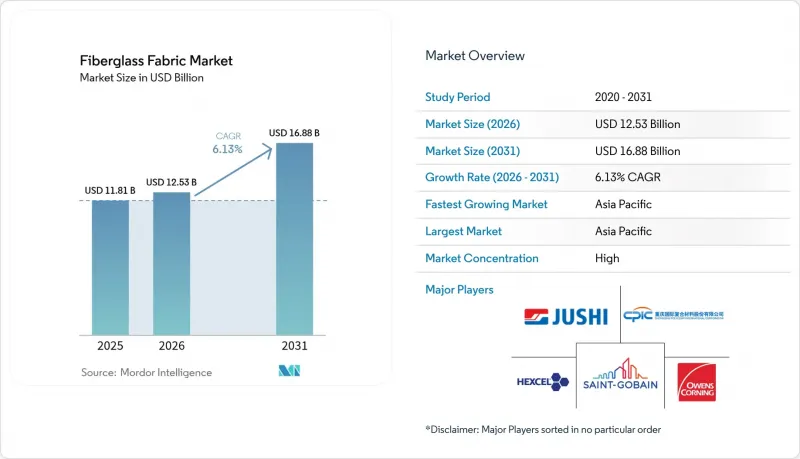
Mordor Intelligence에 의하면, 유리섬유 직물 시장 규모는 2025년 118억 1,000만 달러로 평가되었고, 2026년에는 125억 3,000만 달러로 추정되고, 2026-2031년 CAGR 6.13%로 성장을 지속할 전망이며, 2031년에는 168억 8,000만 달러에 이를 것으로 예측됩니다.
본 보고서에서는 산업을 섬유 유형별(S-글라스, C-글라스, 기타), 직물 유형별(직조 유리섬유, 부직포 유리섬유, 기타), 용도별(자동차 및 항공우주, 건축 및 건설, 기타), 지역별(아시아태평양, 북미, 유럽, 남미, 중동 및 아프리카)로 분류하고 있습니다. 시장 전망은 금액(달러) 기준으로 제시되어 있습니다.
세계의 유리섬유 직물 시장 동향 및 인사이트
자동차 및 항공우주 부문에서 경량 소재에 대한 수요 증가
자동차 제조업체와 항공우주 기업들은 엄격한 규제를 준수하고 성능을 향상시키기 위해 경량 소재의 사용을 점점 더 늘리고 있습니다. 미국에서는 2027-2032년 시행될 새로운 연비 및 배기가스 규제로 인해, 전 세계 공급망에서 경량화가 최우선 과제로 대두되고 있습니다. 포드사는 브롱코 랩터에 채택된 복합재 C-브레이스를 통해 이러한 추세를 구현하고 있으며, 유리섬유 강화 브래킷과 언더바디 패널을 도입함으로써 안전성을 저해하지 않으면서 무게를 줄이고 있습니다. 민간 항공 부문에서는 네덜란드 컨소시엄이 2025년까지 완전 복합재로 제작된 액체 수소 탱크의 인증 획득을 위해 추진 중이며, 극저온 물질 밀봉에 있어 업계가 고강도 유리 섬유에 의존하고 있다는 사실이 부각되고 있습니다. 이러한 소재의 전략적 중요성은 사모펀드(PE)의 투자를 통해서도 더욱 부각되고 있습니다. 예를 들어, AURELIUS는 2024년 경량화에 관한 전문 지식을 활용하기 위해 Teijin Automotive Technologies 북미 법인을 10억 달러 이상에 인수했습니다. 천연섬유 복합재는 온실가스 배출량을 최대 60%까지 줄일 수 있지만, 현재로서는 유리섬유와 같은 기계적 안정성이 부족하여 안전성이 극히 중요한 용도에서 유리섬유의 입지가 더욱 공고해지고 있습니다.
풍력 발전 설비의 확대
세계풍력에너지협의회(GWEC)의 기록에 따르면, 2024년 신규 도입 용량은 117기가와트에 달하며, 2030년까지 연평균 8.8%의 성장이 예상됩니다. 베스타스(Vestas)사의 V236 설계와 같이 블레이드 길이가 115미터를 초과하는 경우, 터빈 1기당 자재 사용량이 증가하므로 비용과 강성 목표를 동시에 달성할 수 있는 하이브리드형 E-글라스와 S-글라스 적층 구조가 적합합니다. 현지 조달 정책에 따라 제조 거점 이전이 가속화되고 있으며, 키네코 엑셀 복합재료사는 2025년 하반기, 아시아의 해상 풍력 발전 프로젝트를 위해 고아 주에서 인발 성형된 유리 섬유·탄소섬유 복합재 플랭크 공급을 시작했습니다. 다우(Dow)와 베스타스(Vestas)가 인증한 폴리우레탄·탄소재 스퍼 캡 기술은 90%가 넘는 경화율을 달성하고 있지만, 견고성을 확보하기 위해 대부분의 전단 웹에는 유리섬유 코어가 유지되고 있습니다. SGL 카본은 원자재 가격 급등으로 인해 풍력 발전용 고객에 대한 매출이 35.2% 감소했다고 보고했으나, 유리 섬유 공급업체들은 더 저렴한 보강재로 대체되는 수요의 혜택을 누리고 있어 유리 섬유 직물 시장을 견인하고 있습니다.
원자재 및 에너지 비용의 변동
유리 용융에는 다량의 천연가스와 전력이 소비됩니다. 2023-2024년에 걸쳐 유럽의 에너지 가격이 급등하면서, 시벨코가 포트폴리오 구성 개선을 통해 EBITDA를 22% 증가시켰음에도 불구하고 이익률이 압박을 받았습니다. 전 세계 생산량 3억 8,000만 톤에 비해 물류비 및 인허가 취득 비용의 상승에 직면하고 있어 규사 가격은 상승 추세를 보이고 있습니다. 미국 환경보호청(EPA)이 정한 울·유리섬유용 용광로에 관한 규제에서는 크롬 배출량의 지속적인 모니터링이 의무화되어 있어, 북미의 공장에는 규정 준수를 위한 설비 투자가 필요합니다. 각 생산 업체들은 자사가 소유한 재생에너지 자산을 통해 가격 변동 위험을 헤지하고 있으며, 중국 Jushi의 제로 탄소 공장에서는 전력 공급을 안정화하기 위해 200MW 규모의 풍력 발전소를 통합하고 있습니다. 존스 맨빌(Johns Manville)사가 슬로바키아에서 시행하고 있는 1만 톤 규모의 프로그램과 같은 공정 스크랩 재활용은 버진 유리 수요를 상쇄하고, 비용 변동을 완화하고 있습니다.
부문별 분석
E-글라스는 성숙한 세계 공급망과 주류 엔지니어링 목표를 충족하는 파운드당 5달러 이하의 단가를 바탕으로 2025년에도 54.52%의 시장 점유율을 유지했습니다. S 유리는 6.69%라는 가장 높은 연평균 성장률(CAGR)로 확대되고 있으며, 인장 강도가 30-35% 더 높기 때문에 프리미엄 가격 책정이 정당화되는 항공우주, 방위, 회전익기 부품 시장을 장악하고 있습니다. E6 강화 유리 등의 특수 등급은 일부 성능 격차를 메우고 있으며, 생체 흡수성 유리 섬유는 의료용 섬유 부문에 새로운 기회를 제공합니다. E 유리와 S 유리의 생산 능력 균형을 맞추고 있는 공급업체는 2031년에 가장 수익성이 높은 제품 구성에 따라 생산량을 유연하게 조정할 수 있습니다.
시멘트 보강재용 AR 유리와 화학 물질 봉쇄 용도의 C 유리 채택은 견조한 추세를 보이는 반면, D 유리는 고유전율 레이더·라도메 부문에서 틈새 성장을 이어가고 있습니다. 비원형 단면을 개발하는 기업들은 동일한 무게에서 12-18% 더 높은 굽힘 강성을 보이는 신장형이나 삼엽형 필라멘트의 상용화를 목표로 하고 있지만, 이를 위해서는 새로운 직조 매개변수가 필요합니다. E 유리는 여전히 주력 제품이며, 유리 섬유 직물 시장은 여러 대륙에 걸쳐 있는 용해로 네트워크를 통해 공급 안정성을 유지하고 있습니다.
지역별 분석
아시아태평양은 2025년 전 세계 매출의 41.47%를 차지했으며, 중국의 규모와 인도의 인프라 부양책에 힘입어 연평균 성장률(CAGR) 6.93%로 향후 성장을 주도하고 있습니다. 중국 Jushi의 8억 1,200만 달러 규모의 제로 카본 용광로 복합 시설은 이 지역의 생산 능력을 40만 톤으로 끌어올려 현지 고객에 대한 납기 단축을 실현하고 있습니다. 동남아시아 국가들은 관세 우대 조치를 원하는 해외 OEM 기업들을 유치하고 있으며, 베트남의 연안 산업단지에는 유럽용 풍력 발전 블레이드의 리드 타임을 단축하는 새로운 직조기가 도입되었습니다. 인도의 ‘메이크 인 인디아(Make in India)’ 정책은 유리섬유 제조업체가 주 정부와 제휴하여 신규 용융 공장을 건설하도록 뒷받침하고 있으며, 국내 로터 공장에 대한 원료의 안정적인 공급을 확보하고 있습니다.
북미에서는 연방 정부의 세액 공제를 통해 풍력 발전소 도입 및 건물 단열 개보수가 촉진되고 있습니다. 또한, 미국의 복합재 선박 건조업체들도 작업선의 경량화와 내충격성 향상을 동시에 실현하는 스티치 가공된 다축 유리섬유 직물에 대한 수요를 자극하고 있습니다. 한편, 해당 지역의 유리섬유 직물 시장 규모는 자동차 제조업체들이 개정된 CAFE 기준을 준수하기 위해 유리섬유·열가소성 수지제 도어 모듈의 시제품 제작을 추진하고 있어 계속해서 확대되는 추세를 보이고 있습니다.
유럽에서는 주택 건설 사이클의 둔화로 인해 단기적인 단열용 섬유 수요가 억제되는 반면, 해상 풍력 발전 목표와 항공우주 부문의 생산 확대에 힘입어 기본 수요량은 유지되고 있습니다. 영국은 중국 및 이집트산 직물에 대해 최대 99.7%의 반덤핑 관세를 부과하고 있으며, 이에 따라 EU 바이어들은 튀르키예 및 현지 생산자로 조달처를 다각화하여 공급망을 조정하고 있습니다. 순환형 경제에 대한 규제적 중점이 유리 재활용 투자를 뒷받침하고 있으며, 독일의 한 공장에서는 새로운 E-유리 생산 라인에 공급될 고순도 칼렛 스트림의 시범 운영이 진행되고 있습니다.
남미의 복합재 파이프 및 탱크 시장은 대형 석유 회사들이 브라질에서 내식성 인프라 현대화를 추진함에 따라 서서히 성장하고 있습니다. 칠레와 콜롬비아에서 진행되는 지역별 풍력 발전소 입찰에서는 100m급 육상용 블레이드가 요구되고 있어, 현지 직물 가공 산업에 새로운 기회가 창출되고 있습니다. 중동 및 아프리카는 여전히 시장 점유율이 작지만, 아랍에미리트의 해수 담수화 프로젝트에서는 내식성을 이유로 유리섬유 복합재 그레이팅이 지정되어 있어, 건조한 기후 하에서 틈새 시장이지만 안정적인 수요가 확보되고 있습니다.
기타 혜택
- 엑셀 형식 시장 예측(ME) 시트
- 3개월간의 애널리스트 지원
자주 묻는 질문
목차
제1장 서론
제2장 조사 방법
제3장 주요 요약
제4장 시장 구도
제5장 시장 규모 및 성장 예측
제6장 경쟁 구도
제7장 시장 기회 및 향후 전망
AJY 26.08.28According to Mordor Intelligence, the fiberglass fabric market size is expected to grow from USD 11.81 billion in 2025 to USD 12.53 billion in 2026 and is forecast to reach USD 16.88 billion by 2031 at 6.13% CAGR over 2026-2031.
This report Segments the Industry by Fiber Type (S-Glass, C-Glass and More), Fabric Type (Woven Fiberglass Fabric, and Non-Woven Fiberglass Fabric), Application (Automotive and Aerospace, Building and Construction, and More), and Geography (Asia-Pacific, North America, Europe, South America, Middle-East and Africa). The Market Forecasts are Provided in Terms of Value (USD).
Global Fiberglass Fabric Market Trends and Insights
Growing demand for lightweight materials in automotive & aerospace
Automakers and aerospace firms increasingly use lightweight materials to meet stringent regulations and enhance performance. In the United States, new fuel-economy and emissions rules for 2027-2032 are driving global supply chains to prioritize weight reduction. Ford exemplifies this trend with its composite C-brace in the Bronco Raptor, incorporating fiberglass-reinforced brackets and under-body panels that reduce mass without compromising safety. In civil aviation, a Dutch consortium is progressing toward validating fully composite liquid-hydrogen tanks by 2025, emphasizing the industry's reliance on high-strength glass fabrics for cryogenic containment. The strategic importance of these materials is further highlighted by private-equity investments, such as AURELIUS acquiring Teijin Automotive Technologies North America in 2024 for over USD 1 billion to leverage their lightweighting expertise. While natural-fiber composites offer up to 60% lower greenhouse gas emissions, they currently lack the mechanical consistency of fiberglass, reinforcing fiberglass's position in safety-critical applications.
Expansion of wind-energy installations
The Global Wind Energy Council recorded 117 GW of new capacity in 2024, with 8.8% annual growth expected through 2030. Blade lengths surpassing 115 m, such as Vestas' V236 design, elevate material-volume requirements per turbine and favor hybrid E-Glass and S-Glass lay-ups that manage cost and stiffness targets. Local content policies accelerate manufacturing shifts; Kineco Exel Composites began supplying pultruded glass-carbon planks from Goa in late 2025 for Asian offshore projects. Polyurethane-carbon spar-cap technology, qualified by Dow and Vestas, achieves cure rates above 90%, yet most shear webs retain glass-fiber cores for robustness. Although SGL Carbon noted a 35.2% sales decline to wind customers due to raw-material inflation, glass-fiber suppliers benefit from substitution to lower-price reinforcements, bolstering the fiberglass fabric market.
Raw-material & energy cost volatility
Glass melting consumes significant natural-gas and electricity inputs; spikes in European energy prices during 2023-2024 squeezed margins despite Sibelco's 22% EBITDA rise from portfolio mix improvements. Silica-sand prices trend upward as 380 million t global output faces higher logistics and permitting costs. U.S. EPA rules for wool-fiberglass furnaces require continuous chromium-emission monitoring, adding compliance capital to North American plants. Producers hedge volatility through captive renewable-energy assets; China Jushi's zero-carbon plant integrates a 200 MW wind farm to stabilize power supply. Process scrap recycling, such as Johns Manville's 10,000 t program in Slovakia, offsets virgin-glass demand and buffers cost swings.
Other drivers and restraints analyzed in the detailed report include:
- Energy-efficient buildings boost insulation textiles demand
- Electronics miniaturization driving EMI-shielding fabrics
- Rising competition from carbon & basalt fiber fabrics
For complete list of drivers and restraints, kindly check the Table Of Contents.
Segment Analysis
E-Glass maintained 54.52% market share in 2025 due to mature global supply networks and unit costs below USD 5/lb that meet mainstream engineering targets. S-Glass, advancing at the fastest CAGR of 6.69%, captures aerospace, defense, and rotorcraft parts where 30-35% higher tensile strength justifies its premium pricing. Specialty grades such as E6 enhanced glass bridge some performance gaps, while bioabsorbable glass fibers add opportunities in medical textiles. Suppliers balancing E- and S-Glass capacity can flex volume toward the most profitable mixes through 2031.
Adoption of AR-Glass for cement reinforcement and C-Glass for chemical containment remains steady, whereas D-Glass continues niche growth in high-dielectric radar radomes. Developers of non-circular cross-sections seek to commercialize kidney-shaped and trilobal filaments that exhibit 12-18% higher flexural stiffness at similar weight, yet require new weaving parameters. E-Glass remains the anchor product, and the fiberglass fabric market preserves supply security via multi-continent melter networks.
Complete Report Scope:
- By Fiber Type
- S-Glass
- C-Glass
- D-Glass
- A-Glass
- E-Glass
- Other Fiber Types (AR-Glass, etc.)
- By Fabric Type
- Woven Fiberglass Fabrics
- Non-Woven Fiberglass Fabrics
- By Application
- Automotive and Aerospace
- Building and Construction
- Wind Energy
- Electrical and Electronics
- Marine
- Other Applications (Oil and Gas, Chemical Processing, etc.)
- By Geography
- Asia-Pacific
- China
- India
- Japan
- South Korea
- Rest of Asia-Pacific
- North America
- United States
- Canada
- Mexico
- Europe
- Germany
- United Kingdom
- France
- Italy
- Rest of Europe
- South America
- Brazil
- Argentina
- Rest of South America
- Middle East and Africa
- Saudi Arabia
- South Africa
- Rest of Middle East and Africa
- Asia-Pacific
Geography Analysis
Asia-Pacific generated 41.47% of 2025 global revenue and leads future growth with a 6.93% CAGR, propelled by China's scale and India's infrastructure stimulus. China Jushi's USD 812 million zero-carbon furnace complex elevates regional capacity to 400,000 t and provides local customers faster delivery cycles. Southeast Asian economies attract foreign OEMs seeking tariff advantages, and Vietnam's coastal industrial parks host new woven-fabric looms that shorten European wind-blade lead times. India's "Make in India" push encourages glass-fiber producers to partner with state governments on greenfield melts, ensuring raw-material availability for domestic rotor factories.
North America benefits from federal tax credits that extend wind-farm deployments and building-insulation retrofits. U.S. composite shipbuilders also stimulate demand for stitched multiaxial glass fabrics that lower weight while improving impact tolerance in workboats. Meanwhile, the fiberglass fabric market size for the region remains under expansion as automotive OEMs prototype glass-thermoplastic door modules to comply with updated CAFE standards.
Europe experiences mixed signals: a softer residential-construction cycle restrains short-term insulation textiles, yet offshore-wind targets and aerospace ramp-ups sustain baseline volume. The U.K. enforces anti-dumping duties up to 99.7% on Chinese and Egyptian fabrics, prompting EU buyers to diversify toward Turkish and local producers, thereby adjusting supply chains. Regulatory focus on circularity spurs investments in glass recycling, with German plants piloting high-purity cullet streams that feed new E-Glass pulls.
South America's composite pipe and tank markets grow gradually as oil majors modernize corrosion-resistant infrastructure in Brazil. Regional wind-farm auctions in Chile and Colombia call for 100-m onshore blades, opening opportunities for local fabric conversion. The Middle East & Africa region remains a smaller slice, yet United Arab Emirates desalination projects specify glass-fiber composite gratings for corrosion resistance, anchoring a steady, if niche, demand profile across arid climates.
- Ahlstrom
- BGF Industries Inc.
- Central Glass Co. Ltd
- China Jushi Co., Ltd.
- Chongqing Polycomp International (CPIC)
- CTG Group
- Fulltech Industries Corp.
- Hexcel Corporation
- Johns Manville
- Mid-Mountain Materials Inc.
- Owens Corning
- Saertex GmbH & Co. KG
- Saint-Gobain
- Taiwan Electric Insulator Co. Ltd
Additional Benefits:
- The market estimate (ME) sheet in Excel format
- 3 months of analyst support
TABLE OF CONTENTS
1 Introduction
- 1.1 Study Assumptions & Market Definition
- 1.2 Scope of the Study
2 Research Methodology
3 Executive Summary
4 Market Landscape
- 4.1 Market Overview
- 4.2 Market Drivers
- 4.2.1 Growing demand for lightweight, high-strength materials in automotive & aerospace
- 4.2.2 Expansion of wind-energy installations
- 4.2.3 Energy-efficient buildings boost insulation textiles demand
- 4.2.4 Electronics miniaturization driving EMI-shielding fabrics
- 4.2.5 Retrofitting of industrial chimneys
- 4.3 Market Restraints
- 4.3.1 Raw-material & energy cost volatility
- 4.3.2 Rising competition from carbon & basalt fiber fabrics
- 4.3.3 Costly end-of-life fiberglass disposal regulations
- 4.4 Value Chain Analysis
- 4.5 Porter's Five Forces
- 4.5.1 Threat of New Entrants
- 4.5.2 Bargaining Power of Buyers
- 4.5.3 Bargaining Power of Suppliers
- 4.5.4 Threat of Substitute Products
- 4.5.5 Degree of Competition
5 Market Size & Growth Forecasts (Value)
- 5.1 By Fiber Type
- 5.1.1 S-Glass
- 5.1.2 C-Glass
- 5.1.3 D-Glass
- 5.1.4 A-Glass
- 5.1.5 E-Glass
- 5.1.6 Other Fiber Types (AR-Glass, etc.)
- 5.2 By Fabric Type
- 5.2.1 Woven Fiberglass Fabrics
- 5.2.2 Non-Woven Fiberglass Fabrics
- 5.3 By Application
- 5.3.1 Automotive and Aerospace
- 5.3.2 Building and Construction
- 5.3.3 Wind Energy
- 5.3.4 Electrical and Electronics
- 5.3.5 Marine
- 5.3.6 Other Applications (Oil and Gas, Chemical Processing, etc.)
- 5.4 By Geography
- 5.4.1 Asia-Pacific
- 5.4.1.1 China
- 5.4.1.2 India
- 5.4.1.3 Japan
- 5.4.1.4 South Korea
- 5.4.1.5 Rest of Asia-Pacific
- 5.4.2 North America
- 5.4.2.1 United States
- 5.4.2.2 Canada
- 5.4.2.3 Mexico
- 5.4.3 Europe
- 5.4.3.1 Germany
- 5.4.3.2 United Kingdom
- 5.4.3.3 France
- 5.4.3.4 Italy
- 5.4.3.5 Rest of Europe
- 5.4.4 South America
- 5.4.4.1 Brazil
- 5.4.4.2 Argentina
- 5.4.4.3 Rest of South America
- 5.4.5 Middle East and Africa
- 5.4.5.1 Saudi Arabia
- 5.4.5.2 South Africa
- 5.4.5.3 Rest of Middle East and Africa
- 5.4.1 Asia-Pacific
6 Competitive Landscape
- 6.1 Market Concentration
- 6.2 Strategic Moves
- 6.3 Market Share(%)/Ranking Analysis
- 6.4 Company Profiles (includes Global level Overview, Market level overview, Core Segments, Financials as available, Strategic Information, Market Rank/Share for key companies, Products & Services, and Recent Developments)
- 6.4.1 Ahlstrom
- 6.4.2 BGF Industries Inc.
- 6.4.3 Central Glass Co. Ltd
- 6.4.4 China Jushi Co., Ltd.
- 6.4.5 Chongqing Polycomp International (CPIC)
- 6.4.6 CTG Group
- 6.4.7 Fulltech Industries Corp.
- 6.4.8 Hexcel Corporation
- 6.4.9 Johns Manville
- 6.4.10 Mid-Mountain Materials Inc.
- 6.4.11 Owens Corning
- 6.4.12 Saertex GmbH & Co. KG
- 6.4.13 Saint-Gobain
- 6.4.14 Taiwan Electric Insulator Co. Ltd
7 Market Opportunities & Future Outlook
- 7.1 White-space & unmet-need assessment


