

|
시장보고서
상품코드
2114991
프로그래머블 로봇 시장 : 시장 점유율 분석, 업계 동향 및 통계, 성장 예측(2026-2031년)Programmable Robots - Market Share Analysis, Industry Trends & Statistics, Growth Forecasts (2026 - 2031) |
||||||
 Mordor Intelligence
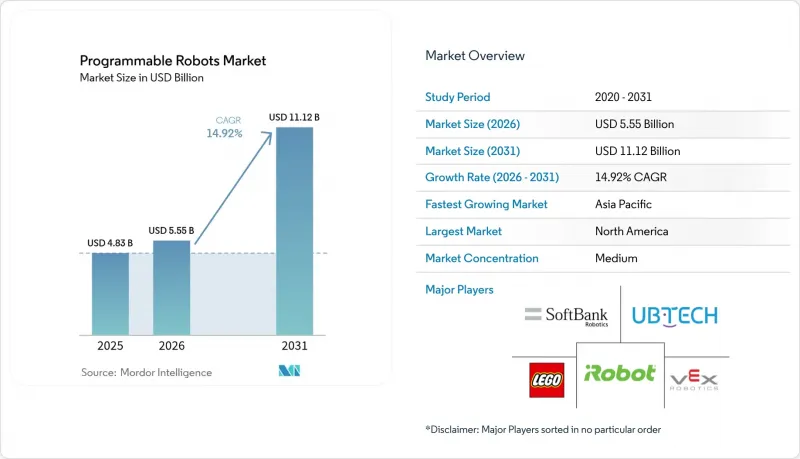
에 의하면, 2026년 프로그래머블 로봇 시장 규모는 55억 5,000만 달러로 추정되고, 2025년 48억 3,000만 달러에서 확대해, 2031년에는 111억 2,000만 달러에 이를 것으로 예측됩니다.
2026-2031년 연평균 성장률(CAGR)은 14.92%가 될 것으로 전망됩니다.
본 보고서는 구성 요소별(하드웨어, 소프트웨어, 서비스), 이동 방식별(바퀴식, 트랙식, 다리식/휴머노이드형 등), 프로그래밍 환경별(그래픽 기반, 스크립트 기반, ROS 기반), 용도별(교육, 엔터테인먼트, 가사 등), 최종 사용자별(K-12 학교, 고등교육 기관 및 연구 기관 등), 그리고 지역별로 분류되어 있습니다. 시장 예측은 금액(달러) 기준으로 제시되어 있습니다.
세계의 프로그래머블 로봇 시장 동향 및 인사이트
STEM 기반 교육 커리큘럼의 도입이 급증
로봇 공학은 방과 후 활동에서 수업의 필수 과목으로 전환되고 있으며, 재량적 지출이 기반이 되는 인프라 투자로 변화하고 있습니다. 카네기 멜론 대학이 2025년까지 K-12 프로그램 전체에 VEX V5 비전 센서 모듈을 도입하기로 결정한 것은 첨단 지각 기술이 조기 교육에 점차 스며들고 있음을 보여줍니다. 표준화된 교육 과정 덕분에 조달 주기가 예측 가능해져, 공급업체는 금형 비용을 상각하고 생산 규모를 확대할 수 있게 됩니다. 종단적 연구에 따르면, 실습 중심의 로봇 공학 교육은 기존 교육 방식에 비해 문제 해결 분야 시험 성적 향상에 기여하는 것으로 나타났습니다. 교육구가 다년간의 계약을 체결함에 따라, 프로그래머블 로봇 시장은 안정적인 수익 전망을 확보하게 되었으며, 이는 신규 진출기업들이 교육 전용 플랫폼에 대한 투자를 촉진하는 요인이 되고 있습니다.
리튬 이온 배터리 가격 하락으로 인해 더 가볍고 전원 코드가 필요 없는 키트가 실현되었습니다.
전기자동차 공급망에서 활용된 범용 배터리 셀 덕분에 와트시당 비용이 절감되고 에너지 밀도가 향상되었습니다. 경량화된 섀시 설계 덕분에 전원 케이블 없이도 교실에서 하루 종일 작동할 수 있게 되어, 고정식 충전 도크와 관련된 인프라 비용이 절감되고 있습니다. 또한 휴대용 키트는 방과 후 프로그램이나 원격 학습 환경과 같은 적용 범위를 확대되고 있습니다. 2024년 학군 입찰에서 수집된 가격 탄력성 데이터에 따르면, 배터리 팩 비용 하락과 보급형 로봇 키트 주문 수량 사이에 직접적인 상관관계가 나타나며, 이는 수량 기준의 구매 협상을 뒷받침하고 있습니다.
초기 설비 투자(Capex)와 급속히 진화하는 기능 세트
교육구는 3년에서 5년에 걸쳐 사양이 고정되는 예산 주기에 직면해 있지만, 로봇 플랫폼은 매년 업데이트됩니다. 구매 담당자들은 기술의 노후화를 우려하여 표준화된 기능 기준이 확립될 때까지 구매를 미루는 경우가 많습니다. 하드웨어 업데이트 옵션이 포함된 구독 모델은 이러한 위험을 완화하기 시작했지만, 새로운 조달 정책이 필요합니다. 자본 지출 승인 일정과 급속한 부품 혁신 간의 불일치는 특히 교육 예산이 제한된 시장에서 당면한 수요를 억제하는 요인이 되고 있습니다.
부문 분석
2025년, 하드웨어는 프로그래머블 로봇 시장의 63.65%를 차지한 것으로 평가되었으며, 이는 기계 조립, 센서, 구동 시스템의 자본 집약성을 반영한 것입니다. 하드웨어 분야의 프로그래밍 가능 로봇 시장 규모는 30억 7,000만 달러를 초과하며, 로봇을 내구 자산으로 간주하는 교육 과정의 의무화에 따라 앞으로도 성장이 예상됩니다. 모듈식 섀시와 표준화된 센서 소켓은 통합 장벽을 낮추고 학년 간 재사용을 가능하게 합니다.
소프트웨어 부문은 매출액 규모는 작지만, 구독형 업그레이드를 제공하는 벤더에게는 70%가 넘는 이익률을 가져다주고 있습니다. 서비스 부문은 연평균 성장률(CAGR) 15.18%로 성장을 지속하고, 있으며, 교육 시간, 수업 계획 라이브러리, 연장 보증 등을 통해 수익을 창출함으로써 하드웨어의 계절적 변동을 완화하는 지속적인 현금 흐름을 만들어내고 있습니다. 교육 기관에서는 총 소유 비용(TCO)을 비교 검토하는 경향이 강해지고 있으며, 이에 따라 공급업체들은 하드웨어, 클라우드 대시보드, 교원 전문 역량 개발 크레딧을 통합한 계약을 제안하고 있습니다. 예측 기간 동안, 일회성 하드웨어 주문을 연간 지불 방식의 서비스 수익으로 전환할 수 있는 벤더는 동종 업계 경쟁사보다 뛰어난 실적을 올릴 것입니다.
2025년, 바퀴 달린 로봇은 프로그래머블 로봇 시장 점유율의 48.85%를 유지했습니다. 이는 부품 수가 적고 교실 사용에 적합한 형태이기 때문에 즉각적인 도입이 용이하기 때문입니다. 이 부문은 시중에서 구할 수 있는 구동계 부품이 풍부하다는 이점을 누리고 있으며, 평균 판매 가격을 공립학교의 보조금 지원 범위 내로 억제하고 있습니다.
그러나 휴머노이드 및 기타 보행형 로봇은 액추에이터 가격 하락과 제어 알고리즘의 성숙에 따라 연평균 성장률(CAGR) 15.74%로 성장하여 프로그래머블 로봇 시장 규모에서 점유율을 확대할 것으로 예측됩니다. 유럽의 공학 프로그램에서는 보행 계획 및 힘 피드백 원리를 가르치기 위해 이족 보행 키트를 채택하는 사례가 증가하고 있으며, 이는 엔터테인먼트 및 의료 분야의 시범 프로젝트에서 수요가 파급되고 있음을 시사합니다. 바퀴식, 트랙식, 다리식 등의 옵션을 아우르는 플랫폼 제품군을 전개하는 벤더는 학생들의 숙련도에 따라 고급 모델을 업셀링할 수 있으며, 교육 기관을 자사의 브랜드 생태계에 안착시킬 수 있습니다.
지역별 분석
북미는 2025년에 프로그래머블 로봇 시장의 37.35% 점유율을 차지했습니다. 이는 학군 차원의 견실한 교육 예산과 전미과학재단(NSF)의 로봇 공학 보조금 확대에 힘입은 결과입니다. UL 3300 및 ISO 13482와 같은 안전 규격은 규정 준수 달성 경로를 명확히 함으로써 교육 현장에 대한 도입 기간을 단축하고 있습니다. 각 벤더사는 광범위한 유통망와 학교 내 시연 프로그램을 활용하여 판매 주기를 단축하고 있습니다. 캐나다의 첨단 제조업에 대한 산업 정책 집중과 멕시코의 북미 공급망 통합은 지역 내 부품 조달을 촉진하고 관세 위험을 완화하고 있습니다.
중국이 로봇 기술 가속화를 위해 1,380억 달러를 투입하고 모든 성도에 훈련 시설을 설립함에 따라, 아시아태평양은 연평균 성장률(CAGR) 16.42%를 달성하며 세계에서 가장 빠른 성장을 보일 것으로 전망됩니다. 한국의 2,000억 원 규모의 인프라 프로그램과 일본의 ‘신로봇 전략’은 국내 OEM 제조업체로 자본을 유도하여 현지 공급망의 회복탄력성을 강화하고 있습니다. 인도의 ‘국가 교육 정책’에서는 초등학교 6학년부터 코딩 교육을 중시하고 있어, 이를 통해 막대한 수의 새로운 학습자층이 생겨나고 있습니다. 지역 벤더들은 반도체 파브 및 배터리 공장과 지리적으로 인접한 이점을 활용하여, 기능성을 저하시키지 않으면서도 경쟁력 있는 가격 책정을 실현하고 있습니다.
유럽에서는 ‘호라이즌 유럽’의 1,000억 유로 규모의 혁신 예산과 독일의 ‘하이테크 전략 2025’에 따른 예산 배분을 기반으로 꾸준한 성장이 나타나고 있습니다. 영국의 ‘스마트 머신 전략 2035’에서는 로봇 관련 부가가치(GVA)가 1,500억 파운드에 달할 것으로 예측되어, 교육 기술에 대한 투자에 장기적인 성장 여지를 제공합니다. 다만, 강화된 ‘일반 제품 안전 규정’ 개정에 따라 규정 준수 비용이 증가하고 있으므로, 전담 규제 대응 팀을 보유한 공급업체가 유리합니다. 범유럽 로봇 경진대회는 생태계 간의 협력을 촉진하며, 간접적으로 국경을 초월한 키트의 표준화를 추진하고 있습니다.
기타 혜택 :
- 엑셀 형식 시장 예측(ME) 시트
- 3개월간의 애널리스트 지원
자주 묻는 질문
목차
제1장 서론
제2장 조사 방법
제3장 주요 요약
제4장 시장 구도
제5장 시장 규모 및 성장 예측
제6장 경쟁 구도
제7장 시장 기회 및 향후 전망
AJY 26.08.28According to Mordor Intelligence, programmable robots market size in 2026 is estimated at USD 5.55 billion, growing from 2025 value of USD 4.83 billion with 2031 projections showing USD 11.12 billion, growing at 14.92% CAGR over 2026-2031.
This report is Segmented by Component (Hardware, Software, Services), Mobility Type (Wheeled, Tracked, Legged/Humanoid, and More), Programming Environment (Graphical, Script-Based, ROS-Based), Application (Education, Entertainment, Household Tasks, and More), End-User (K-12 Schools, Higher-Education and Research Labs, and More), and by Geography. The Market Forecasts are Provided in Terms of Value (USD).
Global Programmable Robots Market Trends and Insights
Surge in STEM-Based Educational Curricula Adoption
Robotics has shifted from extracurricular clubs to core classroom requirements, converting discretionary spending into baseline infrastructure outlays. Carnegie Mellon University's decision to embed VEX V5 vision-sensor modules across its 2025 K-12 programs illustrates how advanced perception is entering early education. Standardized curricula create predictable procurement cycles, letting vendors amortize tooling costs and scale production. Longitudinal studies show that hands-on robotics raises test-score performance in problem-solving domains versus traditional instruction. As school districts lock in multi-year contracts, the programmable robots market secures steady revenue visibility, encouraging entrants to invest in purpose-built education platforms.
Falling Li-Ion Battery Prices Enabling Lighter Untethered Kits
Commodity battery cells leveraged from the electric-vehicle supply chain have reduced cost per watt-hour and improved energy density. Lighter chassis designs now support full-day classroom operation without power tethers, cutting infrastructure costs associated with fixed charging docks. Portable kits also widen the addressable base to after-school programs and remote learning environments. Price elasticity data gathered from 2024 district tenders shows a direct correlation between lower battery pack costs and order quantities for entry-level robotic kits, strengthening volume-based purchasing negotiations.
Up-Front Capex Versus Fast-Evolving Feature Sets
School districts face budget cycles that lock specifications for three to five years, yet robotics platforms refresh annually. Buyers fear technological obsolescence, often delaying purchases until standardized feature baselines emerge. Subscription models that bundle hardware refresh options are starting to mitigate this risk but require new procurement policies. The mismatch between capital-approval timelines and rapid component innovation tempers immediate demand, particularly in markets with constrained education budgets.
Other drivers and restraints analyzed in the detailed report include:
- Mainstream Availability of Open-Source MCU Boards
- AI-on-Edge Chips Enabling On-Board Vision and Speech
- Shortage of Classroom-Ready Coding Instructors
For complete list of drivers and restraints, kindly check the Table Of Contents.
Segment Analysis
Hardware commanded 63.65% of programmable robots market share in 2025, reflecting the capital intensity of mechanical assemblies, sensors, and drive systems. The programmable robots market size for hardware exceeded USD 3.07 billion and is set to grow alongside curriculum mandates that view robots as durable assets. Modular chassis and standardized sensor sockets lower integration friction, enabling cross-grade reusability.
Software, though smaller in revenue, yields margins exceeding 70% for vendors offering subscription upgrades. Services, posting 15.18% CAGR, monetize training hours, lesson-plan libraries, and extended warranties, providing recurring cash flows that smooth hardware seasonality. Institutions increasingly benchmark total cost of ownership, prompting suppliers to bundle hardware, cloud dashboards, and teacher professional-development credits into unified contracts. Over the forecast period, vendors able to translate one-time hardware wins into annuity-style service revenues will outperform peers.
Wheeled robots retained 48.85% programmable robots market share in 2025 because their low part counts and classroom-safe profiles facilitate immediate deployment. The segment benefits from abundant off-the-shelf drivetrain components, keeping average selling prices within public-school grant thresholds.
Yet humanoid and other legged variants are projected to capture a rising slice of programmable robots market size, growing at 15.74% CAGR as actuator prices fall and control algorithms mature. Engineering programs in Europe increasingly adopt bipedal kits to teach gait-planning and force-feedback principles, suggesting a demand spill-over from entertainment and healthcare pilots. Vendors that field platform families spanning wheeled, tracked, and legged options can upsell advanced models as students progress, locking institutions into brand ecosystems.
Complete Report Scope:
- By Component
- Hardware
- Software
- Services
- By Mobility Type
- Wheeled
- Tracked
- Legged/Humanoid
- Modular/Re-configurable
- By Programming Environment
- Graphical (Scratch/Block-based)
- Script-based (Python/C/C++)
- ROS-based
- By Application
- Education
- Entertainment
- Household Tasks
- Research and Prototyping
- By End-user
- K-12 Schools
- Higher-Education and Research Labs
- Consumers (DIY/Hobbyists)
- Theme Parks and Exhibition Centres
- By Geography
- North America
- United States
- Canada
- Mexico
- South America
- Brazil
- Argentina
- Rest of South America
- Europe
- Germany
- United Kingdom
- France
- Italy
- Russia
- Rest of Europe
- Asia Pacific
- China
- Japan
- India
- South Korea
- Australia
- Rest of Asia Pacific
- Middle East and Africa
- Middle East
- Saudi Arabia
- UAE
- Turkey
- Rest of Middle East
- Africa
- South Africa
- Nigeria
- Rest of Africa
- Middle East
- North America
Geography Analysis
North America held 37.35% programmable robots market share in 2025, underpinned by robust district-level education funding and the National Science Foundation's expanded robotics grants. Safety frameworks such as UL 3300 and ISO 13482 accelerate time-to-classroom by clarifying compliance pathways. Vendors leverage extensive reseller networks and in-school demonstration programs to shorten sales cycles. Canada's industrial-policy tilt toward advanced manufacturing and Mexico's integration into North American supply chains support regional component sourcing, mitigating tariff exposure.
Asia-Pacific is projected to deliver a 16.42% CAGR, fastest worldwide, as China mobilizes USD 138 billion for robotics acceleration and establishes training facilities in all provincial capitals.South Korea's KRW 200 billion infrastructure program and Japan's New Robot Strategy funnel capital toward domestic OEMs, reinforcing local supply-base resilience. India's National Education Policy emphasizes coding from grade six, unlocking a vast incremental learner cohort. Regional vendors exploit proximity to semiconductor fabs and battery plants, allowing competitive pricing without compromising feature sets.
Europe records steady growth, anchored by Horizon Europe's EUR 100 billion innovation budget and Germany's High-Tech Strategy 2025 allocations. The United Kingdom's Smart Machines Strategy 2035 forecasts GBP 150 billion in robotics-related GVA, offering a long runway for education-technology investments.However, stringent General Product Safety Regulation updates add compliance costs, favoring suppliers with dedicated regulatory-affairs teams. Pan-European robotics competitions foster ecosystem collaboration, indirectly driving cross-border kit standardization.
- iRobot Corporation
- Lego Group
- SoftBank Robotics
- UBTECH Robotics
- VEX Robotics (Innovation First)
- Modular Robotics Inc.
- DJI Technology Co.
- Pudu Robotics
- Xiaomi Corp. (CyberDog)
- Hanson Robotics
- Honda Motor Co. (ASIMO legacy)
- WowWee Group Ltd.
- Fischertechnik GmbH
- SuperDroid Robots Inc.
- Makeblock Co. Ltd.
- Robolink Inc.
- Robotis Co. Ltd.
- Kinova Inc.
- Nippon Electric Company (Nao joint IP)
- GJS Robot
Additional Benefits:
- The market estimate (ME) sheet in Excel format
- 3 months of analyst support
TABLE OF CONTENTS
1 INTRODUCTION
- 1.1 Study Assumptions and Market Definition
- 1.2 Scope of the Study
2 RESEARCH METHODOLOGY
3 EXECUTIVE SUMMARY
4 MARKET LANDSCAPE
- 4.1 Market Overview
- 4.2 Market Drivers
- 4.2.1 Surge in STEM-based educational curricula adoption
- 4.2.2 Falling Li-ion battery prices enabling lighter untethered kits
- 4.2.3 Mainstream availability of open-source MCU boards (Arduino, RPi)
- 4.2.4 AI-on-edge chips enabling on-board vision and speech
- 4.2.5 National robotics strategies (e.g., South Korea, UAE)
- 4.2.6 Growing demand for tele-presence care robots in ageing societies
- 4.3 Market Restraints
- 4.3.1 Up-front capex vs. fast-evolving feature sets (obsolescence risk)
- 4.3.2 Shortage of classroom-ready coding instructors
- 4.3.3 Safety certification bottlenecks for home robots
- 4.3.4 Supply-chain fragility for small-run custom actuators
- 4.4 Value / Supply-Chain Analysis
- 4.5 Regulatory Landscape
- 4.6 Technological Outlook
- 4.7 Porter's Five Forces
- 4.7.1 Threat of New Entrants
- 4.7.2 Bargaining Power of Buyers
- 4.7.3 Bargaining Power of Suppliers
- 4.7.4 Threat of Substitutes
- 4.7.5 Intensity of Competitive Rivalry
5 MARKET SIZE AND GROWTH FORECASTS (VALUE)
- 5.1 By Component
- 5.1.1 Hardware
- 5.1.2 Software
- 5.1.3 Services
- 5.2 By Mobility Type
- 5.2.1 Wheeled
- 5.2.2 Tracked
- 5.2.3 Legged/Humanoid
- 5.2.4 Modular/Re-configurable
- 5.3 By Programming Environment
- 5.3.1 Graphical (Scratch/Block-based)
- 5.3.2 Script-based (Python/C/C++)
- 5.3.3 ROS-based
- 5.4 By Application
- 5.4.1 Education
- 5.4.2 Entertainment
- 5.4.3 Household Tasks
- 5.4.4 Research and Prototyping
- 5.5 By End-user
- 5.5.1 K-12 Schools
- 5.5.2 Higher-Education and Research Labs
- 5.5.3 Consumers (DIY/Hobbyists)
- 5.5.4 Theme Parks and Exhibition Centres
- 5.6 By Geography
- 5.6.1 North America
- 5.6.1.1 United States
- 5.6.1.2 Canada
- 5.6.1.3 Mexico
- 5.6.2 South America
- 5.6.2.1 Brazil
- 5.6.2.2 Argentina
- 5.6.2.3 Rest of South America
- 5.6.3 Europe
- 5.6.3.1 Germany
- 5.6.3.2 United Kingdom
- 5.6.3.3 France
- 5.6.3.4 Italy
- 5.6.3.5 Russia
- 5.6.3.6 Rest of Europe
- 5.6.4 Asia Pacific
- 5.6.4.1 China
- 5.6.4.2 Japan
- 5.6.4.3 India
- 5.6.4.4 South Korea
- 5.6.4.5 Australia
- 5.6.4.6 Rest of Asia Pacific
- 5.6.5 Middle East and Africa
- 5.6.5.1 Middle East
- 5.6.5.1.1 Saudi Arabia
- 5.6.5.1.2 UAE
- 5.6.5.1.3 Turkey
- 5.6.5.1.4 Rest of Middle East
- 5.6.5.2 Africa
- 5.6.5.2.1 South Africa
- 5.6.5.2.2 Nigeria
- 5.6.5.2.3 Rest of Africa
- 5.6.5.1 Middle East
- 5.6.1 North America
6 COMPETITIVE LANDSCAPE
- 6.1 Market Concentration
- 6.2 Strategic Moves
- 6.3 Market Share Analysis
- 6.4 Company Profiles (includes Global level Overview, Market level overview, Core Segments, Financials as available, Strategic Information, Market Rank/Share for key companies, Products and Services, and Recent Developments)
- 6.4.1 iRobot Corporation
- 6.4.2 Lego Group
- 6.4.3 SoftBank Robotics
- 6.4.4 UBTECH Robotics
- 6.4.5 VEX Robotics (Innovation First)
- 6.4.6 Modular Robotics Inc.
- 6.4.7 DJI Technology Co.
- 6.4.8 Pudu Robotics
- 6.4.9 Xiaomi Corp. (CyberDog)
- 6.4.10 Hanson Robotics
- 6.4.11 Honda Motor Co. (ASIMO legacy)
- 6.4.12 WowWee Group Ltd.
- 6.4.13 Fischertechnik GmbH
- 6.4.14 SuperDroid Robots Inc.
- 6.4.15 Makeblock Co. Ltd.
- 6.4.16 Robolink Inc.
- 6.4.17 Robotis Co. Ltd.
- 6.4.18 Kinova Inc.
- 6.4.19 Nippon Electric Company (Nao joint IP)
- 6.4.20 GJS Robot
7 MARKET OPPORTUNITIES AND FUTURE OUTLOOK
- 7.1 White-space and Unmet-Need Assessment


