|
시장보고서
상품코드
2114994
활성 알루미나 시장 : 점유율 분석, 업계 동향과 통계, 성장 예측(2026-2031년)Activated Alumina - Market Share Analysis, Industry Trends & Statistics, Growth Forecasts (2026 - 2031) |
||||||
 Mordor Intelligence
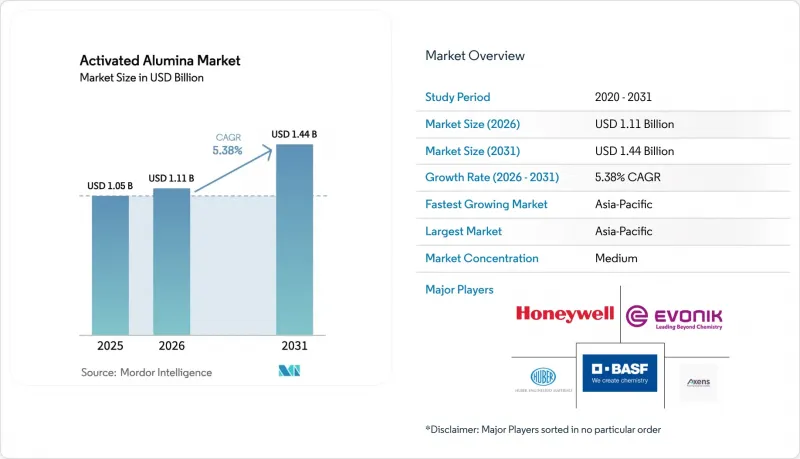
Mordor Intelligence에 의하면, 활성 알루미나 시장 규모는 2025년에 10억 5,000만 달러로 평가되었고 2026년 11억 1,000만 달러에서 2031년까지 14억 4,000만 달러에 이를 것으로 예측되며, 예측 기간(2026-2031년) CAGR은 5.38%를 나타낼 전망입니다.
본 보고서는 용도별(흡착제, 건조제, 촉매 지지체, 기타 용도), 최종 사용자 산업별(석유 및 가스, 상하수도 처리, 화학제품 및 석유화학제품, 의료 및 제약, 전력 및 에너지, 기타), 지역별(아시아태평양, 북미, 유럽, 남미, 중동 및 아프리카)로 분류되어 있습니다. 시장 전망은 금액(달러) 기준으로 제시되어 있습니다.
세계 활성 알루미나 시장 동향 및 인사이트력
도시 상수도 처리에서 불소 제거 매체에 대한 수요 증가
규제 당국은 2024년 4월, 미국 내 PFAS(퍼플루오로알킬 물질)에 관한 ‘국가 1차 음용수 규정’을 최종 확정하고, 2029년 4월까지 준수해야 할 최대 오염 물질 농도(MCL)를 정했습니다. 이로 인해 도시 하수 처리장에서 광범위한 개보수 주기가 촉진되고 있습니다. 활성 알루미나(Al2O3)는 양성이온성 표면 덕분에 불소와 미량의 중금속을 동등한 효율로 제거할 수 있어, 단일 용도의 매체보다 뛰어난 성능을 발휘합니다. 비교 연구에 따르면, 미세결정 알루미나의 불소 흡착 능력은 기존 실리카 모래에 비해 7배 높으며, 150°C에서의 재생 처리를 통해 여러 번의 주기를 거치더라도 흡착 용량의 90% 이상을 유지할 수 있는 것으로 나타났습니다. 상수도 유틸리티자들은 규제 준수까지의 기간이 제한된 상황에서 이러한 실적이 입증된 화학 기술을 채택하는 경향을 보이고 있으며, 2025년부터 2029년까지 대량 발주량이 증가할 전망입니다. 이미 턴키 방식에 따른 원료 공급, 재생 처리, 계장 지원 체제를 갖춘 각 벤더사는 대규모 수도국과의 기본 계약 체결에 착수하고 있어, 활성 알루미나 시장 전망이 더욱 밝아지고 있습니다. 또한, 유럽과 캐나다에서 진행 중인 공중보건 기금 프로그램은 해당 지역에서 신종 오염 물질에 대한 규제 기준이 통일됨에 따라 추가적인 성장의 호재가 되고 있습니다.
천연가스 및 석유 정제 분야의 탈수 프로젝트 확대
초저유황 연료 및 원료 기준을 충족하기 위해서는 수분 관리가 여전히 매우 중요하며, 주요 라이선스 제공 기업들은 현재 극성 오염 물질을 제거하기 위한 활성 알루미나 가드 층을 통합한 다층 탈수 트레인을 지정하고 있습니다. Axens사에 따르면, 자사의 AxSorb 시리즈는 배출수 내 수분 농도를 0.1 ppm 미만으로 억제하는 동시에 경메르캅탄을 제거할 수 있으며, 이러한 이중 기능 덕분에 장비 대수와 설비 투자 부담을 줄일 수 있다고 합니다. 동남아시아에서 건설 중인 새로운 에탄 크래커 및 수소 대응형 수증기 메탄 개질 장치에는 알루미나계 건조제 베드가 채택되고 있습니다. 이는 이 매체가 현장에서 재생 가능하며 스윙 모드 운전에 대응할 수 있기 때문입니다. 인도 및 중국에서 분산형 LNG 및 CNG 네트워크가 보급됨에 따라, 소형 스키드형 패키지의 경우 처리량 단위당 더 많은 흡착제 용량이 필요하게 되었으며, 이는 활성 알루미나 시장의 추가적인 확대로 이어지고 있습니다. 장비의 수명이 길고, 연속적인 재생 공정을 거치더라도 성능 저하가 제한적이기 때문에 2030년까지 예측 가능한 교체 주기가 유지됩니다.
대체 흡착제의 이용 가능성
산화철 나노 입자는 일부 중금속에 대해 70-98%의 제거 효율을 발휘하고, 자기 분리도 가능하기 때문에 활성 알루미나에 열 재생이 필요한 연속 유동 시스템에서 운영상의 이점을 제공합니다. 농업 폐기물로 제조되는 바이오 탄소 흡착제도 메조 기공 분포가 미세 플라스틱 포집에 적합하다는 점에서 주목을 받고 있습니다. 비용에 매우 민감한 동남아시아와 라틴아메리카에서는 사업이 급속히 확대되고 있기 때문에 현지 유틸리티자들은 고가 알루미나 등급을 검토하기 전에 이러한 대체품을 시험적으로 도입할 가능성이 있습니다. 따라서 활성 알루미나 시장의 각 공급업체들은 절대적인 성능보다는 범용성과 총 소유 비용(TCO)을 강조하는 방향으로 전략을 전환하고 있습니다. 규제 당국이 알루미나 매체에 익숙해져 있어 이 억제요인이 미치는 단기적인 영향은 완화되고 있지만, 지자체 입찰에서의 조달 동향 변화는 자금 조달 제약이 지배적인 상황에서는 가격이 매우 큰 역할을 한다는 것을 보여줍니다.
부문 분석
2025년, 건조제 용도는 활성 알루미나 시장 규모의 35.12%를 차지하고 있으며, 이는 벌크 가스의 탈수 처리에서 표준 처리 매체로서의 위상을 반영하고 있습니다. 연속 스윙 베드식 장치는 200°C에서 알루미나를 재생하며, 1,000회 사이클 후에도 95% 이상의 흡착 용량을 유지합니다. 이러한 경제적 우위 덕분에 LNG, CNG 및 정유시설 운영 분야에서 장기 계약이 강화되고 있습니다. 현재 수요 증가분은 엄격한 이슬점 제어가 필요한 수소 대응 가스 터빈에 기인하고 있으며, 이에 따라 해당 부문은 예측 기간 동안 저-중단 한 자릿수 성장률을 유지할 것으로 전망됩니다. 경쟁사와의 차별화는 부피 밀도가 아닌 용도에 맞춘 기공 직경 분포에 중점을 두고 있으며, 주요 공급업체들은 마모를 억제하는 첨단 졸-겔 공법에 대한 투자를 추진하고 있습니다.
2031년까지의 연평균 성장률(CAGR)은 5.93%로 가장 높은 성장세가 예상되며, 이는 지자체 및 산업 사용자들이 새로운 오염 물질 기준치를 준수하기 위해 시스템 개조를 진행하고 있기 때문입니다. 활성 알루미나(Al₂O₃)는 재생이 가능하기 때문에 일회용 이온 교환 수지에 비해 수명 주기 비용을 낮게 유지할 수 있으며, 그 양성이온성 표면 덕분에 불화물, 비소, 셀레늄을 동시에 포집할 수 있습니다. 미국 중서부 지역의 시범 도입 사례에서는 금속염 응집제와 비교하여 슬러지 처리량이 85% 감소했으며, 이러한 지속가능성 측면의 이점은 정책 입안자들로부터도 호의적으로 받아들여지고 있습니다. 리튬 이온 배터리 분리막 코팅에 대한 초기 단계의 채택은 추가적인 성장 여지를 제공합니다. 이는 단 5% 시장 침투율만으로도 연간 수천 톤에 달하는 수요가 예상되기 때문입니다. 이러한 동향들이 결합되어 활성 알루미나 시장은 균형 잡힌 수익 구조를 유지하게 되며, 특정 최종 용도에서 발생하는 주기적인 변동을 완화하는 효과가 있습니다.
지역별 분석
아시아태평양은 2025년에 활성 알루미나 시장 점유율의 53.78%를 차지하고 있으며, 2031년까지 연평균 성장률(CAGR)이 6.31%에 달함에 따라 선두 자리를 유지할 전망입니다. 중국 연안 지역의 화학 산업 단지나 동남아시아의 크래커 복합 시설에서 진행되는 고부가가치 프로젝트에는 대량의 건조제가 필요합니다. 한편, 해당 지역 전체에서 기가팩토리 건설이 확대됨에 따라 차세대 전기차(EV) 배터리용 알루미나 코팅 분리막이 실증되고 있습니다. 보크사이트 광상 및 통합형 알루미나 정제소와의 근접성 등 현지 조달상의 이점이 경쟁력 있는 납품 비용을 뒷받침하고 있으며, 이를 통해 지역 생산자들은 중동 및 아프리카로의 수출 기반을 강화하고 있습니다.
북미에서는 천연가스 중류 자산 및 연방 정부 주도의 수질 규제로 인해 확고한 수요가 지속되고 있습니다. 2024년에 확정된 PFAS 규제는 2029년까지의 준수를 의무화하고 있으며, 이로 인해 대용량 불소화합물 흡착제 층에 대한 예측 가능한 지출 주기가 발생하고 있습니다. 오대호 지역에서 진행된 선진적인 시범 프로그램을 통해 이미 확장 가능한 재생 기술이 입증되었으며, 이를 통해 수명 주기 동안 매체 소비량을 최대 30%까지 줄일 수 있음이 밝혀졌습니다. 이는 알루미나의 비용 측면에서의 우위를 더욱 공고히 하고 있습니다. 그러나 2025년부터 2026년까지 에보니크(Evonik)사가 뉴욕주와 메릴랜드주에서 계획하고 있는 실리카 공장 폐쇄는 특수 화학제품 공급업체 간의 합리화가 더욱 진행될 것임을 시사하며, 이로 인해 단기적으로는 국내 공급이 부족해질 가능성이 있습니다.
유럽은 재생 가능한 흡착제를 우대하는 순환형 경제 목표를 여전히 추진하고 있습니다. ‘산업 배출 지침’과 같은 정책 수단은 사업자에게 수명 주기 영향의 정량화를 촉구하고 있으며, 이로 인해 일회용 수지보다 알루미나가 조달되는 경향이 강해지고 있습니다. 독일의 저온 분무 열분해 장치를 포함한 친환경 알루미나 합성 기술에 대한 투자는 특수 화학제품 생산 분야에서도 탈탄소화를 추진하는 움직임을 보여주고 있습니다. 남미 및 중동 및 아프리카에서는 새로운 가스 처리 시설과 물 부족 해소 프로젝트가 가동을 시작함에 따라, 이들 지역을 합친 수요량이 서서히 증가하고 있습니다. 총 톤수는 적지만, 경수 조건 하에서 높은 교환 빈도로 인해 지속적인 수요가 발생하며, 장기적으로는 이들 지역의 활성 알루미나 시장을 견인하게 될 것입니다.
기타 혜택:
- 엑셀 형식 시장 예측(ME) 시트
- 3개월간의 애널리스트 지원
자주 묻는 질문
목차
제1장 서론
제2장 조사 방법
제3장 주요 요약
제4장 시장 구도
제5장 시장 규모와 성장 예측
제6장 경쟁 구도
제7장 시장 기회와 향후 전망
JHS 26.08.26According to Mordor Intelligence, the activated alumina market size was valued at USD 1.05 billion in 2025 and estimated to grow from USD 1.11 billion in 2026 to reach USD 1.44 billion by 2031, at a CAGR of 5.38% during the forecast period (2026-2031).
This report is Segmented by Application (Adsorbent, Desiccant, Catalyst Carrier, Other Applications), End-User Industry (Oil and Gas, Water and Wastewater Treatment, Chemical and Petrochemical, Healthcare and Pharmaceuticals, Power and Energy, Others), and Geography (Asia-Pacific, North America, Europe, South America, Middle East and Africa). The Market Forecasts are Provided in Terms of Value (USD).
Global Activated Alumina Market Trends and Insights
Growing Demand for Fluoride-Removal Media in Municipal Water Treatment
Regulators finalized the United States PFAS National Primary Drinking Water Regulation in April 2024, establishing maximum contaminant levels that must be met by April 2029, which has catalyzed a broader upgrade cycle for municipal treatment plants. Activated alumina outperforms single-purpose media because its amphoteric surface removes both fluoride and trace heavy metals with equal efficiency. Comparative studies demonstrate seven-fold higher fluoride adsorption on micro-crystalline alumina versus traditional silica sand, while regeneration at 150 °C preserves more than 90 % capacity over multiple cycles. Utility operators gravitate toward this proven chemistry during compressed compliance windows, pushing bulk-order volumes higher between 2025 and 2029. Vendors already positioned with turnkey feed, regenerate, and instrumentation support have begun locking in framework contracts with large water districts, reinforcing visibility in the activated alumina market. Ongoing public-health funding programs in Europe and Canada provide additional upside as those regions harmonize limits on emerging contaminants.
Expansion of Natural-Gas and Oil-Refining Dehydration Projects
Moisture management remains critical for meeting ultra-low-sulfur fuel and feedstock standards, and major licensors now specify multi-bed dehydration trains that integrate activated alumina guard layers for polar contaminant removal. Axens reports that its AxSorb series achieves outlet water levels below 0.1 ppm while simultaneously scavenging light mercaptans, a dual function that reduces vessel count and capital burden. New ethane crackers and hydrogen-ready steam-methane reformers under construction in Southeast Asia select alumina-based desiccant beds because the media regenerates on-site and accommodates swing-mode operation. As distributed LNG and CNG networks proliferate across India and China, smaller skid packages require higher adsorbent volumes per throughput unit, which further lifts the activated alumina market. The long equipment life cycle and limited performance degradation over successive regenerations sustain a predictable replacement rhythm through 2030.
Availability of Substitute Adsorbents
Iron-oxide nanoparticles provide 70-98 % removal efficiency for several heavy metals and permit magnetic separation, delivering operational advantages in continuous-flow systems where activated alumina requires thermal regeneration. Bio-based carbon adsorbents produced from agricultural waste also show growing appeal because their mesopore distribution favors microplastic capture. Rapid scale-up in Southeast Asia and Latin America, where cost sensitivity is acute, means local utilities may trial these alternatives before considering premium alumina grades. Suppliers inside the activated alumina market therefore reposition on versatility and total-cost-of-ownership messaging rather than absolute performance. The restraint's near-term impact is cushioned by regulatory familiarity with alumina media, yet procurement shifts in municipal bids demonstrate that price plays an outsized role when financing constraints dominate.
Other drivers and restraints analyzed in the detailed report include:
- Rising Pharmaceutical Catalyst and Adsorbent Usage
- Integration of Activated-Alumina Layers in Li-ion Battery Separators
- Alumina Feedstock Price Volatility
For complete list of drivers and restraints, kindly check the Table Of Contents.
Segment Analysis
Desiccant uses represented 35.12% of the activated alumina market size in 2025, reflecting the medium's status as the processing standard for bulk gas dehydration. Continuous swing-bed units regenerate alumina at 200 °C, preserving over 95 % capacity after 1,000 cycles, an economic edge that fortifies long-term contracts in LNG, CNG, and refinery operations. Incremental volume now comes from hydrogen-ready gas turbines that demand stringent dew-point control, ensuring the segment sustains a low-to-mid single-digit growth rate across the forecast period. Competitive differentiation centers on tailored pore-size distribution rather than bulk density, prompting leading suppliers to invest in advanced sol-gel routes that suppress attrition.
Adsorbent applications are on track for the fastest 5.93% CAGR through 2031 as municipalities and industrial users retrofit systems to comply with emerging contaminant thresholds. Activated alumina's regenerability keeps lifetime operating costs lower than single-use ion-exchange resins, while its amphoteric surface allows simultaneous capture of fluoride, arsenic, and selenium. Pilot installations in the Midwest United States show 85 % lower sludge disposal volumes compared with metal-salt coagulants, a sustainability advantage that policymakers view favorably. Early-stage adoption inside lithium-ion battery separator coatings adds further upside because even a 5 % penetration would equate to thousands of tons annually. Together, these dynamics ensure the activated alumina market maintains a balanced revenue mix that buffers cyclic swings in any one end use.
Complete Report Scope:
- By Application
- Adsorbent
- Desiccant
- Catalyst Carrier
- Other Applications
- By End-User Industry
- Oil and Gas
- Water and Wastewater Treatment
- Chemical and Petrochemical
- Healthcare and Pharmaceuticals
- Power and Energy
- Others (Textiles and Cosmetics)
- By Geography
- Asia-Pacific
- China
- Japan
- India
- South Korea
- ASEAN Countries
- Rest of Asia-Pacific
- North America
- United States
- Canada
- Mexico
- Europe
- Germany
- United Kingdom
- France
- Italy
- Spain
- Russia
- NORDIC Countries
- Rest of Europe
- South America
- Brazil
- Argentina
- Rest of South America
- Middle East and Africa
- Saudi Arabia
- South Africa
- Rest of Middle East and Africa
- Asia-Pacific
Geography Analysis
Asia Pacific held 53.78% of the activated alumina market share in 2025 and will likely retain pole position as CAGR reaches 6.31% through 2031. High-value projects in China's coastal chemical parks and Southeast Asian cracker complexes require large desiccant volumes, while gigafactory build-outs across the region test alumina-coated separator films for the next generation of EV batteries. Local sourcing advantages, including proximity to bauxite deposits and integrated alumina refineries, support competitive delivered costs, ensuring that regional producers strengthen export positions to the Middle East and Africa.
North America follows with entrenched demand from natural-gas midstream assets and federally driven water-quality mandates. The PFAS rule finalized in 2024 schedules compliance by 2029, triggering a predictable spending cycle on high-capacity fluoride adsorbent beds. Advanced pilot programs in the Great Lakes region already demonstrate scalable regeneration that curbs lifecycle media consumption by up to 30%, reinforcing alumina's cost proposition. However, planned silica-plant closures by Evonik in New York and Maryland between 2025 and 2026 point to intensified rationalization among specialty-chemical suppliers, which may tighten near-term domestic availability.
Europe remains committed to circular-economy targets that favor regenerable adsorbents. Policy instruments such as the Industrial Emissions Directive incentivize operators to quantify life-cycle impact, which tilts procurement toward alumina over single-use resins. Investment in green alumina synthesis technologies, including low-temperature spray-pyrolysis units in Germany, signals a drive to decarbonize even specialty-chemical production. South America and the Middle East & Africa collectively add incremental volume as new gas-processing facilities and water-scarcity relief projects come online. Although their combined tonnage is modest, higher replacement rates in hard-water conditions create recurring demand that lifts the activated alumina market in these regions over time.
- AGC Chemicals
- Arkema
- Axens
- BASF
- Clariant
- Dynamic Adsorbents Inc.
- Evonik Industries AG
- Hindalco Industries Ltd.
- Honeywell International
- Huber Engineered Materials
- Jiangsu Jingjing New Material
- KIN Filter Engineering
- Petrosadid
- Porocel (Evonik)
- Sorbead India
- Sumitomo Chemical Co. Ltd.
- W. R. Grace and Co.
- Zeochem AG
Additional Benefits:
- The market estimate (ME) sheet in Excel format
- 3 months of analyst support
TABLE OF CONTENTS
1 Introduction
- 1.1 Study Assumptions and Market Definition
- 1.2 Scope of the Study
2 Research Methodology
3 Executive Summary
4 Market Landscape
- 4.1 Market Overview
- 4.2 Market Drivers
- 4.2.1 Growing demand for fluoride-removal media in municipal water treatment
- 4.2.2 Expansion of natural-gas and oil-refining dehydration projects
- 4.2.3 Rising pharmaceutical catalyst and adsorbent usage
- 4.2.4 Integration of activated-alumina layers in Li-ion battery separators
- 4.2.5 Circular-economy push for regenerable adsorbents
- 4.3 Market Restraints
- 4.3.1 Availability of substitute adsorbents
- 4.3.2 Alumina feedstock price volatility
- 4.3.3 Emerging regulations on spent-alumina disposal and recycling
- 4.4 Value Chain Analysis
- 4.5 Porter's Five Forces
- 4.5.1 Threat of New Entrants
- 4.5.2 Bargaining Power of Suppliers
- 4.5.3 Bargaining Power of Buyers
- 4.5.4 Threat of Substitute Products and Services
- 4.5.5 Degree of Competition
5 Market Size and Growth Forecasts (Value)
- 5.1 By Application
- 5.1.1 Adsorbent
- 5.1.2 Desiccant
- 5.1.3 Catalyst Carrier
- 5.1.4 Other Applications
- 5.2 By End-User Industry
- 5.2.1 Oil and Gas
- 5.2.2 Water and Wastewater Treatment
- 5.2.3 Chemical and Petrochemical
- 5.2.4 Healthcare and Pharmaceuticals
- 5.2.5 Power and Energy
- 5.2.6 Others (Textiles and Cosmetics)
- 5.3 By Geography
- 5.3.1 Asia-Pacific
- 5.3.1.1 China
- 5.3.1.2 Japan
- 5.3.1.3 India
- 5.3.1.4 South Korea
- 5.3.1.5 ASEAN Countries
- 5.3.1.6 Rest of Asia-Pacific
- 5.3.2 North America
- 5.3.2.1 United States
- 5.3.2.2 Canada
- 5.3.2.3 Mexico
- 5.3.3 Europe
- 5.3.3.1 Germany
- 5.3.3.2 United Kingdom
- 5.3.3.3 France
- 5.3.3.4 Italy
- 5.3.3.5 Spain
- 5.3.3.6 Russia
- 5.3.3.7 NORDIC Countries
- 5.3.3.8 Rest of Europe
- 5.3.4 South America
- 5.3.4.1 Brazil
- 5.3.4.2 Argentina
- 5.3.4.3 Rest of South America
- 5.3.5 Middle East and Africa
- 5.3.5.1 Saudi Arabia
- 5.3.5.2 South Africa
- 5.3.5.3 Rest of Middle East and Africa
- 5.3.1 Asia-Pacific
6 Competitive Landscape
- 6.1 Market Concentration
- 6.2 Strategic Moves
- 6.3 Market Share (%)/ RankingAnalysis
- 6.4 Company Profiles {(includes Global level Overview, Market level overview, Core Segments, Financials as available, Strategic Information, Market Rank/Share for key companies, Products and Services, and Recent Developments)}
- 6.4.1 AGC Chemicals
- 6.4.2 Arkema
- 6.4.3 Axens
- 6.4.4 BASF
- 6.4.5 Clariant
- 6.4.6 Dynamic Adsorbents Inc.
- 6.4.7 Evonik Industries AG
- 6.4.8 Hindalco Industries Ltd.
- 6.4.9 Honeywell International
- 6.4.10 Huber Engineered Materials
- 6.4.11 Jiangsu Jingjing New Material
- 6.4.12 KIN Filter Engineering
- 6.4.13 Petrosadid
- 6.4.14 Porocel (Evonik)
- 6.4.15 Sorbead India
- 6.4.16 Sumitomo Chemical Co. Ltd.
- 6.4.17 W. R. Grace and Co.
- 6.4.18 Zeochem AG
7 Market Opportunities and Future Outlook
- 7.1 White-space and Unmet-need Assessment
- 7.2 Scope for Use in Industries Like Textiles and Cosmetics