

|
시장보고서
상품코드
2115003
엘라스토머 멤브레인 시장 : 점유율 분석, 업계 동향과 통계, 성장 예측(2026-2031년)Elastomeric Membrane - Market Share Analysis, Industry Trends & Statistics, Growth Forecasts (2026 - 2031) |
||||||
 Mordor Intelligence
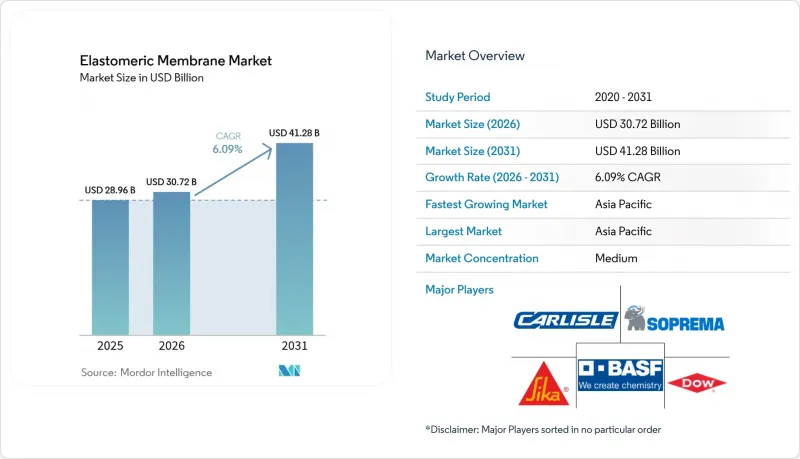
Mordor Intelligence에 의하면, 엘라스토머 멤브레인 시장 규모는 2025년 289억 6,000만 달러에서 2026년에는 307억 2,000만 달러로 확대되어 2026년부터 2031년까지 CAGR 6.09%로 성장을 지속하여, 2031년에는 412억 8,000만 달러에 이를 것으로 예측됩니다.
본 보고서는 유형(폴리우레탄, 아크릴, 실리콘, 기타), 최종 사용자 산업(주거용, 비주거용), 용도(지붕, 벽, 습기가 많은 장소, 기타 용도) 및 지역(아시아태평양, 북미, 유럽, 남미, 중동 및 아프리카)별로 분류되어 있습니다. 시장 예측은 금액(달러)으로 표시되어 있습니다.
세계 엘라스토머 멤브레인 시장 동향 및 인사이트
인프라 개보수에서 내구성이 뛰어난 방수재에 대한 수요 급증
1980년대 및 1990년대에 설치된 막재의 교체가 진행됨에 따라, 인프라 개보수가 조달 계획의 중심을 차지하고 있습니다. Sika AG는 2024년 EMEA 지역에서 13.5%, 북미 및 남미에서 15.1%의 매출 성장을 기록했는데, 그 주된 요인은 콘크리트 구조물에 대한 고성능 코팅을 지정된 보수 공사에 기인합니다. 액상 도포형 엘라스토머 시스템은 불규칙한 바탕면 위에서도 전면적인 박리 작업 없이 매끄러운 차단막을 형성할 수 있어, 교량, 터널, 주차장 데크의 가동 중단 시간을 단축할 수 있다는 장점이 있습니다. 기후 변화의 심화로 인해 그 중요성은 더욱 커지고 있습니다. 방수 시트는 균열이 발생하지 않으면서 더 심한 동결-융해 및 폭풍우를 견뎌야 합니다. 결함이 발생하면 막대한 소송으로 이어질 가능성이 있기 때문에 사양 결정자들은 현장 실적 데이터로 뒷받침되는 20-30년 보증을 점점 더 요구하고 있습니다. 습한 기층에 대한 밀착성을 입증할 수 있는 공급업체는 표면을 항상 완전히 건조시킬 수 없는 신속한 보수 프로그램에서 우선적으로 선정되고 있습니다.
도시 및 상업시설 건설의 급속한 성장
아시아태평양의 건설 붐은 단순한 건설량 증가에 그치지 않고 기술적 고도화로 확대되고 있습니다. 스마트 시티 마스터 플랜에서는 방습성, 열 반사성, 경우에 따라서는 태양광 발전과의 호환성을 겸비한 방수 시트가 요구되고 있습니다. 고층 빌딩 개발업자들은 균열이 발생하지 않으면서 구조물의 흔들림에 대응할 수 있는 엘라스토머 멤브레인를 지정하고 있는데, 이는 기존의 아스팔트계 시트로는 거의 충족할 수 없는 성능 요건입니다. 여러 주에서 동시에 프로젝트를 진행하는 시공업체는 재교육 부담을 최소화하기 위해 표준화된 시공 절차를 갖춘 시스템을 선호하며, 제조업체 인증 시공자 프로그램이 포함된 1액형 폴리우레탄이나 실리콘에 대한 선호도가 높아지고 있습니다. 이러한 수요의 확산은 아시아의 디자인 템플릿을 반영한 대규모 상업 복합 시설이 건설되고 있는 걸프협력회의(GCC) 국가들에서도 볼 수 있습니다.
비용 대비 효과가 높은 아스팔트계 대체재
적층 펠트나 아스팔트 고무 막은 엘라스토머 소재의 비용을 최대 50%까지 낮출 수 있어, 자금 조달에 어려움을 겪는 발주자에게는 매력적인 가격 차이를 제공합니다. 신흥 경제국에서는 인건비가 여전히 낮고, 작업자들이 이미 토치 시공 시스템에 대한 훈련을 받았기 때문에 시스템을 전환할 동기는 약해지고 있습니다. 그러나 에너지 성능 기준의 강화와 탄소세 인상으로 인해 이러한 가격 경쟁력은 서서히 사라지고 있습니다. 이는 아스팔트계 지붕이 쿨루프(Cool Roof) 기준을 충족하지 못하는 경우가 많기 때문입니다. 원자재 공급업체들은 반사성 광물 입자를 활용한 대책을 전개하고 있지만, 이러한 코팅은 자외선에 의해 열화가 가속화되기 때문에 수명 주기 비용에 대한 논의가 재점화되며, 간접적으로 엘라스토머계 재료의 채택을 뒷받침하고 있습니다.
부문 분석
2025년, 폴리우레탄은 엘라스토머 멤브레인 시장 점유율의 33.10%를 차지하며, 상업용 지붕 및 주차장 데크에서 주력 제품으로서의 입지를 확고히 했습니다. 구입 용이성, 균형 잡힌 인장 강도 및 내화학성 덕분에, 특히 노후된 아스팔트에 대한 밀착성이 중요한 보수 공사에서 판매량은 높은 수준을 유지하고 있습니다. 반면, 설계자들이 뛰어난 자외선 안정성과 -50°C에서 +200°C에 이르는 사용 온도 범위를 우선시함에 따라, 실리콘계 제품 시장은 연평균 성장률(CAGR) 6.44%로 급속히 확대되고 있습니다. 이는 사막이나 고산 지대의 기후에서 필수적인 특성입니다. 따라서 실리콘계 엘라스토머 필름 시장 규모는 10년 이상 태양 반사율을 유지하는 수명이 긴 쿨 루프에 대한 수요에 힘입어 폴리우레탄계를 빠르게 따라잡을 것으로 예측됩니다. 각 공급업체들은 시공을 간소화하고 습도가 높은 환경에서도 개방 시간을 연장하는 1액형 습기 경화형 화학 조성으로 차별화를 꾀하고 있습니다.
또한, 바이오 유래 성분이나 하이브리드 화학 조성에서도 혁신이 나타나고 있습니다. ISCC PLUS 기준에 따라 바이오 잔여물을 이용하여 제조된 다우(Dow)사의 ‘NORDEL REN EPDM’ 시리즈는 기계적 성능을 유지하면서도 엘라스토머 멤브레인 업계가 넷 제로 목표를 향해 나아가고 있음을 보여주는 좋은 사례입니다. 아크릴계 분산액은 악취 규제로 인해 용제계를 사용할 수 없는 주택 도장 공사 분야에서 틈새 수요를 확보하고 있지만, 성장률이 낮아 구조용도로의 적용에는 한계가 있습니다. 전반적으로 경쟁의 초점은 단순한 인장 강도에서 가속 내후성 시험 프로토콜에 기반한 검증된 내구 연한 데이터로 이동하고 있으며, 이에 따라 투명성이 높은 제3자 기관에 의한 시험 및 더 장기적인 보증 제공이 촉진되고 있습니다.
지역별 분석
아시아태평양은 2025년에 전 세계 지출의 35.40%를 차지하며, 2031년까지 연평균 성장률(CAGR) 6.30%로 확대되고 있어, 이 지역은 엘라스토머 멤브레인 시장의 주요 성장 동력이 되고 있습니다. 인도의 ‘스마트 시티 미션’에서 호주의 ‘레질리언트 빌딩 패키지’에 이르기까지, 각국의 정책에 따라 공공 공사 입찰에 방수 및 열섬 현상 완화에 관한 기준이 포함됨에 따라 고성능 방수 시트가 표준화되고 있습니다. 현지 제조업체들은 유럽의 배합 기술 라이선스를 확보하는 한편, 열대 및 몬순 기후에 맞춘 저비용 버전을 개발함으로써 기술력을 급속히 높이고 있습니다. 싱가포르의 그린 루프 의무화로 인해 뿌리 침투 방지제가 첨가된 쿨 루프용 막재 수요가 증가하고 있으며, 이 틈새 시장에서 아시아태평양 기업들은 현재 그 노하우를 전 세계로 수출하고 있습니다.
북미는 리모델링 및 건축 기준에 따른 개보수에 중점을 둔 프리미엄 시장으로 남아 있습니다. 업계 재편을 통해 공급 구조가 재구축되고 있습니다. 칼라일 컴퍼니는 2024년부터 2025년까지 20억 달러 이상을 투자하여 헨리 컴퍼니,MTL 홀딩스, 플라스티 팹을 인수했습니다. 이를 통해 방수 시트와 단열재, 실란트를 연계하여 종합적인 외피 패키지를 제공할 수 있게 되었습니다. ASHRAE 90.1과 같은 에너지 기준은 쿨 루프(Cool Roof)의 도입을 촉진하고 있으며, 보험사들도 높은 내충격성 평가를 평가 기준으로 삼고 있습니다. 이러한 특징 덕분에 저렴한 개질 아스팔트와의 경쟁에도 불구하고 엘라스토머계 제품의 채택이 유지되고 있습니다.
유럽의 성숙한 건설 업계는 지속가능성 분야의 혁신을 주도하고 있습니다. 건축가들은 50년 이상 지속되고 완전히 재활용 가능하다고 알려진 EPDM 시스템을 지정하고 있으며, 이는 순환 경제 규정에 부합하는 것입니다. EU 그린 딜에 기반한 넷 제로 지침에 따라 반사율 및 VOC(휘발성 유기 화합물) 제한이 더욱 엄격해졌습니다. 성장률은 아시아태평양(APAC)에 미치지 못하지만, 1제곱미터당 가치는 세계 최고 수준입니다. 한편, 중동 및 아프리카에서는 메가 프로젝트와 기후 변화에 강한 인프라에 대한 투자가 활발히 이루어지고 있습니다. UAE와 사우디아라비아는 LEED 및 에스티다마 인증 획득을 목표로 하는 의사결정권자들의 지원을 받아, 이 지역의 실란트 및 방수 시트 소비량의 절반 이상을 차지하고 있습니다. 고온 기후에서의 성능과 모래로 인한 마모에 대한 내성이 중요한 판매 포인트로 작용하고 있습니다.
기타 혜택:
- 엑셀 형식 시장 예측(ME) 시트
- 3개월간의 애널리스트 지원
자주 묻는 질문
목차
제1장 서론
제2장 조사 방법
제3장 주요 요약
제4장 시장 구도
제5장 시장 규모와 성장 예측
제6장 경쟁 구도
제7장 시장 기회와 향후 전망
JHS 26.08.26According to Mordor Intelligence, the elastomeric membrane market size is expected to grow from USD 28.96 billion in 2025 to USD 30.72 billion in 2026 and is forecast to reach USD 41.28 billion by 2031 at 6.09% CAGR over 2026-2031.
This report is Segmented by Type (Polyurethane, Acrylic, Silicone, Other Types), End-User Industry (Residential, Non-Residential), Application (Roofs, Walls, Wet Areas, Other Applications), and Geography (Asia-Pacific, North America, Europe, South America, Middle East and Africa). The Market Forecasts are Provided in Terms of Value (USD).
Global Elastomeric Membrane Market Trends and Insights
Surging Demand for Durable Waterproofing in Infrastructure Rehabilitation
Infrastructure rehabilitation dominates procurement agendas as owners replace membranes installed in the 1980s and 1990s. Sika AG recorded 13.5% sales growth in EMEA and 15.1% in the Americas during 2024, largely from rehabilitation work that specified high-performance coatings over concrete structures. Liquid-applied elastomeric systems benefit because they form seamless barriers across irregular substrates without full tear-off, reducing downtime on bridges, tunnels, and parking decks. Climate volatility further raises the stakes: membranes must tolerate more intense freeze-thaw and storm events without splitting. Because failures can trigger costly litigation, specifiers increasingly demand 20- to 30-year warranty cover backed by field performance data. Suppliers that can certify adhesion to damp substrates earn preference in fast-track repair programs where surfaces cannot always be fully dried.
Rapid Urban & Commercial Construction Growth
Asia-Pacific's building boom is stretching beyond sheer volume into technical sophistication. Smart-city master plans require membranes that integrate moisture protection, heat reflectivity, and, in some cases, photovoltaic compatibility. High-rise developers specify elastomeric membranes able to accommodate structural sway without cracking, a performance envelope that traditional bituminous sheets rarely meet. Contractors running concurrent projects across multiple provinces favor systems with standardized application protocols to minimize retraining, boosting preference for single-component polyurethanes and silicones supplied with manufacturer-certified installer programs. Spill-over demand is visible in Gulf Cooperation Council countries where large commercial complexes mirror Asian design templates.
Cost-Effective Bituminous Alternatives
Built-up felt and asphaltic rubber membranes can undercut elastomeric material costs by up to 50%, a gap persuasive to cash-constrained owners. In emerging economies, labor remains inexpensive, and crews are already trained on torch-applied systems, reducing switching incentives. However, rising energy-performance penalties and carbon taxes are eroding this price advantage because bituminous roofs often fail cool-roof criteria. Commodity suppliers respond with reflective mineral granules, but these coatings degrade faster under UV, reopening lifecycle-cost debates and indirectly supporting elastomerics.
Other drivers and restraints analyzed in the detailed report include:
- Stringent Energy-Efficiency & Green-Building Codes
- Adoption of Liquid-Applied Membranes in Modular Off-Site Builds
- Installation-Skill Shortages Delaying Projects
For complete list of drivers and restraints, kindly check the Table Of Contents.
Segment Analysis
Polyurethane held 33.10% of the elastomeric membrane market share in 2025, confirming its status as the workhorse for commercial roofs and parking decks. Widespread availability, balanced tensile strength, and chemical resistance keep volume high, especially in refurbishment where adhesion to aged bitumen is critical. Yet silicone grades are accelerating at a 6.44% CAGR as designers prioritize superior UV stability and service temperatures from -50 °C to +200 °C, qualities essential in desert or alpine climates. The elastomeric membrane market size for silicone is therefore projected to close rapidly on polyurethane, buoyed by demand for long-life cool roofs that retain solar reflectance beyond ten years. Suppliers differentiate through one-part moisture-cure chemistries that simplify application and extend open-time in humid conditions.
Innovation also surfaces in bio-content and hybrid chemistries. Dow's NORDEL REN EPDM line, manufactured with bio-residues under ISCC PLUS, exemplifies how the elastomeric membrane industry is aligning with net-zero targets while preserving mechanical performance. Acrylic dispersions gain niche traction in residential repaint programs where odor restrictions rule out solvent systems, though their lower elongation limits structural applications. Overall, competition is shifting from raw tensile strength to demonstrated service-life data under accelerated-weathering protocols, encouraging transparent third-party testing and longer warranty offers.
Complete Report Scope:
- By Type
- Polyurethane
- Acrylic
- Silicone
- Other Types
- By End-user Industry
- Residential
- Non-Residential
- Commercial
- Industrial
- Infrastructure
- By Application
- Roofs
- Walls
- Wet Areas
- Other Applications
- By Geography
- Asia-Pacific
- China
- India
- Japan
- South Korea
- Australia and New Zealand
- ASEAN
- Rest of Asia-Pacific
- North America
- United States
- Canada
- Mexico
- Europe
- Germany
- United Kingdom
- France
- Italy
- Spain
- Russia
- Rest of Europe
- South America
- Brazil
- Argentina
- Rest of South America
- Middle East and Africa
- Saudi Arabia
- United Arab Emirates
- Qatar
- South Africa
- Rest of Middle East and Africa
- Asia-Pacific
Geography Analysis
Asia-Pacific maintained 35.40% of global spending in 2025 and is advancing at 6.30% CAGR to 2031, making the region the primary engine of the elastomeric membrane market. National programs-from India's Smart Cities Mission to Australia's Resilient Buildings Package-embed waterproofing and heat-island mitigation criteria in public-works tenders, thereby standardizing high-performance membranes. Local producers rapidly climb the technology ladder, licensing European formulations while engineering cost-down versions tailored to tropical or monsoon climates. Singapore's green-roof mandates encourage cool roof membranes with root-inhibitor additives, a niche where APAC firms now export know-how globally.
North America remains a premium market focused on refurbishment and code-driven upgrades. Consolidation is reshaping supply: Carlisle Companies invested more than USD 2 billion between 2024 and 2025 to add Henry Company, MTL Holdings, and Plasti-Fab, linking membranes with insulation and sealants to deliver complete envelope packages. Energy codes such as ASHRAE 90.1 push cool-roof adoption, while insurance providers reward high-impact-resistance ratings; these features sustain elastomeric adoption despite competition from cheaper modified bitumen.
Europe's mature construction scene drives innovation in sustainability. Architects specify EPDM systems advertised to last 50+ years and be fully recyclable, aligning with circular-economy regulations. Net-zero directives under the EU Green Deal are ratcheting up reflectivity and VOC limits. Growth rates lag APAC but value per square metre is highest worldwide. Meanwhile, the Middle East and Africa leverage investment in mega-projects and climate-resilient infrastructure. The UAE and Saudi Arabia together consume over half of regional sealants and membranes, stimulated by decision-makers seeking LEED or Estidama certification. Hot-climate performance and sand-abrasion resistance become critical selling points.
- Barrett Company
- BASF SE
- Carlisle Companies Inc.
- Covestro AG
- Dow
- Fosroc Inc.
- GAF Materials LLC
- Hempel A/S
- Holcim
- IKO Group
- Johns Manville
- KEMPER SYSTEM AMERICA Inc.
- Lapolla Industries, Inc.
- Malarkey Roofing
- POLYGLASS S.p.A
- Saint-Gobain
- Sika AG
- Soprema Group
- Triton Inc
- Uniflex
Additional Benefits:
- The market estimate (ME) sheet in Excel format
- 3 months of analyst support
TABLE OF CONTENTS
1 Introduction
- 1.1 Study Assumptions and Market Definition
- 1.2 Scope of the Study
2 Research Methodology
3 Executive Summary
4 Market Landscape
- 4.1 Market Overview
- 4.2 Market Drivers
- 4.2.1 Surging demand for durable waterproofing in infrastructure rehabilitation
- 4.2.2 Rapid urban and commercial construction growth
- 4.2.3 Stringent energy-efficiency and green-building codes
- 4.2.4 Aging roof stock driving refurbishment activities
- 4.2.5 Adoption of liquid-applied membranes in modular off-site builds
- 4.3 Market Restraints
- 4.3.1 Cost-effective bituminous alternatives
- 4.3.2 Installation-skill shortages delaying projects
- 4.3.3 Fire-performance regulatory scrutiny on some polymers
- 4.4 Value Chain Analysis
- 4.5 Porter's Five Forces Analysis
- 4.5.1 Bargaining Power of Suppliers
- 4.5.2 Bargaining Power of Buyers
- 4.5.3 Threat of New Entrants
- 4.5.4 Threat of Substitutes
- 4.5.5 Degree of Competition
5 Market Size and Growth Forecasts (Value)
- 5.1 By Type
- 5.1.1 Polyurethane
- 5.1.2 Acrylic
- 5.1.3 Silicone
- 5.1.4 Other Types
- 5.2 By End-user Industry
- 5.2.1 Residential
- 5.2.2 Non-Residential
- 5.2.2.1 Commercial
- 5.2.2.2 Industrial
- 5.2.2.3 Infrastructure
- 5.3 By Application
- 5.3.1 Roofs
- 5.3.2 Walls
- 5.3.3 Wet Areas
- 5.3.4 Other Applications
- 5.4 By Geography
- 5.4.1 Asia-Pacific
- 5.4.1.1 China
- 5.4.1.2 India
- 5.4.1.3 Japan
- 5.4.1.4 South Korea
- 5.4.1.5 Australia and New Zealand
- 5.4.1.6 ASEAN
- 5.4.1.7 Rest of Asia-Pacific
- 5.4.2 North America
- 5.4.2.1 United States
- 5.4.2.2 Canada
- 5.4.2.3 Mexico
- 5.4.3 Europe
- 5.4.3.1 Germany
- 5.4.3.2 United Kingdom
- 5.4.3.3 France
- 5.4.3.4 Italy
- 5.4.3.5 Spain
- 5.4.3.6 Russia
- 5.4.3.7 Rest of Europe
- 5.4.4 South America
- 5.4.4.1 Brazil
- 5.4.4.2 Argentina
- 5.4.4.3 Rest of South America
- 5.4.5 Middle East and Africa
- 5.4.5.1 Saudi Arabia
- 5.4.5.2 United Arab Emirates
- 5.4.5.3 Qatar
- 5.4.5.4 South Africa
- 5.4.5.5 Rest of Middle East and Africa
- 5.4.1 Asia-Pacific
6 Competitive Landscape
- 6.1 Market Concentration
- 6.2 Strategic Moves
- 6.3 Market Share(%)/Ranking Analysis
- 6.4 Company Profiles (includes Global level Overview, Market level overview, Core Segments, Financials as available, Strategic Information, Market Rank/Share for key companies, Products and Services, and Recent Developments)
- 6.4.1 Barrett Company
- 6.4.2 BASF SE
- 6.4.3 Carlisle Companies Inc.
- 6.4.4 Covestro AG
- 6.4.5 Dow
- 6.4.6 Fosroc Inc.
- 6.4.7 GAF Materials LLC
- 6.4.8 Hempel A/S
- 6.4.9 Holcim
- 6.4.10 IKO Group
- 6.4.11 Johns Manville
- 6.4.12 KEMPER SYSTEM AMERICA Inc.
- 6.4.13 Lapolla Industries, Inc.
- 6.4.14 Malarkey Roofing
- 6.4.15 POLYGLASS S.p.A
- 6.4.16 Saint-Gobain
- 6.4.17 Sika AG
- 6.4.18 Soprema Group
- 6.4.19 Triton Inc
- 6.4.20 Uniflex
7 Market Opportunities and Future Outlook
- 7.1 White-space and Unmet-need Assessment


