

|
시장보고서
상품코드
2115004
알파 올레핀 시장 : 점유율 분석, 업계 동향과 통계, 성장 예측(2026-2031년)Alpha Olefins - Market Share Analysis, Industry Trends & Statistics, Growth Forecasts (2026 - 2031) |
||||||
 Mordor Intelligence
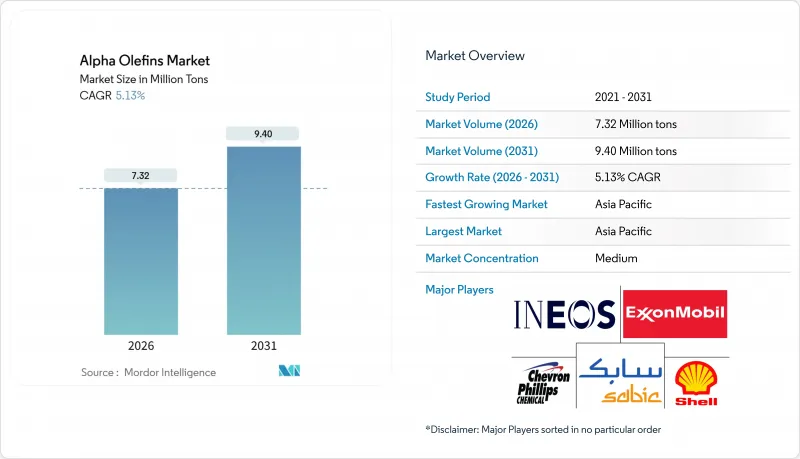
Mordor Intelligence에 의하면, 알파 올레핀 시장 규모는 2026년에 732만 톤으로 추정되고 있어 예측 기간(2026-2031년)에서 CAGR 5.13%로 확대되어 2031년에는 940만 톤에 이른다고 전망되고 있습니다.
본 보고서는 유형(C4(1-부텐), C6(1-헥센) 등), 제조 공정(에틸렌 올리고머화, 피셔-트로프스 공정, 바이오 유래 알코올의 탈수), 용도(폴리올레핀 공중합체, 윤활제, 기타),최종 이용 산업(포장, 자동차, 석유 및 가스, 기타), 지역(아시아태평양, 북미, 유럽, 남미, 중동 및 아프리카)별로 분류되어 있습니다.
세계 알파 올레핀 시장 동향 및 인사이트
폴리에틸렌 코모노머 수요 급증
메탈로센계 LLDPE 등급의 경우, 보다 엄격한 분자량 제어가 요구되므로 고순도의 1-헥센 및 1-옥텐 공중합체의 소비량이 증가하고 있습니다. Chevron Phillips Chemical은 시더 바이유(Cedar Bayou)의 크래커를 연간 150만 톤의 에틸렌 생산 능력으로 확장하고, 에틸렌에서 C6/C8로의 스프레드를 수익화하기 위해 해당 지역에 알파 올레핀 생산 라인을 병설했습니다. 쉘의 모나카 콤플렉스도 유사한 통합 모델을 채택하여, 160만 톤의 폴리에틸렌 수요에 대응할 수 있는 코모노머의 자체 공급을 확보하고 있습니다. 전자상거래 물류로 인해 스트레치 필름 수요가 가속화되고 있으며, 브랜드 소유주들은 메탈로센 LLDPE만이 제공할 수 있는 얇으면서도 내천자성이 뛰어난 필름을 선호하고 있습니다. 이러한 하류 부문 수요로 인해 코모노머 수요는 소폭의 가격 급등에도 탄력성을 잃고 있습니다. 아시아의 새로운 LLDPE 반응 장치가 지글러-나타 촉매에서 메탈로센 촉매로 전환됨에 따라, 알파 올레핀 시장의 거래량은 구조적인 상승세를 보이고 있습니다.
합성 윤활유의 성장
폴리아알파 올레핀(PAO) 베이스스톡은 점도 지수 130 이상, 유동점 -50°C 이하를 실현하여 API SP 및 ILSAC GF-6 규격을 충족하는 차세대 엔진 오일 생산을 가능하게 하고 있습니다. 셰브론 Philips 케미컬(Chevron Phillips Chemical)은 2025년 11월, 벨기에 베링겐에서 PAO 생산 설비 확장 공사에 착수했습니다. 이는 오일 교환 주기 연장 및 하이브리드 파워트레인 도입을 목표로 하는 유럽 자동차 제조업체에 공급하기 위한 것입니다. 전기차(EV)는 PAO 수요를 더욱 확대시키고 있습니다. 이는 배터리 셀을 직접 냉각하기 위해서는 150°C 이상에서도 안정적이며 높은 절연 내력을 가진 유체가 필요하기 때문입니다. 산업용 기어박스나 압축기도 마찬가지로, 수명 연장과 가동 중단 시간 감소를 목적으로 PAO로의 전환이 진행되고 있습니다. 규모의 경제에 따라 PAO와 광물유 간의 비용 차이는 줄어들고 있으며, 중급 등급 윤활유 배합에서의 대체가 가속화되고 있습니다.
에틸렌 원료 가격 변동
2024년부터 2025년까지 브렌트 원유 가격은 배럴당 70-90달러 사이에서 변동하며, 나프타 크래커의 마진을 압박하는 동시에 올리고머화 사업의 수익성을 저해했습니다. 아시아의 에틸렌 현물 가격은 톤당 800-1,100달러 사이에서 변동하여, 코모노머 공급업체들은 선물 계약을 통해 헤지할 수밖에 없게 되었고, 그 결과 수익성이 약화되고 있습니다. 유럽의 생산자들은 EU 배출권 거래 제도(EU ETS)에 따라 톤당 50-70유로의 추가적인 탄소 비용이라는 역풍에 직면해 있습니다. 그 결과, 시판 에틸렌에 의존하는 독립형 LAO 플랜트는 생산 능력 확대를 미루고 있는 반면, 걸프 코스트의 통합형 복합 시설은 높은 가동률로 가동되고 있습니다.
부문별 분석
C4(1-부텐)은 비용 경쟁력과 기존의 지글러-나타 공법을 통한 LLDPE 용도로 인해 2025년 생산량의 35.23%를 차지했습니다. 한편, C6(1-헥센)은 연평균 성장률(CAGR) 5.88%를 기록하며 알파 올레핀 시장 규모 확대를 고부가가치 제품군으로 이끌었습니다. 다우(Dow)사의 ‘AFFINITY’ 플라스토머는 엘라스토머 필름에 C8(1-옥텐)을 활용하고 있으며, C4계 수지에 비해 15-20%의 프리미엄 가격을 실현하고 있습니다.
메탈로센 촉매의 경우, 분자량 분포를 좁히고 먼지 충격 및 응력 균열 저항성을 향상시키기 위해 1-헥센 또는 1-옥텐이 필요합니다. 탄소 수가 더 많은 알파 올레핀(C10-C20+)은 합성 윤활유나 가소제용 알코올로 이용되며, 생산량이 C4-C8에 집중되어 있음에도 불구하고 이익률의 다양성을 유지하고 있습니다. 피셔-트로프스 공법에서 유래한 알파 올레핀은 멀티컷 제품군을 목표로 하고 있지만, 자본 집약도가 높기 때문에 생산량에서 차지하는 비율은 10% 미만에 그치고 있습니다.
에틸렌 올리고머화는 2025년 생산량의 80.12%를 차지하고, 1-헥센의 촉매 선택성이 95%를 초과하는 것을 배경으로 연평균 성장률(CAGR) 5.67%로 확대될 것으로 전망됩니다. 셰브론 Philips와 INEOS는 자사 생산 에틸렌을 활용하여 원자재 가격 변동에 대한 이익률 보호를 실현하고 있습니다. 피셔-트로프스 공법에 의한 합성은 카타르의 미활용 가스와 남아프리카의 석탄을 효과적으로 활용하고 있지만, 여전히 소규모에 그치고 있습니다. 유럽의 바이오알코올 탈수 파일럿 플랜트는 촉매 수명이 개선될 때까지 연간 생산량이 1만 톤 미만에 머물 것으로 전망됩니다.
통합에 따른 경제성은 올리고머화에 유리하게 작용합니다. 에틸렌 크래커는 스프레드에 따라 LAO, 폴리에틸렌, 에틸렌 유도체 간에 생산을 전환할 수 있으므로, 사이클에 관계없이 알파 올레핀 산업의 경쟁력을 유지할 수 있기 때문입니다.
지역별 분석
아시아태평양은 2025년 수요의 40.45%를 차지하고, 중국의 100억 달러 규모 ‘시노펙-아람코 푸젠 콤플렉스’와 인도의 석유화학제품 소비량이 연평균 7% 증가하고 있는 것을 배경으로 연평균 성장률(CAGR) 6.89%를 나타낼 것으로 예측됩니다. 현지 알파 올레핀 생산 능력이 수요를 따라가지 못하고 있어 중동으로부터의 지역 내 수입은 여전히 견조하지만, 중국과 사우디아라비아에서 가동 예정인 새로운 생산 능력으로 인해 공급망은 동쪽으로 재편되고 있습니다. 일본과 한국은 특수 LLDPE용 고순도 C6/C8을 수입하고 있는 반면, 아세안(ASEAN)의 폴리올레핀 수요는 연평균 6% 이상 확대되며 알파 올레핀 시장 증가분을 흡수하고 있습니다.
북미에서는 셰일 에탄의 가격 경쟁력을 활용하여 에틸렌의 현금 비용을 유럽의 나프타 상당 비용보다 50% 가까이 낮게 유지하고 있습니다. 총 919만 톤의 에틸렌 생산 능력을 갖춘 걸프 코스트의 14개 크래커가 이 지역에 위치한 LAO(선형 알파-올레핀) 플랜트를 뒷받침하며, 이 지역이 순수출국으로서의 역할을 강화하고 있습니다. 캐나다와 멕시코공급 부족으로 인해 국경을 넘는 물류가 확보되면서, 북미 대륙의 원료 측면에서의 우위가 하류 부문의 경쟁력으로 이어지고 있습니다.
유럽은 나프타 비용의 급등, EU 배출권 거래 제도(EU ETS)에 따른 탄소 가격, 그리고 SABIC의 헤렌 올레핀 3 및 티즈사이드 크래커 폐쇄 등으로 인한 50만 톤의 에틸렌 생산 능력 감축과 같은 구조적인 역풍에 직면해 있습니다. 대조적으로, 중동에서는 야슬레프가 계획 중인 연간 180만 톤 규모의 크래커 등 에탄을 원료로 하는 확장 사업이 가속화되어 아시아 수요를 보완하고 있습니다. 남미의 경우, 브라질의 브라스크렘이 여전히 핵심 역할을 담당하고 있지만, 거시경제의 변동과 업스트림 부문에 대한 투자 한계가 성장 가능성을 억제하고 있습니다.
기타 혜택:
- 엑셀 형식 시장 예측(ME) 시트
- 3개월간의 애널리스트 지원
자주 묻는 질문
목차
제1장 서론
제2장 조사 방법
제3장 주요 요약
제4장 시장 구도
제5장 시장 규모와 성장 예측
제6장 경쟁 구도
제7장 시장 기회와 향후 전망
JHS 26.08.26According to Mordor Intelligence, the alpha olefins market size is estimated at 7.32 Million tons in 2026, and is expected to reach 9.40 Million tons by 2031, at a CAGR of 5.13% during the forecast period (2026-2031).
This report is Segmented by Type (C4 (1-Butene), C6 (1-Hexene), and More), Production Process (Ethylene Oligomerization, Fischer-Tropsch Synthesis, and Bio-Based Alcohol Dehydration), Application (Polyolefin Comonomers, Lubricants, and More), End-Use Industry (Packaging, Automotive, Oil and Gas, and More), and Geography (Asia-Pacific, North America, Europe, South America, and Middle-East and Africa).
Global Alpha Olefins Market Trends and Insights
Surging Polyethylene Comonomer Demand
Metallocene LLDPE grades require tighter molecular-weight control, elevating consumption of high-purity 1-hexene and 1-octene comonomers. Chevron Phillips Chemical expanded its Cedar Bayou cracker to 1.5 million tons-per-year ethylene capacity and co-located alpha-olefin trains to monetize the ethylene-to-C6/C8 spread. Shell's Monaca complex follows a similar integration model, ensuring captive comonomer supply for 1.6 million tons of polyethylene demand. E-commerce logistics accelerate stretch-film uptake, and brand owners prefer downgauged yet puncture-resistant films that only metallocene LLDPE can deliver. This downstream pull renders comonomer demand inelastic to modest price spikes. As new Asian LLDPE reactors switch from Ziegler-Natta to metallocene catalysts, alpha olefins market volumes receive a structural uplift.
Growth in Synthetic Lubricants
Poly-alpha-olefin base stocks achieve viscosity indices above 130 and pour points below -50 °C, enabling next-generation engine oils that satisfy API SP and ILSAC GF-6 specifications. Chevron Phillips Chemical broke ground in November 2025 on a PAO expansion in Beringen, Belgium, to service European automakers pursuing longer drain intervals and hybrid powertrains. EVs further amplify PAO demand, as direct battery-cell cooling requires fluids stable above 150 °C with high dielectric strength. Industrial gearboxes and compressors similarly upgrade to PAO to extend service life and reduce downtime. Economies of scale are narrowing the PAO-to-mineral-oil cost delta, hastening substitution in mid-tier lubricant formulations.
Ethylene Feedstock Price Volatility
Brent crude oscillated between USD 70 and USD 90 per barrel during 2024-2025, compressing naphtha cracker margins and disrupting oligomerization economics. Asian ethylene spot prices fluctuated USD 800-1,100 per ton, forcing comonomer suppliers to hedge through futures contracts that dilute profitability. European producers face an additional EUR 50-70 per ton carbon-cost headwind under the EU ETS. Consequently, standalone LAO units reliant on merchant ethylene are deferring capacity expansions, while integrated Gulf Coast complexes run at elevated rates.
Other drivers and restraints analyzed in the detailed report include:
- Shale-Ethane Cost Advantage in North America
- Capacity Additions in Emerging Economies
- Non-Biodegradability of Polyethylene
For complete list of drivers and restraints, kindly check the Table Of Contents.
Segment Analysis
C4 (1-Butene) captured 35.23% of 2025 volume on cost advantage and legacy Ziegler-Natta LLDPE use. Conversely, C6 (1-Hexene) grew at a 5.88% CAGR, steering alpha olefins market size expansion toward higher-value streams. Dow's AFFINITY plastomers leverage C8 (1-octene) for elastomeric films, commanding premiums of 15-20% over C4-based resins.
Metallocene catalysts require 1-hexene or 1-octene for narrow molecular-weight distributions, improving dart impact and stress-crack resistance. Higher carbon-number alpha olefins (C10-C20+) serve synthetic lubricants and plasticizer alcohols, sustaining margin diversity even as volume concentrates in C4-C8. Fischer-Tropsch-derived alpha olefins target multi-cut portfolios but remain below 10% of output due to capital intensity.
Ethylene oligomerization delivered 80.12% of 2025 production and is projected to expand at 5.67% CAGR, underpinned by catalyst selectivity surpassing 95% for 1-hexene. Chevron Phillips and INEOS capitalize on captive ethylene, achieving margin insulation against feedstock volatility. Fischer-Tropsch synthesis monetizes stranded gas in Qatar and coal in South Africa, yet remains subscale. Bio-alcohol dehydration pilot plants in Europe stay below 10,000 tons-per-year until catalyst lifetimes improve.
Integration economics favor oligomerization, as ethylene crackers can swing between LAO, polyethylene, and ethylene derivatives depending on spreads, preserving alpha olefins industry competitiveness across cycles.
Complete Report Scope:
- By Type
- C4 (1-Butene)
- C6 (1-Hexene)
- C8 (1-Octene)
- Other Types
- By Production Process
- Ethylene Oligomerization
- Fischer-Tropsch Synthesis
- Bio-based Alcohol Dehydration
- By Application
- Polyolefin Comonomers
- Lubricants
- Oil Field Chemicals
- Plasticizers
- Surfactants
- Other Applications
- By End-use Industry
- Packaging
- Automotive
- Oil and Gas
- Cosmetics and Personal Care
- Other End-user Industries
- By Geography
- Asia-Pacific
- China
- India
- Japan
- South Korea
- ASEAN Countries
- Rest of Asia-Pacific
- North America
- United States
- Canada
- Mexico
- Europe
- Germany
- United Kingdom
- Italy
- France
- NORDIC Countries
- Rest of Europe
- South America
- Brazil
- Argentina
- Rest of South America
- Middle-East and Africa
- Saudi Arabia
- South Africa
- Rest of Middle-East and Africa
- Asia-Pacific
Geography Analysis
Asia-Pacific controlled 40.45% of 2025 demand and is set to grow at a 6.89% CAGR, driven by China's USD 10 billion Sinopec-Aramco Fujian complex and India's 7% annual petrochemical consumption uptick. With local alpha olefin capacity trailing demand, regional imports from the Middle-East remain robust, yet upcoming Chinese and Saudi capacities reposition supply chains eastward. Japan and South Korea import high-purity C6/C8 for specialty LLDPE, whereas ASEAN polyolefin demand expands above 6% annually, absorbing incremental alpha olefins market volumes.
North America leverages shale-ethane pricing, enabling ethylene cash costs nearly 50% lower than European naphtha equivalents. Fourteen Gulf Coast crackers totaling 9.19 million tons of ethylene will support co-located LAO units, reinforcing the region's role as a net exporter. Canadian and Mexican deficits ensure cross-border flows, consolidating the continent's feedstock advantage into downstream competitiveness.
Europe faces structural headwinds: high naphtha costs, EU ETS carbon pricing, and plant closures such as SABIC's Geleen Olefins 3 and Teesside crackers removing 500,000 tons of ethylene capacity. The Middle-East, conversely, accelerates ethane-fed expansions like Yasref's planned 1.8 million tons-per-year cracker, bridging Asian demand. South America remains anchored by Braskem in Brazil, but macroeconomic volatility and limited upstream investment restrain growth potential.
- Braskem
- Chevron Phillips Chemical Company LLC
- China Petrochemical Corporation (Sinopec)
- CNOOC & Shell Petrochemicals Company Limited
- Dow
- Evonik Industries AG
- Exxon Mobil Corporation
- Idemitsu Kosan Co., Ltd.
- INEOS
- LG Chem
- Mitsui Chemicals, Inc.
- National Petrochemical Co. (Iran)
- PetroChina Company Limited
- Qatar Chemical Company Ltd
- SABIC
- Sasol Limited
- Shell plc
Additional Benefits:
- The market estimate (ME) sheet in Excel format
- 3 months of analyst support
TABLE OF CONTENTS
1 Introduction
- 1.1 Study Assumptions and Market Definition
- 1.2 Scope of the Study
2 Research Methodology
3 Executive Summary
4 Market Landscape
- 4.1 Market Overview
- 4.2 Market Drivers
- 4.2.1 Surging Polyethylene Comonomer Demand
- 4.2.2 Growth in Synthetic Lubricants
- 4.2.3 Shale-Ethane Cost Advantage in North America
- 4.2.4 Capacity Additions in Emerging Economies
- 4.2.5 EV Thermal Management Fluid Requirements
- 4.3 Market Restraints
- 4.3.1 Ethylene Feedstock Price Volatility
- 4.3.2 Non-Biodegradability of Polyethylene
- 4.3.3 Catalyst Deactivation in Bio-Based LAO Synthesis
- 4.4 Value Chain Analysis
- 4.5 Porter's Five Forces
- 4.5.1 Bargaining Power of Suppliers
- 4.5.2 Bargaining Power of Buyers
- 4.5.3 Threat of New Entrants
- 4.5.4 Threat of Substitutes
- 4.5.5 Degree of Competition
5 Market Size and Growth Forecasts (Volume)
- 5.1 By Type
- 5.1.1 C4 (1-Butene)
- 5.1.2 C6 (1-Hexene)
- 5.1.3 C8 (1-Octene)
- 5.1.4 Other Types
- 5.2 By Production Process
- 5.2.1 Ethylene Oligomerization
- 5.2.2 Fischer-Tropsch Synthesis
- 5.2.3 Bio-based Alcohol Dehydration
- 5.3 By Application
- 5.3.1 Polyolefin Comonomers
- 5.3.2 Lubricants
- 5.3.3 Oil Field Chemicals
- 5.3.4 Plasticizers
- 5.3.5 Surfactants
- 5.3.6 Other Applications
- 5.4 By End-use Industry
- 5.4.1 Packaging
- 5.4.2 Automotive
- 5.4.3 Oil and Gas
- 5.4.4 Cosmetics and Personal Care
- 5.4.5 Other End-user Industries
- 5.5 By Geography
- 5.5.1 Asia-Pacific
- 5.5.1.1 China
- 5.5.1.2 India
- 5.5.1.3 Japan
- 5.5.1.4 South Korea
- 5.5.1.5 ASEAN Countries
- 5.5.1.6 Rest of Asia-Pacific
- 5.5.2 North America
- 5.5.2.1 United States
- 5.5.2.2 Canada
- 5.5.2.3 Mexico
- 5.5.3 Europe
- 5.5.3.1 Germany
- 5.5.3.2 United Kingdom
- 5.5.3.3 Italy
- 5.5.3.4 France
- 5.5.3.5 NORDIC Countries
- 5.5.3.6 Rest of Europe
- 5.5.4 South America
- 5.5.4.1 Brazil
- 5.5.4.2 Argentina
- 5.5.4.3 Rest of South America
- 5.5.5 Middle-East and Africa
- 5.5.5.1 Saudi Arabia
- 5.5.5.2 South Africa
- 5.5.5.3 Rest of Middle-East and Africa
- 5.5.1 Asia-Pacific
6 Competitive Landscape
- 6.1 Market Concentration
- 6.2 Strategic Moves
- 6.3 Market Share (%)/Ranking Analysis
- 6.4 Company Profiles (includes Global-level Overview, Market-level Overview, Core Segments, Financials as available, Strategic Information, Products and Services, and Recent Developments)
- 6.4.1 Braskem
- 6.4.2 Chevron Phillips Chemical Company LLC
- 6.4.3 China Petrochemical Corporation (Sinopec)
- 6.4.4 CNOOC & Shell Petrochemicals Company Limited
- 6.4.5 Dow
- 6.4.6 Evonik Industries AG
- 6.4.7 Exxon Mobil Corporation
- 6.4.8 Idemitsu Kosan Co., Ltd.
- 6.4.9 INEOS
- 6.4.10 LG Chem
- 6.4.11 Mitsui Chemicals, Inc.
- 6.4.12 National Petrochemical Co. (Iran)
- 6.4.13 PetroChina Company Limited
- 6.4.14 Qatar Chemical Company Ltd
- 6.4.15 SABIC
- 6.4.16 Sasol Limited
- 6.4.17 Shell plc
7 Market Opportunities and Future Outlook
- 7.1 Development of Sustainable and Bio-based Alternatives
- 7.2 White-space and Unmet-need Assessment


