

|
시장보고서
상품코드
2115005
커플링제 시장 : 시장 점유율 분석, 업계 동향 및 통계, 성장 예측(2026-2031년)Coupling Agent - Market Share Analysis, Industry Trends & Statistics, Growth Forecasts (2026 - 2031) |
||||||
 Mordor Intelligence
Mordor Intelligence에 의하면, 커플링제 시장 규모는 2025년에 16억 8,000만 달러로 평가되었고, 2026년 17억 5,000만 달러에서 2031년까지 21억 8,000만 달러에 이를 것으로 예측되며, 예측 기간(2026-2031년) CAGR은 4.46%를 나타낼 전망입니다.
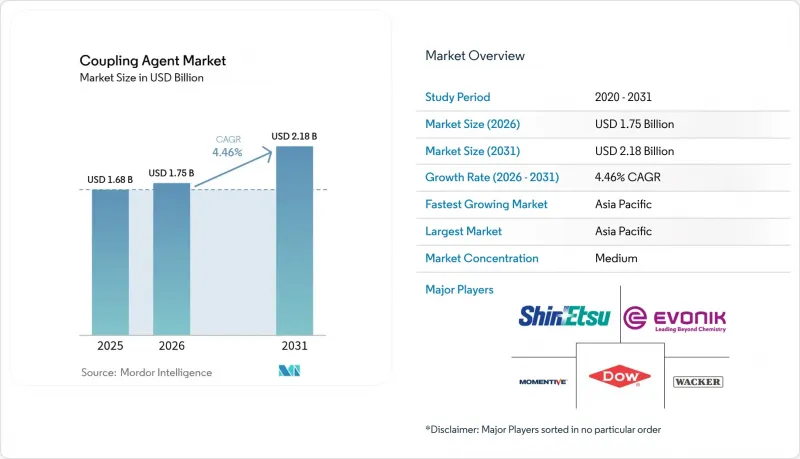
본 보고서는 기능군별(실란, 티타네이트, 지르코네이트, 기타 기능군), 용도별(고무 및 플라스틱, 접착제 및 실란트 등), 최종 사용자 산업별(자동차 및 운송, 건축 및 건설 등) 및 지역별(아시아태평양, 북미, 유럽, 남미, 중동 및 아프리카)로 분류되어 있습니다. 시장 예측은 금액(달러) 기준으로 제시되어 있습니다.
세계의 커플링제 시장 동향 및 인사이트
경량 플라스틱 및 복합재료의 채택
엄격한 차량 평균 CO₂ 배출량 상한선을 목표로 하는 자동차 OEM 업체들은 진동, 염수 분무, 온도 사이클을 견뎌야 하는 탄소섬유 강화 플라스틱, 알루미늄·폴리머 하이브리드 및 다중 재료 접합부에 점점 더 의존하고 있습니다. 미국 에너지부가 수립한 ‘2025년 가혹 환경용 소재 로드맵’에서는 실란계 앵커 프라이머를 포함한 기능성 표면 처리가 차세대 섀시 및 배터리 인클로저를 실현하기 위한 횡단적 기반 기술로 자리매김하고 있습니다. 직접 인클레이팅(Direct Inlaying) 공법을 사용하여 제조된 항공우주용 브래킷은 실란 개질 프리프레그를 도입한 결과, 인장 강성이 39% 향상되었습니다. 이는 3D 프린팅이 커플링제의 새로운 수요 창출로 이어질 것임을 보여줍니다.
건설용 실란트 및 접착제 수요 급증
인도, 인도네시아, 베트남의 급속한 도시화로 인해 유리용 실란트, 구조용 실리콘 접착제 및 파사드용 코팅제 수요가 증가하고 있습니다. 열대 기후의 사양에서는 수분 경화형 폴리우레탄 및 실릴 변성 폴리머(SMP) 기술이 주류를 이루고 있습니다. 이는 실란 말단을 가진 네트워크 구조가 수분에 의한 박리에 내성을 갖기 때문입니다. 헌츠맨(Huntsman)사가 2025년을 목표로 배터리 재료 및 건설용 접착제 화학 분야로 포트폴리오를 재편하고 있는 것은 통합형 제조업체들이 급성장하는 토목 인프라 분야의 비즈니스 기회를 어떻게 추구하고 있는지를 여실히 보여줍니다. 빌딩 정보 모델링(BIM) 워크플로우의 도입 확대에 따라, 기계적 결합과 내장형 센서를 결합한 스마트 접착제 시스템이 등장하고 있습니다. 이러한 기능성은 맞춤형 커플링제의 계면을 통해 가장 효과적으로 실현됩니다.
실란 원료 가격 변동
2024년, 중국 연안 지역의 생산 거점이 폭풍우의 영향으로 가동을 중단함에 따라 에틸실리케이트 및 클로로실란 원료 가격은 전 분기 대비 최대 18% 상승했습니다. 보관 기간이 제한적이기 때문에 배합 제조업체는 재고를 최소화할 수밖에 없어, 현물 시장의 가격 급등으로 인한 현금 흐름에 미치는 영향이 더욱 확대되고 있습니다. 금속 실리콘 제련 사업으로의 후방 통합이나 염화물에 관한 장기 계약을 보유한 공급업체는 이익률을 보다 견고하게 유지하고 있으며, 이로 인해 모노머의 안정적인 공급을 확보하려는 범용 실록산 제조업체들의 인수합병에 대한 관심이 높아지고 있습니다. 헤지 수단이 없는 2차 기업들은 운전자금 사이클이 핍박되어 있으며, 이는 추가적인 업계 재편을 초래할 가능성이 있습니다.
부문별 분석
2025년 매출액 중 실란계 제품이 70.25%를 차지했으며, 유기 폴리머 및 무기 충전제 모두와 비교할 수 없는 뛰어난 호환성을 자랑합니다. 가수분해 및 축합을 통해 생성되는 안정적인 실록산 결합 덕분에, 배합 제조업체는 단일 공정으로 유리, 금속, 광물, 폴리머의 표면을 접합할 수 있으며, 이것이 커플링제 시장의 지속적인 수요를 견인하고 있습니다. 지르코네이트 계열 화합물은 시장 점유율은 작지만, 시록산의 절단을 유발하는 사용 온도도 견딜 수 있기 때문에 2031년까지 연평균 성장률(CAGR)이 4.73%로 가장 높은 성장세를 보였습니다. 티타네이트계 제품은 여전히 틈새 시장으로 분류되지만, 수분에 민감한 충전 폴리올레핀계 소재에서 그 킬레이트 작용이 물로 인한 점도 상승을 억제하기 때문에 자주 채택되고 있습니다.
최근 학술 연구에 따르면, 폴리디메틸실록산 사슬에 2-피론-4,6-디카르복실산기를 도입함으로써 내열 산화성이 27°C 향상되고, 알루미늄 기판 위의 랩 전단 강도가 2배로 증가하는 것으로 나타났습니다. 이러한 결과는 기존의 실란 화학 구조를 완전히 대체하는 것이 아니라, 그 성능 범위를 확대하려는 지속적인 노력의 유효성을 뒷받침합니다. 그 결과, 커플링제 시장은 고온 환경 하의 항공우주 및 전자기기 조립 분야에서 지르코네이트의 표적 도입과 병행하여, 실란의 점진적인 혁신을 중심으로 계속해서 발전하고 있습니다.
지역별 분석
아시아태평양은 2025년에 38.30%의 점유율을 유지하였고, 2031년까지 연평균 성장률(CAGR) 4.67%로 확대되어 커플링제 시장 수요 중심지로서의 입지를 공고히 할 전망입니다. 중국은 전 세계 레이디얼 타이어 생산량의 절반 이상을 차지하고 있으며, 카본블랙에서 실리카-실란 배합 트레드로의 전환이 진행될 때마다 현지 실란 수요가 직접적으로 확대될 것입니다. 인도의 승용차 조립 능력은 2027년까지 700만 대를 넘어설 것으로 예상되며, 유리 접합, 차체 하부 코팅, 경량 복합 소재용 접착 촉진제 소비가 급증할 전망입니다. 일본과 한국은 수익성이 높은 전자기기 및 반도체 용도에 주력하고 있으며, 이러한 분야에서는 초고순도 실란이 중요한 방습층으로 기능하고 있습니다. 아세안 국가들, 특히 베트남과 태국은 타이어, 전자기기, 가전제품 공장에 대한 외국인 직접 투자를 유치하고 있어, 이 지역의 실란 생산 업체들에게 새로운 고객 기반이 되고 있습니다.
북미는 성숙한 시장이지만 기술적으로는 역동적인 시장입니다. ‘인플레이션 감축법(Inflation Reduction Act)’의 국내 조달 요건에 따라 미국 및 멕시코의 배터리 및 전기차 제조업체들은 현지에서 커플링제를 조달하도록 장려받고 있으며, 이는 아시아 중심공급망에 혼란을 초래할 가능성이 있습니다. 각 OEM 업체들이 수지 전사 성형(RTM) 방식을 통해 픽업 트럭 프레임 및 탄소섬유 구동축으로의 전환을 추진함에 따라, 아미노실란을 이용한 표면 처리 수요가 증가하고 있습니다. 캐나다의 오일샌드 관련 시설 및 북극권 인프라 구축으로 인해, 열충격 및 화학 물질 노출에 내성을 가진 커플링 시스템에 대한 틈새 수요가 발생하고 있습니다.
유럽의 엄격한 ‘그린 딜(Green Deal)’ 법규로 인해 저VOC 및 바이오 화학 물질로의 신속한 배합 변경이 요구되고 있습니다. 독일의 자동차 제조업체들은 실란 경화형 접착제로 고정된 복합 소재 배터리 트레이의 전 세계적 도입을 주도하고 있는 반면, 북유럽의 조립식 목조 고층 빌딩에서는 내화성과 방습성을 확보하기 위해 실란 강화형 하이브리드 실란트가 채택되고 있습니다. 2024년 모멘티브(Momentive)사가 지역 내 유통 체계를 강화하기 위해 사픽 알칸(Saffic Alkan)사와의 제휴를 확대함에 따라, 동유럽 시장이 주요 고객층을 확대되고 있습니다. 이러한 동향들이 맞물리면서, 유럽은 세계 커플링제 시장에서 규제 준수를 주도하는 역할을 수행하는 동시에 프리미엄 부문으로서의 지위를 지속적으로 유지하고 있습니다.
기타 혜택 :
- 엑셀 형식 시장 예측(ME) 시트
- 3개월간의 애널리스트 지원
자주 묻는 질문
목차
제1장 서론
제2장 조사 방법
제3장 주요 요약
제4장 시장 구도
제5장 시장 규모 및 성장 예측
제6장 경쟁 구도
제7장 시장 기회 및 향후 전망
AJY 26.08.28According to Mordor Intelligence, the coupling agent market size was valued at USD 1.68 billion in 2025 and estimated to grow from USD 1.75 billion in 2026 to reach USD 2.18 billion by 2031, at a CAGR of 4.46% during the forecast period (2026-2031).
This report is Segmented by Functional Group (Silane, Titanate, Zirconate, Other Functional Groups), Application (Rubber and Plastics, Adhesives and Sealants, and More), End-User Industry (Automotive and Transportation, Building and Construction, and More), and Geography (Asia-Pacific, North America, Europe, South America, Middle East and Africa). The Market Forecasts are Provided in Terms of Value (USD).
Global Coupling Agent Market Trends and Insights
Lightweight plastics & composites adoption
Automotive OEMs targeting stringent fleet-average CO2 caps increasingly rely on carbon-fiber-reinforced plastics, aluminum-polymer hybrids, and multi-material joints that must survive vibration, salt-spray, and temperature cycles. The U.S. Department of Energy's 2025 harsh-environment materials roadmap identifies functional surface treatments-including silane-anchored primers-as a cross-cutting enabler for next-generation chassis and battery enclosures. Additive-manufactured aerospace brackets fabricated via direct ink writing posted 39% tensile-stiffness gains once silane-modified pre-impregnation was introduced, illustrating how 3D-printing unlocks new demand nodes for coupling agents.
Construction sealants & adhesives boom
Rapid urbanization across India, Indonesia, and Vietnam boosts volumes of glazing sealants, structural silicone adhesives, and facade coatings. Moisture-cure polyurethane and silyl-modified polymer (SMP) technologies dominate specifications in tropical climates because silane-terminated networks resist humidity-induced debonding. Huntsman's 2025 portfolio repositioning toward battery-material and construction-adhesive chemistries exemplifies how integrated producers chase high-growth civil-infrastructure opportunities. Growing adoption of building-information-modeling workflows is spawning smart-adhesive systems that pair mechanical bonding with embedded sensors-a functionality best delivered through tailored coupling-agent interfaces.
Silane raw-material price volatility
Ethyl-silicate and chlorosilane feedstock prices swung up to 18% quarter-on-quarter during 2024 as storms interrupted coastal Chinese production clusters. Limited shelf life forces formulators to run lean inventories, magnifying the cash-flow impact of spot-market spikes. Suppliers with backward integration into silicon-metal smelting or long-term chloride contracts shield margins better, prompting merger interest from commodity siloxane makers aiming to lock in monomer security. Tier-two players lacking hedging tools confront tighter working-capital cycles, which may trigger further consolidation.
Other drivers and restraints analyzed in the detailed report include:
- Electronics miniaturization & moisture protection
- Shift to solvent-free SMP adhesives
- Stringent VOC & health regulations
For complete list of drivers and restraints, kindly check the Table Of Contents.
Segment Analysis
Silane variants commanded 70.25% of 2025 revenue, underlining their unrivaled compatibility with both organic polymers and inorganic fillers. Stable siloxane linkages generated through hydrolysis and condensation let formulators bridge glass, metal, mineral, and polymer surfaces in a single step, driving sustained preference within the coupling agents market. Zirconate molecules, although representing a smaller share, posted the quickest 4.73% CAGR to 2031 because they tolerate service temperatures that cause siloxane scission. Titanate offerings remain niche, often selected for moisture-sensitive filled-polyolefin systems where their chelating action suppresses water-induced viscosity rise.
Recent academic work shows that integrating a 2-pyrone-4,6-dicarboxylic-acid moiety into polydimethylsiloxane chains raises thermal-oxidative resistance by 27 °C while doubling lap-shear strength on aluminum substrates. Such results validate ongoing efforts to extend conventional silane performance envelopes rather than replace the chemistry outright. Consequently, the coupling agents market continues to revolve around incremental silane innovation alongside targeted zirconate deployment in high-heat aerospace and electronics assemblies.
Complete Report Scope:
- By Functional Group
- Silane
- Titanate
- Zirconate
- Other Functional Groups
- By Application
- Rubber and Plastics
- Adhesives and Sealants
- Paints and Coatings
- Fiber Treatment
- Other Applications
- By End-User Industry
- Automotive and Transportation
- Building and Construction
- Electrical and Electronics
- Industrial Machinery
- Medical Devices
- Packaging
- Other End-User Industries
- By Geography
- Asia-Pacific
- China
- India
- Japan
- South Korea
- ASEAN
- Rest of Asia-Pacific
- North America
- United States
- Canada
- Mexico
- Europe
- Germany
- United Kingdom
- France
- Italy
- Spain
- Russia
- Rest of Europe
- South America
- Brazil
- Argentina
- Rest of South America
- Middle East and Africa
- Saudi Arabia
- United Arab Emirates
- South Africa
- Egypt
- Rest of Middle East and Africa
- Asia-Pacific
Geography Analysis
Asia-Pacific retained a 38.30% share in 2025 and will expand at a 4.67% CAGR to 2031, cementing its position as the epicenter of coupling agents market demand. China produces over half of the world's radial tires, and every incremental switch from carbon-black to silica-silane tread blends directly amplifies local silane offtake. India's passenger-car assembly capacity is set to surpass 7 million units by 2027, escalating consumption of adhesion promoters for glass bonding, under-body coatings, and lightweight composites. Japan and South Korea concentrate on high-margin electronics and semiconductor applications where ultra-pure silanes deliver critical moisture barriers. ASEAN economies, especially Vietnam and Thailand, attract foreign direct investment into tire, electronics, and consumer-appliance plants, providing new customer bases for regional silane producers.
North America represents a mature yet technologically dynamic arena. The Inflation Reduction Act's domestic-content rules incentivize U.S. and Mexican battery and EV OEMs to source local coupling-agent volumes, potentially disrupting Asia-centric supply chains. OEM migration toward resin-transfer-molded pickup frames and carbon-fiber driveshafts pushes demand for aminosilane surface treatments. Canada's oil-sands equipment and Arctic infrastructure create niche requirements for coupling systems resilient to thermal shock and chemical exposure.
Europe's stringent Green Deal legislation forces rapid reformulation toward low-VOC, bio-based chemistries. German carmakers lead global deployment of mixed-material battery trays secured with silane-cured adhesives, while Nordic prefabricated timber high-rises rely on silane-enhanced hybrid sealants for fire integrity and moisture control. Eastern European markets enlarge the addressable base as Momentive extended its Safic-Alcan partnership in 2024 to strengthen regional distribution. Collectively, these dynamics ensure that Europe remains both a compliance catalyst and a premium segment within the global coupling agents market.
- 3M
- Arkema
- Dow
- Evonik Industries AG
- Gelest Inc.
- HEXPOL AB
- Huntsman Corporation
- JNC Corporation
- Kenrich Petrochemicals Inc.
- Momentive
- Shin-Etsu Chemical Co., Ltd.
- Sika AG
- Wacker Chemie AG
Additional Benefits:
- The market estimate (ME) sheet in Excel format
- 3 months of analyst support
TABLE OF CONTENTS
1 Introduction
- 1.1 Study Assumptions & Market Definition
- 1.2 Scope of the Study
2 Research Methodology
3 Executive Summary
4 Market Landscape
- 4.1 Market Overview
- 4.2 Market Drivers
- 4.2.1 Green-tire demand for silica-silane technology
- 4.2.2 Lightweight plastics & composites adoption
- 4.2.3 Construction sealants & adhesives boom
- 4.2.4 Electronics miniaturization & moisture protection
- 4.2.5 Shift to solvent-free SMP adhesives
- 4.3 Market Restraints
- 4.3.1 Silane raw-material price volatility
- 4.3.2 Stringent VOC & health regulations
- 4.3.3 Titanium-tetrachloride supply risk
- 4.4 Value Chain Analysis
- 4.5 Porter's Five Forces
- 4.5.1 Threat of New Entrants
- 4.5.2 Bargaining Power of Buyers
- 4.5.3 Bargaining Power of Suppliers
- 4.5.4 Threat of Substitutes
- 4.5.5 Degree of Competition
5 Market Size & Growth Forecasts (Value)
- 5.1 By Functional Group
- 5.1.1 Silane
- 5.1.2 Titanate
- 5.1.3 Zirconate
- 5.1.4 Other Functional Groups
- 5.2 By Application
- 5.2.1 Rubber and Plastics
- 5.2.2 Adhesives and Sealants
- 5.2.3 Paints and Coatings
- 5.2.4 Fiber Treatment
- 5.2.5 Other Applications
- 5.3 By End-User Industry
- 5.3.1 Automotive and Transportation
- 5.3.2 Building and Construction
- 5.3.3 Electrical and Electronics
- 5.3.4 Industrial Machinery
- 5.3.5 Medical Devices
- 5.3.6 Packaging
- 5.3.7 Other End-User Industries
- 5.4 By Geography
- 5.4.1 Asia-Pacific
- 5.4.1.1 China
- 5.4.1.2 India
- 5.4.1.3 Japan
- 5.4.1.4 South Korea
- 5.4.1.5 ASEAN
- 5.4.1.6 Rest of Asia-Pacific
- 5.4.2 North America
- 5.4.2.1 United States
- 5.4.2.2 Canada
- 5.4.2.3 Mexico
- 5.4.3 Europe
- 5.4.3.1 Germany
- 5.4.3.2 United Kingdom
- 5.4.3.3 France
- 5.4.3.4 Italy
- 5.4.3.5 Spain
- 5.4.3.6 Russia
- 5.4.3.7 Rest of Europe
- 5.4.4 South America
- 5.4.4.1 Brazil
- 5.4.4.2 Argentina
- 5.4.4.3 Rest of South America
- 5.4.5 Middle East and Africa
- 5.4.5.1 Saudi Arabia
- 5.4.5.2 United Arab Emirates
- 5.4.5.3 South Africa
- 5.4.5.4 Egypt
- 5.4.5.5 Rest of Middle East and Africa
- 5.4.1 Asia-Pacific
6 Competitive Landscape
- 6.1 Market Concentration
- 6.2 Strategic Moves
- 6.3 Market Share (%)/ Ranking Analysis
- 6.4 Company Profiles (includes Global level Overview, Market level overview, Core Segments, Financials as available, Strategic Information, Market Rank/Share for key companies, Products & Services, and Recent Developments)
- 6.4.1 3M
- 6.4.2 Arkema
- 6.4.3 Dow
- 6.4.4 Evonik Industries AG
- 6.4.5 Gelest Inc.
- 6.4.6 HEXPOL AB
- 6.4.7 Huntsman Corporation
- 6.4.8 JNC Corporation
- 6.4.9 Kenrich Petrochemicals Inc.
- 6.4.10 Momentive
- 6.4.11 Shin-Etsu Chemical Co., Ltd.
- 6.4.12 Sika AG
- 6.4.13 Wacker Chemie AG
7 Market Opportunities & Future Outlook
- 7.1 White-space & unmet-need assessment


