
|
시장보고서
상품코드
2115008
아미노 수지 시장 : 점유율 분석, 업계 동향과 통계, 성장 예측(2026-2031년)Amino Resin - Market Share Analysis, Industry Trends & Statistics, Growth Forecasts (2026 - 2031) |
||||||
 Mordor Intelligence
Mordor Intelligence에 의하면, 아미노 수지 시장 규모는 2026년에 122억 5,000만 달러로 추정되고 있어 예측 기간(2026-2031년)에서 CAGR 4.47%로 성장을 지속하여, 2031년까지 152억 4,000만 달러에 이를 전망입니다.
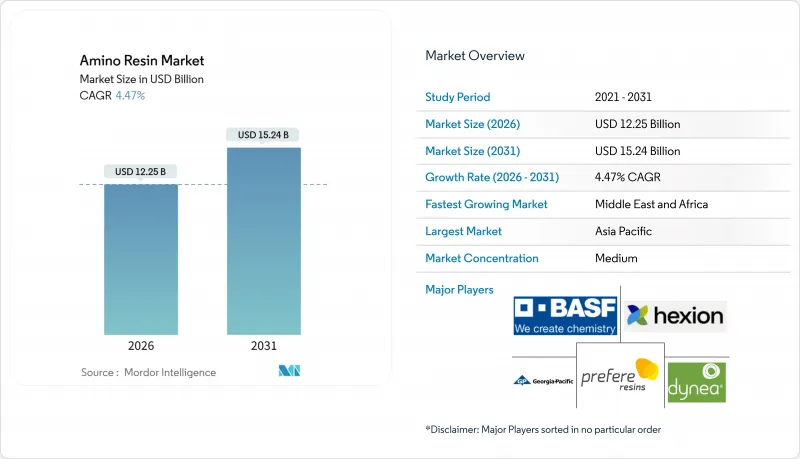
본 보고서는 유형별(요소·포름알데히드, 멜라민·포름알데히드, 멜라민·요소·포름알데히드), 최종 사용자 산업별(페인트 및 코팅,섬유 마감, 접착제 및 실란트, 기타 용도) 및 지역별(아시아태평양, 북미, 유럽, 남미, 중동 및 아프리카)로 분류되어 있습니다. 시장 전망은 금액(달러) 기준으로 제시되어 있습니다.
전 세계 아미노 수지 시장 동향 및 인사이트
페인트 및 코팅 분야 수요 증가
멜라민 가교제는 더 낮은 오븐 온도에서 경화되어 에너지 사용량을 줄이고 유해한 공기 중 이소시아네이트 입자를 방지할 수 있기 때문에 자동차용 클리어 코트에서 이소시아네이트를 대체하고 있습니다. CYMEL 및 Setamine과 같은 브랜드를 통해 배합 설계자는 캘리포니아주 SCAQMD 및 EU 산업 배출 지침의 엄격한 VOC 상한치를 충족하면서도 배터리 모듈용 코팅의 내스크래치성 및 내화학성 기준을 충족할 수 있게 되었습니다. 2024년 및 2025년의 자동차 생산 감소로 인해 단기적인 수지 수요는 감소했으나, 수성 및 분말 플랫폼으로의 전환은 140°C에서 신속한 가교 밀도를 실현하는 고메틸화 MF 등급에 유리한 지속적인 성장 경로를 만들어내고 있습니다.
건설·가구 업계의 목재 패널용 접착제 수요 증가
파티클보드와 MDF는 합쳐서 UF 생산량의 대부분을 차지하고 있으며, 접착제 수요는 새로운 가구 및 주택 인테리어 공사와 밀접하게 연관되어 있습니다. 인도의 MDF 생산 능력은 2025년에 확대될 전망이며, 과잉 생산 능력으로 인해 가격 회복이 지연되고 있음에도 불구하고 두 자릿수의 출하량 성장을 유지하고 있습니다. 유럽에서는 크로노스판(Kronospan)사의 람펠츠발데에서 발스-지젠하임으로 이어지는 블록 열차 노선 등 철도를 통한 수지 운송이 확대되고 있으며, 공급망 재설계에 따른 비용 절감과 이산화탄소 배출량 감축이 부각되고 있습니다. 한편, 중국의 집성재 수출업체들은 패널을 동남아시아와 아프리카로 공급하며, 국경을 넘어 접착제 소비를 효과적으로 재분배하고 있습니다.
유해 대기 오염 물질 및 배출 규제
2025년 7월, 유럽 일반 법원은 멜라민을 ‘고위험 물질(SVHC)’로 지정한 판결을 지지함으로써 규제상의 불확실성을 높이고, 비포름알데히드계 화학 물질로의 전환을 가속화했습니다. 미국 환경보호청(EPA)의 TSCA 제6편에서는 파티클보드 및 MDF의 포름알데히드 배출량에 상한선이 설정되어 있지만, EU 규정 2023/1464에 따르면 2026년 8월부터 허용 배출량을 절반으로 줄여야 합니다. 이러한 규정 준수 요건으로 인해 배합 개발자들은 UF 블렌드 내의 유리 포름알데히드를 저감하거나 글리옥살 계열로 전환해야 하는 상황에 직면해 있으며, 이에 따라 시험 및 인증에 따른 추가 비용이 발생하고 있습니다.
부문 분석
2025년, 요소·포름알데히드계 수지는 아미노 수지 시장 점유율의 47.41%를 차지했습니다. 이 수지의 장점은 멜라민·포름알데히드(MF)보다 고형분당 비용이 낮고, 고속 파티클보드 생산 라인에서 신속하게 경화될 수 있다는 점에 있습니다. 그러나 패널이 고온에 노출되거나 주변 습도가 높아지면 UF의 접착 강도가 저하됩니다. 이러한 취약성으로 인해 가공업체들은 실외용 패널, 배향 스트랜드 보드(OSB), 구조용 합판 등의 용도에서 MF 또는 멜라민·요소·포름알데히드(MUF)를 선호하여 채택하고 있습니다. 그 결과, 멜라민-포름알데히드(MF) 시장은 2031년까지 연평균 성장률(CAGR) 5.22%를 나타낼 것으로 예측됩니다. 또한, 멜라민과 혼합함으로써 MF 비용의 불과 몇 분의 일로 ANSI Type I 수준의 내수성을 달성할 수 있습니다. 한편, 헥시온(Hexion)사의 ‘EcoBind’ 시리즈는 프레스 효율을 저해하지 않으면서 CARB 2단계 및 EPA 기준을 충족합니다.
UF용 아미노 수지 시장 규모는 여전히 크지만, 운송 기기, 선박 용도 및 외장재 사양에서는 MF의 뛰어난 내구성이 점점 더 중요시되고 있습니다. 고메틸화 MF 수지는 높은 고형분에서의 용해성과 적당한 소성 가교 특성으로 인해 산업용 코팅 및 주름 방지 섬유 마감 분야에서 주목을 받고 있습니다. 하이브리드형 멜라민·요소·페놀·포름알데히드계 수지는 MF의 내습성과 페놀 수지의 강도를 결합하여 유럽의 OSB 3 규격 획득을 목표로 하고 있습니다. 각 수지의 향후 동향은 지역별 포름알데히드 규제 및 UF에 필적하는 급속한 경화 속도가 기대되는 글리옥살계 MF의 도입에 달려 있습니다.
지역별 분석
2025년, 아시아태평양은 전 세계 매출의 52.51%를 차지했습니다. 이는 중국의 메탄올 생산량과 해당 지역의 파티클보드 및 MDF 생산 능력이 주도한 결과입니다. 인도의 MDF 생산 능력은 현저한 증가세를 보였습니다. 또한, 기준을 충족하지 않는 수입품에 대한 반덤핑 관세로 인해 제재소는 CARB 기준을 준수하는 UF 및 MUF를 채택할 수밖에 없게 되었고, 패널 1장당 수지 사용량이 증가했습니다. 2024년 중국의 주택 착공 건수가 감소했음에도 불구하고, 동남아시아와 아프리카로의 집성재 수출이 접착제 수요를 견인했습니다. 일본, 한국, 호주 등의 성숙한 시장에서는 규제 준수가 핵심 요소로 부상했으며, 수명 주기 전반에 걸친 탄소 배출량 데이터가 수지 선정에 점점 더 큰 영향을 미치고 있습니다. 2025년 10월로 예정된 BASF의 난징 공장 확장으로 특수 아민 생산 능력이 증대되어, 아시아태평양의 소비에 대한 강한 자신감을 보여주고 있습니다.
수요의 대부분을 차지하는 북미와 유럽에서는 배출량 상한선에 따른 비용 압박에 직면해 있습니다. EPA의 TSCA 제6편에 따라, 파티클보드 제조업체들은 초저배출형 UF로 전환을 추진하거나, MUF 및 페놀계 대체재로 전환을 모색하고 있습니다. 그러나 가공업체들은 가격 상승에 저항하고 있어, 시판 수지의 이익률에 압박을 가하고 있습니다. 메틸아민과 디메틸포름아미드에 초점을 맞춘 아크린(Arcline)사의 웨스트버지니아주 확장 계획은 EPA의 2026년 시행 재검토에 앞서 원료의 안정적인 공급을 강화하기 위한 것입니다. 한편, 유럽에서는 배출 상한선 강화에 대비하여 멜라민이 SVHC(고위험물질)로 지정됨에 따라, 글리옥살 및 리그닌계 시스템에 대한 투자가 진행되고 있습니다. 특히, 크로노스팬의 노르다림사 완전 인수와 베이클라이트 신세틱스사의 그린본드사 인수는 규제상의 과제를 극복하기 위해 자사 전용 또는 독자적인 수지 체계를 구축하려는 하류 기업들의 전략을 여실히 보여주고 있습니다.
중동 및 아프리카는 사우디아라비아와 UAE의 메가 프로젝트에 더해, 남아프리카와 케냐에서 부상하고 있는 가구 산업 클러스터의 뒷받침을 받아 2031년까지 5.94%라는 지역별 최고 수준의 연평균 성장률(CAGR)을 나타낼 전망입니다. 유럽과 아시아의 수지 제조업체들은 운송 비용을 절감하고 신속한 리드타임을 확보하기 위해 현지에서 MUF 블렌딩을 위한 합작 사업에 주목하고 있습니다. 브라질의 경제 변동이 남미의 성장을 둔화시키고 있는 반면, 브라질의 유칼립투스를 원료로 한 MDF 수출은 북미 바이어들에게 다각화 거점으로서 틈새 시장을 개척하고 있습니다. 앞으로 아프리카의 관세 제도와 산업 정책은 현지 패널 제조의 향방을 결정하는 데 있어 지극히 중요한 역할을 할 것이며, 아미노 수지 시장에 새로운 수요 거점이 탄생할 가능성이 있습니다.
기타 혜택:
- 엑셀 형식 시장 예측(ME) 시트
- 3개월간의 애널리스트 지원
자주 묻는 질문
목차
제1장 서론
제2장 조사 방법
제3장 주요 요약
제4장 시장 구도
제5장 시장 규모와 성장 예측
제6장 경쟁 구도
제7장 시장 기회와 향후 전망
JHS 26.08.26According to Mordor Intelligence, the amino resin market size is estimated at USD 12.25 billion in 2026, and is expected to reach USD 15.24 billion by 2031, at a CAGR of 4.47% during the forecast period (2026-2031).
This report is Segmented by Type (Urea-Formaldehyde, Melamine-Formaldehyde, and Melamine-Urea-Formaldehyde), End-User Industry (Paints and Coatings, Textile Finishes, Adhesives and Sealants, and Other Applications), and Geography (Asia-Pacific, North America, Europe, South America, and Middle-East and Africa). Market Forecasts are Provided in Terms of Value (USD).
Global Amino Resin Market Trends and Insights
Rising Demand from Paints and Coatings
Melamine crosslinkers are replacing isocyanates in automotive clearcoats because they cure at lower oven temperatures, cut energy use, and avoid hazardous airborne isocyanate particles. Brands such as CYMEL and Setamine enable formulators to hit strict VOC caps in California's SCAQMD and the EU Industrial Emissions Directive, while meeting mar-resistance and chemical-resistance benchmarks in battery-module coatings. Although vehicle production contractions in 2024 and 2025 trimmed short-term resin off-take, the pivot toward water-borne and powder platforms is generating a durable growth runway that favors highly methylated MF grades for rapid crosslink density at 140 °C.
Wood-Panel Adhesives Boom in Construction and Furniture
Particleboard and MDF together consume a major portion of UF output, making adhesive demand tightly correlated with new furniture and housing fit-outs. India's MDF capacity climbed in 2025 and is tracking double-digit volume growth even as surplus capacity delays price recovery. Europe's rail-linked resin shipments, such as Kronospan's block-train route from Lampertswalde to Wals-Siezenheim, underline the cost and carbon savings that accompany supply-chain redesign. Meanwhile, Chinese engineered-wood exporters are channeling panels into Southeast Asia and Africa, effectively redistributing adhesive consumption across borders.
Hazardous Air Pollutants and Emission Regulations
In July 2025, the European General Court upheld the designation of melamine as a Substance of Very High Concern (SVHC), heightening regulatory uncertainties and hastening the transition to non-formaldehyde chemistries. While the EPA's TSCA Title VI caps formaldehyde emissions for particleboard and MDF, EU Regulation 2023/1464 is set to halve permissible emissions starting August 2026. These compliance mandates are pushing formulators to either reduce free-formaldehyde in UF blends or switch to glyoxal systems, incurring additional costs for testing and certification.
Other drivers and restraints analyzed in the detailed report include:
- Growth of Automotive OEM Coatings
- Expansion of Engineered Flooring and Laminates
- Growing Preference for Bio-Based Resin Systems
For complete list of drivers and restraints, kindly check the Table Of Contents.
Segment Analysis
Urea-formaldehyde retained 47.41% of the amino resins market share in 2025. Its advantage is a lower cost per solids content that's lower than melamine formaldehyde (MF) and the ability to cure rapidly on high-speed particleboard lines. However, UF's bond integrity falters when panels hit high temperatures or encounter elevated ambient humidity. This vulnerability has led converters to favor MF or melamine-urea-formaldehyde (MUF) for applications like exterior-grade panels, oriented strand board (OSB), and structural plywood. As a result, Melamine-Formaldehyde (MF) is projected to grow at a 5.22% CAGR through 2031. Furthermore, blends with melamine achieve ANSI Type I water-resistance at a fraction of the MF cost. Hexion's EcoBind line, on the other hand, meets CARB Phase 2 and EPA standards without compromising on press efficiency.
While the amino resins market size for UF remains substantial, MF's enhanced durability is increasingly being favored for specifications in transport, marine applications, and exterior cladding. Highly methylated MF resins are gaining traction in industrial coatings and wrinkle-resistant textile finishes due to their solubility at high solids and moderate baking crosslinking. Hybrid melamine-urea-phenol-formaldehyde systems are eyeing European OSB 3 ratings, combining MF's moisture resistance with the strength of phenolics. The future trajectory of each resin now hinges on regional formaldehyde regulations and the market introduction of glyoxal-based MF, which promises to match UF's rapid curing speed.
Complete Report Scope:
- By Type
- Urea-Formaldehyde (UF)
- Melamine-Formaldehyde (MF)
- Melamine-Urea-Formaldehyde (MUF)
- By End-User Industry
- Paints and Coatings
- Textile Finishes
- Adhesives and Sealants
- Other Applications
- By Geography
- Asia-Pacific
- China
- India
- Japan
- South Korea
- Australia
- Rest of Asia-Pacific
- North America
- United States
- Canada
- Mexico
- Europe
- Germany
- United Kingdom
- France
- Italy
- Russia
- Rest of Europe
- South America
- Brazil
- Argentina
- Rest of South America
- Middle-East and Africa
- Saudi Arabia
- South Africa
- Rest of Middle-East and Africa
- Asia-Pacific
Geography Analysis
Asia-Pacific commanded 52.51% of global revenue in 2025, driven by China's methanol output and the region's capacity for particleboard and MDF. India's MDF capacity saw notable growth. Additionally, anti-dumping duties on subpar imports have pushed mills to adopt CARB-equivalent UF and MUF, increasing resin intensity per panel. Despite a decline in Chinese housing starts in 2024, engineered wood exports to Southeast Asia and Africa shifted adhesive demand. In mature markets like Japan, Korea, and Australia, compliance is key, with lifecycle carbon data increasingly influencing resin choices. BASF's expansion in Nanjing, set for October 2025, will add specialty amine capacity, signaling strong confidence in Asia-Pacific's consumption.
North America and Europe, together accounting for a substantial portion of demand, grapple with cost pressures from emission caps. Under EPA TSCA Title VI, particleboard producers are pivoting to ultra-low-emission UF or are turning to MUF and phenolic substitutes. However, converters are resisting price hikes, putting pressure on merchant resin margins. Arclin's West Virginia expansion, focusing on methylamine and dimethylformamide, bolsters feedstock security ahead of the EPA's 2026 enforcement review. Meanwhile, Europe is gearing up for stricter emission ceilings and is investing in glyoxal and lignin systems due to melamine's SVHC status. Notably, Kronospan's complete acquisition of Nordalim and Bakelite Synthetics' takeover of GreenBond highlight downstream players' strategies to build captive or unique resin positions, aiming to navigate regulatory challenges.
The Middle-East and Africa will log the fastest regional CAGR of 5.94% to 2031, fueled by megaprojects in Saudi Arabia and the UAE, alongside budding furniture clusters in South Africa and Kenya. Resin producers from Europe and Asia are eyeing joint ventures for local MUF blending, a move to counter shipping costs and ensure swift lead times. While Brazil's economic fluctuations temper South America's growth, the country's eucalyptus-based MDF exports carve out a niche as a diversification hub for North American buyers. Looking ahead, Africa's tariff regimes and industrial policies will play a pivotal role in determining the trajectory of local panel manufacturing, potentially birthing a new demand node for the amino resins market.
- Acron
- Arclin Inc.
- BASF SE
- Chemique Adhesives & Sealants Ltd
- DIC Corporation
- Dynea AS
- Eastman Chemical Company
- Ercros SA
- Georgia-Pacific Chemicals
- Hexion
- Jiangsu Sanmu Group
- Kronoplus Limited
- LRBG Chemicals Inc.
- Prefere Resins Holding GmbH
- Synpol Products Private Limited
- Uniform Synthetics
- Wanhua Ecoboard Co. Ltd
Additional Benefits:
- The market estimate (ME) sheet in Excel format
- 3 months of analyst support
TABLE OF CONTENTS
1 Introduction
- 1.1 Study Assumptions and Market Definition
- 1.2 Scope of the Study
2 Research Methodology
3 Executive Summary
4 Market Landscape
- 4.1 Market Overview
- 4.2 Market Drivers
- 4.2.1 Rising demand from paints and coatings
- 4.2.2 Wood-panel adhesives boom in construction and furniture
- 4.2.3 Growth of automotive OEM coatings
- 4.2.4 Expansion of engineered flooring and laminates
- 4.2.5 Formaldehyde-free glyoxal-based resin adoption
- 4.3 Market Restraints
- 4.3.1 Hazardous air pollutants and emission regulations
- 4.3.2 Growing preference for bio-based resin systems
- 4.3.3 Feed-stock (urea/methanol) price and tariff volatility
- 4.4 Value Chain Analysis
- 4.5 Porter's Five Forces
- 4.5.1 Bargaining Power of Suppliers
- 4.5.2 Bargaining Power of Buyers
- 4.5.3 Threat of New Entrants
- 4.5.4 Threat of Substitutes
- 4.5.5 Degree of Competition
- 4.6 Regulatory Landscape
- 4.7 Technological Outlook
- 4.8 Trade Analysis
5 Market Size and Growth Forecasts (Value)
- 5.1 By Type
- 5.1.1 Urea-Formaldehyde (UF)
- 5.1.2 Melamine-Formaldehyde (MF)
- 5.1.3 Melamine-Urea-Formaldehyde (MUF)
- 5.2 By End-User Industry
- 5.2.1 Paints and Coatings
- 5.2.2 Textile Finishes
- 5.2.3 Adhesives and Sealants
- 5.2.4 Other Applications
- 5.3 By Geography
- 5.3.1 Asia-Pacific
- 5.3.1.1 China
- 5.3.1.2 India
- 5.3.1.3 Japan
- 5.3.1.4 South Korea
- 5.3.1.5 Australia
- 5.3.1.6 Rest of Asia-Pacific
- 5.3.2 North America
- 5.3.2.1 United States
- 5.3.2.2 Canada
- 5.3.2.3 Mexico
- 5.3.3 Europe
- 5.3.3.1 Germany
- 5.3.3.2 United Kingdom
- 5.3.3.3 France
- 5.3.3.4 Italy
- 5.3.3.5 Russia
- 5.3.3.6 Rest of Europe
- 5.3.4 South America
- 5.3.4.1 Brazil
- 5.3.4.2 Argentina
- 5.3.4.3 Rest of South America
- 5.3.5 Middle-East and Africa
- 5.3.5.1 Saudi Arabia
- 5.3.5.2 South Africa
- 5.3.5.3 Rest of Middle-East and Africa
- 5.3.1 Asia-Pacific
6 Competitive Landscape
- 6.1 Market Concentration
- 6.2 Strategic Moves
- 6.3 Market Share(%)/Ranking Analysis
- 6.4 Company Profiles (includes Global-level Overview, Market-level Overview, Core Segments, Financials, Strategic Information, Products and Services, Recent Developments)
- 6.4.1 Acron
- 6.4.2 Arclin Inc.
- 6.4.3 BASF SE
- 6.4.4 Chemique Adhesives & Sealants Ltd
- 6.4.5 DIC Corporation
- 6.4.6 Dynea AS
- 6.4.7 Eastman Chemical Company
- 6.4.8 Ercros SA
- 6.4.9 Georgia-Pacific Chemicals
- 6.4.10 Hexion
- 6.4.11 Jiangsu Sanmu Group
- 6.4.12 Kronoplus Limited
- 6.4.13 LRBG Chemicals Inc.
- 6.4.14 Prefere Resins Holding GmbH
- 6.4.15 Synpol Products Private Limited
- 6.4.16 Uniform Synthetics
- 6.4.17 Wanhua Ecoboard Co. Ltd
7 Market Opportunities and Future Outlook
- 7.1 White-space and Unmet-Need Assessment