

|
시장보고서
상품코드
2115010
저온 단열재 시장 : 시장 점유율 분석, 업계 동향 및 통계, 성장 예측(2026-2031년)Cold Insulation - Market Share Analysis, Industry Trends & Statistics, Growth Forecasts (2026 - 2031) |
||||||
 Mordor Intelligence
Mordor Intelligence에 의하면, 2026년 저온 단열재 시장 규모는 76억 달러로 추정되고, 2025년 72억 6,000만 달러에서 성장하여 2031년에는 95억 4,000만 달러에 이를 것으로 예측됩니다.
2026-2031년 연평균 성장률(CAGR) 4.65%로 성장할 것으로 전망됩니다.
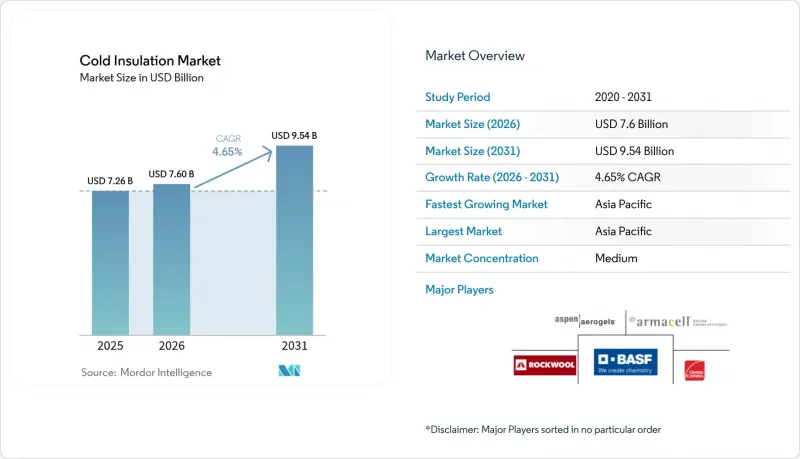
본 보고서는 소재 유형별(폴리우레탄 폼, 유리섬유, 폴리스티렌 폼, 페놀 폼), 용도별(석유 및 가스, 화학, 난방·환기·공조(HVAC), 냉동), 지역별(아시아태평양, 북미, 유럽, 남미, 중동 및 아프리카)로 분류되어 있습니다. 시장 전망은 금액(달러) 기준으로 제시되어 있습니다.
세계의 저온 단열재 시장 동향 및 인사이트
극저온 단열재 수요 증가(LNG 및 LH2 프로젝트)
극저온 용도의 경우, LNG는 -162°C, 액체 수소는 -253°C의 환경에서도 구조적 크리프나 층간 박리가 발생하지 않는 재료가 요구됩니다. 그 결과, 페놀 폼과 다층 배리어를 결합한 복합 시스템이 기존의 유리 섬유를 대체하고 있으며, 이것이 페놀 폼의 5.05%라는 성장률을 설명하고 있습니다. LNG 벙커링에서는 단열재의 무결성이 보일오프율을 급격히 상승시키는 플래시 기화 현상을 방지하는 역할을 하므로, 선박 간 이송 운영자는 더 낮은 열전도율 기준을 지정하고 있습니다. 부유식 저장·재기화 설비(FSRU)의 경우, 극저온 CO₂ 회수 구역이 동일한 선체 내에서 서로 다른 온도 범위를 필요로 하기 때문에 상황은 더욱 복잡해집니다. 에어로겔 강화 폼으로 이에 대응하는 공급업체들은 차별화를 꾀하는 동시에 선급협회로부터 초기 단계의 승인도 확보하고 있습니다. 그 결과, 부피 대비 높은 부가가치를 지닌 틈새 시장이 형성되어, 저온 단열재 시장 전체의 연구개발비에 비해 그 규모 이상의 큰 견인력을 발휘하고 있습니다.
에너지 효율 및 넷 제로 개조에 대한 수요 증가
EU의 개보수 정책에서는 연간 3%의 철저한 개보수율을 요구하고 있으며, 이로 인해 연간 2,750억 유로의 지출이 촉진되는 동시에 외벽의 U값 상한선이 더욱 엄격해지고 있습니다. 진공 단열 패널(VIP)과 에어로겔 시트는 역사적 건축물의 공간 제약 문제를 해결하며, 파사드의 두께를 변경하지 않고도 미네랄 울에 비해 열투과율을 35% 저감합니다. ‘Energiesprong’과 같은 리모델링 프로그램에서는 현장 작업량을 절반으로 줄여주는 산업화된 오버클래딩 키트의 효과가 입증되어, 대규모 주택 재고에 대한 확장 가능한 방안을 제시하고 있습니다. 그 결과, 기업 부동산 소유주와 지자체는 건물 외피 성능을 자본 배분의 최우선 과제로 삼고 있으며, 이는 단열 시장의 기회를 더욱 확대시키고 있습니다.
변동이 심한 석유화학 원료 가격
MDI의 ‘제조 단계까지의 지구 온난화 지수(GWP)’의 85%가 원료 투입에서 비롯되기 때문에 폴리우레탄 제조업체는 비용 측면과 배출량 측면 모두에서 위험에 노출되어 있습니다. 바이오 유래의 순환형 원료로의 다각화는 가격 변동에 대한 헤지 수단으로서 일정한 효과를 발휘하지만, 그 규모는 여전히 파일럿 라인 단계에 머물러 있습니다. 수요 측면에서는 가전 제조업체들이 가격 급등 시 조달을 늦추는 경우가 많아, 그 결과 단기적인 공급량 감소가 발생하고, 이것이 저온 단열재 시장 전체로 파급되고 있습니다. 오웬스 코닝(Owens Corning)사의 수지 조달 계약이나 킹스팬(Kingspan)사의 현지 MDI 저장 탱크 확충과 같은 수직 통합은 이러한 역풍을 완화시킬 수는 있으나, 완전히 해소하는 것은 아닙니다.
부문 분석
2025년, 폴리우레탄 부문은 성숙한 공급망과 스프레이 폼의 경제성 우위에 힘입어 저온 단열재 시장 규모의 43.62%를 차지했습니다. 페놀 폼은 낮은 화염 확산성과 견고한 극저온 성능이 요구되는 LNG 및 수소 프로젝트를 호재로 삼아 연평균 성장률(CAGR) 4.82%로 확대되고 있습니다. 재활용 또는 식물 유래 폴리올을 25% 함유한 바이오 폴리우레탄 제품은 내재 탄소 발자국을 43% 줄여, 제조업체가 공공 부문 입찰에서 수주하는 데 도움이 되고 있습니다.
폴리우레탄 업계 내 경쟁은 생산자들이 가격 리스크를 관리하기 위해 디이소시아네이트 합성으로의 후방 통합을 추진함에 따라 격화되고 있습니다. 오웬스 코닝(Owens Corning)의 2025년 원자재 조달 프로그램은 마진을 안정시키는 동시에 대량 구매를 통한 비용 절감 효과를 가져오고 있습니다. 한편, 킹스팬(Kingspan)의 우크라이나 캠퍼스는 해당 지역에 새로운 생산 능력을 확보하여 운송에 따른 배출량을 줄이는 동시에 동유럽에 대한 공급 안정성을 높이고 있습니다. 이러한 움직임은 저온 단열재 시장에서 규모 확대를 목표로 하는 신규 시장 진출기업에게 진입 장벽이 높다는 점을 뒷받침하고 있습니다.
지역별 분석
아시아태평양은 2025년 매출의 37.35%를 차지하며 주도적인 위치를 차지했고, 2031년까지 연평균 성장률(CAGR) 5.4%로 더욱 확대될 것으로 예상되어 가장 크고 가장 빠르게 성장하는 지역이 될 전망입니다. 중국에서는 -30°C의 창고 내에서 자율 주행 지게차를 도입하는 등 자동화 중심의 콜드체인 개편이 진행되고 있으며, 습도 관리를 유지하기 위해 초저투습성 패널 접합부가 요구되고 있습니다. 인도에서는 제조업이 GDP에서 차지하는 비중을 25%로 끌어올리겠다는 정책 추진에 더해, 냉장 창고 건설에 대한 재정적 우대 조치가 맞물리면서 폴리우레탄 공급업체들이 현지에서 경질 발포 보드 생산 라인을 구축하는 움직임이 나타나고 있습니다.
북미는 연방 정부의 개보수 세액 공제 및 멕시코만 연안에서 사상 최대 규모로 건설되는 LNG 수출 터미널에 힘입어 시장에서 큰 점유율을 차지하고 있습니다. 2027년 가동이 예정된 오웬스 코닝(Owens Corning)사의 오하이오주 신규 유리섬유 생산 라인이 지역 공급을 뒷받침하는 한편, 미국 에너지부(DOE)의 보조금에 힘입어 에어로겔 VIP의 상용화가 가속화되고 있으며, 이를 통해 건축물의 더 대규모 리모델링이 가능해질 전망입니다. 유럽에서는 건설 생산량이 부진한 상황이지만, 법적으로 의무화된 대규모 개보수 비율 덕분에 단열재 수요는 견조한 추세를 보이고 있습니다. 킹스팬(Kingspan)과 크나우프 인슐레이션(Knauf Insulation)은 에너지 가격 변동이 영업 이익률을 압박하는 상황 속에서도 해당 지역의 생산 능력을 확대되고 있습니다. 카타르의 LNG 확장이나 사우디아라비아의 수소 허브와 같은 중동의 메가 프로젝트에서는 엄격한 극저온 사양이 요구되고 있어, 에어로겔 제조업체들에게는 호재가 되고 있습니다. 한편, 라틴아메리카에서는 농산물 및 식품 수출과 관련된 냉장 설비에 대한 투자가 호재로 작용하고 있습니다. 이러한 각 지역의 동향이 맞물려 저온 단열재 시장에 폭넓은 비즈니스 기회를 가져오고 있습니다.
기타 혜택 :
- 엑셀 형식 시장 예측(ME) 시트
- 3개월간의 애널리스트 지원
자주 묻는 질문
목차
제1장 서론
제2장 조사 방법
제3장 주요 요약
제4장 시장 구도
제5장 시장 규모 및 성장 예측
제6장 경쟁 구도
제7장 시장 기회 및 향후 전망
AJY 26.08.28According to Mordor Intelligence, cold insulation market size in 2026 is estimated at USD 7.6 billion, growing from 2025 value of USD 7.26 billion with 2031 projections showing USD 9.54 billion, growing at 4.65% CAGR over 2026-2031.
This report is Segmented by Material Type (Polyurethane Foam, Fiberglass, Polystyrene Foam, and Phenolic Foam), Application (Oil and Gas, Chemicals, Heating, Ventilation, and Air Conditioning (HVAC), and Refrigeration), and Geography (Asia-Pacific, North America, Europe, South America, and Middle East and Africa). The Market Forecasts are Provided in Terms of Value (USD).
Global Cold Insulation Market Trends and Insights
Rising Demand for Cryogenic Insulation (LNG And LH2 Projects)
Cryogenic applications require materials that withstand -162 °C for LNG and -253 °C for liquid hydrogen without structural creep or delamination. Composite systems pairing phenolic foam with multilayer barriers are therefore displacing legacy fiberglass, explaining phenolic's 5.05% growth. In LNG bunkering, insulation integrity safeguards against flash vaporization events that would spike boil-off rates, so ship-to-ship transfer operators specify lower thermal conductivity thresholds. Floating storage and regasification units add complexity because cryogenic CO2 capture zones demand separate temperature envelopes within the same hull. Suppliers responding with aerogel-reinforced foams gain differentiation while securing early-stage approvals from classification societies. The result is a premium-priced niche that punches above its volume weight yet exerts outsized pull on research and development spending across the cold insulation market.
Growing Need for Energy-Efficiency and Net-Zero Retrofits
EU renovation policy calls for a 3% annual deep-renovation rate, driving EUR 275 billion in yearly spending and tightening U-value ceilings for external walls. Vacuum insulation panels (VIPs) and aerogel sheets solve space-constraint issues in heritage buildings, achieving 35% lower thermal transmittance versus mineral wool while keeping facade thickness unchanged. Retrofit programs such as Energiesprong have validated industrialized over-cladding kits that cut site labor by half, signaling scalable pathways for large housing stocks. Corporate landlords and municipalities consequently rank envelope performance as a top capital-allocation priority, further broadening opportunity for the cold insulation market.
Volatile Petrochemical Raw-Material Pricing
With 85% of MDI's cradle-to-gate global-warming potential linked to feedstock inputs, polyurethane makers face both cost and emissions exposure. Diversification into bio-circular feedstocks partially hedges against price volatility, yet scale remains limited to pilot lines. On the demand side, appliance OEMs often delay procurement during price spikes, producing short-run volume dips that ripple through the cold insulation market. Vertical integration, such as Owens Corning's resin procurement contracts and Kingspan's pipeline of local MDI storage tanks, softens but does not eliminate the headwind.
Other drivers and restraints analyzed in the detailed report include:
- Expansion of Global Cold-Chain Logistics and E-Grocery
- Industrial and Infrastructure Growth in Emerging Markets
- Shortage of Certified Installers for Aerogel/VIP Systems
For complete list of drivers and restraints, kindly check the Table Of Contents.
Segment Analysis
The polyurethane segment captured 43.62% of the cold insulation market size in 2025, buoyed by mature supply chains and favourable spray-foam economics. Phenolic foam is expanding at a 4.82% CAGR on the strength of LNG and hydrogen projects demanding low flame-spread and robust cryogenic performance. Bio-based polyurethane variants containing 25% recycled or plant-derived polyols lower embodied-carbon footprints by 43% and help manufacturers win public-sector bids.
Competitive intensity inside polyurethane tightens as producers backward-integrate into diisocyanate synthesis to manage price risk. Owens Corning's 2025 feedstock sourcing program stabilizes margins while enabling bulk purchasing economies. Meanwhile, Kingspan's Ukraine campus injects new regional capacity, reducing freight emissions and enhancing supply security for Eastern Europe. These moves reinforce the high threshold for new entrants seeking scale inside the cold insulation market.
Complete Report Scope:
- By Material Type
- Polyurethane Foam
- Fiberglass
- Polystyrene Foam
- Phenolic Foam
- By Application
- Oil and Gas
- Chemicals
- Heating, Ventilation, and Cooling (HVAC)
- Refrigeration
- By Geography
- Asia-Pacific
- China
- India
- Japan
- South Korea
- Australia
- New Zealand
- Rest of Asia-Pacific
- North America
- United States
- Canada
- Mexico
- Europe
- Germany
- United Kingdom
- France
- Italy
- Russia
- Rest of Europe
- South America
- Brazil
- Argentina
- Rest of South America
- Middle-East and Africa
- Saudi Arabia
- United Arab Emirates
- Qatar
- South Africa
- Egypt
- Rest of Middle-East and Africa
- Asia-Pacific
Geography Analysis
Asia Pacific dominated with 37.35% revenue in 2025 and is projected to add a further 5.4% CAGR to 2031, making it both the largest and fastest region. China's automation-driven cold-chain overhaul, which deploys autonomous forklifts inside -30 °C warehouses, calls for ultra-low-permeability panel joints to maintain humidity control. India's policy push for a 25% manufacturing GDP share, coupled with fiscal incentives for cold-store construction, attracts polyurethane suppliers setting up local rigid-foam board lines.
North America commands a sizeable slice, supported by federal retrofit tax credits and record LNG export terminal builds along the Gulf Coast. Owens Corning's new Ohio fiberglass line, slated for 2027, underpins regional supply, while DOE grants accelerate aerogel VIP commercialization that could unlock deeper building retrofits. Europe, though facing sluggish construction output, maintains healthy insulation demand thanks to legally mandated deep-renovation rates. Kingspan and Knauf Insulation expand regional capacity even as energy-price volatility challenges operating margins. Middle East mega-projects such as Qatar's LNG expansion and Saudi hydrogen hubs apply stringent cryogenic specs that invite aerogel players, while Latin America benefits from refrigeration investments connected to agrifood exports. Collectively, these regional vectors guarantee broad-based opportunity for the cold insulation market.
- Armacell
- Aspen Aerogels Inc.
- BASF
- Carlisle Companies Inc.
- Covestro AG
- Dongsung Finetec
- Dow
- Huntsman International LLC
- International Corrosion Services LLC
- Kingspan Group
- Knauf Insulation
- Owens Corning
- ROCKWOOL A/S
- Saint-Gobain
Additional Benefits:
- The market estimate (ME) sheet in Excel format
- 3 months of analyst support
TABLE OF CONTENTS
1 Introduction
- 1.1 Study Assumptions and Market Definition
- 1.2 Scope of the Study
2 Research Methodology
3 Executive Summary
4 Market Landscape
- 4.1 Market Overview
- 4.2 Market Drivers
- 4.2.1 Rising Demand for Cryogenic Insulation (LNG And LH2 Projects)
- 4.2.2 Growing Need for Energy-Efficiency and Net-Zero Retrofits
- 4.2.3 Expansion of Global Cold-Chain Logistics and E-Grocery
- 4.2.4 Surge in Small-Scale LNG Bunkering Infrastructure
- 4.2.5 Industrial And Infrastructure Growth in Emerging Markets
- 4.3 Market Restraints
- 4.3.1 Volatile Petrochemical Raw-Material Pricing
- 4.3.2 Lack of Awareness about Cold Insulation Materials
- 4.3.3 Shortage of Certified Installers for Aerogel/VIP Systems
- 4.4 Value Chain Analysis
- 4.5 Porter's Five Forces
- 4.5.1 Bargaining Power of Suppliers
- 4.5.2 Bargaining Power of Buyers
- 4.5.3 Threat of New Entrants
- 4.5.4 Threat of Substitutes
- 4.5.5 Degree of Competition
5 Market Size and Growth Forecasts
- 5.1 By Material Type
- 5.1.1 Polyurethane Foam
- 5.1.2 Fiberglass
- 5.1.3 Polystyrene Foam
- 5.1.4 Phenolic Foam
- 5.2 By Application
- 5.2.1 Oil and Gas
- 5.2.2 Chemicals
- 5.2.3 Heating, Ventilation, and Cooling (HVAC)
- 5.2.4 Refrigeration
- 5.3 By Geography
- 5.3.1 Asia-Pacific
- 5.3.1.1 China
- 5.3.1.2 India
- 5.3.1.3 Japan
- 5.3.1.4 South Korea
- 5.3.1.5 Australia
- 5.3.1.6 New Zealand
- 5.3.1.7 Rest of Asia-Pacific
- 5.3.2 North America
- 5.3.2.1 United States
- 5.3.2.2 Canada
- 5.3.2.3 Mexico
- 5.3.3 Europe
- 5.3.3.1 Germany
- 5.3.3.2 United Kingdom
- 5.3.3.3 France
- 5.3.3.4 Italy
- 5.3.3.5 Russia
- 5.3.3.6 Rest of Europe
- 5.3.4 South America
- 5.3.4.1 Brazil
- 5.3.4.2 Argentina
- 5.3.4.3 Rest of South America
- 5.3.5 Middle-East and Africa
- 5.3.5.1 Saudi Arabia
- 5.3.5.2 United Arab Emirates
- 5.3.5.3 Qatar
- 5.3.5.4 South Africa
- 5.3.5.5 Egypt
- 5.3.5.6 Rest of Middle-East and Africa
- 5.3.1 Asia-Pacific
6 Competitive Landscape
- 6.1 Market Concentration
- 6.2 Strategic Moves
- 6.3 Market Share(%)/Ranking Analysis
- 6.4 Company Profiles (includes Global level Overview, Market level overview, Core Segments, Financials as available, Strategic Information, Market Rank/Share, Products and Services, Recent Developments)
- 6.4.1 Armacell
- 6.4.2 Aspen Aerogels Inc.
- 6.4.3 BASF
- 6.4.4 Carlisle Companies Inc.
- 6.4.5 Covestro AG
- 6.4.6 Dongsung Finetec
- 6.4.7 Dow
- 6.4.8 Huntsman International LLC
- 6.4.9 International Corrosion Services LLC
- 6.4.10 Kingspan Group
- 6.4.11 Knauf Insulation
- 6.4.12 Owens Corning
- 6.4.13 ROCKWOOL A/S
- 6.4.14 Saint-Gobain
7 Market Opportunities and Future Outlook
- 7.1 White-space and Unmet-Need Assessment
- 7.2 Increasing Research and Development through Sustainable Raw Material Sources


