

|
시장보고서
상품코드
2115020
COVID 검사 키트 시장 : 점유율 분석, 업계 동향과 통계, 성장 예측(2026-2031년)COVID Testing Kit - Market Share Analysis, Industry Trends & Statistics, Growth Forecasts (2026 - 2031) |
||||||
 Mordor Intelligence
Mordor Intelligence에 의하면, COVID 검사 키트 시장 규모는 2025년에 74억 8,000만 달러로 평가되었고 2026년 70억 1,000만 달러에서 2031년까지 50억 6,000만 달러에 이를 것으로 예측되며, 예측 기간(2026-2031년) CAGR은―6.32%를 나타낼 전망입니다.
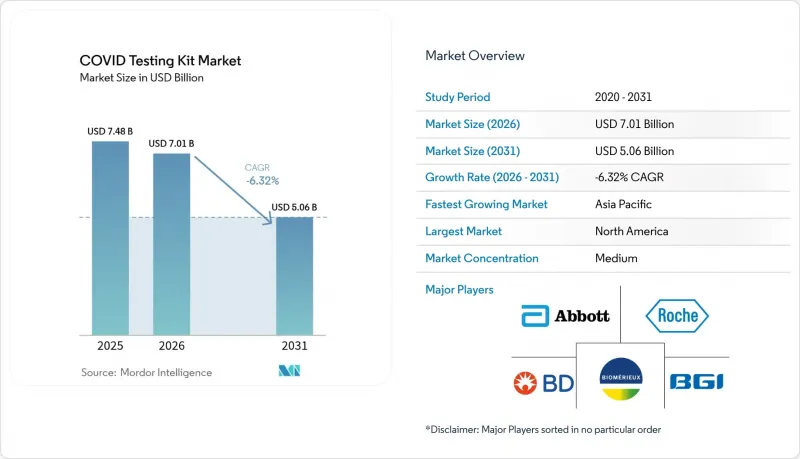
본 보고서는 제품별(RT-PCR 분석 키트, 면역 측정 테스트 스트립/카세트, CRISPR 기반 분자 검사 키트, 차세대 염기서열 분석 패널),검체별(비인두 면봉, 비강 면봉 등), 최종 사용자별(병원, 진단실험실 등), 지역별(북미, 유럽, 아시아태평양, 중동 및 아프리카, 남미)로 분류되어 있습니다. 시장 예측은 금액(달러)으로 제시되어 있습니다.
전 세계 COVID 검사 키트 시장 동향 및 인사이트
COVID-19 변이주 발생률의 높아짐
바이러스가 인플루엔자와 유사한 계절적 경향을 띠게 되면서 대규모 검사의 시급성은 낮아졌으나, 기본적인 감시 요건은 유지되고 있습니다. WHO 자문단은 현재 XBB 계통의 변이주에 초점을 맞추고 있으며, 이는 전체 인구를 대상으로 한 광범위한 선별 검사보다는 백신 접종과 모니터링으로의 전환을 시사합니다. 라보코프는 2024년 1분기 COVID-19 검사 매출이 전분기 대비 1.9% 감소했고, 2분기에는 0.9% 감소했다고 보고했으며, 급성기 수요가 진정되는 가운데 이러한 추세는 주요 검사 기관 전반에서 관찰되고 있습니다. 따라서 진단 기업들은 검사 건수의 감소와 변이주 감지를 위한 시퀀싱 능력 유지의 필요성 사이에서 균형을 맞추어야 합니다. 보건 당국이 유전체 감시에서 계속해서 검사 기관에 의존하는 가운데, 플랫폼의 유연성과 통합된 데이터 보고가 중요한 차별화 요소가 될 것입니다. 기존 검사법에 변이주 특이적 프라이머를 통합하는 제조업체는 새로운 키트 개발 비용을 부담하지 않고도 기관의 지속적인 수요를 확보할 수 있습니다.
정부의 비축 프로그램 확대
정부의 비축 관련 노력은 민간 부문의 발주가 감소하더라도 수요의 하한선을 보장합니다. 미국 보건복지부는 국내 신속 검사 키트 생산을 유지하기 위해 30억 달러 이상을 투자하고, 전략적 비축분으로 5억 개의 자가 검사 키트를 조달했습니다. 유럽연합(EU)의 유사한 조달 체계는 제조업체에 수년에 걸친 구매 보장을 제공함으로써 소매 채널에서의 이익률 감소를 상쇄하고 있습니다. 이러한 계약은 기준 생산량을 안정화함으로써 공급업체가 숙련된 인력을 유지하고, ISO 13485 및 FDA 품질 시스템 규정이 요구하는 품질 관리 체계를 유지하는 데 도움이 되고 있습니다. 그 대가로 정부는 향후 감염 확산에 대비한 확실한 증산 능력을 확보하여, 보다 광범위한 국가 안보 목표를 뒷받침할 수 있습니다.
팬데믹 진정세에 따른 검사 건수 감소
각 진단 기기 제조업체들은 2021년 정점 시기에 비해 COVID 검사 키트 수주가 70-90% 감소했다고 보고하고 있습니다. 애보트(Abbott)는 메인주 시설에서 199명의 인력을 감축했으며, 큐 헬스(Q Health)도 공공 자금이 백신 및 치료제로 전환됨에 따라 직원 수를 170명 감축했습니다. 고정 제조 간접비가 더 소규모의 로트에 분산됨에 따라 비용 압박이 가중되고 있습니다. 검사 기관들은 재고를 합리화하여 몇 달 치의 안전 재고를 보유하는 대신, 적시 생산(JIT) 방식의 재고 관리를 실시했습니다. 이러한 상황에서 각 공급업체들은 위성 공장 폐쇄, 포장 라인 자동화, 그리고 새로운 기준 수요에 맞추어 생산 능력을 조정하기 위한 원자재 계약 재협상을 진행하고 있습니다.
부문별 분석
RT-PCR 분석 키트는 병원 및 검사 기관이 규제 준수 및 보험 환급 요건을 충족하기 위해 그 정확성을 신뢰하고 있기 때문에 2025년에는 COVID 검사 키트 시장 점유율의 73.42%를 차지하며 선두 자리를 유지했습니다. 그러나 CRISPR 기반 분자진단 하위 그룹은 신속한 현장 진단(PoC) 워크플로우에 대한 검사 기관 수요를 반영하여 2031년까지 1.90%라는 가장 높은 연평균 성장률(CAGR)을 보일 것으로 예측됩니다. 면역 측정 카세트는 대규모 선별 검사 수주를 확보하고 있지만, 이익률 하락에 직면해 있습니다. 한편, 차세대 염기서열 분석 패널은 변이주 감시 프로그램에 국한된 상태입니다. SARS-CoV-2, A형·B형 인플루엔자, RSV를 한 번의 측정으로 검출하는 다중 호흡기계 검사는 97-100%의 정확도와 1시간 미만의 검사 소요 시간을 실현하고 있으며, 이러한 성능이 프리미엄 가격 책정을 뒷받침하고 있습니다.
이 분야에서는 범용 검사와 고부가가치의 전문 진단 간의 양극화가 나타나고 있습니다. 모듈식 카트리지 시스템을 도입한 기업은 계절별 병원체 패턴에 맞추어 시약을 교체할 수 있으므로 수익을 안정화할 수 있습니다. 컬럼비아 대학교 공과대학이 개발한 23분 만에 결과가 나오는 RT-PCR 프로토타입은 응급실 처리 능력의 미래 벤치마크가 될 가능성을 시사하고 있습니다. 동시에, 활발한 바이러스 복제와 잔류 단편을 구별하는 CRISPR 분석법은 격리 조치 결정이나 항바이러스제 처방을 이끌어낼 수 있어, 총 검사 건수가 감소하는 상황에서도 임상적 틈새 시장을 개척할 것으로 기대됩니다. 이러한 기술적 진보와 자동화된 결과 보고를 결합하는 공급업체는 규모는 축소되었으나 기술에 정통한 시장에서 지속적인 수요를 확보할 수 있는 입장에 있습니다.
지역별 분석
북미는 2025년에도 COVID 검사 키트 시장에서 39.30%라는 1위 점유율을 유지했습니다. 이는 신속 검사 키트의 조달 및 제조 체제 유지를 위한 30억 달러 규모의 연방 정부 자금 지원에 힘입은 결과입니다. 그러나 보험사들이 종합적인 보상을 축소함에 따라 상업적 검사량은 급격히 감소했고, 제조업체들은 공장 합리화를 추진하며 수익성이 높은 멀티플렉스 패널을 우선시하게 되었습니다. 애보트 래버러토리스는 COVID-19 검사 매출 감소와 수출 관세로 인해 2025년 매출이 10억 달러 이상 감소할 것이라고 밝혔으며, 이는 기존 기업들이 겪고 있는 압박을 여실히 보여줍니다. FDA의 실험실 개발 검사(LDT) 감독에 관한 규정 제정은 새로운 검증 비용을 초래하는 한편, 신속한 승인을 위한 통일된 절차를 약속하고 있어 엄격한 성능 기준을 충족할 수 있는 기업에게는 이점이 됩니다.
아시아태평양은 연평균 성장률(CAGR) 1.98%로 지역별 가장 빠른 성장세를 기록하고 있으며, 도시 지역 병원들이 인플루엔자와 COVID-19 유행 시기가 겹치는 상황에 대응하기 위해 복합 호흡기 패널을 우선적으로 도입하고 있어 2031년까지 이러한 성장세를 유지할 것으로 예측됩니다. 각국 정부는 국내 시약 제조에 대한 보조금을 포함하여 분자진단 역량 강화를 위해 부흥 자금을 투입하고 있습니다. 인도와 중국에서는 민관 파트너십을 통해 검사 결과 판정 담당자와 클라우드 분석을 연결하는 통합 데이터 플랫폼이 구축되어, 개별 검사 키트가 보건부를 위한 감시 자산으로 변모하고 있습니다. 하지만 보험 적용 범위의 불균형과 보상액의 편차로 인해 주요 도시 이외 지역에서의 보급은 더딘 상황입니다.
유럽에서는 유럽의약품청(EMA)이 제시한 전 세계 백신 및 진단 기준에 대한 협력을 지침으로 삼아, 기관 차원의 조달을 계속해서 중시하고 있습니다. 각국의 의료 제도에서는 계약에 지속가능성에 관한 조항이 포함되어 있으며, 재활용 가능한 플라스틱을 사용하거나 회수 서비스를 제공하는 공급업체에 인센티브가 주어지고 있습니다. 이러한 환경적 배려로 인해 일부 공급업체에서는 제품 원가가 상승하고 있지만, 공공 조달 분야에서 선도적인 기업을 차별화하는 요인이 되고 있습니다. 라틴아메리카와 아프리카에서는 기부자 자금 지원을 받은 사업을 통해 검사 네트워크가 개선되고 있으나, 예산 제약으로 인해 평균 판매 가격은 세계 수준보다 낮습니다. 이 지역들을 대상으로 하는 공급업체들은 핵심 감도를 유지하면서 콜드체인 운송 및 최소한의 장비 요건을 충족할 수 있도록 기능을 축소한 키트를 맞춤 제작하고 있습니다.
기타 혜택:
- 엑셀 형식 시장 예측(ME) 시트
- 3개월간의 애널리스트 지원
자주 묻는 질문
목차
제1장 서론
제2장 조사 방법
제3장 주요 요약
제4장 시장 구도
제5장 시장 규모와 성장 예측
제6장 경쟁 구도
제7장 시장 기회와 향후 전망
JHS 26.08.26According to Mordor Intelligence, the COVID testing kit market size was valued at USD 7.48 billion in 2025 and estimated to grow from USD 7.01 billion in 2026 to reach USD 5.06 billion by 2031, at a CAGR of -6.32% during the forecast period (2026-2031).
This report is Segmented by Product (RT-PCR Assay Kits, Immunoassay Test Strips/Cassettes, CRISPR-Based Molecular Kits, Next-Gen Sequencing Panels), Specimen (Nasopharyngeal Swab, Nasal Swab, and More), End User (Hospitals, Diagnostic Laboratories, and More), and Geography (North America, Europe, Asia-Pacific, Middle East & Africa, South America). The Market Forecasts are Provided in Terms of Value (USD).
Global COVID Testing Kit Market Trends and Insights
High Incidence of COVID-19 Variants
The virus's evolution toward seasonal patterns similar to influenza reduces the urgency for mass testing but preserves baseline surveillance requirements. The WHO's advisory group now focuses on XBB-lineage strains, signaling a move to vaccinate and monitor rather than broadly screen entire populations. Labcorp reported a sequential fall in COVID testing revenue of 1.9% in Q1 2024 and 0.9% in Q2 2024, a pattern echoed across major laboratories as acute-phase demand subsides. Diagnostic companies must therefore balance lower volumes with the need to maintain sequencing capacity for variant detection. Platform flexibility and integrated data reporting become important differentiators as health agencies continue to rely on laboratories for genomic surveillance. Manufacturers that embed variant-specific primers into existing assays can capture ongoing institutional demand without incurring the cost of new kit development.
Expanding Governmental Stockpiling Programs
Government preparedness initiatives create a demand floor even as private-sector ordering wanes. The U.S. Department of Health and Human Services has invested more than USD 3 billion to maintain domestic rapid test production and procured 500 million at-home tests for strategic reserves. Similar procurement frameworks in the European Union guarantee manufacturers multi-year purchase commitments, offsetting margin erosion in retail channels. By stabilizing baseline production, these contracts help suppliers retain skilled labor and sustain quality systems required under ISO 13485 and FDA Quality System Regulation. In return, governments gain assured surge capacity for future outbreaks, supporting broader national security goals.
Declining Test Volumes as Pandemic Subsides
Diagnostic companies have reported 70-90% drops in COVID test orders compared with peak 2021 levels. Abbott cut 199 jobs at its Maine facility, and Cue Health reduced headcount by 170 as public funding pivoted toward vaccines and therapeutics. Fixed manufacturing overhead now spreads across smaller batches, intensifying cost pressures. Laboratories are rationalizing inventories, carrying just-in-time stocks rather than months of safety supplies. In this environment, suppliers are shuttering satellite plants, automating packaging lines, and renegotiating raw-material contracts to align capacity with new baseline demand.
Other drivers and restraints analyzed in the detailed report include:
- Rapid Consumer Shift to Self-Testing
- Commercialization of CRISPR-Based Diagnostics
- Price Commoditization Squeezing Margins
For complete list of drivers and restraints, kindly check the Table Of Contents.
Segment Analysis
RT-PCR assay kits sustained their lead with 73.42% COVID testing kit market share in 2025 as hospitals and reference labs trust their accuracy for regulatory and reimbursement compliance. However, the CRISPR-based molecular subgroup is projected to log the highest 1.90% CAGR through 2031, reflecting laboratory demand for rapid, point-of-care workflows. Immunoassay cassettes capture mass-screening orders yet face margin erosion, while next-generation sequencing panels remain confined to variant surveillance programs. Multiplex respiratory assays that detect SARS-CoV-2, influenza A/B, and RSV in a single run clock in at 97-100% accuracy with sub-hour turnaround, a capability that supports their premium pricing.
The segment reveals a split between commodity tests and higher-value specialized diagnostics. Companies that deploy modular cartridge systems can swap reagents to meet seasonal pathogen patterns, thereby shielding revenue. Columbia Engineering's 23-minute RT-PCR prototype hints at future benchmarks for emergency-department throughput. Simultaneously, CRISPR assays that distinguish active viral replication from residual fragments could guide quarantine decisions and antiviral prescriptions, carving out clinical niches even as total test numbers fall. Suppliers that merge these technical advances with automated result reporting stand to capture enduring demand in a downsized yet technology-savvy marketplace.
Complete Report Scope:
- By Product
- RT-PCR Assay Kits
- Immunoassay Test Strips / Cassettes
- CRISPR-based Molecular Kits
- Next-Gen Sequencing Panels
- By Specimen
- Nasopharyngeal Swab
- Nasal Swab
- Oropharyngeal Swab
- Saliva
- Blood / Finger-prick
- By End User
- Hospitals
- Diagnostic Laboratories
- Home Care Settings
- Public Health Agencies
- By Geography
- North America
- United States
- Canada
- Mexico
- Europe
- Germany
- United Kingdom
- France
- Italy
- Spain
- Rest of Europe
- Asia-Pacific
- China
- Japan
- India
- Australia
- South Korea
- Rest of Asia-Pacific
- Middle East & Africa
- GCC
- South Africa
- Rest of Middle East & Africa
- South America
- Brazil
- Argentina
- Rest of South America
- North America
Geography Analysis
North America retained its leading 39.30% slice of the COVID testing kit market in 2025, buffered by USD 3 billion in federal funding for rapid-test procurement and manufacturing resilience. Yet commercial volumes shrank sharply after insurers curtailed blanket coverage, prompting manufacturers to streamline plants and prioritize higher-margin multiplex panels. Abbott Laboratories disclosed that lower COVID testing revenue and export tariffs will trim more than USD 1 billion from 2025 sales, illustrating the pressure on incumbents. FDA rulemaking on laboratory-developed-test oversight introduces new validation costs but promises a harmonized pathway for rapid approvals, benefitting firms that can meet stringent performance benchmarks.
Asia-Pacific recorded the fastest regional expansion at a 1.98% CAGR and is expected to keep that momentum through 2031 as urban hospitals prioritize combined respiratory panels to manage overlapping flu and COVID seasons. Governments are channeling recovery funds into molecular-diagnostic capacity, including subsidies for domestic reagent manufacturing. Public-private partnerships in India and China are building centralized data platforms that connect test readers to cloud analytics, transforming discrete kits into surveillance assets for health ministries. Nevertheless, uneven insurance coverage and variable reimbursement slow widespread adoption outside tier-one cities.
Europe continues to emphasize institutional purchasing, guided by the European Medicines Agency's collaboration on global vaccine and diagnostic standards. Health systems are adding sustainability clauses to contracts, rewarding vendors that use recyclable plastics or supply take-back services. This environmental focus raises cost-of-goods for some suppliers but differentiates early movers in public tenders. In Latin America and Africa, donor-funded initiatives are improving laboratory networks, yet budget constraints keep average selling prices below global norms. Suppliers addressing these regions tailor stripped-down kits that retain core sensitivity while accommodating hot-chain shipping and minimal instrumentation.
- Abbott Laboratories
- Roche
- Thermo Fisher Scientific
- Danaher (Cepheid)
- Beckton Dickinson
- bioMerieux
- QIAGEN
- Randox Laboratories
- DiaSorin
- PerkinElmer
- Laboratory Corporation of America (Labcorp)
- QuidelOrtho
- SD Biosensor
- Siemens Healthineers
- Acon Laboratories
- LumiraDx
- Cue Health
- Seegene
- Ellume
- BGI
Additional Benefits:
- The market estimate (ME) sheet in Excel format
- 3 months of analyst support
TABLE OF CONTENTS
1 Introduction
- 1.1 Study Assumptions & Market Definition
- 1.2 Scope of the Study
2 Research Methodology
3 Executive Summary
4 Market Landscape
- 4.1 Market Overview
- 4.2 Market Drivers
- 4.2.1 High Incidence of COVID-19 & Continuous Variant Emergence
- 4.2.2 Expanding Governmental Stock-Piling Programs for Future Outbreaks
- 4.2.3 Rapid Consumer Shift to Self-Testing & Tele-Health Integration
- 4.2.4 Commercialisation of CRISPR-Based Ultra-Rapid Diagnostics
- 4.2.5 Digital Connectivity/AI-Enabled Result Reporting Mandates
- 4.2.6 Multiplex Respiratory Panels Replacing Single-Pathogen Tests
- 4.3 Market Restraints
- 4.3.1 Declining Test Volumes as Pandemic Moves to Endemic Phase
- 4.3.2 Price Commoditisation Squeezing Margins for Kit Makers
- 4.3.3 Accuracy Concerns with Unsupervised Home Sample Collection
- 4.3.4 Bio-Hazardous Plastic Waste & Disposal Compliance Costs
- 4.4 Regulatory Landscape
- 4.5 Porter's Five Forces Analysis
- 4.5.1 Threat of New Entrants
- 4.5.2 Bargaining Power of Buyers
- 4.5.3 Bargaining Power of Suppliers
- 4.5.4 Threat of Substitutes
- 4.5.5 Intensity of Competitive Rivalry
5 Market Size & Growth Forecasts (Value in USD)
- 5.1 By Product
- 5.1.1 RT-PCR Assay Kits
- 5.1.2 Immunoassay Test Strips / Cassettes
- 5.1.3 CRISPR-based Molecular Kits
- 5.1.4 Next-Gen Sequencing Panels
- 5.2 By Specimen
- 5.2.1 Nasopharyngeal Swab
- 5.2.2 Nasal Swab
- 5.2.3 Oropharyngeal Swab
- 5.2.4 Saliva
- 5.2.5 Blood / Finger-prick
- 5.3 By End User
- 5.3.1 Hospitals
- 5.3.2 Diagnostic Laboratories
- 5.3.3 Home Care Settings
- 5.3.4 Public Health Agencies
- 5.4 By Geography
- 5.4.1 North America
- 5.4.1.1 United States
- 5.4.1.2 Canada
- 5.4.1.3 Mexico
- 5.4.2 Europe
- 5.4.2.1 Germany
- 5.4.2.2 United Kingdom
- 5.4.2.3 France
- 5.4.2.4 Italy
- 5.4.2.5 Spain
- 5.4.2.6 Rest of Europe
- 5.4.3 Asia-Pacific
- 5.4.3.1 China
- 5.4.3.2 Japan
- 5.4.3.3 India
- 5.4.3.4 Australia
- 5.4.3.5 South Korea
- 5.4.3.6 Rest of Asia-Pacific
- 5.4.4 Middle East & Africa
- 5.4.4.1 GCC
- 5.4.4.2 South Africa
- 5.4.4.3 Rest of Middle East & Africa
- 5.4.5 South America
- 5.4.5.1 Brazil
- 5.4.5.2 Argentina
- 5.4.5.3 Rest of South America
- 5.4.1 North America
6 Competitive Landscape
- 6.1 Market Concentration
- 6.2 Market Share Analysis
- 6.3 Company Profiles (includes Global level Overview, Market level overview, Core Segments, Financials as available, Strategic Information, Market Rank/Share for key companies, Products & Services, and Recent Developments)
- 6.3.1 Abbott
- 6.3.2 F. Hoffmann-La Roche
- 6.3.3 Thermo Fisher Scientific
- 6.3.4 Danaher (Cepheid)
- 6.3.5 Becton, Dickinson and Company
- 6.3.6 bioMerieux
- 6.3.7 Qiagen
- 6.3.8 Randox Laboratories
- 6.3.9 DiaSorin
- 6.3.10 PerkinElmer
- 6.3.11 Laboratory Corporation of America (Labcorp)
- 6.3.12 QuidelOrtho
- 6.3.13 SD Biosensor
- 6.3.14 Siemens Healthineers
- 6.3.15 ACON Laboratories
- 6.3.16 LumiraDx
- 6.3.17 Cue Health
- 6.3.18 Seegene
- 6.3.19 Ellume
- 6.3.20 BGI Genomics
7 Market Opportunities & Future Outlook
- 7.1 White-space & Unmet-Need Assessment


