

|
시장보고서
상품코드
2115021
바이오해저드 백 시장 : 점유율 분석, 업계 동향과 통계, 성장 예측(2026-2031년)Biohazard Bags - Market Share Analysis, Industry Trends & Statistics, Growth Forecasts (2026 - 2031) |
||||||
 Mordor Intelligence
Mordor Intelligence에 의하면, 바이오해저드 백 시장 규모는 2025년에 4억 3,641만 달러로 평가되었고 2026년 4억 7,237만 달러에서 2031년까지 7억 132만 달러에 이를 것으로 예측되며, 예측 기간(2026-2031년) CAGR은 8.24%를 나타낼 전망입니다.
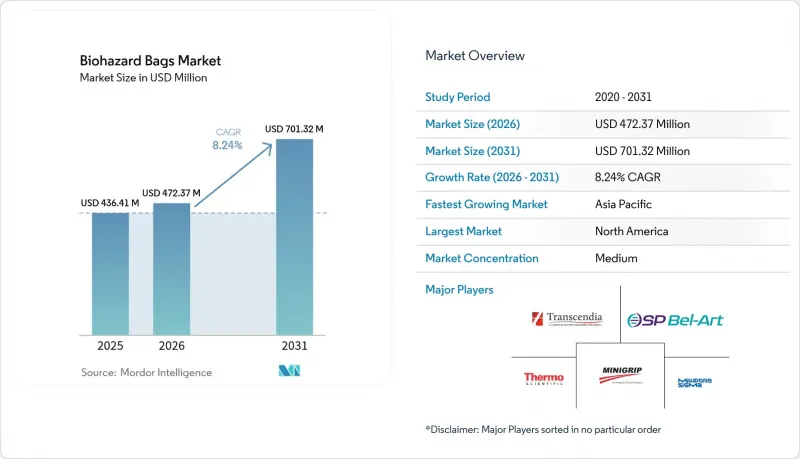
본 보고서는 제품 소재(LDPE, HDPE, 폴리프로필렌 등), 용도(감염성 폐기물, 의료(일반 의료) 폐기물 등), 최종 사용자(병원, 진단실험실 등), 지역(북미, 유럽, 아시아태평양, 중동 및 아프리카, 남미)별로 분류되어 있습니다. 시장 전망은 금액(달러) 기준으로 제시되어 있습니다.
전 세계 바이오해저드 백 시장 동향 및 인사이트
의료 폐기물 발생량 증가
현재 의료시설에서는 폐기물의 15%를 유해 폐기물로 분류하고 있으며, 이 비율은 2020년 이후에도 높은 수준을 유지하고 있습니다. 중환자실이나 응급실에서는 이전보다 더 많은 오염된 일회용 의료용품이 발생하고 있으며, 발생 원천에서의 분리 수거에 관한 세계보건기구(WHO)의 지침이 일상적인 기준으로 자리 잡고 있습니다. 이에 대응하기 위해 병원에서는 추적성, 천공 방지, 누출 방지에 관한 연방, 주 및 국제적 요건을 준수하는 색상 구분 백 시스템을 구매하고 있습니다. 취급 절차에 관한 필수 직원 교육 모듈로 인해 재주문 빈도가 더욱 높아지고 있으며, 이 요인이 생물학적 유해 물질용 백 시장의 가장 지속적인 성장 요인 중 하나가 되고 있습니다.
전 세계 의료 인프라의 확대
아시아태평양의 각국 정부는 다른 지역에서는 유례를 찾아볼 수 없는 속도로 병원, 외래 진료소, 진단센터 건설을 추진하고 있습니다. 이러한 프로젝트에서는 의료 폐기물 처리실, 자동 백 밀봉기 및 검사 지점이 시설 설계도에 포함되고 있습니다. 신규 생물제제 및 백신 공장에서는 미국 및 유럽연합(EU) 규정에 기반한 격리 사양이 채택되고 있으며, 이로 인해 더 두꺼운 폴리프로필렌 및 고밀도 폴리에틸렌 봉투에 대한 수요가 가속화되고 있습니다. 또한 건설업체와 운영 사업자는 지역 당국이 설정한 지속 가능한 조달 목표를 달성하기 위해 친환경 라벨 획득을 의무화하고 있습니다. 따라서 이러한 장기적인 투자 주기가 바이오해저드 백 시장 전반의 지속적인 수요 증가를 뒷받침하고 있습니다.
재사용 가능한 폐기물 봉쇄 시스템의 보급
순환 경제 목표를 내세우는 대규모 병원에서는 견고한 플라스틱 라이너와 밀폐형 뚜껑을 일체화한, 봉투를 사용하지 않는 카트 시스템의 시범 도입이 진행되고 있습니다. 다니엘스 헬스(Daniels Health)와 같은 기업들은 내용물을 비우고 멸균한 후 재사용할 수 있는 카세트형 날카로운 의료 폐기물 수거 용기를 판매하고 있습니다. 지속가능성 위원회는 이중 백 방식에 비해 전체 수명 주기 동안 배출량이 적고, 작업자의 부상 위험도 감소된다는 점을 지적하고 있습니다. 초기 투자와 직원에 대한 종합적인 재교육이 필요하기 때문에 도입은 주요 의료 네트워크로 제한되어 있지만, 이 대안은 생물학적 위험 폐기물 봉투 시장, 특히 저가형 적색 봉투 부문에 가격 민감성을 유발하고 있습니다.
부문 분석
2025년, 저밀도 폴리에틸렌은 생물학적 유해 폐기물 봉투 시장 점유율의 42.11%를 차지했습니다. 이는 일반적인 감염성 폐기물 처리 요건을 충족하는 입증된 유연성과 내천자성을 반영한 결과입니다. 이 소재는 비용,구입 용이성, 자동 밀봉 기계와의 호환성이 가장 중요시되는 처리량이 많은 병원 환경에서 주류를 이루고 있습니다. 그러나 폴리프로필렌은 다른 모든 수지를 계속해서 앞지르고 있으며, 폴리프로필렌 부문의 생물학적 위험 폐기물 봉투 시장 규모는 높은 내화학성, 항암 치료 폐기물 및 의약품 폐기물에 대한 적합성,및 고온 오토클레이브 사이클을 견딜 수 있는 능력 덕분에 2026년부터 2031년까지 연평균 성장률(CAGR) 10.01%로 확대될 것으로 예측됩니다.
제품 선정 경향은 변화하고 있습니다. 전문 암 센터나 생물제제 공장에서는 누출 방지 성능을 더욱 강화하기 위해 고밀도 폴리에틸렌이나 다층 공압출 구조를 지정하는 경우가 많습니다. 또한 일부 시설에서는 탄소 발자국 감소를 목적으로 폴리젖산(PLA)이나 폴리하이드록시아르카노에이트를 원료로 한 바이오 폴리머의 시범 도입도 이루어지고 있지만, 의료 규제 당국이 유해 폐기물용 백의 소재를 승인하기 전에 철저한 검증을 요구하고 있어 그 보급은 아직 초기 단계에 머물러 있습니다. 따라서 각 제조업체는 환경 보호와 ASTM 및 ISO가 의무화하는 천공, 인열, 투과성 시험 간의 균형을 맞추면서, 바이오해저드 백 시장의 핵심 성능 요건을 훼손하지 않는 범위 내에서 혁신을 지속하고 있습니다.
지역별 분석
북미는 EPA, OSHA, FDA로 구성된 확립된 규제 네트워크에 힘입어 2025년에도 매출 점유율 38.12%를 유지하며 계속해서 선두 자리를 지켰습니다. 병원에서는 폐기물 추적 정확성을 확보하고 ASTM D1709의 천공 기준을 충족하는 백을 구매하기 위해 규정 준수를 위한 전용 예산을 배정하고 있습니다. 각 주에서 ‘유해 폐기물 발생자 개선 규정(Hazardous Waste Generator Improvements Rule)’을 도입함에 따라 문서화 요건이 통일되고, 표준화된 라이너 사용이 더욱 정착되어 미국 및 캐나다 전역에서 수요가 유지되고 있습니다. 성장률은 개발도상 지역에 비해 완만하지만, 교체 주기, 지방 진료소에 대한 레드백 보조금, 그리고 폐기물 관리 서비스 제공업체 간의 통합으로 인해 시장의 활기는 유지되고 있습니다.
아시아태평양은 가장 역동적인 성장세를 이끌고 있습니다. 새로운 입원 병상, 암 치료 센터, 투석 시설, 백신 제조 공장에 대한 정부의 자금 지원에 따라, 미국 및 유럽연합(EU)의 지침을 모델로 한 폐기물 분리 수거에 관한 의무적 지침이 도입되고 있습니다. 정부가 이러한 규정을 시행함에 따라 조달 팀은 봉투의 최소 두께, 폐기물 분류별 봉투 색상, 추적 기능을 사양으로 정하고 있습니다. 현지 제조업체들은 생산을 확대하고 있지만, 고사양 주문에 대해서는 여전히 고품질의 수입품이 주류를 이루고 있어, 국경을 넘는 공급망이 생물학적 위험 폐기물 봉투 시장에서 필수적인 요소로 자리 잡고 있습니다. 도시 인구 증가에 따라 의료비가 증가하고 있어, 아시아태평양의 연평균 성장률(CAGR) 9.34%는 향후 10년 동안 유지될 전망입니다.
유럽은 ‘그린 딜’ 정책에 따른 인센티브와 엄격한 순환 경제 목표 덕분에 중요한 시장 지위를 유지하고 있습니다. 병원에서는 저탄소형 및 재사용 가능한 폐기물 시스템의 시범 운영이 진행되고 있지만, 감염 예방이 최우선시되기 때문에 고위험 폐기물 흐름에 대해서는 여전히 일회용 라이너가 정착되어 있습니다. 유럽화학물질청(ECHA) 등 규제 당국은 할로겐계 플라스틱에 관한 지침을 빈번히 갱신하고 있으며, 제조업체들은 이에 따라 배합을 조정하고 있습니다. 중동 및 아프리카에서는 걸프 국가들이 서유럽식 폐기물 처리실을 갖춘 교육 병원을 잇달아 개설하고 있어, 완만하기는 하지만 성장 속도가 가속화되고 있습니다. 한편, 남미에서는 공립 병원이 개정된 폐기물 처리법을 준수하기 위해 설비를 갱신하고 있어 꾸준한 개선이 나타나고 있습니다.
기타 혜택:
- 엑셀 형식 시장 예측(ME) 시트
- 3개월간의 애널리스트 지원
자주 묻는 질문
목차
제1장 서론
제2장 조사 방법
제3장 주요 요약
제4장 시장 구도
제5장 시장 규모와 성장 예측
제6장 경쟁 구도
제7장 시장 기회와 향후 전망
JHS 26.08.26According to Mordor Intelligence, the biohazard bags market size was valued at USD 436.41 million in 2025 and estimated to grow from USD 472.37 million in 2026 to reach USD 701.32 million by 2031, at a CAGR of 8.24% during the forecast period (2026-2031).
This report is Segmented by Product Material (LDPE, HDPE, Polypropylene, and More), Application (Infectious Waste, Healthcare (General Medical) Waste, and More), End User (Hospitals, Diagnostic Laboratories, and More), Geography (North America, Europe, Asia-Pacific, The Middle East and Africa, and South America). The Market Forecasts are Provided in Terms of Value (USD).
Global Biohazard Bags Market Trends and Insights
Accelerating Generation of Biomedical Waste
Healthcare facilities now classify 15% of waste as hazardous, a share that remains elevated after 2020. Intensive care units and emergency departments generate larger volumes of contaminated disposables than before, and the World Health Organization's guidance on point-of-generation segregation has become a routine benchmark. Hospitals respond by purchasing colour-coded bag systems that align with federal, state and international requirements for traceability, puncture resistance and leak protection. Mandatory staff-training modules on handling procedures further increase reorder frequency, making this factor one of the most durable growth contributors for the biohazard bags market.
Expansion of Global Healthcare Infrastructure
Asia-Pacific governments are commissioning hospitals, outpatient clinics and diagnostic hubs at a pace unmatched elsewhere. These projects embed medical-waste rooms, automated bag-sealers and inspection points into facility blueprints. New plants for biologics and vaccines use containment specifications based on United States and European Union rules, which accelerates demand for thicker-gauge polypropylene and high-density polyethylene bags. Builders and operators also stipulate eco-labels as they move toward sustainable procurement targets set by regional authorities. The long-term investment cycle therefore feeds continuous volume growth across the biohazard bags market.
Availability of Reusable Waste Containment Systems
Large hospitals adopting circular-economy objectives trial bag-less cart systems that integrate solid plastic linings and sealed lids. Firms such as Daniels Health market cassette-style sharps units that can be emptied, sterilized and redeployed. Sustainability committees note lower cradle-to-grave emissions and reduced worker-injury risk compared with double-bag techniques. Initial capital outlay and comprehensive staff retraining limit adoption to major networks, yet the option introduces price sensitivity within the biohazard bags market, particularly for low-value red bags.
Other drivers and restraints analyzed in the detailed report include:
- Stricter Regulatory Compliance for Hazardous Waste Segregation
- Rising Adoption of Single-Use Medical Consumables
- Volatility in Polyethylene Raw Material Prices
For complete list of drivers and restraints, kindly check the Table Of Contents.
Segment Analysis
Low-density polyethylene commanded 42.11% of the biohazard bags market share in 2025, reflecting its proven flexibility and puncture-resistance attributes that satisfy general infectious-waste handling requirements. The material dominates high-throughput hospital settings where cost, availability and automated-sealing compatibility matter most. However, polypropylene continues to outpace all other resins, and the biohazard bags market size for the polypropylene segment is projected to expand at 10.01% CAGR between 2026 and 2031 thanks to its higher chemical-resistance threshold, suitability for chemotherapeutic and pharmaceutical waste and ability to withstand high-temperature autoclave cycles.
The preference landscape is evolving. Specialized cancer centers and biologics plants often specify high-density polyethylene or multilayer co-extruded structures to secure extra leak resistance. A niche group of facilities is also piloting biopolymers derived from polylactic acid or polyhydroxyalkanoate, aiming to lower carbon footprints, yet uptake remains embryonic because healthcare regulators require exhaustive validation before approving bag materials for hazardous waste. Manufacturers are therefore balancing environmental claims with mandatory ASTM and ISO puncture, tear and transmissibility testing, ensuring that innovation continues without undermining the core performance expectations of the biohazard bags market.
Complete Report Scope:
- By Product Material
- LDPE
- HDPE
- Polypropylene
- Cellophane
- Other Product Materials
- By Application
- Infectious Waste
- Healthcare (General Medical) Waste
- Chemical & Pharmaceutical Waste
- Other Applications
- By End User
- Hospitals
- Diagnostic Laboratories
- Pharmaceutical & Biologics Manufacturing
- Other End Users
- Geography
- North America
- United States
- Canada
- Mexico
- Europe
- Germany
- United Kingdom
- France
- Italy
- Spain
- Rest of Europe
- Asia-Pacific
- China
- Japan
- India
- Australia
- South Korea
- Rest of Asia-Pacific
- Middle East & Africa
- GCC
- South Africa
- Rest of Middle East & Africa
- South America
- Brazil
- Argentina
- Rest of South America
- North America
Geography Analysis
North America retained leadership with a 38.12% revenue share in 2025, anchored by a well-established regulatory network comprising the EPA, OSHA and FDA. Hospitals allocate dedicated compliance budgets to ensure waste-tracking accuracy and purchase bags meeting ASTM D1709 puncture standards. States' uptake of the Hazardous Waste Generator Improvements Rule harmonizes documentation requirements, further embedding standardized liner use and sustaining demand across the United States and Canada. While growth is slower than in developing regions, replacement cycles, red-bag subsidies for rural clinics and consolidation among waste-management service providers preserve market vibrancy.
Asia-Pacific contributes the most dynamic growth storyline. Government funding for new inpatient beds, oncology centers, dialysis units and vaccine plants is accompanied by mandatory waste-segregation guidelines modeled on United States and European Union directives. As governments implement these rules, procurement teams specify minimum bag thickness, bag color by waste class and traceability features. Local manufacturers ramp production, yet premium imports still dominate high-spec orders, ensuring cross-border supply chains form an integral part of the biohazard bags market. With healthcare expenditure rising alongside urban population growth, Asia-Pacific's 9.34% CAGR is likely to remain intact this decade.
Europe maintains a significant market position thanks to Green Deal policy incentives and stringent circular-economy objectives. Hospitals are piloting low-carbon or reusable waste systems, yet infection-prevention priorities keep single-use liners firmly in place for high-risk waste streams. Regulatory authorities such as the European Chemicals Agency frequently update guidance on halogenated plastics, prompting manufacturers to adjust formulations. The Middle East and Africa display moderate yet accelerating growth as Gulf states commission teaching hospitals with Western-style waste rooms, while South America records steady improvement as public-sector hospitals upgrade to meet revised waste-handling laws.
- Thermo Fisher Scientific
- SP Bel-Art
- International Plastics Inc.
- Inteplast Group (Minigrip)
- Merck KGaA (MilliporeSigma)
- Transcendia Inc.
- Champion Plastics
- Desco Medical
- Welpack Industries Pvt. Ltd
- Propper Manufacturing Co.
- Daniels Health
- Stericycle Inc.
- Lithey Inc.
- BioMedical Waste Solutions LLC
- Dana Poly Inc.
- Plasti-Med (Turkey)
- PacMed Labs
- Safetec of America
- Jiangsu Huanxin High-Tech Materials Co.
Additional Benefits:
- The market estimate (ME) sheet in Excel format
- 3 months of analyst support
TABLE OF CONTENTS
1 Introduction
- 1.1 Study Assumptions & Market Definition
- 1.2 Scope of the Study
2 Research Methodology
3 Executive Summary
4 Market Landscape
- 4.1 Market Overview
- 4.2 Market Drivers
- 4.2.1 Accelerating Generation Of Biomedical Waste
- 4.2.2 Expansion Of Global Healthcare Infrastructure
- 4.2.3 Stricter Regulatory Compliance For Hazardous Waste Segregation
- 4.2.4 Rising Adoption Of Single-Use Medical Consumables
- 4.2.5 Growth Of Pharmaceutical And Biologics Manufacturing
- 4.2.6 Increasing Public Health Awareness Of Infection Control
- 4.3 Market Restraints
- 4.3.1 Availability Of Reusable Waste Containment Systems
- 4.3.2 Volatility In Polyethylene Raw Material Prices
- 4.3.3 Emerging Bans On Single-Use Plastics
- 4.3.4 High Capital Requirements For Waste Treatment Compliance
- 4.4 Regulatory Landscape
- 4.5 Porter's Five Forces Analysis
- 4.5.1 Threat of New Entrants
- 4.5.2 Bargaining Power of Buyers
- 4.5.3 Bargaining Power of Suppliers
- 4.5.4 Threat of Substitutes
- 4.5.5 Intensity of Competitive Rivalry
5 Market Size & Growth Forecasts (Value, USD)
- 5.1 By Product Material
- 5.1.1 LDPE
- 5.1.2 HDPE
- 5.1.3 Polypropylene
- 5.1.4 Cellophane
- 5.1.5 Other Product Materials
- 5.2 By Application
- 5.2.1 Infectious Waste
- 5.2.2 Healthcare (General Medical) Waste
- 5.2.3 Chemical & Pharmaceutical Waste
- 5.2.4 Other Applications
- 5.3 By End User
- 5.3.1 Hospitals
- 5.3.2 Diagnostic Laboratories
- 5.3.3 Pharmaceutical & Biologics Manufacturing
- 5.3.4 Other End Users
- 5.4 Geography
- 5.4.1 North America
- 5.4.1.1 United States
- 5.4.1.2 Canada
- 5.4.1.3 Mexico
- 5.4.2 Europe
- 5.4.2.1 Germany
- 5.4.2.2 United Kingdom
- 5.4.2.3 France
- 5.4.2.4 Italy
- 5.4.2.5 Spain
- 5.4.2.6 Rest of Europe
- 5.4.3 Asia-Pacific
- 5.4.3.1 China
- 5.4.3.2 Japan
- 5.4.3.3 India
- 5.4.3.4 Australia
- 5.4.3.5 South Korea
- 5.4.3.6 Rest of Asia-Pacific
- 5.4.4 Middle East & Africa
- 5.4.4.1 GCC
- 5.4.4.2 South Africa
- 5.4.4.3 Rest of Middle East & Africa
- 5.4.5 South America
- 5.4.5.1 Brazil
- 5.4.5.2 Argentina
- 5.4.5.3 Rest of South America
- 5.4.1 North America
6 Competitive Landscape
- 6.1 Market Concentration
- 6.2 Market Share Analysis
- 6.3 Company Profiles (includes Global level Overview, Market level overview, Core Business Segments, Financials, Headcount, Key Information, Market Rank, Market Share, Products and Services, and analysis of Recent Developments)
- 6.3.1 Thermo Fisher Scientific
- 6.3.2 SP Bel-Art
- 6.3.3 International Plastics Inc.
- 6.3.4 Inteplast Group (Minigrip)
- 6.3.5 Merck KGaA (MilliporeSigma)
- 6.3.6 Transcendia Inc.
- 6.3.7 Champion Plastics
- 6.3.8 Desco Medical India
- 6.3.9 Welpack Industries Pvt. Ltd
- 6.3.10 Propper Manufacturing Co.
- 6.3.11 Daniels Health
- 6.3.12 Stericycle Inc.
- 6.3.13 Lithey Inc.
- 6.3.14 BioMedical Waste Solutions LLC
- 6.3.15 Dana Poly Inc.
- 6.3.16 Plasti-Med (Turkey)
- 6.3.17 PacMed Labs
- 6.3.18 Safetec of America
- 6.3.19 Jiangsu Huanxin High-Tech Materials Co.
7 Market Opportunities & Future Outlook
- 7.1 White-space & Unmet-need Assessment


