

|
시장보고서
상품코드
2115022
채혈용 란셋 시장 : 시장 점유율 분석, 업계 동향 및 통계, 성장 예측(2026-2031년)Blood Lancet - Market Share Analysis, Industry Trends & Statistics, Growth Forecasts (2026 - 2031) |
||||||
 Mordor Intelligence
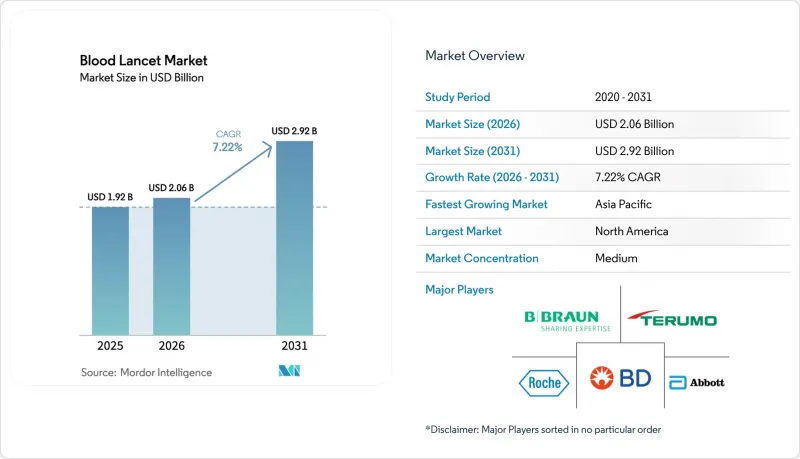
Mordor Intelligence에 의하면, 채혈용 란셋 시장 규모는 2025년에 19억 2,000만 달러로 평가되었고, 2026년 20억 6,000만 달러에서 2031년까지 29억 2,000만 달러에 이를 것으로 예측되며, 예측 기간(2026-2031년) CAGR은 7.22%를 나타낼 전망입니다.
본 보고서는 제품 유형별(안전 랜셋, 표준/개인용 랜셋), 최종 사용자별(병원, 혈액은행, 진단실험실, 재택 간호, 기타), 용도별(혈당 측정, 헤모글로빈 측정, 기타) 및 지역별(북미, 유럽, 아시아태평양, 중동 및 아프리카, 남미)로 분류되어 있습니다. 시장 전망은 금액(달러) 기준으로 제시되어 있습니다.
세계의 채혈용 랜셋 시장 동향 및 인사이트
당뇨병 및 기타 만성 질환 유병률 증가
2024년에는 5억 8,870만 명 이상의 성인이 당뇨병을 앓고 있으며, 이 수치는 2050년까지 8억 5,250만 명에 달할 것으로 예측됩니다. 신흥 지역의 미치료 환자층은 모세혈관 혈액 모니터링의 거대한 잠재 시장을 개척하는 한편, 선진국의 고령화에 따라 동반 질환이 증가함에 따라 환자 1인당 란셋 사용량도 증가하고 있습니다. OECD 국가들의 1차 의료 체계에 통합된 정기적인 선별 검사가 기초적인 수요를 확보하고 있으며, 인도와 중국의 국가 주도 추진 프로그램에 힘입어 2030년까지 출하량이 급증할 것으로 전망됩니다. 만성 신장 질환 및 심혈관 질환의 유병률 상승으로 인해 다항목 손가락 채혈 검사가 표준적인 추적 진단으로 자리 잡음에 따라, 채혈용 란셋 시장은 더욱 확대될 전망입니다.
현장 진단(Point-of-Care)의 보급 확대
분산형 검사 모델은 검사 결과 보고까지의 시간을 단축하고 치료상의 의사결정을 개선하기 때문에 응급실, 외래 진료 센터 및 지방 진료소가 일회용 랜싯을 일괄 구매하도록 촉진하고 있습니다. 배낭 키트에 들어갈 수 있는 휴대용 분석 기기를 통해 의료 서비스가 미치지 않는 지역에 대한 지원이 가능해지면서, 환자 1인당 검사 빈도가 비약적으로 증가하고 있습니다. 가정용 혈당 및 헤모글로빈 측정 기기에 대한 FDA의 패스트트랙 승인 절차는 소비자의 자가 검사를 정당화하는 것이며, 민간 보험사의 가정용 키트에 대한 보험 적용도 증가하고 있어 소매 약국 수요가 촉진되고 있습니다. 정맥 천자 횟수의 감소, 검사 시료 배송 비용 절감, 즉각적인 약물 조정 등 통합된 워크플로우의 이점으로 인해, 채혈용 란셋 시장은 병상 진단(bedside diagnosis)의 기반이 되는 공급 라인으로서의 입지를 확고히 하고 있습니다.
란셋의 재사용 및 부적절한 폐기로 인한 감염 위험
WHO의 주사 안전 캠페인에서는 부적절한 날카로운 물체 폐기가 혈액 매개 병원체의 주요 감염 경로 중 하나로 지적되고 있습니다. 진료소에서는 찔림 사고 방지용 쓰레기통 설치나 인증된 소각 계약 체결이 의무화됨에 따라 규정 준수 비용이 상승하고 있으며, 저소득 지역에서는 재량 예산이 압박받고 있습니다. 의료 종사자의 부상과 관련된 소송으로 인해 의료 기관의 위험 회피 태도가 강화되면서, 조달 과정에서 더 고가의 리트랙터블형으로의 전환이 진행되고 있어, 기본적인 금속 날 제품의 이익률이 압박받고 있습니다.
부문 분석
2025년, 안전 랜싯은 채혈용 란셋 시장 규모의 60.74%를 차지한 것으로 평가되었으며, 이는 병원 공급망에서 날카로운 물건에 의한 부상 방지 프로토콜의 의무화를 반영한 것입니다. 수축식 디자인은 배상 책임 위험과 산재 보상 청구를 줄여주기 때문에 의료 기관의 구매 담당자들은 더 높은 단가를 수용하고 있습니다. 표준형 또는 개인용 랜싯은 평균 가격이 35% 낮은 반면, 원격 의료 상담 및 시판되는 당뇨병 검사 키트로 인해 가정 내 검사가 정착됨에 따라 연평균 성장률(CAGR) 8.05%라는 가장 빠른 판매량 증가를 보이고 있습니다.
미국 및 서유럽의 병원에서는 ISO 인증을 획득한 안전 모델을 우선적으로 채택하는 3년 공급 계약이 체결되어 있어, 이를 통해 시장을 선도하는 기업들에게 예측 가능한 수익원이 확보되고 있습니다. 한편, 아시아의 전자상거래 채널에서는 선명한 색상, 인체공학적으로 설계된 그립, 그리고 자가 관리를 하는 소비자들에게 어필하는 대용량 리필 팩이 판매되고 있습니다. 보호 슬리브와 경제적인 스프링 시스템을 결합한 하이브리드 SKU는 저-중소득층 진료소를 대상으로 하고 있으며, 이는 채혈용 란셋 시장의 향후 융합 추세를 시사합니다.
지역별 분석
북미의 채혈용 란셋 시장 규모는 2025년 매출 점유율 41.88%로 1위를 차지했습니다. 이는 안전 소모품에 대한 메디케어 환급 및 재택 당뇨병 의료용품에 대한 광범위한 보험 적용에 힘입은 결과입니다. 미국의 병원에서는 환자 만족도 향상과 의료 종사자의 안전 관련 소송을 피하기 위해 통증을 최소화한 랜셋을 일상적으로 채택하고 있습니다. 캐나다 각 주의 의료 보험 제도에서는 지역 약국을 채혈 거점으로 활용하고, 보조금을 지원받은 랜셋 스타터 키트를 배포함으로써 기본적인 수요를 유지하고 있습니다.
아시아태평양은 가장 빠르게 성장하고 있는 지역으로, 인도의 국가 비전염성 질환(NCD) 프로그램에 따른 농촌 지역의 검진 확대와 중국의 도시 지역 클리닉에서 원격 모니터링 플랫폼 도입을 배경으로, 2031년까지 연평균 성장률(CAGR) 8.25%가 예상됩니다. 인도네시아에서는 민관 파트너십을 통해 각 주의 보건소에 저비용 안전 랜싯이 공급되고 있는 반면, 일본에서는 고령화 사회가 진행됨에 따라 요양 시설에서의 일일 모세혈관 검사 건수가 증가하고 있습니다. 환율 헤지가 포함된 계약 구조와 현지 블레이드 가공에 대한 투자를 통해 다국적 공급업체들은 해당 지역의 원자재 가격 급등으로부터 보호받고 있습니다.
유럽에서는 NHS 공급망과 같은 견고한 조달 컨소시엄을 통해 안정적인 시장 점유율을 유지하고 있으며, 이러한 컨소시엄은 환경 기준을 충족하는 의료기기에 대해 입찰 할당량을 확보하고 있습니다. 날카로운 폐기물에 관한 지침에 따라 생분해성 부품의 채택이 촉진되어, 폴리머 분야의 혁신 기업들에게 틈새 시장 기회가 생겨나고 있습니다. 남미의 성장은 브라질의 통합 보건 시스템 업그레이드와 아르헨티나의 수입 대체 장려책을 중심으로 전개되고 있는 반면, 걸프협력회의(GCC) 회원국에서는 의료 관광객을 대상으로 한 고급 마이크로니들 키트가 조달되고 있습니다. 전반적으로, 지역별 상환 제도와 규제 동향이 맞물려 채혈용 란셋 시장을 확대시키는 동시에, 획일적인 제품 전략을 억제하는 요인으로 작용하고 있습니다.
기타 혜택 :
- 엑셀 형식 시장 예측(ME) 시트
- 3개월간의 애널리스트 지원
자주 묻는 질문
목차
제1장 서론
제2장 조사 방법
제3장 주요 요약
제4장 시장 구도
제5장 시장 규모 및 성장 예측
제6장 경쟁 구도
제7장 시장 기회 및 향후 전망
AJY 26.08.28According to Mordor Intelligence, the blood lancet market size was valued at USD 1.92 billion in 2025 and estimated to grow from USD 2.06 billion in 2026 to reach USD 2.92 billion by 2031, at a CAGR of 7.22% during the forecast period (2026-2031).
This report is Segmented by Product Type (Safety Lancets, Standard/Personal-use Lancets), End User (Hospitals, Blood Banks, Diagnostic Laboratories, Home Care, Others), Application (Glucose Testing, Hemoglobin Testing, Others), and Geography (North America, Europe, Asia-Pacific, Middle East and Africa, South America). The Market Forecasts are Provided in Terms of Value (USD).
Global Blood Lancet Market Trends and Insights
Rising Diabetes and Other Chronic Disease Incidence
More than 588.7 million adults were living with diabetes in 2024, a number projected to hit 852.5 million by 2050. Untreated populations in emerging regions open a sizable addressable pool for capillary-blood monitoring, while aging demographics in developed economies multiply per-patient lancet use as comorbidities rise. Routine screening embedded in primary care pathways across OECD countries secures baseline demand, and national drive programs in India and China lift unit shipments sharply through 2030. Elevated chronic kidney and cardiovascular disease prevalence further widens the Blood lancet market as multiparameter finger-prick panels become standard follow-up diagnostics.
Growing Adoption of Point-of-Care Diagnostics
Decentralized testing models shorten turnaround times and improve therapeutic decision-making, prompting emergency rooms, ambulatory centers, and rural clinics to bulk-purchase disposable lancets. Portable analyzers that fit into backpack kits enable outreach in underserved zones, multiplying test frequency over a single patient episode. FDA fast-track pathways for at-home glucose and haemoglobin devices legitimize consumer self-testing, and private insurers increasingly reimburse home-based kits, stimulating retail-pharmacy demand. Integrated workflow benefits-fewer venipunctures, lower lab courier costs, immediate drug titration-cement the Blood lancet market as a foundational supply line for bedside diagnostics.
Infection Risk from Lancet Reuse and Poor Disposal
WHO injection-safety campaigns spotlight improper sharps disposal as a leading vector for blood-borne pathogen transmission. Compliance costs rise as clinics must provide puncture-proof bins and certified incineration agreements, eroding discretionary budgets in low-income regions. Litigation linked to healthcare-worker injuries heightens institutional risk aversion, pushing procurement toward costlier retractable models and compressing margins for basic metal-blade lines.
Other drivers and restraints analyzed in the detailed report include:
- Favorable Reimbursement Policies in OECD Nations
- Expansion of Blood-Donation & Screening Programs
- Emergence of Non-Invasive Glucose-Monitoring Devices
For complete list of drivers and restraints, kindly check the Table Of Contents.
Segment Analysis
Safety lancets captured 60.74% of Blood lancet market size in 2025, reflecting mandatory sharps-injury prevention protocols in hospital supply chains. Institutional buyers accept higher unit prices because retractable designs lower liability exposures and workers' compensation claims. Standard or personal-use lancets, while priced 35% lower on average, deliver the fastest volume growth at an 8.05% CAGR as tele-health consults and over-the-counter diabetes packages normalize home testing routines.
Hospitals in the United States and Western Europe lock three-year supply contracts that favor ISO-certified safety models, safeguarding predictable revenue streams for market leaders. Meanwhile, e-commerce channels in Asia promote vivid color variants, ergonomic grips, and bulk refill packs that appeal to self-managing consumers. Hybrid SKUs merging protective sleeves with economical spring systems target low-to-mid income clinics, signaling future convergence within the Blood lancet market .
Complete Report Scope:
- By Product Type
- Safety Lancets
- Standard / Personal-use Lancets
- By End User
- Hospitals
- Blood Banks
- Diagnostic Laboratories
- Home Care
- Others
- By Application
- Glucose Testing
- Haemoglobin Testing
- Others
- By Geography
- North America
- United States
- Canada
- Mexico
- Europe
- Germany
- United Kingdom
- France
- Italy
- Spain
- Rest of Europe
- Asia-Pacific
- China
- Japan
- India
- Australia
- South Korea
- Rest of Asia-Pacific
- Middle East and Africa
- GCC
- South Africa
- Rest of Middle East and Africa
- South America
- Brazil
- Argentina
- Rest of South America
- North America
Geography Analysis
North America's Blood lancet market size leads with a 41.88% revenue share in 2025, anchored by Medicare reimbursement for safety consumables and widespread insurance coverage for at-home diabetes supplies. Hospitals in the United States routinely adopt pain-minimized lancets to bolster patient satisfaction metrics and avert worker-safety litigation. Canadian provincial health plans deploy community-pharmacy collection hubs that distribute subsidized lancet starter kits, sustaining baseline demand.
Asia-Pacific is the fastest-growing region, projecting an 8.25% CAGR through 2031 as India's national non-communicable disease (NCD) program scales rural screening and China's urban clinics adopt tele-monitoring platforms. Public-private partnerships supply low-cost safety lancets in Indonesia's provincial health posts, while Japan's aging society pushes daily capillary testing volumes upward in long-term-care homes. Currency-hedged contract structures and local blade machining investments protect multinational suppliers from raw-material price shocks in the region.
Europe maintains stable share through robust procurement consortia such as NHS Supply Chain, which reserve tender slabs for environmentally compliant devices. Sharps-waste directives incentivize biodegradable components, opening niche opportunities for polymer innovators. South America's growth revolves around Brazilian Unified Health System upgrades and Argentina's import-substitution incentives, whereas Gulf Cooperation Council states procure premium microneedle kits aimed at medical tourists. Overall, region-specific reimbursement and regulation patterns collectively broaden the Blood lancet market while tempering one-size-fits-all product strategies.
- Becton Dickinson & Co.
- Roche
- Abbott Laboratories
- Terumo Corp.
- B. Braun
- Owen Mumford
- HTL-Strefa S.A.
- Ypsomed
- Nipro Corp.
- Greiner Bio-One GmbH
- SteriLance Medical
- Intrinsyk LLC
- Arkray
- Amkay Products Pvt Ltd
- Sarstedt
- HTD Medical Inc.
- AgaMatrix
- Feiner Technology Inc.
- Sterimed (Sagard)
- Lifescan
Additional Benefits:
- The market estimate (ME) sheet in Excel format
- 3 months of analyst support
TABLE OF CONTENTS
1 Introduction
- 1.1 Study Assumptions & Market Definition
- 1.2 Scope of the Study
2 Research Methodology
3 Executive Summary
4 Market Landscape
- 4.1 Market Overview
- 4.2 Market Drivers
- 4.2.1 Rising diabetes & other chronic-disease incidence
- 4.2.2 Growing adoption of point-of-care diagnostics
- 4.2.3 Favourable reimbursement policies in OECD nations
- 4.2.4 Expansion of blood-donation & screening programs
- 4.2.5 Painless microneedle innovations boosting paediatric compliance
- 4.2.6 Home-based genetic / tele-health finger-prick kits surge
- 4.3 Market Restraints
- 4.3.1 Infection risk from lancet reuse & poor disposal
- 4.3.2 Emergence of non-invasive glucose-monitoring devices
- 4.3.3 Sharps-waste environmental regulations raising costs
- 4.3.4 Medical-grade stainless-steel supply bottlenecks
- 4.4 Value / Supply-Chain Analysis
- 4.5 Technological Outlook
- 4.6 Regulatory Landscape
- 4.7 Porter's Five Forces Analysis
- 4.7.1 Threat of New Entrants
- 4.7.2 Bargaining Power of Buyers
- 4.7.3 Bargaining Power of Suppliers
- 4.7.4 Threat of Substitutes
- 4.7.5 Competitive Rivalry
5 Market Size & Growth Forecasts (Value, USD)
- 5.1 By Product Type
- 5.1.1 Safety Lancets
- 5.1.2 Standard / Personal-use Lancets
- 5.2 By End User
- 5.2.1 Hospitals
- 5.2.2 Blood Banks
- 5.2.3 Diagnostic Laboratories
- 5.2.4 Home Care
- 5.2.5 Others
- 5.3 By Application
- 5.3.1 Glucose Testing
- 5.3.2 Haemoglobin Testing
- 5.3.3 Others
- 5.4 By Geography
- 5.4.1 North America
- 5.4.1.1 United States
- 5.4.1.2 Canada
- 5.4.1.3 Mexico
- 5.4.2 Europe
- 5.4.2.1 Germany
- 5.4.2.2 United Kingdom
- 5.4.2.3 France
- 5.4.2.4 Italy
- 5.4.2.5 Spain
- 5.4.2.6 Rest of Europe
- 5.4.3 Asia-Pacific
- 5.4.3.1 China
- 5.4.3.2 Japan
- 5.4.3.3 India
- 5.4.3.4 Australia
- 5.4.3.5 South Korea
- 5.4.3.6 Rest of Asia-Pacific
- 5.4.4 Middle East and Africa
- 5.4.4.1 GCC
- 5.4.4.2 South Africa
- 5.4.4.3 Rest of Middle East and Africa
- 5.4.5 South America
- 5.4.5.1 Brazil
- 5.4.5.2 Argentina
- 5.4.5.3 Rest of South America
- 5.4.1 North America
6 Competitive Landscape
- 6.1 Market Concentration
- 6.2 Market Share Analysis
- 6.3 Company Profiles (includes Global Overview, Market level overview, Core Segments, Financials, Strategic Info, Market Rank/Share, Products & Services, Recent Developments)
- 6.3.1 Becton Dickinson & Co.
- 6.3.2 F. Hoffmann-La Roche Ltd
- 6.3.3 Abbott Laboratories
- 6.3.4 Terumo Corp.
- 6.3.5 B. Braun Melsungen AG
- 6.3.6 Owen Mumford Ltd
- 6.3.7 HTL-Strefa S.A.
- 6.3.8 Ypsomed AG
- 6.3.9 Nipro Corp.
- 6.3.10 Greiner Bio-One GmbH
- 6.3.11 SteriLance Medical (Suzhou) Inc.
- 6.3.12 Intrinsyk LLC
- 6.3.13 ARKRAY Inc.
- 6.3.14 Amkay Products Pvt Ltd
- 6.3.15 Sarstedt AG & Co. KG
- 6.3.16 HTD Medical Inc.
- 6.3.17 AgaMatrix Inc.
- 6.3.18 Feiner Technology Inc.
- 6.3.19 Sterimed (Sagard)
- 6.3.20 LifeScan Inc.
7 Market Opportunities & Future Outlook
- 7.1 White-space & Unmet-Need Assessment


