

|
시장보고서
상품코드
2115024
생체활성 상처 드레싱 시장 : 점유율 분석, 업계 동향과 통계, 성장 예측(2026-2031년)Bioactive Wound Dressing - Market Share Analysis, Industry Trends & Statistics, Growth Forecasts (2026 - 2031) |
||||||
 Mordor Intelligence
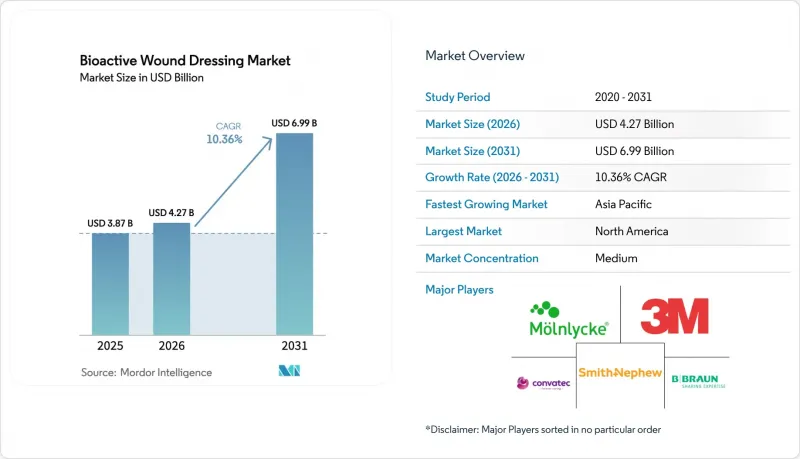
Mordor Intelligence에 의하면, 2026년 생체활성 상처 드레싱 시장 규모는 42억 7,000만 달러로 추정되고 있어 2025년 38억 7,000만 달러에서 확대해, 2031년에는 69억 9,000만 달러에 이를 것으로 예측됩니다.
2026년부터 2031년까지의 연평균 성장률(CAGR)은 10.36%가 될 것으로 전망됩니다.
본 보고서는 제품별(하이드로콜로이드, 알지네이트 드레싱, 피부 대체재, 항균 드레싱 등), 용도별(외과적·외상성 상처, 화상 등), 최종 사용자별(입원 시설, 외래·통원 시설, 재택치료), 지역별로 분류되어 있습니다. 시장 규모 및 전망은 금액(달러) 기준으로 제시되어 있습니다.
전 세계 생체활성 상처 드레싱 시장 동향 및 인사이트
만성 상처 및 당뇨병의 부담 증가
현재 전 세계적으로 5억 3,700만 명 이상의 성인이 당뇨병을 앓고 있으며, 그중 15-25%가 당뇨병성 족부 궤양을 앓고 있습니다. 이로 인해 거즈에 비해 치유 기간을 30-40% 단축할 수 있는 첨단 솔루션에 대한 지속적인 수요가 발생하고 있습니다. 만성 상처는 670만 명의 미국인을 괴롭히고 있으며, 연간 500억 달러의 직접적인 치료비가 소요됩니다. 증거에 따르면, 혈소판 농축 혈장(PRP) 드레싱은 12주 만에 65%의 완전 폐쇄를 달성하는 반면, 표준 치료는 40%에 그칩니다. 이러한 임상적 우위는 높은 가격 책정을 정당화하며, 특히 노화에 따라 치유 능력이 저하되는 고령 환자들 사이에서 의사의 채택을 촉진하고 있습니다.
생체재료 과학 분야의 급속한 혁신(하이드로겔, 알긴산염 복합재료)
차세대 하이드로겔은 자가 복구 특성을 가지고 있어, 몇 시간 이내에 구조적 완전성의 최대 90%를 회복시킵니다. 한편, 고순도 알긴산염의 추출로 생체 적합성이 향상되었으며, 기존공급 병목 현상도 해소되었습니다. 스마트 반응성 폴리머는 상처 부위의 수분, pH 및 포도당 농도 구배를 조절하여, 임상시험에서 상피화를 25% 가속화하는 것으로 확인되었습니다. 은과 구리를 함유한 항균성 나노섬유는 조직 재생을 저해하지 않으면서 감염을 억제하며, 나노다이아몬드 첨가제는 만성 사례에서 기계적 강도를 높입니다.
기존 드레싱과 비교했을 때 제품의 높은 비용
첨단 드레싱의 단가는 개당 50-200달러인 반면, 표준 거즈의 비용은 5달러 미만이므로 비용을 중시하는 의료 제공업체에게는 장벽이 되고 있습니다. 2025년 의사 보수 일정에 따라 평균 환급액이 2.93% 삭감됨에 따라, 병원들은 고가 제품의 도입을 정당화해야 할 필요에 직면해 있습니다. 치료 기간 전체에 걸쳐 30-40%의 비용 절감 효과가 입증되었음에도 불구하고, 저소득 국가에서의 도입률은 최대 70%나 뒤처져 있습니다.
부문 분석
스마트 생체전자 드레싱은 가장 빠르게 성장하는 제품군으로, 연평균 성장률(CAGR) 10.95%로 확대되며 생체활성 상처 드레싱 시장에서의 점유율을 서서히 높이고 있습니다. 한편, 피부 대체재는 임상 현장에서의 높은 인지도와 광범위한 보험 적용 범위로 인해 2025년에도 생체활성 상처 드레싱 시장에서 42.78%의 점유율을 유지했습니다. 피부 대체재를 활용한 생체활성 상처 드레싱 시장 규모는 2025년에 16억 6,000만 달러에 달하며, 긍정적인 임상시험 결과를 바탕으로 지속적인 성장세를 보이고 있습니다.
기존 하이드로콜로이드 및 알긴산 시트는 수술 건수가 많은 사례에서 여전히 주력 제품이지만, 상품화 및 이익률 압박에 직면해 있습니다. 콜라겐 및 키토산 드레싱은 특히 재건 수술에서 조직 재생 효과로 인해 지지를 얻고 있습니다. 지속가능성에 대한 우려로 인해 세균 셀룰로오스나 식물 유래 대체 제품에 대한 관심이 높아지고 있는 반면, 항균제나 성장 인자를 접목한 복합 제품은 드레싱 교체 주기를 단축할 수 있어 더 높은 가격대를 확보하고 있습니다.
지역별 분석
2025년에는 메디케어 적용 범위 확대와 차별화된 기술을 입증하는 탄탄한 임상 증거에 대한 수요에 힘입어 북미가 생체활성 상처 드레싱 시장의 42.30%를 차지하며 1위를 차지했습니다. Solventum사의 ‘V.A.C. Peel and Place Dressing’과 같은 지역 고유의 혁신 기술로 인해 적용 시간이 61% 단축되고 총 비용이 41% 절감됨에 따라 의료 제공업체들의 신뢰가 확고해졌습니다. 2025년에 메디케어 지급액이 2.93% 삭감되었음에도 불구하고, 해당 지역의 고령화와 높은 당뇨병 유병률이 장기적인 수요를 뒷받침하고 있습니다. 또한, 7,500만 달러 상당의 국방부 계약은 외상 치료 솔루션에 대한 정부의 지속적인 지원을 뒷받침하고 있습니다.
아시아태평양은 소득 증가, 보험 적용 범위 확대, 규제 프레임워크의 현대화에 힘입어 2031년까지 연평균 성장률(CAGR)이 11.55%에 달하며 가장 빠르게 성장하는 지역입니다. 인도의 의료기기 판매 규범 개정은 규정 준수의 강화와 해외 브랜드의 원활한 시장 진입을 시사하는 한편, 현지 생산 능력은 경쟁력 있는 가격 책정을 뒷받침하고 있습니다. 임상 연구에 따르면, 생분해성 일시 매몰 매트릭스는 아시아 피험자 집단 전체에서 94.6%의 치유율을 달성하여 임상의들의 신뢰를 높이고 있습니다.
유럽에서는 입증된 유효성을 평가하는 엄격한 의료 기술 평가에 힘입어 꾸준한 진전이 나타나고 있습니다. HARTMANN사는 2024년 상처 관리 분야에서 6억 890만 유로의 매출을 기록했으며, 이는 유기적으로 4.4% 증가한 수치입니다. 이는 복잡한 삼출액 상황을 관리하는 실리콘계 고흡수성 소재에 대한 수요를 반영한 것입니다. 지속가능성에 대한 우선순위가 높아짐에 따라 알긴산염이나 키토산의 채택이 진행되고 있지만, 브렉시트 이후의 규제 조화는 여전히 유동적인 과제이긴 한데, 유럽 대륙에서의 보급을 저해할 가능성은 낮을 것으로 보입니다. 라틴아메리카와 아프리카의 신흥 시장에는 장기적인 성장 여지가 있으나, 저비용 제품과 인프라를 고려한 공급망이 요구되고 있습니다.
기타 혜택:
- 엑셀 형식 시장 예측(ME) 시트
- 3개월간의 애널리스트 지원
자주 묻는 질문
목차
제1장 서론
제2장 조사 방법
제3장 주요 요약
제4장 시장 구도
제5장 시장 규모와 성장 예측
제6장 경쟁 구도
제7장 시장 기회와 향후 전망
JHS 26.08.26According to Mordor Intelligence, bioactive wound dressing market size in 2026 is estimated at USD 4.27 billion, growing from 2025 value of USD 3.87 billion with 2031 projections showing USD 6.99 billion, growing at 10.36% CAGR over 2026-2031.
This report is Segmented by Product (Hydrocolloids, Alginate Dressing, Skin Substitutes, Antimicrobial Dressing, and More), Application (Surgical and Traumatic Wounds, Burns, and More), End User (In-Patient Facilities, Out-Patient / Ambulatory Settings, and Home-Healthcare) and Geography. The Market Sizes and Forecasts are Provided in Terms of Value (USD).
Global Bioactive Wound Dressing Market Trends and Insights
Growing burden of chronic wounds & diabetes
Global diabetes now affects more than 537 million adults, and diabetic foot ulcers reach 15-25% of that population, creating persistent demand for advanced solutions that can cut healing time by 30-40% compared with gauze. Chronic wounds afflict 6.7 million Americans and drive USD 50 billion in direct annual treatment costs; evidence shows platelet-rich plasma dressings achieve 65% complete closure in 12 weeks versus 40% with standard care. Clinical superiority supports premium pricing and drives physician adoption, especially among older patients whose healing capacity declines with age.
Rapid innovation in biomaterial science (hydrogels, alginate composites)
Next-generation hydrogels possess self-healing properties that restore up to 90% structural integrity within hours, while high-purity alginate extraction improves biocompatibility and addresses earlier supply bottlenecks. Smart-responsive polymers now adjust moisture, pH, and glucose gradients on the wound bed, accelerating epithelialization by 25% in clinical studies. Antimicrobial nanofibers containing silver or copper mitigate infection without compromising tissue regeneration, and nanodiamond additives add mechanical strength for chronic cases.
High product cost vs. traditional dressings
Advanced dressings range from USD 50-200 per unit, while standard gauze costs under USD 5, creating hurdles for cost-sensitive providers. The 2025 Physician Fee Schedule trimmed average reimbursement by 2.93%, pushing hospitals to justify premium selections; adoption rates in low-income countries trail by up to 70% despite documented 30-40% savings over an entire treatment episode.
Other drivers and restraints analyzed in the detailed report include:
- Rising geriatric population & surgery volumes
- Wider reimbursement of bioactive dressings in OECD countries
- Emergence of smart bio-electronic dressings with in-situ sensors
- Defense & remote-trauma adoption of fish-skin grafts
- Supply-chain fragility for marine/biologic raw materials
For complete list of drivers and restraints, kindly check the Table Of Contents.
Segment Analysis
Smart bio-electronic dressings are the fastest-growing product group, expanding at an 10.95% CAGR and gradually lifting their share of the bioactive wound dressing market . Skin substitutes, however, retained a 42.78% bioactive wound dressing market share in 2025 owing to broad clinical familiarity and reimbursement coverage. The bioactive wound dressing market size for skin substitutes reached USD 1.66 billion in 2025 and continues to advance on the back of favorable clinical trials.
Traditional hydrocolloid and alginate sheets remain workhorses in high-volume surgical cases but face commoditization and margin squeeze. Collagen and chitosan dressings win favor for regenerative outcomes, particularly in reconstructive surgery. Sustainability concerns amplify interest in bacterial-cellulose and plant-based alternatives, while combination products that embed antimicrobials or growth factors secure higher price points because they shorten dressing cycles.
Complete Report Scope:
- By Product
- Hydrocolloids
- Alginate Dressings
- Collagen-based Dressings
- Skin Substitutes (Acellular & Living)
- Antimicrobial/Silver Dressings
- Chitosan & Bacterial-Cellulose Dressings
- Growth-Factor / Stem-Cell Impregnated
- Smart Bio-electronic Dressings
- By Application
- Surgical & Traumatic Wounds
- Burns
- Diabetic Foot Ulcers
- Pressure Ulcers
- Venous & Arterial Ulcers
- Donor-Site & Other Chronic Wounds
- By End User
- In-patient Facilities
- Out-patient / Ambulatory Settings
- Home-Healthcare
- By Geography
- North America
- United States
- Canada
- Mexico
- Europe
- Germany
- United Kingdom
- France
- Italy
- Spain
- Rest of Europe
- Asia-Pacific
- China
- Japan
- India
- Australia
- South Korea
- Rest of Asia-Pacific
- Middle East & Africa
- GCC
- South Africa
- Rest of Middle East & Africa
- South America
- Brazil
- Argentina
- Rest of South America
- North America
Geography Analysis
North America led with 42.30% of bioactive wound dressing market share in 2025, buoyed by Medicare coverage expansion and robust clinical-evidence demands that reward differentiated technologies. Regional innovations such as Solventum's V.A.C. Peel and Place Dressing have cut application time by 61% and overall costs by 41%, cementing provider confidence . Despite a 2.93% Medicare payment reduction in 2025, the region's aging populace and high diabetes incidence sustain long-run demand; Department of Defense contracts worth USD 75 million underscore continued government backing for trauma solutions.
Asia-Pacific is the fastest-growing territory at 11.55% CAGR through 2031, propelled by rising incomes, insurance coverage, and modernizing regulatory frameworks. India's updated marketing code for medical devices signals tighter compliance and smoother entry for foreign brands, while local manufacturing capacity drives competitive pricing. Clinical studies reveal biodegradable temporizing matrices achieve 94.6% healing rates across Asian cohorts, reinforcing clinician trust .
Europe records steady progress, supported by rigorous health-technology assessments that reward proven efficacy. HARTMANN reported EUR 608.9 million wound-care revenue in 2024, up 4.4% organically, reflecting demand for silicone super-absorbents that manage complex exudate scenarios. Sustainability priorities boost alginate and chitosan uptake, while post-Brexit regulatory alignment remains a moving target but is unlikely to derail continental adoption. Emerging markets in Latin America and Africa present long-term upside yet demand lower-cost variants and infrastructure-friendly supply chains.
- 3M (incl. KCI/Acelity)
- Smiths Group
- Molnlycke Health Care
- ConvaTec Group plc
- B. Braun
- Coloplast
- Organogenesis Holdings
- Kerecis Ltd
- Medtronic
- Johnson & Johnson
- Covalon Technologies
- Hollister
- Integra LifeSciences
- Medline Industries
- Urgo Medical
- Human Biosciences
- Derma Sciences (Integra)
- DermaRite Industries
- Advanced Medical Solutions Group
- Adynxx Inc.
Additional Benefits:
- The market estimate (ME) sheet in Excel format
- 3 months of analyst support
TABLE OF CONTENTS
1 Introduction
- 1.1 Study Assumptions & Market Definition
- 1.2 Scope of the Study
2 Research Methodology
3 Executive Summary
4 Market Landscape
- 4.1 Market Overview
- 4.2 Market Drivers
- 4.2.1 Growing burden of chronic wounds & diabetes
- 4.2.2 Rapid innovation in biomaterial science (hydrogels, alginate composites)
- 4.2.3 Rising geriatric population & surgery volumes
- 4.2.4 Wider reimbursement of bioactive dressings in OECD countries
- 4.2.5 Emergence of smart bio-electronic dressings with in-situ sensors
- 4.2.6 Defence & remote-trauma adoption of fish-skin grafts
- 4.3 Market Restraints
- 4.3.1 High product cost vs. traditional dressings
- 4.3.2 Reimbursement gaps in emerging markets
- 4.3.3 Supply-chain fragility for marine/biologic raw materials
- 4.3.4 Regulatory ambiguity around living-cell/IoT combination dressings
- 4.4 Value / Supply-Chain Analysis
- 4.5 Regulatory Landscape
- 4.6 Technological Outlook
- 4.7 Porter's Five Forces Analysis
- 4.7.1 Threat of New Entrants
- 4.7.2 Bargaining Power of Buyers
- 4.7.3 Bargaining Power of Suppliers
- 4.7.4 Threat of Substitutes
- 4.7.5 Intensity of Competitive Rivalry
5 Market Size & Growth Forecasts (Value)
- 5.1 By Product
- 5.1.1 Hydrocolloids
- 5.1.2 Alginate Dressings
- 5.1.3 Collagen-based Dressings
- 5.1.4 Skin Substitutes (Acellular & Living)
- 5.1.5 Antimicrobial/Silver Dressings
- 5.1.6 Chitosan & Bacterial-Cellulose Dressings
- 5.1.7 Growth-Factor / Stem-Cell Impregnated
- 5.1.8 Smart Bio-electronic Dressings
- 5.2 By Application
- 5.2.1 Surgical & Traumatic Wounds
- 5.2.2 Burns
- 5.2.3 Diabetic Foot Ulcers
- 5.2.4 Pressure Ulcers
- 5.2.5 Venous & Arterial Ulcers
- 5.2.6 Donor-Site & Other Chronic Wounds
- 5.3 By End User
- 5.3.1 In-patient Facilities
- 5.3.2 Out-patient / Ambulatory Settings
- 5.3.3 Home-Healthcare
- 5.4 By Geography
- 5.4.1 North America
- 5.4.1.1 United States
- 5.4.1.2 Canada
- 5.4.1.3 Mexico
- 5.4.2 Europe
- 5.4.2.1 Germany
- 5.4.2.2 United Kingdom
- 5.4.2.3 France
- 5.4.2.4 Italy
- 5.4.2.5 Spain
- 5.4.2.6 Rest of Europe
- 5.4.3 Asia-Pacific
- 5.4.3.1 China
- 5.4.3.2 Japan
- 5.4.3.3 India
- 5.4.3.4 Australia
- 5.4.3.5 South Korea
- 5.4.3.6 Rest of Asia-Pacific
- 5.4.4 Middle East & Africa
- 5.4.4.1 GCC
- 5.4.4.2 South Africa
- 5.4.4.3 Rest of Middle East & Africa
- 5.4.5 South America
- 5.4.5.1 Brazil
- 5.4.5.2 Argentina
- 5.4.5.3 Rest of South America
- 5.4.1 North America
6 Competitive Landscape
- 6.1 Market Concentration
- 6.2 Market Share Analysis
- 6.3 Company Profiles (includes Global level Overview, Market level overview, Core Segments, Financials as available, Strategic Information, Market Rank/Share for key companies, Products & Services, and Recent Developments)
- 6.3.1 3M (incl. KCI/Acelity)
- 6.3.2 Smith & Nephew plc
- 6.3.3 Molnlycke Health Care AB
- 6.3.4 ConvaTec Group plc
- 6.3.5 B. Braun SE
- 6.3.6 Coloplast A/S
- 6.3.7 Organogenesis Holdings
- 6.3.8 Kerecis Ltd
- 6.3.9 Medtronic plc
- 6.3.10 Johnson & Johnson (Ethicon)
- 6.3.11 Covalon Technologies Ltd
- 6.3.12 Hollister Incorporated
- 6.3.13 Integra LifeSciences
- 6.3.14 Medline Industries LP
- 6.3.15 Urgo Medical
- 6.3.16 Human Biosciences
- 6.3.17 Derma Sciences (Integra)
- 6.3.18 DermaRite Industries LLC
- 6.3.19 Advanced Medical Solutions Group
- 6.3.20 Adynxx Inc.
7 Market Opportunities & Future Outlook
- 7.1 White-space & Unmet-need Assessment


