

|
시장보고서
상품코드
2115026
멸균 튜브 용접기 시장 : 시장 점유율 분석, 업계 동향 및 통계, 성장 예측(2026-2031년)Sterile Tubing Welder - Market Share Analysis, Industry Trends & Statistics, Growth Forecasts (2026 - 2031) |
||||||
 Mordor Intelligence
Mordor Intelligence에 의하면, 멸균 튜브 용접기 시장 규모는 2025년 27억 9,000만 달러로 평가되었고, 2026년에는 29억 4,000만 달러로 추정되고, 2026-2031년 CAGR 5.39%로 성장을 지속할 전망이며, 2031년에는 38억 2,000만 달러에 이를 것으로 예측됩니다.
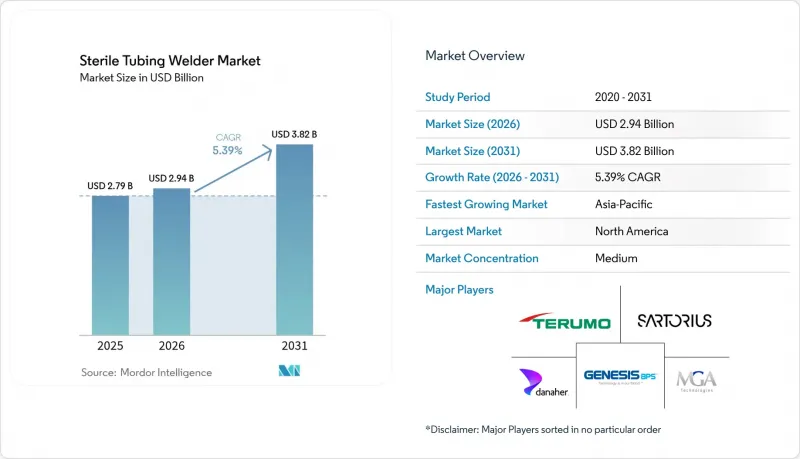
본 보고서는 튜브 소재별(TPE, PVC 등), 방식별(자동식 및 수동식), 용도별(혈액 처리, 바이오의약품 제조 등), 최종 사용자별(병원 등), 지역별(북미, 유럽, 아시아태평양 등)로 세분화되어 있습니다. 시장 예측은 금액(달러) 기준으로 제시되어 있습니다.
세계의 멸균 튜브 용접기 시장 동향 및 인사이트
일회용 바이오프로세싱의 채택 확대
Sartorius에 따르면, 일회용 어셈블리는 이미 연간 120만 건 이상의 멸균 연결을 지원하고 있습니다. 배치 간 교차 오염을 제거함으로써 시설의 설비 투자를 최대 40%까지 절감할 수 있기 때문에 대규모 상업 플랜트에서는 기존의 스테인리스 스틸 다운스트림 라인과 병행하여 일회용 제품을 도입하는 움직임이 진행되고 있습니다. 현재 ASME BPE 규격을 준수하는 더욱 견고한 커넥터가 이러한 시스템의 기반이 되어, 무결성에 대한 감사관의 우려를 해소하고 있습니다. 규제 당국이 EU GMP 부록 1에서 일회용 제품을 승인함에 따라, 플랜트 관리자들은 플렉서블 튜브 재고를 확대하고, 신속한 전환을 통해 TPE, 실리콘, 다층 필름을 처리할 수 있는 용접기 도입을 요구하고 있습니다. 이러한 추세는 멸균 튜브 용접기 시장에 지속적인 성장의 길을 열어주는 동시에, 잔류 오염 위험을 해소하기 위한 자동화 투자를 촉진하고 있습니다.
확대되는 바이오의약품 및 세포 및 유전자 치료 파이프라인
세포 및 유전자 치료 배치의 경우, 기존의 저분자 의약품 처리에 비해 최대 10배의 무균 연결이 필요하며, 이러한 현실이 현재 멸균 튜브 용접기 시장 전체의 설비 예산을 좌우하고 있습니다. 싱가포르의 mRNA 암 백신 투자와 한국이 자국의 mRNA 플랫폼에 19억 2,000만 달러를 배정한 것은 첨단 치료법에 대응하는 생산 능력에 대한 지역적 수요가 높음을 여실히 보여주고 있습니다. MIT의 InSCyT 시스템과 같은 휴대용 모듈식 제조 시설은 분산형 생산에서 1교대당 수백 개의 연결부를 검증할 수 있는 소형 용접기에 대한 수요가 있음을 여실히 보여줍니다. 규제 당국이 분산형 제조에 관한 지침을 마련하는 가운데, 소형 장비로 멸균성을 확보할 수 있는 공급업체가 시장 점유율을 확보하게 될 것입니다. 신규 벡터 및 맞춤형 면역 요법에 대한 지속적인 활동으로 인해 연결부 수요는 높은 수준을 유지할 것이며, 멸균 튜브 용접기 시장은 더 높은 처리량과 자동 보정 기능을 갖춘 장비로 나아가고 있습니다.
자동 용접기의 높은 설비 투자 및 검증 비용
완전히 인증된 용접 스키드의 가격은 10만 달러를 초과할 수 있으며, 여기에 검증 작업비로 30-50%의 비용이 추가로 발생합니다. 라틴아메리카나 동남아시아의 중소규모 CDMO는 용접기가 이미 설치된 외부 위탁 배치 조제를 우선시하여 구매를 미루는 경우가 많습니다. 그 결과, 신흥 지역의 멸균 튜브 용접기 시장에서는 판매 주기가 장기화되고 있습니다. 각 벤더사는 지불을 여러 해에 걸쳐 분산시키는 ‘Equipment-as-a-Service(EaaS)’ 계약을 시범적으로 도입하고 있으며, 컨설팅 비용을 절감하기 위해 디지털 IQ/OQ 템플릿이 번들로 제공되는 사전 검증 완료된 ‘스마트 용접기’를 제공하는 기업도 있습니다.
부문 분석
TPE 튜브는 2025년에 멸균 튜브 용접기 시장의 48.02% 점유율을 차지했으며, 5.55%의 연평균 성장률(CAGR)로 확대되고 있습니다. 이는 제약 업계가 저추출성이며 감마선 멸균이 가능한 소재를 선호하는 경향을 반영한 것입니다. 이러한 주도적인 위치 덕분에 TPE의 용융 온도에 맞추어 특별히 구성된 용접기에 대한 대량 수요가 확보되어, TPE 라인에서만 파생되는 멸균 튜브 용접기 시장 규모가 확대되고 있습니다. PVC는 예산을 중시하는 혈액 센터에서 계속 사용되고 있지만, 실리콘은 고온이나 용제 사용이 필요한 제한된 용도에서 채택되고 있습니다.
Teknor Apex와 같은 제조업체들은 용접 중 광학 검사를 가능하게 하는 투명하고 스퍼레이션이 극히 적은 등급의 제품을 출시하고 있습니다. KRAIBURG사의 PFAS 무함유 제품은 화학 물질 규제가 강화되는 가운데 미래를 내다본 공급을 확보함으로써, TPE가 자본 예산에 미치는 영향을 더욱 강화하고 있습니다. 한편, 불가항력적인 사건으로 인해 최종 사용자는 공급의 연속성을 확보하기 위해 여러 TPE 브랜드의 인증을 받아야만 하며, 이에 따라 각 컴파운드 고유의 가열 프로파일을 저장하는 용접기 펌웨어 업데이트가 진행되고 있습니다.
2025년에는 멸균 튜브 용접기 시장 규모의 62.10%를 자동 장비가 차지한 것으로 평가되었으며, 5.51%라는 가장 높은 연평균 성장률(CAGR)을 보일 것으로 전망됩니다. 이는 인적 접촉을 배제하고 용접 품질을 표준화함으로써 얻은 이중적인 우위 덕분입니다. 이러한 장비를 통한 배치 기록의 통합은 실시간 출하 기준 준수를 가능하게 하며, 이는 특히 EU 감사에서 높이 평가되는 요소입니다. 이러한 규정 준수 측면의 우위 덕분에 자동화 플랫폼은 모든 신규 상업용 바이오리액터 시설의 표준 사양이 되었으며, 멸균 튜브 용접기 시장에서 수동식 장비에 대한 우위를 확고히 하고 있습니다.
1세대 벤치형 용접기는 전문가의 설정이 필요했으나, 최신 모델은 바코드를 통한 튜브 ID를 기반으로 자동 보정을 수행하므로 교육 시간을 단축할 수 있습니다. 인라인 센서가 용접 압력과 온도를 측정하고, 그 데이터를 제조 실행 시스템(MES)으로 전송함으로써 예방 정비가 자동으로 실행됩니다. 수동식 장비는 유연성이 요구되는 연구 개발(R&D) 현장에서는 여전히 사용되고 있지만, 자동식 장비의 가격이 하락함에 따라 현재는 가격 면에서만 경쟁하고 있습니다.
지역별 분석
2025년, 북미는 멸균 튜브 용접기 시장 매출의 38.12%를 차지했습니다. 이는 해당 지역에 바이오의약품 산업 클러스터가 밀집해 있고, 일회용 기술의 도입이 역사적으로 앞서 있으며, 고도의 오염 관리를 중시하는 규제 환경이 뒷받침된 결과입니다. 써모피셔 사이언티픽(Thermo Fisher Scientific)의 20억 달러 규모에 달하는 다년간의 생산 능력 투자가 해당 지역의 수주 잔고를 끌어올리고 있는 한편, 다나허(Danaher)의 사이티바(Cytiva)와 팔(Pal) 통합은 검증(validation)을 가속화하는 서비스 기반을 확충하고 있습니다. 또한, 보스턴과 샌디에이고에 위치한 공급업체의 교육 아카데미는 운영 인력 부족을 완화하고, 이미 도입된 장비 전체의 가동률을 유지하고 있습니다.
아시아태평양은 2031년까지 연평균 성장률(CAGR)이 6.07%로 가장 빠른 성장이 전망되고 있는 지역입니다. 중국의 41억 7,000만 달러 규모의 바이오 제조 장려책, 삼성바이오로직스의 78만 4,000리터 생산 능력 확장, 그리고 싱가포르의 mRNA 프로그램이 사상 최대 규모의 설비 수입을 견인하고 있습니다. 또한 각 지역 정부는 GMP 라이선싱 절차를 간소화하여 자동 용접 도입에 있어 오랫동안 존재해 온 장벽 중 하나를 제거했습니다. 기술 인력 부족은 여전히 심각하지만, 각 공급업체는 상하이, 서울, 하이데라바드에 현지 애프터서비스 거점을 설치하여 현장 검증 서비스를 제공합니다.
유럽에서는 엄격한 무균 기준 하에서 꾸준한 확장이 이어지고 있습니다. 부속서 1의 개정에 따라 기존 플랜트에서는 A등급 클린룸에 용접기를 사후 설치해야 할 의무가 부과되었으며, 이로 인해 갱신 수요가 확대되고 있습니다. 또한, 프랑스와 영국에서 활발히 진행 중인 세포 치료제 파이프라인도 유럽 시장을 뒷받침하고 있으며, 많은 소규모 임상 규모 시설이 생겨나면서 이들이 합쳐져 생산량을 끌어올리고 있습니다. 신흥 지역인 라틴아메리카, 중동 및 아프리카에서는 공공 혈액은행의 설비 갱신과 새로운 백신 충전·마감 라인 도입이 시장의 성장 동력을 창출하고 있지만, 자금 조달 주기가 길어지면서 프로젝트 일정이 지연되고 있습니다.
기타 혜택 :
- 엑셀 형식 시장 예측(ME) 시트
- 3개월간의 애널리스트 지원
자주 묻는 질문
목차
제1장 서론
제2장 조사 방법
제3장 주요 요약
제4장 시장 구도
제5장 시장 규모 및 성장 예측
제6장 경쟁 구도
제7장 시장 기회 및 향후 전망
AJY 26.08.28According to Mordor Intelligence, the sterile tubing welder market size is expected to grow from USD 2.79 billion in 2025 to USD 2.94 billion in 2026 and is forecast to reach USD 3.82 billion by 2031 at 5.39% CAGR over 2026-2031.
This report is Segmented by Tube Material (TPE, PVC, and More), Mode (Automatic and Manual), Application (Blood Processing, Biopharmaceutical Manufacturing, and More), End-User (Hospitals and More), and Geography (North America, Europe, Asia-Pacific, and More). The Market Forecasts are Provided in Terms of Value (USD).
Global Sterile Tubing Welder Market Trends and Insights
Rising Adoption of Single-Use Bioprocessing
Single-use assemblies already support more than 1.2 million sterile connections per year, according to Sartorius. Eliminating cross-contamination between batches can trim facility capital outlays by up to 40%, encouraging large commercial plants to integrate disposables alongside legacy stainless downstream trains. More robust connectors that comply with the ASME BPE code now anchor these systems, satisfying auditor concerns over integrity. As regulatory bodies have endorsed disposables within EU GMP Annex 1, plant managers are expanding inventories of flexible tubing and calling for welders capable of handling TPE, silicone, and multilayer films in fast changeovers. This dynamic secures a durable growth path for the sterile tubing welder market while reinforcing automation investment to close remaining contamination gaps.
Expanding Biologics & Cell-Gene Therapy Pipelines
Cell and gene therapy batches require up to 10 times more sterile connections than legacy small-molecule processing, a reality now shaping equipment budgets across the sterile tubing welder market. Singapore's investment in mRNA cancer vaccines and South Korea's USD 1.92 billion allocation for home-grown mRNA platforms underscore regional appetite for advanced modality capacity. Portable, modular factories such as MIT's InSCyT system highlight how distributed production demands compact welders that can validate hundreds of connections per shift. As regulators draft guidance on decentralized manufacturing, suppliers able to ensure sterility in small-footprint devices will capture share. Continuous activity in novel vectors and personalized immunotherapies sustains elevated connection volumes, pushing the sterile tubing welder market toward higher-throughput, auto-calibrating equipment.
High Capital & Validation Cost of Automated Welders
A fully qualified welding skid can exceed USD 100,000 and accrues another 30-50% in validation labor. Smaller CDMOs in Latin America and Southeast Asia often postpone purchases, favoring outsourced batch preparation where the welder is already installed. The sterile tubing welder market thus experiences elongated sales cycles in emerging regions. Vendors are piloting equipment-as-a-service contracts that spread payments over multi-year terms, and some offer pre-validated "smart welders" bundled with digital IQ/OQ templates to curb consultant fees.
Other drivers and restraints analyzed in the detailed report include:
- Growth in Global Blood & Plasma Collections
- Stricter cGMP Sterility Regulations
- Availability of Sterile Connector Alternatives
For complete list of drivers and restraints, kindly check the Table Of Contents.
Segment Analysis
TPE tubing captured 48.02% of the sterile tubing welder market share in 2025 and is expanding at a 5.55% CAGR, reflecting pharmaceutical preference for low-extractable, gamma-compatible materials. This leadership locks in large volumes for welders configured specifically for TPE melt temperatures, broadening the sterile tubing welder market size derived from TPE lines alone. PVC persists in budget-focused blood centers, while silicone finds narrow roles where elevated temperatures or solvents demand it.
Manufacturers such as Teknor Apex are launching clear, ultra-low-spallation grades that allow optical inspection during welding. KRAIBURG's PFAS-free advances future-proof supply amid tightening chemical restrictions, reinforcing TPE's pull on capital budgets. Meanwhile, force-majeure events have pushed end-users to qualify multiple TPE brands to secure continuity, prompting welder firmware updates that store unique heat profiles for each compound.
Automatic units owned 62.10% of the sterile tubing welder market size in 2025 and show the highest 5.51% CAGR, a twin-lead gained by eliminating human contact and standardizing weld quality. Their batch-record integration supports real-time release criteria, a factor especially valued in EU inspections. Because of that compliance edge, automatic platforms are the reference specification for every new commercial bioreactor suite, cementing the sterile tubing welder market size advantage over manual units.
First-generation bench welders required expert setup, yet modern models calibrate themselves through barcode-driven tubing IDs, cutting training hours. Inline sensors measure weld pressure and temperature, feeding data to manufacturing execution systems that trigger preventive maintenance. Manual devices remain in R&D cabinets where flexibility matters, but they now compete on price alone as automatic prices fall.
Complete Report Scope:
- By Tube Material
- Thermoplastic Elastomer (TPE)
- PVC
- Silicone
- Others
- By Mode
- Automatic
- Manual
- By Application
- Blood Processing
- Biopharmaceutical Manufacturing
- Diagnostic Laboratories
- Others
- By End-User
- Hospitals
- Research & Academic Institutes
- Contract Manufacturing
- Others
- By Geography
- North America
- United States
- Canada
- Mexico
- Europe
- Germany
- United Kingdom
- France
- Italy
- Spain
- Rest of Europe
- Asia-Pacific
- China
- India
- Japan
- Australia
- South Korea
- Rest of Asia-Pacific
- Middle East and Africa
- GCC
- South Africa
- Rest of Middle East and Africa
- South America
- Brazil
- Argentina
- Rest of South America
- North America
Geography Analysis
North America accounted for 38.12% of the sterile tubing welder market revenue in 2025, propelled by its dense biopharma corridor, historic uptake of single-use technology, and a regulatory culture that rewards advanced contamination controls. Thermo Fisher Scientific's USD 2 billion multi-year capacity investment amplifies the regional order book, while Danaher's Cytiva-Pall consolidation broadens a service backbone that accelerates validation. Vendor training academies in Boston and San Diego also mitigate operator shortages, sustaining utilization rates across installed fleets.
Asia-Pacific is the fastest-growing territory at 6.07% CAGR through 2031. China's USD 4.17 billion biomanufacturing incentive, Samsung Biologics' 784,000 L build-out, and Singapore's mRNA programs are channeling record equipment imports. Regional governments have also streamlined GMP licensing, removing one historical hurdle to automated welding adoption. While skill gaps remain acute, suppliers have localized after-sales hubs in Shanghai, Seoul, and Hyderabad to provide on-site validation.
Europe maintains steady expansion under hard-line sterility rules. Annex 1 revisions oblige legacy plants to retrofit welders into Grade A cleanrooms, inflating replacement demand. The continent additionally benefits from aggressive cell-therapy pipelines in France and the United Kingdom, spawning many small clinical-scale units that collectively lift volume. In emerging regions-Latin America, the Middle East, and Africa-market momentum stems from public blood-bank upgrades and new vaccine fill-finish lines, though funding cycles stretch project timelines.
- Aseptic Group
- Avantor
- ChargePoint Technology
- Colder Products Company (CPC)
- Danaher
- Entegris
- Genesis BPS
- GMPTEC GmbH
- Hangzhou Cobetter Filtration Equipment Co., Ltd
- Meissner Filtration Products
- MGA Technologies
- Parker Hannifin
- PendoTECH
- Repligen
- Saint-Gobain Life Sciences
- Sartorius
- Terumo
- Thermo Fisher Scientific
- Vante Biopharm/Sebra
- Watson-Marlow Fluid Technology
Additional Benefits:
- The market estimate (ME) sheet in Excel format
- 3 months of analyst support
TABLE OF CONTENTS
1 Introduction
- 1.1 Study Assumptions & Market Definition
- 1.2 Scope of the Study
2 Research Methodology
3 Executive Summary
4 Market Landscape
- 4.1 Market Overview
- 4.2 Market Drivers
- 4.2.1 Rising adoption of single-use bioprocessing
- 4.2.2 Expanding biologics & cell-gene therapy pipelines
- 4.2.3 Growth in global blood & plasma collections
- 4.2.4 Stricter cGMP sterility regulations
- 4.2.5 Decentralized point-of-care manufacturing push
- 4.2.6 Multi-use aseptic connectors lowering validation cost
- 4.3 Market Restraints
- 4.3.1 High capital & validation cost of automated welders
- 4.3.2 Availability of sterile connector alternatives
- 4.3.3 Shortage of skilled operators / training gaps
- 4.3.4 TPE-grade supply chain volatility
- 4.4 Supply Chain Analysis
- 4.5 Regulatory Landscape
- 4.6 Technological Outlook
- 4.7 Porter's Five Forces Analysis
- 4.7.1 Threat of New Entrants
- 4.7.2 Bargaining Power of Buyers
- 4.7.3 Bargaining Power of Suppliers
- 4.7.4 Threat of Substitutes
- 4.7.5 Intensity of Competitive Rivalry
5 Market Size & Growth Forecasts (Value)
- 5.1 By Tube Material
- 5.1.1 Thermoplastic Elastomer (TPE)
- 5.1.2 PVC
- 5.1.3 Silicone
- 5.1.4 Others
- 5.2 By Mode
- 5.2.1 Automatic
- 5.2.2 Manual
- 5.3 By Application
- 5.3.1 Blood Processing
- 5.3.2 Biopharmaceutical Manufacturing
- 5.3.3 Diagnostic Laboratories
- 5.3.4 Others
- 5.4 By End-User
- 5.4.1 Hospitals
- 5.4.2 Research & Academic Institutes
- 5.4.3 Contract Manufacturing
- 5.4.4 Others
- 5.5 By Geography
- 5.5.1 North America
- 5.5.1.1 United States
- 5.5.1.2 Canada
- 5.5.1.3 Mexico
- 5.5.2 Europe
- 5.5.2.1 Germany
- 5.5.2.2 United Kingdom
- 5.5.2.3 France
- 5.5.2.4 Italy
- 5.5.2.5 Spain
- 5.5.2.6 Rest of Europe
- 5.5.3 Asia-Pacific
- 5.5.3.1 China
- 5.5.3.2 India
- 5.5.3.3 Japan
- 5.5.3.4 Australia
- 5.5.3.5 South Korea
- 5.5.3.6 Rest of Asia-Pacific
- 5.5.4 Middle East and Africa
- 5.5.4.1 GCC
- 5.5.4.2 South Africa
- 5.5.4.3 Rest of Middle East and Africa
- 5.5.5 South America
- 5.5.5.1 Brazil
- 5.5.5.2 Argentina
- 5.5.5.3 Rest of South America
- 5.5.1 North America
6 Competitive Landscape
- 6.1 Market Concentration
- 6.2 Competitive Benchmarking
- 6.3 Market Share Analysis
- 6.4 Company Profiles (includes Global level Overview, Market level overview, Core Segments, Financials as available, Strategic Information, Market Rank/Share for key companies, Products & Services, and Recent Developments)
- 6.4.1 Aseptic Group
- 6.4.2 Avantor, Inc.
- 6.4.3 ChargePoint Technology
- 6.4.4 Colder Products Company (CPC)
- 6.4.5 Danaher Corporation
- 6.4.6 Entegris, Inc.
- 6.4.7 Genesis BPS
- 6.4.8 GMPTEC GmbH
- 6.4.9 Hangzhou Cobetter Filtration Equipment Co., Ltd
- 6.4.10 Meissner Filtration Products
- 6.4.11 MGA Technologies
- 6.4.12 Parker-Hannifin Corporation
- 6.4.13 PendoTECH
- 6.4.14 Repligen Corporation
- 6.4.15 Saint-Gobain Life Sciences
- 6.4.16 Sartorius AG
- 6.4.17 Terumo Corporation
- 6.4.18 Thermo Fisher Scientific
- 6.4.19 Vante Biopharm/Sebra
- 6.4.20 Watson-Marlow Fluid Technology
7 Market Opportunities & Future Outlook
- 7.1 White-space & Unmet-need Assessment


