

|
시장보고서
상품코드
2115037
자동차용 휴먼 머신 인터페이스(HMI) 시장 : 시장 점유율 분석, 업계 동향 및 통계, 성장 예측(2026-2031년)Automotive Human Machine Interface - Market Share Analysis, Industry Trends & Statistics, Growth Forecasts (2026 - 2031) |
||||||
 Mordor Intelligence
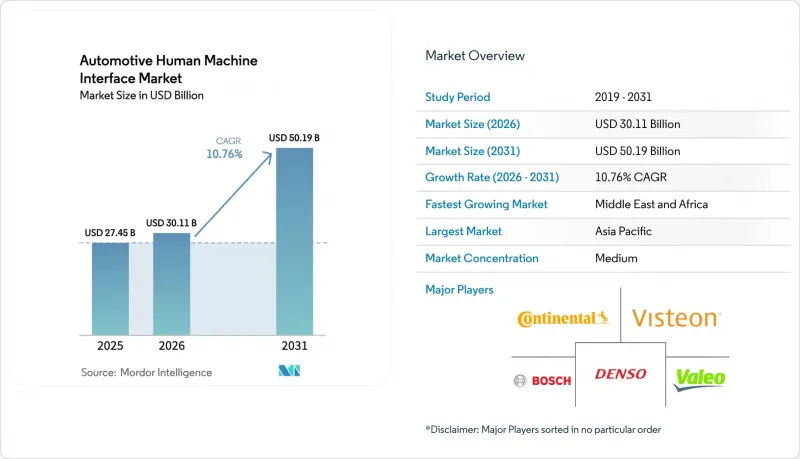
Mordor Intelligence에 의하면, 자동차용 휴먼 머신 인터페이스(HMI) 시장 규모는 2025년에 274억 5,000만 달러로 평가되었고, 2026년 301억 1,000만 달러에서 2031년까지 501억 9,000만 달러에 이를 것으로 예측되며, 예측 기간(2026-2031년) CAGR은 10.76%를 나타낼 전망입니다.
본 보고서는 제품 유형별(센터 디스플레이 등), 액세스 유형별(싱글 모달 및 멀티 모달), 상호작용 방식별(시각적 등), 차량 유형별(경제형 승용차 등), 추진 방식별(내연기관 등), 판매 채널별(OEM 탑재 및 애프터마켓), 그리고 지역별로 분류되어 있습니다. 예측치는 금액 기준(달러)으로 표시되어 있습니다.
세계의 자동차용 휴먼 머신 인터페이스(HMI) 시장 동향 및 인사이트
커넥티드 인포테인먼트 생태계에 대한 수요
소비자들은 자동차를 더 광범위한 디지털 메쉬의 하나의 노드로 인식하며, 스마트폰, 홈 어시스턴트, 자동차 간의 원활한 연동을 기대하고 있습니다. TomTom과 Microsoft는 2025년, Azure OpenAI Service를 활용하여 실시간 교통 정보를 스토리 형식으로 제공하는 대화형 내비게이션 플랫폼을 도입했습니다. SoundHound와 같은 음성 플랫폼은 2024년에 OEM 채택 브랜드 수를 두 배로 늘려 18개 브랜드로 확대했으며, 공조, 미디어, 스마트 홈 제어를 위한 다단계 대화를 실현하고 있습니다. 상시 연결을 통해 사용량에 따른 보험 및 예측 유지보수 알림이 가능해져, 하드웨어 비용을 상쇄하는 판매 후 수익을 창출합니다. 엣지 컴퓨팅이 콕핏 도메인 컨트롤러로 전환됨에 따라, 소프트웨어 업데이트를 통해 하드웨어를 교체하지 않고도 새로운 기능을 제공할 수 있게 되어, 가전제품의 리프레시 주기와 자동차 개발 사이의 격차가 좁혀집니다. 따라서 휴먼-머신 인터페이스(HMI) 시장은 더욱 풍부한 클라우드 서비스가 연결형 구독의 가치를 높이고, 이는 다시 고성능 인터페이스를 필요로 하는 선순환의 혜택을 누리고 있습니다.
ADAS 및 자율 주행에서 직관적인 HMI에 대한 의존도
레벨 2+ 운전 지원에서는 운전자가 핸들에 손을 가볍게 얹은 채로, 횡방향 및 종방향 제어를 장시간 동안 시스템에 맡길 수 있습니다. 2024년부터 시행되는 유엔 유럽 경제 위원회(UNECE)의 R171 규격은 시스템이 시각적·청각적 신호를 단계적으로 강화하여 상태나 운전 인계를 알리도록 의무화하고 있습니다. 메르세데스-벤츠의 ‘드라이브 파일럿’은 3가지 색상의 라이트 스트립과 스티어링 휠의 LED를 사용하여 역할 변화를 알림으로써 모호함을 최소화하고 있습니다. 각 공급업체들은 AR 헤드업 디스플레이에 지오펜싱 및 기상 조건에 따른 제한을 통합하여, 안전한 주행 범위를 도로 위에 직접 중첩 표시함으로써 운전자의 시선이 도로에서 벗어나는 시간을 단축하고 있습니다. 운전자 모니터링 카메라는 시선 집중 여부를 확인하고, 주의가 산만해질 경우 보조 모드를 일시 정지시킬 수 있습니다. 자율주행 기능이 레벨 3에 점차 가까워짐에 따라, 휴먼-머신 인터페이스(HMI) 시장은 운전자의 신뢰를 유지하기 위해 차량의 의도를 충분히 명확하게 시각화해야 합니다. 그렇지 않으면 규제 당국이 도입을 제한할 가능성이 있습니다.
고급 HMI 하드웨어 스택의 높은 비용
곡면 OLED 패널, 초음파 햅틱스, AR-HUD용 광학 시스템은 부품 원가를 800-1,500달러까지 끌어올려, 보급형 모델에는 가격 면에서 채택하기 어렵게 만들고 있습니다. BOE 등 중국 패널 제조업체들은 자동차용 곡면 OLED의 수율을 아직 70% 이상으로 끌어올리지 못해 고가 대가 유지되고 있습니다. 다이 이송 공정이 여전히 반수작업인 마이크로 LED 웨이퍼는 OLED보다 3배의 비용이 들기 때문에 그 채택은 초고급 등급으로 한정되어 있습니다. OEM 업체들은 높은 가격에 놀라는 고객의 부담을 덜어주기 위해 등급별로 기능을 단계적으로 설정하고 있지만, 하드웨어의 파편화는 소프트웨어의 일관성을 해치고 테스트 부담을 가중시켜, 인간-기계 인터페이스(HMI) 시장 규모 확대를 저해하고 있습니다.
부문 분석
2025년에는 10-15인치 터치스크린이 내비게이션, 미디어, 공조 제어의 표준 인터페이스로 자리 잡으면서 센터 디스플레이가 HMI 시장에서 42.28%라는 압도적인 점유율을 차지했습니다. 증강현실(AR) 헤드업 디스플레이 부문은 연평균 성장률(CAGR) 17.06%로 확대되고 있습니다. 이는 유엔 유럽 경제 위원회(UNECE)가 정한 운전 중 주의 산만 관련 기준을 준수하며, 시선 집중 시간을 짧게 억제하는 전면 유리에 표시되는 내비게이션 화살표에 의해 주도되고 있습니다. 음성 제어 시스템은 반도체 수요를 줄여주는 클라우드 기반 자연어 처리 방식으로 전환되고 있으며, 이에 따라 잠재적 시장 규모가 확대되고 있습니다. 로터리 노브는 주류 모델에서는 점차 사라지고 있지만, 촉각적인 안정감을 추구하는 일부 럭셔리 브랜드에서는 여전히 채택되고 있습니다.
파나소닉의 증강현실(AR) 유닛은 전방 10미터 지점을 13도의 시야각으로 투영하여 주행 화면에 물체 감지 정보를 중첩시킵니다. Ultraleap사의 제스처 모듈은 공중에서 통화 응답 동작을 구현하고 있지만, 노면의 요철이 있는 상황에서는 의도파관 않은 트리거가 발생하기 쉽다는 과제를 안고 있습니다. 웨어러블 단말기의 확장 기능, 스마트폰 잠금 해제, 스마트 워치 배터리 잔량 확인 등은 아직 초기 단계이긴 하지만, 성장세가 두드러지는 분야를 형성하고 있습니다. 고급차용 디스플레이가 중가대 차종에도 보급됨에 따라, 디스플레이 단독의 휴먼-머신 인터페이스(HMI) 시장 규모는 시장 전체 매출보다 빠른 속도로 확대될 전망입니다.
멀티모달 시스템은 2025년 매출의 51.62%를 차지한 것으로 평가되었으며, 14.93%의 성장률을 보일 전망입니다. 이는 레벨 2 이상의 ADAS 및 인포테인먼트 기능이 단일 채널의 처리 능력을 훨씬 능가하기 때문입니다. 메르세데스의 56인치 ‘하이퍼스크린’은 터치, 제스처, 음성을 융합하여 상황에 따라 운전 방해가 가장 적은 채널을 동적으로 우선시합니다. 비용 제약으로 인해 실험적인 시도가 제한되는 이코노미 부문에서는 단일 모달리티 레이아웃이 여전히 주류를 이루고 있지만, 이러한 차종에서도 외부 음성 비서를 연동하는 무선 전화 미러링 기능은 채택되고 있습니다.
촉각 피드백은 터치, 음성, 제스처에 이은 제4의 채널로 추가됩니다. 보쉬의 피에조식 터치스크린은 시각적인 확인 없이 선택을 확정할 수 있도록 기계적인 클릭감을 재현합니다. 적응형 시스템은 운전자의 선호도를 파악하고 주로 사용되는 조작 모드를 강조 표시함으로써 NHTSA의 ‘2초 시선 이탈 규칙’ 준수를 목표로 하고 있습니다. 그러나 제스처 오인식이나 음성 지연은 사용자에게 불만을 야기할 위험이 있으며, 멀티모달 기술의 가치는 인간-기계 인터페이스 시장에서의 통합 품질에 달려 있음이 입증되었습니다.
지역별 분석
아시아태평양은 2025년 매출의 47.88%를 차지했으며, 그 원동력은 중국의 배터리 전기자동차(BEV) 급증과 콕핏 데이터를 로컬에 저장하도록 의무화하는 규제입니다. 이로 인해 세계 공급업체들은 중국어 음성 모델과 국내 클라우드 노드를 급속도로 구축해야 하는 상황에 처해 있습니다. 일본 브랜드들은 주의 산만을 최소화하려는 문화적 선호에 맞추어 미니멀한 촉각 버튼을 선호하고 있습니다. 한편, 한국은 현대모비스(Hyundai Mobis)와 자이스(Zeiss)의 제휴를 통해 AR-HUD 광학 시스템의 두 번째 공급원으로서의 입지를 확고히 하고 있습니다. 인도에서는 1만 5,000달러 미만의 자동차에 9인치 디스플레이가 탑재된 힌디어 음성 어시스턴트가 기본 사양으로 장착되어 판매 대수 확대에 기여하고 있습니다.
중동 및 아프리카는 연평균 성장률(CAGR) 13.74%를 기록하며, 지역별로는 가장 높은 성장률을 보이고 있습니다. 사우디아라비아가 루시드(Lucid)에 투자한 56억 달러에는 아랍어 지원 HMI와 지역별 맞춤형 지도가 포함되어 있습니다. 두바이에서 진행 중인 다국어 지원 자율주행 택시 실증 실험에서는 아랍어, 영어, 힌디어, 우르두어 간의 실시간 번역 기능이 요구되고 있습니다. 남아프리카의 조립 라인에서는 인터페이스가 아프리칸스어와 줄루어를 지원하며, 사하라 이남 아프리카 시장의 성장을 염두에 두고 각 OEM 업체들이 현지화에 적극적으로 나서고 있음을 알 수 있습니다.
북미와 유럽은 성숙 속도가 완만하지만, 표준화의 선구자 역할을 하고 있습니다. 유엔 유럽 경제 위원회(UNECE)의 R171 및 GDPR(EU 개인정보보호규정)이 전 세계 콕핏 설계와 데이터 파이프라인을 형성하고 있으며, 독일의 고급 자동차 제조업체들은 일반적으로 새로운 인터페이스 기술을 먼저 자국에서 도입한 후 해외로 확대되고 있습니다. 브라질과 아르헨티나는 기존 제조업체에 유리한 유럽식 인증 체계를 채택하고 있는 반면, 러시아 브랜드는 제재 하에서 중국의 안드로이드 헤드 유닛에 의존하고 있습니다. 이러한 지역별 동향으로 인해 인간-기계 인터페이스(HMI) 시장은 분산된 상태가 지속되고 있으며, 디자인 센터는 독일, 미국, 중국, 일본에 집중되어 있는 반면, 걸프 국가들과 인도에서는 성장의 조짐이 보입니다.
기타 혜택 :
- 엑셀 형식 시장 예측(ME) 시트
- 3개월간의 애널리스트 지원
자주 묻는 질문
목차
제1장 서론
제2장 조사 방법
제3장 주요 요약
제4장 시장 구도
제5장 시장 규모 및 성장 예측
제6장 경쟁 구도
제7장 시장 기회 및 향후 전망
AJY 26.08.28According to Mordor Intelligence, the automotive human machine interface market size was valued at USD 27.45 billion in 2025 and estimated to grow from USD 30.11 billion in 2026 to reach USD 50.19 billion by 2031, at a CAGR of 10.76% during the forecast period (2026-2031).
This report is Segmented by Product Type (Central Displays, and More), Access Type (Single-Modal and Multimodal), Interaction Modality (Visual, and More), Vehicle Type (Economy Passenger Cars, and More), Propulsion Type (Internal Combustion Engine and More), Sales Channel (Original Equipment Manufacturer-Installed and Aftermarket), and Geography. Forecasts in Value (USD).
Global Automotive Human Machine Interface Market Trends and Insights
Demand for Connected-Infotainment Ecosystems
Consumers treat the vehicle as a node in a wider digital mesh, expecting seamless handoffs among phone, home assistant, and car. TomTom and Microsoft introduced a conversational navigation platform in 2025 that employs Azure OpenAI Service to deliver real-time traffic storytelling. Voice platforms such as SoundHound, which doubled original equipment manufacturer wins to 18 brands in 2024, allow multi-turn dialogue for climate, media, and smart-home control. Always-on connectivity unlocks usage-based insurance and predictive-maintenance alerts, producing post-sale revenue that offsets hardware cost. As edge computing migrates to cockpit domain controllers, software updates can deliver new features without hardware swaps, shrinking the gap between consumer-electronics refresh cycles and automotive development. The human machine interface market, therefore, benefits from a virtuous loop in which richer cloud services justify connectivity subscriptions that in turn demand more capable interfaces.
ADAS and Autonomous-Driving Dependency on Intuitive HMI
Level 2+ assistance keeps hands loosely on the wheel while transferring lateral and longitudinal control for extended stretches. United Nations Economic Commission for Europe (UNECE) R171, enforced from 2024, obliges systems to communicate status and takeover prompts by escalating audio-visual cues. Mercedes-Benz Drive Pilot uses tri-color light strips and steering-wheel light-emitting diodes to signal role changes, minimizing ambiguity. Suppliers embed geo-fencing and weather limits into AR head-up displays that overlay safe-operation bounds directly on the road, trimming eyes-off-road time. Driver-monitor cameras ensure gaze compliance and can suspend assisted mode when attention drifts. As autonomous functions inch toward Level 3, the human machine interface market must visualize vehicle intent clearly enough to sustain driver trust, or regulators could throttle roll-outs.
High Cost of Advanced HMI Hardware Stacks
Curved organic light-emitting diode panels, ultrasonic haptics, and AR-HUD optics add USD 800-1,500 to the bill of materials, pricing them out of entry models. Chinese panel makers such as BOE have yet to bring curved automotive organic light-emitting diode (OLED) yields above 70%, sustaining premiums. Micro-LED wafers, still semi-manual in die transfer, sit at thrice the organic light-emitting diode (OLED) cost, confining adoption to ultra-luxury trims. Original equipment manufacturers tier features by trim to soften sticker shock, but fragmented hardware complicates software consistency and raises test overhead, an impediment to scale within the human machine interface market.
Other drivers and restraints analyzed in the detailed report include:
- Regulatory Focus on Driver-Distraction Mitigation
- Shift Toward Software-Defined Vehicles and OTA UI Upgrades
- Cyber-Security and Data-Privacy Vulnerabilities
For complete list of drivers and restraints, kindly check the Table Of Contents.
Segment Analysis
Central displays held a commanding 42.28% human-machine interface market share in 2025, as 10- to 15-inch touchscreens became the default portal for navigation, media, and climate control. The augmented-reality head-up display category is scaling at a 17.06% CAGR, propelled by windshield-level navigation arrows that align with United Nations Economic Commission for Europe (UNECE) distraction caps and keep glance durations low. Voice control systems are migrating down-market to cloud natural-language processing that lowers silicon demands, expanding total addressable units. Rotary knobs are disappearing in mainstream models but linger in select luxury brands for tactile reassurance.
Augmented-reality units from Panasonic project a 13-degree field of view 10 meters ahead, overlaying object detection on the driving scene. Gesture modules from Ultraleap give mid-air call-accept motions, yet struggle with unintentional triggers in bumpy conditions. Wearable extensions, phone unlock, smartwatch battery checks, form a nascent but rising slice. As premium screens filter into mid-price cars, the human machine interface market size for displays alone is positioned to expand faster than overall revenue.
Multimodal systems controlled 51.62% of the 2025 revenue and will grow at 14.93%, because Level 2+ ADAS and infotainment depth exceed any single channel's bandwidth. Mercedes' 56-inch Hyperscreen marries touch, gesture, and voice, dynamically prioritizing the least distracting channel per context. Single-modality layouts persist in economy tiers where cost gates experimentation, yet even these cars adopt wireless phone mirroring that injects external voice assistants.
Haptic feedback joins touch, voice, and gesture as a fourth lane; Bosch piezo touchscreens fake mechanical clicks to confirm selections without visual verification. Adaptive systems observe driver preference and highlight the dominant modality, aiming to meet NHTSA's 2-second glance rule. However, gesture misreads and voice latency risk frustrating users, proving that multimodal value depends on orchestration quality within the human machine interface market.
Complete Report Scope:
- By Product Type
- Central Displays
- Voice Control Systems
- Head-Up Displays (Conventional and AR)
- Touch-Sensitive Steering Controls
- Gesture-Control Modules
- Rotary/Knob Controllers
- Wearable and Bring-Your-Own-Device Interfaces
- By Access Type
- Single-Modal
- Multimodal (Voice+Gesture+Touch)
- By Interaction Modality
- Visual (LCD/OLED/micro-LED)
- Acoustic (Voice, Sound-Haptics)
- Haptic (Force-feedback, Ultrasonic)
- By Vehicle Type
- Economy Passenger Cars
- Mid-Price Passenger Cars
- Luxury Passenger Cars
- Commercial Vehicles
- By Propulsion Type
- Internal Combustion Engine (ICE)
- Battery-Electric Vehicles (BEVs)
- Plug-in Hybrid Vehicles (PHEVs)
- Fuel-Cell Vehicles (FCEVs)
- By Sales Channel
- OEM-Installed Systems
- Aftermarket Retro-fits
- By Geography
- North America
- United States
- Canada
- Rest of North America
- South America
- Brazil
- Argentina
- Rest of South America
- Europe
- Germany
- United Kingdom
- France
- Italy
- Spain
- Russia
- Rest of Europe
- Asia-Pacific
- China
- Japan
- India
- South Korea
- Rest of Asia-Pacific
- Middle East and Africa
- Saudi Arabia
- United Arab Emirates
- South Africa
- Rest of Middle East and Africa
- North America
Geography Analysis
Asia-Pacific owned 47.88% of 2025 revenue, anchored by China's battery electric vehicle surge and mandates that cockpit data be stored locally, forcing global suppliers to spin up Mandarin voice models and in-country cloud nodes. Japanese brands favor minimalist tactile buttons, fitting cultural preferences for low distraction, while South Korea positions itself as a second source for AR-HUD optics through Hyundai Mobis and Zeiss collaboration. India's sub-USD 15,000 cars now feature Hindi voice assistance on 9-inch displays, enlarging unit volume.
The Middle East and Africa books a 13.74% CAGR, the fastest geography. Saudi Arabia's USD 5.6 billion investment in Lucid includes Arabic-local HMI and region-specific maps. Dubai's multilingual autonomous-taxi pilots demand real-time translation across Arabic, English, Hindi, and Urdu. South African assembly lines adapt interfaces to Afrikaans and Zulu, indicating original equipment manufacturer willingness to localize for sub-Saharan growth.
North America and Europe mature more slowly yet pioneer standards. United Nations Economic Commission for Europe (UNECE) R171 and GDPR shape global cockpit design and data pipelines, and premium German cars typically debut new interface tech before exporting it. Brazil and Argentina adopt Euro-style approval frameworks that favor incumbents, while Russian brands rely on Chinese Android head units amid sanctions. These regional dynamics keep the human machine interface market dispersed, with design centers clustered in Germany, the United States, China, and Japan, but growth pockets emerging in the Gulf and India.
- Continental AG
- Visteon Corporation
- DENSO Corporation
- Bosch GmbH
- Valeo S.A.
- Harman International (Samsung)
- Panasonic Automotive
- Aptiv plc
- Synaptics Inc.
- Luxoft (DXC Technology)
- Alps Alpine
- Magna International
- Faurecia Clarion
- Hyundai Mobis
- Yazaki Corp.
- Nippon Seiki
- Pioneer Corp.
- Tencent
- Cerence Inc.
- Elektrobit Automotive
Additional Benefits:
- The market estimate (ME) sheet in Excel format
- 3 months of analyst support
TABLE OF CONTENTS
1 Introduction
- 1.1 Study Assumptions
- 1.2 Scope of the Study
2 Research Methodology
3 Executive Summary
4 Market Landscape
- 4.1 Market Overview
- 4.2 Market Drivers
- 4.2.1 Demand for Connected-Infotainment Ecosystems
- 4.2.2 ADAS and Autonomous-Driving Dependency on Intuitive HMI
- 4.2.3 Regulatory Focus on Driver-Distraction Mitigation
- 4.2.4 Shift Toward Software-Defined Vehicles and OTA UI Upgrades
- 4.2.5 In-Cabin Health and Wellness Interface Innovations
- 4.2.6 Generative-AI Copilots Enabling Hyper-Personalized Voice UX
- 4.3 Market Restraints
- 4.3.1 High Cost of Advanced HMI Hardware Stacks
- 4.3.2 Cyber-Security and Data-Privacy Vulnerabilities
- 4.3.3 Micro-LED and AR-HUD Component Supply Bottlenecks
- 4.3.4 Cognitive Overload From Multimodal UI Complexity
- 4.4 Value/Supply-Chain Analysis
- 4.5 Regulatory Landscape
- 4.6 Technological Outlook
- 4.7 Porter's Five Forces Analysis
- 4.7.1 Threat of New Entrants
- 4.7.2 Bargaining Power of Buyers/Consumers
- 4.7.3 Bargaining Power of Suppliers
- 4.7.4 Threat of Substitute Products
- 4.7.5 Intensity of Competitive Rivalry
5 Market Size and Growth Forecasts (Value (USD))
- 5.1 By Product Type
- 5.1.1 Central Displays
- 5.1.2 Voice Control Systems
- 5.1.3 Head-Up Displays (Conventional and AR)
- 5.1.4 Touch-Sensitive Steering Controls
- 5.1.5 Gesture-Control Modules
- 5.1.6 Rotary/Knob Controllers
- 5.1.7 Wearable and Bring-Your-Own-Device Interfaces
- 5.2 By Access Type
- 5.2.1 Single-Modal
- 5.2.2 Multimodal (Voice+Gesture+Touch)
- 5.3 By Interaction Modality
- 5.3.1 Visual (LCD/OLED/micro-LED)
- 5.3.2 Acoustic (Voice, Sound-Haptics)
- 5.3.3 Haptic (Force-feedback, Ultrasonic)
- 5.4 By Vehicle Type
- 5.4.1 Economy Passenger Cars
- 5.4.2 Mid-Price Passenger Cars
- 5.4.3 Luxury Passenger Cars
- 5.4.4 Commercial Vehicles
- 5.5 By Propulsion Type
- 5.5.1 Internal Combustion Engine (ICE)
- 5.5.2 Battery-Electric Vehicles (BEVs)
- 5.5.3 Plug-in Hybrid Vehicles (PHEVs)
- 5.5.4 Fuel-Cell Vehicles (FCEVs)
- 5.6 By Sales Channel
- 5.6.1 OEM-Installed Systems
- 5.6.2 Aftermarket Retro-fits
- 5.7 By Geography
- 5.7.1 North America
- 5.7.1.1 United States
- 5.7.1.2 Canada
- 5.7.1.3 Rest of North America
- 5.7.2 South America
- 5.7.2.1 Brazil
- 5.7.2.2 Argentina
- 5.7.2.3 Rest of South America
- 5.7.3 Europe
- 5.7.3.1 Germany
- 5.7.3.2 United Kingdom
- 5.7.3.3 France
- 5.7.3.4 Italy
- 5.7.3.5 Spain
- 5.7.3.6 Russia
- 5.7.3.7 Rest of Europe
- 5.7.4 Asia-Pacific
- 5.7.4.1 China
- 5.7.4.2 Japan
- 5.7.4.3 India
- 5.7.4.4 South Korea
- 5.7.4.5 Rest of Asia-Pacific
- 5.7.5 Middle East and Africa
- 5.7.5.1 Saudi Arabia
- 5.7.5.2 United Arab Emirates
- 5.7.5.3 South Africa
- 5.7.5.4 Rest of Middle East and Africa
- 5.7.1 North America
6 Competitive Landscape
- 6.1 Market Concentration
- 6.2 Strategic Moves
- 6.3 Market Share Analysis
- 6.4 Company Profiles (Includes Global level Overview, Market level overview, Core Segments, Financials as available, Strategic Information, Market Rank/Share for key companies, Products and Services, and Recent Developments)
- 6.4.1 Continental AG
- 6.4.2 Visteon Corporation
- 6.4.3 DENSO Corporation
- 6.4.4 Bosch GmbH
- 6.4.5 Valeo S.A.
- 6.4.6 Harman International (Samsung)
- 6.4.7 Panasonic Automotive
- 6.4.8 Aptiv plc
- 6.4.9 Synaptics Inc.
- 6.4.10 Luxoft (DXC Technology)
- 6.4.11 Alps Alpine
- 6.4.12 Magna International
- 6.4.13 Faurecia Clarion
- 6.4.14 Hyundai Mobis
- 6.4.15 Yazaki Corp.
- 6.4.16 Nippon Seiki
- 6.4.17 Pioneer Corp.
- 6.4.18 Tencent
- 6.4.19 Cerence Inc.
- 6.4.20 Elektrobit Automotive
7 Market Opportunities and Future Outlook
- 7.1 White-space and Unmet-Need Assessment


