

|
시장보고서
상품코드
2115047
수술 트레이 시장 : 시장 점유율 분석, 업계 동향 및 통계, 성장 예측(2026-2031년)Global Procedure Trays - Market Share Analysis, Industry Trends & Statistics, Growth Forecasts (2026 - 2031) |
||||||
 Mordor Intelligence
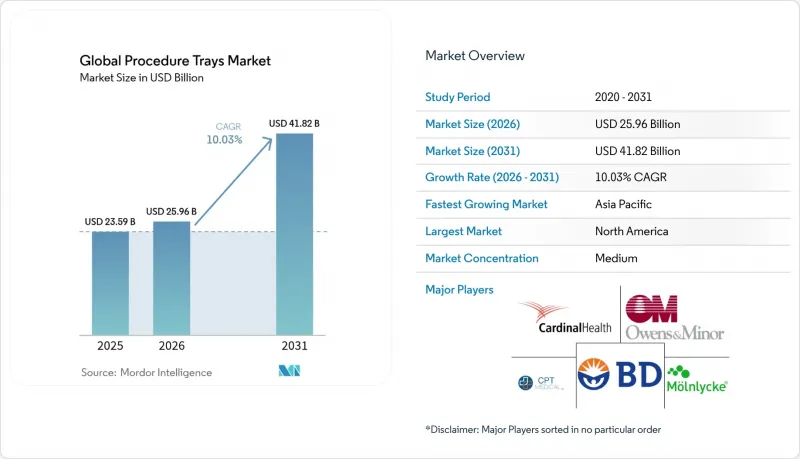
Mordor Intelligence에 의하면, 수술 트레이 시장 규모는 2025년 235억 9,000만 달러로 평가되었고, 2026년에는 259억 6,000만 달러로 추정되고, 2026-2031년 CAGR 10.03%로 성장을 지속할 전망이며, 2031년에는 418억 2,000만 달러에 이를 것으로 예측됩니다.
본 보고서는 수술 트레이 유형별(수술실용 수술 트레이, 혈관조영용 트레이, 안과용 트레이, 마취용 트레이, 기타 전문용 트레이), 최종 사용자별(병원, 외래수술센터(ASC), 진료소, 기타) 및 지역별(북미, 유럽, 아시아태평양, 남미, 중동 및 아프리카)로 분류되어 있습니다. 시장 예측은 금액(달러) 기준으로 제시되어 있습니다.
세계의 수술 트레이 시장 동향 및 인사이트
최소 침습 수술 및 당일 수술 건수 증가
외래수술센터(ASC)에서는 2024-2034년 수술 처리 건수가 21% 증가할 것으로 예측되며, 이러한 변화로 인해 수술실 회전율 향상을 목적으로 하는 경량 1인용 키트에 대한 수요가 증가하고 있습니다. CMS(미국 의료보험서비스센터)는 2026년 ASC 대상 수술 목록에 이미 547개의 새로운 코드를 추가하여 외래 수술의 임상 범위를 확대되고 있습니다. ASC의 수술 비용은 병원 외래 부서에 비해 144% 저렴하기 때문에 보험사와 환자들은 계속해서 선택적 수술을 입원 환경에서 외래 환경으로 전환하고 있습니다. 각 제조업체는 현재 무균 상태를 유지하면서 구성 부품 수를 줄인 소형 수술 트레이를 제공하고 있으며, 이를 통해 준비 시간이 단축되고 수술 건수를 늘릴 수 있게 되었습니다. 이러한 추세는 특히 마취 트레이 공급업체에 유리합니다. 외래 마취에서는 기도 관리, 신경 차단, 모니터링용으로 특별히 설계된 소모품이 필요하기 때문입니다. 내시경 검사, 관절경 검사, 경피적 심혈관 중재술의 지속적인 확대로 인해 시술별로 특화된 세트에 대한 수요가 증가하고 있습니다.
병원의 비용 절감을 위한 일회용 CPT로의 전환
의료 기관들은 가중되는 재정적 압박과 멸균 처리 과정의 만성적인 병목 현상에 대한 직접적인 대응책으로 일회용 맞춤형 수술 트레이를 도입하고 있습니다. 주요 병원에서는 매년 최소 1,500만 달러 상당의 미사용 외과용 소모품이 폐기되고 있으며, 개봉된 물품의 27%는 환자에게 사용되지 않은 채 폐기되고 있습니다. 카디널 헬스(Cardinal Health)의 내부 분석에 따르면, 시술 카드의 오류로 인해 연간 수술용 소모품 예산의 3-5%가 낭비되고 있습니다. 대규모 시설의 경우, 이는 300만 달러가 넘는 피할 수 있는 비용에 해당하지만, 단 7장의 시술 카드를 갱신하는 것만으로도 연간 6만 8,000달러 이상을 절약할 수 있습니다. 일회용 키트로의 전환을 통해 재처리 비용이 절감되고 오염 위험도 낮아집니다. CensisAI2를 도입한 병원에서는 인력을 증원하지 않고도 매월 트레이 처리량을 20% 늘리고 있습니다. 공동구매기구(GPO)는 일회용 제품을 경제적으로 실현 가능하게 하는 대량 구매 계약을 협상함으로써 그 도입을 가속화하고 있습니다. 수술실 워크플로우 최적화를 위한 인공지능 솔루션은 이러한 이점을 더욱 확대합니다. 도입으로 인해 효율이 향상되고 폐기물이 감소한 결과, 수술실 1실당 연간 50만 달러의 비용 절감이 실현되고 있습니다. 인건비가 높고 무균성에 관한 규제 요건이 엄격한 북미에서는 이러한 경제적 이점이 가장 두드러집니다.
GPO 입찰 및 일괄 구매를 통한 가격 하락
미국 상위 6개 GPO는 급성기 의료 조달액의 90% 가까이를 차지하며, 총 1,080억 달러 이상의 조달 규모를 협상하고, 수술 트레이 등 회전율이 높은 품목에 대해 두 자릿수의 가격 양보를 요구하고 있습니다. 입찰 대상이 종합적인 키트 포트폴리오를 아우르는 경우, 1.22%-2.25%의 관리 수수료가 제조업체의 이익률을 더욱 압박합니다. 현재 가치 기반 계약에서는 가격이 수술 후 감염(SSI) 발생률이나 트레이와 관련된 수술 지연 등의 임상 지표에 연동되도록 되어 있어, 성과에 대한 위험이 공급업체로 전가되고 있습니다. 중소 공급업체들은 입찰 가격으로 맞춤형 사양을 충족하기 위해 필요한 금형 변경을 대규모로 대응하는 데 어려움을 겪고 있으며, 업계 재편이 가속화되고 있습니다. 수지, 펄프, 인건비에 대한 인플레이션 압력은 단기적으로 GPO와의 협상을 통해 완전히 상쇄될 가능성은 희박합니다.
부문 분석
2025년, 수술실(OR)용 수술 트레이는 맞춤형 수술 트레이 시장 점유율의 46.21%를 차지했으며, 전 세계에서 이루어지는 외과 수술의 대부분에서 중심적인 역할을 하고 있음이 부각되었습니다. 이러한 지배적인 지위는 일반외과 수술에 대한 폭넓은 적용 가능성과 미리 조립된 구성을 선호하는 표준화된 수술실 프로토콜로의 꾸준한 전환을 반영합니다. 마취 트레이는 수술 전후 관리가 더욱 복잡해지고, 고도로 전문화된 마취 관리가 필수적인 외래 수술로의 전환이 진행됨에 따라 2031년까지 연평균 성장률(CAGR) 10.54%로 확대되고 있습니다. 혈관조영 트레이는 심장 중재 시술 건수 증가의 혜택을 받고 있습니다. 카디널 헬스(Cardinal Health)사의 카테터실 및 진료소용 키트는 시장이 시술에 특화된 솔루션으로 진화하고 있음을 보여줍니다. 안과용 트레이는 규모는 작지만 꾸준히 성장하고 있는 틈새 시장으로, 유리체망막용 기기의 발전과 외과적 개입이 필요한 노화 관련 안과 질환의 유병률 증가에 힘입고 있습니다.
전체 맞춤형 수술 트레이 시장에서 전문화의 진전과 임상 결과에 대한 관심 증대가 수요 패턴을 재편하고 있습니다. 일련의 워크플로 조사에 따르면, 일반적인 수술 트레이에 포함된 기구 중 실제로 수술 중에 사용되는 것은 고작 14%에 불과하며, 트레이를 최적화함으로써 상당한 비용 절감 여지가 있는 것으로 밝혀졌습니다. 또한, 트레이 관련 실수의 87%는 인적 점검의 미비에서 기인하며, 대규모 병원의 경우 수술실 가용 시간 손실로 인해 연간 670만-940만 달러의 경제적 손실이 발생하고 있습니다. 2024년 체계적 문헌 고찰에 따르면, 수술 팩을 재검토함으로써 21.8%의 비용 절감과 8.06%의 폐기물 감축이 실현된 것으로 보고되었습니다. 주요 카테고리 외의 전문 트레이는 개별 규모는 작지만, 제조업체가 새로운 기술이나 세부 전문 분야의 수술을 지원하기 위한 틈새 키트를 개발함으로써 지속적인 혁신을 촉진하고 있습니다.
지역별 분석
북미는 선진적인 병원 인프라, AI 재고 관리 시스템의 조기 도입, 그리고 성숙한 GPO(그룹 구매 조직)에 의한 조달 체계 덕분에 2025년 매출의 37.95%를 차지했습니다. FDA(미국 식품의약국)의 ‘의료기기 단일 감사 프로그램(Medical Device Single Audit Program)’과 같은 정책 프레임워크가 각종 트레이 시장 진입을 가속화하는 한편, 디지털 수술실 통합에 대한 투자가 RFID 태그가 부착된 키트에 대한 수요를 더욱 높이고 있습니다. 또한, 미국의 의료 기관은 벤더 관리 재고(VMI) 보급률에서도 선두를 달리고 있으며, 이를 통해 공급업체와의 더욱 견고한 파트너십이 구축되고 예측 가능한 재주문 주기가 확립되고 있습니다. 캐나다도 미국의 동향과 유사하지만, 주 차원의 공동 구매로 인해 가격이 압박받고 있어 공급업체는 기구 절감 분석을 통해 비용 절감 효과를 입증해야 합니다.
아시아태평양은 2031년까지 연평균 성장률(CAGR) 11.02%를 기록할 전망이며, 이는 모든 지역 중 가장 높은 성장률입니다. 국민건강보험의 확대와 인도의 ‘생산 연계형 인센티브(PLI) 제도’로 대표되는 정부의 국내 제조 촉진 정책에 힘입어 맞춤형 트레이의 현지 조립이 활성화되어 리드타임 단축과 배송비 절감으로 이어지고 있습니다. 중국의 ‘Buy China’ 정책은 공공 조달에서 국내 조달 키트를 우선시하고 있으며, 이로 인해 세계 대기업과 현지 가공업체 간의 합작 사업이 촉진되고 있습니다. 3차 의료기관이 유럽과 미국의 수술 프로토콜을 채택함에 따라 내시경, 복강경 산부인과 수술, 정형외과 외상 수술용 수술별 세트가 보급되고 있습니다. 특히 동남아시아에서는 멸균 능력의 불균형이 여전히 병목 현상으로 작용하고 있으나, 이러한 격차를 해소하기 위해 이동식 감마선 조사 서비스 및 에틸렌옥사이드 시설의 공동 이용이 부상하고 있습니다.
유럽은 여전히 규모는 크지만 성숙한 시장이며, 지속가능성에 관한 규제가 구매 기준을 형성하고 있습니다. EU의 재활용 가능 포장재 의무화가 임박함에 따라, 이미 많은 입찰에 환경 평가가 반영되고 있습니다. 독일과 북유럽 국가들의 병원에서는 트레이 포장재의 폐쇄형 재활용 시범 운영이 진행되고 있어, 단일 소재 라미네이트 소재에 대한 수요를 뒷받침하고 있습니다. 법정 보험에 따른 가격 규제로 인해 전반적인 성장세는 완만한 수준에 머물고 있으나, 첨단 의료 센터에서는 사례별 편차를 줄이기 위해 복잡한 심장·신경외과용 트레이의 표준화가 진행되고 있습니다. 남유럽에서는 재정적 제약과 설비 투자 주기의 지연으로 인해 도입이 늦어지고 있습니다.
남미 및 중동 및 아프리카에서는 거시경제의 변동과 상환 제도의 불균일성이 확장을 억제하고 있어 성장률은 한 자릿수 중반에 머물고 있습니다. 도입은 국제 인증이나 SSI 기준에 따른 차별화가 핵심이 되는 민간 병원 그룹 및 의료 관광 거점에 집중되고 있습니다. 현지 조달이 가능한 소모품에 적용할 수 있는 모듈식 트레이 개념에 주력하는 공급업체들은 수입 관세를 회피하면서도 시장 내 입지를 공고히 하고 있습니다.
기타 혜택 :
- 엑셀 형식 시장 예측(ME) 시트
- 3개월간의 애널리스트 지원
자주 묻는 질문
목차
제1장 서론
제2장 조사 방법
제3장 주요 요약
제4장 시장 구도
제5장 시장 규모 및 성장 예측(금액 기준, 2024-2030년)
제6장 경쟁 구도
AJY 26.08.28According to Mordor Intelligence, the procedure trays market size is expected to grow from USD 23.59 billion in 2025 to USD 25.96 billion in 2026 and is forecast to reach USD 41.82 billion by 2031 at 10.03% CAGR over 2026-2031.
This report is Segmented by Procedure Tray Type (Operating Room Procedure Trays, Angiography Trays, Ophthalmology Trays, Anaesthesia Trays, Other Specialty Trays), End User (Hospitals, Ambulatory Surgical Centers, Clinics, Others), and Geography (North America, Europe, Asia-Pacific, South America, Middle East and Africa). The Market Forecasts are Provided in Terms of Value (USD).
Global Procedure Trays Market Trends and Insights
Growth in Minimally Invasive and Day-Surgery Volumes
Ambulatory surgical centers are forecast to boost procedure throughput by 21% between 2024 and 2034, a shift that elevates demand for lighter, single-patient kits designed for fast room turnover. CMS has already added 547 new codes to the ASC covered-procedures list for 2026, broadening the clinical scope of outpatient surgery. With ASCs performing operations at 144% lower cost than hospital outpatient departments, payers and patients continue to migrate elective procedures out of inpatient settings. Manufacturers now offer compact procedure trays that preserve sterility yet reduce component counts, cutting setup time and facilitating higher caseloads. The trend is especially beneficial to anaesthesia tray providers because outpatient anesthesia demands purpose-fitted airway, nerve block, and monitoring supplies. Continued growth in endoscopy, arthroscopy, and percutaneous cardiovascular interventions amplifies the requirement for procedure-specific sets.
Hospital Cost-Containment Push Toward Single-Use CPTs
Providers are embracing single-use custom procedure trays as a direct response to rising financial pressure and persistent bottlenecks in sterile processing. Major hospitals discard at least USD 15 million worth of unused surgical supplies each year, with 27% of opened items never touching a patient. Internal Cardinal Health analyses indicate that errors on procedure cards waste 3-5% of annual surgical-supply budgets; for a large facility that is an avoidable cost of more than USD 3 million, while updating just seven procedure cards can save over USD 68,000 per year. Moving to single-use kits eliminates reprocessing expense and lowers contamination risk; hospitals using CensisAI2 have processed 20% more trays each month without adding staff. Group purchasing organizations are accelerating adoption by negotiating bulk contracts that make disposable options financially feasible. Artificial-intelligence solutions for OR workflow optimization amplify the benefit: deployments have produced USD 500,000 in annual savings per operating room by improving efficiency and reducing waste. The economic case is strongest in North America, where labor costs are high and regulatory requirements around sterility are stringent.
Price Erosion from GPO Tenders & Bulk Buying
The six largest US GPOs channel nearly 90% of acute-care purchasing, together negotiating over USD 108 billion in volume and forcing double-digit price concessions on high-turn items such as procedure trays. Administrative fees of 1.22%-2.25% diminish manufacturer margins further when tenders cover comprehensive kit portfolios. Value-based contracts now peg price to clinical metrics such as SSI rates or tray-related case delays, transferring outcome risk to suppliers. Smaller vendors struggle to scale tooling changes needed to meet bespoke specs at tendered prices, accelerating consolidation. Inflationary pressure on resin, paper pulp, and labor is unlikely to be fully recouped through GPO negotiations in the near term.
Other drivers and restraints analyzed in the detailed report include:
- Stricter Global Surgical Site-Infection Benchmarks
- Vendor-Managed Inventory Adoption in IDNs
- Regulatory Scrutiny Over Plastics Waste in OR Kits
For complete list of drivers and restraints, kindly check the Table Of Contents.
Segment Analysis
Operating Room (OR) procedure trays accounted for 46.21% of the custom procedure trays market share in 2025, underscoring their central role in the majority of surgical interventions performed around the world. Their dominance reflects the broad applicability of general surgical procedures and the steady move toward standardized OR protocols that favor pre-assembled configurations. Anaesthesia trays are expanding at a 10.54% CAGR through 2031 as perioperative care grows more complex and more surgeries shift to ambulatory settings, where highly specialized anesthetic management is critical. Angiography trays are benefiting from the rising volume of interventional cardiology procedures; Cardinal Health's cath-lab and office-based-lab kits illustrate the market's evolution toward procedure-specific solutions. Ophthalmology trays remain a smaller but steadily growing niche, powered by advances in vitreoretinal instruments and the growing prevalence of age-related ocular disorders that require surgical intervention.
Across the custom procedure trays market, increasing specialization and a sharper focus on clinical outcomes are reshaping demand patterns. A series of workflow studies shows that just 14% of instruments in a typical surgical pan are actually used during a case, revealing substantial opportunities for cost savings through tray optimization. Further, 87% of tray errors stem from lapses in human inspection, driving annual financial losses of USD 6.7 million-9.4 million in lost chargeable OR minutes for large hospitals. A 2024 systematic review reported that revising surgical packs generated 21.8% cost savings and cut waste by 8.06%. Specialty trays outside the major categories, though individually smaller, spur continual innovation as manufacturers develop niche kits to support emerging techniques and subspecialty procedures.
Complete Report Scope:
- By Procedure Tray Type
- Operating Room Procedure Trays
- Angiography Trays
- Ophthalmology Trays
- Anaesthesia Trays
- Other Specialty Trays
- By End User
- Hospitals
- Ambulatory Surgical Centers
- Clinics
- Others
- By Geography
- North America
- United States
- Canada
- Mexico
- Europe
- Germany
- United Kingdom
- France
- Italy
- Spain
- Rest of Europe
- Asia-Pacific
- China
- India
- Japan
- South Korea
- Australia
- Rest of Asia-Pacific
- South America
- Brazil
- Argentina
- Rest of South America
- Middle East and Africa
- GCC
- South Africa
- Rest of Middle East and Africa
- North America
Geography Analysis
North America held 37.95% of 2025 revenue thanks to advanced hospital infrastructure, early adoption of AI inventory systems, and mature GPO procurement. Policy frameworks such as the FDA's Medical Device Single Audit Program accelerate market entry for tray variants, while investment in digital OR integration amplifies demand for RFID-tagged kits. US providers also lead in vendor-managed inventory penetration, creating stickier supplier partnerships and predictable reorder cadence. Canada mirrors US trends although provincial group purchasing has compressed prices, compelling suppliers to demonstrate cost-avoidance value through instrument reduction analytics.
Asia-Pacific is on track for an 11.02% CAGR to 2031, the fastest among all regions. Universal health-insurance expansion and government pushes for domestic manufacturing-exemplified by India's Production-Linked Incentive scheme-are encouraging local assembly of custom trays, shortening lead times and lowering landed cost. China's "Buy China" directives prioritize domestically sourced kits for public tenders, spurring joint ventures between global majors and local converters. Procedure-specific sets for endoscopy, laparoscopic gynecology, and orthopedic trauma are gaining traction as tertiary hospitals adopt Western surgical protocols. Uneven sterilization capacity remains a bottleneck, particularly in Southeast Asia, but mobile gamma-irradiation services and shared ethylene-oxide facilities are emerging to bridge the gap.
Europe remains a large yet mature market where sustainability regulation shapes purchasing criteria. The impending EU requirement for recyclable packaging has already prompted many tenders to include environmental scoring. Hospitals in Germany and the Nordics pilot closed-loop recycling of tray wrap, feeding demand for mono-material laminates. Price discipline enforced by statutory insurance keeps overall growth moderate, but high-acuity centers continue to standardize complex cardiac and neuro trays to reduce case variation. Southern Europe lags in adoption owing to fiscal constraints and slower capital-spend cycles.
South America and the Middle East & Africa register mid-single-digit growth as macroeconomic volatility and uneven reimbursement temper expansion. Uptake concentrates in private hospital groups and medical tourism hubs where differentiation hinges on international accreditation and SSI benchmarks. Suppliers focusing on modular tray concepts that can be adapted to locally sourced consumables gain a foothold while circumventing import tariffs.
- Owens & Minor Inc.
- Cardinal Health
- Molnlycke Health Care
- Medline Industries
- 3M Co.
- B. Braun
- Halyard
- Smiths Group
- Teleflex
- Medtronic
- STERIS
- Stryker
- Zimmer Biomet
- Beckton Dickinson
- Merit Medical Systems
Additional Benefits:
- The market estimate (ME) sheet in Excel format
- 3 months of analyst support
TABLE OF CONTENTS
1 Introduction
- 1.1 Study Assumptions & Market Definition
- 1.2 Scope of the Study
2 Research Methodology
3 Executive Summary
4 Market Landscape
- 4.1 Market Overview
- 4.2 Market Drivers
- 4.2.1 Growth in minimally-invasive and day-surgery volumes
- 4.2.2 Hospital cost-containment push toward single-use CPTs
- 4.2.3 Stricter global surgical site-infection (SSI) benchmarks
- 4.2.4 Vendor-managed-inventory (VMI) adoption in IDNs
- 4.2.5 Surge in AI-driven tray-optimization software
- 4.2.6 Sustainability mandates favoring life-cycle-assessed kits
- 4.3 Market Restraints
- 4.3.1 Price erosion from GPO tenders & bulk buying
- 4.3.2 Regulatory scrutiny over plastics waste in OR kits
- 4.3.3 Supply-chain fragility for sterilization capacity
- 4.3.4 Clinician resistance to "one-size-fits-all" custom kits
- 4.4 Value / Supply-Chain Analysis
- 4.5 Regulatory Landscape
- 4.6 Technological Outlook
- 4.7 Porter's Five Forces
- 4.7.1 Threat of New Entrants
- 4.7.2 Bargaining Power of Suppliers
- 4.7.3 Bargaining Power of Buyers
- 4.7.4 Threat of Substitutes
- 4.7.5 Competitive Rivalry
5 Market Size & Growth Forecasts (Value, 2024-2030)
- 5.1 By Procedure Tray Type
- 5.1.1 Operating Room Procedure Trays
- 5.1.2 Angiography Trays
- 5.1.3 Ophthalmology Trays
- 5.1.4 Anaesthesia Trays
- 5.1.5 Other Specialty Trays
- 5.2 By End User
- 5.2.1 Hospitals
- 5.2.2 Ambulatory Surgical Centers
- 5.2.3 Clinics
- 5.2.4 Others
- 5.3 By Geography
- 5.3.1 North America
- 5.3.1.1 United States
- 5.3.1.2 Canada
- 5.3.1.3 Mexico
- 5.3.2 Europe
- 5.3.2.1 Germany
- 5.3.2.2 United Kingdom
- 5.3.2.3 France
- 5.3.2.4 Italy
- 5.3.2.5 Spain
- 5.3.2.6 Rest of Europe
- 5.3.3 Asia-Pacific
- 5.3.3.1 China
- 5.3.3.2 India
- 5.3.3.3 Japan
- 5.3.3.4 South Korea
- 5.3.3.5 Australia
- 5.3.3.6 Rest of Asia-Pacific
- 5.3.4 South America
- 5.3.4.1 Brazil
- 5.3.4.2 Argentina
- 5.3.4.3 Rest of South America
- 5.3.5 Middle East and Africa
- 5.3.5.1 GCC
- 5.3.5.2 South Africa
- 5.3.5.3 Rest of Middle East and Africa
- 5.3.1 North America
6 Competitive Landscape
- 6.1 Market Concentration
- 6.2 Market Share Analysis
- 6.3 Company Profiles (includes Global level Overview, Market level overview, Core Segments, Financials as available, Strategic Information, Market Rank/Share, Products & Services, and Recent Developments)
- 6.3.1 Owens & Minor Inc.
- 6.3.2 Cardinal Health Inc.
- 6.3.3 Molnlycke Health Care AB
- 6.3.4 Medline Industries LP
- 6.3.5 3M Co.
- 6.3.6 B. Braun Melsungen AG
- 6.3.7 Halyard Health Inc.
- 6.3.8 Smith & Nephew plc
- 6.3.9 Teleflex Inc.
- 6.3.10 Medtronic plc
- 6.3.11 STERIS plc
- 6.3.12 Stryker Corp.
- 6.3.13 Zimmer Biomet Holdings Inc.
- 6.3.14 Becton, Dickinson and Co.
- 6.3.15 Merit Medical Systems Inc.
- 6.4 White-space & Unmet-Need Assessment


