

|
시장보고서
상품코드
2115052
조직공학 피부 대체물 시장 : 시장 점유율 분석, 업계 동향 및 통계, 성장 예측(2026-2031년)Tissue Engineered Skin Substitute - Market Share Analysis, Industry Trends & Statistics, Growth Forecasts (2026 - 2031) |
||||||
 Mordor Intelligence
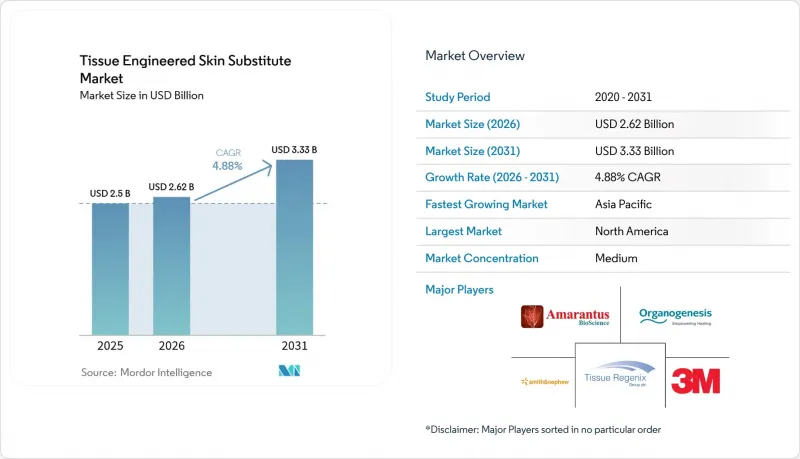
에 의하면, 2026년 조직공학 피부 대체물 시장 규모는 26억 2,000만 달러로 추정되고, 2025년 25억 달러에서 성장하여 2031년에는 33억 3,000만 달러에 이를 것으로 예측됩니다.
2026-2031년 연평균 성장률(CAGR) 4.88%로 성장할 것으로 전망됩니다.
본 보고서는 유형별(자가 세포 유래, 기타), 소재별(천연/생물 유래, 기타), 생체 재료 원료별(콜라겐, 기타), 제조 기술별(기존 수작업, 기타), 용도별(만성 상처, 기타), 최종 사용자별(병원, 기타), 지역별(북미, 유럽, 기타)로 분류되어 있습니다. 시장 규모 및 전망은 금액(달러) 기준으로 제시되어 있습니다.
세계의 조직공학 피부 대체재 시장 동향 및 인사이트
만성 상처 유병률 증가
미국에서는 약 670만 명이 만성 상처를 앓고 있으며, 그 치료비는 매년 500억 달러를 초과합니다. 2040년까지 미국인의 21%가 65세 이상이 될 것으로 예상되는 가운데, 당뇨병이나 혈관 질환 등의 동반 질환이 치료를 더욱 복잡하게 만들고 있습니다. 이에 따라 병원에서는 치유 기간을 단축하고 고액의 치료비가 드는 감염증을 예방할 수 있는 첨단 대체 제품에 대한 투자가 진행되고 있습니다. 재입원율 감소를 입증하는 실제 임상 데이터베이스는 보험사의 신뢰를 높여, 보험 적용 목록에 더 광범위하게 포함되도록 촉진하고 있습니다.
증가하는 화상 및 외상 발생률
화상, 화학적 화상, 전기 화상은 생체 재료에 의한 치료에 대한 시급한 필요성을 낳고 있습니다. 2024년 AVITA Medical사의 RECELL GO 시스템이 FDA 승인을 획득함에 따라, 기증 부위의 합병증을 줄이고 피부 색조를 일치시키는 자가 유래 스프레이식 치료법이 제공되게 되었습니다. 국방 및 산업 안전 예산이 유사한 플랫폼에 배정됨에 따라, 그 도입은 전문 화상 치료 부문을 넘어 지역 외상 센터로 확대되고 있습니다.
신흥 시장의 제한된 보험 급여
많은 개발도상국에서는 첨단 상처 치료보다 1차 의료가 우선시되고 있어, 임상적 필요성이 높음에도 불구하고 도입이 지연되고 있습니다. 공식적인 의료 기술 평가 제도가 부재하여 체계적인 가치 분석이 제한되고 있으며, 공립 병원에서는 종종 거즈나 생리식염수를 이용한 처치가 기본으로 이루어지고 있습니다. 각 제조업체들은 현재 이러한 지역을 위해 비용을 절감한 제품을 설계하고 있지만, 이익률 하락이 연구 개발에 대한 재투자를 위협하고 있습니다.
부문 분석
무세포 매트릭스는 멸균이 용이하고 즉시 납품이 가능한 물류 체계를 바탕으로, 2025년에는 조직공학적 피부 대체재 시장에서 24.35%의 점유율을 차지했습니다. 한편, 세포성 자가 이식편은 맞춤형 의료의 추세와 면역원성 감소에 힘입어 연평균 성장률(CAGR) 13.10%로 성장을 지속하고, 있습니다. 전용 조직 연구소를 보유한 병원에서는 약물 치료에 반응하지 않는 궤양에 대해 이러한 솔루션을 도입하고 있습니다. 2024년 12월에 승인된 ‘RECELL GO mini’는 기증자로부터 채취하는 양을 최소화하면서도 최대 480 cm²의 상처를 치료할 수 있어, 자동화를 통해 자원 수요가 어떻게 감소되는지를 여실히 보여주고 있습니다. 생산량이 증가함에 따라 규모의 경제 효과로 인해 비용 격차가 줄어들 것으로 예상되며, 시장의 선호도는 맞춤형 구조물로 이동할 것입니다.
복합 진피·표피 제품은 기술적으로 고도로 발전해 있지만, 다층 구조의 제조에는 엄격한 환경 관리가 요구되기 때문에 생산 능력에 제약이 있습니다. 세포 유래 동종 이식 제품은 즉시 사용 가능성과 생물학적 신호 전달의 균형을 잘 맞춘 중간적인 위치를 차지하고 있지만, 기증자가 병원체 스크리닝 규정을 준수해야 하기 때문에 물류 과정이 복잡해집니다. 따라서 업계의 투자는 진료 현장에서의 신속성과 면역 적합성을 겸비한 바이오 프린팅 기술을 활용한 자가 유래 세포 플랫폼에 집중되고 있습니다.
소와 돼지의 진피를 포함한 천연 생체 스캐폴드는 2025년 매출의 32.85%를 차지했습니다. 그 실적과 알려진 안전성 프로파일 덕분에 병원 위원회의 승인이 순조롭게 진행되고 있습니다. 그러나 공급 제한과 동물 유래에 대한 우려로 인해, 재조합 인간 콜라겐과 강인한 폴리머를 결합한 생체합성 대체재 시장은 연평균 성장률(CAGR) 11.05%로 확대되고 있습니다. 병원 측은 일관된 기계적 강도와 예측 가능한 분해 곡선을 높이 평가하고 있으며, 이를 통해 외과 의사의 훈련이 용이해집니다.
해양 유래 콜라겐의 혁신으로 인해 소재의 다양성이 확대되고 있습니다. Kerecis사는 오메가-3 지방산이 풍부한 생선 껍질 유래 매트릭스를 활용하여 2025년에 신속하게 메디케어 코드 인증을 획득했습니다. 이는 지속 가능한 생체 소재에 대한 보험사 측의 수용성을 보여주는 사례입니다. 한편, 순수 합성 메쉬는 대규모 화상 치료나 야전 병원에서의 응급 사용에 있어 여전히 비용 면에서 우위를 유지하고 있습니다. 현재 연구개발 파이프라인에서는 하이브리드 생합성 플랫폼이 주류를 이루고 있으며, 생물학적 신호를 재현하면서도 산업 규모의 생산성을 확보하는 것을 목표로 하고 있습니다.
지역별 분석
북미는 2025년 조직공학 피부 대체재 시장에서 29.60%의 점유율을 확보했습니다. 이는 메디케어 코드 Q4100-Q4180과 민간 보험에 의한 견실한 채택에 힘입은 결과입니다. 벤처 캐피탈공급은 여전히 풍부하며, 미국의 재생의학 부문은 2033년까지 807억 4,000만 달러에 달할 것으로 예측됩니다. 2025년에 ‘지역별 급여 결정(LCD)’이 연기됨에 따라 단기적인 상환 압력이 완화되었고, 공급업체들은 코드에 관한 로비 활동보다는 치료 성과 데이터 생성에 집중할 수 있게 되었습니다. 보스턴, 샌안토니오, 로스앤젤레스의 대학 부속 화상 치료 센터에서는 AI를 활용한 투여 일정 시범 시험이 진행되고 있으며, 이 지역은 근거 기반 상처 치료의 최전선에 위치하고 있습니다.
아시아태평양은 2031년까지 연평균 성장률(CAGR) 9.02%라는 가장 빠른 성장세를 보일 전망입니다. 중국의 상처 치료 시설은 2010년 16곳에서 2019년 357곳으로 증가하여, 전문 의료에 대한 중국의 노력을 엿볼 수 있습니다. 상하이와 광저우의 도시 병원에서는 당뇨병성 궤양용 생체합성 시트에 대한 임상시험이 진행되고 있으며, 지방 진료소에서는 비용을 절감한 돼지 유래 매트릭스가 도입되고 있습니다. 일본의 PMDA는 세포 치료 신청 서류를 명확히 하는 지침 초안을 공표하여, 미국 개발 기업에 대한 이중 승인을 가속화하고 있습니다. 한국은 국방부의 보조금을 전투 외상용 바이오프린팅에 투입하여 지역 혁신 기반을 더욱 확대되고 있습니다.
유럽에서는 엄격한 의료 기술 평가를 통해 가격 규율이 철저히 적용되고 있어 완만한 확대세가 나타나고 있습니다. 독일의 공적 보험사는 새로운 이식 재료를 보험 적용 목록에 추가하기 전에 결정적인 비용 대비 효과 데이터를 요구하고 있으며, 이에 따라 파일럿 등록 제도를 통해 실제 임상 데이터가 수집되고 있습니다. 프랑스와 북유럽 국가들은 장기적인 비용 절감 효과를 인식하고, 간호 시간을 단축하는 생체 합성 매트릭스에 대한 보험 적용을 실시했습니다. 중동 및 아프리카에서는 두바이 등 의료 관광 거점에서 급속한 보급이 나타나고 있습니다. 그곳에서는 사립 병원이 경제적으로 여유가 있는 화상 환자를 대상으로 삼고 있습니다. 남미의 성장은 브라질과 콜롬비아의 거시경제 안정화와 밀접한 관련이 있으며, 이들 국가에서는 공적 보험 기관이 만성 상처 관리를 위한 예산을 점차 배정하고 있습니다.
기타 혜택 :
- 엑셀 형식 시장 예측(ME) 시트
- 3개월간의 애널리스트 지원
자주 묻는 질문
목차
제1장 서론
제2장 조사 방법
제3장 주요 요약
제4장 시장 구도
제5장 시장 규모 및 성장 예측
제6장 경쟁 구도
제7장 시장 기회 및 향후 전망
AJY 26.08.28According to Mordor Intelligence, tissue-engineered skin substitutes market size in 2026 is estimated at USD 2.62 billion, growing from 2025 value of USD 2.5 billion with 2031 projections showing USD 3.33 billion, growing at 4.88% CAGR over 2026-2031.
This report is Segmented by Type (Cellular Autologous, and More), Material (Natural/Biological, and More), Biomaterial Source (Collagen, and More), Manufacturing Technology (Conventional Manual, and More), Application (Chronic Wounds, and More), End User (Hospitals, and More), and Geography (North America, Europe, and More). The Market Sizes and Forecasts are Provided in Terms of Value (USD).
Global Tissue Engineered Skin Substitute Market Trends and Insights
Increasing Prevalence Of Chronic Wounds
Roughly 6.7 million people in the United States live with chronic wounds, generating treatment outlays exceeding USD 50 billion each year. As 21% of Americans are expected to be 65 or older by 2040, comorbidities such as diabetes and vascular disease further complicate care. Hospitals, therefore, invest in advanced substitutes that shorten healing time and prevent costly infections. Real-world databases documenting reduced readmissions strengthen payer confidence, encouraging broader formulary inclusion.
Rising Burn & Trauma Incidence
Thermal, chemical, and electrical burns create an immediate need for biologic coverage. FDA clearance of AVITA Medical's RECELL GO system in 2024 provided an autologous spray-on therapy that lessens donor-site morbidity and matches pigmentation. Defense and industrial-safety budgets fund similar platforms, driving procurement beyond specialized burn units into regional trauma centers.
Limited Reimbursement in Emerging Markets
Many developing economies prioritize primary care over premium wound treatments, delaying uptake despite high clinical need. Absence of formal health-technology assessment limits systematic value analysis, and public hospitals often default to gauze and saline. Manufacturers now design cost-controlled variants specifically for these regions, though lower margins threaten reinvestment in R&D.
Other drivers and restraints analyzed in the detailed report include:
- Rapid Adoption Of 3D-Bioprinting Workflows
- Aging Population with Fragile Skin & Comorbidities
- Regulatory Uncertainty For Autologous Point-Of-Care Printing
For complete list of drivers and restraints, kindly check the Table Of Contents.
Segment Analysis
Acellular matrices commanded 24.35% tissue-engineered skin substitutes market share in 2025 due to easier sterilization and off-the-shelf logistics. Cellular autologous grafts, however, are registering a 13.10% CAGR, driven by personalized medicine trends and reduced immunogenicity. Hospitals with dedicated tissue labs deploy these solutions for ulcers unresponsive to medicines. RECELL GO mini, approved in December 2024, treats wounds up to 480 cm2 with limited donor harvest, spotlighting how automation lowers resource needs. As volumes grow, economies of scale are expected to narrow cost gaps, nudging market preference toward bespoke constructs.
Composite dermo-epidermal products remain technically sophisticated but capacity-constrained because multilayer fabrication demands strict environmental control. Cellular allogeneic options occupy a midpoint, balancing shelf-readiness with biologic signaling, yet donors must match pathogen-screening regulations that complicate logistics. Industry investment, therefore, favors bio-printed cellular autologous platforms that pair point-of-care speed with immune compatibility.
Natural biological scaffolds, including bovine and porcine dermis, captured 32.85% revenues in 2025. Their track record and known safety profiles smooth hospital committee approvals. Supply limitations and animal-origin sensitivities, though, stimulate an 11.05% CAGR in biosynthetic substitutes that combine recombinant human collagen with robust polymers. Hospitals appreciate consistent mechanical strength and predictable degradation curves, which ease surgeon training.
Marine collagen innovations extend material diversity. Kerecis leveraged fish-skin matrices rich in omega-3 lipids and gained quick Medicare coding in 2025, illustrating payer openness to sustainable biomaterials. Meanwhile, purely synthetic meshes retain cost advantages for high-volume burns and emergent use in field hospitals. Hybrid biosynthetic platforms now dominate R&D pipelines, aiming to mirror biologic cues while ensuring industrial scalability.
Complete Report Scope:
- By Construct Type
- Cellular Autologous
- Cellular Allogeneic
- Acellular Matrices
- Composite (Dermo-epidermal)
- By Product Material
- Natural/Biological
- Synthetic
- Biosynthetic
- By Biomaterial Source
- Collagen
- Chitosan
- Hyaluronic Acid
- PEG & Other Polymers
- By Manufacturing Technology
- Conventional Manual
- 3-D Bioprinted
- Electrospun Nanofiber
- Decellularized ECM
- By Application
- Chronic Wounds
- Diabetic Foot Ulcers
- Venous Leg Ulcers
- Pressure Ulcers
- Burn & Trauma
- Thermal Burns
- Chemical/Radiation Burns
- Surgical Wounds
- Cosmetic Reconstruction
- Chronic Wounds
- By End-User
- Hospitals
- Specialised Burn Centres
- Ambulatory Surgical Centres
- Home Healthcare
- By Geography
- North America
- United States
- Canada
- Mexico
- Europe
- Germany
- United Kingdom
- France
- Italy
- Spain
- Rest of Europe
- Asia Pacific
- China
- Japan
- India
- South Korea
- Australia
- Rest of Asia Pacific
- Middle East & Africa
- GCC
- South Africa
- Rest of Middle East & Africa
- South America
- Brazil
- Argentina
- Rest of South America
- North America
Geography Analysis
North America secured a 29.60% market share in tissue-engineered skin substitutes in 2025, anchored by Medicare codes Q4100-Q4180 and robust private insurance uptake. Venture capital remains plentiful: the U.S. regenerative medicine segment is projected to reach USD 80.74 billion by 2033. The recent postponement of Local Coverage Determinations in 2025 eased near-term reimbursement pressure, letting suppliers focus on outcome-data generation rather than code lobbying. Academic burn units in Boston, San Antonio, and Los Angeles pilot AI-directed dosing schedules, positioning the region at the forefront of evidence-based wound care.
Asia Pacific delivers the fastest rise with a 9.02% CAGR to 2031. China's wound-care facilities grew from 16 in 2010 to 357 in 2019, showcasing the state's commitment to specialty care. Urban hospitals in Shanghai and Guangzhou test biosynthetic sheets for diabetic ulcers, while provincial clinics deploy cost-trimmed porcine matrices. Japan's PMDA has published draft guidance clarifying cell-therapy dossiers, accelerating dual approvals for U.S. developers. South Korea funnels Defense Ministry grants into combat wound bioprinting, further enlarging the regional innovation base.
Europe registers moderate expansion as tight health-technology assessments enforce price discipline. Germany's statutory insurers demand conclusive cost-utility data before listing new grafts, prompting pilot registries to collect real-world evidence. France and the Nordics reimburse biosynthetic matrices that cut nursing time, recognizing long-term savings. The Middle East & Africa feature pockets of rapid uptake in medical tourism hubs such as Dubai, where private hospitals target affluent burn patients. South America's growth is tied to macro-economic stabilization in Brazil and Colombia, where public insurers gradually allocate budgets for chronic-wound management.
- 3M (Acelity)
- Smiths Group
- Organogenesis
- Integra LifeSciences
- Molnlycke Health Care
- Avita Medical
- Tissue Regenix
- Stratatech (Mallinckrodt)
- CryoLife
- Convatec Group
- Medtronic
- Vericel
- AxoGen
- RenovoDerm
- PolarityTE
- BSN Medical
- Baxter
- MiMedx Group
- Aroa Biosurgery
- Regenity Biosciences
Additional Benefits:
- The market estimate (ME) sheet in Excel format
- 3 months of analyst support
TABLE OF CONTENTS
1 Introduction
- 1.1 Study Assumptions & Market Definition
- 1.2 Scope of the Study
2 Research Methodology
3 Executive Summary
4 Market Landscape
- 4.1 Market Overview
- 4.2 Market Drivers
- 4.2.1 Increasing Prevalence Of Chronic Wounds
- 4.2.2 Rising Burn & Trauma Incidence
- 4.2.3 Rapid Adoption Of 3-D Bioprinting Workflows
- 4.2.4 Aging Population With Fragile Skin & Comorbidities
- 4.2.5 Increasing Regenerative-Medicine Funding
- 4.2.6 Veterinary Wound-Care Crossover Demand
- 4.3 Market Restraints
- 4.3.1 Limited Reimbursement in Emerging Markets
- 4.3.2 Inability To Recreate Skin Appendages
- 4.3.3 Donor-Tissue Supply Chain Bottlenecks
- 4.3.4 Regulatory Uncertainty For Autologous Point-Of-Care Printing
- 4.4 Supply Chain Analysis
- 4.5 Regulatory Landscape
- 4.6 Technological Outlook
- 4.7 Porter's Five Forces Analysis
- 4.7.1 Threat of New Entrants
- 4.7.2 Bargaining Power of Buyers
- 4.7.3 Bargaining Power of Suppliers
- 4.7.4 Threat of Substitutes
- 4.7.5 Intensity of Competitive Rivalry
5 Market Size & Growth Forecasts (Value)
- 5.1 By Construct Type
- 5.1.1 Cellular Autologous
- 5.1.2 Cellular Allogeneic
- 5.1.3 Acellular Matrices
- 5.1.4 Composite (Dermo-epidermal)
- 5.2 By Product Material
- 5.2.1 Natural/Biological
- 5.2.2 Synthetic
- 5.2.3 Biosynthetic
- 5.3 By Biomaterial Source
- 5.3.1 Collagen
- 5.3.2 Chitosan
- 5.3.3 Hyaluronic Acid
- 5.3.4 PEG & Other Polymers
- 5.4 By Manufacturing Technology
- 5.4.1 Conventional Manual
- 5.4.2 3-D Bioprinted
- 5.4.3 Electrospun Nanofiber
- 5.4.4 Decellularized ECM
- 5.5 By Application
- 5.5.1 Chronic Wounds
- 5.5.1.1 Diabetic Foot Ulcers
- 5.5.1.2 Venous Leg Ulcers
- 5.5.1.3 Pressure Ulcers
- 5.5.2 Burn & Trauma
- 5.5.2.1 Thermal Burns
- 5.5.2.2 Chemical/Radiation Burns
- 5.5.3 Surgical Wounds
- 5.5.4 Cosmetic Reconstruction
- 5.5.1 Chronic Wounds
- 5.6 By End-User
- 5.6.1 Hospitals
- 5.6.2 Specialised Burn Centres
- 5.6.3 Ambulatory Surgical Centres
- 5.6.4 Home Healthcare
- 5.7 By Geography
- 5.7.1 North America
- 5.7.1.1 United States
- 5.7.1.2 Canada
- 5.7.1.3 Mexico
- 5.7.2 Europe
- 5.7.2.1 Germany
- 5.7.2.2 United Kingdom
- 5.7.2.3 France
- 5.7.2.4 Italy
- 5.7.2.5 Spain
- 5.7.2.6 Rest of Europe
- 5.7.3 Asia Pacific
- 5.7.3.1 China
- 5.7.3.2 Japan
- 5.7.3.3 India
- 5.7.3.4 South Korea
- 5.7.3.5 Australia
- 5.7.3.6 Rest of Asia Pacific
- 5.7.4 Middle East & Africa
- 5.7.4.1 GCC
- 5.7.4.2 South Africa
- 5.7.4.3 Rest of Middle East & Africa
- 5.7.5 South America
- 5.7.5.1 Brazil
- 5.7.5.2 Argentina
- 5.7.5.3 Rest of South America
- 5.7.1 North America
6 Competitive Landscape
- 6.1 Market Concentration
- 6.2 Market Share Analysis
- 6.3 Company Profiles (includes Global level Overview, Market level overview, Core Segments, Financials as available, Strategic Information, Market Rank/Share for key companies, Products & Services, and Recent Developments)
- 6.3.1 3M (Acelity)
- 6.3.2 Smith & Nephew
- 6.3.3 Organogenesis
- 6.3.4 Integra LifeSciences
- 6.3.5 Molnlycke Health Care
- 6.3.6 Avita Medical
- 6.3.7 Tissue Regenix
- 6.3.8 Stratatech (Mallinckrodt)
- 6.3.9 CryoLife
- 6.3.10 Convatec Group
- 6.3.11 Medtronic
- 6.3.12 Vericel Corporation
- 6.3.13 AxoGen
- 6.3.14 RenovoDerm
- 6.3.15 PolarityTE
- 6.3.16 BSN medical
- 6.3.17 Baxter International
- 6.3.18 MiMedx Group
- 6.3.19 Aroa Biosurgery
- 6.3.20 Regenity Biosciences
7 Market Opportunities & Future Outlook
- 7.1 White-space & Unmet-need Assessment


