
|
시장보고서
상품코드
2115053
조산 예방 및 관리 시장 : 시장 점유율 분석, 업계 동향 및 통계, 성장 예측(2026-2031년)Preterm Birth Prevention And Management - Market Share Analysis, Industry Trends & Statistics, Growth Forecasts (2026 - 2031) |
||||||
 Mordor Intelligence
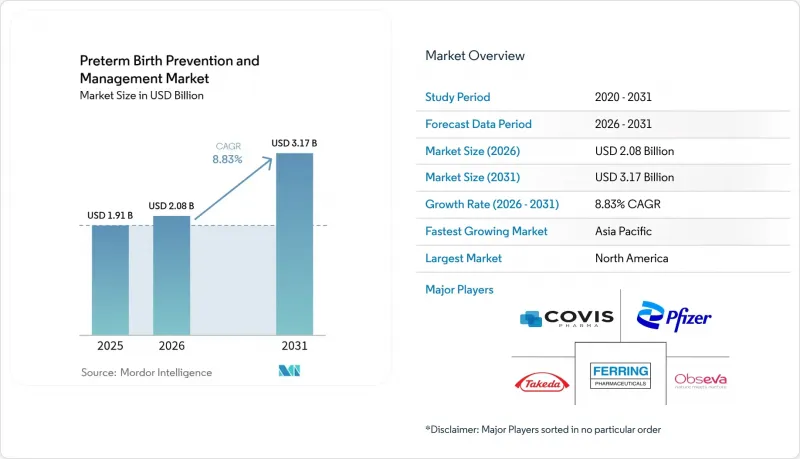
Mordor Intelligence에 의하면, 조산 예방 및 관리 시장 규모는 2025년 19억 1,000만 달러로 평가되었고, 2026년에는 20억 8,000만 달러로 추정되고, 2026-2031년 CAGR 8.83%로 성장을 지속할 전망이며, 2031년에는 31억 7,000만 달러에 이를 것으로 예측됩니다.
본 보고서는 중재 방법별(치료제, 진단제), 투여 경로별(질 내, 경구, 비경구), 최종 사용자별(병원, 산부인과·불임 치료 클리닉 등), 재태 주수에 따른 위험 분류별(초조산, 극조산, 조산 등), 지역별(북미, 유럽 등)로 분류되어 있습니다. 시장 예측은 금액(달러) 기준으로 제시되어 있습니다.
세계의 조산 예방 및 관리 시장 동향과 인사이트
전 세계적으로 증가하는 조산 발생률
현재 조산은 연간 1,340만 명의 영아에게 영향을 미치고 있으며, 치료 및 진단 각 부문에서 안정적인 수요를 뒷받침하고 있습니다. 산모의 고령화, 보조생식기술에 의한 다태임신, 그리고 뿌리 깊은 의료 격차가 이러한 상승 추세를 부추기고 있습니다. 저·중소득국이 가장 큰 부담을 지고 있지만, 생존자의 평생 치료 비용은 미국에서만 연간 300억 달러를 초과하기 때문에 비용 측면의 압박은 전 세계적인 문제가 되고 있습니다. 이러한 역학적 상황이 예방적 개입과 신생아 집중 치료 기술의 동시적인 성장을 가속하고 있으며, 조산 예방 및 관리 시장을 다방면에서 지속적으로 확대시키는 이중 성장 동력을 강화하고 있습니다.
프로게스테론 요법에 대한 임상 지침의 전환
17-하이드록시프로게스테론 카프로에이트의 판매 중단에 따라, 전문 학회는 현재 자궁경관 단축이 있는 여성에게 질 내 프로게스테론 투여를 권장하고 있습니다. 주요 PREGNANT 임상시험에서 조산이 45% 감소한 것으로 나타나, 그동안의 불확실성이 해소되고 처방 패턴이 통일되었습니다. 제약사들은 복약 순응도를 높이는 서방형 미세결정 제제로 이에 대응하고 있으며, 한편 유전자 연구를 통해 어떤 환자가 가장 큰 혜택을 받을 수 있는지가 점차 밝혀지고 있습니다. 이러한 명확화로 인해 투여 경로의 혁신을 향한 자본이 유입되고 있으며, 예측 가능한 판매량 증가가 뒷받침되고 있습니다.
FDA에 의한 ‘마케나’ 시장 철수 및 규제 강화
규제 당국은 유효성과 안전성에 대한 우려가 제기됨에 따라 2023년에 17-하이드록시프로게스테론 카프로에이트를 시장에서 철수시켰습니다. 이로 인해 임상의들은 치료 프로토콜을 재설계해야만 했으며, 신약에 대한 증거 기준이 높아졌습니다. 이러한 조치는 향후 치료제 개발 기간을 연장하고 필요한 자금을 증가시켜, 환자의 치료 성과를 보호하는 한편 단기적으로는 성장 모멘텀을 둔화시킬 것입니다.
부문 분석
2025년, 프로게스테론, 칼슘 채널 차단제, 코르티코스테로이드를 주력 제품으로 하는 치료제는 조산 예방 및 관리 시장에서 60.62%의 점유율을 차지하며 계속해서 주도적인 위치를 유지했습니다. 질 내 투여용 프로게스테론은 여전히 1차 선택 약제이지만, 니페디핀은 임신 기간 연장 측면에서 기존의 자궁 수축 억제제를 능가하는 효과를 보이고 있습니다. 코르티코스테로이드는 엄격한 임신 주수 범위 내에서 태아의 폐 성숙을 지속적으로 촉진하고 있습니다. 개발 파이프라인에는 옥시토신 수용체 길항제 및 혈관확장제의 병용 요법 등이 포함되어 있으나, 그 보급은 보다 명확한 생존율 데이터의 제시 여부에 달려 있습니다.
진단 분야는 피브로넥틴 검사 키트, PAMG-1 분석법, 그리고 머신러닝을 통한 위험도 평가와 연계된 자궁경부 길이 초음파 진단 기기에 힘입어 9.41%라는 가장 높은 연평균 성장률(CAGR)을 기록하고 있습니다. 높은 음성 예측도로 인해 입원 기간이 단축되고 스테로이드의 표적 투여가 가능해짐에 따라, 보험사들의 지지도 강화되고 있습니다. 이러한 동향들이 맞물려 조산 예방 및 관리 시장은 ‘예방을 최우선으로 하는’ 임상 환경으로 자리 잡았습니다.
2025년에는 질 내 투여가 조산 예방 및 관리 시장 규모의 44.02%를 차지했습니다. 이는 국소 투여를 통해 프로게스테론이 필요한 부위에 집중되고, 전신성 부작용을 최소화할 수 있기 때문입니다. 자가 투여, 서방형 링, 그리고 낮은 보관 비용이 추가적인 보급을 뒷받침하고 있습니다.
경구 제제는 생체이용률을 치료 역치까지 높이는 초미세 분말화 기술과 보호 코팅의 도움으로 연평균 성장률(CAGR) 9.62%로 급속히 확대되고 있습니다. 환자들은 편의성 때문에 정제를 선호하고, 의사들은 처방의 간소화를 중요시합니다. 비경구 투여 경로는 응급 상황에서의 자궁 수축 억제에 있어 특정 틈새 시장을 유지하고 있지만, 사용 시 불편함과 의료 현장에서의 비용 증가라는 과제에 직면해 있습니다.
지역별 분석
북미는 2025년 조산 예방 및 관리 시장 점유율의 41.76%를 차지했으며, 이는 환급 제도, NIH(미국 국립보건원)의 자금 지원 및 가이드라인의 성숙도에 의해 뒷받침되고 있습니다. 신속 바이오마커 검사 및 서방형 프로게스테론 시장 침투율은 이미 높은 수준에 있습니다. 마케나(Makena) 시장 철수 이후 발생한 규제상의 불확실성은 약물감시를 강화하는 한편, 진료소를 진단 주도형 치료 경로로 이끌게 된 계기가 되었습니다.
아시아태평양은 보험 적용 범위 확대, 정부의 의료기기 승인 제도 개혁, 그리고 신생아 관리를 표준화하는 CARE-Preterm과 같은 다국적 코호트 연구에 힘입어 10.05%라는 가장 높은 연평균 성장률(CAGR)을 기록하고 있습니다. 중국의 신생아 중환자실(NICU) 네트워크 확대와 인도의 ‘싱글 윈도우’ 규제 포털 덕분에 제품 출시까지의 기간이 단축되고 있습니다. 한편, 일본에서는 질내 프로게스테론이 산과 일상 진료에 점차 도입되고 있습니다. 이러한 움직임들이 맞물리면서, 해당 지역은 조산 예방 및 관리 시장 수요 동향을 재편하고 있습니다.
유럽, 중동 및 아프리카, 그리고 남미에서는 추가적인 성장 여지가 예상됩니다. EMA의 17-하이드록시프로게스테론 카프로에이트 사용 중단 조치로 인해 대체 약제의 도입이 가속화되고 있습니다. 사하라 이남 아프리카는 여전히 발생률이 가장 높은 지역이지만, 인프라 격차에 직면해 있어 저비용 진단법 및 원격 의료를 위한 미개척 시장이 형성되고 있습니다. 남미의 규제 당국은 임산부 건강에 관한 역량 강화에 투자하고 있으며, 이는 기초 수요를 끌어올리는 데 기여하고 있습니다.
기타 혜택 :
- 엑셀 형식 시장 예측(ME) 시트
- 3개월간의 애널리스트 지원
자주 묻는 질문
목차
제1장 서론
제2장 조사 방법
제3장 주요 요약
제4장 시장 구도
제5장 시장 규모 및 성장 예측
제6장 경쟁 구도
제7장 시장 기회 및 향후 전망
AJY 26.08.28According to Mordor Intelligence, the preterm birth prevention and management market size is expected to grow from USD 1.91 billion in 2025 to USD 2.08 billion in 2026 and is forecast to reach USD 3.17 billion by 2031 at 8.83% CAGR over 2026-2031.
This report is Segmented by Intervention (Therapeutics, Diagnostics), Route of Administration (Vaginal, Oral, Parenteral), End User (Hospitals, Maternity & Fertility Clinics, and More), Gestational-Age Risk Category (Extremely Preterm, Very Preterm, and More), and Geography (North America, Europe, and More). The Market Forecasts are Provided in Terms of Value (USD).
Global Preterm Birth Prevention And Management Market Trends and Insights
Escalating Global Incidence of Preterm Births
Preterm births now affect 13.4 million infants a year, anchoring steady demand across therapeutic and diagnostic segments. Rising maternal age, multiple-birth pregnancies from assisted-reproductive technologies, and persistent care disparities sustain the upward trend. Low- and middle-income countries shoulder the heaviest burden, yet cost pressures are global because life-long care of survivors tops USD 30 billion in annual spending in the United States alone. This epidemiology is driving simultaneous growth in preventive interventions and neonatal intensive-care technologies, reinforcing a dual-growth dynamic that keeps the preterm birth prevention and management market expanding on multiple fronts.
Clinical-Guideline Shift Toward Progesterone Therapy
Professional societies now endorse vaginal progesterone for women with short cervix after the withdrawal of 17-hydroxyprogesterone caproate. The pivotal PREGNANT trial showed a 45% drop in preterm deliveries, eliminating earlier uncertainty and unifying prescribing patterns. Pharmaceutical firms are responding with sustained-release microcrystal formulations that improve adherence, while genetic research is clarifying which patients benefit most. The resulting clarity is channelling capital toward route-of-administration innovation and supports predictable volume growth.
FDA Withdrawal of Makena and Tighter Regulations
Regulators pulled 17-hydroxyprogesterone caproate from the market in 2023 after efficacy and safety doubts surfaced, forcing clinicians to redesign treatment protocols and raising evidentiary hurdles for new agents. The action lengthens development timelines and raises capital requirements for future therapeutics, tempering growth momentum in the near term even as it safeguards patient outcomes.
Other drivers and restraints analyzed in the detailed report include:
- Rapid Uptake of Point-of-Care Biomarker Tests
- Government Maternal-Health Funding Boosts
- Limited Novel-Drug R&D Investment
For complete list of drivers and restraints, kindly check the Table Of Contents.
Segment Analysis
Therapeutics retained leadership with a 60.62% slice of the preterm birth prevention and management market in 2025, anchored by progesterone, calcium channel blockers, and corticosteroids. Vaginal progesterone remains first line, while nifedipine outperforms historic tocolytics in prolonging gestation. Corticosteroids continue to support fetal lung maturation under strict gestational-age windows. Pipeline activity spans oxytocin-receptor antagonists and vasodilator combinations, yet uptake hinges on clearer survival data.
Diagnostics are posting the fastest 9.41% CAGR, fuelled by fibronectin kits, PAMG-1 assays, and cervical-length ultrasound systems that integrate with machine-learning risk-scoring. High negative predictive value shortens hospital stays and guides targeted steroid use, strengthening payer backing. Combined, these trends reinforce the preterm birth prevention and management market as a prevention-first clinical environment.
Vaginal delivery captured 44.02% share of the preterm birth prevention and management market size in 2025 because local dosing concentrates progesterone where it is needed and minimizes systemic side effects. Self-administration, sustained-release rings, and low storage costs favour further adoption.
Oral formulations are accelerating at 9.62% CAGR, energised by micronization and protective coatings that lift bioavailability to therapeutic thresholds. Patients prefer tablets for convenience, and physicians value simplified prescribing. Parenteral routes retain a corner niche for emergency tocolysis but face user discomfort and higher site-of-care costs.
Complete Report Scope:
- By Intervention
- Therapeutics
- Calcium Channel Blockers
- Progesterone Therapy
- Oxytocin Receptor Antagonists
- Corticosteroids
- Others
- Diagnostics
- Biomarker Test Kits (fFN, PAMG-1)
- Cervical Length Ultrasound Devices
- Other Diagnostic Tools
- Therapeutics
- By Route of Administration
- Vaginal
- Oral
- Parenteral
- By End User
- Hospitals
- Maternity & Fertility Clinics
- Home Healthcare Settings
- Research & Academic Institutes
- By Gestational-Age Risk Category
- Extremely Preterm (<28 w)
- Very Preterm (28-32 w)
- Moderate-Late Preterm (32-37 w)
- By Geography
- North America
- United States
- Canada
- Mexico
- Europe
- Germany
- United Kingdom
- France
- Italy
- Spain
- Rest of Europe
- Asia-Pacific
- China
- India
- Japan
- South Korea
- Australia
- Rest of Asia-Pacific
- South America
- Brazil
- Argentina
- Rest of South America
- Middle East and Africa
- GCC
- South Africa
- Rest of Middle East and Africa
- North America
Geography Analysis
North America commanded 41.76% of the preterm birth prevention and management market share in 2025, sustained by reimbursement structures, NIH funding streams, and guideline maturity. Market penetration of rapid biomarker tests and sustained-release progesterone is already high. Regulatory uncertainty after Makena's withdrawal spurred tighter pharmacovigilance but also nudged clinics toward diagnostically driven care paths.
Asia-Pacific registers the quickest 10.05% CAGR, propelled by broader insurance coverage, government device-approval reforms, and multi-country cohort studies such as CARE-Preterm that standardise neonatal care. China's expanding NICU network and India's Single Window regulatory portal are shortening product-rollout timelines, while Japan is integrating vaginal progesterone into routine obstetrics. Collectively, the region is reshaping volume dynamics for the preterm birth prevention and management market.
Europe, the Middle East and Africa, and South America offer incremental upside. EMA's suspension of 17-hydroxyprogesterone caproate is accelerating adoption of alternative agents. Sub-Saharan Africa remains the highest-incidence region yet faces infrastructure gaps, creating white-space for low-cost diagnostics and telehealth. South American regulators are investing in maternal-health capacity building, helping lift baseline demand.
- Ferring Pharmaceuticals
- Hologic
- The Cooper Companies
- Covis Pharma
- Besins Healthcare
- Pfizer
- Merck
- Cipla
- Sun Pharmaceuticals Industries
- Dr. Reddy's Laboratories
- Lupin
- ObsEva SA
- Cook Group
- QIAGEN
- Utah Medical Products
- MedGyn Products
Additional Benefits:
- The market estimate (ME) sheet in Excel format
- 3 months of analyst support
TABLE OF CONTENTS
1 Introduction
- 1.1 Study Assumptions & Market Definition
- 1.2 Scope of the Study
2 Research Methodology
3 Executive Summary
4 Market Landscape
- 4.1 Market Overview
- 4.2 Market Drivers
- 4.2.1 Escalating global incidence of preterm births
- 4.2.2 Clinical-guideline shift toward progesterone therapy
- 4.2.3 Rapid uptake of point-of-care biomarker tests
- 4.2.4 Government maternal-health funding boosts
- 4.2.5 AI-driven risk-stratification platforms
- 4.2.6 Repurposed vasodilators entering late-stage trials
- 4.3 Market Restraints
- 4.3.1 FDA withdrawal of Makena & tighter regulations
- 4.3.2 Limited novel-drug R&D investment
- 4.3.3 Elective-cesarean trend curbing tocolytic demand
- 4.3.4 API supply-chain fragility for key hormones
- 4.4 Value Chain Analysis
- 4.5 Regulatory Landscape
- 4.6 Technological Outlook
- 4.7 Porter's Five Forces
- 4.7.1 Threat of New Entrants
- 4.7.2 Bargaining Power of Suppliers
- 4.7.3 Bargaining Power of Buyers
- 4.7.4 Threat of Substitutes
- 4.7.5 Intensity of Competitive Rivalry
5 Market Size & Growth Forecasts (Value)
- 5.1 By Intervention
- 5.1.1 Therapeutics
- 5.1.1.1 Calcium Channel Blockers
- 5.1.1.2 Progesterone Therapy
- 5.1.1.3 Oxytocin Receptor Antagonists
- 5.1.1.4 Corticosteroids
- 5.1.1.5 Others
- 5.1.2 Diagnostics
- 5.1.2.1 Biomarker Test Kits (fFN, PAMG-1)
- 5.1.2.2 Cervical Length Ultrasound Devices
- 5.1.2.3 Other Diagnostic Tools
- 5.1.1 Therapeutics
- 5.2 By Route of Administration
- 5.2.1 Vaginal
- 5.2.2 Oral
- 5.2.3 Parenteral
- 5.3 By End User
- 5.3.1 Hospitals
- 5.3.2 Maternity & Fertility Clinics
- 5.3.3 Home Healthcare Settings
- 5.3.4 Research & Academic Institutes
- 5.4 By Gestational-Age Risk Category
- 5.4.1 Extremely Preterm (<28 w)
- 5.4.2 Very Preterm (28-32 w)
- 5.4.3 Moderate-Late Preterm (32-37 w)
- 5.5 By Geography
- 5.5.1 North America
- 5.5.1.1 United States
- 5.5.1.2 Canada
- 5.5.1.3 Mexico
- 5.5.2 Europe
- 5.5.2.1 Germany
- 5.5.2.2 United Kingdom
- 5.5.2.3 France
- 5.5.2.4 Italy
- 5.5.2.5 Spain
- 5.5.2.6 Rest of Europe
- 5.5.3 Asia-Pacific
- 5.5.3.1 China
- 5.5.3.2 India
- 5.5.3.3 Japan
- 5.5.3.4 South Korea
- 5.5.3.5 Australia
- 5.5.3.6 Rest of Asia-Pacific
- 5.5.4 South America
- 5.5.4.1 Brazil
- 5.5.4.2 Argentina
- 5.5.4.3 Rest of South America
- 5.5.5 Middle East and Africa
- 5.5.5.1 GCC
- 5.5.5.2 South Africa
- 5.5.5.3 Rest of Middle East and Africa
- 5.5.1 North America
6 Competitive Landscape
- 6.1 Market Share Analysis
- 6.2 Company Profiles (includes Global level Overview, Market level overview, Core Segments, Financials as available, Strategic Information, Market Rank/Share for key companies, Products & Services, and Recent Developments)
- 6.2.1 Ferring Pharmaceuticals
- 6.2.2 Hologic Inc.
- 6.2.3 CooperSurgical Inc.
- 6.2.4 Covis Pharma
- 6.2.5 Besins Healthcare
- 6.2.6 Pfizer Inc.
- 6.2.7 Merck KGaA
- 6.2.8 Cipla Ltd.
- 6.2.9 Sun Pharma
- 6.2.10 Dr. Reddy's Laboratories
- 6.2.11 Lupin Pharma
- 6.2.12 ObsEva SA
- 6.2.13 Cook Medical
- 6.2.14 QIAGEN
- 6.2.15 Utah Medical Products Inc.
- 6.2.16 MedGyn Products Inc.
7 Market Opportunities & Future Outlook
- 7.1 White-space & Unmet-need Assessment


