

|
시장보고서
상품코드
2115054
에소메프라졸 시장 : 점유율 분석, 업계 동향과 통계, 성장 예측(2026-2031년)Esomeprazole - Market Share Analysis, Industry Trends & Statistics, Growth Forecasts (2026 - 2031) |
||||||
 Mordor Intelligence
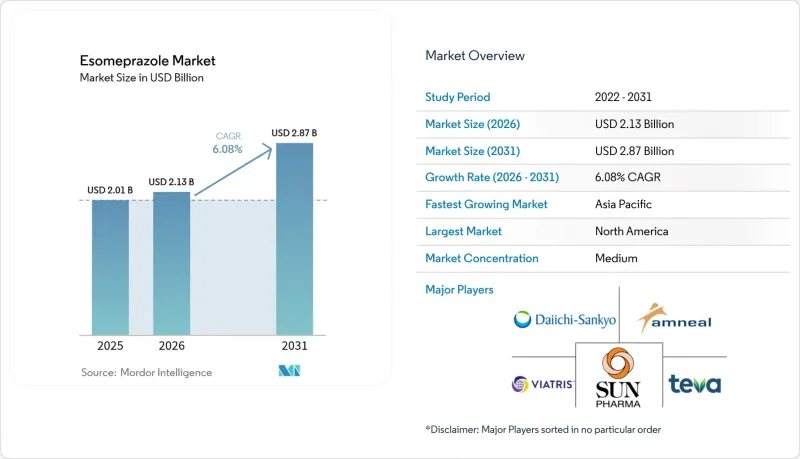
Mordor Intelligence에 의하면, 에소메프라졸 시장 규모는 2025년에 20억 1,000만 달러로 평가되었고 2026년 21억 3,000만 달러에서 2031년까지 28억 7,000만 달러에 이를 것으로 예측되며, 예측 기간(2026-2031년) CAGR은 6.08%를 나타낼 전망입니다.
본 보고서는 제형(정제, 캡슐, 기타), 함량(20mg, 40mg, 기타), 적응증(위식도 역류증, 위궤양, 기타),유통 채널(병원 약국, 소매 약국, 온라인 약국), 지역(북미, 유럽, 아시아태평양, 중동 및 아프리카, 남미)별로 분류되어 있습니다. 시장 전망은 금액(미 달러) 기준으로 제시되어 있습니다.
전 세계 에소메프라졸 시장 동향 및 인사이트
GERD 유병률 증가
세계 GERD 유병률의 상승이 에소메프라졸 시장 수요를 견인하고 있습니다. 현재 이 질환은 전 세계 인구의 최대 5분의 1에 영향을 미치고 있습니다. 미국에서만 직접적인 의료비는 연간 93억 달러에 달할 전망입니다. 튀르키예의 유병률 23%는 서유럽 국가 수준과 유사하지만, 아시아태평양에서는 생활 방식의 변화와 내시경 검사에 대한 접근성 향상에 따라 진단 건수가 증가하고 있습니다. 고령 환자는 바렛 식도나 선암의 위험이 높기 때문에 치료 기간이 장기화되는 경향이 있습니다. 그로 인해 임상의들은 여전히 고효능의 양성자 펌프 억제제에 의존하고 있으며, 에소메프라졸 시장은 견조한 성장세를 유지하고 있습니다.
고령화에 따른 위 질환
인구 고령화로 인해 만성 산 관련 질환 환자층이 더욱 확대되고 있으며, 이것이 에소메프라졸 시장의 성장을 뒷받침하고 있습니다. 하부 식도 괄약근 압력 저하, 타액 분비량 감소, 운동 기능 장애로 인해 증상이 경미하게 느껴지는 경우에도 고령자의 역류는 악화됩니다. 다제 병용이나 동반 질환이 위 점막에 가하는 부담을 증가시키기 때문에 의사들은 장기적인 관리를 위해 실적이 입증된 PPI를 선호하여 처방하고 있습니다. 선진국의 보험사들은 만성적인 처방 사용에 대응하기 위해 약제 목록을 조정하고 있으며, 이는 에소메프라졸 시장 전망을 뒷받침하고 있습니다.
제네릭으로 인한 가격 하락과 이익률 축소
주요 특허가 만료되면서 캡슐제 및 현탁액의 승인이 잇따라 이루어졌고, 정가는 최대 80%나 하락했습니다. 대형 제네릭 의약품 제조업체들은 인도와 중국에서 저비용 활성 성분을 조달하는 것을 활용하고 있어 경쟁이 치열해지고 있습니다. 현재 병원 처방 목록에서는 가장 저렴한 생물학적 동등성이 입증된 제품이 우선적으로 선정되고 있으며, 소비자 대상 직접 판매 플랫폼 또한 이익률을 더욱 압박하고 있어, 전략적 초점은 브랜드 프리미엄보다는 판매량으로 이동하고 있습니다.
부문 분석
2025년, 에소메프라졸 시장에서는 지불자 및 처방 의사가 가장 비용 효율적인 고형 경구 제형을 선호함에 따라 정제가 시장의 46.12%를 차지했습니다. 캡슐 제제는 이중 방출 기술 및 나노 전달 기술의 혜택을 받아 야간 증상 조절 및 환자의 복약 순응도 향상으로 인해 연평균 성장률(CAGR) 6.98%로 정제를 능가하는 성장이 예상됩니다. 에소메프라졸 정제 시장 규모는 꾸준히 확대될 전망이지만, 2031년까지 캡슐제가 그 격차를 좁힐 것으로 보입니다. 액상 현탁액 및 정맥 주사제는 소아과 및 입원 환자의 급성기 치료에 필요한 특수한 요구를 충족시키고 있습니다.
각 캡슐 제조업체는 pH 구간에 따라 순차적으로 약물을 방출하는 장용 펠릿을 채택하여, 즉효성과 지속 효과를 제공함으로써 점막 치유율 향상을 도모하고 있습니다. 한편, 정제 제조업체들은 블리스터 팩의 재설계와 대량 생산을 통한 비용 효율화를 통해 시장 점유율을 사수하려 하고 있습니다. 병원 조달 위원회가 가격 상한선과 임상적 차별화를 저울질함에 따라, 에소메프라졸 시장 내에서는 치열한 경쟁이 계속되고 있습니다.
2025년 시점에서 20mg 부문은 에소메프라졸 시장 점유율의 64.72%를 차지하고 있는데, 이는 전형적인 GERD(위식도 역류병)에 대한 지침에서 권장하는 초기 용량이 여전히 유지되고 있기 때문입니다. 고용량인 40mg 제제는 난치성 사례에서 용량 증량이 점막 치유를 촉진한다는 임상의들의 견해에 힘입어 연평균 성장률(CAGR) 6.90%로 확대될 것으로 예측됩니다. 따라서 40mg 에소메프라졸 시장 규모는 저용량 제품에 비해 더 빠른 속도로 확대되고 있습니다.
10mg 소포장 제품은 소아의 체중에 따른 투여량에 대응하는 반면, 에소메프라졸·돈페리돈 등의 복합제는 운동 기능 장애를 대상으로 합니다. 임상의들이 증상의 중증도, 동반 질환, 야간 증상 악화에 맞추어 투여량을 조정함에 따라, 용량 선택은 점점 더 맞춤형 의료의 추세를 반영하고 있습니다.
지역별 분석
북미는 GERD(위식도 역류 질환) 인식 제고 프로그램, 광범위한 보험 적용, 성숙한 제네릭 의약품 유통에 힘입어 2025년에는 매출 점유율 40.12%로 시장을 독점했습니다. 이 지역의 에소메프라졸 시장 규모는 고령화에 따라 산 관련 질환의 유병률이 높아짐에 따라 2031년까지 계속해서 큰 규모를 유지할 전망입니다. 유럽은 제네릭 의약품의 보급이 진전되는 한편, 엄격한 의약품 안전성 감시가 이루어지고 있는 균형 잡힌 상황에 있어, 판매량은 높은 수준을 유지하고 있으나 가격 경쟁은 치열한 상황입니다.
아시아태평양은 생활 수준 향상, 도시 지역의 식생활 변화, 내시경 검사 서비스 확대를 배경으로 세계 최고 수준인 연평균 성장률(CAGR) 7.08%를 나타낼 것으로 예측됩니다. 현지 제약사들은 PPI와 P-CAB를 모두 도입하여 가격 경쟁을 촉진하는 한편, 치료 보급률도 높이고 있습니다. 라틴아메리카 및 중동과 같은 신흥 지역에서는 공적 보험 제도에 따른 처방약 목록 대상 확대에 따라 PPI 사용이 증가하고 있지만, 환율 변동과 유통망 미비로 인해 성장세가 둔화되고 있습니다. 유럽은 확립된 의약품 제조 능력과 만성 질환 관리 프로토콜을 뒷받침하는 종합적인 의료 시스템을 통해 시장에서 중요한 입지를 유지하고 있습니다. 이 지역의 규제 환경은 품질 기준을 유지하면서 제네릭 의약품의 경쟁을 촉진하고 있어, 혁신성과 합리적인 가격 사이의 균형 잡힌 시장 역학을 창출하고 있습니다. 중동, 아프리카, 남미의 신흥 시장은 의료 인프라 확충과 의약품 접근성 확대에 힘입어 성장 기회를 지니고 있으나, 시장 침투율은 여전히 경제적 요인과 규제 복잡성으로 인해 제약을 받고 있습니다.
기타 혜택:
- 엑셀 형식 시장 예측(ME) 시트
- 3개월간의 애널리스트 지원
자주 묻는 질문
목차
제1장 서론
제2장 조사 방법
제3장 주요 요약
제4장 시장 구도
제5장 시장 규모와 성장 예측
제6장 경쟁 구도
제7장 시장 기회와 향후 전망
JHS 26.08.26According to Mordor Intelligence, the esomeprazole market size was valued at USD 2.01 billion in 2025 and estimated to grow from USD 2.13 billion in 2026 to reach USD 2.87 billion by 2031, at a CAGR of 6.08% during the forecast period (2026-2031).
This report is Segmented by Dosage Form (Tablets, Capsules, Others), Strength (20 Mg, 40 Mg, Others), Application (Gastroesophageal Reflux Disease, Stomach Ulcers, Others), Distribution Channel (Hospital Pharmacies, Retail Pharmacies, Online Pharmacies), and Geography (North America, Europe, Asia-Pacific, Middle East and Africa, South America). The Market Forecasts are Provided in Terms of Value (USD).
Global Esomeprazole Market Trends and Insights
Increasing Prevalence of GERD
Rising global GERD incidence propels esomeprazole market demand as the disorder now affects up to one fifth of the global population. Direct medical spending in the United States alone reaches USD 9.3 billion annually. Turkey's 23% prevalence mirrors rates in Western economies, while Asia-Pacific sees rising diagnosis given lifestyle shifts and better endoscopic access. Elderly patients face heightened risks of Barrett's esophagus and adenocarcinoma, prompting longer treatment courses. Clinicians thus continue to rely on high-potency proton pump inhibitors, keeping the esomeprazole market on a firm growth footing.
Ageing Population-Linked Gastric Disorders
Demographic aging creates a deeper pool of chronic acid-related diseases that underpin esomeprazole market expansion. Lower esophageal sphincter pressure, reduced saliva flow, and impaired motility worsen reflux in older adults, even when symptoms feel milder. Polypharmacy and comorbidities compound gastric mucosal stress, leading physicians to prefer proven PPIs for long-term control. Payers in developed markets have adjusted formularies to accommodate chronic prescription use, reinforcing esomeprazole market prospects.
Generic Price Erosion & Shrinking Margins
Once key patents lapsed, a wave of approvals for capsules and suspensions drove list prices down by as much as 80%. Major generics players leverage low-cost active ingredient sourcing in India and China, intensifying price competition. Hospital formularies now favor the least-expensive bio-equivalent option, and direct-to-consumer platforms further compress margins, redirecting strategic focus toward volume rather than brand premium.
Other drivers and restraints analyzed in the detailed report include:
- Rx-to-OTC Switch Momentum in Key Markets
- Escalating Demand for Pediatric-Approved PPIs
- Long-Term Safety Concerns
For complete list of drivers and restraints, kindly check the Table Of Contents.
Segment Analysis
Tablets controlled 46.12% of the esomeprazole market in 2025 as payers and prescribers gravitated toward the most budget-friendly solid oral form. Capsules, helped by dual-release and nano-delivery technologies, are expected to outpace with a 6.98% CAGR thanks to better nightly symptom control and patient adherence. The esomeprazole market size for tablets is poised to expand steadily, yet capsules will narrow the gap by 2031. Liquid suspensions and intravenous formulations fill specialized gaps in pediatrics and hospitalized acute care.
Capsule makers adopt enteric pellets that release drug in sequential pH zones, offering an immediate and sustained effect that improves mucosal healing rates. Tablet producers defend share with blister-pack redesigns and high-volume cost efficiencies . Hospital procurement committees weigh price ceilings against clinical differentiation, keeping competitive tension strong within the esomeprazole market.
The 20 mg segment held 64.72% of esomeprazole market share in 2025 as it remains the guideline-recommended starting dose for typical GERD. High-dose 40 mg variants are projected to rise at a 6.90% CAGR, supported by clinician experience that dose escalation speeds mucosal healing in refractory cases. The esomeprazole market size for 40 mg is therefore widening faster than its lower-dose counterpart.
Ten-milligram sachets address pediatric weight-based regimens, while combination products such as esomeprazole-domperidone target motility disorders. Strength choice increasingly reflects personalized medicine trends as clinicians calibrate dosing to symptom severity, comorbidities, and nighttime breakthrough episodes.
Complete Report Scope:
- By Dosage Form
- Tablets
- Capsules
- Others
- By Strength
- 20 mg
- 40 mg
- Others
- By Application
- Gastroesophageal Reflux Disease (GERD)
- Stomach Ulcers
- Others
- By Distribution Channel
- Hospital Pharmacies
- Retail Pharmacies
- Online Pharmacies
- By Geography
- North America
- United States
- Canada
- Mexico
- Europe
- Germany
- United Kingdom
- France
- Italy
- Spain
- Rest of Europe
- Asia-Pacific
- China
- Japan
- India
- Australia
- South Korea
- Rest of Asia-Pacific
- Middle East and Africa
- GCC
- South Africa
- Rest of Middle East and Africa
- South America
- Brazil
- Argentina
- Rest of South America
- North America
Geography Analysis
North America dominated with a 40.12% revenue share in 2025, anchored by GERD awareness programs, wide insurance coverage, and mature generic distribution. The esomeprazole market size in the region will remain substantial through 2031 as aging demographics heighten acid-related morbidity. Europe holds a balanced profile where strong generic uptake meets stringent pharmacovigilance, keeping volumes high but pricing tight.
Asia-Pacific is forecast to register a 7.08% CAGR, the fastest worldwide, driven by rising living standards, urban dietary shifts, and expanded endoscopic services. Local makers have introduced both PPIs and P-CABs, fostering price competition yet also elevating treatment penetration. Emerging regions in Latin America and the Middle East experience rising PPI use as public insurance schemes broaden formulary coverage, though currency volatility and distribution gaps temper upside. Europe maintains a significant market presence through established pharmaceutical manufacturing capabilities and comprehensive healthcare systems that support chronic disease management protocols. The region's regulatory environment promotes generic competition while maintaining quality standards, creating balanced market dynamics between innovation and affordability. Emerging markets in the Middle East and Africa, along with South America, represent growth opportunities driven by healthcare infrastructure development and increasing pharmaceutical access, though market penetration remains constrained by economic factors and regulatory complexities.
- AstraZeneca
- Daiichi Sankyo Co. Ltd.
- Teva Pharmaceutical Industries
- Sun Pharmaceuticals Industries
- Dr. Reddy's Laboratories
- Viatris
- Cadila Pharmaceuticals Ltd.
- Torrent Pharmaceuticals
- Amneal Pharmaceuticals
- Glenmark Pharmaceuticals
- Alkem Laboratories Ltd.
- Aurobindo Pharma Ltd.
- Lupin
- Perrigo Company
- Sandoz (Novartis AG)
- Takeda Pharmaceuticals
- Cipla
- Hikma Pharmaceuticals
- Pfizer
- Stada Arzneimittel
- Haleon Plc
Additional Benefits:
- The market estimate (ME) sheet in Excel format
- 3 months of analyst support
TABLE OF CONTENTS
1 Introduction
- 1.1 Study Assumptions & Market Definition
- 1.2 Scope of the Study
2 Research Methodology
3 Executive Summary
4 Market Landscape
- 4.1 Market Overview
- 4.2 Market Drivers
- 4.2.1 Increasing prevalence of GERD
- 4.2.2 Ageing population-linked gastric disorders
- 4.2.3 Rx-to-OTC switch momentum in key markets
- 4.2.4 Escalating demand for pediatric-approved PPIs
- 4.2.5 E-pharmacy penetration in emerging economies
- 4.2.6 Nano- & dual-release formulation breakthroughs
- 4.3 Market Restraints
- 4.3.1 Generic price erosion & shrinking margins
- 4.3.2 Long-term safety concerns
- 4.3.3 Rapid uptake of P-CAB alternatives
- 4.3.4 API supply-chain volatility
- 4.4 Value / Supply-Chain Analysis
- 4.5 Regulatory Landscape
- 4.6 Porters Five Forces Analysis
- 4.6.1 Threat of New Entrants
- 4.6.2 Bargaining Power of Buyers
- 4.6.3 Bargaining Power of Suppliers
- 4.6.4 Threat of Substitutes
- 4.6.5 Intensity of Competitive Rivalry
5 Market Size & Growth Forecasts (Value, USD)
- 5.1 By Dosage Form
- 5.1.1 Tablets
- 5.1.2 Capsules
- 5.1.3 Others
- 5.2 By Strength
- 5.2.1 20 mg
- 5.2.2 40 mg
- 5.2.3 Others
- 5.3 By Application
- 5.3.1 Gastroesophageal Reflux Disease (GERD)
- 5.3.2 Stomach Ulcers
- 5.3.3 Others
- 5.4 By Distribution Channel
- 5.4.1 Hospital Pharmacies
- 5.4.2 Retail Pharmacies
- 5.4.3 Online Pharmacies
- 5.5 By Geography
- 5.5.1 North America
- 5.5.1.1 United States
- 5.5.1.2 Canada
- 5.5.1.3 Mexico
- 5.5.2 Europe
- 5.5.2.1 Germany
- 5.5.2.2 United Kingdom
- 5.5.2.3 France
- 5.5.2.4 Italy
- 5.5.2.5 Spain
- 5.5.2.6 Rest of Europe
- 5.5.3 Asia-Pacific
- 5.5.3.1 China
- 5.5.3.2 Japan
- 5.5.3.3 India
- 5.5.3.4 Australia
- 5.5.3.5 South Korea
- 5.5.3.6 Rest of Asia-Pacific
- 5.5.4 Middle East and Africa
- 5.5.4.1 GCC
- 5.5.4.2 South Africa
- 5.5.4.3 Rest of Middle East and Africa
- 5.5.5 South America
- 5.5.5.1 Brazil
- 5.5.5.2 Argentina
- 5.5.5.3 Rest of South America
- 5.5.1 North America
6 Competitive Landscape
- 6.1 Market Concentration
- 6.2 Market Share Analysis
- 6.3 Company Profiles (includes Global level Overview, Market level overview, Core Segments, Financials as available, Strategic Information, Market Rank/Share for key companies, Products & Services, and Recent Developments)
- 6.3.1 AstraZeneca plc
- 6.3.2 Daiichi Sankyo Co. Ltd.
- 6.3.3 Teva Pharmaceutical Industries Ltd.
- 6.3.4 Sun Pharmaceutical Industries Ltd.
- 6.3.5 Dr. Reddy's Laboratories Ltd.
- 6.3.6 Viatris Inc.
- 6.3.7 Cadila Pharmaceuticals Ltd.
- 6.3.8 Torrent Pharmaceuticals Ltd.
- 6.3.9 Amneal Pharmaceuticals LLC
- 6.3.10 Glenmark Pharmaceuticals Ltd.
- 6.3.11 Alkem Laboratories Ltd.
- 6.3.12 Aurobindo Pharma Ltd.
- 6.3.13 Lupin Ltd.
- 6.3.14 Perrigo Company plc
- 6.3.15 Sandoz (Novartis AG)
- 6.3.16 Takeda Pharmaceutical Co. Ltd.
- 6.3.17 Cipla Ltd.
- 6.3.18 Hikma Pharmaceuticals plc
- 6.3.19 Pfizer Inc.
- 6.3.20 Stada Arzneimittel AG
- 6.3.21 Haleon Plc
7 Market Opportunities & Future Outlook
- 7.1 White-space & Unmet-Need Assessment


