|
시장보고서
상품코드
2115055
진동식 양압호흡기 시장 : 시장 점유율 분석, 업계 동향 및 통계, 성장 예측(2026-2031년)Oscillating Positive Expiratory Pressure (OPEP) Devices - Market Share Analysis, Industry Trends & Statistics, Growth Forecasts (2026 - 2031) |
||||||
 Mordor Intelligence
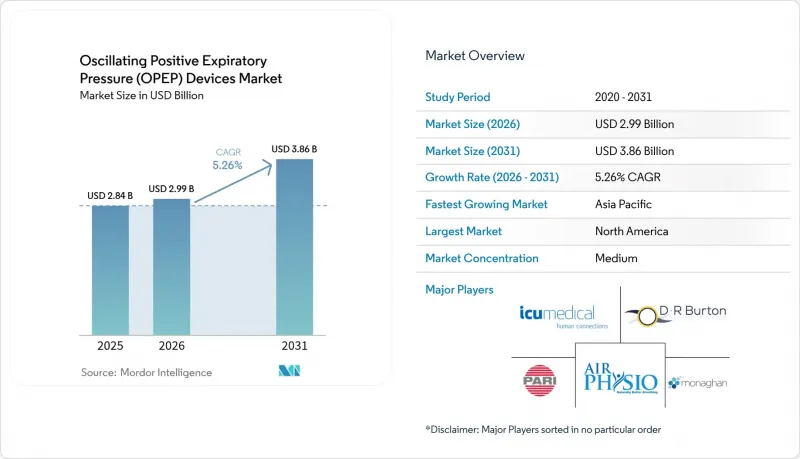
Mordor Intelligence에 의하면, 진동식 양압호흡기 시장 규모는 2025년에 28억 4,000만 달러로 평가되었고, 2026년 29억 9,000만 달러에서 2031년까지 38억 6,000만 달러에 이를 것으로 추정되며, 예측 기간 CAGR은 5.26%로 전망됩니다(2026-2031년).
본 보고서는 제품 유형별(페이스 마스크형 PEP 기기, 마우스피스형 PEP 기기 등), 적응증별(COPD 및 천식, 기관지염 등), 최종 사용자별(병원 및 진료소 등), 유통 채널별(오프라인 소매 및 온라인 플랫폼), 지역별(북미, 유럽 등)로 분류되어 있습니다. 시장 예측은 금액(달러) 기준으로 제시되어 있습니다.
세계의 진동식 양압호흡기 시장 동향 및 인사이트
COPD 및 천식 유병률 증가
미국에서는 40세 이상의 피보험자 1,170만 명이 COPD를 앓고 있어, 기도 청소 솔루션에 대한 대규모의 지속적인 수요가 발생하고 있습니다. 메디케어 가입자의 높은 사망률은 조기 및 지속적인 치료 도입의 임상적·재정적 시급성을 여실히 드러내고 있습니다. 고령화에 따라 호흡근의 쇠약이 진행되고 점액 저류 위험이 높아짐에 따라, 의료 시스템은 악화를 최소화하는 기계적 보조 장치를 우선시하고 있습니다. 보험사가 재입원 벌금을 엄격하게 검토함에 따라, 병원에서는 COPD 및 천식 환자가 가정에서 안정된 상태를 유지할 수 있도록 진동식 양압호흡기 시장의 제품을 점점 더 우선적으로 채택하고 있습니다. 현재 공중보건 캠페인에서는 예방 조치로 기도 청소를 준수하는 것이 강조되고 있어, 주치의와 환자들 사이에서 이 기기에 대한 인지도가 높아지고 있습니다.
휴대용·중력에 의존하지 않는 OPEP 기기의 기술적 진보
중력에 의존하지 않는 설계 덕분에, 과거 침대 옆이나 보행 중 사용을 제한하던 체위상의 제약이 해소되었습니다. 임상시험에서 T-PEP 시스템은 기준치에 비해 FVC를 10.25%, FEV1을 7.06% 향상시켰으며, 3개월 후 악화 발생률을 감소시키는 것으로 나타났습니다. 배터리 구동식 오실레이터는 실시간 기류 감지를 바탕으로 주파수와 진폭을 자동 조정하여 개인에 맞추어 점액 제거를 최적화하는 동시에, 임상의가 활용할 수 있는 사용 현황 분석 데이터를 수집합니다. 블루투스 지원 대시보드는 호흡 관리 앱과 연동되어 의료진이 치료 준수 상황을 확인하거나 원격으로 개입할 수 있도록 합니다. 이 기능은 미국의 원격 생리학적 모니터링에 관한 CPT 코드를 준수합니다. 이러한 혁신적인 기술들이 결합되어, 이 장치는 데이터가 풍부한 플랫폼으로 재정의되었으며, 진동식 호기 양압(OPEP) 장치 시장의 프리미엄 부문의 기반이 되고 있습니다.
훈련을 받은 호흡 치료사의 부족
많은 국가에서 호흡 치료사의 노동 시장이 핍박되어 있어, 기도 청결 기술에 대한 지도 능력이 제한되고 있습니다. 2024년에 시작된 미국의 파트너십은 18개월 내에 더 많은 전문가를 양성하는 것을 목표로 하고 있지만, 이러한 프로그램은 여전히 드물며 특정 지역으로 제한되어 있습니다. 기존 호흡 치료사들이 도시 지역에 집중되어 있어 지방의 COPD 환자 집단에 대한 서비스 제공이 미흡하며, 기기가 공급되더라도 그 이용률이 낮아지고 있습니다. 또한, 폐 재활에 대한 보험 급여 격차로 인해 일부 병원은 인력 확충을 주저하고 있으며, 이는 프로그램 도입을 더욱 제한하고 있습니다. 그 결과, 장비 제조업체들은 자가 관리를 지원하고 임상 전문가 부족을 보완하기 위해 음성과 영상을 활용한 지도 기능을 장비에 탑재하고 있습니다.
부문 분석
마우스피스형 장치는 2025년 매출의 44.88%를 차지했으며, 밀폐하기 쉬운 점과 광범위한 성인에게 적용 가능하다는 점 덕분에 1위 자리를 유지하고 있습니다. 중력에 의존하지 않는 모델은 환자의 체위에 관계없이 확실하게 작동하기 때문에 자택이나 수술 후 병동에서 높은 평가를 받고 있으며, 연평균 성장률(CAGR) 9.14%로 가장 빠르게 성장하고 있습니다. 금액 기준으로는 이 하위 부문이 2031년까지 진동식 양압호흡기 시장 규모에 3억 6,200만 달러를 추가할 것으로 예측됩니다. 페이스 마스크형 인터페이스는 효과적인 입 닫힘을 유지할 수 없는 소아 및 신경근 질환 환자층에게 여전히 필수적인 반면, 병형 장치는 의료진이 미세한 압력 조정이 필요한 상황에서 저비용 틈새 시장을 유지하고 있습니다.
현재 경쟁 기업들 간의 경쟁은 압력 목표치 확인, 사용 데이터 수집, 병원 전자 건강 기록(EHR)과의 동기화를 수행하는 센서 통합에 초점을 맞추었습니다. 클라우드 대시보드를 함께 제공하는 공급업체는 가격이 비싸더라도 처방 목록에서 선정될 확률이 높습니다. 이는 의료진이 보험사 대상 규정 준수 보고서를 제공할 수 있기 때문입니다. 그 결과, 중력에 의존하는 기존 설계는 3차 의료 기관에서 점차 시장 점유율을 잃어가고 있지만, 라틴아메리카나 아프리카의 예산이 제한된 시설에서는 여전히 사용되고 있습니다.
2025년, 만성폐쇄성폐질환(COPD)와 천식은 악화 관리에 대한 지침에 따른 위상 강화에 힘입어 진동식 양압호흡기 시장 점유율 55.01%를 차지했습니다. 기관지 및 호흡기 전문의 커뮤니티에서는 보험사가 재택 모니터링 패키지를 평가함에 따라 도입이 더욱 확대될 것으로 예측됩니다. 기관지확장증은 연평균 성장률(CAGR) 9.43%로 예측되며, 기도 클리어런스 방법과 방사선학적 패턴 및 가래 표현형을 대조하는 정밀 의학 추세 속에서 임상적 시급성이 높아지고 있습니다.
전자의무기록의 경고를 통해 기관지확장증 사례에서 호흡기내과 전문의가 더 조기에 OPEP 도입을 검토하도록 권장되는 가운데, 각 제조업체들은 표현형별 치료 성과를 파악하기 위해 레지스트리 연구에 공동 자금을 지원하고 있습니다. 또한, 수술 후 폐 합병증 예방은 회복 촉진 프로토콜에서 입원 일수를 단축하기 위해 비약물적 점액 제거가 요구됨에 따라, 2차 성장 분야로 부상하고 있습니다. 한편, 낭포성 섬유증(CF) 수요는 CFTR 조절제의 보급으로 환자 수가 안정화되면서 정체 국면에 접어들었으나, 평생 치료의 필요성으로 인해 수요량은 견조한 추세를 보이고 있습니다.
지역별 분석
북미는 종합적인 보험 적용과 커넥티드 호흡기 기술의 조기 도입에 힘입어 2025년에도 38.05%의 시장 점유율을 유지했습니다. 미국의 병원에서는 클라우드 대시보드와 연동되는 OPEP 키트 세트를 COPD 환자에게 제공한 후 퇴원시키고 있으며, 캐나다의 주 의료 제도에서는 내구 의료기기 목록에 따라 기기 비용이 상환되고 있습니다. 그러나 폐 재활 프로그램에 대한 보험 급여 축소가 병원 예산을 압박하고 있어, 원격 모니터링 코드를 활용할 수 있는 외래 및 재택 간호 서비스 제공업체로의 성장이 촉진되고 있습니다. 멕시코에서는 국민건강보험 확대에 힘입어 비용이 최적화된 마우스피스 장치가 수입되고 있으며, 2030년까지 도입 대수가 두 배로 증가할 가능성이 있습니다.
유럽에서는 통일된 CE 마크 규제와 근거 기반 문화가 정착되어 있는 것이 강점으로 작용하고 있습니다. 독일과 영국에서는 진동식 양압호흡기가 기관지확장증 치료 프로토콜에 포함되어 있으며, 스페인과 이탈리아에서는 재택 산소 요법 환자를 위한 조달을 가속화하고 있습니다. 동유럽 국가들에서 보급이 더딘 것은 교육 부족으로 인해 지침 이행이 지연되고 있기 때문이지만, 디지털 헬스케어에 배정된 EU 부흥 기금 덕분에 이러한 격차 해소가 앞당겨질 가능성이 있습니다. 지역 전체적으로 볼 때, 지급 기관의 심사는 입증된 비용 절감 효과를 중시하고 있어, 실제 임상 증거 아카이브를 보유한 공급업체가 유리한 입장에 있습니다.
아시아태평양은 지역 진료소의 기도 청결 기기에 대한 보조금을 포함하는 중국의 만성 질환 대책에 힘입어 8.27%라는 가장 높은 연평균 성장률(CAGR)을 기록하고 있습니다. 초고령 사회인 일본에서는 고령자가 누운 자세에서도 조작할 수 있는 중력에 의존하지 않는 모델이 중시되고 있습니다. 한편, 한국에서는 디지털화된 국민건강보험 데이터를 활용하여 복약 순응도를 모니터링하고 있습니다. 인도에서는 품질 기준이 강화되면서 호흡기 전문의들 사이에서 신뢰도가 높아져, 즉석 병형 PEP에서 FDA 승인을 받은 수입 제품으로의 전환이 진행되고 있습니다. 호주의 외딴 농촌 지역에서는 원주민 환자와 대도시권의 호흡기 치료사를 연결해 주는 원격의료 보험 적용의 혜택을 받고 있으며, 이것이 연결형 기기의 꾸준한 보급을 뒷받침하고 있습니다.
기타 혜택 :
- 엑셀 형식 시장 예측(ME) 시트
- 3개월간의 애널리스트 지원
자주 묻는 질문
목차
제1장 서론
제2장 조사 방법
제3장 주요 요약
제4장 시장 구도
제5장 시장 규모 및 성장 예측
제6장 경쟁 구도
제7장 시장 기회 및 향후 전망
AJY 26.08.28According to Mordor Intelligence, the oscillating positive expiratory pressure (OPEP) devices market size was valued at USD 2.84 billion in 2025 and estimated to grow from USD 2.99 billion in 2026 to reach USD 3.86 billion by 2031, at a CAGR of 5.26% during the forecast period (2026-2031).
This report is Segmented by Product Type (Face Mask PEP Devices, Mouthpiece PEP Devices, and More), Indication (COPD and Asthma, Bronchitis, and More), End-User (Hospital & Clinics, and More), Distribution Channel (Offline Retail and Online Platforms), and Geography (North America, Europe, and More). The Market Forecasts are Provided in Terms of Value (USD).
Global Oscillating Positive Expiratory Pressure (OPEP) Devices Market Trends and Insights
Rising Prevalence Of COPD & Asthma
COPD affects 11.7 million insured adults >= 40 years in the United States, creating large-scale, persistent demand for airway-clearance solutions. Higher mortality among Medicare-insured patients underscores the clinical and financial urgency behind earlier, continuous therapy adoption. Aging drives progressive respiratory-muscle weakness that magnifies mucus retention risk and pushes health systems to favor mechanical aids that minimise exacerbations. As payers scrutinise hospital readmission penalties, hospitals increasingly prioritise oscillating positive expiratory pressure (OPEP) devices market products to keep COPD and asthma patients stable at home. Public-health campaigns now highlight airway-clearance adherence as a preventive measure, broadening device familiarity among primary-care physicians and patients alike.
Technological Advancements In Portable, Gravity-Independent OPEP Devices
Gravity-independent engineering removes posture limits that once curtailed bedside and ambulatory use. Trials show T-PEP systems boosting FVC by 10.25% and FEV1 by 7.06% versus baseline, plus lower exacerbation incidence after three months. Battery-powered oscillators automate frequency and amplitude based on real-time airflow sensing, personalising mucus mobilisation while collecting usage analytics for clinicians. Bluetooth-enabled dashboards link into respiratory-management apps, letting providers verify adherence and intervene remotely, a capability that aligns with U.S. remote-physiologic-monitoring CPT codes. Collectively, such innovations reposition devices as data-rich platforms, underpinning a premium tier within the oscillating positive expiratory pressure (OPEP) devices market.
Shortage Of Trained Respiratory Therapists
Many countries face tight labour markets for respiratory therapists, restricting capacity to teach airway-clearance techniques. A U.S. partnership launched in 2024 aims to graduate more professionals in 18 months, yet such programs remain rare and localised. Urban concentration of existing therapists leaves rural COPD clusters underserved, hampering equipment utilisation rates even when devices are supplied. Reimbursement gaps for pulmonary rehabilitation discourage some hospitals from expanding staff rosters, further constraining uptake. Device makers are consequently embedding audiovisual coaching features to guide self-management and offset clinician shortages.
Other drivers and restraints analyzed in the detailed report include:
- Inclusion In Global GOLD & ERS Clinical Guidelines
- Rapid Growth Of Home-Based Respiratory Care Programs
- Limited Clinical Evidence Versus Alternative ACTs
For complete list of drivers and restraints, kindly check the Table Of Contents.
Segment Analysis
Mouthpiece units delivered 44.88% of 2025 revenue, maintaining leadership due to ease of sealing and broad adult suitability. Gravity-independent models are scaling fastest at 9.14% CAGR because they operate reliably regardless of patient orientation, a feature valued in home and post-operative wards. In monetary terms, this sub-segment is forecast to add USD 362 million to oscillating positive expiratory pressure (OPEP) devices market size by 2031. Face-mask interfaces remain essential for paediatric and neuro-muscular cohorts that cannot sustain effective mouth closure, while bottle-type devices keep a low-cost niche where clinicians require fine pressure adjustment.
Competitive rivalry now centres on integrating sensors that verify pressure targets, collect usage data, and sync with hospital EHRs. Vendors that bundle cloud dashboards demonstrate higher formulary preference, even at price premiums, because they arm clinicians with compliance reports for payers. Consequently, gravity-dependent legacy designs are losing shelf space across tertiary centres, although they still serve budget-constrained facilities in Latin America and Africa.
COPD and asthma collectively held 55.01% of oscillating positive expiratory pressure (OPEP) devices market share in 2025, driven by guideline-backed positioning in exacerbation management. The broncho-pulmonary specialist community expects adoption to deepen as payers reward home-monitoring bundles. Bronchiectasis, with a 9.43% forecast CAGR, enjoys higher clinical urgency amid precision-medicine trends that match airway-clearance modalities to radiologic pattern and sputum phenotype.
As electronic-health-record flags prompt pulmonologists to consider OPEP earlier in bronchiectasis, manufacturers are co-funding registry studies to capture phenotype-specific outcomes. Post-operative pulmonary-complication prevention forms a secondary growth pocket as enhanced-recovery protocols require non-pharmacologic mucus clearance to shorten length of stay. Meanwhile, cystic-fibrosis demand plateaus as the patient base stabilises under CFTR modulators, yet lifelong therapy needs ensure steady volume.
Complete Report Scope:
- By Product Type
- Face Mask PEP Devices
- Mouthpiece PEP Devices
- Bottle/Water-column PEP Devices
- Gravity-Dependent OPEP Devices
- Gravity-Independent OPEP Devices
- By Indication
- COPD & Asthma
- Bronchitis
- Bronchiectasis
- Cystic Fibrosis
- Post-operative Pulmonary Complications
- Others
- By End User
- Hospitals & Clinics
- Home-care Settings
- Ambulatory Surgical Centers
- Pulmonary Rehabilitation Centers
- Others
- By Distribution Channel
- Offline Retail
- Online Platforms
- Geography
- North America
- United States
- Canada
- Mexico
- Europe
- Germany
- United Kingdom
- France
- Italy
- Spain
- Rest of Europe
- Asia-Pacific
- China
- Japan
- India
- South Korea
- Australia
- Rest of Asia-Pacific
- Middle East and Africa
- GCC
- South Africa
- Rest of Middle East and Africa
- South America
- Brazil
- Argentina
- Rest of South America
- North America
Geography Analysis
North America kept its 38.05% leadership stake in 2025 by virtue of comprehensive insurance coverage and early adoption of connected respiratory technologies. U.S. hospitals discharge COPD patients with bundled OPEP kits that synchronise to cloud dashboards, while Canada's provincial systems reimburse devices under durable-medical-equipment lists. Still, reimbursement cuts to pulmonary-rehab programmes strain hospital budgets, nudging growth towards outpatient and home-care providers that can leverage telemonitoring codes. Mexico, propelled by universal-coverage expansion, imports cost-optimised mouthpiece units and may double its installed base by 2030.
Europe benefits from harmonised CE-mark rules and strong evidence-based culture. Germany and the United Kingdom integrate oscillating positive expiratory pressure (OPEP) devices market products into bronchiectasis pathways, while Spain and Italy accelerate procurement for home-oxygen patients. Eastern-European uptake lags because training shortages slow guideline implementation, yet EU recovery funds earmarked for digital health could hasten closing the gap. Region-wide, payer scrutiny emphasises proven cost offsets, favouring vendors armed with real-world evidence archives.
Asia-Pacific posts the fastest 8.27% CAGR, anchored by China's chronic-disease strategy that subsidises airway-clearance devices in community clinics. Japan's super-aged society values gravity-independent models that seniors can operate supine, while South Korea channels digitised national-insurance data to monitor adherence. India tightens quality norms, fostering trust among pulmonologists to switch from improvised bottle PEP to FDA-cleared imports. Australia's remote rural communities benefit from tele-health reimbursement that pairs indigenous patients with metropolitan respiratory therapists, underpinning steady adoption of connected devices.
- Monaghan Medical / Trudell
- ICU Medical
- PARI Pharma
- D-R Burton Healthcare
- AirPhysio
- R. Cegla
- Philips Respironics
- Baxter
- Tactile Medical
- Vyaire Medical
- ResMed (Acapella)
- Drive DeVilbiss Healthcare
- Dynarex
- Thayer Medical
- Vortran Medical
- Teleflex
- Medica Holdings
- Medtronic
- Smiths Group
Additional Benefits:
- The market estimate (ME) sheet in Excel format
- 3 months of analyst support
TABLE OF CONTENTS
1 Introduction
- 1.1 Study Assumptions & Market Definition
- 1.2 Scope of the Study
2 Research Methodology
3 Executive Summary
4 Market Landscape
- 4.1 Market Overview
- 4.2 Market Drivers
- 4.2.1 Rising Prevalence of COPD & Asthma
- 4.2.2 Technological Advancements In Portable, Gravity-Independent OPEP Devices
- 4.2.3 Inclusion In Global GOLD & ERS Clinical Guidelines
- 4.2.4 Rapid Growth Of Home-Based Respiratory Care Programs
- 4.2.5 Reimbursement Expansion For Airway-Clearance Digital Monitoring Bundles
- 4.2.6 Employer-Funded COPD Wellness Benefits Driving Device Uptake
- 4.3 Market Restraints
- 4.3.1 Shortage Of Trained Respiratory Therapists
- 4.3.2 Limited Clinical Evidence Versus Alternative ACTs
- 4.3.3 Device Reuse Safety Concerns In Low-Income Settings
- 4.3.4 Patent Expiries Triggering Low-Margin Price Competition
- 4.4 Technological Outlook
- 4.5 Porter's Five Forces
- 4.5.1 Threat of New Entrants
- 4.5.2 Bargaining Power of Buyers
- 4.5.3 Bargaining Power of Suppliers
- 4.5.4 Threat of Substitutes
- 4.5.5 Intensity of Competitive Rivalry
5 Market Size & Growth Forecasts (Value, USD)
- 5.1 By Product Type
- 5.1.1 Face Mask PEP Devices
- 5.1.2 Mouthpiece PEP Devices
- 5.1.3 Bottle/Water-column PEP Devices
- 5.1.4 Gravity-Dependent OPEP Devices
- 5.1.5 Gravity-Independent OPEP Devices
- 5.2 By Indication
- 5.2.1 COPD & Asthma
- 5.2.2 Bronchitis
- 5.2.3 Bronchiectasis
- 5.2.4 Cystic Fibrosis
- 5.2.5 Post-operative Pulmonary Complications
- 5.2.6 Others
- 5.3 By End User
- 5.3.1 Hospitals & Clinics
- 5.3.2 Home-care Settings
- 5.3.3 Ambulatory Surgical Centers
- 5.3.4 Pulmonary Rehabilitation Centers
- 5.3.5 Others
- 5.4 By Distribution Channel
- 5.4.1 Offline Retail
- 5.4.2 Online Platforms
- 5.5 Geography
- 5.5.1 North America
- 5.5.1.1 United States
- 5.5.1.2 Canada
- 5.5.1.3 Mexico
- 5.5.2 Europe
- 5.5.2.1 Germany
- 5.5.2.2 United Kingdom
- 5.5.2.3 France
- 5.5.2.4 Italy
- 5.5.2.5 Spain
- 5.5.2.6 Rest of Europe
- 5.5.3 Asia-Pacific
- 5.5.3.1 China
- 5.5.3.2 Japan
- 5.5.3.3 India
- 5.5.3.4 South Korea
- 5.5.3.5 Australia
- 5.5.3.6 Rest of Asia-Pacific
- 5.5.4 Middle East and Africa
- 5.5.4.1 GCC
- 5.5.4.2 South Africa
- 5.5.4.3 Rest of Middle East and Africa
- 5.5.5 South America
- 5.5.5.1 Brazil
- 5.5.5.2 Argentina
- 5.5.5.3 Rest of South America
- 5.5.1 North America
6 Competitive Landscape
- 6.1 Market Concentration
- 6.2 Market Share Analysis
- 6.3 Company Profiles (includes Global level Overview, Market level overview, Core Segments, Financials as available, Strategic Information, Market Rank/Share for key companies, Products & Services, and Recent Developments)
- 6.3.1 Monaghan Medical / Trudell
- 6.3.2 ICU Medical (Smiths Medical)
- 6.3.3 PARI GmbH
- 6.3.4 D-R Burton Healthcare
- 6.3.5 AirPhysio
- 6.3.6 R. Cegla GmbH & Co. KG
- 6.3.7 Philips Respironics
- 6.3.8 Baxter International
- 6.3.9 Tactile Medical
- 6.3.10 Vyaire Medical
- 6.3.11 ResMed (Acapella)
- 6.3.12 Drive DeVilbiss Healthcare
- 6.3.13 Dynarex Corporation
- 6.3.14 Thayer Medical
- 6.3.15 Vortran Medical
- 6.3.16 Teleflex Inc.
- 6.3.17 Medica Holdings
- 6.3.18 Medtronic
- 6.3.19 Smith & Nephew
7 Market Opportunities & Future Outlook
- 7.1 White-space & Unmet-Need Assessment