
|
시장보고서
상품코드
2115063
건설기계 어태치먼트 시장 : 시장 점유율 분석, 업계 동향 및 통계, 성장 예측(2026-2031년)Construction Machinery Attachment - Market Share Analysis, Industry Trends & Statistics, Growth Forecasts (2026 - 2031) |
||||||
 Mordor Intelligence
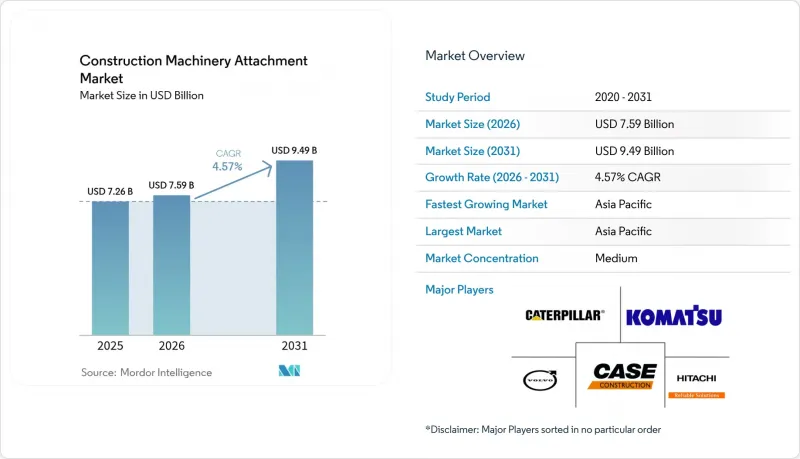
Mordor Intelligence에 의하면, 건설기계 어태치먼트 시장 규모는 2025년 72억 6,000만 달러로 평가되었고, 2026년에는 75억 9,000만 달러로 추정되고, 2026-2031년 CAGR 4.57%로 성장을 지속할 전망이며, 2031년에는 94억 9,000만 달러에 이를 것으로 예측됩니다.
본 보고서는 장비 유형별(버킷, 그래플러 등), 장비 등급별(굴삭기용 어태치먼트,스키드 스티어 로더용 어태치먼트 등), 연결 시스템별(핀 온 방식, 전용 퀵 커플러 등), 용도별(건설, 임업 등), 판매 채널별(OEM, 애프터마켓 등), 지역별로 분류되어 있습니다. 시장 예측은 금액(달러) 기준으로 제시되어 있습니다.
세계의 건설기계 어태치먼트 시장 동향 및 인사이트
신흥 시장의 인프라 투자 가속화
인도의 ‘국가 인프라 파이프라인’ 등의 프로그램에 따라, 열악한 현장이나 정비 공장에 대한 접근이 제한된 환경에 적합한, 견고하고 유지보수가 용이한 부착물에 대한 수요가 증가하고 있습니다. 인도의 건설기계 부문은 지방 도로, 지하철 프로젝트, 주택 건설 계획 등을 배경으로 2030년까지 85억 달러에서 250억 달러로 규모를 확대하는 것을 목표로 하고 있습니다. 중국의 각 OEM 업체들은 간소화된 유압 시스템과 현지 강재 등급을 채택한 가치 공학(Value Engineering)을 적용한 부착물로 이에 대응하고 있으며, 해당 지역에 거점을 둔 공장이 리드타임 단축과 관세 위험 감소를 뒷받침하고 있습니다. 이러한 움직임은 밸류체인의 재구성을 가져왔으며, OEM 업체들이 고성장 시장에 대한 접근성을 추구하는 가운데 현지화가 더욱 심화되고 있음을 보여줍니다.
고효율 부착물에 대한 수요 증가
이익률이 축소되는 가운데, 건설업체들은 처리 능력과 연료비 절감을 우선시하고 있으며, 이에 따라 고유량 유압 시스템과 정밀 공구의 보급이 가속화되고 있습니다. 이러한 변화를 상징하는 것이 틸트 로테이터로, 360° 회전이 가능해 위치 조정 수고를 줄이고 운전자의 피로를 경감시켜 연평균 성장률(CAGR) 5.86%로 성장을 지속하고, 있습니다. 에너지 회수형 해머는 기존 기종에 비해 연료 소비를 최대 15% 절감하는 한편, 내장 센서가 현장 분석 플랫폼에 데이터를 전송하여 유지보수의 필요성을 조기에 감지합니다. 생태계적 사고를 바탕으로 퀵 커플러, 자동 제어, 텔레매틱스가 통합된 워크플로가 구축되어, 효율적인 일정 관리와 프로젝트 주기 단축이 실현되고 있습니다.
숙련된 어태치먼트 조작자 부족
업계 조사에 따르면, 첨단 부착물을 다루기 위해서는 2030년까지 7만 3,500명의 신규 기술자가 필요하지만, 인재 양성 체계는 이를 따라가지 못하고 있습니다. 복잡한 틸트 로테이터나 스마트 커플러를 조작하려면 유압, 전자기기 및 진단에 관한 지식이 필요합니다. 가동 중단 시간의 최대 40%는 조작자의 실수로 인해 발생하며, 이는 프로젝트 비용을 상승시키고 있습니다. OEM이 후원하는 아카데미, 마이크로 크레덴셜 프로그램, 시뮬레이터 플랫폼은 이러한 격차를 해소하는 것을 목표로 하고 있지만, 인재 확보는 단기 도입 계획에서 여전히 병목 현상으로 남아 있습니다.
부문 분석
버킷은 굴착, 자재관리, 채석 등 폭넓은 용도로 범용적으로 적용될 수 있어 2025년 건설기계 어태치먼트 시장에서 43.12%를 차지했습니다. 인프라 현대화로 인해 기초적인 수요가 유지될 것으로 예상에 따라, 버킷의 건설기계 어태치먼트 시장 규모는 꾸준히 확대될 것으로 전망됩니다. 퀵 커플러는 점유율은 작지만, 차량 관리자들이 가동 중지 시간을 최소화하기 위해 신속하고 공구 없이 교체할 수 있는 점을 중요시하고 있어 연평균 성장률(CAGR) 5.05%를 나타낼 것으로 예측됩니다.
성장 추세를 보면 모듈식 설계로의 전환이 두드러지고 있습니다. 각 제조업체는 가동 사이클 수나 유지보수 필요성을 실시간으로 추적하는 LIN 버스 센서나 RFID 태그를 점점 더 적극적으로 탑재하고 있습니다. 유압 해머는 도심 지역의 개보수 및 철거 공사에서 수요가 증가하는 한편, 그래플은 임업 및 폐기물 운반 분야에서 수요가 확대되고 있습니다. 오거는 통신용 도랑 파기 및 전신주 설치 분야에서 안정적인 수주를 유지하고 있습니다. 재활용 규제가 강화됨에 따라 특수 전단기 및 분쇄기 수요도 증가하고 있습니다. 이 부문의 미래는 경쟁하는 부착물 브랜드와, 성능을 저하시키지 않고 하나의 커플러로 연결할 수 있는 상호 운용성 기준에 달려 있습니다.
2025년, 굴삭기용 부착물은 건설기계용 부착물 시장 점유율의 47.20%를 차지했으며, 굴삭기가 주요 토공 작업 플랫폼으로서의 역할을 수행하고 있음을 반영합니다. 콤팩트 트랙 로더용 부착물은 밀집된 도심 지역에서 대형 기계의 사용이 규제되는 가운데, 연평균 성장률(CAGR) 7.01%로 가장 빠르게 성장하고 있습니다. 렌탈 업체들이 90 hp급 캐리어에 대응하는 트렌처, 플래너, 콜드 밀링 헤드의 재고를 확대함에 따라, 콤팩트 로더 관련 건설 기계 부착물 시장 규모는 급격히 확대될 것으로 예측됩니다.
스키드 스티어 로더용 어태치먼트는 뛰어난 가성비로 인해 소규모 도급업자들 사이에서 계속해서 인기를 끌고 있는 반면, 백호 로더용 어태치먼트는 지자체 유틸리티에 활용되고 있습니다. 휠 로더용 포크와 재하역용 버킷은 계속해서 벌크 자재관리의 주력으로 활약하고 있습니다. 미니 굴삭기용 부착 장비는 주택지 매립 건설의 수혜를 입고 있으며, 틸트식 그레이딩 버킷 시장 점유율이 확대되고 있습니다. 텔레핸들러용 플랫폼은 메자닌 층 건설이나 산업용 랙 설치 분야에서 수요가 서서히 증가하고 있습니다. 각 공급업체들은 각 어태치먼트의 최적 설정에 맞추어 유압 유량을 자동으로 미세 조정하는 클라우드 연동형 제어 시스템 개발을 경쟁적으로 추진하고 있습니다.
지역별 분석
아시아태평양은 2025년에 46.10%의 점유율로 건설기계 어태치먼트 시장을 주도했으며, 2031년까지 연평균 성장률(CAGR) 5.18%를 나타낼 것으로 예측됩니다. 중국의 탈탄소화 로드맵에 따라 전동 캐리어 도입이 가속화되고 있으며, Sany 및 XCMG와 같은 국내 OEM 기업들은 현지 배기가스 규제 목표에 부합하는 전용 설계의 해머, 그래플, 트렌처를 시장에 출시하고 있습니다. 2024 회계연도, 정부의 인프라 주도 정책에 힘입어 인도의 건설기계 판매 대수는 26% 급증하여 총 13만 5,650대에 달했습니다. 동남아시아 국가들은 ‘일대일로’ 투자를 유료 도로와 항만에 집중하고 있어 준설용 버킷과 장거리형 해체용 부착물에 대한 수요가 증가하고 있습니다.
북미는 여전히 2위 규모 시장을 자랑하고 있으며, 5,500억 달러 규모의 ‘인프라 투자 및 고용법’에 기반한 프로젝트들이 교량 보수, 철도 개선, 상수도 시스템 개량을 뒷받침하고 있습니다. 2024년에는 캐리어 판매 대수가 감소했음에도 불구하고, 어태치먼트 수요는 현장 가동률을 높이는 고부가가치 도구로 전환되었습니다. 캐나다에서는 인력 부족으로 인해 도급업체들이 작업자의 근무 시간을 단축하는 기술 도입을 강요받고 있어, 틸트 로테이터의 채택이 증가하고 있습니다. 캘리포니아주와 뉴욕주에서는 주 정부의 정책에 따라 배기가스 규제가 강화되는 가운데, 전동화에 대응하는 부착 장비가 조기에 보급되기 시작했습니다.
유럽에서는 도시 지역의 엄격한 규제를 배경으로 저소음·저진동 시스템이 우선시되고 있습니다. 볼보가 2030년까지 완전 전동식 경량 장비 라인업 구축을 목표로 하고 있는 데 따라, 각 제조업체들은 전동식 소형 굴삭기용 부착 장비를 개량하고 있습니다. 독일에서는 역사적 건축물 개보수를 위해 정밀한 조이스틱 제어식 커플러 개발이 선도되고 있습니다. 영국과 프랑스에서는 개보수 보조금이 에너지 절약 건물의 개보수에 사용되고 있어, 손목 진동을 줄여주는 브레이커나 분진 억제 기능이 탑재된 시어에 대한 수요가 증가하고 있습니다. 동유럽 시장에서는 합리적인 가격이 중시되고 있으며, 고속도로 확장 공사가 가속화되는 가운데 예산을 효율적으로 활용하기 위해 재생 어태치먼트나 현지 재생 수리 공장이 선호되고 있습니다.
기타 혜택 :
- 엑셀 형식 시장 예측(ME) 시트
- 3개월간 애널리스트 지원
자주 묻는 질문
목차
제1장 서론
제2장 조사 방법
제3장 주요 요약
제4장 시장 구도
제5장 시장 규모 및 성장 예측
제6장 경쟁 구도
제7장 시장 기회 및 향후 전망
AJY 26.08.28According to Mordor Intelligence, the construction machinery attachment market size is expected to grow from USD 7.26 billion in 2025 to USD 7.59 billion in 2026 and is forecast to reach USD 9.49 billion by 2031 at 4.57% CAGR over 2026-2031.
This report is Segmented by Equipment Type (Buckets, Grapplers, and More), Equipment Class (Excavator Attachments, Skid-Steer Loader Attachments, and More), Coupling System (Pin-On, Dedicated Quick Coupler, and More), Application (Construction, Forestry, and More), Sales Channel (OEM, Aftermarket, and More), and Geography. The Market Forecasts are Provided in Terms of Value (USD).
Global Construction Machinery Attachment Market Trends and Insights
Accelerated Infrastructure Spend in Emerging Markets
Programs such as India's National Infrastructure Pipeline elevate demand for robust, easy-service attachments suitable for rugged sites and limited workshop access. India's construction equipment sector targets USD 25 billion by 2030, up from USD 8.5 billion, on the back of rural roads, metro projects, and housing missions. Chinese OEMs respond with value-engineered tools that use simplified hydraulics and local steel grades, backed by regional plants that cut lead times and tariff exposure. These moves recalibrate supply chains and signal deeper localization as OEMs chase proximity to high-growth markets.
Rising Demand for High-Efficiency Attachments
Contractors prioritize throughput and fuel savings as margins tighten, driving widespread adoption of high-flow hydraulics and precision tooling. Tiltrotators illustrate the shift, recording a 5.86% CAGR on the ability to rotate 360°, reduce repositioning, and ease operator fatigue . Energy-recapture hammers now cut fuel use by up to 15% over conventional units, while integrated sensors feed job-site analytics platforms that flag maintenance needs early. Ecosystem thinking links quick couplers, automated controls, and telematics into a unified workflow that supports lean scheduling and shorter project cycles.
Scarcity of Skilled Attachment Operators
Industry surveys indicate 73,500 new technicians are needed by 2030 to support advanced tooling, yet training pipelines lag. Complex tiltrotators and smart couplers demand hydraulic, electronic, and diagnostic literacy. Up to 40% of downtime links to operator error, inflating project costs. OEM-sponsored academies, micro-credential programs, and simulator platforms aim to fill gaps, but talent availability remains a chokepoint in near-term deployment plans.
Other drivers and restraints analyzed in the detailed report include:
- Expansion of Rental Fleets Requiring Multi-Purpose Tools
- Electrification Retrofits Boosting Low-Vibration Tools
- Specialty-Steel Supply-Chain Volatility
For complete list of drivers and restraints, kindly check the Table Of Contents.
Segment Analysis
Buckets accounted for 43.12% of the construction machinery attachment market in 2025, owing to their universal applicability across excavation, material handling, and quarrying. The construction machinery attachment market size for buckets is projected to climb steadily as infrastructure renewal sustains baseline demand. Quick couplers, while holding a smaller slice, are set for a 5.05% CAGR as fleet managers value rapid, tool-free swaps that minimize idle time.
Growth patterns underline a pivot to modular design. Manufacturers increasingly embed LIN-bus sensors and RFID tags that track cycle counts and maintenance needs in real time. Hydraulic hammers ride renovation and teardown work in urban cores, whereas grapples gain in forestry and waste transfer. Augers maintain steady orders from telecom trenching and utility pole installation. Specialty shears and pulverizers find traction as recycling mandates tighten. The segment's future hinges on interoperability standards that let one coupler mate with competing attachment brands without performance loss.
Excavator attachments represented 47.20% construction machinery attachment market share in 2025, reflecting excavators' role as the primary earthmoving platform. Compact track loader tools grow fastest at 7.01% CAGR as jurisdictions restrict full-size machines in dense downtown corridors. The construction machinery attachment market size tied to compact loaders is forecast to climb sharply as rental depots expand inventories of trenchers, planers, and cold-milling heads sized for 90 hp carriers.
Skid-steer loader tools remain popular among small contractors for cost-effectiveness, whereas backhoe loader add-ons serve municipal utility jobs. Wheel loader forks and rehandling buckets continue as bulk-material workhorses. Mini-excavator attachments benefit from residential infill construction, with tilting grading buckets gaining share. Telehandler platforms see incremental demand in mezzanine builds and industrial racking installs. Suppliers race to develop cloud-linked control systems that automatically fine-tune hydraulic flows to each attachment's optimum setting.
Complete Report Scope:
- By Equipment Type
- Buckets
- Grapples
- Hydraulic Hammers
- Augers
- Quick Couplers
- Rippers
- Pulverizers
- Shears
- Mulchers
- Others
- By Equipment Class
- Excavator Attachments
- Skid-Steer Loader Attachments
- Compact Track Loader Attachments
- Backhoe Loader Attachments
- Wheel Loader Attachments
- Mini-Excavator Attachments
- Telehandler Attachments
- Others
- By Coupling System
- Pin-On
- Dedicated Quick Coupler
- Universal Quick Coupler
- Tiltrotator
- Automatic Hydraulic Coupler
- By Application
- Construction
- Demolition and Decommissioning
- Mining and Quarrying
- Forestry
- Agriculture and Landscaping
- Waste and Recycling
- Snow Removal and Road Maintenance
- Others
- By Sales Channel
- OEM
- Aftermarket
- Rental
- By Geography
- North America
- United States
- Canada
- Rest of North America
- South America
- Brazil
- Rest of South America
- Europe
- Germany
- United Kingdom
- France
- Italy
- Spain
- Russia
- Rest of Europe
- Asia-Pacific
- China
- India
- Japan
- South Korea
- Australia and New Zealand
- Rest of Asia-Pacific
- Middle East and Africa
- Turkey
- South Africa
- Rest of Middle East and Africa
- North America
Geography Analysis
Asia-Pacific led the construction machinery attachment market with a 46.10% footing in 2025 and is predicted to log a 5.18% CAGR through 2031. China's decarbonization roadmap accelerates electric carrier deployment, prompting indigenous OEMs such as Sany and XCMG to roll out purpose-built hammers, grapples, and trenchers that match local emissions targets. In FY2024, bolstered by the government's infrastructure-driven initiatives, India witnessed a 26% surge in construction equipment sales, totaling 135,650 units. Southeast Asian nations channel Belt and Road investments into toll roads and ports, elevating demand for dredging buckets and long-reach demolition attachments.
North America remains the second-largest region, anchored by the USD 550 billion Infrastructure Investment and Jobs Act pipeline that spurs bridge repair, rail upgrades, and water-system overhauls. While carrier sales dipped in 2024, attachment demand shifted to high-value tools that lift job-site utilization. Adoption of tiltrotators rises in Canada, where labor scarcity pushes contractors toward technology that saves operator time. Electric-ready attachments gain early traction in California and New York as state policies tighten emissions caps.
Europe prioritizes low-noise, low-vibration systems, catalyzed by dense urban regulations. Manufacturers refine attachments for all-electric compact excavators as Volvo targets fully electric light equipment portfolios by 2030 . Germany spearheads precision joystick-controlled couplers for historical building renovations. The United Kingdom and France funnel renovation subsidies into energy-efficient building retrofits, boosting demand for hand-arm-vibration-reduced breakers and dust-suppression shears. Eastern European markets emphasize affordability, favoring refurbished attachments and local rebuild shops to stretch budgets while ramping up highway expansions.
- Caterpillar Inc.
- Komatsu Ltd.
- Volvo Construction Equipment
- Hitachi Construction Machinery
- Hyundai Construction Equipment
- Case Construction Equipment
- JCB
- Liebherr Group
- Sany Group
- Develon (Doosan Infracore)
- Kubota Corporation
- Takeuchi Manufacturing
- Wacker Neuson
- Epiroc AB
- Manitou Group
Additional Benefits:
- The market estimate (ME) sheet in Excel format
- 3 months of analyst support
TABLE OF CONTENTS
1 Introduction
- 1.1 Study Assumptions and Market Definition
- 1.2 Scope of the Study
2 Research Methodology
3 Executive Summary
4 Market Landscape
- 4.1 Market Overview
- 4.2 Market Drivers
- 4.2.1 Accelerated Infrastructure Spend in Emerging Markets
- 4.2.2 Rising Demand for High-Efficiency Attachments
- 4.2.3 Expansion of Rental Fleets Requiring Multi-Purpose Tools
- 4.2.4 Electrification Retrofits Boosting Low-Vibration Tools
- 4.2.5 BIM-Ready Smart-ID Attachments Enable Predictive Maintenance
- 4.2.6 Lightweight Composite Designs to Meet Carbon Quotas
- 4.3 Market Restraints
- 4.3.1 Scarcity of Skilled Attachment Operators
- 4.3.2 Specialty-Steel Supply-Chain Volatility
- 4.3.3 High Upfront Cost of Advanced Hydraulic Tools
- 4.3.4 Data-ownership concerns in IoT-enabled attachments
- 4.4 Value / Supply-Chain Analysis
- 4.5 Regulatory Landscape
- 4.6 Technological Outlook
- 4.7 Porter's Five Forces
- 4.7.1 Threat of New Entrants
- 4.7.2 Bargaining Power of Buyers
- 4.7.3 Bargaining Power of Suppliers
- 4.7.4 Threat of Substitute Products
- 4.7.5 Intensity of Competitive Rivalry
- 4.8 Sustainability and Circular Economy Analysis
5 Market Size and Growth Forecasts (Value, USD)
- 5.1 By Equipment Type
- 5.1.1 Buckets
- 5.1.2 Grapples
- 5.1.3 Hydraulic Hammers
- 5.1.4 Augers
- 5.1.5 Quick Couplers
- 5.1.6 Rippers
- 5.1.7 Pulverizers
- 5.1.8 Shears
- 5.1.9 Mulchers
- 5.1.10 Others
- 5.2 By Equipment Class
- 5.2.1 Excavator Attachments
- 5.2.2 Skid-Steer Loader Attachments
- 5.2.3 Compact Track Loader Attachments
- 5.2.4 Backhoe Loader Attachments
- 5.2.5 Wheel Loader Attachments
- 5.2.6 Mini-Excavator Attachments
- 5.2.7 Telehandler Attachments
- 5.2.8 Others
- 5.3 By Coupling System
- 5.3.1 Pin-On
- 5.3.2 Dedicated Quick Coupler
- 5.3.3 Universal Quick Coupler
- 5.3.4 Tiltrotator
- 5.3.5 Automatic Hydraulic Coupler
- 5.4 By Application
- 5.4.1 Construction
- 5.4.2 Demolition and Decommissioning
- 5.4.3 Mining and Quarrying
- 5.4.4 Forestry
- 5.4.5 Agriculture and Landscaping
- 5.4.6 Waste and Recycling
- 5.4.7 Snow Removal and Road Maintenance
- 5.4.8 Others
- 5.5 By Sales Channel
- 5.5.1 OEM
- 5.5.2 Aftermarket
- 5.5.3 Rental
- 5.6 By Geography
- 5.6.1 North America
- 5.6.1.1 United States
- 5.6.1.2 Canada
- 5.6.1.3 Rest of North America
- 5.6.2 South America
- 5.6.2.1 Brazil
- 5.6.2.2 Rest of South America
- 5.6.3 Europe
- 5.6.3.1 Germany
- 5.6.3.2 United Kingdom
- 5.6.3.3 France
- 5.6.3.4 Italy
- 5.6.3.5 Spain
- 5.6.3.6 Russia
- 5.6.3.7 Rest of Europe
- 5.6.4 Asia-Pacific
- 5.6.4.1 China
- 5.6.4.2 India
- 5.6.4.3 Japan
- 5.6.4.4 South Korea
- 5.6.4.5 Australia and New Zealand
- 5.6.4.6 Rest of Asia-Pacific
- 5.6.5 Middle East and Africa
- 5.6.5.1 Turkey
- 5.6.5.2 South Africa
- 5.6.5.3 Rest of Middle East and Africa
- 5.6.1 North America
6 Competitive Landscape
- 6.1 Market Concentration
- 6.2 Strategic Moves
- 6.3 Market Share Analysis
- 6.4 Company Profiles (Includes Global Level Overview, Market Level Overview, Core Segments, Financials as Available, Strategic Information, Market Rank/Share for Key Companies, Products and Services, SWOT Analysis, and Recent Developments)
- 6.4.1 Caterpillar Inc.
- 6.4.2 Komatsu Ltd.
- 6.4.3 Volvo Construction Equipment
- 6.4.4 Hitachi Construction Machinery
- 6.4.5 Hyundai Construction Equipment
- 6.4.6 Case Construction Equipment
- 6.4.7 JCB
- 6.4.8 Liebherr Group
- 6.4.9 Sany Group
- 6.4.10 Develon (Doosan Infracore)
- 6.4.11 Kubota Corporation
- 6.4.12 Takeuchi Manufacturing
- 6.4.13 Wacker Neuson
- 6.4.14 Epiroc AB
- 6.4.15 Manitou Group
7 Market Opportunities and Future Outlook
- 7.1 White-space and Unmet-Need Assessment