

|
시장보고서
상품코드
2115075
유리 플레이크 코팅 시장 : 시장 점유율 분석, 업계 동향 및 통계, 성장 예측(2026-2031년)Glass Flake Coating - Market Share Analysis, Industry Trends & Statistics, Growth Forecasts (2026 - 2031) |
||||||
 Mordor Intelligence
Mordor Intelligence에 의하면, 유리 플레이크 코팅 시장 규모는 2025년 17억 4,000만 달러로 평가되었고, 2026년에는 18억 2,000만 달러로 추정되고, 2026-2031년 CAGR 4.52%로 성장을 지속할 전망이며, 2031년까지 22억 7,000만 달러에 이를 것으로 예측됩니다.
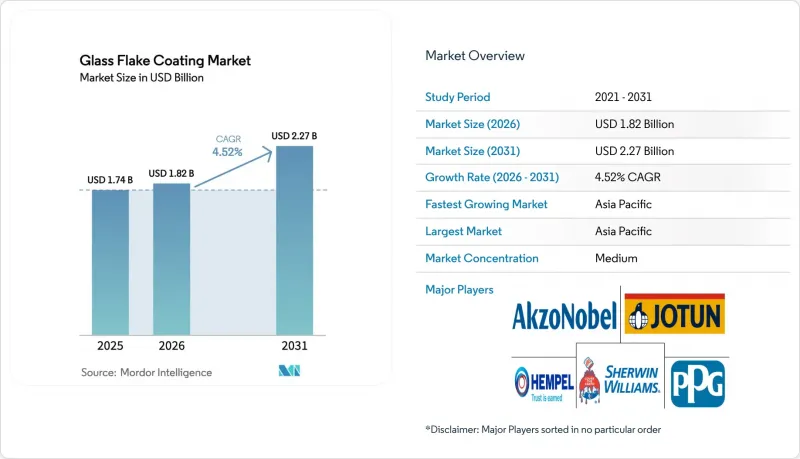
본 보고서는 기판별(강철 및 콘크리트), 수지별(비닐 에스테르, 폴리에스테르, 에폭시), 코팅층별(중간층, 프라이머, 탑코트), 최종 사용자 산업별(석유 및 가스,선박, 화학 처리 등) 및 지역별(아시아태평양, 북미, 유럽, 남미, 중동 및 아프리카)로 분류되어 있습니다. 시장 예측은 금액(달러) 기준으로 제시되어 있습니다.
세계의 유리 플레이크 코팅 시장 동향 및 인사이트
석유 및 가스 파이프라인 유지보수 활동의 확대
파이프라인 사업자들은 자산을 교체하기보다는 수명을 연장하고 있으며, 이에 따라 유리 플레이크 시스템은 총 건조 필름 두께 1,000μm 및 주기적인 노후화 검증을 규정하는 IOGP S-715에 따라 프리미엄 선택지에서 기본 사양으로 위상이 높아지고 있습니다. 에너지 연구소의 지침은 의무적인 상태 조사 및 공인 검사관에 의한 감독을 강화하고 있으며, 이로 인해 자재 수요에 서비스 수요의 시너지 효과가 더해지고 있습니다. 북미의 PHMSA 규제로 인해 현재 건전성 조사를 통한 개착과 코팅 갱신이 연동되고 있습니다. 특히, 용착 에폭시 수지의 사용이 현실적으로 어려운 원주 용접부에서 이러한 경향이 두드러집니다. 시공업체는 NACE 또는 FROSIO 레벨 III 자격 및 ISO 9001 시스템 보유가 필수이므로 진입 장벽이 높아져, 경험이 풍부한 도급업체에 업무가 집중되고 있습니다. 그 결과, 유리 플레이크 코팅 시장은 재량적 지출이 아닌 사양에 기반한 수요의 견인에 힘입어 혜택을 보고 있습니다.
해양 인프라의 심각한 부식 문제
IMO PSPC는 밸러스트 탱크용 코팅에 대해 15년의 수명, 블리스터링 제로, 그리고 최소 5 MPa의 접착 강도를 의무화하고 있지만, 다층 유리 플레이크 에폭시 코팅은 이러한 기준을 일관되게 충족하고 있습니다. 3층, 1,400μm 도장 체계는 북극권의 주기적인 동결 시험에서 열분사 알루미늄을 능가하는 성능을 보여, 저온 환경에서의 내구성을 입증했습니다. 요툰의 ‘발트 플레이크’ 폴리에스터는 비말 구역에서 30년 이상의 무유지보수를 실현하고 있으며, DNV의 조사에 따르면 기존 에폭시계 도료에 비해 수명 주기 비용을 50% 절감할 수 있는 것으로 추정됩니다. 해상 풍력 발전의 확대에 따라, ISO 24656 유형 V 유리 플레이크 기준을 충족해야 하는 모노파일 및 트랜지션 피스가 수천 기 추가되면서, 부식 대책이 자재 프로그램의 주요 항목 중 하나로 자리 잡고 있습니다. 이러한 추세에 따라 유리 플레이크 솔루션은 전 세계의 선박, 잭업식 리그 및 기초의 사양서에 확실하게 반영되고 있습니다.
원자재 및 수지 가격 변동
2024년 초, 중국의 불포화 폴리에스터 수지 가격은 톤당 100-200위안 하락했으나, 미국에서는 비스페놀 A 공급 부족과 항만 혼잡으로 인해 에폭시 수지 가격이 전월 대비 14% 변동하여, 매출 총이익률을 압박하는 동시에 입찰 유효 기간 설정을 복잡하게 만들고 있습니다. 대형 공급업체들은 다년간공급 계약을 통해 가격 변동 위험을 헤지하고 있지만, 지역 중소기업들은 가격 변동을 하류 단계로 전가하고 있어 고정 가격 입찰에서의 경쟁력을 약화시키고 있습니다. 에너지 집약적인 유리 플레이크 생산은 추가적인 변동 요인이 되어, 비용 곡선을 유럽 전역의 LNG 및 전력 가격에 연동시키고 있습니다.
부문 분석
2025년, 철강은 전 세계 파이프라인망, 해양 플랫폼, 탱커 선체 및 공정용 용기 수요를 배경으로 유리 플레이크 코팅 시장 규모의 61.47%를 차지했습니다. 라멜라형 플레이크는 강재 기판과 평행하게 배향되어 순수 수지에 비해 최대 20배 더 긴 확산 경로를 제공할 뿐만 아니라, NORSOK M-501의 스플래시 존 성능 기준을 충족합니다. 시공업체와 검사관은 거의 예외 없이 강재에 관한 프로토콜에 대해서만 교육을 받고 있으며, 이는 기판으로서 강재의 우위를 더욱 공고히 하고 있습니다. 사양과 자격을 갖춘 인력의 확보가 맞물리면서, 예측 기간 동안 강재의 우위는 자생적으로 강화될 것입니다.
콘크리트는 뒤처지고 있지만, 아시아태평양의 인프라 소유주들이 교량 및 하수 처리 시설에서 염화물 침투를 방지하기 위해 유리 플레이크 에폭시를 채택함에 따라 연평균 성장률(CAGR) 5.82%로 성장하고 있습니다. ACI PRC-515.2-13에서는 표면의 수분 및 표면 거칠기가 엄격하게 관리된다는 전제 하에, 고산성 환경에 적합한 비닐 에스테르 및 에폭시계 코팅이 규정되어 있습니다. 콘크리트는 다공성이 높기 때문에 기포 발생 위험을 줄이려면 투습성 프라이머 또는 매립 스크림을 사용해야 하며, 이로 인해 표면 처리, 프라이머 및 상도 도료의 보증을 패키지로 제공하는 턴키 방식공급업체가 유리합니다.
비닐 에스테르는 IOGP 및 IMO 규정에 기반한 스플래시 존에서 수십 년에 걸친 현장 실적을 바탕으로, 2025년에도 유리 플레이크 코팅 시장 점유율 39.36%를 유지했습니다. 사전 승인된 배합 및 알려진 음극 박리 거동 덕분에 해수 침지 시 소유주의 위험이 경감됩니다. 그러나 에폭시 수지는 높은 가교 밀도와 상온 경화성 덕분에 기존에 보였던 성능 차이를 좁혀가고 있어, 2031년까지 연평균 성장률(CAGR) 5.94%라는 높은 성장세를 보이고 있습니다. 에폭시 수지는 표면 처리가 불충분한 강재에 대해서도 우수한 접착성을 나타내기 때문에 보수 공사에 대한 적용 범위도 확대되고 있습니다. 폴리에스테르는 여전히 내구 연한이 10-15년이면 충분하다고 여겨지며, 비용 효율을 중시하는 건설 용도로만 제한되어 있습니다.
지역별 분석
아시아태평양은 2025년에 유리 플레이크 코팅 시장의 46.31%를 차지한 것으로 평가되었으며, 중국의 파이프라인 건설, 인도의 정유시설 개보수, 그리고 염화물 농도가 높은 연안 지역에 집중된 동남아시아의 LNG 터미널을 견인력으로 삼아 연평균 성장률(CAGR) 5.63%로 성장할 전망입니다. 다국적 공급업체들은 싱가포르에 기반을 둔 교육 센터와 ISO 17025 인증 시험소를 활용하여 세분화된 아세안(ASEAN) 규제를 충족하고, 현지 경쟁사보다 앞서 대량 수주를 확보하고 있습니다. 북미 수요는 PHMSA(미국 파이프라인 및 위험물 안전청)가 주도하는 파이프라인 건전성 조사 및 수명 주기 비용 조사 기법을 도입한 연방 정부 자금 지원에 의한 교량 보전에 의해 뒷받침되고 있습니다. 2026년에 가동을 시작할 PPG의 테네시주 신규 시설은 지역 내 완충 재고 역할을 하여 멕시코만 연안 지역의 턴어라운드(정기 점검) 리드타임을 단축할 것입니다.
유럽에서는 성장이 예상되며, ScotWind 및 INTOG의 기초 공사만으로도 2035년까지 2,000개 이상의 모노파일에 대한 잠재 수요가 추가될 것입니다. CoaST 프로그램을 통한 수상 시공 기술의 발전은 탄소 발자국 감소와 시공 간소화를 목표로 하고 있으며, 이는 EU 그린딜의 목표와 부합합니다. 남미, 중동 및 아프리카에서는 브라질의 프레스솔트층 FPSO 및 사우디아라비아의 정유시설 개보수로 인해 수요 증가가 예상되지만, 숙련된 인력 부족과 규격 시행의 불일치가 제약 요인으로 작용하고 있습니다.
기타 혜택 :
- 엑셀 형식 시장 예측(ME) 시트
- 3개월간의 애널리스트 지원
자주 묻는 질문
목차
제1장 서론
제2장 조사 방법
제3장 주요 요약
제4장 시장 구도
제5장 시장 규모 및 성장 예측
제6장 경쟁 구도
제7장 시장 기회 및 향후 전망
AJY 26.08.28According to Mordor Intelligence, the glass flake coating market size is expected to grow from USD 1.74 billion in 2025 to USD 1.82 billion in 2026 and is forecast to reach USD 2.27 billion by 2031 at 4.52% CAGR over 2026-2031.
This report is Segmented by Substrate (Steel and Concrete), Resin (Vinyl Ester, Polyester, and Epoxy), Coating Layer (Intermediate, Primer, and Topcoat), End-User Industry (Oil and Gas, Marine, Chemical Processing, and More), and Geography (Asia-Pacific, North America, Europe, South America, and Middle-East and Africa). The Market Forecasts are Provided in Terms of Value (USD).
Global Glass Flake Coating Market Trends and Insights
Expanding Oil and Gas Pipeline Maintenance Activities
Pipeline operators are extending service life rather than replacing assets, elevating glass flake systems from premium options to baseline specifications under IOGP S-715, which prescribes 1,000 µm total dry film thickness and cyclic aging validation. Energy Institute guidelines reinforce mandatory condition surveys and certified inspector oversight, adding a services multiplier to material demand. PHMSA enforcement in North America now links integrity digs to coating upgrades, particularly at girth welds where fusion-bonded epoxy is impractical. Qualification barriers rise as applicators must hold NACE or FROSIO Level III credentials and ISO 9001 systems, consolidating work among experienced contractors. As a result, the glass flake coating market benefits from specification-driven pull rather than discretionary spend.
Severe Corrosion Challenges in Marine Infrastructure
IMO PSPC mandates a 15-year ballast-tank coating life with zero blistering and a minimum 5 MPa adhesion threshold, benchmarks consistently met by multi-layer glass flake epoxy packages. A three-coat, 1,400 µm scheme surpassed thermal-sprayed aluminum under Arctic cyclic freeze testing, underscoring resilience in low temperatures. Jotun's Baltoflake polyester delivers 30-plus maintenance-free years in splash zones, and a DNV study pegged life-cycle cost savings at 50% relative to conventional epoxies. Offshore wind expansion adds thousands of monopiles and transition pieces that must meet ISO 24656 Type V glass-flake criteria, converting corrosion control into a material program line item. These dynamics lock glass flake solutions into vessel, jack-up, and foundation specifications worldwide.
Fluctuating Raw-Material and Resin Prices
Unsaturated polyester resin prices in China moved downward by 100-200 CNY per t in early 2024, but epoxy prices in the United States swung 14% month-over-month due to bisphenol-A outages and port congestion, compressing gross margins and complicating bid validity windows. Large vendors hedge through multi-year supply contracts, yet regional players pass volatility downstream, eroding competitiveness on fixed-price tenders. Energy-intensive glass flake production adds another variable, tying cost curves to LNG and electricity prices across Europe.
Other drivers and restraints analyzed in the detailed report include:
- Rising Demand for High-Performance Coatings in Chemical Processing
- Stringent Environmental Regulations Driving Long-Life Protective Systems
- Volatile Oil Prices Delaying CAPEX Cycles
For complete list of drivers and restraints, kindly check the Table Of Contents.
Segment Analysis
Steel contributed 61.47% of the glass flake coating market size in 2025 on the strength of global pipeline networks, offshore platforms, tanker hulls, and process vessels. Lamellar flakes orient parallel to steel substrates, delivering diffusion paths up to 20 times longer than neat resin and meeting NORSOK M-501 splash-zone performance levels. Contractors and inspectors are trained almost exclusively on steel protocols, reinforcing the substrate's hegemony. Coupling specifications with qualified workforce availability makes steel's dominance self-reinforcing over the forecast period.
Concrete trails but advances at a 5.82% CAGR as Asia-Pacific infrastructure owners adopt glass flake epoxies to arrest chloride ingress in bridges and wastewater assets. ACI PRC-515.2-13 lists vinyl ester and epoxy coatings for high-acid environments, provided surface moisture and profile are tightly controlled. The higher porosity of concrete necessitates vapor-permeable primers or embedded scrims to mitigate blister risk, favoring turnkey suppliers that bundle surface preparation, primer, and overcoat warranties.
Vinyl ester retained 39.36% of the glass flake coating market share in 2025, supported by decades of splash-zone field performance under IOGP and IMO rules. Pre-approved formulations and known cathodic-disbondment behavior reduce owner risk in seawater immersion. However, epoxy is outpacing at a 5.94% CAGR through 2031 thanks to high cross-link densities and ambient cures that narrow historical performance gaps. Epoxies also bond better to marginally prepared steel, expanding retrofit suitability. Polyester remains confined to cost-sensitive construction applications, where 10-15-year service life suffices.
Complete Report Scope:
- By Substrate
- Steel
- Concrete
- By Resin
- Vinyl Ester
- Polyester
- Epoxy
- By Coating Layer
- Intermediate
- Primer
- Topcoat
- By End-user Industry
- Oil and Gas
- Marine
- Chemical Processing
- Industrial
- Construction
- Other End-user Industries
- By Geography
- Asia-Pacific
- China
- India
- Japan
- South Korea
- ASEAN Countries
- Rest of Asia-Pacific
- North America
- United States
- Canada
- Mexico
- Europe
- Germany
- United Kingdom
- France
- Italy
- NORDIC Countries
- Rest of Europe
- South America
- Brazil
- Argentina
- Rest of South America
- Middle-East and Africa
- Saudi Arabia
- South Africa
- Rest of Middle East and Africa
- Asia-Pacific
Geography Analysis
Asia-Pacific commanded 46.31% of the glass flake coating market in 2025 and will expand at a 5.63% CAGR, led by Chinese pipeline buildouts, Indian refinery upgrades, and Southeast Asian LNG terminals that cluster in high-chloride coastal zones. Multinational suppliers leverage Singapore-based training centers and ISO 17025 labs to navigate fragmented ASEAN regulations, securing bulk orders ahead of local challengers. North America's demand is supported by PHMSA-driven pipeline integrity digs and federally funded bridge preservation that embed life-cycle cost methodology. The new PPG Tennessee facility, operational in 2026, provides regional buffer stock that reduces lead time for Gulf Coast turnarounds.
Europe is seeing growth, with ScotWind and INTOG foundations alone adding an addressable demand of more than 2,000 monopiles through 2035. The CoaST program's waterborne advances aim at lowering carbon footprints and application complexity, aligning with EU Green Deal objectives. South America and the Middle East and Africa show upside from Brazilian pre-salt FPSOs and Saudi refinery upgrades, constrained by skilled labor shortages and inconsistent standard enforcement.
- Akzo Nobel N.V.
- Asian Paints PPG Pvt. Ltd.
- BASF
- Berger Paints India
- Carboline (RPM International)
- Chemco International Ltd
- Chugoku Marine Paints Ltd.
- Hempel A/S
- Induron
- Jotun A/S
- KCC Corporation
- Nippon Paint Holdings
- Polyglass Coatings
- PPG Industries, Inc.
- Teknos Group
- The Sherwin-Williams Company
- Tnemec
Additional Benefits:
- The market estimate (ME) sheet in Excel format
- 3 months of analyst support
TABLE OF CONTENTS
1 Introduction
- 1.1 Study Assumptions and Market Definition
- 1.2 Scope of the Study
2 Research Methodology
3 Executive Summary
4 Market Landscape
- 4.1 Market Overview
- 4.2 Market Drivers
- 4.2.1 Expanding Oil and Gas Pipeline Maintenance Activities
- 4.2.2 Severe Corrosion Challenges in Marine Infrastructure
- 4.2.3 Rising Demand for High-Performance Coatings in Chemical Processing
- 4.2.4 Stringent Environmental Regulations Driving Long-Life Protective Systems
- 4.2.5 Shift Toward Life-Cycle Cost Modelling in Asset-Intensive Sectors
- 4.3 Market Restraints
- 4.3.1 Fluctuating Raw-Material and Resin Prices
- 4.3.2 Volatile Oil Prices Delaying CAPEX Cycles
- 4.3.3 Application Complexity Requiring Skilled Workforce
- 4.4 Value Chain Analysis
- 4.5 Porter's Five Forces Analysis
- 4.5.1 Threat of New Entrants
- 4.5.2 Bargaining Power of Buyers
- 4.5.3 Bargaining Power of Suppliers
- 4.5.4 Threat of Substitute Products
- 4.5.5 Degree of Competition
5 Market Size and Growth Forecasts (Value)
- 5.1 By Substrate
- 5.1.1 Steel
- 5.1.2 Concrete
- 5.2 By Resin
- 5.2.1 Vinyl Ester
- 5.2.2 Polyester
- 5.2.3 Epoxy
- 5.3 By Coating Layer
- 5.3.1 Intermediate
- 5.3.2 Primer
- 5.3.3 Topcoat
- 5.4 By End-user Industry
- 5.4.1 Oil and Gas
- 5.4.2 Marine
- 5.4.3 Chemical Processing
- 5.4.4 Industrial
- 5.4.5 Construction
- 5.4.6 Other End-user Industries
- 5.5 By Geography
- 5.5.1 Asia-Pacific
- 5.5.1.1 China
- 5.5.1.2 India
- 5.5.1.3 Japan
- 5.5.1.4 South Korea
- 5.5.1.5 ASEAN Countries
- 5.5.1.6 Rest of Asia-Pacific
- 5.5.2 North America
- 5.5.2.1 United States
- 5.5.2.2 Canada
- 5.5.2.3 Mexico
- 5.5.3 Europe
- 5.5.3.1 Germany
- 5.5.3.2 United Kingdom
- 5.5.3.3 France
- 5.5.3.4 Italy
- 5.5.3.5 NORDIC Countries
- 5.5.3.6 Rest of Europe
- 5.5.4 South America
- 5.5.4.1 Brazil
- 5.5.4.2 Argentina
- 5.5.4.3 Rest of South America
- 5.5.5 Middle-East and Africa
- 5.5.5.1 Saudi Arabia
- 5.5.5.2 South Africa
- 5.5.5.3 Rest of Middle East and Africa
- 5.5.1 Asia-Pacific
6 Competitive Landscape
- 6.1 Market Concentration
- 6.2 Strategic Moves
- 6.3 Market Share/Ranking Analysis
- 6.4 Company Profiles (includes Global level Overview, Market level overview, Core Segments, Financials as available, Strategic Information, Market Rank/Share for key companies, Products and Services, and Recent Developments)
- 6.4.1 Akzo Nobel N.V.
- 6.4.2 Asian Paints PPG Pvt. Ltd.
- 6.4.3 BASF
- 6.4.4 Berger Paints India
- 6.4.5 Carboline (RPM International)
- 6.4.6 Chemco International Ltd
- 6.4.7 Chugoku Marine Paints Ltd.
- 6.4.8 Hempel A/S
- 6.4.9 Induron
- 6.4.10 Jotun A/S
- 6.4.11 KCC Corporation
- 6.4.12 Nippon Paint Holdings
- 6.4.13 Polyglass Coatings
- 6.4.14 PPG Industries, Inc.
- 6.4.15 Teknos Group
- 6.4.16 The Sherwin-Williams Company
- 6.4.17 Tnemec
7 Market Opportunities and Future Outlook
- 7.1 White-space and Unmet-need Assessment


