|
시장보고서
상품코드
2115087
차량 액세스 제어 시장 : 시장 점유율 분석, 업계 동향 및 통계, 성장 예측(2026-2031년)Vehicle Access Control - Market Share Analysis, Industry Trends & Statistics, Growth Forecasts (2026 - 2031) |
||||||
 Mordor Intelligence
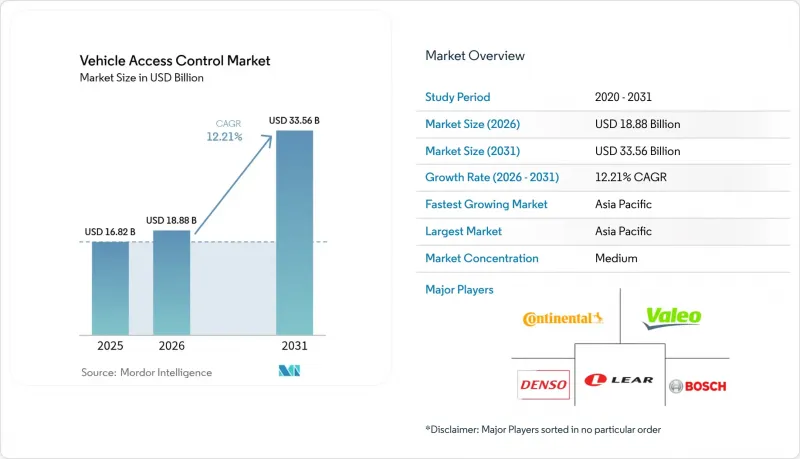
Mordor Intelligence에 의하면, 차량 액세스 제어 시장 규모는 2025년 168억 2,000만 달러로 평가되었고, 2026년에는 188억 8,000만 달러로 추정되고, 2026-2031년 CAGR 12.21%로 성장을 지속할 전망이며, 2031년에는 335억 6,000만 달러에 이를 것으로 예측됩니다.
본 보고서는 시스템 유형별(생체 인증 및 비생체 인증), 기술별(RFID, 블루투스, NFC, 초광대역(UWB) 등), 차량 유형별(승용차 및 상용차), 최종 사용자별(OEM 탑재 등), 판매 채널별(OEM에 대한 직접 판매 등), 그리고 지역별(북미, 남미, 유럽 등)로 분류되어 있습니다. 시장 전망은 금액(달러) 기준으로 제시되어 있습니다.
세계의 차량 접근 제어 시장 동향 및 인사이트
커넥티드카 및 자율주행 차량에 대한 수요 증가
커넥티드 아키텍처에 따라 접근 제어는 단순한 탑승 기능에서 무선 업데이트, 진단, 자율 주행 연동을 위한 주요 인증 게이트웨이로 진화했습니다. BMW의 ‘Digital Key Plus’는 UWB를 활용한 공간 인식 기술이 릴레이 공격을 방지하면서 자동 주차 및 충전을 가능하게 함을 입증하고 있습니다. 카 커넥티비티 컨소시엄(Car Connectivity Consortium)이 ‘Digital Key 3.0’에서 UWB를 표준화함에 따라, 각 OEM 업체들은 안전한 위치 정보 제공에 대한 단가 인상을 정당화할 수 있게 되었으며, 프리미엄 부문 및 대중 시장 부문 전반에 걸친 도입이 가속화될 전망입니다.
OEM 각사가 추진하는 ‘Key-As-A-Service’ 플랫폼
구독형 디지털 키는 일회성 하드웨어 수익을 지속적인 클라우드 수익으로 전환합니다. 콘티넨탈의 ‘CoSmA’는 여러 OEM에 걸친 인증 정보의 라이프사이클 관리를 가능하게 하며, 편의성 수준에 따른 과금을 실현하는 동적 기능 업그레이드를 지원합니다. 이 모델은 키 포브의 물류 비용을 절감하고, 인증 정보의 실시간 발급 및 무효화 처리를 통해 공유 모빌리티를 지원합니다.
심화되는 사이버 보안 취약성과 제로데이 공격
MIT의 조사에 따르면, 현재 오픈소스 도구를 통해 8개의 원격 키리스 프로토콜이 복제되고 있으며, 그중 1개는 완전히 침해된 상태입니다. 공격의 급속한 진화는 자동차 업계의 패치 적용 주기를 앞지르고 있어, 소비자의 불안을 가중시키고 더 엄격한 감독을 초래하고 있습니다. 테슬라에서 과거 발생한 CVE-2022-37709에 의한 스마트폰 키 우회 사건은 아무리 정교한 설계라 하더라도 출시 후 몇 달 만에 취약점이 드러날 수 있음을 여실히 보여줍니다.
부문 분석
2025년에는 성숙한 RFID 및 NFC 가격대와 확립된 공급망에 힘입어 비생체 인증 솔루션이 67.62%라는 견고한 점유율을 유지했습니다. 그러나 지문 인식 및 얼굴 인식이 고급 승용차에서 초기 성공을 거두고 있는 만큼, 생체 인식 솔루션은 연평균 성장률(CAGR) 13.63%로 자동차 접근 제어 시장을 주도하고 있습니다. OEM의 실증 실험에 따르면, 생체 인증 모듈이 도난으로 인한 보험 청구를 획기적으로 줄여, 비용 프리미엄의 일부를 상쇄하는 보험 환급을 촉진하고 있는 것으로 나타났습니다.
센서 비용과 개인정보 보호 규제가 여전히 보급의 장벽으로 작용하고 있지만, 100개 이상의 자동차 제조업체와 Tier 1 공급업체가 생체 인식 게이트웨이 프로토타입 개발을 진행 중입니다. 콘티넨탈이 2025년 CES에서 선보인 전시에서는 얼굴 인식과 생체 신호 모니터링을 결합해 무단 탑승자를 감지하는 기술이 소개되었으며, 이는 접근 제어가 안전 플랫폼으로도 기능하는 미래를 예고했습니다.
RFID는 2025년 매출의 44.95%를 차지했으나, UWB의 연평균 성장률(CAGR) 18.05%가 자동차 접근 제어 시장 경쟁 구도를 재편하고 있습니다. BMW, 폭스바겐, 현대자동차는 신호 증폭 공격을 차단하는 센티미터 단위의 보안 구역을 구축하기 위해 UWB를 도입하고 있습니다. NXP의 NCJ29D5 칩과 같은 반도체 혁신으로 인해 통합 장벽이 낮아지면서, UWB의 보급이 저가 시장으로 확대되고 있습니다.
블루투스나 NFC는 비용 상한선이 중요시되거나 물리적 접촉이 선호되는 경우, 예를 들어 카셰어링 픽업 장소 등에서 계속해서 활용되고 있습니다. Wi-Fi나 휴대전화 통신은 즉각적인 잠금 해제보다는 백그라운드에서 인증 정보를 동기화하는 데 사용되고 있습니다.
지역별 분석
2025년 차량 접근 제어 시장에서 아시아태평양이 42.87%의 점유율을 차지하는 배경에는 전기차 판매량의 견조한 성장과 반도체부터 최종 조립에 이르기까지를 아우르는 통합된 공급망이 있습니다. 2024년 중국에서 판매된 800만 대의 전기차에는 충전 인프라와 연동되는 보안 키가 필요했습니다. 한편, 인도의 국내 생산 추진은 비용 최적화된 모듈에 대한 수요를 불러일으켜 2031년까지 연평균 성장률(CAGR) 13.12%의 성장을 견인하고 있습니다. 일본과 한국은 반도체 혁신을 주도하고 있으며, 르네사스와 삼성은 차세대 인증 정보 저장소를 지원하는 보안 마이크로컨트롤러를 제공합니다.
북미에서는 높은 차량 밀도와 생체 인증 및 UWB와 같은 추가 기능에 적극적으로 투자하는 견실한 프리미엄 부문을 바탕으로 꾸준한 성장을 기록하고 있습니다. NHTSA의 지침과 보험사의 인센티브가 맞물려 더 높은 보안 기준의 표준화가 진행되고 있습니다. 라이드셰어링 및 전자상거래용 차량 군에서 이 지역의 리더십이 다중 사용자 인증 실험을 가속화하며, 전 세계 SaaS(Software-as-a-Service) 기능 세트 형성에 기여하고 있습니다.
유럽의 성장세는 완만하지만, 규제의 영향력이 순수 성장률을 상회하고 있습니다. ‘사이버 복원력 법(Cyber Resilience Act)’은 변조 방지 기능을 갖춘 OTA 업데이트와 포스트 양자암호에 대한 대응을 시장 진입 요건으로 확고히 정립하고 있습니다. 콘티넨탈(Continental)의 ‘Aumovio’로의 브랜드 변경과 소프트웨어 생태계로의 전환은 공급업체들이 규제 주도형 수요에 어떻게 적응하고 있는지를 반영합니다. OEM 업체들은 대개 먼저 EU 규격 인증을 획득한 후 동일한 아키텍처를 전 세계에 배포하기 때문에 유럽의 정책 방향은 전 세계의 지표가 되고 있습니다.
기타 혜택 :
- 엑셀 형식 시장 예측(ME) 시트
- 3개월간의 애널리스트 지원
자주 묻는 질문
목차
제1장 서론
제2장 조사 방법
제3장 주요 요약
제4장 시장 구도
제5장 시장 규모 및 성장 예측
제6장 경쟁 구도
제7장 시장 기회 및 향후 전망
AJY 26.08.28According to Mordor Intelligence, the vehicle access control market size is expected to grow from USD 16.82 billion in 2025 to USD 18.88 billion in 2026 and is forecast to reach USD 33.56 billion by 2031 at 12.21% CAGR over 2026-2031.
This report is Segmented by System Type (Biometric and Non-Biometric), Technology (RFID, Bluetooth, NFC, Ultra-Wideband (UWB), and More), Vehicle Type (Passenger Cars and Commercial Vehicles), End User (OEM-Installed and More), Sales Channel (Direct To OEM, and More), and Geography (North America, South America, Europe, and More). The Market Forecasts are Provided in Terms of Value (USD).
Global Vehicle Access Control Market Trends and Insights
Rising Demand For Connected And Autonomous-Ready Vehicles
Connected architectures have elevated access control from simple entry to the master authentication gateway for over-the-air updates, diagnostics, and autonomous coordination. BMW's Digital Key Plus proves how UWB-driven spatial awareness enables automated parking and charging while preventing relay attacks. As the Car Connectivity Consortium codifies UWB in Digital Key 3.0, OEMs can justify higher per-unit pricing for secure positioning, accelerating adoption across premium and mass-market segments.
OEM Push Toward Key-As-A-Service Platforms
Subscription-based digital keys transform one-time hardware margins into recurring cloud revenue. Continental's CoSmA allows multi-OEM credential lifecycle management, supporting dynamic feature upgrades that monetize convenience tiers. This model reduces key-fob logistics costs and supports shared-mobility by provisioning and revoking credentials in real time.
Escalating Cybersecurity Vulnerabilities And Zero-Day Exploits
Open-source tools now clone eight remote-keyless protocols, with one fully compromised according to MIT research. Rapid attack evolution outpaces automotive patch cycles, keeping consumer anxiety high and inviting stricter oversight. Tesla's past CVE-2022-37709 phone-key bypass exemplifies how even high-end designs can be undermined within months of launch.
Other drivers and restraints analyzed in the detailed report include:
- Insurance Incentives For Integrated Anti-Theft Analytics
- EU "Digit-Key" Regulation Mandating Tamper-Proof OTA Credentialing
- High BOM Cost For Premium Biometric Modules
For complete list of drivers and restraints, kindly check the Table Of Contents.
Segment Analysis
Non-biometric solutions sustained a 67.62% stronghold in 2025, driven by mature RFID and NFC price points and entrenched supply chains. Biometric alternatives, however, are pacing the vehicle access control market at a 13.63% CAGR as fingerprint and facial recognition find early success in luxury passenger cars. OEM pilots show that biometric modules dramatically cut theft claims, bolstering insurance rebates that erase part of the cost premium.
Volume adoption remains gated by sensor cost and privacy regulation, yet over 100 automakers and Tier-1s are prototyping biometric gateways. Continental's 2025 CES showcase blended facial ID with vital-sign monitoring to detect unauthorized occupants, hinting at a future where access control doubles as a safety platform.
RFID retained 44.95% of 2025 revenue, but UWB's 18.05% CAGR is resetting the competitive arc of the vehicle access control market. BMW, Volkswagen, and Hyundai embed UWB to build centimeter-grade secure zones that block signal amplification attacks. Semiconductor innovation, such as NXP's NCJ29D5 chip, lowers integration hurdles and pushes UWB downmarket.
Bluetooth and NFC persist where cost ceilings matter or physical contact is preferred, for instance, in car-sharing pick-up spots. Wi-Fi and cellular serve background credential synchronization rather than immediate unlock.
Complete Report Scope:
- System Type
- Biometric
- Fingerprint Recognition
- Facial Recognition
- Iris / Retina Recognition
- Non-Biometric
- RFID Tag and Reader
- NFC / Bluetooth Low Energy
- Key Fob / Smart Card
- Biometric
- Technology
- RFID
- Bluetooth
- NFC
- Ultra-Wideband (UWB)
- Wi-Fi / Cellular
- Vehicle Type
- Passenger Cars
- Hatchback
- Sedan
- SUV / Crossover
- Commercial Vehicles
- Light Commercial Vehicles
- Heavy Trucks and Busses
- Passenger Cars
- End User
- OEM-installed
- Aftermarket Retrofit
- Sales Channel (Cross-segmentation)
- Direct to OEM
- Tier-1 Supply
- e-Commerce / Aftermarket
- Geography
- North America
- United States
- Canada
- Mexico
- Rest of North America
- South America
- Brazil
- Argentina
- Rest of South America
- Europe
- Germany
- United Kingdom
- France
- Italy
- Rest of Europe
- Asia-Pacific
- China
- Japan
- India
- South Korea
- Rest of Asia-Pacific
- Middle East and Africa
- Saudi Arabia
- United Arab Emirates
- South Africa
- Rest of Middle East and Africa
- North America
Geography Analysis
The Asia-Pacific's 42.87% share in vehicle access control market in 2025 is rooted in strong EV volume and an integrated supply chain that spans semiconductors to final assembly. China's 8 million EV sales in 2024 required secure keys that coordinate with charging infrastructure, while India's domestic production push fuels demand for cost-optimized modules fueling growth of 13.12% CAGR through 2031. Japan and South Korea drive semiconductor innovation-Renesas and Samsung deliver secure microcontrollers that underpin next-generation credential vaults.
North America records a steady growth, leveraging high vehicle density and robust premium segments that readily pay for biometric and UWB additions. NHTSA guidelines and insurer incentives combine to standardize higher security baselines. The region's leadership in ride-hailing and e-commerce fleets speeds multi-user credential experimentation, shaping global software-as-a-service feature sets.
Europe growth is moderate, but regulatory gravity outstrips raw growth. The Cyber Resilience Act cements tamper-proof OTA updating and post-quantum readiness as ticket-to-play requirements. Continental's rebranding to Aumovio and pivot to software ecosystems reflect how suppliers adapt to regulation-led demand. OEMs often certify to EU standards first and roll the same architecture worldwide, making Europe's policy stance a global bellwether.
- Continental AG
- Robert Bosch GmbH
- Denso Corporation
- Valeo SA
- Lear Corporation
- VOXX Automotive
- Fingerprint Cards AB
- Mitsubishi Electric Corp.
- BorgWarner Inc.
- Nuance Communications
- Thales Group
- Gentex Corporation
- Synaptics Incorporated
- ASSA ABLOY
- dormakaba Holding
- HID Global
- Impinj Inc.
- IDEMIA
- Nedap N.V.
- Smartrac Technology
- Stanley Black and Decker (STANLEY Access)
Additional Benefits:
- The market estimate (ME) sheet in Excel format
- 3 months of analyst support
TABLE OF CONTENTS
1 Introduction
- 1.1 Study Assumptions and Market Definition
- 1.2 Scope of the Study
2 Research Methodology
3 Executive Summary
4 Market Landscape
- 4.1 Market Overview
- 4.2 Market Drivers
- 4.2.1 Rising demand for connected and autonomous-ready vehicles
- 4.2.2 OEM push toward key-as-a-service platforms
- 4.2.3 Insurance incentives for integrated anti-theft analytics
- 4.2.4 EU "Digit-Key" regulation mandating tamper-proof over-the-air (OTA) credentialing
- 4.2.5 Fleet-based e-commerce dark-hour delivery programs
- 4.2.6 Semiconductor foundry shift to integrated secure element (iSE) chipsets
- 4.3 Market Restraints
- 4.3.1 Escalating cybersecurity vulnerabilities and zero-day exploits
- 4.3.2 High BOM cost for premium biometric modules
- 4.3.3 Automotive E/E architecture consolidation limiting aftermarket integration
- 4.3.4 Fragmented credential standards delaying V2X trust frameworks
- 4.4 Value / Supply-Chain Analysis
- 4.5 Regulatory Landscape
- 4.6 Technological Outlook
- 4.7 Porter's Five Forces
- 4.7.1 Threat of New Entrants
- 4.7.2 Bargaining Power of Buyers
- 4.7.3 Bargaining Power of Suppliers
- 4.7.4 Threat of Substitutes
- 4.7.5 Intensity of Competitive Rivalry
5 Market Size and Growth Forecasts (Value)
- 5.1 System Type
- 5.1.1 Biometric
- 5.1.1.1 Fingerprint Recognition
- 5.1.1.2 Facial Recognition
- 5.1.1.3 Iris / Retina Recognition
- 5.1.2 Non-Biometric
- 5.1.2.1 RFID Tag and Reader
- 5.1.2.2 NFC / Bluetooth Low Energy
- 5.1.2.3 Key Fob / Smart Card
- 5.1.1 Biometric
- 5.2 Technology
- 5.2.1 RFID
- 5.2.2 Bluetooth
- 5.2.3 NFC
- 5.2.4 Ultra-Wideband (UWB)
- 5.2.5 Wi-Fi / Cellular
- 5.3 Vehicle Type
- 5.3.1 Passenger Cars
- 5.3.1.1 Hatchback
- 5.3.1.2 Sedan
- 5.3.1.3 SUV / Crossover
- 5.3.2 Commercial Vehicles
- 5.3.2.1 Light Commercial Vehicles
- 5.3.2.2 Heavy Trucks and Busses
- 5.3.1 Passenger Cars
- 5.4 End User
- 5.4.1 OEM-installed
- 5.4.2 Aftermarket Retrofit
- 5.5 Sales Channel (Cross-segmentation)
- 5.5.1 Direct to OEM
- 5.5.2 Tier-1 Supply
- 5.5.3 e-Commerce / Aftermarket
- 5.6 Geography
- 5.6.1 North America
- 5.6.1.1 United States
- 5.6.1.2 Canada
- 5.6.1.3 Mexico
- 5.6.1.4 Rest of North America
- 5.6.2 South America
- 5.6.2.1 Brazil
- 5.6.2.2 Argentina
- 5.6.2.3 Rest of South America
- 5.6.3 Europe
- 5.6.3.1 Germany
- 5.6.3.2 United Kingdom
- 5.6.3.3 France
- 5.6.3.4 Italy
- 5.6.3.5 Rest of Europe
- 5.6.4 Asia-Pacific
- 5.6.4.1 China
- 5.6.4.2 Japan
- 5.6.4.3 India
- 5.6.4.4 South Korea
- 5.6.4.5 Rest of Asia-Pacific
- 5.6.5 Middle East and Africa
- 5.6.5.1 Saudi Arabia
- 5.6.5.2 United Arab Emirates
- 5.6.5.3 South Africa
- 5.6.5.4 Rest of Middle East and Africa
- 5.6.1 North America
6 Competitive Landscape
- 6.1 Market Concentration
- 6.2 Strategic Moves
- 6.3 Market Share Analysis
- 6.4 Company Profiles (Includes Global Level Overview, Market Level Overview, Core Segments, Financials as Available, Strategic Information, Market Rank/Share for Key Companies, Products and Services, SWOT Analysis, and Recent Developments)
- 6.4.1 Continental AG
- 6.4.2 Robert Bosch GmbH
- 6.4.3 Denso Corporation
- 6.4.4 Valeo SA
- 6.4.5 Lear Corporation
- 6.4.6 VOXX Automotive
- 6.4.7 Fingerprint Cards AB
- 6.4.8 Mitsubishi Electric Corp.
- 6.4.9 BorgWarner Inc.
- 6.4.10 Nuance Communications
- 6.4.11 Thales Group
- 6.4.12 Gentex Corporation
- 6.4.13 Synaptics Incorporated
- 6.4.14 ASSA ABLOY
- 6.4.15 dormakaba Holding
- 6.4.16 HID Global
- 6.4.17 Impinj Inc.
- 6.4.18 IDEMIA
- 6.4.19 Nedap N.V.
- 6.4.20 Smartrac Technology
- 6.4.21 Stanley Black and Decker (STANLEY Access)
7 Market Opportunities and Future Outlook
- 7.1 White-space and Unmet-Need Assessment