

|
시장보고서
상품코드
2115098
망막 생물제제 시장 : 시장 점유율 분석, 업계 동향 및 통계, 성장 예측(2026-2031년)Retinal Biologics - Market Share Analysis, Industry Trends & Statistics, Growth Forecasts (2026 - 2031) |
||||||
 Mordor Intelligence
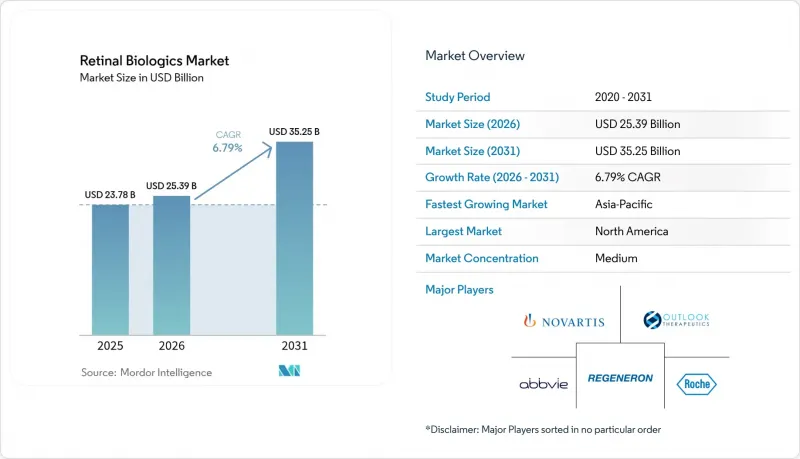
Mordor Intelligence에 의하면, 2026년 망막 생물제제 시장 규모는 253억 9,000만 달러로 추정되고, 2025년 237억 8,000만 달러에서 확대해, 2031년에는 352억 5,000만 달러에 이를 것으로 예측됩니다.
2026-2031년 연평균 성장률(CAGR)은 6.79%를 나타낼 전망입니다.
본 보고서는 약물 분류별(VEGF-A 길항제 등), 분자 유형별(단일클론 항체 등), 적응증별(노화성 황반변성(AMD) 등), 투여 경로별(유리체 내 주사 등), 유통 채널별(병원 약국 등), 지역별(북미, 유럽, 아시아태평양 등)로 분류되어 있습니다. 시장 전망은 금액(달러) 기준으로 제시되어 있습니다.
세계의 망막 생물제제 시장 동향 및 인사이트
망막 질환의 부담 및 당뇨병 환자 수의 급격한 증가
당뇨병 유병률 증가에 따라 당뇨병성 망막병증이 증가하고 있으며, 이 질환은 연평균 성장률(CAGR) 9.26%를 기록하며 현재 망막용 바이오로직스 시장에서 가장 빠르게 성장하는 적응증이 되고 있습니다. 신흥국에서는 진단 능력이 동시에 향상되면서 잠재적 환자층이 점차 드러나고 있습니다. ABBV-RGX-314와 같은 1회 투여형 치료법은 ALTITUDE 임상시험에서 당뇨병성 망막병증의 중증도 점수에 임상적으로 유의미한 개선을 보였으며, 시력 상실로 이어지는 사건을 감소시키고 평생 치료비 절감 효과도 시사하고 있습니다. 미국에서만 시력 상실과 관련된 경제적 부담이 1,342억 달러에 달한다는 점을 감안할 때, 보험사들도 그 가치를 인식하고 있습니다. 아시아태평양 시장은 높은 근시 유병률과 가속화되는 대사성 질환이 맞물려 가장 급격한 성장을 맞이하고 있습니다. 이러한 요인에 따른 장기적인 추세는 지속적 작용을 하는 생물학적 제제에 대한 지속적인 수요를 뒷받침하고 있습니다.
신규 바이오의약품 연구 개발의 가속화와 FDA/EMA의 승인
규제 측면의 모멘텀이 활기찬 파이프라인을 뒷받침하고 있습니다. 2025년 3월, FDA는 황반 모세혈관 확장증 2형에 대한 ENCELTO를 승인하며 유전자 치료 분야의 선례를 확립했습니다. EMA가 OCU410 및 OCU410ST에 대해 내린 긍정적 의견은 유럽 내 첨단 치료법에 대한 조화로운 승인 절차를 뒷받침하고 있습니다. 생산 능력에 대한 자본 유입이 진행되고 있습니다. Ritedose는 연간 26억 단위의 안과용 제제를 생산할 수 있는 블로우-필-씰(BFS) 라인에 8,100만 달러를 투자하고 있습니다. 베링거 인겔하임(Boehringer Ingelheim)과의 RetinAI 제휴로 대표되는 AI를 활용한 임상시험 설계를 통해 성공 확률이 높아지고 있습니다. 이러한 요인들이 맞물려 혁신의 속도가 가속화되고, 망막 생물제제 시장이 확대되고 있습니다.
엄격한 규제 장벽과 설비 투자의 집중
파리시마브의 첨부 문서가 망막 혈관염의 위험을 명시하도록 갱신된 사례에서 볼 수 있듯이, 시판 후 안전성 문제로 인해 규제 당국의 감시가 강화되고 있습니다. 2024년 8월 Regenerative Processing Plant사에 대해 CGMP 위반을 이유로 발부된 것을 포함한 FDA의 경고장은 규정 준수 비용의 상승을 여실히 보여주고 있습니다. 유전자 치료 프로그램에는 수년에 걸친 추적 조사가 의무화되어 있어, 중소기업에게는 자본 집약적인 부담이 되고 있습니다. 최근 FDA가 네스바테그라스트와 아웃룩 테라퓨틱스(Outlook Therapeutics)의 습성 연령 관련 황반변성(wet AMD) 치료용 바이오의약품 승인을 거부한 것은 유효성 기준이 높아지고, 개발 기간이 장기화되며, 예산이 불어나고 있음을 여실히 드러내고 있습니다. 이러한 압박은 투자자들의 강한 관심에도 불구하고 파이프라인 처리 능력을 저해하고 있습니다.
부문별 분석
ENCELTO의 2025년 승인으로 입증된 유전자 치료는 만성적인 주사 요법에서 벗어나는 전환점을 알리는 것이지만, 2025년에도 VEGF-A 길항제는 망막 바이오의약품 시장에서 58.12%의 점유율을 차지했습니다. 이러한 우위는 오랜 기간 확립된 안전성 프로파일과 보험 적용 경로에 기인합니다. 그러나 유전자 치료는 연평균 성장률(CAGR) 13.09%로 확대될 것으로 예측되며, 이는 망막용 생물학적 제제 시장 내에서 가장 빠른 성장률입니다. 이는 지속적인 단백질 발현 플랫폼에 대한 임상의들의 기대를 반영한 것입니다. 파리시마브와 같은 이중 특이성 VEGF/Ang-2 억제제는 입증된 VEGF의 생물학적 특성을 활용하면서 투여 간격을 연장하는 가교 기술을 제공합니다.
또한, 페그세타코플란이나 아바신카프타드-페골과 같은 보체 억제제도 혈관신생 이외의 작용기전의 폭을 넓힘으로써 성장 전망을 뒷받침하고 있습니다. TNF-α 억제제는 틈새 시장에 머물러 있으며, 주로 전신성 염증이 병태를 촉진하는 포도막염 치료에 사용되고 있습니다. ‘기타’ 범주에는 티로신 키나아제 억제제와 세포 기반 제제가 포함되어 있으며, 이들 제제는 현재 시장 구조를 뒤바꿀 가능성을 내포하고 있습니다. 작용기전의 다양화와 성과 연동형 계약에 대한 지불 주체의 의욕 고조가 망막 생물제제 시장에서 유전자 치료의 성장 곡선을 뒷받침하고 있습니다.
단일클론항체는 2025년 망막 생물제제 시장 규모의 45.74%를 차지했으며, 브랜드 제품의 성숙기 및 바이오시밀러의 진입을 통해 앞으로도 견조한 판매량을 유지할 전망입니다. 한편, 주로 아데노연관바이러스(AAV)를 이용한 유전자 벡터는 ABBV-RGX-314 임상시험에서 항-VEGF 단백질의 안구 내 지속적인 발현에 힘입어 연평균 성장률(CAGR) 11.98%를 기록할 전망입니다. 융합 단백질은 아프리벨셉트의 임상 현장 보급으로 여전히 중요성을 유지하고 있으나, 항체 단편은 비용 측면과 시장 침투 측면에서 잠재적인 우위를 제공합니다.
ProQR사의 편집 플랫폼을 필두로 하는 RNA 기반 후보 약물은 단일 돌연변이 질환을 표적으로 하고 있으며, 희귀질환 치료제(오펀 드럭)에 대한 우대 조치의 대상이 됩니다. 모듈식 벡터 스위트와 같은 제조 기술의 발전으로 인해 로트 릴리스가 가속화되고, 1회 투여당 비용이 절감됩니다. 지불 주체는 치유 가능성과 초기 비용을 저울질하고 있지만, 일회성 가격을 정상화할 가능성이 있는 치료 성과 기반 계약도 등장하고 있습니다. 벡터가 규제상의 장벽을 극복해 나감에 따라, 유전자 치료는 망막 생물제제 시장에서 항체의 지배적 지위를 서서히 잠식해 나갈 위치에 있습니다.
지역별 분석
북미는 2025년 망막 바이오의약품 시장 규모의 39.21%를 차지한 것으로 평가되었으며, 단계적 치료 프로토콜이 강화되고 있음에도 불구하고 고품질 바이오의약품을 수용하는 보험 지급 체계에 힘입어 2031년까지 연평균 성장률(CAGR) 6.45%로 성장할 전망입니다. FDA의 지정은 해당 지역 내 승인을 가속화하고 있으며, Ritedose사의 블로우-필-씰(BFS) 프로젝트와 같은 국내 제조 확대에 힘입어 미국은 공급 거점으로서의 입지를 확고히 하고 있습니다. 바이오시밀러의 진입으로 가격 결정력은 압박을 받고 있지만, 혁신 사이클은 여전히 이 지역에 뿌리내리고 있습니다.
아시아태평양은 인구 고령화, 당뇨병 환자 수 증가, 그리고 안과 인프라에 대한 정부 투자의 견인 효과로 8.12%라는 가장 높은 연평균 성장률(CAGR)을 나타낼 전망입니다. 과제로는 전문의의 불균형한 분포와 산발적인 품질 관리 문제를 꼽을 수 있습니다. 인도의 충전·마무리 공장이 멸균 미비로 FDA로부터 지적을 받은 사례는 여전히 남아 있는 장벽을 여실히 보여줍니다. 알콘(Alcon)과 같은 다국적 기업들은 지속 가능한 수요를 구축하기 위해 현지 연구센터 및 의사 대상 연수 프로그램에 자본을 투자하고 있습니다.
유럽은 선진적인 치료법에 관한 규제와 정책에 힘입어 6.83%의 연평균 성장률(CAGR)을 기록하고 있습니다. EMA가 특정 용도로 조제된 베바시주맙 제제 ‘Lytenava’를 승인한 것은 적응증 외 사용 문제를 해결하기 위한 조치로, 가격 기준을 재설정할 가능성이 있습니다. 또한, OCU410 파생 제품에 대한 EMA의 지정은 유전자 치료 전개에서 유럽의 중요성을 더욱 공고히 하고 있습니다. 중동 및 아프리카 및 남미는 비교적 작은 기반에서 각각 연평균 성장률(CAGR) 7.65%와 7.12%로 성장하고 있어, 초기 진출기업들에게 장기적인 성장 여지를 제공합니다.
기타 혜택 :
- 엑셀 형식 시장 예측(ME) 시트
- 3개월간의 애널리스트 지원
자주 묻는 질문
목차
제1장 시장명은 '망막 생물제제 시장'입니다.
제2장 서론
제3장 조사 방법
제4장 주요 요약
제5장 시장 구도
제6장 시장 규모 및 성장 예측
제7장 경쟁 구도
제8장 시장 기회 및 향후 전망
AJY 26.08.28According to Mordor Intelligence, retinal biologics market size in 2026 is estimated at USD 25.39 billion, growing from 2025 value of USD 23.78 billion with 2031 projections showing USD 35.25 billion, growing at 6.79% CAGR over 2026-2031.
This report is Segmented by Drug Class (VEGF-A Antagonist and More), Molecule Type (Monoclonal Antibodies and More), Indication (AMD and More), Route of Administration (Intravitreal Injection and More), Distribution Channel (Hospital Pharmacies and More), and Geography (North America, Europe, Asia-Pacific, and More). The Market Forecasts are Provided in Terms of Value (USD).
Global Retinal Biologics Market Trends and Insights
Rapid Rise in Retinal Disease Burden & Diabetic Population
Escalating diabetes prevalence is fuelling diabetic retinopathy, which records a 9.26% CAGR and now represents the fastest-growing indication within the retinal biologics market. Emerging economies see parallel gains in diagnostic capacity that expose latent disease pools. One-time modalities such as ABBV-RGX-314 showed clinically meaningful improvements in diabetic retinopathy severity scores in the ALTITUDE study, reducing vision-threatening events and hinting at lower lifetime treatment costs. Payers see value, given the USD 134.2 billion economic burden tied to vision loss in the United States alone. Asia-Pacific markets face the steepest climb, combining high myopia rates with accelerating metabolic disease. The driver's long-term trajectory supports sustained demand for biologics with durable activity.
Accelerated R&D Output & FDA/EMA Approvals of Novel Biologics
Regulatory momentum underpins a vibrant pipeline. In March 2025 the FDA cleared ENCELTO for Macular Telangiectasia type 2, establishing a gene-based precedent. EMA's positive opinions for OCU410 and OCU410ST reinforce a harmonised European path for advanced therapies. Capital is flowing into capacity: Ritedose is investing USD 81 million in blow-fill-seal lines capable of producing 2.6 billion ophthalmic units annually. AI-driven trial design, exemplified by RetinAI collaborations with Boehringer Ingelheim, is elevating success odds. Together, these factors raise innovation velocity and broaden the retinal biologics market.
Stringent Regulatory Hurdles & Cap-Ex Intensity
Post-marketing safety issues heighten oversight, as seen when faricimab's label was updated to flag retinal vasculitis risk. FDA warning letters, including one issued to Regenerative Processing Plant in August 2024 for CGMP violations, illustrate rising compliance costs. Gene therapy programmes face multi-year follow-up mandates that smaller firms find capital-intensive. Recent FDA refusals of Nesvategrast and Outlook Therapeutics' wet AMD biologic underscore higher efficacy thresholds that elongate timelines and inflate budgets. These pressures restrain pipeline throughput despite strong investor interest.
Other drivers and restraints analyzed in the detailed report include:
- Ageing Demographics Driving AMD Cases
- Strong Clinical Adoption of Anti-VEGF Injections
- High Drop-Out Rates from Burdensome Injection Schedules
For complete list of drivers and restraints, kindly check the Table Of Contents.
Segment Analysis
Gene therapies validated by ENCELTO's 2025 approval herald a shift from chronic injection regimens, yet VEGF-A antagonists still commanded a 58.12% retinal biologics market share in 2025. That dominance springs from long-established safety profiles and insurance coverage pathways. However, gene therapies are projected to expand at a 13.09% CAGR, the fastest within the retinal biologics market, reflecting clinician enthusiasm for durable protein expression platforms. Bispecific VEGF/Ang-2 inhibitors such as faricimab offer a bridging technology that lengthens dosing intervals while leveraging proven VEGF biology.
Growth prospects are also buoyed by complement inhibitors like pegcetacoplan and avacincaptad pegol, which widen the mechanism spectrum beyond angiogenesis. TNF-a inhibitors stay niche, primarily treating uveitic entities where systemic inflammation drives pathology-an "Others" bucket houses tyrosine kinase inhibitors and cell-based constructs that could upend today's hierarchy. Diversifying mechanisms and payer appetite for outcomes-based contracting reinforce the gene therapy growth curve inside the retinal biologics market.
Monoclonal antibodies undergirded 45.74% of the 2025 retinal biologics market size and will continue to post solid volume through brand maturity and biosimilar entry. Yet gene vectors, primarily adeno-associated viruses, will register a 11.98% CAGR, aided by sustained intraocular expression of anti-VEGF proteins in ABBV-RGX-314 trials. Fusion proteins retain relevance owing to aflibercept's clinical ubiquity, while antibody fragments provide potential cost and penetration advantages.
RNA-based candidates, led by ProQR's editing platform, target single-mutation diseases and attract orphan-drug incentives. Manufacturing advances such as modular vector suites accelerate lot release and reduce cost per dose. Payers weigh curative promise against upfront cost, yet outcome-based deals are emerging that could normalise one-time prices. As vectors cross regulatory hurdles, gene therapies are positioned to erode antibody hegemony in the retinal biologics market.
Complete Report Scope:
- By Drug Class
- VEGF-A Antagonists
- Bispecific VEGF/Ang-2 Inhibitors
- Complement Inhibitors
- TNF-? Inhibitors
- Gene Therapies
- Others
- By Molecule Type
- Monoclonal Antibodies
- Fusion Proteins
- Antibody Fragments
- Gene Therapy Vectors
- RNA-based Biologics
- By Indication
- Age-Related Macular Degeneration (AMD)
- Diabetic Retinopathy
- Uveitis
- Other Retinal Disorders
- By Route of Administration
- Intravitreal Injection
- Suprachoroidal Injection
- Sustained-Release Implant
- Topical Delivery
- Other Routes
- By Distribution Channel
- Hospital Pharmacies
- Specialty Clinics
- Retail & Online Pharmacies
- By Geography
- North America
- United States
- Canada
- Mexico
- Europe
- Germany
- United Kingdom
- France
- Italy
- Spain
- Rest of Europe
- Asia-Pacific
- China
- Japan
- India
- Australia
- South Korea
- Rest of Asia-Pacific
- Middle East and Africa
- GCC
- South Africa
- Rest of Middle East and Africa
- South America
- Brazil
- Argentina
- Rest of South America
- North America
Geography Analysis
North America held 39.21% of the retinal biologics market size in 2025 and will grow at a 6.45% CAGR through 2031, buoyed by reimbursement frameworks that accept premium biologics despite intensifying step-therapy protocols. FDA designations hasten regional approvals, while domestic manufacturing expansions such as Ritedose's blow-fill-seal project position the United States as a supply hub. Biosimilar entry compresses pricing power, yet innovation cycles remain anchored in the region.
Asia-Pacific will deliver the fastest 8.12% CAGR, driven by demographic aging, diabetes growth, and government investment in ophthalmology infrastructure. Constraints include uneven specialist distribution and sporadic quality lapses; FDA citations of Indian fill-finish plants for sterility failures illustrate lingering hurdles. Multinationals such as Alcon are committing capital to local research centres and physician training programmes to build sustainable demand.
Europe enjoys 6.83% CAGR, aided by advanced therapy regulations and proactive biosimilar policies. EMA approval of Lytenava, a purpose-formulated bevacizumab, addresses off-label use and may reset price anchors. EMA designations for OCU410 variants further cement Europe's weight in gene therapy roll-out. Middle East & Africa and South America grow from smaller bases at 7.65% and 7.12% CAGRs respectively, offering longer-term upside to early entrants.
- Abbvie
- AbCellera Biologics
- Adverum Biotechnologies
- Amgen
- Bausch Health
- Bayer
- Bioeq AG
- Chengdu Kanghong Biotech
- Roche
- Genentech USA
- GenSight Biologics S.A.
- Astellas Pharma
- Kodiak Sciences Inc.
- Lumos Pharma, Inc.
- MeiraGTx Holdings PLC
- Novartis
- Outlook Therapeutics Inc.
- Oxurion
- Regeneron Pharmaceuticals
- Samsung Group
- SemaThera
- Viatris
Additional Benefits:
- The market estimate (ME) sheet in Excel format
- 3 months of analyst support
TABLE OF CONTENTS
1 Market's Name is Retinal Biologics Market
2 Introduction
- 2.1 Study Assumptions & Market Definition
- 2.2 Scope of the Study
3 Research Methodology
4 Executive Summary
5 Market Landscape
- 5.1 Market Overview
- 5.2 Market Drivers
- 5.2.1 Rapid Rise in Retinal Disease Burden & Diabetic Population
- 5.2.2 Accelerated R&D Output & FDA/EMA Approvals of Novel Biologics
- 5.2.3 Ageing Demographics Driving AMD Cases
- 5.2.4 Strong Clinical Adoption of Anti-VEGF Injections
- 5.2.5 Long-Acting Delivery Platforms Unlocking New Patient Pools
- 5.2.6 Payer-Led Biosimilar Uptake in Cost-Sensitive Regions
- 5.3 Market Restraints
- 5.3.1 Stringent Regulatory Hurdles & Cap-Ex Intensity
- 5.3.2 Safety-Related Label Updates
- 5.3.3 Sterile Fill-Finish Capacity Bottlenecks
- 5.3.4 High Drop-Out Rates from Burdensome Injection Schedules
- 5.4 Supply Chain Analysis
- 5.5 Regulatory Landscape
- 5.6 Technological Outlook
- 5.7 Porter's Five Forces Analysis
- 5.7.1 Threat of New Entrants
- 5.7.2 Bargaining Power of Buyers
- 5.7.3 Bargaining Power of Suppliers
- 5.7.4 Threat of Substitutes
- 5.7.5 Competitive Rivalry
6 Market Size & Growth Forecasts (Value)
- 6.1 By Drug Class
- 6.1.1 VEGF-A Antagonists
- 6.1.2 Bispecific VEGF/Ang-2 Inhibitors
- 6.1.3 Complement Inhibitors
- 6.1.4 TNF-? Inhibitors
- 6.1.5 Gene Therapies
- 6.1.6 Others
- 6.2 By Molecule Type
- 6.2.1 Monoclonal Antibodies
- 6.2.2 Fusion Proteins
- 6.2.3 Antibody Fragments
- 6.2.4 Gene Therapy Vectors
- 6.2.5 RNA-based Biologics
- 6.3 By Indication
- 6.3.1 Age-Related Macular Degeneration (AMD)
- 6.3.2 Diabetic Retinopathy
- 6.3.3 Uveitis
- 6.3.4 Other Retinal Disorders
- 6.4 By Route of Administration
- 6.4.1 Intravitreal Injection
- 6.4.2 Suprachoroidal Injection
- 6.4.3 Sustained-Release Implant
- 6.4.4 Topical Delivery
- 6.4.5 Other Routes
- 6.5 By Distribution Channel
- 6.5.1 Hospital Pharmacies
- 6.5.2 Specialty Clinics
- 6.5.3 Retail & Online Pharmacies
- 6.6 By Geography
- 6.6.1 North America
- 6.6.1.1 United States
- 6.6.1.2 Canada
- 6.6.1.3 Mexico
- 6.6.2 Europe
- 6.6.2.1 Germany
- 6.6.2.2 United Kingdom
- 6.6.2.3 France
- 6.6.2.4 Italy
- 6.6.2.5 Spain
- 6.6.2.6 Rest of Europe
- 6.6.3 Asia-Pacific
- 6.6.3.1 China
- 6.6.3.2 Japan
- 6.6.3.3 India
- 6.6.3.4 Australia
- 6.6.3.5 South Korea
- 6.6.3.6 Rest of Asia-Pacific
- 6.6.4 Middle East and Africa
- 6.6.4.1 GCC
- 6.6.4.2 South Africa
- 6.6.4.3 Rest of Middle East and Africa
- 6.6.5 South America
- 6.6.5.1 Brazil
- 6.6.5.2 Argentina
- 6.6.5.3 Rest of South America
- 6.6.1 North America
7 Competitive Landscape
- 7.1 Market Concentration
- 7.2 Competitive Benchmarking
- 7.3 Market Share Analysis
- 7.4 Company Profiles (includes Global level Overview, Market level overview, Core Segments, Financials as available, Strategic Information, Market Rank/Share for key companies, Products & Services, and Recent Developments)
- 7.4.1 AbbVie Inc.
- 7.4.2 AbCellera Biologics
- 7.4.3 Adverum Biotechnologies Inc.
- 7.4.4 Amgen Inc.
- 7.4.5 Bausch Health Companies Inc.
- 7.4.6 Bayer AG
- 7.4.7 Bioeq AG
- 7.4.8 Chengdu Kanghong Biotech
- 7.4.9 F. Hoffmann-La Roche Ltd
- 7.4.10 Genentech USA
- 7.4.11 GenSight Biologics S.A.
- 7.4.12 Astellas Pharma Inc.
- 7.4.13 Kodiak Sciences Inc.
- 7.4.14 Lumos Pharma, Inc.
- 7.4.15 MeiraGTx Holdings PLC
- 7.4.16 Novartis AG
- 7.4.17 Outlook Therapeutics Inc.
- 7.4.18 Oxurion NV
- 7.4.19 Regeneron Pharmaceuticals Inc.
- 7.4.20 Samsung Biologics
- 7.4.21 SemaThera Inc.
- 7.4.22 Viatris Inc.
8 Market Opportunities & Future Outlook
- 8.1 White-space & Unmet-need Assessment


