|
시장보고서
상품코드
2115119
오일 및 가스 분리기 시장 : 시장 점유율 분석, 업계 동향 및 통계, 성장 예측(2026-2031년)Oil And Gas Separator - Market Share Analysis, Industry Trends & Statistics, Growth Forecasts (2026 - 2031) |
||||||
 Mordor Intelligence
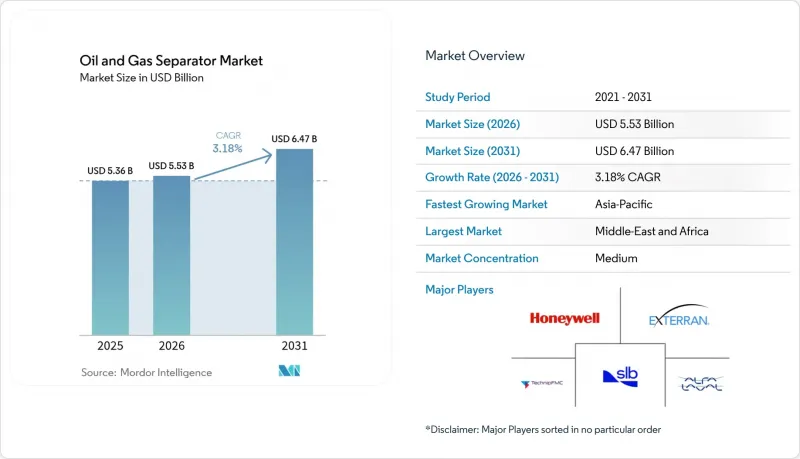
Mordor Intelligence에 의하면, 오일 및 가스 분리기 시장 규모는 2025년에 53억 6,000만 달러로 평가되었고, 2026년 55억 3,000만 달러에서 2031년까지 64억 7,000만 달러에 이를 것으로 예측되며, 예측 기간(2026-2031년) CAGR은 3.18%를 나타낼 전망입니다.
본 보고서는 용기 배치별(수평형, 수직형, 기타), 상(相) 유형별(2상, 3상, 기타), 기술별(중력식, 원심식, 기타), 정격 압력별(고압, 저압, 기타), 재료별(탄소강, 듀플렉스/슈퍼 듀플렉스, 기타), 용도별(업스트림, 중류, 하류), 지역별(아시아태평양, 중동 및 아프리카, 기타)로 분류되어 있습니다.
세계의 오일 및 가스 분리기 시장 동향 및 인사이트
비전통적 셰일 생산량 증가
퍼미안 분지를 대표하는 셰일층은 계속해서 확대되고 있으며, 분리기의 설계 요건도 지속적으로 변화하고 있습니다. 타이트 지층에서는 가스와 원유의 비율이 크게 변동하기 때문에 사업자들은 가스의 급격한 증가나 때때로 발생하는 모래 유입에 대응할 수 있는 3상 분리조를 채택할 수밖에 없습니다. 생산성은 시간이 지남에 따라 급격히 저하되므로, 생산자들은 신속하게 재배치 가능한 설비를 원하고 있으며, 각 패드 간에 쉽게 이동할 수 있는 조립식 모듈 유닛이 표준적인 조달 옵션으로 자리 잡고 있습니다. 2024년에는 타이트 오일 생산량이 하루 940만 배럴에 달하면서, 침식성 모래와 발포성 유체에도 견딜 수 있는 분리 장치에 대한 지속적인 수요가 부각되었습니다. 이러한 유정에서 생산된 산물이 주 파이프라인으로 유입됨에 따라, 미드스트림 기업들은 조성의 변동에 대응하기 위해 높은 턴다운 비율을 가진 분리 장치를 추가해야 하며, 그 결과 수요는 유정 입구를 넘어 확대되고 있습니다.
생산수에 대한 환경 규제 강화
특히 북미와 유럽에서는 생산수 배출 기준이 엄격해지고 있으며, 잔류 유분 농도 저감이 중요시되고 있습니다. 개정된 미국의 폐수 규제는 해양 배출 시 물 속의 유분 농도를 거의 제로 수준으로 낮출 것을 요구하고 있으며, 이에 따라 사업자들은 독자적인 매체층을 조합한 고성능 코얼레서 도입을 추진하고 있습니다. 국제 석유 및 가스 생산자 협회(IAOGP)에 따르면, 전 세계 생산수의 양은 하루 2억 5,000만 배럴을 초과하며, 처분·처리 비용은 배럴당 0.50달러에서 2달러에 이르는 것으로 알려져 있습니다. 보다 효율적인 1차 분리를 통해 다운스트림 공정에서의 여과 및 약품 주입이 직접적으로 감소되며, 환경 규제 준수가 석유 및 가스용 분리기 시장에서 중요한 자본 투자의 원동력이 되고 있습니다.
원유 가격 변동
벤치마크 가격이 배럴당 70달러 아래로 떨어지면, 사업자들은 분리 장치 구매를 연기하거나 축소하는 경향이 있으며, 자본 지출(CAPEX)이 적은 표준형 장치에 중점을 두게 됩니다. 국제에너지기구(IEA)의 기록에 따르면, 2024년 연간 가격 변동률은 40% 증가했으며, 그 결과 전 세계적으로 150억 달러 상당의 프로젝트가 연기되었습니다. 소규모 독립 기업들은 특히 영향을 받기 쉬우며, 현금 흐름이 안정될 때까지 재생품이나 임대 장비를 선택하는 경우가 많아 석유 및 가스용 분리기 시장의 단기적인 성장세를 둔화시키고 있습니다.
부문 분석
2025년 오일 및 가스 분리기 시장에서 수평형 장비가 50.62%라는 최대 시장 점유율을 확보한 반면, 수직형 장비도 주목을 받았습니다. 해상 프로젝트의 모듈화가 진행됨에 따라 수직형 모델에 대한 의존도가 높아지고 있으며, 해당 부문은 2031년까지 연평균 성장률(CAGR) 5.28%로 성장할 전망입니다. 2024년에 계약이 체결된 몇몇 브라질 FPSO의 경우, 데크 공간을 30% 절감할 수 있다는 점을 이유로 1차 분리 트레인을 완전히 수직형으로 구성했습니다. 육상에서는 유지보수 인력이 지상 수준에서 트레이를 쉽게 빼내고 내부 구조를 점검할 수 있기 때문에 수평형 유닛이 여전히 주류를 차지하고 있습니다. 그러나 아시아태평양의 심해 가스 및 액체 취급에 중점을 두면서, 입찰에서는 이미 슬림한 수직형 설계로 기울고 있는 추세가 보입니다.
컴팩트함은 차치하고라도, 수직형 설계는 액체의 체류 거리가 짧아 슬로싱 내성 측면에서 높은 평가를 받고 있습니다. 이는 부유식 생산 시스템에 있어 매우 중요한 특성입니다. 테크닙 FMC는 최신 수직형 제품 라인에 개선된 슬로싱 방지 배플을 채택함으로써 운영자에게 20년이라는 인상적인 수명을 제시했습니다. 한편, 구형 설계는 여전히 틈새 분야에 머물러 있으며, 주로 해저 모듈에 채택되고 있습니다. 이 형상은 환상 응력을 고르게 분산시킨다는 장점이 있습니다. 따라서 다방향 대응 제품 라인업을 구축한 OEM은 더 폭넓은 용도에 어필할 수 있으며, 업스트림 부문의 활동이 육상에서 해상으로 이전되더라도 오일 및 가스 분리기 시장에서의 점유율을 견고하게 유지할 수 있을 것입니다.
2025년 오일 및 가스 분리기 시장 규모에서 2상식 장치는 66.12%의 점유율을 차지했으나, 이 분야는 정적인 것이 아닙니다. LNG 플랜트, NGL 분별 장치, 파이프라인 컨디셔너는 넓은 턴다운 비율을 가진 단순한 기액 분리 장치에 의존하고 있어, 안정적인 수요와 예측 가능한 이익률을 확보하고 있습니다. 반면, 3상식 장치는 노후화된 유전에서 수분 함량이 증가하고 생산수 배출 규제로 인해 더 깨끗한 분리가 요구됨에 따라 점유율을 서서히 확대되고 있습니다. 3.72%의 연평균 성장률(CAGR)은 비전통적 석유 및 가스 저류층에서 통합형 모래 처리 및 탈염 전처리에 대한 수요가 증가하고 있음을 반영합니다.
각 OEM 업체의 로드맵에 따르면, 3상 시스템에서 오일 혼입을 최소화하기 위해 위어(weir) 설계 및 인터페이스 컨트롤러 개선이 빠르게 진행되고 있습니다. 한편, 캐나다의 중유 생산 현장에서는 샌드젯 기능을 갖춘 4상 분리 장치가 도입되기 시작했습니다. 그렇지만 2상 기술도 계속 진화하고 있습니다. 알파 라발(Alfa Laval)은 최근 중류 처리 스테이션을 위해, 동일한 설치 공간에서 처리 능력을 25% 향상시킨 대용량 믹서·세틀러를 발표했습니다. 이러한 비약적인 발전 덕분에, 이미 확립된 2상 솔루션은 여전히 매력적이며, 오일 및 가스 분리기 시장에서 주도권을 쉽게 내주지는 않을 것입니다.
지역별 분석
2025년, 중동 및 아프리카은 매출의 39.05%를 차지했으며, 오일 및 가스 분리기 시장을 주도했습니다. 이는 사우디아라비아, 아랍에미리트, 카타르가 해양 브라운필드 확장 및 사워가스 수집에 수십억을 투자했기 때문입니다. 아라비아만에서의 증산(EOR) 프로젝트에서는 내식성이 향상된 대용량 3상 분리기가 채택되어, 원유 생산량이 정체되어 있음에도 불구하고 수주 실적은 견조한 추세를 보이고 있습니다. 나이지리아와 앙골라에서는 새로운 심해 유전 개발을 위해 고압 해저 솔루션이 채택되었으며, 데크 중량 제한과 엄격한 플레어링 규제를 모두 충족하기 위해 수직 사이클론식 패키지가 수입되었습니다.
아시아태평양은 5.96%라는 가장 높은 연평균 성장률(CAGR)을 기록했으며, 2031년까지 걸프 지역과의 격차를 좁힐 전망입니다. 중국의 가스 전환 가속화와 남중국해 광구에 대한 국영 기업의 적극적인 투자 의지가 이 지역의 오일 및 가스 분리기 시장 성장을 견인하고 있습니다. 페트로나스, CNOOC, ONGC는 해양 배출 상한선 강화에 따라 2024년 입찰에서 가스 처리탑과 미스트 엘리미네이터를 우선적으로 선정했습니다. 호주의 LNG 메가 트레인에서는 유입 가스의 수분 함량이 증가함에 따라 더 대형의 스크러버로 개조하는 작업이 진행되고 있으며, 이는 아시아태평양의 오일 및 가스 분리기 시장 규모가 업스트림 부문을 넘어 LNG 백엔드 분야로 확대될 여지가 있음을 보여줍니다.
북미는 다른 지역의 해양 분야가 급속히 확대됨에 따라 전체 시장 점유율은 하락하고 있지만, 퍼미안 분지의 끊임없는 성장 궤도에서 여전히 매우 중요한 위치를 차지하고 있습니다. 셰일 패드의 재배치에 맞추어 맞춤 제작된 3상 스키드는 계속해서 주요 수익원으로 자리 잡고 있습니다. 캐나다에서는 오일 샌드의 펌프 고장이나 70%를 초과하는 수분 함량에 대응할 수 있는 모래에 대한 내성이 뛰어난 4상 유닛에 대한 수요가 증가하고 있습니다. 현재 유럽의 북해에서는 개조 및 교체가 중점을 두고 있으며, 성숙한 플랫폼이 EU의 메탄 규제를 준수하면서 경제 수명을 연장해 나가는 가운데, 오일 및 가스 분리기 시장의 애프터마켓 점유율이 확대되고 있습니다.
기타 혜택 :
- 엑셀 형식 시장 예측(ME) 시트
- 3개월간의 애널리스트 지원
자주 묻는 질문
목차
제1장 서론
제2장 조사 방법
제3장 주요 요약
제4장 시장 구도
제5장 시장 규모 및 성장 예측
제6장 경쟁 구도
제7장 시장 기회 및 향후 전망
AJY 26.08.28According to Mordor Intelligence, the oil and gas separator market size was valued at USD 5.36 billion in 2025 and estimated to grow from USD 5.53 billion in 2026 to reach USD 6.47 billion by 2031, at a CAGR of 3.18% during the forecast period (2026-2031).
This report is Segmented by Vessel Orientation (Horizontal, Vertical, and More), Phase Type (Two-Phase, Three-Phase, and More), Technology (Gravity-Based, Centrifugal, and More), Pressure Rating (High-Pressure, Low-Pressure, and More), Material (Carbon Steel, Duplex/Super-duplex, and More), Application (Upstream, Midstream, and Downstream), and Geography (Asia-Pacific, Middle East and Africa, and More).
Global Oil And Gas Separator Market Trends and Insights
Growth in Unconventional Shale Output
Shale plays, typified by the Permian Basin, continue to expand and reshape the design needs for separators. Tight formations generate highly variable gas-to-oil ratios, forcing operators to specify three-phase vessels able to cope with surging gas volumes and occasional sand influx. Prefabricated modular units that can be easily shuffled between pads have become a standard procurement choice because productivity declines steeply over time, and producers want equipment that can be redeployed quickly. Tight-oil production reached 9.4 million b/d in 2024, underlining the sustained call for separators that tolerate erosive sand and foaming fluids. As these wells flow into trunk pipelines, midstream firms must add high-turndown separators to handle compositional swings, thereby enlarging demand beyond the wellhead.
Stricter Environmental Regulations on Produced Water
Discharge standards for produced water have tightened, particularly in North America and Europe, leading to an emphasis on reducing residual oil content. Updated U.S. wastewater rules require oil-in-water concentrations to be near zero for offshore discharges, prompting operators to adopt high-performance coalescers supplemented with proprietary media layers. Global produced-water volumes exceed 250 million barrels per day, and disposal/treatment costs can range from USD 0.50 to USD 2.00 per barrel, according to the International Association of Oil & Gas Producers. More efficient primary separation directly reduces downstream filtration and chemical dosing, transforming environmental compliance into a significant capital driver for the oil and gas separator market.
Volatility in Crude-Oil Prices
When benchmark prices drop below USD 70/bbl, operators tend to delay or scale back separator purchases, focusing on lower-capex standard units. The International Energy Agency recorded a 40% increase in annual price volatility in 2024, resulting in USD 15 billion in deferred projects worldwide. Smaller independents are particularly vulnerable, often opting for refurbished separators or rental units until their cash flows stabilize, which dampens near-term momentum for the oil and gas separator market.
Other drivers and restraints analyzed in the detailed report include:
- Offshore Deep-Water Project Revival
- Demand for Compact Modular Separators in FPSOs
- High Capital Cost of High-Pressure Separators
For complete list of drivers and restraints, kindly check the Table Of Contents.
Segment Analysis
Vertical-orientation units captured notable attention, even though horizontal vessels secured the largest 50.62% market share for oil and gas separators in 2025. The modular nature of offshore projects now leans heavily on vertical models, sending that segment on a 5.28% CAGR run toward 2031. Several Brazilian FPSOs signed in 2024 feature entirely vertical primary separation trains, citing a 30% reduction in deck space. Horizontal units retain dominance onshore because maintenance crews find tray-pulling and internals inspection easier at ground level. Yet, the heavier focus on deep-water gas and liquids within the Asia-Pacific region is already tilting tenders toward slimmer vertical footprints.
Compactness aside, vertical designs score higher in sloshing tolerance thanks to shorter liquid hold-up lengths, a critical attribute for floating production systems. TechnipFMC quoted operators an impressive 20-year service life with upgraded anti-slosh baffles in its newest vertical line. Meanwhile, spherical designs remain niche, primarily in subsea modules, where the geometry distributes hoop stress evenly. OEMs that master multi-orientation portfolios thus appeal to a broader spread of applications, ensuring their share of the oil and gas separator market stays resilient even if upstream activity migrates from land to sea.
Two-phase equipment accounted for a 66.12% share of the oil and gas separator market size in 2025; however, this space is not static. LNG trains, NGL fractionators, and pipeline conditioners rely on simple gas-liquid splitters with large turndown ratios, ensuring stable demand and predictable margins. Three-phase units, however, notch incremental share as water cut climbs in aging fields and as produced-water discharge rules call for cleaner splits. Their 3.72% CAGR reflects the heightened need for integrated sand handling and desalter pre-treatment in unconventional oil and gas reservoirs.
OEM roadmaps indicate a rapid refinement of weir designs and interface controllers to minimize oil carryover in three-phase systems. Meanwhile, four-phase separators with sand jetting are popping up on Canadian heavy-oil pads. Yet, two-phase technology continues to evolve as well: Alfa Laval recently unveiled a high-capacity mixer-settler that brings 25% more throughput within the same envelope for midstream stations. Such step changes keep established two-phase solutions attractive and prevent them from yielding leadership easily in the oil and gas separator market.
Complete Report Scope:
- By Vessel Orientation
- Horizontal Separators
- Vertical Separators
- Spherical Separators
- By Phase Type
- Two-phase Separators
- Three-phase Separators
- Four-phase/Sand Separators
- By Separator Technology
- Gravity-based
- Centrifugal
- Filter-vane / Mist Eliminator
- Coalescer-based
- Compact Cyclonic
- By Pressure Rating
- High-pressure (Above 1,000 psi)
- Medium-pressure (300 to 1,000 psi)
- Low-pressure (Below 300 psi)
- By Material of Construction
- Carbon Steel
- Stainless Steel
- Duplex/Super-duplex
- Composite and Lined Vessels
- By Application
- Upstream
- Midstream
- Downstream (Refineries and Gas Processing)
- By Geography
- North America
- United States
- Canada
- Mexico
- Europe
- Norway
- United Kingdom
- Russia
- Netherlands
- Germany
- Rest of Europe
- Asia Pacific
- China
- India
- Japan
- South Korea
- ASEAN Countries
- Australia
- Rest of Asia Pacific
- South America
- Brazil
- Argentina
- Colombia
- Rest of South America
- Middle East and Africa
- Saudi Arabia
- United Arab Emirates
- Qatar
- Nigeria
- South Africa
- Rest of Middle East and Africa
- North America
Geography Analysis
The Middle East & Africa led the oil and gas separator market with 39.05% revenue in 2025, as Saudi Arabia, the United Arab Emirates, and Qatar invested billions in offshore brownfield expansions and sour-gas gathering. Enhanced-oil-recovery campaigns within the Arabian Gulf rely on high-capacity three-phase separators with anti-corrosion upgrades, sustaining orders despite flat crude volumes. Nigeria and Angola adopted high-pressure subsea solutions for new deep-water plays, importing vertical cyclonic packages to meet both deck weight limits and stringent flaring rules.
The Asia-Pacific region delivered the swiftest 5.96% CAGR and is on track to narrow the gap with the Gulf by 2031. China's accelerating gas pivot and state-owned enterprise appetite for South China Sea blocks are driving the growth of the oil and gas separator market in the region. Petronas, CNOOC, and ONGC prioritized gas-handling towers and mist eliminators in 2024 tenders, citing tighter marine discharge caps. Australia's LNG megatrains continue to retrofit larger scrubbers as inlet gas becomes wetter, proving that the oil and gas separator market size within the Asia-Pacific region has room to expand beyond upstream into LNG backends.
North America remains pivotal throughout the Permian's relentless growth path, even as its overall share slips with faster offshore gains elsewhere. Three-phase skids customized for shale pad redeployment continue to be a core revenue pillar. Canada adds demand for sand-tolerant four-phase units capable of handling oil-sands pump failures and water content exceeding 70%. Europe's North Sea now emphasizes refurbishment and replacement, swelling the aftermarket share of the oil and gas separator market as mature platforms seek to extend economic life while complying with EU methane rules.
- Schlumberger Limited
- TechnipFMC plc
- Alfa Laval AB
- Honeywell International Inc.
- Exterran Corporation
- GEA Group AG
- Frames Energy Systems B.V.
- Pentair plc
- Halliburton Company
- Sulzer AG
- National Oilwell Varco
- Andritz Group
- ProSep Inc.
- Pall Corporation
- Twister BV
- HAT International
- ACS Manufacturing Inc.
- Sep-Pro Systems Inc.
- Valerus (Enerflex)
- Worthington Industries
Additional Benefits:
- The market estimate (ME) sheet in Excel format
- 3 months of analyst support
TABLE OF CONTENTS
1 Introduction
- 1.1 Study Assumptions & Market Definition
- 1.2 Scope of the Study
2 Research Methodology
3 Executive Summary
4 Market Landscape
- 4.1 Market Overview
- 4.2 Market Drivers
- 4.2.1 Growth in unconventional shale output
- 4.2.2 Stricter environmental regulations on produced water
- 4.2.3 Offshore deep-water project revival
- 4.2.4 Demand for compact modular separators in FPSOs
- 4.2.5 Adoption of AI-driven predictive maintenance
- 4.2.6 Composite internals to curb corrosion in sour service
- 4.3 Market Restraints
- 4.3.1 Volatility in crude-oil prices
- 4.3.2 High capital cost of high-pressure separators
- 4.3.3 Skilled-labor shortages for offshore maintenance
- 4.3.4 Supply-chain bottlenecks for specialty alloy internals
- 4.4 Supply-Chain Analysis
- 4.5 Regulatory Landscape
- 4.6 Technological Outlook
- 4.7 Porter's Five Forces
- 4.7.1 Bargaining Power of Suppliers
- 4.7.2 Bargaining Power of Consumers
- 4.7.3 Threat of New Entrants
- 4.7.4 Threat of Substitute Products
- 4.7.5 Intensity of Competitive Rivalry
5 Market Size & Growth Forecasts
- 5.1 By Vessel Orientation
- 5.1.1 Horizontal Separators
- 5.1.2 Vertical Separators
- 5.1.3 Spherical Separators
- 5.2 By Phase Type
- 5.2.1 Two-phase Separators
- 5.2.2 Three-phase Separators
- 5.2.3 Four-phase/Sand Separators
- 5.3 By Separator Technology
- 5.3.1 Gravity-based
- 5.3.2 Centrifugal
- 5.3.3 Filter-vane / Mist Eliminator
- 5.3.4 Coalescer-based
- 5.3.5 Compact Cyclonic
- 5.4 By Pressure Rating
- 5.4.1 High-pressure (Above 1,000 psi)
- 5.4.2 Medium-pressure (300 to 1,000 psi)
- 5.4.3 Low-pressure (Below 300 psi)
- 5.5 By Material of Construction
- 5.5.1 Carbon Steel
- 5.5.2 Stainless Steel
- 5.5.3 Duplex/Super-duplex
- 5.5.4 Composite and Lined Vessels
- 5.6 By Application
- 5.6.1 Upstream
- 5.6.2 Midstream
- 5.6.3 Downstream (Refineries and Gas Processing)
- 5.7 By Geography
- 5.7.1 North America
- 5.7.1.1 United States
- 5.7.1.2 Canada
- 5.7.1.3 Mexico
- 5.7.2 Europe
- 5.7.2.1 Norway
- 5.7.2.2 United Kingdom
- 5.7.2.3 Russia
- 5.7.2.4 Netherlands
- 5.7.2.5 Germany
- 5.7.2.6 Rest of Europe
- 5.7.3 Asia Pacific
- 5.7.3.1 China
- 5.7.3.2 India
- 5.7.3.3 Japan
- 5.7.3.4 South Korea
- 5.7.3.5 ASEAN Countries
- 5.7.3.6 Australia
- 5.7.3.7 Rest of Asia Pacific
- 5.7.4 South America
- 5.7.4.1 Brazil
- 5.7.4.2 Argentina
- 5.7.4.3 Colombia
- 5.7.4.4 Rest of South America
- 5.7.5 Middle East and Africa
- 5.7.5.1 Saudi Arabia
- 5.7.5.2 United Arab Emirates
- 5.7.5.3 Qatar
- 5.7.5.4 Nigeria
- 5.7.5.5 South Africa
- 5.7.5.6 Rest of Middle East and Africa
- 5.7.1 North America
6 Competitive Landscape
- 6.1 Market Concentration
- 6.2 Strategic Moves (M&A, Partnerships, PPAs)
- 6.3 Market Share Analysis (Market Rank/Share for key companies)
- 6.4 Company Profiles (includes Global level Overview, Market level overview, Core Segments, Financials as available, Strategic Information, Products & Services, and Recent Developments)
- 6.4.1 Schlumberger Limited
- 6.4.2 TechnipFMC plc
- 6.4.3 Alfa Laval AB
- 6.4.4 Honeywell International Inc.
- 6.4.5 Exterran Corporation
- 6.4.6 GEA Group AG
- 6.4.7 Frames Energy Systems B.V.
- 6.4.8 Pentair plc
- 6.4.9 Halliburton Company
- 6.4.10 Sulzer AG
- 6.4.11 National Oilwell Varco
- 6.4.12 Andritz Group
- 6.4.13 ProSep Inc.
- 6.4.14 Pall Corporation
- 6.4.15 Twister BV
- 6.4.16 HAT International
- 6.4.17 ACS Manufacturing Inc.
- 6.4.18 Sep-Pro Systems Inc.
- 6.4.19 Valerus (Enerflex)
- 6.4.20 Worthington Industries
7 Market Opportunities & Future Outlook
- 7.1 White-space & Unmet-need Assessment