|
시장보고서
상품코드
2115155
탑승자 분류 시스템 시장 : 시장 점유율 분석, 업계 동향 및 통계, 성장 예측(2026-2031년)Occupant Classification Systems - Market Share Analysis, Industry Trends & Statistics, Growth Forecasts (2026 - 2031) |
||||||
 Mordor Intelligence
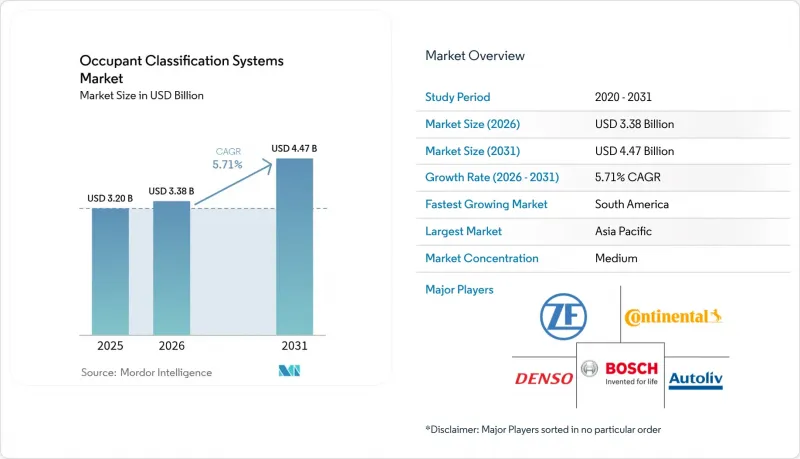
Mordor Intelligence에 의하면, 탑승자 분류 시스템 시장 규모는 2025년에 32억 달러로 평가되었고, 2026년 33억 8,000만 달러에서 2031년까지 44억 7,000만 달러에 이를 것으로 추정되며, 예측 기간(2026-2031년) CAGR은 5.71%를 나타낼 전망입니다.
본 보고서는 구성 요소별(ACU, 센서), 센서 유형별(압력 센서, 안전벨트 장력 센서, 기타), 차종별(승용차, BEV, PHEV, 상용차), 유통 채널별(OEM 순정, 애프터마켓), 지역별로 분류되어 있습니다. 시장 예측은 금액(달러) 기준으로 제시되어 있습니다.
세계의 탑승자 분류 시스템 시장 동향 및 인사이트
저비용 mm파 레이더 모듈의 등장
Infineon사의 BGT60ATR24C와 같은 60GHz 및 77GHz 칩은 현재 소비자용 수준의 가격대로 출하되고 있으며, 2만 5,000달러 미만의 차량에서도 레이더가 중량 감지 매트를 대체할 수 있게 하고 있습니다. 이러한 솔리드 스테이트 장치는 모든 조명 및 온도 조건에서 성인, 유아, 빈 좌석을 분류하여 발포재의 히스테리시스로 인한 보증 청구를 줄여줍니다. 아시아의 각 OEM 업체들은 중국의 새로운 동적 중량 감지 규정을 준수하고 수출 시장용 플랫폼을 표준화하기 위해 이 기술을 빠르게 도입하고 있습니다.
2026년 NCAP에 의한 뒷좌석 안전벨트 착용 알림 장치 의무화
Euro NCAP과 NHTSA는 현재 뒷좌석 착석 감지 외에도 안전벨트를 매지 않은 경우 시각 및 청각 경고를 의무화하고 있으며, 자동차 제조업체들은 유아, 유아용 카시트, 짐을 구별할 수 있는 다중 센서 어레이를 도입할 수밖에 없습니다. 양산화를 통해 레이더와 정전용량식 솔루션의 규모의 경제가 촉진되어, 공급업체의 견적에 따르면 차량 1대당 시스템 비용이 최대 18% 절감될 것으로 보입니다.
시트 폼의 히스테리시스에 따른 교정 드리프트
초탄성 폼은 시간 경과나 온도 변화에 따라 변형되어 중량 센서의 출력 기준값을 어긋나게 하므로, 비용이 많이 드는 재보정이 필요합니다. 2022년 MDPI 연구에 따르면, 2년 이내에 6kg 이상의 드리프트가 발생하는 것으로 확인되었으며, 이는 체구가 작은 성인을 유아로 오분류할 정도로 심각한 수준이어서 레이더나 고도 패키징 구조로의 전환이 불가피합니다.
부문 분석
각 OEM 업체들이 전 세계 안전 기준을 충족하기 위해 멀티모달 어레이에 의존한 결과, 2025년 매출의 63.60%를 센서가 차지했습니다. 압력 센서, 정전용량식 센서, 레이더 센서가 연동되어 에어백 제어 로직에 필요한 실시간 데이터를 생성하고 있습니다. ASIL D 요건을 충족하기 위해 하드웨어 스택과 내장형 진단 기능을 결합할 수 있는 공급업체가 가장 큰 가치를 창출하고 있습니다. 에어백 제어 유닛(ACU) 부문은 연평균 성장률(CAGR) 8.18%로 확대되고 있습니다. 이는 도메인 컨트롤러가 탑승자 데이터와 충돌 알고리즘을 단일 박스 내에서 융합함으로써, 하네스 길이와 조립 시간을 단축하고 있기 때문입니다.
콘티넨탈의 ‘ACU Premium’ 플랫폼은 구속 로직을 통합하고 OTA(Over-the-Air)를 통한 보정을 가능하게 함으로써 차량의 전체 수명 주기 동안 보증 비용을 22% 절감합니다. 베오니아의 ‘SC3’ 컨트롤러는 전 세계 신차의 4분의 1에 탑재되어 있으며, 이는 각 OEM 업체들이 통합형 안전용 실리콘을 신뢰하고 있음을 반영합니다. 이러한 사례들은 탑승자 분류 시스템 시장에서 과거에는 개별 센서만이 차지하던 이익률을 현재는 소프트웨어 기능이 점차 확보하고 있음을 보여줍니다.
압력 센서는 저렴한 단가 덕분에 2025년에도 47.30%의 점유율을 유지했지만, OEM 업체들이 보정이 필요 없는 정밀도를 추구하는 가운데 mm파 레이더는 현재 12.21%의 연평균 성장률(CAGR)을 기록하고 있습니다. 정전용량식 그리드는 터치 표면이 HMI 역할을 겸하는 프리미엄 인테리어에 대응하고 있으며, 초음파 장치는 좁은 차량 내부에서 활용되고 있지만 음향 간섭 문제에 직면해 있습니다. 압력 센서와 레이더를 결합한 듀얼 모드 키트는 기존 시트 구조를 활용하면서 NCAP 평가용 아동 감지 기능을 추가하는 중가대 솔루션으로 부상하고 있습니다.
수명 주기 비용을 비교해 보면, 공급업체의 추산에 따르면 레이더 모듈은 폼의 변위에 영향을 받지 않기 때문에 보증 적립금을 30% 절감할 수 있는 것으로 알려져 있습니다. 이러한 위험 감소라는 장점이 2027년 이후 생산이 시작될 신규 플랫폼용 탑승자 분류 시스템 시장에서 레이더의 점유율이 급속히 확대되고 있는 배경이 되고 있습니다.
지역별 분석
아시아태평양은 중국의 동적 중량 감지 규제와 부품 비용을 절감하는 탄탄한 레이더 공급망에 힘입어 2025년 매출의 30.60%를 차지했습니다. 국내 OEM 기업들은 이미 오토리브의 중국 내 매출의 40%를 차지하고 있으며, 이는 첨단 안전 기술에 대한 현지 수요가 높음을 보여줍니다. 일본은 레벨 3 자율 주행을 위한 운전자 상태 모니터링을 추진하고 있으며, 한국에서는 전기차에 대한 인센티브가 레이더 채택을 촉진하여 탑승자 분류 시스템 시장을 둘러싼 견고한 지역 생태계를 형성하고 있습니다.
북미와 유럽이 규제 방향성을 결정하고 있습니다. Euro NCAP 2026과 NHTSA의 FMVSS 208 개정을 통해 뒷좌석 경고 기능이 통일되고 센서 사양이 표준화될 예정입니다. 2024년 7월부터 시행되고 있는 EU 일반 안전 규정 II에서는 탑승자 감지와 졸음 경보가 통합되어 멀티 센서 도입이 촉진되고 있습니다. 두 지역 모두에서 프라이버시를 중시하는 소비자들은 카메라를 통한 분석보다 레이더를 선호하고 있으며, 이는 공급업체의 로드맵을 형성하고 탑승자 분류 시스템 시장에서 비시각적 센싱에 대한 수요를 뒷받침하고 있습니다.
남미는 연평균 성장률(CAGR) 8.48%로 가장 빠른 성장 궤도를 보이고 있는데, 이는 브라질과 아르헨티나가 안전 기준을 강화하고 OEM의 투자를 유치하고 있기 때문입니다. 아르헨티나의 2025년 교통법에는 자율주행 기능이 언급되어 있어, 간접적으로 탑승자 모니터링 기능의 통합이 촉진되고 있습니다. 가격에 대한 민감성으로 인해 카메라 사용은 제한되고 있지만, 유연한 압력 센서와 간소화된 레이더 덕분에 규제를 준수하는 패키지가 중급 모델에도 도입되면서 대상 시장 규모가 확대되고 있습니다. 중동 및 아프리카는 여전히 발전 단계에 있지만, 걸프 국가들의 차량 개조에서는 보험 할인 요건을 충족하기 위해 애프터마켓 키트가 활용되고 있어, 전 세계 탑승자 분류 시스템 시장 전반에서 점차 보급이 확대되고 있음을 보여줍니다.
기타 혜택
- 엑셀 형식 시장 예측(ME) 시트
- 3개월간 애널리스트 지원
자주 묻는 질문
목차
제1장 서론
제2장 조사 방법
제3장 주요 요약
제4장 시장 구도
제5장 시장 규모 및 성장 예측
제6장 경쟁 구도
제7장 시장 기회 및 향후 전망
AJYAccording to Mordor Intelligence, the occupant classification systems market size was valued at USD 3.2 billion in 2025 and estimated to grow from USD 3.38 billion in 2026 to reach USD 4.47 billion by 2031, at a CAGR of 5.71% during the forecast period (2026-2031).
This report is Segmented by Component (ACU, Sensors), Sensor Type (Pressure Sensors Seat-Belt Tension Sensors, and More), Vehicle Type (Passenger Vehicles, Bevs, Phevs, Commercial Vehicles), Sales Channel (OEM-Fitted, Aftermarket), and Geography. The Market Forecasts are Provided in Terms of Value (USD).
Global Occupant Classification Systems Market Trends and Insights
Emergence of low-cost mmWave radar modules
Sixty-gigahertz and 77 GHz chips such as Infineon's BGT60ATR24C now ship at consumer-grade price points, allowing radar to replace weight mats even in sub-USD 25,000 vehicles. These solid-state devices classify adults, children and empty seats under all lighting and temperature conditions, reducing warranty claims linked to foam hysteresis. Asian OEMs rapidly embed the technology to meet China's new dynamic weight-sensing rule and to standardize platforms for export markets.
NCAP 2026 mandate on rear-seat belt reminders
Euro NCAP and NHTSA now require detection of occupied rear seats combined with audiovisual warnings if belts stay unfastened, compelling automakers to deploy multi-sensor arrays that distinguish toddlers, child seats and luggage. Volume deployment boosts economies of scale for radar and capacitive solutions, lowering per-vehicle system cost by up to 18% based on supplier quotations.
Seat-foam hysteresis causing calibration drift
Hyper-elastic foams deform over time and temperature, shifting baseline weight-sensor output and prompting costly recalibration. A 2022 MDPI study confirmed drift can exceed 6 kg within two years, enough to misclassify small adults as children, forcing migration to radar or advanced packaging structures.
Other drivers and restraints analyzed in the detailed report include:
- BEV skateboard floors freeing sensor space
- Shift to software-defined vehicles enabling OTA updates
- High-GHz radar interference with 5G modules
For complete list of drivers and restraints, kindly check the Table Of Contents.
Segment Analysis
Sensors captured 63.60% of 2025 revenue as OEMs relied on multi-modal arrays to fulfill global safety norms. Pressure, capacitive and radar elements together generate the real-time data that air-bag logics demand. Most value accrues to suppliers that can combine hardware stacks with embedded diagnostics to meet ASIL D targets. The airbag control-unit segment is rising at 8.18% CAGR because domain controllers now fuse occupant data with crash algorithms in a single box, trimming harness length and assembly time.
Continental's ACU Premium platform consolidates restraint logic, enabling OTA calibrations that cut warranty costs by 22% over the vehicle life cycle. Veoneer's SC3 controller ships in one-fourth of new cars worldwide, reflecting OEM confidence in integrated safety silicon. These examples illustrate how software capability is capturing margin once held solely by discrete sensors within the occupant classification systems market.
Pressure mats retained a 47.30% share in 2025 thanks to low unit cost; yet mmWave radar now posts a 12.21% CAGR as OEMs seek calibration-free accuracy. Capacitive grids address premium interiors where touch surfaces double as HMI, and ultrasonic devices serve compact cabins but face acoustic interference. Dual-mode pressure-plus-radar kits are emerging as a mid-cost solution that leverages existing seat architecture while adding child-presence detection for NCAP scoring.
When comparing lifetime cost, suppliers estimate radar modules lower warranty provisioning by 30% through immunity to foam drift. This risk-reduction advantage underpins radar's swift share gains within the occupant classification systems market size for new platforms entering production from 2027 onward.
Complete Report Scope:
- By Component
- Airbag Control Unit (ACU)
- Sensors
- By Sensor Type
- Pressure Sensors
- Seat-belt Tension Sensors
- Strain-Gauge Mat Sensors
- Capacitive Sensors
- Ultrasonic Sensors
- 60 GHz and 77 GHz Radar Sensors
- By Vehicle Type
- Passenger Light Vehicles
- Battery-Electric Vehicles
- Plug-in Hybrid Vehicles
- Commercial Light Trucks and Vans
- By Sales Channel
- OEM-Fitted Systems
- Aftermarket and Retrofit Kits
- By Geography
- North America
- United States
- Canada
- Mexico
- Europe
- United Kingdom
- Germany
- France
- Italy
- Rest of Europe
- Asia-Pacific
- China
- Japan
- India
- South Korea
- Rest of Asia-Pacific
- Middle East
- Israel
- Saudi Arabia
- United Arab Emirates
- Turkey
- Rest of Middle East
- Africa
- South Africa
- Egypt
- Rest of Africa
- South America
- Brazil
- Argentina
- Rest of South America
- North America
Geography Analysis
Asia-Pacific commanded 30.60% of 2025 revenue, driven by China's dynamic weight-sensing regulation and a deep radar supply chain that compresses component costs. Domestic OEMs already represent 40% of Autoliv's Chinese sales, evidencing local appetite for advanced restraint technologies. Japan pushes driver-condition monitoring for Level-3 autonomy, and South Korea's EV incentives stimulate radar adoption, creating a robust regional ecosystem around the occupant classification systems market.
North America and Europe set the regulatory tone. Euro NCAP 2026 and NHTSA's FMVSS 208 revisions harmonize rear-seat alerts and thus standardize sensor specifications. The EU General Safety Regulation II, live since July 2024, bundles occupant detection with drowsiness alarms, driving multi-sensor rollouts. Privacy-minded consumers in both regions prefer radar over camera analytics, shaping supplier roadmaps and reinforcing demand for non-visual sensing within the occupant classification systems market size.
South America marks the fastest trajectory at 8.48% CAGR, as Brazil and Argentina upgrade safety standards and court OEM investment. Argentina's 2025 traffic law now references autonomous functions, indirectly encouraging occupant-monitoring integration. While price sensitivity limits camera use, flexible pressure sensors and simplified radar bring compliant packages into mid-range models, widening addressable volume. Middle East and Africa remain nascent, but fleet retrofits in the Gulf leverage aftermarket kits to satisfy insurance discounts, indicating gradual diffusion across the global occupant classification systems market.
- ZF Group
- Continental AG
- Robert Bosch GmbH
- Autoliv Inc.
- Denso Corporation
- Aptiv PLC
- Aisin Seiki Co. Ltd
- IEE Sensing
- TE Connectivity Ltd
- ON Semiconductor Corp.
- Joyson Safety Systems
- Infineon Technologies AG
- Veoneer AB
- Murata Manufacturing Co., Ltd
- Lear Corporation
- Hyundai Mobis
- NXP Semiconductors N.V.
- STMicroelectronics N.V.
- Visteon Corporation
- Flexpoint Sensor Systems Inc.
Additional Benefits:
- The market estimate (ME) sheet in Excel format
- 3 months of analyst support
TABLE OF CONTENTS
1 INTRODUCTION
- 1.1 Study Assumptions and Market Definition
- 1.2 Scope of the Study
2 RESEARCH METHODOLOGY
3 EXECUTIVE SUMMARY
4 MARKET LANDSCAPE
- 4.1 Market Overview
- 4.2 Market Drivers
- 4.2.1 Emergence of Low-cost mmWave Radar Modules for In-Cabin Sensing (Asia)
- 4.2.2 NCAP 2026 Mandate on Rear-Seat Belt Reminders (US and EU)
- 4.2.3 Rapid Uptake of Smart Curtain-Airbag Architectures in SUVs
- 4.2.4 Battery-Electric Vehicle (BEV) Skateboard Floors Freeing Space for Embedded OCS
- 4.2.5 China's GB 15083-2024 Crash-Safety Rule Adding Dynamic Weight-Sensing
- 4.2.6 Automaker Shift to Software-Defined Vehicles Enabling Over-the-Air OCS Updates
- 4.3 Market Restraints
- 4.3.1 Seat-Foam Hysteresis Causing Calibration Drift in Weight Sensors
- 4.3.2 High-GHz Radar Interference with 5G Modules inside EV Cabins
- 4.3.3 Tariff-Driven Cost Inflation on MEMS Pressure Cells (US-China)
- 4.3.4 Consumer Privacy Concerns over Camera-based Occupancy Analytics
- 4.4 Value / Supply-Chain Analysis
- 4.5 Regulatory Outlook
- 4.6 Technological Outlook
- 4.7 Emerging Technology Trends
- 4.8 Pandemic Impact Assessment
- 4.9 Investment and Funding Analysis
- 4.10 Porter's Five Forces Analysis
- 4.10.1 Threat of New Entrants
- 4.10.2 Bargaining Power of Buyers
- 4.10.3 Bargaining Power of Suppliers
- 4.10.4 Threat of Substitutes
- 4.10.5 Intensity of Rivalry
5 MARKET SIZE AND GROWTH FORECASTS (VALUE)
- 5.1 By Component
- 5.1.1 Airbag Control Unit (ACU)
- 5.1.2 Sensors
- 5.2 By Sensor Type
- 5.2.1 Pressure Sensors
- 5.2.2 Seat-belt Tension Sensors
- 5.2.3 Strain-Gauge Mat Sensors
- 5.2.4 Capacitive Sensors
- 5.2.5 Ultrasonic Sensors
- 5.2.6 60 GHz and 77 GHz Radar Sensors
- 5.3 By Vehicle Type
- 5.3.1 Passenger Light Vehicles
- 5.3.2 Battery-Electric Vehicles
- 5.3.3 Plug-in Hybrid Vehicles
- 5.3.4 Commercial Light Trucks and Vans
- 5.4 By Sales Channel
- 5.4.1 OEM-Fitted Systems
- 5.4.2 Aftermarket and Retrofit Kits
- 5.5 By Geography
- 5.5.1 North America
- 5.5.1.1 United States
- 5.5.1.2 Canada
- 5.5.1.3 Mexico
- 5.5.2 Europe
- 5.5.2.1 United Kingdom
- 5.5.2.2 Germany
- 5.5.2.3 France
- 5.5.2.4 Italy
- 5.5.2.5 Rest of Europe
- 5.5.3 Asia-Pacific
- 5.5.3.1 China
- 5.5.3.2 Japan
- 5.5.3.3 India
- 5.5.3.4 South Korea
- 5.5.3.5 Rest of Asia-Pacific
- 5.5.4 Middle East
- 5.5.4.1 Israel
- 5.5.4.2 Saudi Arabia
- 5.5.4.3 United Arab Emirates
- 5.5.4.4 Turkey
- 5.5.4.5 Rest of Middle East
- 5.5.5 Africa
- 5.5.5.1 South Africa
- 5.5.5.2 Egypt
- 5.5.5.3 Rest of Africa
- 5.5.6 South America
- 5.5.6.1 Brazil
- 5.5.6.2 Argentina
- 5.5.6.3 Rest of South America
- 5.5.1 North America
6 COMPETITIVE LANDSCAPE
- 6.1 Market Concentration
- 6.2 Strategic Moves
- 6.3 Market Share Analysis
- 6.4 Company Profiles (includes Global level Overview, Market level overview, Core Segments, Financials as available, Strategic Information, Market Rank/Share, Products and Services, Recent Developments)
- 6.4.1 ZF Group
- 6.4.2 Continental AG
- 6.4.3 Robert Bosch GmbH
- 6.4.4 Autoliv Inc.
- 6.4.5 Denso Corporation
- 6.4.6 Aptiv PLC
- 6.4.7 Aisin Seiki Co. Ltd
- 6.4.8 IEE Sensing
- 6.4.9 TE Connectivity Ltd
- 6.4.10 ON Semiconductor Corp.
- 6.4.11 Joyson Safety Systems
- 6.4.12 Infineon Technologies AG
- 6.4.13 Veoneer AB
- 6.4.14 Murata Manufacturing Co., Ltd
- 6.4.15 Lear Corporation
- 6.4.16 Hyundai Mobis
- 6.4.17 NXP Semiconductors N.V.
- 6.4.18 STMicroelectronics N.V.
- 6.4.19 Visteon Corporation
- 6.4.20 Flexpoint Sensor Systems Inc.
7 MARKET OPPORTUNITIES AND FUTURE OUTLOOK
- 7.1 White-space and Unmet-Need Assessment