

|
시장보고서
상품코드
2115164
저GWP 냉매 시장 : 점유율 분석, 업계 동향과 통계, 성장 예측(2026-2031년)Low GWP Refrigerants - Market Share Analysis, Industry Trends & Statistics, Growth Forecasts (2026 - 2031) |
||||||
 Mordor Intelligence
Mordor Intelligence에 의하면, 저GWP 냉매 시장 규모는 2026년에 220.78 킬로톤과 추정되고 있어 예측 기간(2026-2031년)에서 CAGR 7.93%로 성장을 지속하여, 2031년에는 323.35 킬로톤에 이른다고 전망되고 있습니다.
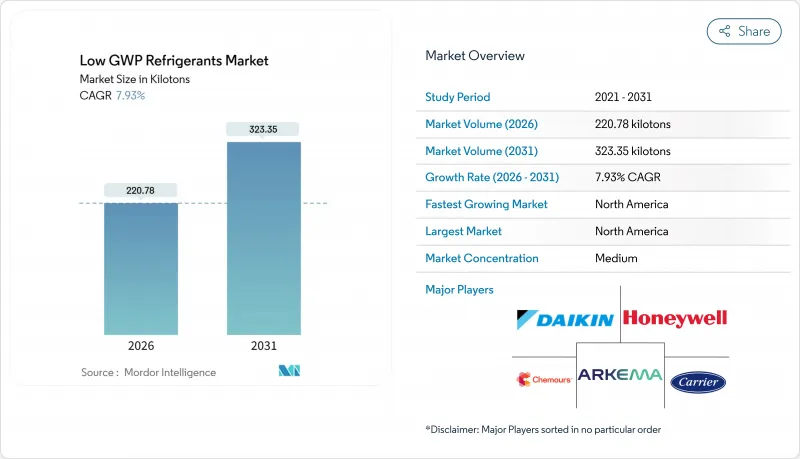
본 보고서는 유형별(무기계, 탄화수소계, 불소계 및 불소올레핀계), 용도별(상업용, 산업용, 가정용, 기타),최종 사용자 산업별(식품 및 음료, 화학·의약품, 주택용, 기타), 지역별(아시아태평양, 북미, 유럽, 남미, 중동 및 아프리카)로 분류되어 있습니다. 시장 예측은 수량(톤) 기준으로 제시되어 있습니다.
세계 저GWP 냉매 시장 동향 및 인사이트
엄격한 규제와 낮은 환경 영향
유럽연합(EU)은 2024년에 HFC 허용 할당량을 40% 감축하고, 도매업체들에게 상업용 장비에서 HFO 블렌드 및 천연 냉매를 우선적으로 사용하도록 요구했습니다. 미국 환경보호청(EPA)의 AIM법은 2025년 1월부터 신규 냉동기에서 HFC-134a 사용을 금지하고, 슈퍼마켓에 대해 2028년까지 12,000개 점포의 개조를 의무화했습니다. 키갈리 개정안에 따라 선진국은 2036년까지 2011년부터 2013년 기준치 대비 HFC 소비량을 85% 감축해야 하며, 이로 인해 공급 부족이 발생하여 장기 공급 계약을 체결한 조기 도입 기업에 유리한 상황이 조성되고 있습니다. ASHRAE는 2024년에 R-32 및 R-454B를 A2L로 재분류하여 주거용 히트펌프에서의 사용을 허용했으나, 이를 위해서는 주 차원의 규제 개정이 필요했으며, 2025년 12월 시점에서 이를 시행한 곳은 미국의 18개 주에 불과했습니다. 일본의 ‘프레온 배출 규제법’에서는 CO₂ 환산으로 1,000톤을 초과하는 시스템에 대해 연 1회의 누출 검사를 의무화하고 있으며, 이로 인해 산업용 냉장 창고에서 충전량이 적은 HFO나 자연 순환 시스템으로의 전환이 가속화되고 있습니다.
친환경 HVAC 시스템에 대한 수요 증가
넷 제로 목표가 조달 방침을 새롭게 바꾸고 있습니다. 포춘 500대 기업의 68%가 2040년까지 탄소 중립을 목표로 하고 있으며, 이 목표를 달성하기 위해서는 자사 소유 및 임대 건물에서 저GWP 냉매의 사용이 필수적입니다. 월마트는 2030년까지 미국 내 1,400개 매장을 CO₂ 시스템으로 교체하기 위해 21억 달러를 책정했습니다. 이를 통해 에너지 비용을 20% 절감하고, 연간 250만 tCO₂-e의 배출 감축이 예상됩니다. ISO 5149 규격에 따라 2024년부터 탄화수소 충전량 상한선이 회로당 500g으로 상향 조정됨에 따라, 고가의 환기 설비 개조를 거치지 않고도 프로판을 사용하는 진열장을 더 광범위하게 사용할 수 있게 되었습니다. 미국 연방조달청(GSA)은 현재 연방 정부의 HVAC 조달에서 GWP를 700 미만으로 제한하고 있으며, HFO-1234ze(E) 칠러를 권장하고 있습니다(gsa.gov). 아부다비의 지역 냉방 사업자는 해당 에미리트의 2030년 탄소 중립 계획에 따라 2025년에 18 MW 규모의 저GWP 설비를 설치했습니다.
전 세계 HFO 원료 부족 및 가격 변동
하네웰, 켐어스, 알케마 등 3개사의 HFO-1234yf 총 생산량 45킬로톤은 2025년 수요를 충족하지 못하여 2025년 상반기에 가격이 22% 급등했습니다. 하네웰의 가이스마르 공장 가동 중단으로 인해 6주 동안 북미 공급량이 40% 감소하여 자동차 모델 출시가 지연되었습니다. 케모어스사의 코퍼스크리스티 공장 확장 프로젝트는 인허가 절차 지연으로 인해 2026년 중반까지 완전 가동에 이르지 못해, 공급 부족이 장기화될 전망입니다. 2025년 1월에 시행된 중국의 불소화학물제품 수입에 대한 15% 관세로 인해, 도착 비용이 1kg당 3.50달러 증가하여 현지 블렌딩 업체에 타격을 주고 있습니다. 소규모 생산자들은 HFO-1234ze(E)로의 전환을 추진하고 있으나, 설비 재설계가 필요하기 때문에 상용화까지 추가로 2년이 소요될 전망입니다.
부문 분석
2025년, 저GWP 냉매 시장에서 플루오로탄화수소 및 플루오로올레핀은 66.62%의 점유율을 차지하며, 연평균 성장률(CAGR) 7.98%를 기록할 전망입니다. 자동차 업계의 규제에 따라 2025년에 생산된 5,200만 대의 차량에서 R-1234yf가 표준 냉매로 채택되었습니다. HFO-513A를 이용한 개조는 CO2로 업그레이드하는 것에 비해 칠러 전환 비용을 30% 절감합니다. 탄화수소계 냉매의 채택이 확대되고 있으며, ISO 5149의 충전량 제한 개정에 따라 2025년에는 유럽 제조업체들이 180만 대의 프로판 히트 펌프 유닛을 출하하여 주택 분야에서 채택이 확산되었습니다. 무기계 냉매는 여전히 틈새 시장 수준에 머물러 있습니다. 스웨덴의 신규 슈퍼마켓에서는 CO₂ 랙 방식이 72%를 차지하고 있지만, 안전 프로토콜과 중앙 집중식 기계실을 통해 독성 우려가 완화된 산업 플랜트에서는 암모니아가 주류를 이루고 있습니다. 성장 전망은 HFO 원료 공급 부족의 완화와 탄화수소 안전 기준의 통일에 달려 있으며, 이는 시장 점유율을 더욱 확대하기 위한 전제조건입니다.
불소계 냉매 공급업체들은 고온 기후용 옥상 설치형 유닛에는 R-455A를, A1 안전 프로파일이 요구되는 칠러 용도에는 R-515B와 같이 용도에 맞는 블렌드 개발을 추진하고 있습니다. 탄화수소 전문 제조업체들은 가연성과 효율의 균형이 뛰어난 프로파일렌이나 디메틸에테르를 원료로 한 시제품 냉매 개발에 주력하고 있습니다. 카테고리를 넘나드는 혁신도 대두되고 있습니다. 듀얼 루프 시스템에서는 중온 회로에 CO2를, 저온 회로에 암모니아 또는 프로판을 조합함으로써 충전량을 줄이고, 독자적인 HFO를 사용하지 않고도 GWP 목표를 달성하고 있습니다.
지역별 분석
CAGR은 8.26%이며, 2025년 시장 규모의 32.74%를 차지하고 있습니다. EPA의 금지 조치와 IRA(인플레이션 억제법)에 따른 세액 공제가 슈퍼마켓과 주택의 냉매 전환을 가속화하고 있는 반면, 캐나다의 탄소 가격 및 주 정부의 리베이트 제도가 상업시설의 개조를 뒷받침하고 있습니다. 멕시코는 규제 집행이 미흡하여 뒤처지고 있으며, 저GWP 냉매 도입은 수출 지향적인 공장에 집중되어 있습니다.
유럽에서는 2024년에 HFC 할당량을 40% 감축하여, 이로 인해 현물 가격이 18% 상승했고, HFO 및 천연가스로의 전환이 가속화되었습니다. 독일은 2025년에 35억 유로의 히트펌프 도입 보조금을 지급하여 주택용 판매 대수를 120만 대로 끌어올렸으며, 그중 프로판이 28%의 점유율을 차지했습니다. 북유럽 국가들은 CO2 랙을 선호하는 반면, 온난한 기후의 남유럽 국가들에서는 HFO-513A가 주류를 이루고 있습니다. 영국은 EU 규정을 준수하고 있지만, 전환 기간의 유연성을 활용하여 HFC를 비축함으로써 일시적으로 공급 제약을 완화했습니다.
아시아태평양에서는 HCFC의 단계적 폐지 일정에 따라 전환이 가속화되고 있습니다. 중국은 콜드체인 현대화에 500억 위안을 배정하고, 암모니아와 CO₂를 우선적으로 도입하고 있습니다. 인도의 3.5 ISEER 규제로 인해 스플릿형 에어컨 제조업체들은 R-32나 HFO 혼합 가스로의 전환을 강요받고 있습니다. 일본에서는 1,200억 엔 규모의 히트펌프 보조금 제도가 CO₂나 탄화수소를 채택하는 숙박·외식 산업을 대상으로 하고 있습니다. 남미 및 중동 및 아프리카는 여전히 도입 초기 단계에 있으며, 자본 집약적이고 낮은 GWP를 가진 시스템을 도입할 수 있는 다국적 기업을 중심으로 보급이 진행되고 있습니다.
기타 혜택:
- 엑셀 형식 시장 예측(ME) 시트
- 3개월간의 애널리스트 지원
자주 묻는 질문
목차
제1장 서론
제2장 조사 방법
제3장 주요 요약
제4장 시장 구도
제5장 시장 규모와 성장 예측
제6장 경쟁 구도
제7장 시장 기회와 향후 전망
JHS 26.08.26According to Mordor Intelligence, the low GWP refrigerants market size is estimated at 220.78 kilotons in 2026, and is expected to reach 323.35 kilotons by 2031, at a CAGR of 7.93% during the forecast period (2026-2031).
This report is Segmented by Type (Inorganics, Hydrocarbons, and Fluorocarbons and Fluoro-Olefins), Application (Commercial, Industrial, Domestic, Other), End-User Industry (Food and Beverage, Chemicals and Pharmaceuticals, Residential, and More), and Geography (Asia-Pacific, North America, Europe, South America, and Middle East and Africa). Market Forecasts are Provided in Terms of Volume (Tons).
Global Low GWP Refrigerants Market Trends and Insights
Stringent Regulations And Low Environmental Impacts
The European Union trimmed allowable HFC quotas by 40% in 2024, forcing wholesalers to prioritize HFO blends and natural refrigerants in commercial equipment. The U.S. EPA's AIM Act banned HFC-134a in new chillers starting January 2025, compelling supermarkets to retrofit 12,000 stores by 2028. Developed nations must cut HFC consumption 85% from 2011-2013 baselines by 2036 under the Kigali Amendment, creating supply scarcity that rewards early adopters holding long-term offtake contracts. ASHRAE reclassified R-32 and R-454B as A2L in 2024, enabling their use in residential heat pumps but requiring state-level code updates that only 18 U.S. states had enacted by December 2025. Japan's Fluorocarbon Emissions Control Law obliges annual leak checks on systems above 1,000 tons CO2-e, accelerating the shift to low-charge HFO or natural systems in industrial cold storage.
Growing Demand For Eco-Friendly HVAC Systems
Net-zero goals are reshaping procurement; 68% of Fortune 500 companies target carbon neutrality by 2040, a milestone that requires low-GWP refrigerants in owned and leased buildings. Walmart earmarked USD 2.1 billion to upgrade 1,400 U.S. stores to CO2 systems by 2030, citing a 20% energy cost cut and removal of 2.5 million tCO2-e annually. ISO 5149 raised hydrocarbon charge limits to 500 g per circuit in 2024, permitting wider use of propane display cases without expensive ventilation retrofits. The U.S. General Services Administration now limits federal HVAC procurements to GWP below 700, favoring HFO-1234ze(E) chillers (gsa.gov). District cooling providers in Abu Dhabi installed 18 MW of low-GWP capacity during 2025, aligning with the emirate's 2030 carbon-neutral plan.
Global HFO Feedstock Shortage And Price Volatility
The combined 45 kiloton HFO-1234yf output of Honeywell, Chemours, and Arkema could not satisfy 2025 demand, driving a 22% price jump in H1 2025. Honeywell's Geismar plant outage trimmed 40% of North American supply for six weeks, delaying automotive model launches. Chemours' Corpus Christi expansion will reach full capacity only in mid-2026 due to permitting delays, prolonging tightness. China's 15% tariff on fluorochemical imports enforced in January 2025 added USD 3.50 per kg to landed costs, hurting local blenders. Smaller producers pivot to HFO-1234ze(E) but need equipment redesign, lengthening commercialization by two years.
Other drivers and restraints analyzed in the detailed report include:
- Increasing Demand For Energy-Efficient Cooling
- Data-Center Liquid-Cooling Boom Driving Demand
- End-User Safety Concerns Over Mild Flammability
For complete list of drivers and restraints, kindly check the Table Of Contents.
Segment Analysis
Fluorocarbons and fluoro-olefins captured 66.62% of the low GWP refrigerants market share in 2025 and are on track for a 7.98% CAGR. Automotive mandates made R-1234yf standard across 52 million vehicles built in 2025. HFO-513A retrofits reduce chiller conversion costs by 30% compared with CO2 upgrades. Hydrocarbons are rising; European manufacturers shipped 1.8 million propane heat-pump units in 2025 after ISO 5149's charge-limit revision, broadening residential adoption. Inorganics remain niche; CO2 racks account for 72% of new Swedish supermarkets, while ammonia prevails in industrial plants where safety protocols and centralized machine rooms mitigate toxicity concerns. Growth prospects hinge on easing HFO feedstock tightness and harmonizing hydrocarbon safety codes, both prerequisites for greater share displacement.
Fluorocarbon suppliers are tailoring blends such as R-455A for rooftop units in hot climates and R-515B for chiller applications that require A1 safety profiles. Hydrocarbon specialists focus on propylene and dimethyl ether prototypes that balance flammability and efficiency. Cross-category innovation is emerging; dual-loop systems pair CO2 in medium-temperature cases with ammonia or propane in low-temperature circuits, cutting charge volumes and meeting GWP targets without proprietary HFOs.
Complete Report Scope:
- By Type
- Inorganics
- Hydrocarbons
- Fluorocarbons and Fluoro-olefins (HFCs and HFOs)
- By Application
- Commercial Refrigeration
- Industrial Refrigeration
- Domestic Refrigeration
- Other Applications
- By End-user Industry
- Food and Beverage
- Chemicals and Pharmaceuticals
- Residential
- Automotive
- Other End-user Industry (Hospitality, Retail Fuel Stations, etc.)
- By Geography
- Asia-Pacific
- China
- India
- Japan
- South Korea
- ASEAN Countries
- Rest of Asia-Pacific
- North America
- United States
- Canada
- Mexico
- Europe
- Germany
- United Kingdom
- France
- Italy
- Spain
- Nordic Countries
- Rest of Europe
- South America
- Brazil
- Argentina
- Rest of South America
- Middle East and Africa
- Saudi Arabia
- South Africa
- Rest of Middle East and Africa
- Asia-Pacific
Geography Analysis
North America commanded 32.74% of the 2025 volume and is growing at an 8.26% CAGR to 2031. EPA bans and IRA tax credits accelerate supermarket and residential conversions, while Canada's carbon price and provincial rebates support commercial retrofits. Mexico lags due to weak enforcement, concentrating low-GWP adoption in export-oriented plants.
Europe cut HFC quotas by 40% in 2024, lifting spot prices by 18% and fast-tracking HFO and natural adoption. Germany issued EUR 3.5 billion in 2025 heat-pump grants, spurring 1.2 million residential sales with 28% propane share. Nordic nations favor CO2 racks; Southern Europe leans on HFO-513A in warm climates. The U.K. mirrors EU controls but used transition flexibility to stockpile HFCs, temporarily easing supply constraints.
Asia-Pacific accelerates under HCFC phase-out schedules. China allocated CNY 50 billion to cold-chain upgrades, favoring ammonia and CO2. India's 3.5 ISEER rule pushes split AC makers toward R-32 and HFO blends. Japan's JPY 120 billion heat-pump subsidy targets hospitality and food-service sectors with CO2 or hydrocarbons. South America and the Middle East-Africa remain early-stage; uptake centers on multinationals able to finance capital-intensive low-GWP systems.
- A-Gas
- Arkema S.A.
- Bitzer SE
- Carrier Global Corporation
- Daikin Industries, Ltd.
- Danfoss A/S
- Dongyue Group Ltd.
- Engas Australasia
- GTS S.p.A.
- Harp International Ltd.
- Honeywell International Inc.
- Johnson Controls International plc
- Linde plc
- Mayekawa Mfg. Co., Ltd.
- Messer SE & Co. KGaA
- Orbia (Koura)
- Panasonic Corporation
- Sinochem Holdings
- Tazzetti S.p.A.
- The Chemours Company
- Zhejiang Sanmei Chemical
Additional Benefits:
- The market estimate (ME) sheet in Excel format
- 3 months of analyst support
TABLE OF CONTENTS
1 Introduction
- 1.1 Study Assumptions and Market Definition
- 1.2 Scope of the Study
2 Research Methodology
3 Executive Summary
4 Market Landscape
- 4.1 Market Overview
- 4.2 Market Drivers
- 4.2.1 Stringent regulations and low environmental impacts
- 4.2.2 Growing demand for eco-friendly HVAC systems
- 4.2.3 Increasing demand for energy-efficient cooling
- 4.2.4 Data-center liquid-cooling boom drivind demand
- 4.2.5 Heat-pump incentive programs boosting hydrocarbon systems
- 4.3 Market Restraints
- 4.3.1 Global HFO feedstock shortage and price volatility
- 4.3.2 End-user safety concerns over mild flammability
- 4.3.3 Limited technician training for CO2 booster systems
- 4.4 Value Chain Analysis
- 4.5 Porter's Five Forces
- 4.5.1 Bargaining Power of Suppliers
- 4.5.2 Bargaining Power of Buyers
- 4.5.3 Threat of New Entrants
- 4.5.4 Threat of Substitutes
- 4.5.5 Competitive Rivalry
5 Market Size and Growth Forecasts (Volume)
- 5.1 By Type
- 5.1.1 Inorganics
- 5.1.2 Hydrocarbons
- 5.1.3 Fluorocarbons and Fluoro-olefins (HFCs and HFOs)
- 5.2 By Application
- 5.2.1 Commercial Refrigeration
- 5.2.2 Industrial Refrigeration
- 5.2.3 Domestic Refrigeration
- 5.2.4 Other Applications
- 5.3 By End-user Industry
- 5.3.1 Food and Beverage
- 5.3.2 Chemicals and Pharmaceuticals
- 5.3.3 Residential
- 5.3.4 Automotive
- 5.3.5 Other End-user Industry (Hospitality, Retail Fuel Stations, etc.)
- 5.4 By Geography
- 5.4.1 Asia-Pacific
- 5.4.1.1 China
- 5.4.1.2 India
- 5.4.1.3 Japan
- 5.4.1.4 South Korea
- 5.4.1.5 ASEAN Countries
- 5.4.1.6 Rest of Asia-Pacific
- 5.4.2 North America
- 5.4.2.1 United States
- 5.4.2.2 Canada
- 5.4.2.3 Mexico
- 5.4.3 Europe
- 5.4.3.1 Germany
- 5.4.3.2 United Kingdom
- 5.4.3.3 France
- 5.4.3.4 Italy
- 5.4.3.5 Spain
- 5.4.3.6 Nordic Countries
- 5.4.3.7 Rest of Europe
- 5.4.4 South America
- 5.4.4.1 Brazil
- 5.4.4.2 Argentina
- 5.4.4.3 Rest of South America
- 5.4.5 Middle East and Africa
- 5.4.5.1 Saudi Arabia
- 5.4.5.2 South Africa
- 5.4.5.3 Rest of Middle East and Africa
- 5.4.1 Asia-Pacific
6 Competitive Landscape
- 6.1 Market Concentration
- 6.2 Strategic Moves
- 6.3 Market Share(%)/Ranking Analysis
- 6.4 Company Profiles (includes Global level Overview, Market level overview, Core Segments, Financials as available, Strategic Information, Products and Services, and Recent Developments)
- 6.4.1 A-Gas
- 6.4.2 Arkema S.A.
- 6.4.3 Bitzer SE
- 6.4.4 Carrier Global Corporation
- 6.4.5 Daikin Industries, Ltd.
- 6.4.6 Danfoss A/S
- 6.4.7 Dongyue Group Ltd.
- 6.4.8 Engas Australasia
- 6.4.9 GTS S.p.A.
- 6.4.10 Harp International Ltd.
- 6.4.11 Honeywell International Inc.
- 6.4.12 Johnson Controls International plc
- 6.4.13 Linde plc
- 6.4.14 Mayekawa Mfg. Co., Ltd.
- 6.4.15 Messer SE & Co. KGaA
- 6.4.16 Orbia (Koura)
- 6.4.17 Panasonic Corporation
- 6.4.18 Sinochem Holdings
- 6.4.19 Tazzetti S.p.A.
- 6.4.20 The Chemours Company
- 6.4.21 Zhejiang Sanmei Chemical
7 Market Opportunities and Future Outlook
- 7.1 White-Space and Unmet-Need Assessment
- 7.2 Developments for Promoting Low GWP Refrigerants


