

|
시장보고서
상품코드
2115165
폴리머 필러 시장 : 점유율 분석, 업계 동향과 통계, 성장 예측(2026-2031년)Polymer Fillers - Market Share Analysis, Industry Trends & Statistics, Growth Forecasts (2026 - 2031) |
||||||
 Mordor Intelligence
Mordor Intelligence에 의하면, 2026년 폴리머 필러 시장 규모는 587억 4,000만 달러로 추정되고 있어 2025년 564억 4,000만 달러에서 확대해, 2031년에는 717억 4,000만 달러에 이를 것으로 예측됩니다.
2026년부터 2031년까지 연평균 성장률(CAGR) 4.08%로 성장할 것으로 전망됩니다.
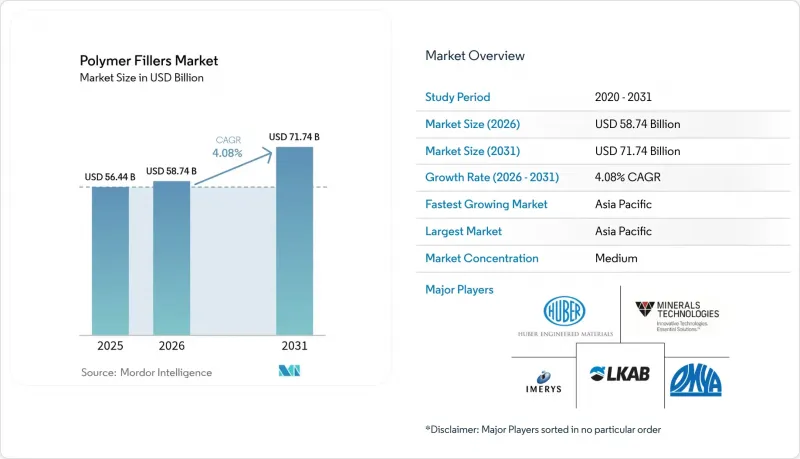
본 보고서에서는 업계를 제품 유형(유기 및 무기), 폴리머 매트릭스(열가소성 수지, 열경화성 수지 등), 최종 사용자 산업(자동차 및 운송, 건축 및 건설 등), 지역(아시아태평양, 북미, 유럽, 남미, 중동 및 아프리카)별로 분류하고 있습니다. 시장 전망은 금액(달러) 기준으로 제시되어 있습니다.
세계 폴리머 필러 시장 동향 및 인사이트
건축 및 건설 분야 수요 증가
인프라 현대화 및 친환경 건축 기준에 따라 콘크리트, 시멘트, 아스팔트 혼합물에서 필러의 사용량이 증가하고 있습니다. 초미세 분쇄 탄산칼슘은 포틀랜드·석회석 시멘트에서 클링커의 필요량을 줄여, 강도를 유지하면서도 CO₂ 배출량을 감축합니다. 고무 보강 콘크리트는 압축 강도를 최대 29%, 굽힘 강도를 66% 향상시켜 내진 설계 분야에서 수요가 높습니다. 광물 섬유나 식물 섬유를 배합한 지오폴리머는 동결-해동에 대한 내성을 향상시켜 한랭 지역 프로젝트에서 중요합니다. 셀룰로오스 에테르가 타일용 접착제의 보습성과 작업성을 향상시킴으로써 폴리머 필러 시장이 혜택을 보고 있으며, 이러한 특성은 신흥 경제국에서 적극적으로 채택되고 있습니다. 아시아 및 북미 전역의 대규모 인프라 입찰에서 시공사들은 더 고가의 결합재를 필러로 대체함으로써 자재비를 10-15% 절감할 수 있다고 지적하고 있습니다.
모빌리티의 전기화 및 경량화 추진
배터리식 전기자동차에는 경량화를 도모하면서도 충돌 내성, 난연성, 전자기 차폐성을 겸비한 복합재료가 요구되고 있습니다. 이온 액체로 처리된 나노튜브를 포함하는 탄소섬유 강화 나노복합재는 UL 94 V-0 난연 등급을 충족하면서 803 MPa에 가까운 굽힘 강도를 발휘합니다. 화학 발포제를 사용하여 성형된 충전재를 풍부하게 함유한 폴리프로필렌 도어 패널은 질량을 15% 이상 줄여, 각 OEM 업체가 미국의 기업 평균 연비(CAFE) 목표를 달성할 수 있도록 지원합니다. 천연섬유 강화 폴리프로필렌 블렌드는 10 wt.%의 아마와 20 wt.%의 목분을 배합함으로써, 보닛 하부 사용에 적합한 열 안정성을 실현하고 있습니다. 이러한 발전으로 인해 폴리머 필러 시장의 장기 CAGR은 0.9포인트 상승할 전망입니다. 특히, 신차 판매 대수의 50% 이상을 전기차가 차지하는 유럽과 중국에서 이러한 경향이 두드러집니다.
특수 필러의 고비용 가공 및 분산 공정
그래핀, CNT 또는 층상 규산염을 균일하게 분산시키려면 강력한 혼련 블록과 최적화된 배럴 형상을 갖춘 이축 압출기가 필요합니다. 중소규모의 컴파운드 제조업체는 라인당 200만 달러가 넘는 설비 투자 장벽에 직면해 있으며, 이로 인해 제품 라인업 확장이 제한되고 있습니다. 마스터배치 제조업체는 높은 충전재 함량과 허용 가능한 용융 유동성 사이의 균형을 맞추어야 합니다. 유동성이 낮으면 다이 립에 축적되거나 가동 중단으로 이어집니다. 새로운 분산제는 분쇄 효율을 향상시키지만, 배합 비용을 8-12% 끌어올려 이익률을 압박합니다. 광물성 필러의 흡유성은 점도 제어를 더욱 복잡하게 만들고, 표면 처리가 필요하기 때문에 원자재비가 증가합니다. 이러한 현실로 인해 폴리머 필러 시장 전체의 단기 성장률은 0.8포인트 하락할 것으로 예측됩니다.
부문 분석
폴리머 필러 시장에서 2025년 매출의 67.92%를 무기 필러가 차지하고 있으며, 그 경제성과 폭넓은 적용성 덕분에 계속해서 주도적인 위치를 유지하고 있습니다. 탄산칼슘계 필러는 폴리프로필렌 부품의 비용을 최대 40% 절감할 수 있을 뿐만 아니라, 강성 및 치수 안정성도 향상시킬 수 있습니다. 실리카와 엔지니어드 탈크는 식품 포장 필름에 안티블로킹 기능과 핵형성 기능을 부여합니다. 주요 제조업체들은 컴파운딩 거점 인근에서 광산을 운영함으로써 물류 비용을 절감하고 있습니다. 이산화티타늄 등의 금속 산화물은 불투명성 및 자외선 차단 기능을 위해 여전히 필수적이지만, 공급 제약으로 인해 가격이 상승하고 있습니다.
유기 필러는 바이오 유래 성분에 대한 규제적 지원을 반영하여 2031년까지 연평균 성장률(CAGR) 5.12%로 확대되고 있습니다. 목분, 전분, 분쇄 달걀 껍질 등의 지속 가능한 원료는 광물성 소재에 비해 5-10%의 경량화를 실현하여, 소비재의 친환경 라벨 획득을 뒷받침하고 있습니다. 또한, 리그노셀룰로오스계 섬유는 바이오 폴리머 블렌드의 인장 탄성률을 높여 퇴비화 가능한 봉투의 성능 향상에 기여하고 있습니다. 탄소계 필러는 전도성 용도로도 확대되고 있습니다. 1-3 중량%로 분산된 그래핀 나노플레이틀릿은 표면 저항률을 3자리 수만큼 낮춥니다. 이러한 첨단 유기 소재가 상업적으로 확대됨에 따라, 유기 등급 폴리머 충전재 시장 규모는 2031년까지 132억 5,000만 달러를 넘어설 가능성이 있습니다.
지역별 분석
아시아태평양은 세계 수요의 39.78%를 차지하고 있으며, 2031년까지 연평균 성장률(CAGR) 5.30%를 나타낼 것으로 예측됩니다. 중국은 리튬 배터리 재료 및 엔지니어링 플라스틱에 대한 대규모 투자를 통해 충전재 소비를 주도하고 있는 반면, 인도의 도로 건설 프로그램은 탄산칼슘 수요를 끌어올리고 있습니다. 이 지역의 광물 가공업체들은 광산과 코팅 시설을 통합하여 운영하고 있으며, 이를 통해 납품 비용을 절감하는 동시에 전자기기 생산 라인의 적시 생산(JIT) 요건을 충족시키고 있습니다. 베트남과 인도네시아에서 신소재 공장에 대한 정부 보조금 지원으로 현지 공급이 더욱 확대되고 있습니다.
북미에서는 전기차 생산 및 연방 정부의 인프라 정비 정책이 폴리프로필렌과 활석 수요를 활성화시켜 꾸준한 확대를 보이고 있습니다. 카본블랙 제조업체들은 국내 배터리 공급망을 지원하는 에너지부의 보조금을 확보하고 있으며, 재활용 업체들은 데크보드용 사용 후 PVC 필러의 생산을 확대되고 있습니다. 고순도 석영 공급을 혼란에 빠뜨린 이상 기상은 취약성을 여실히 드러냈지만, 결과적으로 리스크 완화를 위한 재고 축적을 촉진하는 계기가 되었습니다.
유럽에서는 미세 플라스틱 규제로 인해 규정 준수 비용이 상승함에 따라 성장이 완만하게 그치고 있습니다. 그러나 순환 경제 목표를 배경으로, EU의 택소노미 요건에 부합하는 유리 컷렛 필러 및 바이오 첨가제에 대한 투자가 촉진되고 있습니다. 주요 공급업체들은 재생 에너지를 활용한 저탄소 탈크 채굴을 선도하며, 스코프 1 및 2 배출량 감축을 목표로 하고 있습니다. 이러한 지역별 동향이 결합되어 폴리머 필러 시장에는 균형 잡힌 전망이 형성되고 있습니다.
기타 혜택:
- 엑셀 형식 시장 예측(ME) 시트
- 3개월간의 애널리스트 지원
자주 묻는 질문
목차
제1장 서론
제2장 조사 방법
제3장 주요 요약
제4장 시장 구도
제5장 시장 규모와 성장 예측
제6장 경쟁 구도
제7장 시장 기회와 향후 전망
JHS 26.08.26According to Mordor Intelligence, the polymer filler market size in 2026 is estimated at USD 58.74 billion, growing from 2025 value of USD 56.44 billion with 2031 projections showing USD 71.74 billion, growing at 4.08% CAGR over 2026-2031.
This report Segments the Industry by Product Type (Organic and Inorganic), Polymer Matrix (Thermoplastics, Thermosets, and More), End-User Industry (Automotive and Transportation, Building and Construction, and More), and Geography (Asia-Pacific, North America, Europe, South America, and Middle East and Africa). The Market Forecasts are Provided in Terms of Value (USD).
Global Polymer Fillers Market Trends and Insights
Rising Demand in Building & Construction
Infrastructure modernization and green building codes are lifting filler usage in concrete, cement, and asphalt mixes. Ground calcium carbonate lowers clinker requirements in portland-limestone cements, reducing CO2 output while retaining strength. Rubber-reinforced concretes boost compressive strength by up to 29% and flexural strength by 66%, which appeals to seismic-resistant designs. Geopolymer mixes with mineral and plant fibers improve freeze-thaw resilience, important for cold-climate projects. The polymer fillers market benefits when cellulose ethers enhance tile adhesives by improving water retention and workability, a feature keenly adopted in emerging economies. In large infrastructure bids throughout Asia and North America, contractors cite material cost savings of 10-15% when fillers replace more expensive binders.
Electrification of Mobility & Lightweighting Push
Battery-electric vehicles require composites that cut weight yet provide crash resistance, flame retardance, and electromagnetic shielding. Carbon-fiber-reinforced nanocomposites with ionic-liquid-treated nanotubes offer flexural strength near 803 MPa while meeting UL 94 V-0 flame ratings. Filler-rich polypropylene door panels formed with chemical foaming agents trim mass by over 15%, helping OEMs meet U.S. Corporate Average Fuel Economy targets. Natural fiber-reinforced polypropylene blends combine 10 wt.% flax and 20 wt.% wood flour to deliver thermal stability suitable for under-hood use. These advances fuel a 0.9 percentage-point boost in the long-term CAGR of the polymer fillers market, particularly in Europe and China where EV penetration tops 50% of new-car sales.
High Processing & Dispersion Cost of Specialty Fillers
Uniform dispersion of graphene, CNTs, or layered silicates requires twin-screw extruders outfitted with intensive kneading blocks and optimized barrel profiles. Small-and-medium compounders face capital barriers exceeding USD 2 million per line, which limits product range. Masterbatch producers must balance high filler loading with acceptable melt flow; poor flow fosters die-lip build-up and downtime. New dispersants improve milling efficiency but add 8-12 % to formulation cost, compressing margins. Oil absorption in mineral fillers further complicates viscosity control, necessitating surface treatments that raise raw-material spend. These realities trim near-term growth by 0.8 percentage points across the polymer fillers market.
Other drivers and restraints analyzed in the detailed report include:
- Surge in Electrical & Electronics Production
- Growth of Recycled-Content Polymer Compounds
- Emerging Micro-Plastics-Dust Emission Norms
For complete list of drivers and restraints, kindly check the Table Of Contents.
Segment Analysis
Inorganic fillers accounted for 67.92% of 2025 revenue within the polymer fillers market share, sustaining leadership due to their favorable economics and broad applicability. Calcium carbonate fillers can lower polypropylene part cost by up to 40% while imparting improved stiffness and dimensional stability. Silica and engineered talc supply anti-blocking and nucleating functions for food packaging films, with major producers operating mines adjacent to compounding hubs, which reduces logistics overhead. Metal oxides such as titanium dioxide remain essential for opacity and UV protection, although supply constraints have prompted price surcharges.
Organic fillers are expanding at a 5.12% CAGR through 2031, reflecting regulatory support for bio-based content. Sustainable streams like wood flour, starch, and ground eggshells provide weight reductions of 5-10% compared with mineral systems, which supports eco-labeling in consumer goods. Lignocellulosic fibers additionally raise tensile modulus in biopolymer blends, aiding compostable bag performance. Carbon-based fillers extend into conductive applications; graphene nanoplatelets dispersed at 1-3 wt.% lower surface resistivity by three orders of magnitude. As these advanced organics scale commercially, the polymer fillers market size for organic grades could exceed USD 13.25 billion by 2031.
Complete Report Scope:
- By Product Type
- Organic
- Natural (wood-flour, starch)
- Carbon-based (carbon black, graphene)
- Inorganic
- Oxides (CaCO3, SiO2, Al(OH)3)
- Hydro-oxides
- Salts
- Silicates (talc, kaolin, mica)
- Metals and Metal-Oxides (ZnO, Al2O3, Fe2O3)
- Organic
- By Polymer Matrix
- Thermoplastics
- Thermosets
- Elastomers
- By End-User Industry
- Automotive and Transportation
- Building and Construction
- Electrical and Electronics
- Packaging
- Consumer Goods
- Others (Agriculture, Healthcare, 3-D Printing)
- By Geography
- Asia Pacific
- China
- India
- Japan
- South Korea
- Rest of Asia Pacific
- North America
- United States
- Canada
- Mexico
- Europe
- Germany
- United Kingdom
- Italy
- France
- Rest of Europe
- South America
- Brazil
- Argentina
- Rest of South America
- Middle East and Africa
- Saudi Arabia
- South Africa
- Rest of Middle East and Africa
- Asia Pacific
Geography Analysis
Asia Pacific contributes 39.78% of global demand and is projected to post a 5.30% CAGR through 2031. China leads filler consumption through large-scale investments in lithium-battery materials and engineering plastics, while India's road-building program drives calcium-carbonate volumes. Regional mineral processors operate integrated mines and coating facilities, lowering delivered costs and meeting just-in-time requirements for electronics lines. Government subsidies for new-material plants in Vietnam and Indonesia further expand local supply.
North America records steady expansion as EV production and federal infrastructure packages invigorate polypropylene and talc demand. Carbon-black producers secure Department of Energy grants that back domestic battery supply chains, and recyclers scale post-consumer PVC fillers for decking boards. Extreme weather events disrupting high-purity quartz supply highlight vulnerability but have spurred risk-mitigation inventories.
Europe experiences moderate growth because micro-plastic restrictions tighten compliance costs. Yet, circularity goals spur investment in glass-cullet fillers and bio-based additives that align with EU taxonomy requirements. Established vendors pioneer low-carbon talc mining with renewable power, aiming for Scope 1 and 2 emission reductions. Collectively, these geographic dynamics shape a balanced outlook for the polymer fillers market.
- 20 Microns
- Birla Carbon
- Cabot Corporation
- Carbo Ceramics Inc.
- Covia Holdings LLC
- GCR Group
- Hoffmann Mineral
- Huber Engineered Materials
- Imerys
- LKAB Minerals
- Minerals Technologies Inc.
- Nanocyl SA
- Nippon Talc Co., Ltd.
- Nordkalk
- Omya AG
- Quarzwerke GmbH
- Sibelco
- Talga Group
- Tokai Carbon Co., Ltd
Additional Benefits:
- The market estimate (ME) sheet in Excel format
- 3 months of analyst support
TABLE OF CONTENTS
1 Introduction
- 1.1 Study Assumptions & Market Definition
- 1.2 Scope of the Study
2 Research Methodology
3 Executive Summary
4 Market Landscape
- 4.1 Market Overview
- 4.2 Market Drivers
- 4.2.1 Rising demand in building & construction
- 4.2.2 Electrification of mobility & lightweighting push
- 4.2.3 Surge in electrical & electronics production
- 4.2.4 Growth of recycled-content polymer compounds
- 4.2.5 Rapid uptake of composite 3-D-printing filaments
- 4.3 Market Restraints
- 4.3.1 High processing & dispersion cost of specialty fillers
- 4.3.2 Raw-material price volatility
- 4.3.3 Emerging micro-plastics-dust emission norms (under-reported)
- 4.4 Value Chain Analysis
- 4.5 Porter's Five Forces
- 4.5.1 Bargaining Power of Suppliers
- 4.5.2 Bargaining Power of Buyers
- 4.5.3 Threat of New Entrants
- 4.5.4 Threat of Substitutes
- 4.5.5 Degree of Competition
5 Market Size & Growth Forecasts (Value)
- 5.1 By Product Type
- 5.1.1 Organic
- 5.1.1.1 Natural (wood-flour, starch)
- 5.1.1.2 Carbon-based (carbon black, graphene)
- 5.1.2 Inorganic
- 5.1.2.1 Oxides (CaCO3, SiO2, Al(OH)3)
- 5.1.2.2 Hydro-oxides
- 5.1.2.3 Salts
- 5.1.2.4 Silicates (talc, kaolin, mica)
- 5.1.2.5 Metals and Metal-Oxides (ZnO, Al2O3, Fe2O3)
- 5.1.1 Organic
- 5.2 By Polymer Matrix
- 5.2.1 Thermoplastics
- 5.2.2 Thermosets
- 5.2.3 Elastomers
- 5.3 By End-User Industry
- 5.3.1 Automotive and Transportation
- 5.3.2 Building and Construction
- 5.3.3 Electrical and Electronics
- 5.3.4 Packaging
- 5.3.5 Consumer Goods
- 5.3.6 Others (Agriculture, Healthcare, 3-D Printing)
- 5.4 By Geography
- 5.4.1 Asia Pacific
- 5.4.1.1 China
- 5.4.1.2 India
- 5.4.1.3 Japan
- 5.4.1.4 South Korea
- 5.4.1.5 Rest of Asia Pacific
- 5.4.2 North America
- 5.4.2.1 United States
- 5.4.2.2 Canada
- 5.4.2.3 Mexico
- 5.4.3 Europe
- 5.4.3.1 Germany
- 5.4.3.2 United Kingdom
- 5.4.3.3 Italy
- 5.4.3.4 France
- 5.4.3.5 Rest of Europe
- 5.4.4 South America
- 5.4.4.1 Brazil
- 5.4.4.2 Argentina
- 5.4.4.3 Rest of South America
- 5.4.5 Middle East and Africa
- 5.4.5.1 Saudi Arabia
- 5.4.5.2 South Africa
- 5.4.5.3 Rest of Middle East and Africa
- 5.4.1 Asia Pacific
6 Competitive Landscape
- 6.1 Market Concentration
- 6.2 Strategic Moves
- 6.3 Market Share Analysis
- 6.4 Company Profiles (includes Global level Overview, Market level overview, Core Segments, Financials as available, Strategic Information, Market Rank/Share for key companies, Products & Services, and Recent Developments)
- 6.4.1 20 Microns
- 6.4.2 Birla Carbon
- 6.4.3 Cabot Corporation
- 6.4.4 Carbo Ceramics Inc.
- 6.4.5 Covia Holdings LLC
- 6.4.6 GCR Group
- 6.4.7 Hoffmann Mineral
- 6.4.8 Huber Engineered Materials
- 6.4.9 Imerys
- 6.4.10 LKAB Minerals
- 6.4.11 Minerals Technologies Inc.
- 6.4.12 Nanocyl SA
- 6.4.13 Nippon Talc Co., Ltd.
- 6.4.14 Nordkalk
- 6.4.15 Omya AG
- 6.4.16 Quarzwerke GmbH
- 6.4.17 Sibelco
- 6.4.18 Talga Group
- 6.4.19 Tokai Carbon Co., Ltd
7 Market Opportunities & Future Outlook
- 7.1 White-space & Unmet-need Assessment
- 7.2 Growing Trend of Electric Vehicles in Automotive Industry


