|
시장보고서
상품코드
2115167
지방산 메틸 에스테르 시장 : 시장 점유율 분석, 업계 동향 및 통계, 성장 예측(2026-2031년)Fatty Acid Methyl Ester - Market Share Analysis, Industry Trends & Statistics, Growth Forecasts (2026 - 2031) |
||||||
 Mordor Intelligence
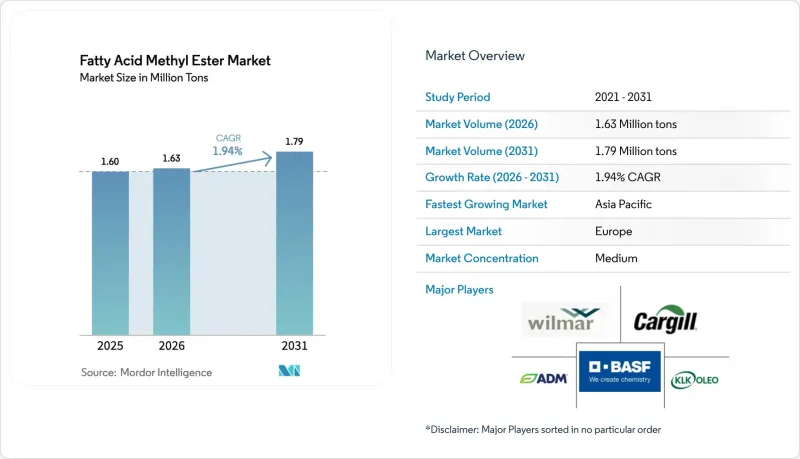
Mordor Intelligence에 의하면, 지방산 메틸 에스테르 시장 규모는 2025년 160만 톤으로 평가되었고, 2026년에는 163만 톤으로 추정되고, 2026-2031년 CAGR 1.94%로 성장을 지속할 전망이며, 2031년에는 179만 톤에 이를 것으로 예측됩니다.
본 보고서는 유형별(유채, 대두, 팜유, 기타), 용도별(연료, 윤활유, 코팅, 식품 및 농업, 퍼스널케어 제품, 기타 용도), 지역별(아시아태평양, 북미, 유럽, 남미, 중동 및 아프리카)로 분류되어 있습니다. 시장 예측은 수량(톤) 단위로 표시됩니다.
세계의 지방산 메틸 에스테르 시장 동향 및 인사이트
바이오디젤 혼합 의무 강화
인도네시아는 2026년에 B50 의무화를 도입할 예정이며, 이로 인해 연간 약 1,100만 톤의 팜유가 흡수될 것으로 예상되어 국내 생산자들은 수출 변동 위험으로부터 보호받게 될 것입니다. 브라질에서는 RenovaBio에 따라 B15로의 단계적 전환으로 15억 리터의 추가 수요가 예상됩니다. 한편, 미국은 71억 2,000만-75억 RIN의 바이오매스 유래 디젤 연료량을 제안하고 있지만, 수입 원료와 연계된 크레딧에 대해서는 할인을 적용할 의향입니다. 유럽에서는 RED III에 따라 운송용 에너지 목표치를 29%로 유지하면서 작물 유래 바이오연료를 7%로 제한하고 있어, 이에 따라 투자가 폐유 에스테르로 이동하고 있습니다. ISCC 및 REDcert-EU와 같은 인증 제도는 현재 1만 5,000곳 이상을 포괄하며, 전 세계 무역 접근성을 형성하고 있습니다.
원료 공급량 증가와 비용 경쟁력 향상
ISCC 인증에 힘입어, 지자체의 회수 프로그램을 통해 2024년 중국에서 EU로 수출된 사용 후 식용유(UCO)의 양은 120만 톤에 달했습니다. RED III의 크레딧 이중 산입으로 인해 2024년 평균 가격이 톤당 950유로임에도 불구하고, 유럽산 UCO는 경제성을 유지하고 있습니다. 2024년 말까지 팜유 가격은 톤당 3,800-4,000 말레이시아 링깃까지 하락하여, 장기 계약을 체결한 동남아시아 생산자들의 이익률을 끌어올렸습니다. 그러나 남미의 기상 변동과 인도네시아의 팜유 수출 할당량으로 인해 이러한 비용 우위는 급속히 역전될 가능성이 있어, 지방산 메틸 에스테르 시장에 내재된 원료 리스크를 부각시키고 있습니다.
식물성 기름 가격 변동
팜유 선물 가격은 2023년 초 톤당 5,200 말레이시아 링깃에서 2024년 12월까지 톤당 3,800 말레이시아 링깃으로 변동했으며,헤지 조치를 취하지 않은 생산자의 FAME(지방산 메틸 에스테르) 이익률은 최대 20%나 축소되었습니다. 미국의 대두유 가격도 비슷한 움직임을 보이며, 2024년 3월에는 파운드당 68센트로 정점을 찍었으나, 브라질의 수확량이 급증함에 따라 10월까지 42센트까지 하락했습니다. 생산 비용의 최대 85%를 원료비가 차지하고 있기 때문에 이러한 가격 변동은 수익성을 급격히 저해할 가능성이 있습니다.
부문 분석
폐유, 동물성 지방, 조류유 유래 메틸 에스테르 등 기타 유형은 2031년까지 연평균 성장률(CAGR) 2.76%로 확대될 전망이며, 지방산 메틸 에스테르 시장 전체를 상회하는 속도로 성장할 것으로 보입니다. 2024년 중국의 폐유 유래 에스테르 생산량은 총 180만 톤에 달했으며, 시노펙(Sinopec)과 중량집단(COFCO)은 인증을 받은 화물을 로테르담과 함부르크로 수출했습니다. 달링 인그리디언츠(Darling Ingredients) 등 북미의 렌더링 기업들은 수직 통합형 회수 네트워크를 활용하여 동물성 지방 유래 FAME 40만 톤을 공급했습니다.
2025년에는 유럽의 800만 톤 규모 정제 기반과 EN 14214 규격에 부합하는 저온 유동성의 이점 덕분에 유채 메틸 에스테르가 세계 생산량의 45.12%를 계속 차지했으나, 북미와 남미에서는 대두 메틸 에스테르가 시장을 독점했습니다. 인도네시아와 말레이시아에 집중되어 있는 팜유 에스테르는 수입 할당량을 2019년 수준으로 동결하는 EU의 ILUC(간접 토지 이용 변화) 상한선에 직면해 있습니다. 따라서 ISCC 및 REDcert 인증은 시장 진입에 있어 매우 중요하며, 산림 파괴가 없는 공급망을 입증하지 못하는 생산자는 시장에서 배제될 위험이 있습니다.
지역별 분석
2025년, 유럽은 세계 총량의 38.92%를 차지했으나, 재생 가능 디젤 플랜트 및 첨단 바이오연료 할당으로 인해 기존 FAME용 원료가 유출되고 있습니다. 독일의 2024년 생산량은 사용 후 식용유(UCO) 부족으로 인해 이익률이 압박을 받아 4% 감소한 280만 톤을 기록했지만, 프랑스는 사이폴(Sipol)사의 통합된 유채 자산 덕분에 160만 톤으로 보합세를 유지했습니다. 영국은 2024년에 FAME용으로 120만 장의 재생 가능 운송 연료 인증서를 발급했으나, 정유업체들이 HVO로 전환함에 따라 전년 대비 8% 감소했습니다. 북유럽 수요는 여전히 소폭에 그치고 있지만, 폐기물 유래 대체 연료로 빠르게 전환되고 있어 유럽 내 원료의 구조적 전환을 뒷받침하고 있습니다.
아시아태평양은 2031년까지 연평균 성장률(CAGR) 3.54%를 나타낼 것으로 예측됩니다. 말레이시아는 잉여분을 필리핀과 태국에 수출했으나, 팜유 가격 하락으로 정제 마진이 축소되었습니다. 중국의 국내 생산은 도시 폐기물유 프로그램이 중심이며, 생산량의 80%가 EU로 수출되고 있지만, EU에서는 인센티브의 이중 계상이 일반적입니다. 인도는 에탄올 혼합 연료에 우선순위를 두고 있어 뒤처지고 있지만, 일본과 한국은 기업의 지속가능성에 관한 공약을 이행하기 위해 소량을 수입하고 있습니다.
2025년에는 북미가 큰 시장 점유율을 차지했습니다. 미국은 아이오와주와 일리노이주의 대두유 정제 시설이 급속히 확대된 데 힘입어, 압도적인 소비량을 기록하며 1위를 차지했습니다. 캐나다는 ‘청정 연료 규정’에 따라 32만 톤을 소비했고, 멕시코는 18만 톤을 수입에 의존했습니다. 남미는 2024년에 320만 톤을 공급했습니다. 브라질의 B12 규제로 인해 63억 리터가 흡수되었으며, 아르헨티나는 무역 분쟁이 완화된 후 120만 톤을 수출했습니다. 중동 및 아프리카는 여전히 발전 단계에 있지만, 사우디아라비아가 2026년에 예정된 30만 톤 규모의 폐유 프로젝트에 5억 달러를 투자하는 등 잠재력을 보여주고 있습니다.
기타 혜택
- 엑셀 형식 시장 예측(ME) 시트
- 3개월간의 애널리스트 지원
자주 묻는 질문
목차
제1장 서론
제2장 조사 방법
제3장 주요 요약
제4장 시장 구도
제5장 시장 규모 및 성장 예측
제6장 경쟁 구도
제7장 시장 기회 및 향후 전망
AJY 26.08.28According to Mordor Intelligence, the fatty acid methyl ester market size is expected to grow from 1.60 million tons in 2025 to 1.63 million tons in 2026 and is forecast to reach 1.79 million tons by 2031 at a 1.94% CAGR over 2026-2031.
This report is Segmented by Type (Rapeseed, Soy, Palm Oil, Other Types), Application (Fuel, Lubricants, Coatings, Food and Agriculture, Personal Care Products, Other Applications), and Geography (Asia-Pacific, North America, Europe, South America, Middle East and Africa). The Market Forecasts are Provided in Terms of Volume (Tons).
Global Fatty Acid Methyl Ester Market Trends and Insights
Escalating Biodiesel Blend Mandates
Indonesia will introduce a B50 requirement in 2026 that is expected to absorb about 11 million tons of palm oil annually, insulating domestic producers from export volatility. Brazil's phased move to B15 adds 1.5 billion liters of incremental demand under RenovaBio, while the United States proposes biomass-based diesel volumes of 7.12-7.50 billion RINs but intends to discount credits tied to imported feedstocks. In Europe, RED III preserves a 29% transport-energy target yet caps crop-based biofuels at 7%, nudging investments toward waste-oil esters. Certification schemes such as ISCC and REDcert-EU now cover more than 15,000 sites, shaping global trade access.
Increasing Feedstock Availability and Cost Competitiveness
Municipal collection programs lifted China's used-cooking-oil exports to the EU to 1.2 million tons in 2024, supported by ISCC approvals. Double-counting credits under RED III keeps European UCO economical despite the average 2024 prices of EUR 950 per ton. Palm oil eased to MYR 3,800-4,000 per ton by late-2024, boosting margins for Southeast Asian producers holding long-term contracts. However, weather shifts in South America or palm-export quotas in Indonesia can swiftly reverse the cost advantage, underscoring the feedstock risk embedded in the Fatty Acid Methyl Ester market.
Vegetable-Oil Price Volatility
Palm-oil futures swung from MYR 5,200 per ton in early 2023 to MYR 3,800 per ton by December 2024, slicing FAME margins by as much as 20 percentage points for producers lacking hedges. Soybean oil prices saw a similar pattern in the United States, peaking at 68 cents per pound in March 2024, then sliding to 42 cents by October as Brazilian harvests surged. With feedstock accounting for up to 85% of production cost, such volatility can erode profitability swiftly.
Other drivers and restraints analyzed in the detailed report include:
- Rising Demand for Low-Sulfur Renewable Diesel Substitutes
- Maritime Bio-Bunkering Pilots Adopting FAME Blends
- Competition from Alternative Biofuels and Renewable Diesel
For complete list of drivers and restraints, kindly check the Table Of Contents.
Segment Analysis
Other Types - spanning waste-oil, animal-fat, and algal-oil methyl esters - are set to expand at a 2.76% CAGR through 2031, outpacing the overall Fatty Acid Methyl Ester market. Waste-oil ester output in China totaled 1.8 million tons in 2024, with Sinopec and COFCO exporting certified cargoes to Rotterdam and Hamburg. North American renderers such as Darling Ingredients supplied 400,000 tons of tallow-based FAME, leveraging vertically integrated collection networks.
Rapeseed methyl ester retained 45.12% global volume in 2025 due to Europe's 8 million-ton refining base and cold-flow advantages that align with EN 14214 norms, while soy methyl ester dominated the Americas. Palm-oil esters, concentrated in Indonesia and Malaysia, face EU ILUC caps that freeze import quotas at 2019 levels. Certification under ISCC and REDcert is therefore pivotal for market access, and producers unable to document zero-deforestation supply chains risk exclusion.
Complete Report Scope:
- By Type
- Rapeseed Methyl Ester
- Soy Methyl Ester
- Palm Oil Methyl Ester
- Other Types (Waste-Oil Methyl Ester, Animal-Fat-Derived Methyl Ester, Algal-Oil Methyl Ester)
- By Application
- Fuel
- Lubricants
- Coatings
- Food and Agriculture
- Personal Care Products
- Other Applications (Plasticizers and Surfactants,Metalworking Fluids)
- By Geography
- Asia-Pacific
- China
- India
- Japan
- South Korea
- ASEAN Countries
- Rest of Asia-Pacific
- North America
- United States
- Canada
- Mexico
- Europe
- Germany
- United Kingdom
- France
- Italy
- Spain
- NORDIC Countries
- Rest of Europe
- South America
- Brazil
- Argentina
- Rest of South America
- Middle-East and Africa
- Saudi Arabia
- United Arab Emirates
- South Africa
- Nigeria
- Rest of Middle-East and Africa
- Asia-Pacific
Geography Analysis
Europe commanded 38.92% of global volume in 2025, yet renewable diesel plants and advanced-biofuel quotas are siphoning feedstocks away from traditional FAME. Germany's 2024 output slipped 4% to 2.8 million tons as UCO shortages pressed margins, while France held flat at 1.6 million tons thanks to Saipol's integrated rapeseed assets. The United Kingdom issued 1.2 million Renewable Transport Fuel Certificates for FAME in 2024, 8% lower than the prior year as refiners pivoted toward HVO. Nordic demand remains modest but is shifting quickly to waste-based alternatives, reinforcing Europe's structural feedstock shift.
Asia-Pacific is primed for a 3.54% CAGR through 2031. Malaysia exported surplus volumes to the Philippines and Thailand, but softer palm prices narrowed refinery spreads. China's domestic output is centered on municipal waste-oil programs, with 80% of production exported to the EU, where double-counting incentives prevail. India lags due to ethanol-blend priorities, while Japan and South Korea import modest cargoes to deliver corporate sustainability pledges.
North America accounted for a significant market share in 2025. The United States led with outstanding volume consumption anchored by rapidly scaled soybean-oil refining in Iowa and Illinois. Canada consumed 320,000 tons under its Clean Fuel Regulations, and Mexico relied on imports for 180,000 tons. South America supplied 3.2 million tons in 2024, with Brazil's B12 rule absorbing 6.3 billion liters and Argentina exporting 1.2 million tons after trade disputes eased. The Middle East and Africa remain nascent but show potential as Saudi Arabia channels USD 500 million into a 300,000-ton waste-oil project slated for 2026.
- Archer Daniels Midland Co.
- BASF
- Cargill, Incorporated.
- Emery Oleochemicals
- Godrej Industries Limited
- IOI Oleochemical
- KLK OLEO
- ABITEC, Larodan Research Grade Lipids
- Louis Dreyfus Company
- Mewah Group
- Chevron
- Tokyo Chemical Industry Pvt. Ltd.
- VERBIO North America LLC
- Wilmar International Ltd
Additional Benefits:
- The market estimate (ME) sheet in Excel format
- 3 months of analyst support
TABLE OF CONTENTS
1 Introduction
- 1.1 Study Assumptions and Market Definition
- 1.2 Scope of the Study
2 Research Methodology
3 Executive Summary
4 Market Landscape
- 4.1 Market Overview
- 4.2 Market Drivers
- 4.2.1 Escalating biodiesel blend mandates
- 4.2.2 Increasing feedstock availability and cost competitiveness
- 4.2.3 Rising demand for low-sulfur renewable diesel substitutes
- 4.2.4 Maritime bio-bunkering pilots adopting FAME blends
- 4.2.5 Increasing demand from personal care industry
- 4.3 Market Restraints
- 4.3.1 Vegetable-oil price volatility
- 4.3.2 Competition from Alternative Biofuels and Renewable Diesel
- 4.3.3 Regulatory Uncertainty and Policy Dependence
- 4.4 Value Chain Analysis
- 4.5 Porter's Five Forces
- 4.5.1 Bargaining Power of Buyers
- 4.5.2 Bargaining Power of Suppliers
- 4.5.3 Threat of New Entrants
- 4.5.4 Threat of Substitutes
- 4.5.5 Degree of Competition
5 Market Size and Growth Forecasts (Volume)
- 5.1 By Type
- 5.1.1 Rapeseed Methyl Ester
- 5.1.2 Soy Methyl Ester
- 5.1.3 Palm Oil Methyl Ester
- 5.1.4 Other Types (Waste-Oil Methyl Ester, Animal-Fat-Derived Methyl Ester, Algal-Oil Methyl Ester)
- 5.2 By Application
- 5.2.1 Fuel
- 5.2.2 Lubricants
- 5.2.3 Coatings
- 5.2.4 Food and Agriculture
- 5.2.5 Personal Care Products
- 5.2.6 Other Applications (Plasticizers and Surfactants,Metalworking Fluids)
- 5.3 By Geography
- 5.3.1 Asia-Pacific
- 5.3.1.1 China
- 5.3.1.2 India
- 5.3.1.3 Japan
- 5.3.1.4 South Korea
- 5.3.1.5 ASEAN Countries
- 5.3.1.6 Rest of Asia-Pacific
- 5.3.2 North America
- 5.3.2.1 United States
- 5.3.2.2 Canada
- 5.3.2.3 Mexico
- 5.3.3 Europe
- 5.3.3.1 Germany
- 5.3.3.2 United Kingdom
- 5.3.3.3 France
- 5.3.3.4 Italy
- 5.3.3.5 Spain
- 5.3.3.6 NORDIC Countries
- 5.3.3.7 Rest of Europe
- 5.3.4 South America
- 5.3.4.1 Brazil
- 5.3.4.2 Argentina
- 5.3.4.3 Rest of South America
- 5.3.5 Middle-East and Africa
- 5.3.5.1 Saudi Arabia
- 5.3.5.2 United Arab Emirates
- 5.3.5.3 South Africa
- 5.3.5.4 Nigeria
- 5.3.5.5 Rest of Middle-East and Africa
- 5.3.1 Asia-Pacific
6 Competitive Landscape
- 6.1 Market Concentration
- 6.2 Strategic Moves
- 6.3 Market Share(%)/Ranking Analysis
- 6.4 Company Profiles (includes Global level Overview, Market level overview, Core Segments, Financials as available, Strategic Information, Market Rank/Share, Products and Services, Recent Developments)
- 6.4.1 Archer Daniels Midland Co.
- 6.4.2 BASF
- 6.4.3 Cargill, Incorporated.
- 6.4.4 Emery Oleochemicals
- 6.4.5 Godrej Industries Limited
- 6.4.6 IOI Oleochemical
- 6.4.7 KLK OLEO
- 6.4.8 ABITEC, Larodan Research Grade Lipids
- 6.4.9 Louis Dreyfus Company
- 6.4.10 Mewah Group
- 6.4.11 Chevron
- 6.4.12 Tokyo Chemical Industry Pvt. Ltd.
- 6.4.13 VERBIO North America LLC
- 6.4.14 Wilmar International Ltd
7 Market Opportunities and Future Outlook
- 7.1 White-space and Unmet-Need Assessment
- 7.2 Catalyst and process-intensification breakthroughs