|
시장보고서
상품코드
2115169
증기 보일러 시스템 시장 : 시장 점유율 분석, 업계 동향 및 통계, 성장 예측(2026-2031년)Steam Boiler System - Market Share Analysis, Industry Trends & Statistics, Growth Forecasts (2026 - 2031) |
||||||
 Mordor Intelligence
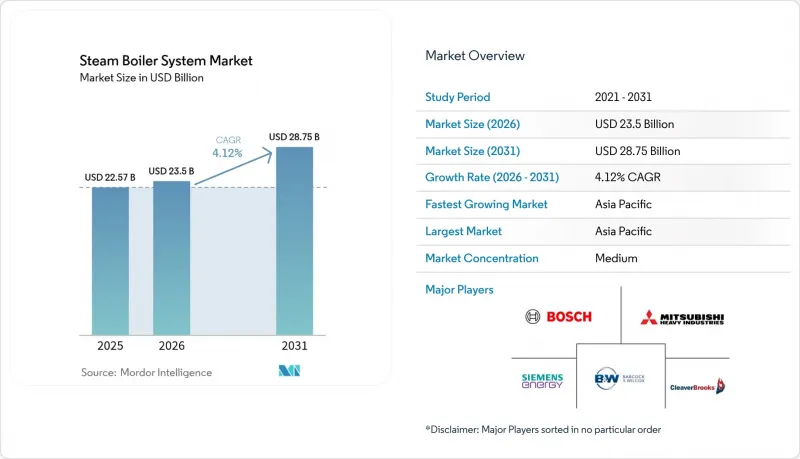
Mordor Intelligence에 의하면, 증기 보일러 시스템 시장 규모는 2025년 225억 7,000만 달러로 평가되었고, 2026년에는 235억 달러로 추정되고, 2026-2031년 CAGR 4.12%로 성장을 지속할 전망이며, 2031년에는 287억 5,000만 달러에 이를 것으로 예측됩니다.
본 보고서는 보일러 유형별(수관식, 전극식/전기식, 기타), 연료 유형별(천연가스·바이오매스, 수소·합성연료, 기타), 생산 능력별(10-150BHP, 600BHP 초과/유틸리티 규모, 기타), 기술별(응축식 및 비응축식), 최종 이용 산업별(발전, 제약, 화학, 기타), 지역별(북미, 유럽, 아시아태평양, 기타)로 분류되어 있습니다.
세계의 증기 보일러 시스템 시장 동향 및 인사이트
엄격한 배출 규제
미국 환경보호청(EPA)의 NESHAP 규정에 따라 10MMBtu/h를 초과하는 보일러에 대해 2년마다 조정 및 지속적인 모니터링이 의무화되어 있으며, 저NOx 버너, 선택적 촉매 환원(SCR), 대체 연료에 대한 투자가 촉진되고 있습니다. 인도에서도 유사한 규제 강화가 진행되고 있으며, 현재 심의 중인 ‘2024년 보일러 법안’에 따라 약 400만 대의 보일러에 대한 점검 빈도가 높아지게 되어 자가 진단 제어 시스템에 대한 수요가 증가하고 있습니다. 규제 준수 비용이 프로젝트 총 예산의 15%에 달할 가능성이 있기 때문에 사업자들은 배기가스 처리 장치, 제어 시스템, 서비스 계약을 통합한 패키지형 솔루션을 선호하는 경향이 있습니다. 이러한 규제는 본질적으로 청정 연소나 전전기식 난방에 대응 가능한 수관식 및 전극식 설계를 뒷받침하고 있습니다. 공급업체들은 규정 준수 대시보드를 기업용 소프트웨어와 연동함으로써, 디지털 트윈을 실시간 성능을 검증하고 규정 위반에 따른 벌금을 피하기 위한 가장 비용 효율적인 수단으로 자리매김하고 있습니다.
식음료 가공 능력의 급증
콜드체인에 대한 투자와 위생 프로토콜의 엄격화로 인해 의약품 순도 기준을 준수하는 식품용 증기에 대한 수요가 증가하고 있습니다. 스키드 장착형 패키지는 중앙 보일러실에 비해 설치 시간을 최대 50% 단축할 수 있어, 가공업체가 계절적 수요 피크에 맞추어 처리 능력을 조정할 수 있다는 점에서 매력적입니다. IoT 프로브는 라인 운영자에게 라이브 스트림 품질의 데이터를 실시간으로 제공하여 제품의 부패 위험을 줄이는 동시에 규제 감사를 간소화합니다. 에너지 비용의 급등으로 인해 포장 홀용 응축식 화관 보일러에 대한 관심이 높아지고 있습니다. 한편, 전극식 시스템은 연소에 따른 오염 물질을 포함하지 않는 깨끗한 증기를 SIP 라인에 거의 즉시 공급합니다. 이러한 특징들이 결합되어 식품 부문의 증기 보일러 시스템 시장 규모를 확대되고 있습니다.
높은 초기 설비 투자(Capex) 및 운영·유지보수(O&M) 비용
표준 유틸리티 설비의 건설 비용은 1톤시당 6,000-1만 3,000달러이지만, 수처리, 이코노마이저, 사이버 보안 대책이 적용된 제어 시스템으로 인해 수명 주기 비용은 40-60% 증가합니다. 중소규모 기업들은 이러한 지출에 필요한 자금을 조달하는 데 어려움을 겪고 있어, OEM 업체들은 현재 ‘SaaS(Steam-as-a-Service)’ 계약을 제안하고 있습니다. 이 계약에서 고객은 톤당 요금을 지불하는 반면, 공급업체가 자산의 소유권과 유지보수 의무를 부담합니다. 디지털 트윈은 예기치 못한 가동 중단을 줄여주지만, 그 개발비와 데이터 통합비로 인해 프로젝트 자본에 3-5%가 추가되므로, 자본 비용이 두 자릿수 대를 기록하는 신흥 시장에서는 진입 장벽이 되고 있습니다.
부문 분석
2025년 매출액 중 수관식 보일러가 57.86%를 차지했으며, 증기 보일러 시스템 시장에서 압도적인 선두를 유지하고 있습니다. 넓은 열전달 면적 덕분에 600℃ 및 270bar의 운전 조건에 대응할 수 있어 발전소나 석유화학 플랜트에서 널리 채택되고 있습니다. 화관식 보일러는 제조가 간편하고 초기 비용이 저렴하여 최대 250psig까지의 중규모 용도에서 여전히 인기가 높습니다. 한편, 코일식이나 원패스식은 설치 면적이 용량보다 중요시되는 상황에서 뛰어난 성능을 발휘합니다.
전극식/전기 보일러는 연평균 성장률(CAGR) 6.08%로 다른 모든 유형을 앞지르고 있습니다. 이들 모두 99.9%의 전기-열 변환 효율과 즉각적인 출력 조절을 실현하고 있어, 지역 열 공급 및 제약 산업의 멸균 공정에서 높은 평가를 받고 있습니다. Vicinity Energy의 캠브리지에 위치한 42MW 설비는 그 규모의 잠재력을 보여주는 좋은 사례로, 3,000만 제곱피트 규모의 부동산에 탄소 배출이 없는 증기를 공급하고 있습니다. 재생 가능 전력 가격이 하락함에 따라 전력의 보급이 확대되고, 증기 보일러 시스템 시장도 성장하고 있습니다.
천연가스와 바이오매스는 파이프라인망의 정비 상황과 재생에너지로서의 실적을 바탕으로 2025년 매출의 41.62%를 계속 차지했습니다. 셰일가스 생산은 북미의 안정적인 가스 공급을 뒷받침하고 있는 반면, 바이오매스 이용 사업자들은 펄프 및 제지 산업에서 순환형 경제 인센티브의 혜택을 받고 있습니다. 석유 버너는 대기질 규제로 인해 감소 추세를 보이고 있으며, 석탄 화력 발전소는 2030-2035년에 걸친 단계적 폐지 명령에 따라 폐지가 진행되고 있습니다.
수소와 합성 연료는 5.63%라는 가장 높은 연평균 성장률(CAGR)을 기록하고 있습니다. 비스만(Viessmann)사는 2024년, 최초의 100% 수소 대응 응축식 보일러 시리즈를 출하했습니다. 정유시설에서는 이미 오프가스 수소가 생산되고 있어, 현장에서 증기 생성을 위한 저비용 원료를 제공합니다. 수소, 천연가스, 바이오 합성가스를 전환하여 사용할 수 있는 하이브리드 버너는 공급 변동을 완화하고, 다연료 대응의 유연성이라는 증기 보일러 시스템 시장의 매력을 높이고 있습니다.
지역별 분석
아시아태평양은 2025년 세계 매출의 39.05%를 차지했으며, 2031년까지 연평균 성장률(CAGR) 4.74%로 성장했습니다. 중국의 정유시설, 시멘트, 화학 단지는 베이스로드용 증기공급원이 되고 있는 반면, 인도의 ‘메이크 인 인디아(Make in India)’ 프로그램은 중규모 패키지 판매를 뒷받침하고 있습니다. 일본과 한국은 수소 대응 연소 기술 및 초고효율 응축식 보일러 어레이에 투자하고 있으며, 이러한 혁신 기술을 아세안(ASEAN) 각 거점으로 수출하고 있습니다.
북미에서는 성숙한 교체 수요가 나타나고 있습니다. 저렴한 셰일 가스가 수관식 보일러의 개조를 뒷받침하고 있지만, 캘리포니아주와 북동부 지역의 탈탄소화 정책이 전기와 수소를 활용한 시범 사업 추진을 뒷받침하고 있습니다. 전력 회사가 운영 데이터를 수익화함에 따라 디지털 트윈을 활용한 서비스 계약이 점차 확산되고 있습니다.
유럽에서는 석탄 탈피가 가속화되고 있으며, 자금이 바이오매스 열병합발전(CHP) 및 수소 혼합 가스 보일러로 재분배되고 있습니다. 중동 및 아프리카는 사우디아라비아의 산업 다각화와 아프리카의 산업화 회랑을 배경으로 5% 이상의 성장 궤도를 그리고 있습니다. 남미의 펄프, 광업, 농산물 가공 플랜트에서는 안정적인 수주가 예상되지만, 환율 변동의 영향으로 구매자들은 모듈식이며 ‘성장에 맞추어 단계적으로 도입하는’ 패키지로 기울고 있습니다. 이러한 동향이 맞물려 증기 보일러 시스템 시장은 균형 잡힌 확장을 이어가고 있습니다.
기타 혜택
- 엑셀 형식 시장 예측(ME) 시트
- 3개월간의 애널리스트 지원
자주 묻는 질문
목차
제1장 서론
제2장 조사 방법
제3장 주요 요약
제4장 시장 구도
제5장 시장 규모 및 성장 예측
제6장 경쟁 구도
제7장 시장 기회 및 향후 전망
AJY 26.08.28According to Mordor Intelligence, the steam boiler system market size is expected to grow from USD 22.57 billion in 2025 to USD 23.5 billion in 2026 and is forecast to reach USD 28.75 billion by 2031 at 4.12% CAGR over 2026-2031.
This report is Segmented by Boiler Type (Water-Tube, Electrode/Electric, and More), Fuel Type (Natural Gas and Biomass, Hydrogen and Synthetic Fuels, and More), Capacity (10 To 150 BHP, Above 600 BHP/Utility-Scale, and More), Technology (Condensing and Non-Condensing), End-Use Industry (Power Generation, Pharmaceuticals, Chemicals, and More), and Geography (North America, Europe, Asia-Pacific, and More).
Global Steam Boiler System Market Trends and Insights
Stringent Emission-Control Regulations
The U.S. EPA's NESHAP mandate compels biennial tune-ups and continuous monitoring for boilers above 10 MMBtu/h, driving investment in low-NOx burners, selective catalytic reduction, and alternative fuels. Similar tightening is underway in India, where the pending Boilers Bill 2024 raises inspection frequency for roughly 4 million units, prompting demand for self-diagnostic control systems. Compliance outlays can reach 15% of total project budgets, so operators gravitate toward bundled solutions that integrate emission hardware, controls, and service contracts. These rules favor water-tube and electrode designs that inherently accommodate cleaner combustion or all-electric heating. By linking compliance dashboards to enterprise software, suppliers position digital twins as the least-cost pathway to verify real-time performance and avoid non-compliance penalties.
Surging Food & Beverage Processing Capacity
Cold-chain investments and stricter sanitation protocols have sharpened demand for culinary-grade steam that matches pharmaceutical purity benchmarks. Skid-mounted packages appeal because they curb installation time by up to 50% compared with central boiler rooms, letting processors align capacity with seasonal peaks. IoT probes now stream live-stream-quality data to line operators, cutting product-spoilage risk and simplifying regulatory audits. Rising utility bills amplify interest in condensing fire-tube units for packaging halls, whereas electrode systems supply near-instantaneous clean steam for SIP lines without combustion-related contaminants. These features collectively enlarge the food sector's steam boiler system market footprint.
High Upfront Capex & O&M Costs
Standard utility builds cost USD 6,000-13,000 per ton-hour, with water treatment, economizers, and cybersecure controls lifting lifecycle spend by 40-60%. Smaller firms struggle to finance such outlays, so OEMs now pitch steam-as-a-service contracts in which clients pay a per-ton tariff while suppliers retain asset ownership and maintenance obligations. Digital twins cut unscheduled outages, but their development and data-integration fees add 3-5% to project capital, a hurdle in emerging markets where the cost of capital hovers in double digits.
Other drivers and restraints analyzed in the detailed report include:
- Power-Plant Capacity Additions in Emerging Asia & Africa
- Hydrogen-Ready Boiler Retrofits in Refineries
- Volatile Natural-Gas & Coal Prices
For complete list of drivers and restraints, kindly check the Table Of Contents.
Segment Analysis
Water-tube units generated 57.86% of 2025 revenue, a commanding steam boiler system market lead. Their large surface area handles 600 °C and 270 bar service, a power and petrochemical complexes. Fire-tube designs remain popular in mid-range duties up to 250 psig due to simpler fabrication and lower upfront cost, while coil/once-through variants excel where footprint trumps capacity.
Electrode/electric boilers outpace every other type at a 6.08% CAGR. They deliver 99.9% electrical-to-thermal efficiency and instant modulation, prized in district energy and pharma sterilization. Vicinity Energy's 42 MW Cambridge installation exemplifies scale possibilities, supplying carbon-free steam to 30 million ft2 of real estate. As renewable electricity cheapens, electric penetration deepens, broadening the steam boiler system market.
Natural gas and biomass retained 41.62% of 2025 sales, thanks to pipeline reach and renewable credentials. Shale output underpins North American gas security, while biomass rollers benefit from circular-economy incentives in pulp and paper lines. Oil burners fade amid air-quality rules, and coal units retire under 2030-2035 phase-out edicts.
Hydrogen and synthetic fuels clock the fastest 5.63% CAGR. Viessmann shipped its first 100% H2-ready condensing boiler line in 2024. Refineries already produce off-gas hydrogen, offering low-cost feedstock for on-site steam. Hybrid burners that swap between H2, nat-gas, and bio-syngas mitigate supply volatility, reinforcing the steam boiler system market appeal of multi-fuel flexibility.
Complete Report Scope:
- By Boiler Type
- Water-Tube
- Fire-Tube
- Coil/Once-Through
- Electrode/Electric
- By Fuel Type
- Natural Gas and Biomass
- Oil
- Coal
- Hydrogen and Synthetic Fuels
- By Capacity (BHP)
- 10 to 150 BHP
- 151 to 300 BHP
- 301 to 600 BHP
- Above 600 BHP/Utility-Scale
- By Technology
- Condensing
- Non-condensing
- By End-Use Industry
- Power Generation
- Oil Refineries and Petrochemicals
- Food and Beverage
- Chemicals
- Pulp and Paper
- Pharmaceuticals
- Others (Textile, Rubber, etc.)
- By Geography
- North America
- United States
- Canada
- Mexico
- Europe
- Germnay
- United Kingdom
- France
- Italy
- Spain
- Russia
- Rest of Europe
- Asia Pacific
- China
- India
- Japan
- South Korea
- Australia
- ASEAN Countries
- Rest of Asia Pacific
- South America
- Argentina
- Brazil
- Rest of South America
- Middle East and Africa
- Saudi Arabia
- United Arab Emirates
- South Africa
- Egypt
- Rest of Middle East and Africa
- North America
Geography Analysis
Asia-Pacific generated 39.05% of global revenue in 2025 and expanded at a 4.74% CAGR through 2031. China's refinery, cement, and chemicals complexes fuel base-load steam, while India's Make-in-India program spurs mid-range package sales. Japan and South Korea invest in hydrogen-ready combustion and ultra-efficient condensing arrays, exporting those innovations across ASEAN sites.
North America shows mature replacement demand. Cheap shale gas sustains water-tube retrofits, but decarbonization policies in California and the Northeast propel electric and hydrogen pilots. Digital-twin service contracts gain traction as utilities monetize operational data.
Europe hastens away from coal, reallocating funds to biomass CHP and H2-blend gas boilers. The Middle East & Africa region charts a 5%-plus trajectory on the back of Saudi industrial diversification and African industrialization corridors. South America's pulp, mining, and agro-processing plants deliver steady orders, though currency volatility nudges buyers toward modular, pay-as-you-grow packages. Collectively, these currents keep the steam boiler system market in balanced expansion.
- Bosch Industriekessel
- Babcock & Wilcox Enterprises
- Mitsubishi Heavy Industries
- Siemens Energy
- Cleaver-Brooks
- Fulton Boiler Works
- Hurst Boiler & Welding
- General Electric
- ANDRITZ AG
- Forbes Marshall
- Thermax Ltd.
- Miura Co., Ltd.
- IHI Corporation
- Johnston Boiler Company
- Harbin Electric Boiler Co.
- Zhangjiagang Future Boiler
- Viessmann Group
- Superior Boiler
- Liming Energy Equipment
- Dongfang Boiler Group
Additional Benefits:
- The market estimate (ME) sheet in Excel format
- 3 months of analyst support
TABLE OF CONTENTS
1 Introduction
- 1.1 Study Assumptions & Market Definition
- 1.2 Scope of the Study
2 Research Methodology
3 Executive Summary
4 Market Landscape
- 4.1 Market Overview
- 4.2 Market Drivers
- 4.2.1 Stringent emission?control regulations
- 4.2.2 Surging food & beverage processing capacity (post-COVID cold-chain boom)
- 4.2.3 Power?plant capacity additions in emerging Asia & Africa
- 4.2.4 Hydrogen-ready boiler retrofits in refineries
- 4.2.5 Digital-twin enabled predictive maintenance
- 4.2.6 Modular offshore steam generators for FPSOs
- 4.3 Market Restraints
- 4.3.1 High upfront capex & O&M costs
- 4.3.2 Volatile natural-gas & coal prices
- 4.3.3 Shortage of certified boilermakers in OECD
- 4.3.4 Nickel & chromium supply risk for high-alloy tubing
- 4.4 Supply-Chain Analysis
- 4.5 Regulatory Landscape
- 4.6 Technological Outlook (AI, IoT, hydrogen-ready materials)
- 4.7 Porter's Five Forces
- 4.7.1 Bargaining Power of Suppliers
- 4.7.2 Bargaining Power of Buyers
- 4.7.3 Threat of New Entrants
- 4.7.4 Threat of Substitutes
- 4.7.5 Competitive Rivalry
5 Market Size & Growth Forecasts
- 5.1 By Boiler Type
- 5.1.1 Water-Tube
- 5.1.2 Fire-Tube
- 5.1.3 Coil/Once-Through
- 5.1.4 Electrode/Electric
- 5.2 By Fuel Type
- 5.2.1 Natural Gas and Biomass
- 5.2.2 Oil
- 5.2.3 Coal
- 5.2.4 Hydrogen and Synthetic Fuels
- 5.3 By Capacity (BHP)
- 5.3.1 10 to 150 BHP
- 5.3.2 151 to 300 BHP
- 5.3.3 301 to 600 BHP
- 5.3.4 Above 600 BHP/Utility-Scale
- 5.4 By Technology
- 5.4.1 Condensing
- 5.4.2 Non-condensing
- 5.5 By End-Use Industry
- 5.5.1 Power Generation
- 5.5.2 Oil Refineries and Petrochemicals
- 5.5.3 Food and Beverage
- 5.5.4 Chemicals
- 5.5.5 Pulp and Paper
- 5.5.6 Pharmaceuticals
- 5.5.7 Others (Textile, Rubber, etc.)
- 5.6 By Geography
- 5.6.1 North America
- 5.6.1.1 United States
- 5.6.1.2 Canada
- 5.6.1.3 Mexico
- 5.6.2 Europe
- 5.6.2.1 Germnay
- 5.6.2.2 United Kingdom
- 5.6.2.3 France
- 5.6.2.4 Italy
- 5.6.2.5 Spain
- 5.6.2.6 Russia
- 5.6.2.7 Rest of Europe
- 5.6.3 Asia Pacific
- 5.6.3.1 China
- 5.6.3.2 India
- 5.6.3.3 Japan
- 5.6.3.4 South Korea
- 5.6.3.5 Australia
- 5.6.3.6 ASEAN Countries
- 5.6.3.7 Rest of Asia Pacific
- 5.6.4 South America
- 5.6.4.1 Argentina
- 5.6.4.2 Brazil
- 5.6.4.3 Rest of South America
- 5.6.5 Middle East and Africa
- 5.6.5.1 Saudi Arabia
- 5.6.5.2 United Arab Emirates
- 5.6.5.3 South Africa
- 5.6.5.4 Egypt
- 5.6.5.5 Rest of Middle East and Africa
- 5.6.1 North America
6 Competitive Landscape
- 6.1 Market Concentration
- 6.2 Strategic Moves (M&A, Partnerships, PPAs)
- 6.3 Market Share Analysis (Market Rank/Share for key companies)
- 6.4 Company Profiles (includes Global level Overview, Market level overview, Core Segments, Financials as available, Strategic Information, Products & Services, and Recent Developments)
- 6.4.1 Bosch Industriekessel
- 6.4.2 Babcock & Wilcox Enterprises
- 6.4.3 Mitsubishi Heavy Industries
- 6.4.4 Siemens Energy
- 6.4.5 Cleaver-Brooks
- 6.4.6 Fulton Boiler Works
- 6.4.7 Hurst Boiler & Welding
- 6.4.8 General Electric
- 6.4.9 ANDRITZ AG
- 6.4.10 Forbes Marshall
- 6.4.11 Thermax Ltd.
- 6.4.12 Miura Co., Ltd.
- 6.4.13 IHI Corporation
- 6.4.14 Johnston Boiler Company
- 6.4.15 Harbin Electric Boiler Co.
- 6.4.16 Zhangjiagang Future Boiler
- 6.4.17 Viessmann Group
- 6.4.18 Superior Boiler
- 6.4.19 Liming Energy Equipment
- 6.4.20 Dongfang Boiler Group
7 Market Opportunities & Future Outlook
- 7.1 White-space & Unmet-need Assessment