

|
시장보고서
상품코드
2115171
재귀 반사재 시장 : 점유율 분석, 업계 동향과 통계, 성장 예측(2026-2031년)Retro-Reflective Materials - Market Share Analysis, Industry Trends & Statistics, Growth Forecasts (2026 - 2031) |
||||||
 Mordor Intelligence
Mordor Intelligence에 의하면, 재귀 반사재 시장 규모는 2026년에 52억 8,000만 달러로 추정되고 있어 예측 기간(2026-2031년)에서 CAGR 4.78%로 확대되어 2031년까지 66억 7,000만 달러에 이를 전망입니다.
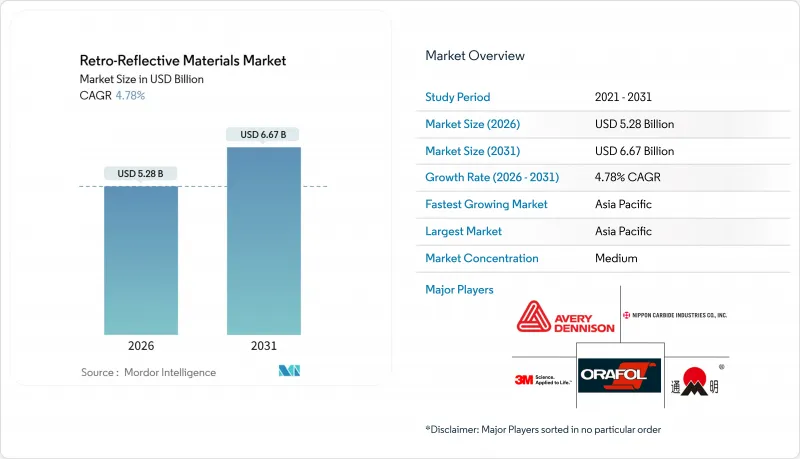
본 보고서는 기술별(세라믹 비드, 유리 비드, 마이크로 프리즘), 제품 형태별(필름, 시트, 테이프 및 도료, 코팅, 잉크), 최종 사용자 산업별(자동차, 산업용, 섬유, 기타),지역별(아시아태평양, 북미, 유럽, 남미, 중동 및 아프리카)로 분류되어 있습니다. 시장 예측은 금액(달러) 기준으로 제시되어 있습니다.
전 세계 재귀 반사재 시장 동향 및 인사이트
전 세계 가시성 규제의 강화
규격 개정으로 인해 의류, 표지판, 노면 표시의 최소 역반사율 기준이 상향 조정되면서, 구매자들은 고품질의 마이크로 프리즘형 광학 소재로 전환해야 하는 상황에 직면해 있습니다. ISO 20471-2024에서는 클래스 3 의류에 대한 요건이 강화되어, 섬유 제조업체들은 산업용 세탁을 견딜 수 있는 프리즘형 아플리케를 채택하는 방향으로 나아가고 있습니다. 2025년 미국 MUTCD(도로 교통 제어 장치 매뉴얼) 개정에서는 새로운 주간 고속도로의 노면 표시에 대해 습윤 상태에서의 역반사율 기준값이 설정되었습니다. 이 기준은 고가의 폴리머 첨가제를 사용하지 않는 한 레벨 비즈 도료로는 달성하기 어려운 것입니다. 인도의 IS 16321:2024에서는 국도에서의 프리즘형 시트 사용이 공식적으로 승인되어 필름 수요를 견인하고 있습니다. 규제 당국은 일관되게 가시성이 향상된 인프라가 야간 사망 사고를 줄일 가능성이 있음을 인정하고 있습니다.
아시아태평양의 급속한 인프라 확충
중국은 제14차 5개년 계획에 따라 고속도로에 막대한 자금을 배정하고, 특히 농촌 지역에 대한 중점적인 노력을 강조하고 있습니다. 이러한 농촌 지역 중점화로 인해, 특히 주변 조명이 불충분한 지역에서 차선 구획 표시에 대한 수요가 증가하고 있습니다. 한편, 인도의 ‘바라트마라 계획’ 2단계에서는 열가소성 마킹을 활용하여 간선 도로의 개보수가 이루어질 예정입니다. 또한 인도네시아, 필리핀, 베트남 등 국가들도 유사한 전략을 채택하고 있으며, 그 결과 대만과 한국에서는 컨버터의 수주 잔고가 12주를 초과하고 있습니다.
원자재 가격 변동
2024년 중반부터 2025년 초까지 천연가스 가격 급등을 배경으로 유럽의 유리 마이크로스피어 가격이 상승했습니다. 이에 따라 각 비드 제조업체들은 분기별 추가 요금 조항을 도입하게 되었습니다. 2026년 초에는 중국 쓰촨성에서 발생한 공급 차질로 인해 이산화티타늄 가격이 대폭 상승했습니다. 2025년에는 주로 미국의 프로파일렌 부족으로 인해 아크릴 폴리머 원가가 상승했습니다. 한편, 헤지 수단이 없는 중견 컨버터 기업들은 지자체와의 계약을 유지하기 위해 이익률을 어느 정도 희생할 수밖에 없었습니다.
부문별 분석
마이크로 프리즘 광학 시스템은 전 세계 매출의 47.58%를 차지하고 있으며, 2031년까지 연평균 성장률(CAGR)은 5.09%로 견조한 상승세를 보일 것으로 전망됩니다. 이러한 강력한 수요는 좁은 시야각에서 1제곱미터당 1,000칸델라를 초과하는 휘도 계수에 기인합니다. 이는 고속도로 주행 속도에서도 멀리서 식별 가능해야 하는 고속도로 표지판에 있어 매우 중요합니다. 유리 비드 시스템은 더 저렴하지만, 거리가 멀어질수록 성능이 급격히 저하됩니다. 성능을 중시하는 입찰이 우선시됨에 따라, 이러한 시스템 시장 점유율은 하락할 것으로 예측됩니다. 한편, 세라믹 비드 기술은 활주로와 같은 고온 환경에서 필수적이지만, 시장 규모에서 차지하는 점유율은 여전히 미미한 수준입니다.
하이브리드 구조가 부상하고 있습니다. 예를 들어, 3M사의 2025년 특허에서는 프리즘 모양의 표층 아래에 유리 마이크로스피어를 통합하고 있습니다. 이 혁신적인 기술은 광각에서의 휘도와 비드의 내구성을 겸비하고 있으며, 현재 텍사스주의 지방 고속도로에서 시험이 진행 중입니다. 한편, ORAFOL사가 체코의 금형 설비를 인수함에 따라 금형 제조 비용이 절감되었습니다. 이러한 진전으로 맞춤형 프로파일 개발이 가속화되었으며, 이 회사는 스마트 인프라 프로젝트에 신속하게 입찰할 수 있는 체계를 갖추고 있습니다. 또한, 디자이너들이 공기역학적 특성을 유지하면서도 경량화된 가시성 솔루션을 선택하는 경향이 강해짐에 따라, 에이버리 데니슨(Avery Dennison)사의 전기차 OEM 제조업체에 대한 반사 필름 공급량이 증가하고 있습니다.
지역별 분석
아시아태평양은 2025년에 전 세계 매출의 44.34%를 차지하고, 2031년까지 연평균 성장률(CAGR) 5.07%라는 가장 높은 성장률을 유지할 전망입니다. 이러한 성장은 주로 중국의 고속도로 정비 계획 및 인도의 ‘바라트마라’ 개선 사업에 의해 주도되고 있습니다. 2026년까지 일본은 반경이 작은 커브의 대부분을 프리즘형 델리네이터로 개조할 계획입니다. 한편, 한국의 ‘스마트 하이웨이’ 프로젝트에서는 RFID 태그와 반사 스트라이프를 통합하여 차량과 인프라 간의 데이터 통신을 강화하고 있습니다. 또한, 아세안(ASEAN) 내 규격 조화를 통해 국경을 넘는 자재 이동이 효율화되고, 입찰 주기가 단축되며, 규정 준수 비용이 절감되고 있습니다.
2025년 매출액 중 북미가 상당한 비중을 차지했습니다. 2025년 MUTCD(도로 표지 통일 규격)의 대폭적인 개정에 따라, 비즈 도료에서 프리즘형 열가소성 수지로의 대규모 전환이 진행되었습니다. 이러한 전환으로 인해 미국 시장에서 추가적인 수요가 발생할 것으로 예측됩니다. ‘비전 제로(Vision Zero)’ 이니셔티브에 따라 캐나다 지자체에서는 재귀반사형 횡단보도 도입이 진행되고 있습니다. 한편, 멕시코에서는 ASTM D4956 유형 IX 규격 준수를 확보하기 위해 지방 도로 표지판에 막대한 자금이 배정되고 있습니다.
유럽은 2025년에 두드러진 시장 점유율을 확보했으나, 엄격한 환경 규제로 인해 성장이 억제되었습니다. 독일에서는 모든 신규 아우토반 표지판에 대해 수명이 10년에 달하는 마이크로 프리즘 시트의 사용이 의무화되어 있으며, 이는 고품질 공급업체에게 유리하게 작용하고 있습니다. 영국에서는 스마트 고속도로 갠트리에 반사성 백플레이트 장착을 의무화하여, 전자 기기 고장 시에도 가시성을 확보하고 있습니다. 프랑스에서는 도로 표지재 사용 제한을 두어 수성 시스템에 우위를 부여하고 있습니다. 2024년 사고 건수 감소를 계기로, 이탈리아는 산악 고개에 델리네이터 설치 노력을 확대했습니다.
남미 및 중동 및 아프리카는 2025년 매출에서 차지하는 비중은 작았으나, 세계 평균 성장률을 상회하는 추세를 보이고 있습니다. 브라질의 BR-163호선 개보수 프로젝트에서는 유형 IX 시트의 사용이 의무화되어 있어, 2028년까지 상당한 소비가 예상됩니다. 사우디아라비아는 2029년까지 광대한 도로망의 대부분을 고휘도 노면 표시로 개보수하겠다는 야심찬 목표를 설정했습니다. 이 계획에는 시공사에 대해 엄격한 성능 기준에 따른 벌칙이 마련되어 있으며, 3년 동안 소정의 휘도 수준을 유지해야 할 의무가 부과되어 있습니다. 남아프리카공화국에서는 도로 작업자에 대한 고시인성 조끼 착용이 새롭게 의무화됨에 따라 2025년에 추가 수요가 발생하고 있습니다.
기타 혜택:
- 엑셀 형식 시장 예측(ME) 시트
- 3개월간의 애널리스트 지원
자주 묻는 질문
목차
제1장 서론
제2장 조사 방법
제3장 주요 요약
제4장 시장 구도
제5장 시장 규모와 성장 예측
제6장 경쟁 구도
제7장 시장 기회와 향후 전망
JHS 26.08.26According to Mordor Intelligence, the retro-Reflective materials market size is estimated at USD 5.28 billion in 2026, and is expected to reach USD 6.67 billion by 2031, at a CAGR of 4.78% during the forecast period (2026-2031).
This report is Segmented by Technology (Ceramic Beads, Glass Beads, and Micro-Prismatic), Product Form (Films, Sheets, and Tapes and Paints, Coatings, and Inks), End-User Industry (Automotive, Industrial, Textile, and More), and Geography (Asia-Pacific, North America, Europe, South America, and Middle-East and Africa). The Market Forecasts are Provided in Terms of Value (USD).
Global Retro-Reflective Materials Market Trends and Insights
Stricter Global Visibility Regulations
Amended standards are raising the minimum retroreflectance thresholds for garments, signage, and pavement markings, pushing buyers towards premium micro-prismatic optics. ISO 20471-2024 has increased requirements for Class 3 garments, steering textile mills towards prismatic appliques that can endure industrial washes. The 2025 U.S. MUTCD update set a wet-retroreflectance benchmark for new interstate markings, a standard that level bead paints find challenging to achieve without costly polymer additives. India's IS 16321:2024 has officially endorsed prismatic sheeting on national highways, driving demand for film. In unison, regulators acknowledge that enhanced visibility infrastructure can potentially reduce nighttime fatalities.
Rapid Infrastructure Expansion in Asia-Pacific
Under its 14th Five-Year Plan, China allocated significant funding to expressways, emphasizing a focus on rural areas. This rural emphasis is driving heightened demand for lane delineation, especially in areas with poor ambient lighting. Meanwhile, India's Bharatmala Phase II is set to revamp corridors, utilizing thermoplastic markings. Furthermore, countries like Indonesia, the Philippines, and Vietnam are adopting similar strategies, leading to converter backlogs in Taiwan and South Korea that now surpass 12 weeks.
Raw-Material Price Volatility
Between mid-2024 and early 2025, European glass-microsphere prices increased, driven by spikes in natural gas prices. This led bead makers to implement quarterly surcharge clauses. In early 2026, titanium dioxide prices rose significantly, following supply disruptions in China's Sichuan province. In 2025, costs for acrylic polymers increased, largely due to shortages of propylene in the U.S. Meanwhile, mid-tier converters, without hedging tools, conceded some margin to retain their municipal contracts.
Other drivers and restraints analyzed in the detailed report include:
- Rising Adoption of High-Visibility Safety Apparel
- Machine-Readable Infrastructure for Autonomous Vehicles
- Substitute Marking Technologies
For complete list of drivers and restraints, kindly check the Table Of Contents.
Segment Analysis
Micro-prismatic optics represents 47.58% of global revenue and a robust 5.09% CAGR outlook to 2031. Demand strength arises from coefficients surpassing 1,000 candelas per lux per square meter at narrow observation angles. This is crucial for expressway signage, which needs to be visible from long distances at highway speeds. While glass-bead systems are more affordable, they quickly lose performance over distance. These systems are expected to decline in market share as performance-based tenders take precedence. On the other hand, while ceramic-bead technology is vital for high-temperature areas like runways, it holds a smaller share of the market volume.
Hybrid architectures are on the rise. For instance, 3M's 2025 patent integrates glass microspheres beneath a prismatic top layer. This innovation combines wide-angle brightness with the durability of beads and is currently being tested on rural highways in Texas. Meanwhile, ORAFOL's acquisition of Czech tooling has reduced die-manufacturing costs. This advancement accelerates custom-profile development and positions the company for swift bids on smart-infrastructure projects. Additionally, deliveries of reflective films from Avery Dennison to electric-vehicle OEMs have increased as designers opt for lighter conspicuity solutions that maintain aerodynamic integrity.
Complete Report Scope:
- By Technology
- Ceramic Beads
- Glass Beads
- Micro-Prismatic
- By Product Form
- Films, Sheets and Tapes
- Paints, Coatings and Inks
- By End-User Industry
- Automotive
- Industrial
- Construction and Infrastructure
- Textile
- Other End-user Industries
- By Geography
- Asia-Pacific
- China
- India
- Japan
- South Korea
- ASEAN Countries
- Rest of Asia-Pacific
- North America
- United States
- Canada
- Mexico
- Europe
- Germany
- United Kingdom
- France
- Italy
- Spain
- Rest of Europe
- South America
- Brazil
- Argentina
- Rest of South America
- Middle-East and Africa
- Saudi Arabia
- South Africa
- Rest of Middle-East and Africa
- Asia-Pacific
Geography Analysis
Asia-Pacific anchored 44.34% of global revenue in 2025 and will maintain the fastest 5.07% CAGR through 2031. This growth is largely driven by China's expressway initiative and India's Bharatmala upgrades. By 2026, Japan plans to retrofit most of its tight-radius curves with prismatic delineators. Meanwhile, South Korea's Smart Highway project is integrating RFID tags and reflective stripes to enhance vehicle-to-infrastructure data communication. Additionally, ASEAN's standard harmonization is streamlining cross-border material movements, reducing bid cycles, and cutting compliance costs.
North America accounted for a substantial portion of the 2025 revenue. A significant update to the 2025 MUTCD led to a major transition from bead paints to prismatic thermoplastics. This shift is projected to generate additional demand in the U.S. market. Under the Vision Zero initiative, Canadian municipalities are incorporating retro-reflective crosswalks. Concurrently, Mexico has allocated significant funding for rural road signage, ensuring compliance with ASTM D4956 Type IX specifications.
Europe secured a notable share in 2025, though stringent environmental regulations moderated growth. In Germany, all new autobahn signs are now mandated to use micro-prismatic sheeting with a decade-long lifespan, benefiting premium suppliers. The U.K. has made it mandatory for smart-motorway gantries to have reflective back-plates, ensuring visibility even during electronic failures. France has set a limit on road-marking materials, giving an edge to water-based systems. Following a drop in accidents in 2024, Italy has broadened its mountain-pass delineator initiatives.
South America and the Middle East-Africa regions together represented a smaller portion of the 2025 revenue, but are poised to surpass the global growth average. Upgrading Brazil's BR-163, the project mandates Type IX sheeting, with significant consumption anticipated through 2028. Saudi Arabia has set an ambitious goal to retrofit bright pavement markings on most of its expansive network by 2029. This initiative comes with stringent performance-based penalties for contractors, ensuring they uphold a required brightness level for three years. In South Africa, a new mandate for high-visibility vests for roadside teams has spurred additional demand in 2025.
- 3M
- Asian Paints PPG
- Aura Optical Systems, L.P.
- Avery Dennison Corporation
- Changzhou Hua R Sheng Reflective Material Co., Ltd
- Coats Group Plc
- Nippon Carbide Industries Co., Inc
- ORAFOL Europe GmbH
- Paiho Group
- REFLOMAX Co., Ltd
- Unitika Sparklite Ltd
- Viz Reflectives
- Zhejiang Crystal-Optech Co., Ltd.
Additional Benefits:
- The market estimate (ME) sheet in Excel format
- 3 months of analyst support
TABLE OF CONTENTS
1 Introduction
- 1.1 Study Assumptions and Market Definition
- 1.2 Scope of the Study
2 Research Methodology
3 Executive Summary
4 Market Landscape
- 4.1 Market Overview
- 4.2 Market Drivers
- 4.2.1 Stricter global visibility regulations
- 4.2.2 Rapid infrastructure expansion in Asia-Pacific
- 4.2.3 Rising adoption of high-visibility safety apparel
- 4.2.4 Machine-readable infrastructure for autonomous vehicles
- 4.2.5 LiDAR calibration targets integration
- 4.3 Market Restraints
- 4.3.1 Raw-material price volatility
- 4.3.2 Substitute marking technologies (LED, thermoplastic)
- 4.3.3 Waste-management compliance costs
- 4.4 Value Chain Analysis
- 4.5 Porter's Five Forces
- 4.5.1 Threat of New Entrants
- 4.5.2 Bargaining Power of Buyers
- 4.5.3 Bargaining Power of Suppliers
- 4.5.4 Threat of Substitutes
- 4.5.5 Degree of Competition
5 Market Size and Growth Forecasts (Value)
- 5.1 By Technology
- 5.1.1 Ceramic Beads
- 5.1.2 Glass Beads
- 5.1.3 Micro-Prismatic
- 5.2 By Product Form
- 5.2.1 Films, Sheets and Tapes
- 5.2.2 Paints, Coatings and Inks
- 5.3 By End-User Industry
- 5.3.1 Automotive
- 5.3.2 Industrial
- 5.3.3 Construction and Infrastructure
- 5.3.4 Textile
- 5.3.5 Other End-user Industries
- 5.4 By Geography
- 5.4.1 Asia-Pacific
- 5.4.1.1 China
- 5.4.1.2 India
- 5.4.1.3 Japan
- 5.4.1.4 South Korea
- 5.4.1.5 ASEAN Countries
- 5.4.1.6 Rest of Asia-Pacific
- 5.4.2 North America
- 5.4.2.1 United States
- 5.4.2.2 Canada
- 5.4.2.3 Mexico
- 5.4.3 Europe
- 5.4.3.1 Germany
- 5.4.3.2 United Kingdom
- 5.4.3.3 France
- 5.4.3.4 Italy
- 5.4.3.5 Spain
- 5.4.3.6 Rest of Europe
- 5.4.4 South America
- 5.4.4.1 Brazil
- 5.4.4.2 Argentina
- 5.4.4.3 Rest of South America
- 5.4.5 Middle-East and Africa
- 5.4.5.1 Saudi Arabia
- 5.4.5.2 South Africa
- 5.4.5.3 Rest of Middle-East and Africa
- 5.4.1 Asia-Pacific
6 Competitive Landscape
- 6.1 Market Concentration
- 6.2 Strategic Moves
- 6.3 Market Share(%)/Ranking Analysis
- 6.4 Company Profiles (includes Global level overview, Market level overview, Core Segments, Financials as available, Strategic Information, Products and Services, Recent Developments)
- 6.4.1 3M
- 6.4.2 Asian Paints PPG
- 6.4.3 Aura Optical Systems, L.P.
- 6.4.4 Avery Dennison Corporation
- 6.4.5 Changzhou Hua R Sheng Reflective Material Co., Ltd
- 6.4.6 Coats Group Plc
- 6.4.7 Nippon Carbide Industries Co., Inc
- 6.4.8 ORAFOL Europe GmbH
- 6.4.9 Paiho Group
- 6.4.10 REFLOMAX Co., Ltd
- 6.4.11 Unitika Sparklite Ltd
- 6.4.12 Viz Reflectives
- 6.4.13 Zhejiang Crystal-Optech Co., Ltd.
7 Market Opportunities and Future Outlook
- 7.1 White-space and Unmet-Need Assessment


