
|
시장보고서
상품코드
2115173
미래형 제약 라벨 시장 : 시장 점유율 분석, 업계 동향 및 통계, 성장 예측(2026-2031년)Future-proof Pharma Labels - Market Share Analysis, Industry Trends & Statistics, Growth Forecasts (2026 - 2031) |
||||||
 Mordor Intelligence
Mordor Intelligence에 의하면, 미래형 제약 라벨 시장 규모는 2026년에 30억 4,000만 달러로 추정되고, 2025년 26억 7,000만 달러에서 확대해, 2031년에는 58억 6,000만 달러에 이를 것으로 예측됩니다.
2026-2031년 연평균 성장률(CAGR) 14.02%로 성장할 것으로 전망됩니다.
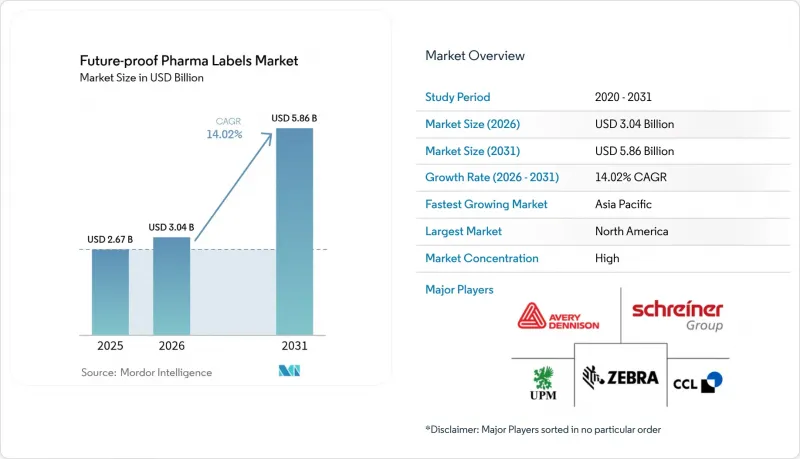
본 보고서는 기술별(RFID, NFC, 센싱 라벨, 듀얼 주파수/하이브리드, 기타), 포장 유형별(블리스터 팩, 주사기·바이알,병, 카톤·키트, 기타), 최종 사용자별(제약 제조업체, 수탁 제조 기업(CMO), 병원·의료 시스템, 기타), 지역별로 분류되어 있습니다. 시장 예측은 금액(달러) 기준으로 제시되어 있습니다.
세계의 미래형 제약 라벨 시장 동향 및 인사이트
일련번호 부여 규정의 최종 준수 기한은 2027-2030년
미국 DSCSA에 따른 단위 수준의 일련번호 부여 규정은 2027년 11월에 로트 수준 요건에서 고유한 제품 식별자 의무화로 전환되며, 모든 처방약 포장에 검증, 추적, 전자 데이터 교환을 지원하는 기계 판독 가능 코드의 표기가 의무화됩니다. EU의 ‘위조 의약품 지침’도 유사한 경로를 따르고 있으며, 회원국별 적용 기한 연장이 같은 시기에 맞추어 마무리됨에 따라 제조업체에게는 전 세계적으로 라벨 부착 라인을 개조하거나 재구축하는 것 외에는 다른 선택지가 없어졌습니다. 도매업체나 조제업자는 출하 또는 조제 전에 코드를 확인해야 하므로, 네트워크 효과로 인해 공장 외부에서의 도입이 가속화되고 있습니다. 그 결과, 기업들은 향후 블록체인 및 IoT의 확대에도 대응 가능한 ‘미래 지향적’ 플랫폼을 우선시하며, 투자 낭비를 피하고 있습니다.
의약품 전자상거래에서의 위조품 급증
세계에서 판매되는 의약품의 약 10%가 위조품인 것으로 추정되며, 이러한 위험은 기존의 육안 검사 단계를 우회하는 소비자 직접 판매 웹 채널을 통해 더욱 증폭되고 있습니다. 스마트폰으로 탭할 수 있는 NFC 및 듀얼 주파수 라벨을 통해 환자는 즉시 진위 여부를 확인할 수 있게 되었으며, 검증의 책임은 최종 사용자에게로 이전되고 있습니다. 신흥 시장의 규제 당국도 이러한 소비자 수준의 인증을 지지하기 시작하면서, 인도, 동남아시아, 아프리카 일부 지역에서 단기적인 수요를 부추기고 있습니다.
NFC/RFID 대역 전반에 걸친 투여량 ID 라벨의 성능 기준 부재
지역별로 RFID에 할당된 주파수 대역이 다르고 데이터 형식에 대한 규정도 달라 상호 운용성에 장애가 발생하고 있습니다. 그 결과, 다국적 기업들은 여러 태그 설계를 동시에 관리할 수밖에 없어 규모의 경제가 저해되고 검증 체계가 복잡해지고 있습니다. NFC와 RFID의 각 주파수 대역에 걸쳐 투여량 식별 기준이 통일되어 있지 않아, 제약 산업의 라벨링에서는 상호 운용성과 신뢰성 확보에 어려움이 발생하고 있습니다. 통일된 기준이 존재하지 않는다는 점은 검증 기간의 장기화, 공급업체 간 호환성 저하, 세계 진출 시 규제상의 장벽을 초래합니다. 그 결과, 특히 높은 신뢰성을 갖춘 실시간 인증을 목적으로 하는 스마트 라벨의 도입은 상당한 지연을 겪고 있습니다.
부문 분석
2025년, 미래형 제약 라벨 시장에서 RFID는 42.05%의 점유율을 차지했습니다. 이는 병원의 약품 캐비닛이나 도매 창고 내의 기존 인프라에 힘입은 결과입니다. 금속으로 된 응급 카트 내에서도 입증된 높은 판독률과 창고 컨베이어와의 호환성이 RFID의 우위를 유지하고 있습니다. 한편, 바이오의약품 제조업체들이 지속적인 온도 및 습도 모니터링을 요구함에 따라 센싱 라벨은 2031년까지 연평균 성장률(CAGR) 15.08%를 나타낼 것으로 예측됩니다. 일괄 판독용 UHF와 소비자가 탭할 수 있는 NFC를 결합한 하이브리드 태그는 옴니채널 물류를 지원하면서 SKU 수를 줄여줍니다. 슈라이너 그룹과 PragmatIC의 제휴를 통해 반경 6mm 바이알에 적합한 초박형 RFID 인레이 개발이 가능해졌으며, 오랫동안 과제로 남아 있던 안테나 코일 문제가 해결되었습니다.
실제로 제약 기업의 고객은 규제 동향에 맞추어 진화하는 기술 스택을 원하고 있기 때문에 공급업체는 블록체인 포인터나 IoT 센서의 페이로드를 저장할 수 있고 펌웨어 업데이트가 가능한 칩을 세트로 제공합니다. 북미의 병원에서는 KitCheck의 검증된 태그를 지정하는 경우가 많기 때문에 전 세계 제조업체들은 검증 감사를 간소화하기 위해 동일한 칩 제품군을 표준화하고 있으며, 이를 통해 미래형 제약 라벨 시장이 더욱 강화되고 있습니다.
지역별 분석
북미는 DSCSA 시행 체크포인트와 병원 내 RFID를 활용한 자동화의 보급에 힘입어 2025년 미래형 제약 라벨 시장 점유율 36.40%를 유지했습니다. 각 주의 약사위원회는 마약류에 기계 판독 가능 식별자 부여를 점점 더 의무화하고 있어, 규정 준수는 필수 사항이 되었습니다. 캐나다는 미국의 많은 프로토콜을 따르고 있기 때문에 국경을 넘나드는 제조업체들은 대개 단일 북미용 라벨 사양을 채택하고 있습니다. 유럽은 이에 뒤이어 매출 규모는 크지만, 발전 속도에는 편차가 보입니다. 스칸디나비아 국가에서는 FMD(의약품 이동 추적 제도)의 디지털화가 거의 완료된 반면, 남유럽 국가에서는 여전히 데이터 허브와의 안정적인 연결이 진행 중입니다. 그럼에도 불구하고, 유럽 의약품 검증 시스템(EMVS)은 일련번호가 부여된 2차원 코드, 기존 데이터 매트릭스 스퀘어 위에 중첩하여 사용되는 이중 주파수 스마트 태그에 대한 안정적인 수주를 뒷받침하고 있습니다.
아시아태평양은 인도와 중국의 급성장하는 수탁 제조 생태계에 힘입어 2031년 연평균 성장률(CAGR)이 15.02%에 달할 전망이며, 가장 빠르게 성장이 예상되는 지역입니다. 인도의 컨버터 기업들은 스마트 라벨 라미네이션에 적합한 자동화된 라이너리스 생산 라인에 투자하고 있는 반면, 중국의 플렉서블 전자 제품 제조 공장은 전 세계 포장 제조업체에 저비용 NFC 칩을 공급하고 있습니다. 한국과 일본 정부는 국내 추적 및 추정 가능성 의무화를 승인하여 지역적 수요를 확대되고 있습니다. 동남아시아의 보건부는 만연한 항생제 위조품 대책으로 스마트폰 기반 인증을 시범적으로 도입하고 있으며, 이는 향후 미래형 제약 라벨 시장 수요를 확대할 조짐으로 보입니다.
중동 및 아프리카에서는 절대적인 금액은 낮지만, 활기찬 지역이 곳곳에 산재해 있습니다. 사우디아라비아의 추적·추적 가능성 포털 ‘Tatmeen’은 수입업체의 RFID 도입을 촉진하고 있으며, 남아프리카의 민간 병원 체인은 암 치료용 주사제에 위조 방지 기능이 탑재된 RFID 라벨의 채택을 요구하고 있습니다. 남미에서는 브라질의 SNCM 일련번호 부여법에 힘입어 점차 도입이 진행되고 있으나, 환율 변동으로 인해 당분간 도입량은 제한될 전망입니다. 전반적으로 신흥 시장의 규제 강화 추세에 힘입어, 미래형 제약 라벨 시장은 2030년까지 모든 대륙에 확산될 것으로 확실시되고 있습니다.
기타 혜택
- 엑셀 형식 시장 예측(ME) 시트
- 3개월간의 애널리스트 지원
자주 묻는 질문
목차
제1장 서론
제2장 조사 방법
제3장 주요 요약
제4장 시장 구도
제5장 시장 규모 및 성장 예측
제6장 경쟁 구도
제7장 시장 기회 및 향후 전망
AJY 26.08.28According to Mordor Intelligence, future-proof pharma labels market size in 2026 is estimated at USD 3.04 billion, growing from 2025 value of USD 2.67 billion with 2031 projections showing USD 5.86 billion, growing at 14.02% CAGR over 2026-2031.
This report is Segmented by Technology (RFID, NFC, Sensing Labels, Dual-Frequency/Hybrid, and More), Packaging Type (Blister Packs, Syringes and Vials, Bottles, Cartons and Kits, and More), End User (Pharmaceutical Manufacturers, Contract Manufacturing Organizations (CMOs), Hospitals and Health Systems, and More), and Geography. The Market Forecasts are Provided in Terms of Value (USD).
Global Future-proof Pharma Labels Market Trends and Insights
Serialization mandates reaching final compliance 2027-30
Unit-level serialization rules under the U.S. DSCSA move from lot-level requirements to mandatory unique product identifiers in November 2027, compelling every prescription drug package to carry a machine-readable code that supports verification, tracing, and electronic data exchange. The EU's Falsified Medicines Directive follows a parallel path, with member-state extensions converging during the same horizon, leaving manufacturers no option but to retrofit or rebuild labeling lines on a global scale. Because wholesalers and dispensers must confirm codes before shipment or dispense, network effects accelerate adoption beyond the factory gate. Companies are consequently prioritizing "future-proof" platforms that also accommodate upcoming blockchain or IoT extensions, avoiding stranded investments.
Escalating pharma e-commerce counterfeits
Roughly 10% of medicines sold globally are estimated to be counterfeit, a risk magnified by direct-to-consumer web channels that bypass traditional visual inspection points. Smartphone-tappable NFC or dual-frequency labels enable patients to instantly confirm authenticity, shifting the verification responsibility to the end user. Emerging-market regulators are beginning to endorse such consumer-level authentication, propelling near-term demand in India, Southeast Asia, and parts of Africa.
Absence of dose-ID performance standards across NFC/RFID bands
Interoperability hurdles arise because different regions allocate varying frequency windows for RFID and specify divergent data-format rules. Multinationals, therefore, juggle multiple tag designs, eroding economies of scale and complicating validation regimes. Pharma labeling struggles with interoperability and reliability due to inconsistent dose-identification standards across NFC and RFID frequency bands. The absence of unified benchmarks extends validation cycles, diminishes cross-vendor compatibility, and introduces regulatory hurdles in global deployments. Consequently, the adoption of smart labels, particularly for high-assurance real-time authentication, faces significant delays.
Other drivers and restraints analyzed in the detailed report include:
- Hospital demand for RFID-based crash-cart and med-room automation
- Rise of temperature-sensitive biologics requiring sensor labels
- Unit-level tag cost >1% of COGS for generics in emerging markets
For complete list of drivers and restraints, kindly check the Table Of Contents.
Segment Analysis
RFID represented 42.05% of the Future-proof Pharma Labels market share in 2025, buoyed by legacy infrastructure inside hospital cabinets and wholesale depots. The tag's proven read-rate in metallic crash carts and its compatibility with warehouse conveyors sustain its dominance. Sensing labels, however, are projected to post a 15.08% CAGR through 2031 as biologic makers request continuous temperature and humidity monitoring. Hybrid tags, which combine UHF for bulk reads and NFC for consumer taps, address omnichannel logistics while reducing SKUs. Schreiner Group's collaboration with PragmatIC enabled the development of an ultra-thin RFID inlay that conforms to 6 mm-radius vials, thereby solving the historical antenna-coil challenge.
In practice, pharma clients want technology stacks that evolve with regulation, so suppliers are bundling firmware-updatable chips that can store blockchain pointers or IoT sensor payloads. Because North American hospitals often specify KitCheck-validated tags, global producers are standardizing on the same chip family to simplify validation audits, further reinforcing the Future-proof Pharma Labels market.
Complete Report Scope:
- By Technology
- RFID
- NFC
- Sensing Labels
- Dual-Frequency / Hybrid
- Others
- By Packaging Type
- Blister Packs
- Syringes and Vials
- Bottles
- Cartons and Kits
- Secondary and Tertiary Logistics Units
- By End User
- Pharmaceutical Manufacturers
- Contract Manufacturing Organizations (CMOs)
- Hospitals and Health Systems
- Pharmacies and Retailers
- Clinical-Trial Sponsors
- By Geography
- North America
- United States
- Canada
- Mexico
- South America
- Brazil
- Argentina
- Chile
- Rest of South America
- Europe
- United Kingdom
- Germany
- France
- Italy
- Spain
- Russia
- Rest of Europe
- Asia-Pacific
- China
- India
- Japan
- South Korea
- Australia
- Rest of Asia-Pacific
- Middle East and Africa
- Middle East
- Saudi Arabia
- United Arab Emirates
- Turkey
- Rest of Middle East
- Africa
- South Africa
- Nigeria
- Rest of Africa
- Middle East
- North America
Geography Analysis
North America retained 36.40% of the Future-proof Pharma Labels market share in 2025, buoyed by DSCSA enforcement checkpoints and widespread RFID hospital automation. State boards of pharmacy increasingly require machine-readable identifiers on narcotics, making compliance non-negotiable. Canada mirrors many U.S. protocols, so cross-border manufacturers often deploy a single North American label spec. Europe follows with sizable revenue but variable speed: Scandinavian states achieve near-full FMD digitalization, whereas Southern Europe still stabilizes data hub connections. The European Medicines Verification System nonetheless underpins steady orders for serialized 2D codes and, increasingly, dual-frequency smart tags that overlay on top of legacy DataMatrix squares.
The Asia-Pacific is the fastest-growing region, with a 15.02% CAGR through 2031, driven by the burgeoning contract-manufacturing ecosystems in India and China. Indian converters invest in automated linerless lines suited to smart-label lamination, while Chinese flexible-electronics fabs supply low-cost NFC chips to global packagers. Governments in South Korea and Japan ratify local track-and-trace mandates, extending regional pull. Southeast Asian health ministries are piloting smartphone-based authentication to combat rampant antibiotic counterfeiting, signaling future purchase orders that will broaden the Future-proof Pharma Labels market.
The Middle East and Africa register lower absolute dollars but post vibrant pockets. Saudi Arabia's track-and-trace portal, Tatmeen, drives RFID adoption among importers, and South Africa's private hospital chains demand tamper-evident RFID labels on oncology injectables. Latin America exhibits a gradual adoption, led by Brazil's SNCM serialization law, although currency volatility tempers immediate volume. Collectively, emerging-market regulatory momentum ensures that the Future-proof Pharma Labels market penetrates every continent before 2030.
- Avery Dennison Corporation
- CCL Industries Inc.
- Zebra Technologies Corporation
- Schreiner Group GmbH & Co. KG
- UPM Adhesive Materials
- Sato Corporation
- Covectra, Inc.
- Loftware, Inc.
- Kit Check, Inc.
- Antares Vision S.p.A.
- OPTEL Group
- TraceLink Inc.
Additional Benefits:
- The market estimate (ME) sheet in Excel format
- 3 months of analyst support
TABLE OF CONTENTS
1 INTRODUCTION
- 1.1 Study Assumptions and Market Definition
- 1.2 Scope of the Study
2 RESEARCH METHODOLOGY
3 EXECUTIVE SUMMARY
4 MARKET LANDSCAPE
- 4.1 Market Overview
- 4.2 Market Drivers
- 4.2.1 Serialization-mandates hitting final compliance triggers 2027-30
- 4.2.2 Escalating pharma e-commerce counterfeits
- 4.2.3 Hospital demand for RFID-based crash-cart and med-room automation
- 4.2.4 Rise of temperature-sensitive biologics requiring sensor-labels
- 4.2.5 Low-cost flexible NFC ICs unlock unit-level adoption
- 4.2.6 Blockchain-linked "digital birth-certificates" for high-value therapies
- 4.3 Market Restraints
- 4.3.1 Lack of dose-ID label performance standards across NFC/RFID bands
- 4.3.2 Unit-level tag cost still > 1 % of COGS for generics in EMs
- 4.3.3 Read-range interference from metals/liquids in small vials
- 4.3.4 Skilled-labor shortage for label-data integration in CMOs
- 4.4 Industry Supply-Chain Analysis
- 4.5 Regulatory Landscape
- 4.6 Technological Outlook
- 4.7 Porter's Five Forces Analysis
- 4.7.1 Threat of New Entrants
- 4.7.2 Bargaining Power of Suppliers
- 4.7.3 Bargaining Power of Buyers
- 4.7.4 Threat of Substitutes
- 4.7.5 Industry Rivalry
5 MARKET SIZE AND GROWTH FORECASTS (VALUE)
- 5.1 By Technology
- 5.1.1 RFID
- 5.1.2 NFC
- 5.1.3 Sensing Labels
- 5.1.4 Dual-Frequency / Hybrid
- 5.1.5 Others
- 5.2 By Packaging Type
- 5.2.1 Blister Packs
- 5.2.2 Syringes and Vials
- 5.2.3 Bottles
- 5.2.4 Cartons and Kits
- 5.2.5 Secondary and Tertiary Logistics Units
- 5.3 By End User
- 5.3.1 Pharmaceutical Manufacturers
- 5.3.2 Contract Manufacturing Organizations (CMOs)
- 5.3.3 Hospitals and Health Systems
- 5.3.4 Pharmacies and Retailers
- 5.3.5 Clinical-Trial Sponsors
- 5.4 By Geography
- 5.4.1 North America
- 5.4.1.1 United States
- 5.4.1.2 Canada
- 5.4.1.3 Mexico
- 5.4.2 South America
- 5.4.2.1 Brazil
- 5.4.2.2 Argentina
- 5.4.2.3 Chile
- 5.4.2.4 Rest of South America
- 5.4.3 Europe
- 5.4.3.1 United Kingdom
- 5.4.3.2 Germany
- 5.4.3.3 France
- 5.4.3.4 Italy
- 5.4.3.5 Spain
- 5.4.3.6 Russia
- 5.4.3.7 Rest of Europe
- 5.4.4 Asia-Pacific
- 5.4.4.1 China
- 5.4.4.2 India
- 5.4.4.3 Japan
- 5.4.4.4 South Korea
- 5.4.4.5 Australia
- 5.4.4.6 Rest of Asia-Pacific
- 5.4.5 Middle East and Africa
- 5.4.5.1 Middle East
- 5.4.5.1.1 Saudi Arabia
- 5.4.5.1.2 United Arab Emirates
- 5.4.5.1.3 Turkey
- 5.4.5.1.4 Rest of Middle East
- 5.4.5.2 Africa
- 5.4.5.2.1 South Africa
- 5.4.5.2.2 Nigeria
- 5.4.5.2.3 Rest of Africa
- 5.4.5.1 Middle East
- 5.4.1 North America
6 COMPETITIVE LANDSCAPE
- 6.1 Market Concentration
- 6.2 Strategic Moves
- 6.3 Market Share Analysis
- 6.4 Company Profiles (includes Global level Overview, Market level overview, Core Segments, Financials as available, Strategic Information, Market Rank/Share for key companies, Products and Services, and Recent Developments)
- 6.4.1 Avery Dennison Corporation
- 6.4.2 CCL Industries Inc.
- 6.4.3 Zebra Technologies Corporation
- 6.4.4 Schreiner Group GmbH & Co. KG
- 6.4.5 UPM Adhesive Materials
- 6.4.6 Sato Corporation
- 6.4.7 Covectra, Inc.
- 6.4.8 Loftware, Inc.
- 6.4.9 Kit Check, Inc.
- 6.4.10 Antares Vision S.p.A.
- 6.4.11 OPTEL Group
- 6.4.12 TraceLink Inc.
7 MARKET OPPORTUNITIES AND FUTURE OUTLOOK
- 7.1 White-space and Unmet-need Assessment