

|
시장보고서
상품코드
2115182
발전소 제어 시스템 시장 : 점유율 분석, 업계 동향과 통계, 성장 예측(2026-2031년)Power Plant Control System - Market Share Analysis, Industry Trends & Statistics, Growth Forecasts (2026 - 2031) |
||||||
 Mordor Intelligence
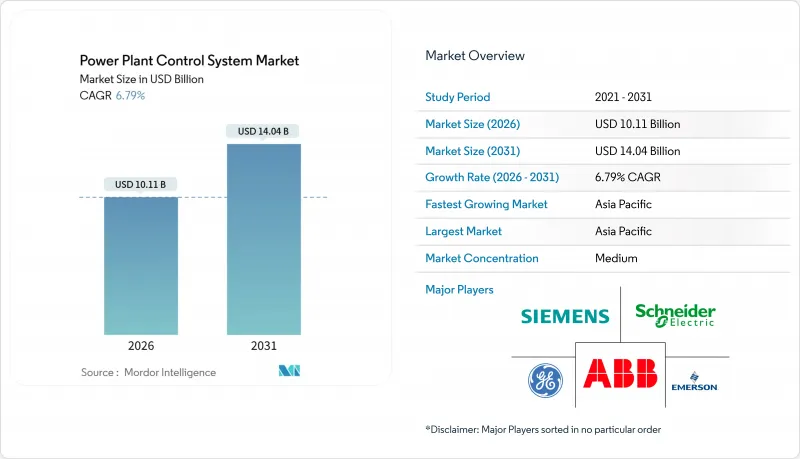
Mordor Intelligence에 의하면, 발전소 제어 시스템 시장 규모는 2026년에 101억 1,000만 달러로 추정되고 있어 예측 기간(2026-2031년)에서 CAGR 6.79%로 확대되어 2031년에는 140억 4,000만 달러에 이를 전망입니다.
본 보고서는 솔루션별(감시 제어·데이터 수집(SCADA), 분산 제어 시스템(DCS), 플랜트 자산 관리 등), 구성 요소별(하드웨어 및 소프트웨어), 플랜트 유형별(화력, 원자력, 재생에너지), 지역별(북미, 유럽,아시아태평양, 남미, 중동 및 아프리카)로 분류되어 있습니다. 시장 규모 및 전망은 금액(달러)으로 표시되어 있습니다.
전 세계 발전소 제어 시스템 시장 동향 및 인사이트
에너지 믹스 내 재생에너지 통합이 진전
변동성이 큰 재생에너지는 이미 OECD 국가 전체 설비 용량의 30% 이상을 차지하고 있으며, 송전망 운영자는 기존 제어 장치로는 대응할 수 없는 최대 40%에 달하는 15분 단위의 태양광 발전 출력 변동에 직면해 있습니다. 새로 도입되는 SCADA 시스템은 분산형 태양광, 풍력 및 배터리 자산을 조정 가능한 블록으로 통합하여, 제어 센터가 현장의 개입 없이 출력 변동 지시를 내릴 수 있도록 합니다. 전력 회사는 변전소 및 발전 유닛이 서브사이클 단위로 데이터를 교환할 수 있도록, 시리얼 링크에서 IEC 61850 이더넷 백본으로의 전환을 추진하고 있습니다. 북해의 해상 풍력 발전소와 라자스탄 주의 태양광 발전소가 중앙 제어실을 도입함에 따라, 이러한 추세의 영향은 2027년부터 2029년까지 정점에 달할 것으로 예측됩니다.
노후화된 발전소의 업그레이드 및 현대화
2025년까지 미국 및 유럽의 석탄 화력 발전 설비의 약 60%가 가동 40년을 초과함에 따라, 소유주들은 배출 규제의 강화에 대응하면서 설비 수명을 최대 20년까지 연장하는 디지털 개조를 추진하고 있습니다. 콘스텔레이션 에너지(Constellation Energy)는 2026년 1월, 리머릭 원자력 발전소에서 아날로그 패널을 디지털 계측 장비로 교체하기 위해 1억 6,700만 달러를 계상했으며, 이를 통해 원격 냉각재 모니터링 및 자동 부하 추적이 가능해집니다. 경제적 이점은 설득력이 있습니다. 500MW 유닛당 5,000만 달러의 비용이 드는 개조를 통해 10억 달러의 설비 갱신 비용을 미룰 수 있습니다.
막대한 설비 투자와 복잡한 통합
500 MW 석탄 화력 발전 유닛의 개보수에는 일반적으로 4,000만-6,000만 달러의 비용이 소요되며, 이 지출액은 더 저렴한 재생에너지의 증설과 경쟁하게 됩니다. 새로운 SCADA를 1990년대의 PLC와 통합하려면 맞춤형 미들웨어가 필요하며, 이로 인해 시운전에 6-12개월의 추가 기간이 소요됩니다. 폴란드의 벨차토프 발전소에서는 단계적인 전환이 이루어졌기 때문에 2025년까지 발전 단위의 절반이 아날로그 제어 상태로 유지될 예정입니다.
부문 분석
SCADA 시장 점유율은 2025년에 27.5%에 그쳤지만, 전력 회사가 전체 포트폴리오에서 재생에너지의 균형을 맞추기 위해 광역적인 가시성을 추구하는 가운데 연평균 성장률(CAGR) 8.1%를 나타낼 것으로 예측되며, 이는 각 솔루션 중 가장 높은 성장률입니다. 분산 제어 시스템(DCS)은 42.6%의 점유율을 유지하고 있으며, 화력 및 원자력 발전 설비에서 1초 미만의 루프 제어에 있어 여전히 필수적인 존재입니다. SCADA 솔루션 중 발전소 제어 시스템 시장 규모는 가상 발전소 조정에 대한 수요 증가를 반영하여 2031년까지 51억 달러에 달할 것으로 예측됩니다. GE Vernova와 같은 벤더들은 현재 디스패치 센터에 혼합 정수 최적화 기능을 통합하고 있으며, 이를 통해 운영자는 5분마다 설정값을 조정할 수 있게 되었습니다. SCADA의 성장은 시장이 발전소 중심의 자동화에서 발전 설비군 수준의 조정으로 전환되고 있음을 보여줍니다.
이러한 가속화에는 전략적인 영향이 따릅니다. 과거 전력 회사는 보일러나 터빈의 효율에 중점을 두었으나, 현재는 50-100개의 자산을 단일 조정 가능한 블록으로 통합하고 있습니다. GE Vernova가 2025년 사우디아라비아에 도입한 시스템은 12GW의 용량을 통합하여 피크 시간대의 연료 소비량을 7% 절감했습니다. 이러한 이용 사례는 지리적으로 분산된 자산에 필요한 네트워크 기능이나 연산 능력을 갖추지 못했던 기존의 DCS로는 실현할 수 없었습니다. 그 결과, 2031년에 이르기까지 SCADA는 발전소 제어 시스템 시장에서 DCS와의 격차를 점차 좁혀갈 전망입니다.
지역별 분석
아시아태평양은 2025년에 37.1%의 점유율로 1위를 차지하며, 연평균 성장률(CAGR) 7.9%를 나타낼 것으로 예측됩니다. 인도의 500GW라는 재생에너지 목표와 중국의 초고압 송전망 구축을 위해서는 각 성의 계통 운영 센터와 발전소 수준의 제어 장치 간에 밀리초 단위의 연동이 요구됩니다. 2025년 NTPC가 Bharat Heavy Electricals사에 발주한 1억 8,000만 달러 규모의 프로젝트에서는 6기의 석탄 화력 발전 유닛에 디지털 배출량 모니터가 사후 설치되었습니다. 이는 재생에너지 도입에 따라 화력 발전소의 현대화가 진행되고 있음을 보여줍니다. 중국 국가전망은 45억 달러를 투자하여 화웨이의 ‘FusionSolar’를 활용해 120GW 규모의 분산형 태양광 발전망을 구축함으로써, 전력 혼잡 시 집중적인 출력 억제가 가능하도록 했습니다.
북미에서는 ‘인프라 투자 및 고용법(IIJA)’ 자금과 미국 에너지부(DOE)의 ‘그리드 복원력’ 보조금을 활용하여, NERC CIP-013에 따라 사이버 위협에 대한 제어 계층의 복원력을 강화하고 있습니다. 테네시강 유역 개발 공사(TVA)가 2025년에 에머슨(Emerson)사와 체결한 계약에는 IEC 62443에 기반한 세분화과 실시간 침입 감지 기능이 통합되어 있습니다. 유럽에서도 이와 유사한 엄격한 기준이 의무화되어 있으며, 독일에서는 2027년까지 100MW를 초과하는 모든 발전소에 디지털 자동화가 의무화되어 있습니다. 또한 지멘스 에너지(Siemens Energy)는 유럽의 모범 사례를 중동에 적용함으로써 15억 유로 규모의 계약을 수주했습니다. 두 지역 모두에서 중시되는 것은 수명 주기 관리 소프트웨어와 지속적인 패치 적용입니다.
중동 및 아프리카에서는 사우디아라비아와 아랍에미리트(UAE)가 에너지 포트폴리오 다각화를 추진하는 가운데, 한 자릿수 후반대의 높은 성장률을 기록하고 있습니다. 남미는 정책의 변동성으로 인해 뒤처지고 있지만, 브라질의 엘레트로브라스(Eletrobras) 민영화로 인해 수력 발전 제어 시스템 업그레이드를 위한 자금이 확보되었습니다. 성숙한 경제권에서는 사이버 보안과 분석이 우선시되는 반면, 신흥 시장에서는 하드웨어의 신뢰성과 공급업체의 자금 조달을 중시하고 있어, 발전소 제어 시스템 시장에서 지역별 조달 방침의 차이가 두드러지고 있습니다.
기타 혜택:
- 엑셀 형식 시장 예측(ME) 시트
- 3개월간의 애널리스트 지원
자주 묻는 질문
목차
제1장 서론
제2장 조사 방법
제3장 주요 요약
제4장 시장 구도
제5장 시장 규모와 성장 예측
제6장 경쟁 구도
제7장 시장 기회와 향후 전망
JHS 26.08.26According to Mordor Intelligence, the power plant control system market size is estimated at USD 10.11 billion in 2026, and is expected to reach USD 14.04 billion by 2031, at a CAGR of 6.79% during the forecast period (2026-2031).
This report is Segmented by Solution (Supervisory Control and Data Acquisition, Distributed Control System, Plant Asset Management, and More), Component (Hardware and Software), Plant Type (Thermal, Nuclear, and Renewables), and Geography (North America, Europe, Asia-Pacific, South America, and Middle East and Africa). The Market Sizes and Forecasts are Provided in Terms of Value (USD).
Global Power Plant Control System Market Trends and Insights
Rising Integration of Renewables in Energy Mix
Variable renewables already provide more than 30% of installed capacity across OECD countries, exposing grid operators to 15-minute solar ramps of up to 40% that legacy governors cannot counteract. New SCADA deployments aggregate distributed solar, wind, and battery assets into dispatchable blocks, allowing control centers to issue ramp commands without on-site intervention. Utilities are migrating from serial links to IEC 61850 Ethernet backbones so that substations and generation units exchange data within sub-cycle intervals. The driver influence peaks between 2027 and 2029 as offshore wind in the North Sea and solar parks in Rajasthan adopt centralized control rooms.
Upgrade and Modernization of Aging Power Plants
Roughly 60% of coal-fired capacity in the United States and Europe exceeded 40 years in service by 2025, steering owners toward digital retrofits that extend life by up to two decades while achieving tighter emissions limits. Constellation Energy earmarked USD 167 million in January 2026 to replace analog panels with digital instrumentation at its Limerick nuclear station, enabling remote coolant monitoring and automated load following. The economic argument is compelling: retrofits that cost USD 50 million per 500 MW unit defer the USD 1 billion replacement expense.
High Capex and Complex Integration
Retrofitting a 500 MW coal unit typically costs USD 40-60 million, an outlay competing with cheaper renewable additions. Integrating new SCADA with 1990s-era PLCs requires custom middleware that adds 6-12 months to commissioning, as seen at Poland's Belchatow power station, where phased cutovers kept half the units on analog controls through 2025.
Other drivers and restraints analyzed in the detailed report include:
- Digitalization and IIoT Adoption Across Utilities
- AI-Driven Predictive Maintenance Analytics
- Semiconductor Supply-Chain Constraints
For complete list of drivers and restraints, kindly check the Table Of Contents.
Segment Analysis
SCADA captured only 27.5% in 2025 but is forecast to grow at an 8.1% CAGR, the fastest among solutions, as utilities pursue wide-area visibility that balances renewables across portfolios. Distributed Control Systems retained 42.6% and remain indispensable for sub-second loop control in thermal and nuclear units. The Power Plant Control System market size for SCADA solutions is projected to reach USD 5.1 billion by 2031, reflecting the escalating need for virtual power plant coordination. Vendors such as GE Vernova now embed mixed-integer optimization in dispatch centers, enabling operators to adjust setpoints every five minutes. SCADA growth illustrates the market's shift from plant-centric automation to fleet-level orchestration.
The acceleration has strategic consequences. Utilities once focused on boiler or turbine efficiency; now they assemble 50-100 assets into a single dispatchable block. GE Vernova's 2025 installation in Saudi Arabia aggregated 12 GW of capacity, slashing peak-period fuel consumption by 7%. Such use cases were out of reach for traditional DCS that lacked the networking and compute muscle required for geographically dispersed assets. Consequently, SCADA is set to narrow the gap with DCS in the Power Plant Control System market through 2031.
Complete Report Scope:
- By Solution
- Supervisory Control and Data Acquisition (SCADA)
- Programmable Logic Controller (PLC)
- Distributed Control System (DCS)
- Plant Asset Management (PAM)
- Plant Lifecycle Management (PLM)
- By Component
- Hardware
- Software
- By Plant Type
- Thermal
- Nuclear
- Renewables
- By Geography
- North America
- United States
- Canada
- Mexico
- Europe
- Germany
- United Kingdom
- France
- Italy
- Spain
- NORDIC Countries
- Russia
- Rest of Europe
- Asia-Pacific
- China
- India
- Japan
- South Korea
- ASEAN Countries
- Australia and New Zealand
- Rest of Asia-Pacific
- South America
- Brazil
- Argentina
- Colombia
- Rest of South America
- Middle East and Africa
- Saudi Arabia
- United Arab Emirates
- South Africa
- Egypt
- Rest of Middle East and Africa
- North America
Geography Analysis
Asia-Pacific led with a 37.1% share in 2025 and is projected to grow at a 7.9% CAGR. India's 500 GW renewable target and China's ultra-high-voltage backbone require millisecond coordination between provincial dispatch centers and plant-level controllers. NTPC's USD 180 million order for Bharat Heavy Electricals in 2025 retrofits six coal units with digital emissions monitors, showing that thermal modernization accompanies renewable additions. China's State Grid invested USD 4.5 billion to network 120 GW of distributed solar via Huawei's FusionSolar, enabling centralized curtailment during congestion.
North America leverages Infrastructure Investment and Jobs Act funds and DOE Grid Resilience grants to harden control layers against cyber threats under NERC CIP-013. Tennessee Valley Authority's 2025 Emerson deal integrates IEC 62443 segmentation and real-time intrusion detection. Europe mandates similar rigor; Germany requires digital automation for all >100 MW plants by 2027, and Siemens Energy secured EUR 1.5 billion in Middle East contracts by exporting European best practices. The emphasis across both regions is on lifecycle-management software and continuous patching.
The Middle East and Africa register high-single-digit growth as Saudi Arabia and the UAE diversify energy portfolios. South America trails due to policy volatility, yet Brazil's Eletrobras privatization unlocks capital for hydro-control upgrades. Mature economies prioritize cybersecurity and analytics, while emerging markets focus on hardware reliability paired with vendor financing, illustrating divergent regional procurement paths within the Power Plant Control System market.
- ABB Ltd
- Siemens AG
- General Electric Company
- Emerson Electric Co.
- Schneider Electric SE
- Honeywell International Inc.
- Mitsubishi Power Ltd.
- Yokogawa Electric Corporation
- Rockwell Automation Inc.
- Toshiba Energy Systems & Solutions
- Endress+Hauser AG
- Valmet Oyj
- Hitachi Energy Ltd.
- DF Power Systems Pvt. Ltd.
- Doosan Enerbility Co., Ltd.
- Bharat Heavy Electricals Ltd. (BHEL)
- Hyundai Electric & Energy Systems
- Fuji Electric Co., Ltd.
- Ingeteam Power Technology
- WAGO Kontakttechnik GmbH
Additional Benefits:
- The market estimate (ME) sheet in Excel format
- 3 months of analyst support
TABLE OF CONTENTS
1 Introduction
- 1.1 Study Assumptions & Market Definition
- 1.2 Scope of the Study
2 Research Methodology
3 Executive Summary
4 Market Landscape
- 4.1 Market Overview
- 4.2 Market Drivers
- 4.2.1 Rising integration of renewables in energy-mix
- 4.2.2 Upgrade & modernization of aging power plants
- 4.2.3 Digitalization & IIoT adoption across utilities
- 4.2.4 Government incentives for grid stability & emissions cuts
- 4.2.5 Mandatory cyber-security standards for critical infrastructure
- 4.2.6 AI-driven predictive maintenance analytics
- 4.3 Market Restraints
- 4.3.1 Growing shift toward distributed energy resources
- 4.3.2 High capex & complex integration
- 4.3.3 Semiconductor supply-chain constraints
- 4.3.4 Shortage of skilled digital-control operators
- 4.4 Supply-Chain Analysis
- 4.5 Regulatory Landscape
- 4.6 Technological Outlook
- 4.7 Porter's Five Forces
- 4.7.1 Bargaining Power of Suppliers
- 4.7.2 Bargaining Power of Buyers
- 4.7.3 Threat of New Entrants
- 4.7.4 Threat of Substitutes
- 4.7.5 Competitive Rivalry
5 Market Size & Growth Forecasts
- 5.1 By Solution
- 5.1.1 Supervisory Control and Data Acquisition (SCADA)
- 5.1.2 Programmable Logic Controller (PLC)
- 5.1.3 Distributed Control System (DCS)
- 5.1.4 Plant Asset Management (PAM)
- 5.1.5 Plant Lifecycle Management (PLM)
- 5.2 By Component
- 5.2.1 Hardware
- 5.2.2 Software
- 5.3 By Plant Type
- 5.3.1 Thermal
- 5.3.2 Nuclear
- 5.3.3 Renewables
- 5.4 By Geography
- 5.4.1 North America
- 5.4.1.1 United States
- 5.4.1.2 Canada
- 5.4.1.3 Mexico
- 5.4.2 Europe
- 5.4.2.1 Germany
- 5.4.2.2 United Kingdom
- 5.4.2.3 France
- 5.4.2.4 Italy
- 5.4.2.5 Spain
- 5.4.2.6 NORDIC Countries
- 5.4.2.7 Russia
- 5.4.2.8 Rest of Europe
- 5.4.3 Asia-Pacific
- 5.4.3.1 China
- 5.4.3.2 India
- 5.4.3.3 Japan
- 5.4.3.4 South Korea
- 5.4.3.5 ASEAN Countries
- 5.4.3.6 Australia and New Zealand
- 5.4.3.7 Rest of Asia-Pacific
- 5.4.4 South America
- 5.4.4.1 Brazil
- 5.4.4.2 Argentina
- 5.4.4.3 Colombia
- 5.4.4.4 Rest of South America
- 5.4.5 Middle East and Africa
- 5.4.5.1 Saudi Arabia
- 5.4.5.2 United Arab Emirates
- 5.4.5.3 South Africa
- 5.4.5.4 Egypt
- 5.4.5.5 Rest of Middle East and Africa
- 5.4.1 North America
6 Competitive Landscape
- 6.1 Market Concentration
- 6.2 Strategic Moves (M&A, Partnerships, PPAs)
- 6.3 Market Share Analysis (Market Rank/Share for key companies)
- 6.4 Company Profiles (includes Global level Overview, Market level overview, Core Segments, Financials as available, Strategic Information, Products & Services, and Recent Developments)
- 6.4.1 ABB Ltd
- 6.4.2 Siemens AG
- 6.4.3 General Electric Company
- 6.4.4 Emerson Electric Co.
- 6.4.5 Schneider Electric SE
- 6.4.6 Honeywell International Inc.
- 6.4.7 Mitsubishi Power Ltd.
- 6.4.8 Yokogawa Electric Corporation
- 6.4.9 Rockwell Automation Inc.
- 6.4.10 Toshiba Energy Systems & Solutions
- 6.4.11 Endress+Hauser AG
- 6.4.12 Valmet Oyj
- 6.4.13 Hitachi Energy Ltd.
- 6.4.14 DF Power Systems Pvt. Ltd.
- 6.4.15 Doosan Enerbility Co., Ltd.
- 6.4.16 Bharat Heavy Electricals Ltd. (BHEL)
- 6.4.17 Hyundai Electric & Energy Systems
- 6.4.18 Fuji Electric Co., Ltd.
- 6.4.19 Ingeteam Power Technology
- 6.4.20 WAGO Kontakttechnik GmbH
7 Market Opportunities & Future Outlook
- 7.1 White-space & Unmet-need Assessment


