

|
시장보고서
상품코드
2115196
마그네타이트 나노입자 시장 : 점유율 분석, 업계 동향과 통계, 성장 예측(2026-2031년)Magnetite Nanoparticles - Market Share Analysis, Industry Trends & Statistics, Growth Forecasts (2026 - 2031) |
||||||
 Mordor Intelligence
Mordor Intelligence에 의하면, 마그네타이트 나노입자 시장 규모는 2025년에 861억 7,000만 달러로 평가되었고 2026년 944억 6,000만 달러에서 2031년까지 1,494억 4,000만 달러에 이를 것으로 예측되며, 예측 기간(2026-2031년) CAGR은 9.62%를 나타낼 전망입니다.
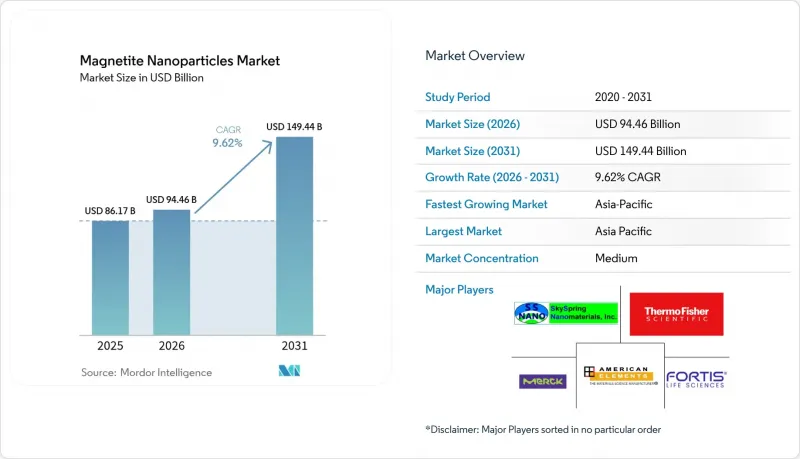
본 보고서는 입자 크기(20 Nm 미만, 20-50 Nm, 기타), 합성 방법(공침법, 열분해법, 기타), 표면 코팅(비코팅, 폴리머 코팅, 기타),용도(생물의학, 전자, 기타), 지역(아시아태평양, 북미, 유럽, 남미, 중동 및 아프리카)별로 분류되어 있습니다. 시장 전망은 금액(달러) 기준으로 제시되어 있습니다.
전 세계 마그네타이트 나노입자 시장 동향 및 인사이트
전자 산업계 수요 증가
나노 스케일에서의 초상자성은 에너지 손실 없이 가역적인 자화를 가능하게 하며, 이 특성은 고밀도 데이터 저장 장치에서 높이 평가받고 있습니다. 마그네타이트 기반 잉크를 통해 미세한 자기장에 반응하는 플렉서블 센서 및 소프트 로보틱스용 액추에이터의 구현이 가능해졌으며, 이는 소비자용 전자 기기의 소형화 목표를 달성하고 있습니다. 입자 직경과 표면 화학을 조절할 수 있기 때문에 설계자는 일부 희토류 자석을 대체할 수 있으며, 이는 지속가능성 요구 사항에도 부합합니다. 실험실 연구에 따르면, 정밀하게 설계된 도메인을 통해 스위칭 속도가 향상되는 것으로 나타났으며, 이는 뉴로모픽 칩에 필수적인 요건입니다. 아시아의 생산 라인에서 생산이 확대됨에 따라 단가가 하락하여 차세대 전자 분야에서 더욱 광범위한 채택이 가능해질 것입니다.
폐수 처리 분야에서의 활용 확대
엄격한 배출 규제로 인해 상수도 유틸리티자들은 중금속, 염료, 미세 플라스틱을 90% 이상의 효율로 제거하면서 동시에 자력 분리 및 촉매 재사용을 가능하게 하는 마그네타이트 나노입자 흡착제의 도입을 가속화하고 있습니다. 기능화된 표면은 현재 의약품 잔류물 제거를 목적으로 하고 있으며, 처리 시설이 새롭게 설정된 미량 오염 물질 기준을 준수하는 데 기여하고 있습니다. 회수된 입자는 여러 번 재생이 가능하며, 슬러지 양을 줄일 수 있어 지자체는 이 기술의 순환형 접근 방식을 높이 평가했습니다. 산업 분야의 기업들은 마그네타이트를 바이오숯과 결합함으로써 염료가 다량 포함된 섬유 산업 폐수의 흡착 능력을 높이고 있습니다. 유럽의 파일럿 플랜트에서는 활성탄에 비해 운영 비용 절감이 입증되어, 지자체들의 시설 개보수 계획이 잇따르고 있습니다.
원자재 가격 변동
마그네타이트 원료 가격은 철광석 시장의 전체 주기와 연동되어 있으며, 장기 계약에 가격 연동 조항이 없는 경우 생산자는 이익률을 압박하는 가격 변동 위험에 노출됩니다. 전 세계 마그네타이트 매장량의 40%를 보유한 호주에서는 2025-26 회계연도의 수출 수입이 감소할 것으로 예측되어, 나노입자 사용자들의 협상력이 제한될 전망입니다. 생산자들은 헤지나 스크랩 재활용을 도입하고 있지만, 경기 침체기에는 확장을 위한 자본 예산이 부족해집니다. 가격 변동은 고정 가격 보장이 주류를 이루는 정부 자금 지원 환경 프로젝트의 입찰 과정을 복잡하게 만들고 있습니다. 자사 소유 광석 자산에 대한 수직 통합을 강화하면 가격 변동으로 인한 충격을 완화할 수 있지만, 막대한 초기 투자가 필요합니다.
부문 분석
20 nm에서 50 nm 사이의 입자는 2025년 생산량의 41.65%를 차지하며, 높은 자기 모멘트와 현탁 안정성 사이의 균형이 잘 잡혀 있어 분리용 수지 및 MRI 추적자에 이상적입니다. 그러나 20 nm 미만의 입자는 첨단 치료법 개발자들이 생체막 투과 능력을 활용하고 있기 때문에 연평균 성장률(CAGR)이 12.61%로 가장 높습니다. 양자 크기 효과로 인해 자기 결정 이방성이 감소하여, 생체 내 안전한 사용에 필수적인 급속한 감자(demagnetization)가 보장됩니다. 또한, 직경이 작을수록 촉매 표면적이 증가하여 수소 발생 시 확산 경로가 단축됩니다. 각 제조업체는 규모를 확대할 때 오스트왈트 성숙화 현상을 극복해야 하는 과제에 직면해 있지만, 연속 유동 반응기를 사용한 파일럿 라인은 유망한 결과를 보여주고 있습니다.
50-100 nm 범위의 입자는 자기 열 냉각 및 벌크 분리에 적합하며, 더 강한 자화가 침전 위험을 상쇄합니다. 100 nm를 초과하면 용도는 견고한 자기 필터나 진동 댐퍼용 페로플루이드로 제한됩니다. 앞으로 공정 최적화와 통계적 관리의 강화에 따라 생산량은 20 nm 미만의 영역으로 이동할 것이며, 마그네타이트 나노입자 시장의 구성이 재편될 전망입니다.
공침법은 단순한 염, 상압, 저렴한 반응 장치를 사용하기 때문에 2025년에는 전 세계 생산량의 46.78%를 차지했습니다. 그러나 배치 간 제품 편차로 인해 고객들은 고정밀 요구 사항을 충족하기 위한 대안을 모색하고 있습니다. 졸-겔법은 좁은 입자 크기 분포와 균일한 표면 화학적 특성을 얻을 수 있기 때문에 마그네타이트 나노입자 시장 전체를 상회하는 연평균 성장률(CAGR) 11.98%로 성장을 지속하고, 있습니다. 실리카 매트릭스 내에서 제어된 가수분해를 통해, 약제 부착 및 서방형에 최적화된 다공성 마그네타이트 구체를 얻을 수 있습니다.
열분해법은 단분산 시드 입자를 얻기 위해 실험실에서는 여전히 널리 사용되고 있지만, 유기 용매에 의존하기 때문에 대규모 생산 시 비용 및 환경 문제가 발생하고 있습니다. 마이크로 에멀젼법으로는 10 nm 미만의 입자를 얻을 수 있지만, 계면활성제 제거라는 과제를 안고 있습니다. 연구자들은 에너지 절약과 결정성 조절이 가능할 것으로 기대되는 상압 마이크로 플라즈마법의 시범 운영을 진행하고 있습니다. 이 기술의 채택 여부는 나노 스케일의 정밀도를 해치지 않으면서 톤 규모의 처리 능력을 입증할 수 있는지에 달려 있습니다.
지역별 분석
아시아태평양은 2025년에 마그네타이트 나노입자 시장 매출의 44.35%를 차지하고, 각국 정부가 나노기술 연구 개발에 300억 달러 이상을 투자하고 있어 연평균 성장률(CAGR) 11.75%로 성장을 지속하고 있습니다. 중국의 특허 건수가 많다는 점은 현지 기업들이 다국적 기업과 라이선싱 계약이나 공동 개발 계약을 협상할 때 협상상의 우위를 가져다주고 있습니다. 선전과 쑤저우의 클러스터에서는 전구체 염에서 표면 개질 분산액에 이르기까지 일관된 공급망이 구축되어 있어, 수출처 고객에 대한 리드타임을 단축하고 있습니다. 인도와 한국은 각각 의료기기 제조 및 반도체 패키징에 대한 우대 조치를 통해 시장에 활력을 불어넣고 있습니다.
북미는 고도의 생의학 연구 역량과 국방 지출을 활용하여 프리미엄 틈새 시장을 유지하고 있습니다. 미국은 자기 유도 요법의 임상 적용을 주도하는 한편, 캐나다는 국내 마그네타이트를 부가가치가 높은 하류 제품으로 전환하는 ‘채굴에서 나노 소재까지’ 프로젝트를 지원하고 있습니다. 그러나 인건비 급등과 엄격한 산업안전 규제로 인해 대량 생산이 제한되고 있어, 이 지역은 범용 등급 제품에 있어 순수입 지역이 되었습니다.
유럽은 수질 지침 및 순환형 경제 요건을 충족하기 위해 마그네타이트 흡착제를 활용하여 지속가능성 목표를 추구하고 있습니다. ‘호라이즌 유럽(Horizon Europe)’ 등의 협력 네트워크는 그린 수소 계획에서 마그네타이트 촉매의 유효성을 검증하는 파일럿 플랜트에 자금을 지원하고 있습니다. 그러나 엄격한 REACH 규제로 인해 인증 주기가 장기화되고 있어, 일부 생산이 아시아의 위탁 공장으로 이관되어 완제품 형태로 재수입되는 사례가 나타나고 있습니다. 남미, 중동 및 아프리카에서는 광업, 석유, 농업 각 부문이 비용 대비 효과가 높은 토양 정화 기술 및 촉매 기술을 요구하고 있어 초기 단계의 비즈니스 기회가 예상되지만, 인프라 및 인력 부족으로 인해 보급이 지연되고 있습니다.
기타 혜택:
- 엑셀 형식 시장 예측(ME) 시트
- 3개월간의 애널리스트 지원
자주 묻는 질문
목차
제1장 서론
제2장 조사 방법
제3장 주요 요약
제4장 시장 구도
제5장 시장 규모와 성장 예측
제6장 경쟁 구도
제7장 시장 기회와 향후 전망
JHS 26.08.26According to Mordor Intelligence, the magnetite nanoparticles market size was valued at USD 86.17 billion in 2025 and estimated to grow from USD 94.46 billion in 2026 to reach USD 149.44 billion by 2031, at a CAGR of 9.62% during the forecast period (2026-2031).
This report is Segmented by Particle Size (less Than 20 Nm, 20-50 Nm, and More), Synthesis Method (Co-Precipitation, Thermal Decomposition, and More), Surface Coating (Uncoated, Polymer-Coated, and More), Application (Biomedical, Electronics, and More), and Geography (Asia-Pacific, North America, Europe, South America, Middle East and Africa). The Market Forecasts are Provided in Terms of Value (USD).
Global Magnetite Nanoparticles Market Trends and Insights
Rising Demand from Electronics Industry
Superparamagnetism at the nanoscale grants reversible magnetization without energy loss, a trait prized for high-density data storage devices. Magnetite-based inks now enable flexible sensors and soft-robotic actuators that respond to modest magnetic fields, meeting miniaturization goals in consumer electronics. Tunable particle size and surface chemistry allow designers to replace some rare-earth magnets, aligning with sustainability imperatives. Laboratory studies show precisely engineered domains boosting switching speed, a prerequisite for neuromorphic chips. As fabrication lines in Asia widen production, unit costs decline, unlocking broader adoption in next-generation electronics.
Growing Use in Wastewater Treatment
Stringent discharge rules spur utilities to deploy magnetite nanoparticle adsorbents that remove heavy metals, dyes, and microplastics at >=90% efficiency while enabling magnetic separation and catalyst re-use. Functionalized surfaces now target pharmaceutical residues, helping plants comply with emerging micropollutant limits. Cities favor the technology's circular profile because recovered particles can be regenerated multiple times, lowering sludge volumes. Industrial players integrate magnetite composites with biochar to elevate adsorption capacity in dye-rich textile effluent. European pilot plants validate operational savings relative to activated carbon, catalyzing a pipeline of municipal upgrades.
Raw-Material Price Volatility
Magnetite feedstock prices track the wider iron ore cycle, exposing producers to swings that erode margins when long-term contracts lack indexation. Australia, holder of 40% of global magnetite resources, forecasts export receipts to soften in FY 2025-26, limiting negotiating leverage for nanoparticle users. Producers adopt hedging and recycling scrap flows, but capital budgets for expansion tighten during downturns. Volatility complicates tender bids in government-funded environmental projects where fixed-price guarantees prevail. Greater vertical integration into captive ore assets could cushion shocks yet requires large up-front investment.
Other drivers and restraints analyzed in the detailed report include:
- Expansion of Biomedical Applications
- Adoption in Additive-Manufacturing Composites
- Industrial-Scale Size-Uniformity Challenges
For complete list of drivers and restraints, kindly check the Table Of Contents.
Segment Analysis
Particles between 20 nm and 50 nm held 41.65% of 2025 volume, balancing high magnetic moment with suspension stability-ideal for separation resins and MRI tracers. Yet particles below 20 nm score the highest 12.61% CAGR as advanced therapy developers exploit their ability to cross biological membranes. Quantum size effects lower magnetocrystalline anisotropy, ensuring rapid demagnetization-essential for safe in-vivo use. Smaller diameters also boost catalytic surface area, shortening diffusion paths in hydrogen evolution. Manufacturers battle Ostwald ripening during scale-up, but pilot lines using continuous flow reactors show promise.
Particles in the 50-100 nm bracket cater to magnetocaloric cooling and bulk separations where stronger magnetization offsets settling risk. Beyond 100 nm, usage narrows to heavy-duty magnetic filters and ferrofluids in vibration dampers. Over time, process optimization and tighter statistical control are likely to tilt output toward the sub-20 nm tier, reshaping the magnetite nanoparticles market mix.
Co-precipitation generated 46.78% of global tonnage in 2025 because it uses simple salts, ambient pressure, and affordable reactors. However, product variation across batches spurs customers to seek alternatives for high-precision needs. Sol-gel lines achieve narrow size distributions and uniform surface chemistry, stimulating a 11.98% CAGR that outpaces the wider magnetite nanoparticles market. Controlled hydrolysis inside silica matrices yields porous magnetite spheres ideal for drug loading and sustained release.
Thermal decomposition remains popular in laboratories for monodisperse seeds but its reliance on organic solvents raises cost and environmental concerns at scale. Micro-emulsion paths enable sub-10 nm particles yet suffer from surfactant removal challenges. Researchers are piloting atmospheric pressure microplasma routes that promise energy savings and tailorable crystallinity. Adoption hinges on demonstration of ton-scale throughput without losing nanoscale precision.
Complete Report Scope:
- By Particle Size
- less than 20 nm
- 20-50 nm
- 50-100 nm
- greater than 100 nm
- By Synthesis Method
- Co-precipitation
- Thermal Decomposition
- Micro-emulsion
- Sol-Gel
- Others
- By Surface Coating
- Uncoated
- Polymer-coated
- Silica-coated
- Gold-coated
- Other Coatings
- By Application
- Biomedical
- Electronics
- Wastewater Treatment
- Energy
- Other Applications
- By Geography
- Asia-Pacific
- China
- India
- Japan
- South Korea
- ASEAN Countries
- Rest of Asia-Pacific
- North America
- United States
- Canada
- Mexico
- Europe
- Germany
- United Kingdom
- France
- Italy
- Spain
- NORDIC Countries
- Rest of Europe
- South America
- Brazil
- Argentina
- Rest of South America
- Middle East and Africa
- Saudi Arabia
- United Arab Emirates
- South Africa
- Rest of Middle East and Africa
- Asia-Pacific
Geography Analysis
Asia-Pacific generated 44.35% of magnetite nanoparticles market revenue in 2025 and continues to grow at 11.75% CAGR as governments funnel more than USD 30 billion into nanotech R&D. China's patent volume grants local firms bargaining power when negotiating licensing or joint-development deals with multinationals. Clusters in Shenzhen and Suzhou host integrated supply chains from precursor salts to surface-modified dispersions, trimming lead times for export customers. India and South Korea add momentum through incentives for medical-device manufacturing and semiconductor packaging, respectively.
North America leverages deep biomedical research capacity and defense spending to sustain premium niches. The United States leads clinical translation of magnetically guided therapies, while Canada supports mining-to-nanomaterial projects that channel domestic magnetite ores into high-value downstream products. Nevertheless, higher labor costs and stricter workplace safety rules restrain mass-scale production, making the region a net importer for commodity grades.
Europe pursues sustainability goals, using magnetite adsorbents to meet water-quality directives and circular-economy mandates. Collaboration networks such as Horizon Europe finance pilot plants that validate magnetite catalysts in green-hydrogen schemes. Stringent REACH regulations, however, elongate certification cycles, nudging some production to contract plants in Asia before re-import as finished formulations. South America and the Middle East & Africa present early-stage opportunities as mining, oil, and agricultural sectors look for cost-effective remediation and catalytic technologies, but infrastructure and skills shortages slow uptake.
- American Elements
- Ascensus
- Cytodiagnostics Inc
- Fortis Life Sciences
- Imagion Biosystems, Ltd.
- Merck KGaA
- NanoComposix
- Nanoshel LLC
- NNCrystal US Corporation
- Sinosteel New Materials Co., Ltd.
- SkySpring Nanomaterials Inc.
- Thermo Fisher Scientific Inc.
- US Research Nanomaterials Inc.
Additional Benefits:
- The market estimate (ME) sheet in Excel format
- 3 months of analyst support
TABLE OF CONTENTS
1 Introduction
- 1.1 Study Assumptions and Market Definition
- 1.2 Scope of the Study
2 Research Methodology
3 Executive Summary
4 Market Landscape
- 4.1 Market Overview
- 4.2 Market Drivers
- 4.2.1 Rising demand from electronics industry
- 4.2.2 Growing use in wastewater treatment
- 4.2.3 Expansion of biomedical applications
- 4.2.4 Adoption in additive-manufacturing composites
- 4.2.5 Catalytic role in green-ammonia and hydrogen value chains
- 4.3 Market Restraints
- 4.3.1 Raw-material price volatility
- 4.3.2 Industrial-scale size-uniformity challenges
- 4.3.3 Competition from high-performance ferrite substitutes
- 4.4 Value Chain Analysis
- 4.5 Porter's Five Forces
- 4.5.1 Bargaining Power of Suppliers
- 4.5.2 Bargaining Power of Buyers
- 4.5.3 Threat of New Entrants
- 4.5.4 Threat of Substitutes
- 4.5.5 Competitive Rivalry
5 Market Size and Growth Forecasts (Value)
- 5.1 By Particle Size
- 5.1.1 less than 20 nm
- 5.1.2 20-50 nm
- 5.1.3 50-100 nm
- 5.1.4 greater than 100 nm
- 5.2 By Synthesis Method
- 5.2.1 Co-precipitation
- 5.2.2 Thermal Decomposition
- 5.2.3 Micro-emulsion
- 5.2.4 Sol-Gel
- 5.2.5 Others
- 5.3 By Surface Coating
- 5.3.1 Uncoated
- 5.3.2 Polymer-coated
- 5.3.3 Silica-coated
- 5.3.4 Gold-coated
- 5.3.5 Other Coatings
- 5.4 By Application
- 5.4.1 Biomedical
- 5.4.2 Electronics
- 5.4.3 Wastewater Treatment
- 5.4.4 Energy
- 5.4.5 Other Applications
- 5.5 By Geography
- 5.5.1 Asia-Pacific
- 5.5.1.1 China
- 5.5.1.2 India
- 5.5.1.3 Japan
- 5.5.1.4 South Korea
- 5.5.1.5 ASEAN Countries
- 5.5.1.6 Rest of Asia-Pacific
- 5.5.2 North America
- 5.5.2.1 United States
- 5.5.2.2 Canada
- 5.5.2.3 Mexico
- 5.5.3 Europe
- 5.5.3.1 Germany
- 5.5.3.2 United Kingdom
- 5.5.3.3 France
- 5.5.3.4 Italy
- 5.5.3.5 Spain
- 5.5.3.6 NORDIC Countries
- 5.5.3.7 Rest of Europe
- 5.5.4 South America
- 5.5.4.1 Brazil
- 5.5.4.2 Argentina
- 5.5.4.3 Rest of South America
- 5.5.5 Middle East and Africa
- 5.5.5.1 Saudi Arabia
- 5.5.5.2 United Arab Emirates
- 5.5.5.3 South Africa
- 5.5.5.4 Rest of Middle East and Africa
- 5.5.1 Asia-Pacific
6 Competitive Landscape
- 6.1 Market Concentration
- 6.2 Strategic Moves
- 6.3 Market Share(%)/Ranking Analysis
- 6.4 Company Profiles (includes Global level Overview, Market level overview, Core Segments, Financials as available, Strategic Information, Market Rank/Share for key companies, Products and Services, and Recent Developments)
- 6.4.1 American Elements
- 6.4.2 Ascensus
- 6.4.3 Cytodiagnostics Inc
- 6.4.4 Fortis Life Sciences
- 6.4.5 Imagion Biosystems, Ltd.
- 6.4.6 Merck KGaA
- 6.4.7 NanoComposix
- 6.4.8 Nanoshel LLC
- 6.4.9 NNCrystal US Corporation
- 6.4.10 Sinosteel New Materials Co., Ltd.
- 6.4.11 SkySpring Nanomaterials Inc.
- 6.4.12 Thermo Fisher Scientific Inc.
- 6.4.13 US Research Nanomaterials Inc.
7 Market Opportunities and Future Outlook
- 7.1 White-space and Unmet-need Assessment


