

|
시장보고서
상품코드
2115202
나노 자기 디바이스 시장 : 시장 점유율 분석, 업계 동향 및 통계, 성장 예측(2026-2031년)Nano-Magnetic Devices - Market Share Analysis, Industry Trends & Statistics, Growth Forecasts (2026 - 2031) |
||||||
 Mordor Intelligence
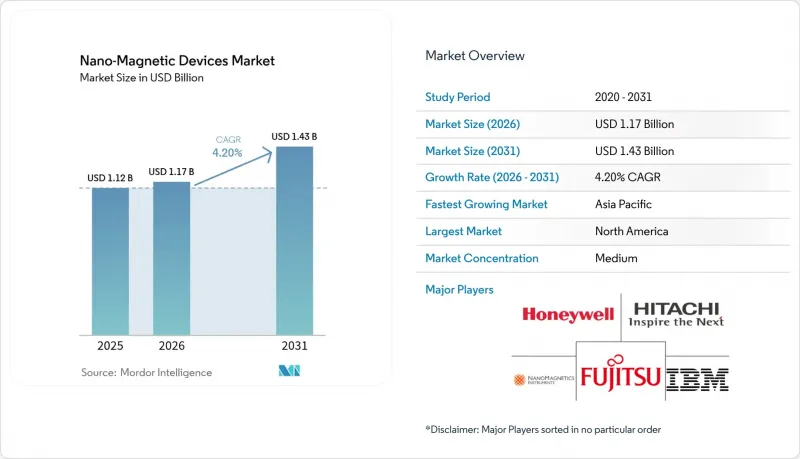
Mordor Intelligence에 의하면, 나노 자기 디바이스 시장 규모는 2025년 11억 2,000만 달러로 평가되었고, 2026년에는 11억 7,000만 달러로 추정되고, 2026-2031년 CAGR 4.20%로 성장을 지속할 전망이며, 2031년까지 14억 3,000만 달러에 이를 것으로 예측됩니다.
본 보고서는 유형별(센서, 데이터 저장 장치, 이미징 장치, 액추에이터·로직 장치, 기타), 기술별(자기저항, 스핀 전이 토크(STT), 전압 제어형 자기 이방성별(VCMA), 기타), 최종 이용 산업별(IT 및 통신(데이터센터), 에너지 및 유틸리티, 기타), 지역별로 분류되어 있습니다. 시장 예측은 금액(달러) 기준으로 제시되어 있습니다.
세계의 나노 자기 디바이스 시장 동향 및 인사이트
OTA 펌웨어 업데이트용 MRAM의 자동차 산업 내 인증
자동차 OEM 업체들은 현재 무제한 쓰기 사이클을 견디는 MRAM을 인증하여, 소프트웨어 정의 차량(SDV)에서 플래시 메모리의 마모에 대한 우려를 해소하고 있습니다. TSMC의 임베디드형 MRAM을 통해 데이터 유출 없이 빈번한 OTA(Over-The-Air) 패치 관리를 수행하는 마이크로컨트롤러가 실현됩니다. TDK는 ASIL D 안전 기준을 준수하고 최대 150°C에서 작동 가능한 이중화형 TMR 각도 센서 ‘TAS8240’을 발표하며 시장의 성장세를 더욱 공고히 했습니다. 전기차 생산 대수는 27% 증가할 것으로 예측되며, 배터리 및 구동계 모듈에서의 자기 센싱에 대한 수요가 높아지고 있습니다. 견고한 메모리 내구성과 고정밀 센싱이 결합된 나노 자기 디바이스 시장은 미래의 자동차 전자 장치를 뒷받침하는 핵심 기술로서 확고한 입지를 다지고 있습니다.
GMR/TMR 센서 IC 생산용 300mm 팹 업그레이드
동아시아의 파운드리 기업들은 300mm 웨이퍼 상의 스핀 궤도 토크(SOT)형 MTJ에 대해 99.6%의 수율을 확인했습니다. 스위칭 전류는 2ns에서 680μA, TMR 비율은 119% 이상을 달성했습니다. 이러한 수율 향상으로 단가가 하락하여, 제조업체는 단일 다이 위에 다축 센서를 통합할 수 있게 되었습니다. 도호쿠 대학이 제정한 1nm급 MTJ 관련 가이드라인에 따르면, 150°C 환경에서 10년 이상의 데이터 보존을 실현하면서도 10ns 이하의 속도를 유지하고 있습니다. EUV 리소그래피는 현재 5nm의 해상도에 도달하여, 추가적인 미세화를 주도하고 있습니다. 비용 경쟁력이 있는 고밀도 센서는 가전 및 산업용 자동화 부문에서의 채택을 확대하며, 나노 자기 디바이스 시장의 성장을 가속화하고 있습니다.
코발트·갈륨에 대한 중요 광물 수출 규제
세계 갈륨 공급량의 98%를 중국이 차지하고 있기 때문에 수출 금지 조치가 시행될 경우 미국의 GDP는 34억 달러 감소할 가능성이 있으며, 갈륨 가격은 150% 이상 급등할 우려가 있습니다. 갈륨 비소 및 질화 갈륨 소자는 RF 모듈 내에서 자기 센서와 결합되는 경우가 많기 때문에 공급 부족은 나노 자기 디바이스 시장 전체로 파급될 것입니다. GaN에 의존하는 미국 국방부의 레이더 현대화 계획은 전략적 위험을 더욱 높이고 있습니다. 재활용 노력과 AI를 활용한 자석 설계를 통해 위험을 완화하고자 하고 있지만, 단기적으로는 가격 변동이 지속될 것으로 보입니다.
부문 분석
2025년에는 자동차, 산업용, 모바일 제품을 주축으로 센서가 나노 자기 디바이스 시장의 41.05%를 차지했습니다. 한편, 데이터 저장 장치는 연평균 성장률(CAGR) 6.01%를 기록하며, 저장용 나노 자기 디바이스 시장 규모를 2026년 2억 4,000만 달러에서 2031년까지 3억 3,000만 달러로 끌어올릴 전망입니다. MRAM의 비휘발성 및 내방사선성은 우주 탐사선 및 전기자동차에서의 채택을 촉진하고 있습니다. 이미징 디바이스는 생체 자기 신호를 포착하는 초고감도 xMR 구성 요소 덕분에 성장세가 가속화되고 있으며, 새로운 수익원을 창출하고 있습니다.
MRAM의 무제한 수명은 플래시 메모리를 능가하여 승용차의 OTA 병목 현상을 해소합니다. 획기적인 3차원 자기 기록 기술은 10Tbit/in²의 용량을 실현하여 HDD의 중요성을 유지합니다. 신기술인 스핀 로직은 메모리와 연산 기능을 통합하여 인메모리 처리의 패러다임을 예고하고 있습니다.
홀 효과 센서는 저렴한 비용과 성숙한 공급망 덕분에 2025년에는 센서 매출의 41.08%를 차지했습니다. TMR 센서는 연평균 성장률(CAGR) 5.61%로 확대되고 있으며, 300mm 팹의 생산량이 증가함에 따라 가격 차이가 줄어들고 있습니다. 이중화된 각도 센서 ‘TAS8240’은 ISO 26262 ASIL D를 준수하며, 자동차 부문에서의 도입 준비가 완료되었음을 보여줍니다.
GMR은 감도와 합리적인 가격의 균형을 맞추며 중급 시장의 틈새 부문을 차지하고 있습니다. 자기변형식 센서는 EMI 내성이 필수적인 항공우주 부문의 유압 제어에서 뛰어난 성능을 발휘합니다. TMR 기반 디지털 나침반은 보정 후 방위각 오차를 4.18°에서 0.46°로 대폭 줄여 드론의 항법 정확도를 향상시킵니다. 오프셋 보정 기능을 갖춘 새로운 3축 실리콘 홀 센서는 감도를 198V/(A·T)까지 향상시켜, 홀 센서 제품군에도 여전히 혁신의 여지가 있음을 보여줍니다.
지역별 분석
2025년, 북미는 나노 자기 디바이스 시장의 31.25%를 차지했습니다. 이는 방사선 내성 MRAM이 필요한 국방 및 우주 프로그램에 힘입은 결과입니다. 대학과 산업계의 강력한 협력을 통해 CHIPS법의 자금을 활용하여 뉴로모픽 스핀 전자 칩의 프로토타입 개발이 진행되고 있습니다. 이 지역의 항공우주 공급망에서는 비용보다 메모리의 내구성이 중시되어, 높은 가격 책정을 뒷받침하고 있습니다.
아시아태평양은 일본, 한국, 중국의 300mm 팹 증산으로 인해 연평균 성장률(CAGR) 4.83%를 나타낼 것으로 예측됩니다. 중국에서 NdFeB 나노 복합 자석으로의 전환은 국내 터빈 제조업체를 강화하며 전 세계에 파급 효과를 가져오고 있습니다. 일본과 한국의 AMR(자율주행 로봇)에 3D LiDAR 및 자기 융합 센서가 도입되면서 스마트 팩토리의 확장이 뒷받침되고 있습니다.
유럽은 ‘칩스 조인트 언더테이킹(Chips Joint Undertaking)’ 프로젝트에 158억 유로를 배정하여, 스카이무 이온형 뉴로모픽 컴퓨팅 부문에서 독보적인 입지를 확립하고 있습니다. 독일의 자동차 생태계에서는 ASIL D를 준수하는 TMR 센서가 요구되는 반면, 프랑스와 벨기에의 연구 기관들은 고NA EUV 리소그래피를 주도하고 있습니다. 남미와 중동 같은 신흥 지역에서는 다국적 OEM의 기술 이전을 활용하여 전력망 안정화 및 산업 자동화를 위해 나노 자기 디바이스를 도입하고 있습니다.
기타 혜택
- 엑셀 형식 시장 예측(ME) 시트
- 3개월간 애널리스트의 지원
자주 묻는 질문
목차
제1장 서론
제2장 조사 방법
제3장 주요 요약
제4장 시장 구도
제5장 시장 규모 및 성장 예측
제6장 경쟁 구도
제7장 시장 기회 및 향후 전망
AJY 26.08.28According to Mordor Intelligence, the nano-magnetic devices market size is expected to grow from USD 1.12 billion in 2025 to USD 1.17 billion in 2026 and is forecast to reach USD 1.43 billion by 2031 at 4.20% CAGR over 2026-2031.
This report is Segmented by Type (Sensors, Data Storage Devices, Imaging Devices, Actuators and Logic Devices, and More), Technology (Magneto-Resistive, Spin-Transfer Torque (STT), Voltage-Controlled Magnetic Anisotropy (VCMA), and More), End-Use Vertical (IT and Telecom (Data Centers), Energy and Utilities, and More), and Geography. The Market Forecasts are Provided in Terms of Value (USD).
Global Nano-Magnetic Devices Market Trends and Insights
Automotive Qualification of MRAM for OTA Firmware Updates
Automotive OEMs now certify MRAM that endures unlimited write cycles, eliminating the wear-out concerns of flash memory in software-defined vehicles. TSMC's embedded MRAM enables microcontrollers that manage frequent over-the-air patches without data corruption. TDK reinforced momentum by unveiling the TAS8240 redundant TMR angle sensor that complies with ASIL D safety norms while operating up to 150 °C. Electric-vehicle production is projected to rise 27%, intensifying demand for magnetic sensing in battery and drivetrain modules. Together, robust memory endurance and high-precision sensing cement the nano-magnetic devices market as a core enabler for future automotive electronics.
300 mm Fab Upgrades for GMR/TMR Sensor IC Production
East-Asian foundries have validated 99.6% yield for spin-orbit-torque MTJs on 300 mm wafers, with switching currents of 680 µA at 2 ns and TMR ratios above 119%. These yields drive down unit costs and let manufacturers integrate multi-axis sensors on a single die. Tohoku University guidelines on single-nanometer MTJs secure data retention beyond 10 years at 150 °C while retaining sub-10 ns speed. EUV lithography now reaches 5 nm resolution, guiding further miniaturization. Cost-competitive high-density sensors broaden adoption in consumer electronics and industrial automation, accelerating the nano-magnetic devices market.
Critical Mineral Export Controls on Cobalt and Gallium
China supplies 98% of global gallium, so potential export bans could shave USD 3.4 billion from U.S. GDP and lift gallium prices more than 150%. Gallium arsenide and gallium nitride devices often co-package with magnetic sensors in RF modules, so shortages reverberate through the nano-magnetic devices market. The Pentagon's radar modernization that relies on GaN further heightens strategic exposure. Recycling initiatives and AI-guided magnet design aim to mitigate risk, but near-term volatility persists.
Other drivers and restraints analyzed in the detailed report include:
- Radiation-Hard Spintronic Memory Demand for Deep-Space Missions
- Shift to NdFeB Nano-Composite Magnets in Chinese Wind Turbines
- Sub-10 nm Patterning Yield Losses in Nano-Magnet Fabrication
For complete list of drivers and restraints, kindly check the Table Of Contents.
Segment Analysis
Sensors dominated 41.05% of the nano-magnetic devices market in 2025, anchored in automotive, industrial, and mobile products. Data storage devices, however, clock a 6.01% CAGR, propelling the nano-magnetic devices market size for storage from USD 0.24 billion in 2026 to USD 0.33 billion by 2031. MRAM's non-volatility and radiation tolerance underpin adoption in space probes and electric vehicles. Imaging devices gain traction thanks to ultra-sensitive xMR components that capture biomagnetic signals, creating new revenue pools.
MRAM's unlimited endurance outperforms flash, removing OTA bottlenecks in passenger vehicles. Breakthrough 3-D magnetic recording promises 10 Tbit/in2 capacities, sustaining HDD relevance. Emerging spin-logic integrates memory and compute, foreshadowing in-memory processing paradigms.
Hall-effect sensors held 41.08% of sensor revenue in 2025 due to low cost and mature supply chains. TMR sensors expand at 5.61% CAGR, narrowing the price gap as 300 mm fabs ramp volume. The TAS8240 redundant angle sensor meets ISO 26262 ASIL D, signaling automotive readiness.
GMR occupies mid-tier niches, balancing sensitivity with affordability. Magnetostrictive sensors excel in aerospace hydraulic controls where EMI immunity is vital. TMR-based digital compasses slash azimuth errors from 4.18° to 0.46° after calibration, improving drone navigation. A new 3-axis silicon Hall sensor with offset cancellation lifts sensitivity to 198 V A-1 T-1, showing the Hall family can still innovate.
Complete Report Scope:
- By Type
- Sensors
- Magnetic Field Sensors
- Hall-Effect Sensors
- GMR Sensors
- TMR Sensors
- Magnetostrictive Sensors
- Data Storage Devices
- MRAM
- Spintronic HDD Read Heads
- Tape Storage Heads
- Imaging Devices
- Magnetic Particle Imaging Systems
- Nano-MRI Coils
- Actuators and Logic Devices
- Spintronic Logic/Transistors
- Micromotors and Actuators
- Other Nano-Magnetic Components
- Antenna and RF Devices
- Sensors
- By Technology
- Magnetoresistive
- Spin-Transfer Torque (STT)
- Voltage-Controlled Magnetic Anisotropy (VCMA)
- Superparamagnetic Nanoparticles
- By End-use Vertical
- Consumer Electronics
- IT and Telecom (Data Centers)
- Automotive and Transportation
- Aerospace and Defense
- Healthcare and Medical Devices
- Energy and Utilities (Wind, Power Converters)
- Industrial Automation and Robotics
- Others (Research and Education)
- By Geography
- North America
- United States
- Canada
- Mexico
- Europe
- Germany
- United Kingdom
- France
- Nordics
- Rest of Europe
- South America
- Brazil
- Rest of South America
- Asia-Pacific
- China
- Japan
- India
- South-East Asia
- Rest of Asia-Pacific
- Middle East and Africa
- Middle East
- Gulf Cooperation Council Countries
- Turkey
- Rest of Middle East
- Africa
- South Africa
- Rest of Africa
- Middle East
- North America
Geography Analysis
North America captured 31.25% of the nano-magnetic devices market in 2025, propelled by defense and space programs requiring radiation-tolerant MRAM. Robust university-industry collaborations harness CHIPS Act funding to prototype neuromorphic spintronic chips. The region's aerospace supply chain values memory endurance over cost, supporting premium pricing.
Asia-Pacific is projected to post a 4.83% CAGR, benefitting from 300 mm fab ramps in Japan, Korea, and China. China's shift to NdFeB nano-composite magnets strengthens domestic turbine makers and sparks global trickle-down effects. Deployment of 3-D LiDAR-magnetic fusion sensors in Japanese and Korean AMRs underpins smart-factory expansion.
Europe allocates EUR 15.8 billion for Chips Joint Undertaking projects, carving a niche in skyrmionic neuromorphic computing. Germany's automotive ecosystem demands ASIL D-compliant TMR sensors, while French and Belgian institutes spearhead High-NA EUV lithography. Emerging regions in South America and the Middle East embrace nano-magnetic devices for grid stability and industrial automation, leveraging technology transfer from multinational OEMs.
- IBM Corporation
- Intel Corporation
- Everspin Technologies Inc.
- Honeywell International Inc.
- NVE Corporation
- Avalanche Technology Inc.
- Fujitsu Limited
- Siemens AG
- Infineon Technologies AG
- TDK Corporation
- Hitachi Metals Ltd.
- Samsung Electronics Co., Ltd.
- Western Digital Technologies Inc.
- Seagate Technology PLC
- Crocus Nano Electronics
- Spin Transfer Technologies
- Analog Devices Inc.
- NXP Semiconductors N.V.
- Micron Technology Inc.
- Bosch Sensortec GmbH
- Renesas Electronics Corporation
- STMicroelectronics N.V.
Additional Benefits:
- The market estimate (ME) sheet in Excel format
- 3 months of analyst support
TABLE OF CONTENTS
1 INTRODUCTION
- 1.1 Study Assumptions and Market Definition
- 1.2 Scope of the Study
2 RESEARCH METHODOLOGY
3 EXECUTIVE SUMMARY
4 MARKET LANDSCAPE
- 4.1 Market Overview
- 4.2 Market Drivers
- 4.2.1 Automotive Qualification of MRAM for OTA Firmware Updates in EU and United States Vehicles
- 4.2.2 300 mm Fab Upgrades for GMR/TMR Sensor IC Production in East Asia
- 4.2.3 Radiation-Hard Spintronic Memory Demand for Deep-Space Missions in North America and Europe
- 4.2.4 Shift to NdFeB Nano-Composite Magnets in Chinese Wind Turbines
- 4.2.5 CHIPS and Science Act + EU Chips Act Funding Allocated to Spintronics R&D
- 4.2.6 Deployment of 3-D Lidar-Magnetic Fusion Sensors in Japanese and Korean AMRs
- 4.3 Market Restraints
- 4.3.1 Critical Mineral Export Controls on Cobalt and Gallium
- 4.3.2 Sub-10 nm Patterning Yield Losses in Nano-Magnet Fabrication
- 4.3.3 Areal Density Limits (Less than 3 Tb/sq. inch) for Next-Gen HDDs
- 4.3.4 Lack of IEC/JEDEC Standards for TMR-Sensor Reliability
- 4.4 Industry Ecosystem Analysis
- 4.5 Technological Outlook
- 4.6 Porter's Five Forces Analysis
- 4.6.1 Threat of New Entrants
- 4.6.2 Bargaining Power of Buyers/Consumers
- 4.6.3 Bargaining Power of Suppliers
- 4.6.4 Threat of Substitute Products
- 4.6.5 Intensity of Competitive Rivalry
5 Market Size and Growth Forecasts
- 5.1 By Type
- 5.1.1 Sensors
- 5.1.1.1 Magnetic Field Sensors
- 5.1.1.2 Hall-Effect Sensors
- 5.1.1.3 GMR Sensors
- 5.1.1.4 TMR Sensors
- 5.1.1.5 Magnetostrictive Sensors
- 5.1.2 Data Storage Devices
- 5.1.2.1 MRAM
- 5.1.2.2 Spintronic HDD Read Heads
- 5.1.2.3 Tape Storage Heads
- 5.1.3 Imaging Devices
- 5.1.3.1 Magnetic Particle Imaging Systems
- 5.1.3.2 Nano-MRI Coils
- 5.1.4 Actuators and Logic Devices
- 5.1.4.1 Spintronic Logic/Transistors
- 5.1.4.2 Micromotors and Actuators
- 5.1.5 Other Nano-Magnetic Components
- 5.1.5.1 Antenna and RF Devices
- 5.1.1 Sensors
- 5.2 By Technology
- 5.2.1 Magnetoresistive
- 5.2.2 Spin-Transfer Torque (STT)
- 5.2.3 Voltage-Controlled Magnetic Anisotropy (VCMA)
- 5.2.4 Superparamagnetic Nanoparticles
- 5.3 By End-use Vertical
- 5.3.1 Consumer Electronics
- 5.3.2 IT and Telecom (Data Centers)
- 5.3.3 Automotive and Transportation
- 5.3.4 Aerospace and Defense
- 5.3.5 Healthcare and Medical Devices
- 5.3.6 Energy and Utilities (Wind, Power Converters)
- 5.3.7 Industrial Automation and Robotics
- 5.3.8 Others (Research and Education)
- 5.4 By Geography
- 5.4.1 North America
- 5.4.1.1 United States
- 5.4.1.2 Canada
- 5.4.1.3 Mexico
- 5.4.2 Europe
- 5.4.2.1 Germany
- 5.4.2.2 United Kingdom
- 5.4.2.3 France
- 5.4.2.4 Nordics
- 5.4.2.5 Rest of Europe
- 5.4.3 South America
- 5.4.3.1 Brazil
- 5.4.3.2 Rest of South America
- 5.4.4 Asia-Pacific
- 5.4.4.1 China
- 5.4.4.2 Japan
- 5.4.4.3 India
- 5.4.4.4 South-East Asia
- 5.4.4.5 Rest of Asia-Pacific
- 5.4.5 Middle East and Africa
- 5.4.5.1 Middle East
- 5.4.5.1.1 Gulf Cooperation Council Countries
- 5.4.5.1.2 Turkey
- 5.4.5.1.3 Rest of Middle East
- 5.4.5.2 Africa
- 5.4.5.2.1 South Africa
- 5.4.5.2.2 Rest of Africa
- 5.4.5.1 Middle East
- 5.4.1 North America
6 COMPETITIVE LANDSCAPE
- 6.1 Market Concentration
- 6.2 Strategic Moves
- 6.3 Market Share Analysis
- 6.4 Company Profiles {(includes Global level Overview, Market level overview, Core Segments, Financials as available, Strategic Information, Market Rank/Share for key companies, Products and Services, and Recent Developments)}
- 6.4.1 IBM Corporation
- 6.4.2 Intel Corporation
- 6.4.3 Everspin Technologies Inc.
- 6.4.4 Honeywell International Inc.
- 6.4.5 NVE Corporation
- 6.4.6 Avalanche Technology Inc.
- 6.4.7 Fujitsu Limited
- 6.4.8 Siemens AG
- 6.4.9 Infineon Technologies AG
- 6.4.10 TDK Corporation
- 6.4.11 Hitachi Metals Ltd.
- 6.4.12 Samsung Electronics Co., Ltd.
- 6.4.13 Western Digital Technologies Inc.
- 6.4.14 Seagate Technology PLC
- 6.4.15 Crocus Nano Electronics
- 6.4.16 Spin Transfer Technologies
- 6.4.17 Analog Devices Inc.
- 6.4.18 NXP Semiconductors N.V.
- 6.4.19 Micron Technology Inc.
- 6.4.20 Bosch Sensortec GmbH
- 6.4.21 Renesas Electronics Corporation
- 6.4.22 STMicroelectronics N.V.
7 MARKET OPPORTUNITIES AND FUTURE OUTLOOK
- 7.1 White-Space and Unmet-Need Assessment


