

|
시장보고서
상품코드
2115213
유럽의 전술용 UAV 시장 : 시장 점유율 분석, 업계 동향 및 통계, 성장 예측(2026-2031년)Europe Tactical UAV - Market Share Analysis, Industry Trends & Statistics, Growth Forecasts (2026 - 2031) |
||||||
 Mordor Intelligence
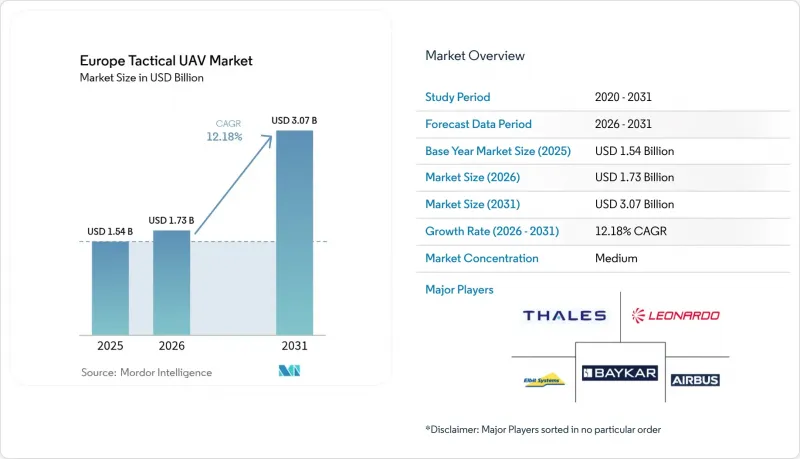
Mordor Intelligence에 의하면, 유럽의 전술용 UAV 시장 규모는 2025년 15억 4,000만 달러로 평가되었고, 2026년에는 17억 3,000만 달러로 추정되고, 2026-2031년 CAGR 12.18%로 성장을 지속할 전망이며, 2031년에는 30억 7,000만 달러에 이를 것으로 예측됩니다.
본 보고서는 플랫폼 유형별(고정익, 회전익, 하이브리드 VTOL), 중량별(5kg 이하 마이크로/나노, 그 이상), 항속 거리 카테고리(50km 이하 단거리, 그 이상), 추진 방식별(전기, 하이브리드, 기존 방식(ICE)), 용도별(군사, 법 집행 기관, 기타), 지역별(영국, 프랑스, 기타)로 분류되어 있습니다. 시장 예측은 금액(달러)으로 표시되어 있습니다.
유럽의 전술용 UAV 시장 동향 및 인사이트
방위 예산 배분 증가가 ISR 중심의 조달을 견인
각국의 국방부는 2024년도 전술용 UAV 예산을 지난 20년 동안 가장 빠른 속도로 증액했습니다. 그 선두에는 독일이 8.2% 증가한 521억 유로(557억 달러), 프랑스가 7.4% 증가한 472억 유로(505억 달러)로 각각 예산을 증액한 것이 있습니다. 영국은 2034년까지의 무인 플랫폼 예산으로 38억 파운드(47억 달러)를 확보했으며, 이는 이전 계획 대비 45%의 대폭적인 증가를 기록했습니다. 폴란드는 전술용 UAV 예산을 2배인 8억 9,000만 달러로 확대하며, 최전선에서의 시급성을 부각시켰습니다. 자금 조달 흐름은 공·육·사이버 자산에서 수집된 실시간 데이터를 통합하는 다영역 작전을 점점 더 중시하는 방향으로 나아가고 있습니다. 이러한 예산의 호조로 인해 유럽 전술용 무인항공기(UAV) 시장에서 향후 수년에 걸친 수주 전망이 확보되었습니다.
우크라이나 분쟁이 촉발한 전술용 UAV의 긴급 수요
우크라이나에서 전해지는 전투 영상은 정찰, 포격 유도, 정밀 공격 분야에서 소형 드론의 다용도성을 여실히 보여주었으며, NATO 회원국들로 하여금 요구 사항을 재검토하도록 촉발했습니다. 독일은 1,200대, 3억 4,000만 유로(3억 6,400만 달러) 상당의 조달을 서둘렀고, 프랑스도 전장의 공백을 메우기 위해 800대를 우선적으로 도입했습니다. 현재 기획 담당자들은 GPS를 이용할 수 없는 환경에서의 항법, 전자전에 대한 내성 강화, 자율적인 군집 비행을 요구 사항으로 명시하고 있습니다. 이러한 기준은 공급업체들의 로드맵을 재구성하며, 유럽 전술용 무인항공기(UAV) 시장의 성장 궤도를 끌어올리고 있습니다.
분열된 산업 기반이 공동 조달의 효율을 저해
27개국 국방 당국은 여전히 30건 이상의 별도 전술용 UAV 입찰을 진행하고 있으며, 이로 인해 규모의 경제가 약화되고 기체 배치가 평균 18개월 지연되고 있습니다. 독일이 자국 내 주요 기업을 우선시하는 태도는 프랑스의 ‘유럽산 제품 구매’ 조항과 충돌하여, 연구 개발의 중복을 초래하고 있습니다. 더 깊은 통합이 이루어지지 않는다면, 유럽의 전술용 UAV 시장은 비용 증가와 상호 운용성 문제로 인해 비유럽에서의 수입이 유리해질 것으로 예측됩니다.
부문 분석
2025년, 유럽 전술용 UAV 시장 매출의 65.80%는 고정익기가 차지했습니다. 이는 18시간의 항속 시간, 75kg의 탑재 능력, 회전익기에 비해 낮은 수명 주기 비용에 힘입은 결과입니다. 유럽 전술용 UAV 시장에서 고정익기의 규모는 주요 1급 군가 이미 성숙한 기체를 운용하고 있기 때문에 연평균 성장률(CAGR)은 한 자릿수에 그치겠지만, 앞으로도 계속 확대될 전망입니다. 한편, 하이브리드 VTOL 모델은 지휘관들이 활주로에 의존하지 않는 이륙과 300km의 항속 거리를 겸비한 기체를 점점 더 요구하고 있기 때문에 해당 부문에서 가장 높은 15.88%의 연평균 성장률(CAGR)을 기록하고 있습니다. 독일, 스웨덴, 영국의 프로그램이 이 개념의 유효성을 입증하고 있으며, 각 공급업체들은 틸트윙 및 벡터 추력 설계를 더욱 정교화해야 하는 압박을 받고 있습니다.
전기 모터의 지속적인 소형화와 경량 복합재 주날개 덕분에 후방 지원 부담이 줄어들어, 여단은 조립이 완료된 VTOL 드론을 전방 기지로 직접 공수할 수 있게 되었습니다. 소프트웨어 정의 비행 제어 장치는 플랫폼 범주 간의 경계를 더욱 모호하게 만들어, ISR(정보·감시·정찰)에서 전자 공격, 혹은 배회형 탄약 탑재로 신속한 역할 전환을 가능하게 하고 있습니다. 이러한 특성을 종합적으로 고려할 때, 훈련 커리큘럼이 수직 이착륙 숙련도 중심으로 전환됨에 따라 2031년까지 경쟁하는 VTOL 기종이 고정익기 시장 점유율을 완만하지만 꾸준히 잠식해 나갈 것입니다.
20-150kg의 경량 부문은 2025년 유럽 전술용 UAV 시장 규모의 45.90%를 차지했으며, 분대 단위의 휴대성과 센서 탑재 능력이라는 운용상의 최적의 균형을 유지하고 있습니다. 고객들은 복잡한 지상 인프라 없이도 다중 스펙트럼 짐벌, 합성 개구 레이더, 혹은 SIGINT 포드를 탑재할 수 있다는 점을 높이 평가했습니다. 마이크로/나노 부문은 현재 매출에서 차지하는 비중이 고작 7.12%에 불과하지만, 칩셋,마이크로 짐벌, 보안 메시 무선기가 1kg의 임계치를 밑돌 정도로 소형화됨에 따라 연평균 성장률(CAGR) 18.12%로 다른 모든 부문을 앞지르는 속도로 성장하고 있습니다.
도시 지역의 대테러 부대는 3km 이상 떨어진 곳의 벽 너머로 4K 동영상을 스트리밍할 수 있고, 손바닥에서 발사 가능한 기체를 선호하는 반면, 포병 대대는 공격 결과를 확인하기 위해 일회용 마이크로 드론을 채택하고 있습니다. 시장 점유율을 지키기 위해 경량 부문 공급업체들은 모듈식 플러그 앤 플레이 베이(bay)를 추가하고 있으며, 이를 통해 단일 기체로 ISR, 전자전 또는 정밀 공격용 페이로드를 몇 분 이내에 전환할 수 있게 되었습니다. 전반적으로, 기술의 파급 효과로 인해 유럽 전술용 UAV 시장에서 두 부문 모두 여전히 필수적인 존재로 자리 잡고 있습니다.
기타 혜택
- 엑셀 형식 시장 예측(ME) 시트
- 3개월간의 애널리스트 지원
자주 묻는 질문
목차
제1장 서론
제2장 조사 방법
제3장 주요 요약
제4장 시장 구도
제5장 시장 규모 및 성장 예측
제6장 경쟁 구도
제7장 시장 기회 및 향후 전망
AJY 26.08.28According to Mordor Intelligence, the Europe tactical UAV market size is expected to grow from USD 1.54 billion in 2025 to USD 1.73 billion in 2026 and is forecast to reach USD 3.07 billion by 2031 at 12.18% CAGR over 2026-2031.
This report is Segmented by Platform Type (Fixed-Wing, Rotary-Wing, Hybrid VTOL), Weight Class (Micro/Nano Less Than 5 Kg, and More), Range Category (Short-Range Less Than 50 Km, and More), Propulsion Type (Electric, Hybrid, Conventional ICE), Application (Military, Law Enforcement, and More), and Geography (United Kingdom, France, and More). The Market Forecasts are Provided in Terms of Value (USD).
Europe Tactical UAV Market Trends and Insights
Rising Defense-Budget Allocations Drive ISR-Centric Procurement
Defense ministries boosted 2024 tactical-drone budgets at the fastest clip in two decades, led by Germany's 8.2% hike to EUR 52.1 billion (USD 55.7 billion) and France's 7.4% lift to EUR 47.2 billion (USD 50.5 billion). The UK locked in GBP 3.8 billion (USD 4.7 billion) for unmanned platforms through 2034, a 45% jump on the previous plan. Poland doubled its tactical-drone line to USD 890 million, underscoring frontline urgency. Funding streams are increasingly referencing multi-domain operations that integrate real-time data from air, land, and cyber assets. This budget momentum secures multi-year order visibility for the European tactical UAV market.
Urgent Tactical-Drone Demand Sparked by Ukraine Conflict
Combat footage from Ukraine showcased the versatility of small drones for reconnaissance, artillery cueing, and precision strikes, prompting NATO states to re-baseline their requirements. Germany rushed a EUR 340 million (USD 364 million) buy of 1,200 systems, while France fast-tracked 800 units to close battlefield gaps. Planners now specify GPS-denied navigation, hardening against electronic warfare, and autonomous swarm maneuvers. These criteria reshape supplier road maps and lift the European tactical UAV market trajectory.
Fragmented Industrial Base Hampers Joint Procurement Efficiency
Twenty-seven national defense bureaucracies still run more than 30 separate tactical-drone tenders, diluting economies of scale and prolonging unit fielding by an average of 18 months. Germany's preference for local primes clashes with France's 'buy European' clauses, forcing duplicate R&D lines. Without deeper integration, the European tactical UAV market faces a cost drag and interoperability friction that favors non-European imports.
Other drivers and restraints analyzed in the detailed report include:
- EU-Funded Eurodrone and PESCO Projects Accelerate Local Supply Chains
- Cross-Border U-Space Regulations Enable BVLOS Operations
- Export-Licence Regimes Constrain Cross-Border Sales Growth
For complete list of drivers and restraints, kindly check the Table Of Contents.
Segment Analysis
Fixed-wing aircraft generated 65.80% of Europe tactical UAV market revenue in 2025, buoyed by 18-hour endurance, 75 kg payload capacity, and lower lifecycle cost compared with rotary peers. The Europe tactical UAV market size for fixed-wing will still expand, albeit at single-digit CAGR as most Tier-1 forces already operate mature fleets. Hybrid VTOL models, however, are logging the segment's headline 15.88% CAGR because commanders increasingly demand runway-independent launch paired with 300 km range capability. Programs in Germany, Sweden, and the UK validate the concept, pushing vendors to refine tilt-wing and vectored-thrust designs.
Continuous miniaturization of electric motors and lightweight composite wings is shrinking logistics footprints, letting brigades air-lift pre-assembled VTOL drones directly to forward bases. Software-defined flight controllers further blur lines between platform categories, enabling quick re-role from ISR to electronic-attack or loitering-munition carriage. Collectively these traits will let VTOL contenders erode fixed-wing share slowly but steadily through 2031 as training curricula pivot to vertical launch-and-recover proficiency.
The 20-150 kg light segment accounted for 45.90% of Europe tactical UAV market size in 2025, sitting at the operational sweet spot between squad portability and sensor heft. Customers value its ability to haul multi-spectral gimbals, synthetic-aperture radar, or SIGINT pods without complex ground infrastructure. The micro/nano tier, though only 7.12% of revenue today, is outpacing all others at 18.12% CAGR as chipsets, micro-gimbals, and secure mesh radios shrink below 1 kg thresholds.
Urban counter-terror units favor palm-launched craft that stream 4K video through walls over 3 km, while artillery battalions adopt expendable micro-drones to verify strike results. To defend share, light-segment suppliers are adding modular plug-and-play bays so that a single airframe can toggle between ISR, electronic-warfare, or precision-strike payloads within minutes. Overall, technology spillovers ensure both tiers remain essential within the Europe tactical UAV market.
Complete Report Scope:
- By Platform Type
- Fixed-wing
- Rotary-wing
- Hybrid VTOL
- By Weight Class
- Micro/Nano (Less than 5 kg)
- Mini (5 to 20 kg)
- Light Tactical (20 to 150 kg)
- Medium Tactical (150 to 600 kg)
- Heavy Tactical (Greater than 600 kg)
- By Range Category
- Short-Range (Less than 50 km)
- Medium-Range (50 to 200 km)
- Extended-Range (Greater than 200 km)
- By Propulsion Type
- Electric
- Hybrid
- Conventional (ICE)
- By Application
- Military
- Law Enforcement
- Disaster and Emergency Response
- Environmental Monitoring
- Other Applications
- By Country
- United Kingdom
- France
- Germany
- Italy
- Spain
- Russia
- Rest of Europe
List of Companies Covered in this Report:
- Airbus SE
- Leonardo S.p.A.
- Safran SA
- Thales Group
- BAE Systems plc
- Rheinmetall AG
- Saab AB
- UMS Skeldar AG
- Quantum-Systems GmbH
- BlueBird Aero Systems
- BAYKAR MAKINA SANAYI VE TICARET A.S.
- Israel Aerospace Industries Ltd.
- Elbit Systems Ltd.
- AeroVironment Inc.
- General Atomics Aeronautical Systems, Inc.
- Northrop Grumman Corporation
- The Boeing Company
- Lockheed Martin Corporation
- Textron Inc.
- Schiebel Corporation
Additional Benefits:
- The market estimate (ME) sheet in Excel format
- 3 months of analyst support
TABLE OF CONTENTS
1 INTRODUCTION
- 1.1 Study Assumptions and Market Definition
- 1.2 Scope of the Study
2 RESEARCH METHODOLOGY
3 EXECUTIVE SUMMARY
4 MARKET LANDSCAPE
- 4.1 Market Overview
- 4.2 Market Drivers
- 4.2.1 Rising defence-budget allocations for ISR-centric UAV procurement
- 4.2.2 Urgent tactical drone demand driven by lessons from Ukraine conflict
- 4.2.3 EU-funded Eurodrone and PESCO projects accelerating local supply chains
- 4.2.4 Cross-border U-space rules enabling BVLOS operations
- 4.2.5 AI-enabled autonomous swarm concepts entering NATO experimentation
- 4.2.6 Combat-proven loitering munitions spur demand for launcher-ready tactical UAVs
- 4.3 Market Restraints
- 4.3.1 Fragmented industrial base and joint-procurement bottlenecks
- 4.3.2 Strict national export-licence regimes slowing cross-border sales
- 4.3.3 EW/cyber vulnerability of C2 links in contested theatres
- 4.3.4 EU public debate scrutinises lethal-autonomy rules
- 4.4 Value Chain Analysis
- 4.5 Regulatory Landscape
- 4.6 Technological Outlook
- 4.7 Porter's Five Forces Analysis
- 4.7.1 Threat of New Entrants
- 4.7.2 Threat of Substitute Products
- 4.7.3 Bargaining Power of Buyers
- 4.7.4 Bargaining Power of Suppliers
- 4.7.5 Intensity of Competitive Rivalry
5 MARKET SIZE AND GROWTH FORECASTS (VALUE)
- 5.1 By Platform Type
- 5.1.1 Fixed-wing
- 5.1.2 Rotary-wing
- 5.1.3 Hybrid VTOL
- 5.2 By Weight Class
- 5.2.1 Micro/Nano (Less than 5 kg)
- 5.2.2 Mini (5 to 20 kg)
- 5.2.3 Light Tactical (20 to 150 kg)
- 5.2.4 Medium Tactical (150 to 600 kg)
- 5.2.5 Heavy Tactical (Greater than 600 kg)
- 5.3 By Range Category
- 5.3.1 Short-Range (Less than 50 km)
- 5.3.2 Medium-Range (50 to 200 km)
- 5.3.3 Extended-Range (Greater than 200 km)
- 5.4 By Propulsion Type
- 5.4.1 Electric
- 5.4.2 Hybrid
- 5.4.3 Conventional (ICE)
- 5.5 By Application
- 5.5.1 Military
- 5.5.2 Law Enforcement
- 5.5.3 Disaster and Emergency Response
- 5.5.4 Environmental Monitoring
- 5.5.5 Other Applications
- 5.6 By Country
- 5.6.1 United Kingdom
- 5.6.2 France
- 5.6.3 Germany
- 5.6.4 Italy
- 5.6.5 Spain
- 5.6.6 Russia
- 5.6.7 Rest of Europe
6 COMPETITIVE LANDSCAPE
- 6.1 Market Concentration
- 6.2 Strategic Moves
- 6.3 Market Share Analysis
- 6.4 Company Profiles (includes Global level Overview, Market level overview, Core Segments, Financials as available, Strategic Information, Market Rank/Share for key companies, Products and Services, and Recent Developments)
- 6.4.1 Airbus SE
- 6.4.2 Leonardo S.p.A.
- 6.4.3 Safran SA
- 6.4.4 Thales Group
- 6.4.5 BAE Systems plc
- 6.4.6 Rheinmetall AG
- 6.4.7 Saab AB
- 6.4.8 UMS Skeldar AG
- 6.4.9 Quantum-Systems GmbH
- 6.4.10 BlueBird Aero Systems
- 6.4.11 BAYKAR MAKINA SANAYI VE TICARET A.S.
- 6.4.12 Israel Aerospace Industries Ltd.
- 6.4.13 Elbit Systems Ltd.
- 6.4.14 AeroVironment Inc.
- 6.4.15 General Atomics Aeronautical Systems, Inc.
- 6.4.16 Northrop Grumman Corporation
- 6.4.17 The Boeing Company
- 6.4.18 Lockheed Martin Corporation
- 6.4.19 Textron Inc.
- 6.4.20 Schiebel Corporation
7 MARKET OPPORTUNITIES AND FUTURE OUTLOOK
- 7.1 White-space and Unmet-Need Assessment


