|
시장보고서
상품코드
2115218
플레어 가스 회수 시스템 시장 : 점유율 분석, 업계 동향과 통계, 성장 예측(2026-2031년)Flare Gas Recovery System - Market Share Analysis, Industry Trends & Statistics, Growth Forecasts (2026 - 2031) |
||||||
 Mordor Intelligence
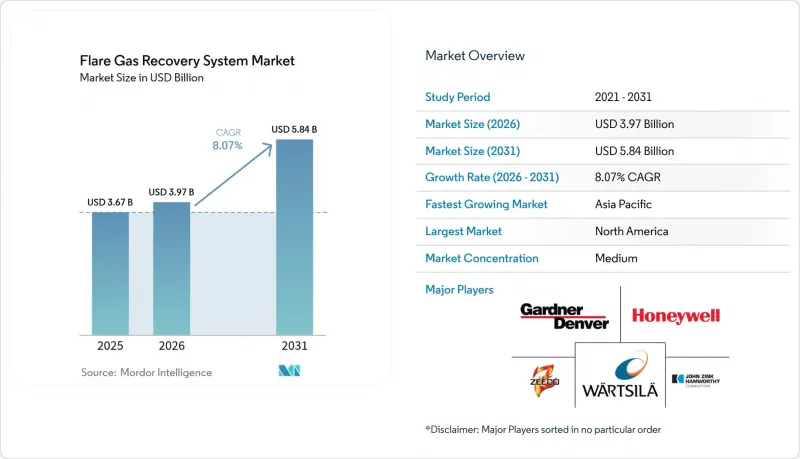
Mordor Intelligence에 의하면, 2026년 플레어 가스 회수 시스템 시장 규모는 39억 7,000만 달러로 추정되고 있어 2025년 36억 7,000만 달러에서 확대해, 2031년에는 58억 4,000만 달러에 이를 것으로 예측됩니다.
2026년부터 2031년까지의 연평균 성장률(CAGR)은 8.07%가 될 것으로 전망됩니다.
본 보고서는 기술별(단순 압축 시스템, 막 분리 등), 구성 부품별(압축기 및 송풍기, 계측·제어 시스템 등), 처리 용량 범위별(1 MMSCFD 미만, 15 MMSCFD 이상 등), 용도별(다운스트림, LNG 및 가스 처리 플랜트, 기타),지역(북미, 유럽, 아시아태평양, 남미, 기타)별로 분류되어 있습니다.
전 세계 플레어 가스 회수 시스템 시장 동향 및 인사이트
전 세계 메탄 배출 규제 강화
규제 당국은 자발적인 지침에서 벌금이 단계적으로 인상되는 구속력 있는 규정으로 전환했습니다. 미국 환경보호청(EPA)의 NSPS OOOOb에서는 메탄 1톤당 900-1,500달러의 벌금이 부과되는 반면, EU에서는 분기별 누출 감지 보고가 의무화되어 있습니다. 캘리포니아주의 개정법에 따르면, 위반을 반복할 경우 하루당 4만 달러의 배상 책임이 추가되며, 이로 인해 플레어 가스 회수 시스템의 도입은 위반이 발생한 후가 아니라 프로젝트 설계 단계에서 이루어지게 되었습니다. 투자자들은 주식 평가에 메탄 배출 강도 지표를 활용하고 있으며, 자금 조달을 위해서는 회수 장치의 도입이 필수적입니다.
증가하는 LNG 액화 및 FLNG 프로젝트
아시아태평양의 LNG 생산 능력은 급속히 확대되고 있습니다. 카타르의 ‘Joint Boil-Off Gas’ 프로젝트에서는 회수 장치를 통합함으로써 가스 이용률 99.5%를 달성했습니다. New Fortress Energy사의 모듈식 ‘Fast LNG’ 플랜트는 0.5-2.0 MMSCFD의 폐가스를 처리하며, 소규모 가스전에서도 경제적으로 실행 가능함을 입증하고 있습니다. 2024년에 승인된 12척의 FLNG 선박에는 콤팩트하고 해상 사용에 적합한 막 및 압축기가 필요하며, 이것이 장기적인 수요의 기반이 되고 있습니다.
초성숙 유전의 고액 설비 투자(CAPEX)와 저가치의 수반 가스
수명이 다해가는 해양 플랫폼은 생산량 감소와 낮은 가스 가격에 직면해 있어, 200만-500만 달러 규모의 소규모 설비 도입을 정당화하기 어렵습니다. 공간 제약으로 인해 설치 비용이 2배로 늘어나는 경우도 드물지 않습니다. 플랫폼 공동 이용 방식은 부담을 줄여주지만, 복잡한 상업 계약과 자산의 잔여 수명이 짧은 점에 의존하고 있습니다.
부문 분석
2025년, 압축 전용 시스템은 입증된 신뢰성과 낮은 초기 비용 덕분에 플레어 가스 회수 시스템 시장 점유율의 45.60%를 유지했습니다. 반면, 막 분리 기술은 기술별로는 가장 높은 연평균 성장률(CAGR) 12.18%를 나타낼 것으로 추정됩니다. 이러한 변화는 파이프라인 사양의 엄격화와 차세대 폴리머가 사워 가스 흐름에 견딜 수 있게 된 데 기인합니다. 극저온 응축법은 초고순도 용도에서 틈새 기술이지만, 에너지 소비량이 많다는 과제를 안고 있습니다. 흡수법 및 흡착법은 H₂S를 많이 포함하는 유전에서 꾸준히 도입되고 있습니다.
압축과 막 기술을 결합한 하이브리드 솔루션은 사업자가 설비 투자(CAPEX)를 최적화하면서 더 높은 회수율을 달성할 수 있어 주목을 받고 있습니다. 2024년 이글포드에서 도입된 MTR사의 FuelSep(TM) 시스템은 기존 스키드에 비해 에너지 사용량을 20% 절감하면서도 C3+ 액체를 회수하여 재판매하는 데 성공했습니다. 각 제조업체가 변화하는 가스 품질에 대응할 수 있는 모듈식 카트리지를 도입함에 따라, 하이브리드형 플레어 가스 회수 시스템 시장 규모는 2031년까지 전체 평균인 8.07%를 상회하는 속도로 확대될 것으로 예측됩니다.
2025년에는 압축기와 송풍기가 매출의 39.60%를 차지하며, 흡입압 및 토출압 생성에서 필수적인 역할을 하고 있음을 알 수 있습니다. 그러나 시설이 수동 밸브에서 클라우드 분석을 통해 제어되는 자율 루프로 전환됨에 따라 계측 및 제어 시스템은 2031년까지 12.05%라는 가장 높은 연평균 성장률(CAGR)을 나타낼 전망입니다. 베이커 휴즈의 ‘flare.IQ’를 통해 운영자는 98%의 연소 효율을 실시간으로 확인할 수 있게 되었으며, 이 기능은 현재 일부 관할 구역에서 의무화되어 있습니다. 증기 회수탑과 노크아웃 드럼은 시장 성장세를 따르고 있지만, 저온 기후에서는 열교환기가 에너지 효율이 높은 칠러 패키지로 대체되는 경향이 있습니다.
지역별 분석
북미는 EPA 규제, 셰일 인프라, 그리고 쉽게 이용할 수 있는 서비스 네트워크에 힘입어 플레어 가스 회수 시스템 시장 규모의 38.70%를 차지하고 있습니다. 그러나 2024년 퍼미안 분지에서 간헐적으로 발생한 가스 가격의 마이너스 현상으로 인해 일부 사업자는 판매 대신 플레어 처리를 할 수밖에 없게 되었으며, 이는 더 엄격한 규제 집행의 필요성을 부각시켰습니다. 캐나다의 ‘청정 전력 규정’과 멕시코에서 부상하고 있는 셰일 자원은 일정에 차이는 있으나, 추가적인 성장 여지를 제공합니다.
아시아태평양은 연평균 성장률(CAGR) 11.35%로 가장 빠르게 성장하고 있는 지역입니다. 중국에서는 정유시설에 탄소 포집 및 플레어 가스 회수 설비의 개보수가 진행되고 있는 반면, 인도에서는 가스화 및 LNG 터미널에 대한 투자가 이루어지고 있습니다. 동남아시아의 FLNG 프로젝트와 일본·한국의 소형 시스템 혁신이 지속적인 성장의 원동력이 되고 있습니다. 메탄 감축에 대한 세제 혜택 조치를 시행하는 정부 정책으로 인해 투자 회수 기간은 더욱 단축되고 있습니다.
유럽에서는 EU의 메탄 전략과 탄소 가격 책정에 힘입어 꾸준한 보급이 진행되고 있습니다. 북해의 사업자들은 개조 비용과 폐쇄 조치를 저울질하고 있지만, EU 배출권 거래 제도(EU ETS)의 할당량이 현재 중요한 수익원이 되고 있기 때문에 많은 사업자가 도입을 추진하고 있습니다. 독일의 운송용 연료 대상 온실가스(THG) 할당 제도는 회수 가스의 새로운 가치 창출의 길을 열어주고 있습니다.
중동 및 아프리카에서는 선택적인 성장이 나타나고 있습니다. 사우디아라비아와 아랍에미리트(UAE)는 플레어 회수 요건을 양허 계약에 포함시켜 도입을 조기에 추진하고 있습니다. 나이지리아의 개정된 상용화 프로그램과 이라크의 GGIP(가스 회수 및 이용 이니셔티브)를 통해 대규모 회수량이 확보되고 있습니다. 다만, 자금 조달 및 현지 조달 의무가 조달을 지연시킬 가능성이 있습니다.
기타 혜택:
- 엑셀 형식 시장 예측(ME) 시트
- 3개월간의 애널리스트 지원
자주 묻는 질문
목차
제1장 서론
제2장 조사 방법
제3장 주요 요약
제4장 시장 구도
제5장 시장 규모와 성장 예측
제6장 경쟁 구도
제7장 시장 기회와 향후 전망
JHS 26.08.26According to Mordor Intelligence, flare gas recovery system market size in 2026 is estimated at USD 3.97 billion, growing from 2025 value of USD 3.67 billion with 2031 projections showing USD 5.84 billion, growing at 8.07% CAGR over 2026-2031.
This report is Segmented by Technology (Compression-Only Systems, Membrane Separation, and More), Component (Compressors and Blowers, Instrumentation and Control Systems, and More), Capacity Range (Below 1 MMSCFD, Above 15 MMSCFD, and More), Application (Downstream, Downstream, LNG and Gas-Processing Plants, and Others), and Geography (North America, Europe, Asia-Pacific, South America, and More).
Global Flare Gas Recovery System Market Trends and Insights
Stricter global methane-emission penalties
Regulators shifted from voluntary guidelines to binding rules with escalating fees. The US EPA's NSPS OOOOb requires methane fees of USD 900-1,500 per metric ton, while the EU mandates quarterly leak-detection reports. California's amendments add a USD 40,000-per-day liability for repeat infractions, ensuring that flare gas recovery system market uptake now occurs during project design rather than after violations. Investors use methane intensity metrics in equity valuations, making recovery units essential for capital access.
Rising LNG liquefaction & FLNG projects
Asia-Pacific LNG capacity is expanding rapidly. Qatar's Joint Boil-Off Gas project integrates recovery units to reach 99.5% gas utilization. Modular "Fast LNG" plants from New Fortress Energy process 0.5-2.0 MMSCFD of waste gas, proving economically viable for small fields. Twelve FLNG vessels sanctioned in 2024 require compact, offshore-rated membranes and compressors, anchoring long-term demand.
High CAPEX vs. low associated-gas value in ultra-mature fields
Late-life offshore platforms face declining production and modest gas prices, making USD 2-5 million small-scale units hard to justify. Space constraints often double installation costs. Joint-platform sharing schemes ease the burden but rely on complex commercial agreements and short remaining asset lives.
Other drivers and restraints analyzed in the detailed report include:
- Carbon-pricing schemes linking flare credits to ESG funding
- Integration with small-scale blue-hydrogen units
- Limited cryogenic-grade gas quality in shale plays
For complete list of drivers and restraints, kindly check the Table Of Contents.
Segment Analysis
Compression-only systems retained 45.60% of the flare gas recovery system market share in 2025, owing to proven reliability and lower upfront costs. Membrane separation, however, is estimated to record a 12.18% CAGR, the fastest among technologies. The shift stems from tighter pipeline specifications and the ability of next-generation polymers to withstand sour-gas streams. Cryogenic condensation is a niche in ultra-high-purity applications but suffers from elevated energy demand. Absorption and adsorption maintain steady uptake in H2S-rich fields.
Hybrid solutions blending compression and membranes are gaining traction because operators optimize capex while achieving higher recovery yields. MTR's FuelSep(TM) system, deployed in the Eagle Ford in 2024, demonstrated 20% lower energy use than legacy skids while capturing C3+ liquids for resale. The flare gas recovery system market size for hybrid units is forecast to expand above the overall 8.07% baseline through 2031 as manufacturers introduce modular cartridges adaptable to changing gas quality.
Compressors and blowers dominated 39.60% of revenue in 2025, reflecting their indispensable role in creating suction and discharge pressure. Yet instrumentation and control systems will post the highest 12.05% CAGR to 2031 as facilities migrate from manual valves to autonomous loops governed by cloud analytics. Baker Hughes' flare.IQ enables operators to verify 98% combustion efficiency in real time, a capability now mandatory in several jurisdictions. Vapour recovery towers and knock-out drums follow market growth, while heat exchangers face substitution by energy-efficient chiller packages in low-temperature climates.
Complete Report Scope:
- By Technology
- Compression-only Systems
- Membrane Separation
- Cryogenic Condensation
- Absorption/Adsorption
- Hybrid (e.g., Compression + Membrane)
- By Component
- Compressors and Blowers
- Vapour Recovery Towers
- Knock-Out Drums and Separators
- Heat Exchangers/Chillers
- Instrumentation and Control Systems
- By Capacity Range
- Below 1 MMSCFD
- 1 to 5 MMSCFD
- 5 to 15 MMSCFD
- Above 15 MMSCFD
- By Application
- Upstream (Onshore and Offshore)
- Downstream (Refineries and Petrochemicals)
- LNG and Gas-processing Plants
- Others (Gas Storage, Terminals)
- By Geography
- North America
- United States
- Canada
- Mexico
- Europe
- Germany
- United Kingdom
- France
- Italy
- NORDIC Countries
- Russia
- Rest of Europe
- Asia-Pacific
- China
- India
- Japan
- South Korea
- ASEAN Countries
- Rest of Asia-Pacific
- South America
- Brazil
- Argentina
- Rest of South America
- Middle East and Africa
- Saudi Arabia
- United Arab Emirates
- Qatar
- South Africa
- Egypt
- Nigeria
- Rest of Middle East and Africa
- North America
Geography Analysis
North America holds 38.70% of the flare gas recovery system market size, supported by EPA rules, shale infrastructure, and readily available service networks. However, intermittent negative gas prices in the Permian Basin during 2024 prompted some operators to flare rather than sell, underlining the need for stricter enforcement. Canada's Clean Electricity Regulations and Mexico's emerging shale resources present incremental upside, though timelines diverge.
Asia-Pacific is the fastest-growing region at 11.35% CAGR. China is retrofitting refineries with carbon-capture and flare-recovery units, while India invests in gasification and LNG terminals. Southeast Asian FLNG projects and Japan and South Korea's compact-system innovations underpin sustained momentum. Government policies offering tax breaks for methane abatement further reduce payback times.
Europe shows steady uptake driven by the EU methane strategy and carbon pricing. Operators in the North Sea weigh retrofit costs against decommissioning obligations, yet many proceed because EU ETS allowances now represent a significant revenue stream. Germany's THG quota system for transport fuels creates another value pathway for recovered gas.
Middle East & Africa record selective growth. Saudi Arabia and UAE bundle flare-recovery requirements into concession agreements, ensuring early-phase deployment. Nigeria's updated commercialization programme and Iraq's GGIP establish large capture volumes. Nevertheless, financing and local-content mandates can slow procurement.
- John Zink Hamworthy Combustion LLC
- Zeeco Inc.
- Honeywell UOP
- Gardner Denver (Ingersoll Rand)
- Wartsila Oyj Abp
- Transvac Systems Ltd
- Aereon (ION Clean Air)
- Schlumberger Endura
- Air Liquide Global E&C
- MAN Energy Solutions
- Eisenmann Environmental
- SoEnergy International
- Zephyr Gas Recovery
- KPS Holdings
- Envent Corporation
- Cimarron Energy Inc.
- Cool Sorpt
- Sundyne LLC
- Ramesa Sistemas
- PetroGas Systems
Additional Benefits:
- The market estimate (ME) sheet in Excel format
- 3 months of analyst support
TABLE OF CONTENTS
1 Introduction
- 1.1 Study Assumptions & Market Definition
- 1.2 Scope of the Study
2 Research Methodology
3 Executive Summary
4 Market Landscape
- 4.1 Market Overview
- 4.2 Market Drivers
- 4.2.1 Stricter global methane-emission penalties
- 4.2.2 Rising LNG liquefaction & FLNG projects
- 4.2.3 Carbon-pricing schemes linking flare credits to ESG funding
- 4.2.4 Integration with small-scale blue-hydrogen units (syngas feed)
- 4.2.5 Mandatory flare-reduction targets in NOC production-sharing contracts
- 4.2.6 AI-enabled predictive vent-gas routing
- 4.3 Market Restraints
- 4.3.1 High CAPEX vs. low associated-gas value in ultra-mature fields
- 4.3.2 Limited cryogenic-grade gas quality in shale plays
- 4.3.3 Uncertain carbon-credit price floors (regulatory risk)
- 4.3.4 Scarcity of retrofit space on ageing offshore platforms
- 4.4 Supply-Chain Analysis
- 4.5 Regulatory Landscape
- 4.6 Technological Outlook
- 4.7 Porter's Five Forces
- 4.7.1 Bargaining Power of Suppliers
- 4.7.2 Bargaining Power of Buyers
- 4.7.3 Threat of New Entrants
- 4.7.4 Threat of Substitutes
- 4.7.5 Competitive Rivalry
5 Market Size & Growth Forecasts
- 5.1 By Technology
- 5.1.1 Compression-only Systems
- 5.1.2 Membrane Separation
- 5.1.3 Cryogenic Condensation
- 5.1.4 Absorption/Adsorption
- 5.1.5 Hybrid (e.g., Compression + Membrane)
- 5.2 By Component
- 5.2.1 Compressors and Blowers
- 5.2.2 Vapour Recovery Towers
- 5.2.3 Knock-Out Drums and Separators
- 5.2.4 Heat Exchangers/Chillers
- 5.2.5 Instrumentation and Control Systems
- 5.3 By Capacity Range
- 5.3.1 Below 1 MMSCFD
- 5.3.2 1 to 5 MMSCFD
- 5.3.3 5 to 15 MMSCFD
- 5.3.4 Above 15 MMSCFD
- 5.4 By Application
- 5.4.1 Upstream (Onshore and Offshore)
- 5.4.2 Downstream (Refineries and Petrochemicals)
- 5.4.3 LNG and Gas-processing Plants
- 5.4.4 Others (Gas Storage, Terminals)
- 5.5 By Geography
- 5.5.1 North America
- 5.5.1.1 United States
- 5.5.1.2 Canada
- 5.5.1.3 Mexico
- 5.5.2 Europe
- 5.5.2.1 Germany
- 5.5.2.2 United Kingdom
- 5.5.2.3 France
- 5.5.2.4 Italy
- 5.5.2.5 NORDIC Countries
- 5.5.2.6 Russia
- 5.5.2.7 Rest of Europe
- 5.5.3 Asia-Pacific
- 5.5.3.1 China
- 5.5.3.2 India
- 5.5.3.3 Japan
- 5.5.3.4 South Korea
- 5.5.3.5 ASEAN Countries
- 5.5.3.6 Rest of Asia-Pacific
- 5.5.4 South America
- 5.5.4.1 Brazil
- 5.5.4.2 Argentina
- 5.5.4.3 Rest of South America
- 5.5.5 Middle East and Africa
- 5.5.5.1 Saudi Arabia
- 5.5.5.2 United Arab Emirates
- 5.5.5.3 Qatar
- 5.5.5.4 South Africa
- 5.5.5.5 Egypt
- 5.5.5.6 Nigeria
- 5.5.5.7 Rest of Middle East and Africa
- 5.5.1 North America
6 Competitive Landscape
- 6.1 Market Concentration
- 6.2 Strategic Moves (M&A, Partnerships, PPAs)
- 6.3 Market Share Analysis (Market Rank/Share for key companies)
- 6.4 Company Profiles (includes Global level Overview, Market level overview, Core Segments, Financials as available, Strategic Information, Products & Services, and Recent Developments)
- 6.4.1 John Zink Hamworthy Combustion LLC
- 6.4.2 Zeeco Inc.
- 6.4.3 Honeywell UOP
- 6.4.4 Gardner Denver (Ingersoll Rand)
- 6.4.5 Wartsila Oyj Abp
- 6.4.6 Transvac Systems Ltd
- 6.4.7 Aereon (ION Clean Air)
- 6.4.8 Schlumberger Endura
- 6.4.9 Air Liquide Global E&C
- 6.4.10 MAN Energy Solutions
- 6.4.11 Eisenmann Environmental
- 6.4.12 SoEnergy International
- 6.4.13 Zephyr Gas Recovery
- 6.4.14 KPS Holdings
- 6.4.15 Envent Corporation
- 6.4.16 Cimarron Energy Inc.
- 6.4.17 Cool Sorpt
- 6.4.18 Sundyne LLC
- 6.4.19 Ramesa Sistemas
- 6.4.20 PetroGas Systems
7 Market Opportunities & Future Outlook
- 7.1 White-space & Unmet-Need Assessment