

|
시장보고서
상품코드
2115238
척추 바이오로직스 시장 : 시장 점유율 분석, 업계 동향 및 통계, 성장 예측(2026-2031년)Spine Biologics - Market Share Analysis, Industry Trends & Statistics, Growth Forecasts (2026 - 2031) |
||||||
 Mordor Intelligence
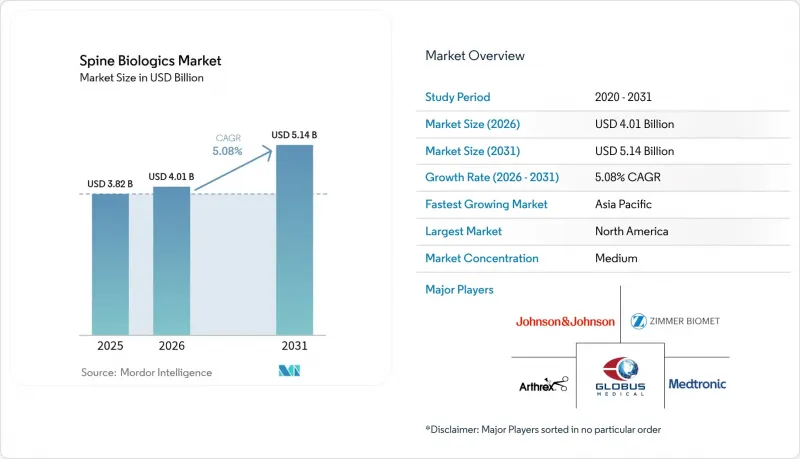
Mordor Intelligence에 의하면, 척추 바이오로직스 시장 규모는 2025년 38억 2,000만 달러로 평가되었고, 2026년에는 40억 1,000만 달러로 추정되고, 2026-2031년 CAGR 5.08%로 성장을 지속할 전망이며, 2031년에는 51억 4,000만 달러에 이를 것으로 예측됩니다.
본 보고서는 제품 유형별(골 이식 대체재(골형성 단백질 등), 척추 동종 이식편(기계 가공형 구조용 동종 이식편 등), 세포 유래 매트릭스, 기타), 수술 유형별(전방 경추 추간판 절제·고정술(ACDF), 기타), 최종 사용자별(병원, 기타), 지역별(북미, 유럽, 기타)로 분류되어 있습니다. 시장 예측은 금액(달러)으로 표시되어 있습니다.
세계의 척추 바이오로직스 시장 동향 및 인사이트
척추 퇴행성 질환을 앓는 고령 인구
65세 이상으로 장수하는 인구가 늘어나고, 다중 추간 수준에서 퇴행성 병변을 보이는 환자가 증가하고 있는 것이 척추 바이오로직스 시장 전체의 지속적인 수요 기반이 되고 있습니다. 중국에서는 2003년부터 2016년 사이 연간 척추 수술 건수가 12.32% 급증했으며, 환자의 평균 연령은 5세 가까이 상승했습니다. 고령자의 뼈는 생물학적 특성상 골유합에 시간이 오래 걸리기 때문에 외과의사들은 골유도 능력이 뛰어난 재조합 단백질이나 세포 매트릭스를 점점 더 선호하여 사용하고 있습니다. 골다공증과 관련된 합병증은 이미 라틴아메리카 척추 진료의 80%에 영향을 미치고 있으며, 이는 인구통계학적 확산을 보여줍니다. 각 제조업체는 저용량의 콜라겐 결합형 BMP와 숙주의 생물학적 기능 저하를 보완하는 줄기세포가 풍부하게 함유된 매트릭스를 개발함으로써 이에 대응하고 있습니다. 아시아태평양의 도시권에서는 고령화와 생활 습관에 기인한 추간판 퇴행이 중첩되어 있어, 예측 기간 전반에 걸쳐 전체 수술 건수와 생체 재료 소비량은 증가 추세를 유지할 전망입니다.
저침습 척추 수술의 급증
현재, 척추 고정술의 대부분은 이식재의 양이나 가시성을 제한하는 관형 리트랙터나 내시경용 통로에 의존하고 있습니다. 메디케어 수혜자를 대상으로 한 경우, 같은 기간 동안 외래수술센터(ASC)에서의 척추 수술 건수는 193% 증가한 반면, 병원의 외래 수술 건수는 9.9% 증가에 그쳤습니다. 절개 부위의 축소에 따라, 더 작은 패키지로 신속하고 예측 가능한 고정을 실현하는 생체 재료가 요구되고 있으며, 이는 성형 가능한 퍼티나 즉시 사용 가능한 스트립 형태의 제품 개발을 촉진하고 있습니다. 비용 모델도 이러한 추세를 뒷받침하고 있습니다. 최소 침습 수술법으로 인해 45일 치료 기간당 비용이 9.6% 절감되어, 평균 2,563달러를 절약하고 있습니다. 로봇 내비게이션을 통해 임플란트 정렬이 더욱 표준화됨에 따라, 이식재 제조업체들은 동력 보조식 주입 암과 연동되는 카트리지 및 주사기 개발을 추진하고 있습니다. 이러한 시너지 효과로 인해 척추용 생체재료 시장 전반에서 고품질이면서도 작업 흐름에 편리한 생체재료에 대한 수요가 지속적으로 증가하고 있습니다.
높은 비용과 제한된 보험 급여
보험사는 선택적 척추 수술에서 고가의 생물학적 제제의 추가 사용을 승인하기 전에, 직접 비교를 통한 비용 대비 효과 데이터의 제시를 점점 더 요구하고 있습니다. 메디케어의 번들링 제도로 인해 재조합 단백질의 개별 청구는 축소되고 있는 반면, 일부 민간 보험사에서는 1단계 경추 고정술에 사용되는 BMP-2를 ‘임상시험 중’으로 취급하고 있습니다. 신흥국에서는 정가가 이미 수술 예산의 상당 부분을 차지하고 있어, 1등급 병원 이외의 곳에서의 도입을 억제하고 있습니다. 경제 모델에 따르면, 유합 부전에 따른 재수술의 평균 비용은 2만 3,702달러이지만, 보험사는 하류 단계의 비용 절감 효과보다는 당장의 청구 총액에 초점을 맞추는 경향이 있습니다. 이러한 상황으로 인해 제품 도입이 제한되고, 중기적으로는 척추 생물학적 제제 시장의 달성 가능한 연평균 성장률(CAGR)이 하락하게 될 것입니다.
부문 분석
2025년, 동종 이식재는 척추 바이오로직스 시장 점유율의 55.88%를 차지했습니다. 이는 안정적인 환급 제도와 오랜 임상 실적을 바탕으로 외과의사들이 탈회골 매트릭스 시트와 기계 가공형 피질골 스페이서를 지속적으로 채택하고 있음을 반영합니다. 이 범주 내에서는 표준 치수로 인해 기구와의 조합이 용이하고 수술 시간을 단축할 수 있기 때문에 가공된 구조용 이식재가 주류를 이루고 있습니다. 각 제조업체는 골유도성 단백질을 보존하는 동결건조 기술을 개선하고 있으며, 이를 통해 척추 바이오로직스 시장에서의 점유율을 더욱 공고히 하고 있습니다.
한편, 세포 유래 매트릭스는 2031년까지 연평균 성장률(CAGR)이 6.55%로 가장 빠른 성장세를 보이고 있습니다. 중간엽 줄기세포를 첨가한 페이스트는 전향적 연구에서 100%의 골유합률을 보여 기존 이식재를 능가하는 성과를 거두었기 때문에 흡연자나 골다공증 환자를 다루는 ‘실패율이 높은’ 의료기관으로부터 주목을 받고 있습니다. i-FACTOR와 같은 펩타이드 강화 합성 소재는 재조합 단백질에 수반되는 합병증을 피하면서도 6년 후 98.6%의 골유합률을 달성하여, 가까운 미래에 전환의 조짐을 보이고 있습니다. 환자별로 최적의 기공률을 실현하는 3D 프린팅 기술의 지원을 받는 합성 세라믹과 생체활성 유리는 완전한 무기질 솔루션을 추구하는 외과의사의 선택 폭을 넓혀주고 있습니다. 이러한 혁신 기술들이 결합되어 척추 바이오로직스 시장 전체의 구매 알고리즘을 재구축하고 있습니다.
지역별 분석
북미는 현재 전 세계 척추 바이오로직스 시장 점유율의 41.98%를 차지했습니다. 선택적 척추 수술에 대한 보험 적용 범위 확대와 외래수술센터(ASC)로의 꾸준한 확산이 맞물리면서, 1인당 바이오로직스 사용량은 높은 수준을 유지하고 있습니다. 그러나 상환 제도가 성숙 단계에 접어들면서, 비용 억제 조치와 안전성에 대한 논의가 프리미엄 제품의 채택을 억제하고 있어, 가치 성장률은 연평균 성장률(CAGR) 4.29%에 그치고 있습니다.
아시아태평양은 중국, 인도, 동남아시아의 평균 수명 연장, 중산층 확대, 병원 투자에 힘입어 6.21%라는 가장 높은 연평균 성장률(CAGR)을 기록하고 있습니다. 중국만 해도 척추 수술 건수가 연평균 12.32% 증가하고 있으며, 이것이 이식재 수요를 뒷받침하여 현재 그 성장률은 세계 평균을 상회하고 있습니다. 일본과 호주에서는 첨단 펩타이드 및 3D 프린팅 스캐폴드를 승인하는 정교한 규제 체계가 마련되어 있는 반면, 신흥 ASEAN 국가에서는 비용 중심의 합성 재료나 현지에서 가공된 동종 이식편이 중시되고 있습니다.
유럽은 4.91%의 성장률을 보이고 있으며, 독일, 프랑스, 영국에서의 안정적인 수술 건수와 엄격한 MDR(의료기기 규정) 준수 비용 간의 균형이 잘 잡혀 있습니다. CE 마크의 통일로 인해 공급업체는 27개국에서 제품을 판매할 수 있게 되었으나, 지급 주체에 따라 환급 제도가 다르기 때문에 기업들은 단계적인 제품 라인 구축을 강요받고 있습니다.
라틴아메리카는 5.39%의 성장 궤도를 보이고 있으며, 브라질과 아르헨티나에서는 외상 치료 지침이 개정되어 생체 재료를 이용한 증강 요법이 포함되었습니다. 다만, 환율 변동이 평균 판매 가격에 영향을 미치고 있습니다.
중동 및 아프리카에서는 출발점은 낮았지만, 걸프 국가들의 의료 관광과 남아프리카공화국의 공공 자금 지원 의료 센터를 통해 5.73%의 성장을 달성하고 있습니다.
기타 혜택
- 엑셀 형식 시장 예측(ME) 시트
- 3개월간의 애널리스트 지원
자주 묻는 질문
목차
제1장 서론
제2장 조사 방법
제3장 주요 요약
제4장 시장 구도
제5장 시장 규모 및 성장 예측
제6장 경쟁 구도
제7장 시장 기회 및 향후 전망
AJY 26.08.28According to Mordor Intelligence, the spine biologics market size is expected to grow from USD 3.82 billion in 2025 to USD 4.01 billion in 2026 and is forecast to reach USD 5.14 billion by 2031 at 5.08% CAGR over 2026-2031.
This report is Segmented by Product Type (Bone Graft Substitutes [Bone Morphogenetic Proteins and More], Spinal Allografts [Machined Structural Allografts and More], Cell-Based Matrices, and More), Surgery Type (Anterior Cervical Discectomy & Fusion and More), End-User (Hospitals and More), and Geography (North America, Europe, and More). The Market Forecasts are Provided in Terms of Value (USD).
Global Spine Biologics Market Trends and Insights
Aging Population with Degenerative Spine Disorders
More individuals live beyond 65 and present multi-level degenerative pathology, underpinning recurrent demand across the spine biologics market. In China, annual spine surgery volumes surged 12.32% between 2003 and 2016, with mean patient age rising by almost five years. Older bone biology imposes longer healing times, so surgeons increasingly prefer recombinant proteins and cellular matrices with stronger osteoinductive cues. Osteoporosis-related complications already influence 80% of Latin American spine practices, illustrating demographic reach. Manufacturers respond with lower-dose, collagen-binding BMPs and stem-cell-enriched matrices that compensate for poor host biology. As aging intersects with lifestyle-related disc degeneration in urban Asia-Pacific, overall procedure volumes-and biologic graft consumption-remain on an upward path over the entire forecast window.
Surge in Minimally-Invasive Spine Procedures
More fusions now rely on tubular retractors and endoscopic corridors that limit graft volume and visibility. Among Medicare beneficiaries, spine cases in ambulatory surgical centers climbed 193% while hospital outpatient volumes grew 9.9% in the same period. Shorter incisions necessitate biologics that deliver rapid, predictable fusion in smaller packages, catalyzing R&D in moldable putties and ready-to-use strip formats. Cost models reinforce the trend: minimally-invasive pathways trim 9.6% from 45-day episode costs, translating to USD 2,563 in average savings. Robotic navigation further standardizes implant alignment, prompting graft makers to develop cartridges and syringes that integrate with power-assisted delivery arms. The blended effect is a durable boost to demand for premium yet workflow-friendly biologics across the spine biologics market.
High Cost & Limited Reimbursement
Payers increasingly demand head-to-head cost-effectiveness data before approving expensive biologics add-ons in elective spine surgery. Medicare bundling has compressed separate billing for recombinant proteins, while several private insurers list BMP-2 as "investigational" for one-level cervical fusions. In emerging economies, list prices already consume a high proportion of procedure budgets, curbing adoption outside Tier-1 hospitals. Economic modeling shows revision surgeries for failed fusions average USD 23,702, yet insurers often focus on immediate invoice totals rather than downstream savings. These dynamics restrict premium uptake and lower the achievable CAGR for the spine biologics market over the medium term.
Other drivers and restraints analyzed in the detailed report include:
- Rising Prevalence of Spinal Deformities & Trauma
- Regulatory Approvals of Next-Gen BMPs
- Safety Concerns Around Recombinant Proteins
For complete list of drivers and restraints, kindly check the Table Of Contents.
Segment Analysis
Allografts captured 55.88% of spine biologics market share in 2025, reflecting stable reimbursement and long clinical track records that keep surgeons loyal to demineralized bone matrix sheets and machined cortical spacers. Within this pool, processed structural grafts dominate because standard dimensions streamline instrument pairing and reduce theatre time. Manufacturers refine freeze-drying techniques that preserve osteoinductive proteins, further defending share within the spine biologics market.
Cell-based matrices, however, are posting the fastest growth, with a 6.55% CAGR to 2031. Mesenchymal stem cell-seeded putties showed 100% fusion in prospective trials, outperforming legacy grafts and drawing interest at high-miss centers managing smokers and osteoporotic patients. Peptide-enhanced synthetics such as i-FACTOR deliver 98.6% six-year fusion while bypassing recombinant protein complications, signalling a near-term pivot. Synthetic ceramics and bioactive glass, boosted by 3D printing that permits patient-specific porosity, extend options for surgeons seeking fully mineral solutions. Collectively these innovations are reshaping buying algorithms across the spine biologics market.
Complete Report Scope:
- By Product Type
- Bone Graft Substitutes
- Bone Morphogenetic Proteins
- Synthetic Ceramics & Bioactive Glass
- Peptide-based & PTH-enhanced Grafts
- Spinal Allografts
- Machined Structural Allografts
- Demineralized Bone Matrix (DBM)
- Cellular Bone Matrices
- Cell-Based Matrices
- Platelet-Rich Plasma (PRP)
- Bone Marrow Aspirate Concentrate (BMAC)
- Others
- Bone Graft Substitutes
- By Surgery Type
- Anterior Cervical Discectomy & Fusion (ACDF)
- Transforaminal/Posterior Lumbar Interbody Fusion (TLIF/PLIF)
- Anterior/Extreme Lumbar Interbody Fusion (ALIF/XLIF)
- Minimally-Invasive Posterolateral Fusion
- Cervical Disc Replacement with Biologics Adjuncts
- By End-User
- Hospitals
- Ambulatory Surgical Centers
- Specialty Clinics
- Academic & Research Institutes
- By Geography
- North America
- United States
- Canada
- Mexico
- Europe
- Germany
- United Kingdom
- France
- Italy
- Spain
- Rest of Europe
- Asia-Pacific
- China
- India
- Japan
- Australia
- South Korea
- Rest of Asia-Pacific
- Middle East and Africa
- GCC
- South Africa
- Rest of Middle East and Africa
- South America
- Brazil
- Argentina
- Rest of South America
- North America
Geography Analysis
North America presently generates 41.98% of the global spine biologics market share. Widespread insurance coverage for elective spine interventions, paired with robust ASC penetration, sustains high biologic use per capita. Mature reimbursement, however, slows value growth to 4.29% CAGR as cost-containment policies and safety debates restrain premium adoption.
Asia-Pacific records the strongest 6.21% CAGR, driven by rising life expectancy, middle-class expansion, and hospital investment across China, India, and Southeast Asia. China alone experienced a 12.32% average annual rise in spine surgeries, fueling graft demand that now outpaces global averages. Japan and Australia bring sophisticated regulatory frameworks that clear advanced peptides and 3-D printed scaffolds, while emerging ASEAN countries emphasize cost-sensitive synthetics and locally processed allografts.
Europe posts a 4.91% growth rate, balancing stringent MDR compliance costs with consistent procedure volume in Germany, France, and the United Kingdom. CE mark alignment grants suppliers access across 27 states, yet reimbursement differs by payer, nudging firms toward tiered product lines.
Latin America shows a 5.39% trajectory as Brazil and Argentina update trauma guidelines to include biologic augmentation, though currency volatility modulates average selling prices.
Middle East and Africa achieve 5.73% growth through medical tourism in the Gulf and state-funded centers in South Africa, albeit from a lower starting base.
- AlloSource
- Alphatec Holdings
- Arthrex
- B. Braun
- Baxter
- BioHorizons Vivigen
- Biosenic SA
- CoreLink Holdings, LLC
- Globus Medical
- Highridge Inc.
- Johnson & Johnson
- Kuros Biosciences
- Medtronic
- Orthofix
- RTI Surgical Holdings
- SeaSpine Holdings
- Spinal Elements, Inc.
- Spine Wave Inc.
- Stryker
- Tissue Regenix Group
- Xtant Medical Holdings
- Zimmer Biomet
Additional Benefits:
- The market estimate (ME) sheet in Excel format
- 3 months of analyst support
TABLE OF CONTENTS
1 Introduction
- 1.1 Study Assumptions & Market Definition
- 1.2 Scope of the Study
2 Research Methodology
3 Executive Summary
4 Market Landscape
- 4.1 Market Overview
- 4.2 Market Drivers
- 4.2.1 Aging population with degenerative spine disorders
- 4.2.2 Surge in minimally-invasive spine procedures
- 4.2.3 Rising prevalence of spinal deformities & trauma
- 4.2.4 Rapid ASC adoption demanding fast-setting biologics
- 4.2.5 Regulatory approvals of next-gen BMPs
- 4.2.6 3-D bioprinted patient-specific grafts
- 4.3 Market Restraints
- 4.3.1 High cost & limited reimbursement
- 4.3.2 Safety concerns around recombinant proteins
- 4.3.3 Tissue-donor supply bottlenecks
- 4.3.4 Surgeon learning curve for cell-based matrices
- 4.4 Supply Chain Analysis
- 4.5 Regulatory Landscape
- 4.6 Technological Outlook
- 4.7 Porter's Five Forces Analysis
- 4.7.1 Threat of New Entrants
- 4.7.2 Bargaining Power of Buyers
- 4.7.3 Bargaining Power of Suppliers
- 4.7.4 Threat of Substitutes
- 4.7.5 Intensity of Competitive Rivalry
5 Market Size & Growth Forecasts (Value)
- 5.1 By Product Type
- 5.1.1 Bone Graft Substitutes
- 5.1.1.1 Bone Morphogenetic Proteins
- 5.1.1.2 Synthetic Ceramics & Bioactive Glass
- 5.1.1.3 Peptide-based & PTH-enhanced Grafts
- 5.1.2 Spinal Allografts
- 5.1.2.1 Machined Structural Allografts
- 5.1.2.2 Demineralized Bone Matrix (DBM)
- 5.1.2.3 Cellular Bone Matrices
- 5.1.3 Cell-Based Matrices
- 5.1.4 Platelet-Rich Plasma (PRP)
- 5.1.5 Bone Marrow Aspirate Concentrate (BMAC)
- 5.1.6 Others
- 5.1.1 Bone Graft Substitutes
- 5.2 By Surgery Type
- 5.2.1 Anterior Cervical Discectomy & Fusion (ACDF)
- 5.2.2 Transforaminal/Posterior Lumbar Interbody Fusion (TLIF/PLIF)
- 5.2.3 Anterior/Extreme Lumbar Interbody Fusion (ALIF/XLIF)
- 5.2.4 Minimally-Invasive Posterolateral Fusion
- 5.2.5 Cervical Disc Replacement with Biologics Adjuncts
- 5.3 By End-User
- 5.3.1 Hospitals
- 5.3.2 Ambulatory Surgical Centers
- 5.3.3 Specialty Clinics
- 5.3.4 Academic & Research Institutes
- 5.4 By Geography
- 5.4.1 North America
- 5.4.1.1 United States
- 5.4.1.2 Canada
- 5.4.1.3 Mexico
- 5.4.2 Europe
- 5.4.2.1 Germany
- 5.4.2.2 United Kingdom
- 5.4.2.3 France
- 5.4.2.4 Italy
- 5.4.2.5 Spain
- 5.4.2.6 Rest of Europe
- 5.4.3 Asia-Pacific
- 5.4.3.1 China
- 5.4.3.2 India
- 5.4.3.3 Japan
- 5.4.3.4 Australia
- 5.4.3.5 South Korea
- 5.4.3.6 Rest of Asia-Pacific
- 5.4.4 Middle East and Africa
- 5.4.4.1 GCC
- 5.4.4.2 South Africa
- 5.4.4.3 Rest of Middle East and Africa
- 5.4.5 South America
- 5.4.5.1 Brazil
- 5.4.5.2 Argentina
- 5.4.5.3 Rest of South America
- 5.4.1 North America
6 Competitive Landscape
- 6.1 Market Concentration
- 6.2 Competitive Benchmarking
- 6.3 Market Share Analysis
- 6.4 Company Profiles (includes Global level Overview, Market level overview, Core Segments, Financials as available, Strategic Information, Market Rank/Share for key companies, Products & Services, and Recent Developments)
- 6.4.1 AlloSource
- 6.4.2 Alphatec Holdings
- 6.4.3 Arthrex Inc.
- 6.4.4 B. Braun Melsungen AG
- 6.4.5 Baxter International
- 6.4.6 BioHorizons Vivigen
- 6.4.7 Biosenic SA
- 6.4.8 CoreLink Holdings, LLC
- 6.4.9 Globus Medical
- 6.4.10 Highridge Inc.
- 6.4.11 Johnson & Johnson Services, Inc.
- 6.4.12 Kuros Biosciences
- 6.4.13 Medtronic plc
- 6.4.14 Orthofix Medical Inc.
- 6.4.15 RTI Surgical Holdings
- 6.4.16 SeaSpine Holdings
- 6.4.17 Spinal Elements, Inc.
- 6.4.18 Spine Wave Inc.
- 6.4.19 Stryker Corporation
- 6.4.20 Tissue Regenix Group
- 6.4.21 Xtant Medical Holdings
- 6.4.22 Zimmer Biomet Holdings
7 Market Opportunities & Future Outlook
- 7.1 White-space & Unmet-Need Assessment


