

|
시장보고서
상품코드
2115242
수술용 장갑 시장 : 점유율 분석, 업계 동향과 통계, 성장 예측(2026-2031년)Surgical Gloves - Market Share Analysis, Industry Trends & Statistics, Growth Forecasts (2026 - 2031) |
||||||
 Mordor Intelligence
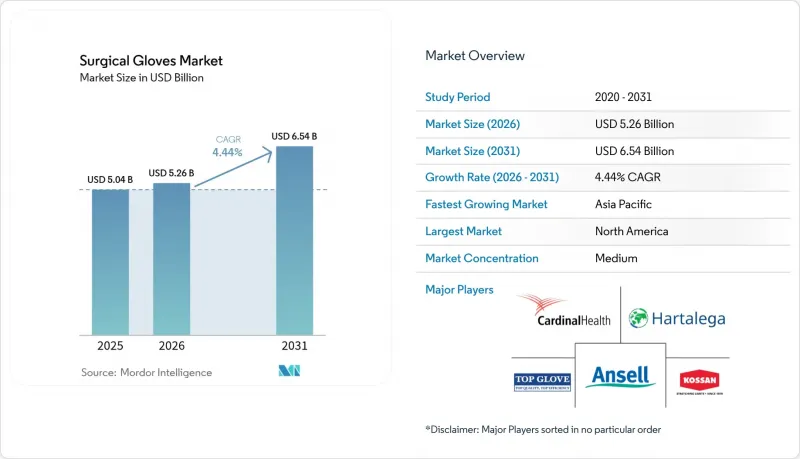
Mordor Intelligence에 의하면, 수술용 장갑 시장 규모는 2025년에 50억 4,000만 달러로 평가되었고 2026년 52억 6,000만 달러에서 2031년까지 65억 4,000만 달러에 이를 것으로 예측되며, 예측 기간(2026-2031년) CAGR은 4.44%를 나타낼 전망입니다.
본 보고서는 소재별(니트릴, 라텍스, 네오프렌, 폴리이소프렌 등), 형태별(파우더 처리 및 파우더 프리), 최종 사용자별(병원, 외래수술센터(ASC), 진료소·의사 진료실, 치과·수의과 시설, 기타),지역별(북미, 유럽, 아시아태평양, 중동 및 아프리카, 남미)로 분류되어 있습니다. 시장 예측은 금액(달러) 기준으로 제시되어 있습니다.
세계 수술용 장갑 시장 동향 및 인사이트
전 세계 수술 건수의 급증
평균 수명의 연장 및 저침습 수술 기술에 따른 회복 기간 단축에 따라, 선택적 수술, 외상 수술 및 외래 수술은 증가세를 이어가고 있습니다. Sg2사의 예측에 따르면, ASC(외래수술센터(ASC))에서의 수술 건수는 21% 증가하여 2034년까지 4,400만 건에 달하고, 이는 입원 환자의 경우에 비해 건당 장갑 소비량이 감소하는 경향을 충분히 상쇄할 것으로 보입니다. 이러한 추세를 주도하고 있는 것은 정형외과 및 척추 수술로, 높은 내천자성과 촉각 피드백을 갖춘 장갑이 요구되고 있습니다. 전 세계적인 공급 부족에도 불구하고, 말레이시아 고무 장갑 제조업체 협회(MARGMA)는 2024년에 800억 장공급 부족이 발생할 것으로 예측했습니다. 수요는 5,000억 장에 달할 전망이지만, 가동 능력은 4,200억 장에 그치고 있습니다. 이러한 격차는 가격 결정력을 유지할 뿐만 아니라, 투기적인 공급 과잉을 피하면서 신중한 생산 능력 확충을 촉진하는 요인이 되고 있습니다. 병원은 복잡한 증례를 계속 담당하기 때문에 고급 장갑에 대한 수요는 유지되겠지만, 비용에 민감한 ASC(외래수술센터(ASC))는 사용 빈도가 높은 품목을 세트로 묶은 일괄 구매 계약을 선호하는 경향이 있습니다. 전반적으로 수술용 장갑 시장은 단가에 대한 압박이 커지고 있음에도 불구하고, 수량 증가로 인한 혜택을 보고 있습니다.
신흥 시장의 엄격한 산업 안전 규제
인도에서 인도네시아에 이르는 각국 정부는 유럽 기준에 부합하는 개인보호구(PPE) 규제를 강화하고 있으며, 수술실이나 고위험 산업 지역에서 인증된 수술용 장갑의 사용을 의무화하고 있습니다. 세계지적재산권기구(WIPO)의 기록에 따르면, 2018년부터 2023년까지 산업위생 기술 관련 특허 수는 연평균 성장률(CAGR) 26.4%를 기록하며 규제 강화의 추세를 뒷받침하고 있습니다. 규제 집행은 종이 기반의 감사에서 디지털 감시로 전환되고 있으며, 장갑 수요는 산발적이지 않고 안정적인 양상을 보이고 있습니다. 국내 조달률에 관한 규정에 따라 현지 생산이 촉진되고 있지만, 공장별 품질에 편차가 있어 전 세계 바이어들의 엄격한 공급업체 감사가 필요해지고 있습니다.
원자재 가격 변동
2024년 10월, 태국과 중국의 농장에 폭우가 직격한 여파로 천연 고무 라텍스(NRL) 가격이 13년 만에 최고치를 기록하며, 동남아시아 공급에 의존하는 장갑 제조업체들의 이익률을 압박했습니다. 이와 동시에, 미국에서 니트릴 부타디엔 고무가 부족해짐에 따라, 적어도 2025년 하반기까지는 해외 조달을 허용하는 연방 정부의 특례 조치가 발동되었습니다. 제조업체들은 비용의 일부를 구매자에게 전가하고 있지만, 장기 계약으로 인해 가격 유연성이 제한되어 있어 EBITDA 마진에 압박이 가해지고 있습니다. 과유르 및 스콜조넬라 타우사기즈로의 다각화는 여전히 시험 단계에 머물러 있어, 수술용 장갑 시장은 상품 가격 변동에 취약한 상황에 놓여 있습니다.
부문별 분석
수술용 장갑 시장에서 라텍스는 저렴한 비용과 입증된 성능을 강점으로 삼아 시장 점유율의 38.70%를 차지하고 있습니다. 그러나 병원에서는 라텍스 프리 수술실로 전환이 진행되고 있어, 이에 따라 폴리이소프렌은 2031년까지 연평균 성장률(CAGR) 4.96%를 나타낼 것으로 예측됩니다. 분자 역학 시뮬레이션에 따르면, 폴리이소프렌의 유리 전이 온도는 204.2 K로 추정되며, 미세 외과 수술에서 중요시되는 유연성과 인열 강도의 균형이 잘 잡혀 있습니다. 각 제조업체는 변색을 억제하기 위해 항산화제를 배합하고 있으며, 촉진제를 사용하지 않는 가황 처리를 통해 IV형 알레르기 위험을 줄이고 있습니다. 니트릴 장갑은 진료 현장에서 계속해서 선호되고 있으며, 네오프렌 장갑은 종양학 조제 등 내약성이 요구되는 틈새 시장에서 수요를 충족시키고 있습니다. 지속 가능한 조달도 확대되고 있으며, Top Glove사의 ‘BioGreen’ 니트릴 장갑은 혐기성 매립 조건에서 생분해되므로 병원의 폐기물 감축 방침에 부합합니다.
조달 입찰에서 구매 담당자들은 현재 알레르기 유발성, 촉감, 환경 부하, 가격이라는 가중치 평가 매트릭스에 따라 소재를 평가했습니다. 이러한 변화로 인해 라텍스 채취, 배합, 완제품 성형을 자체적으로 관리하는 수직 통합형 공급업체가 유리한 입장에 서게 되었습니다. 이들은 배합을 신속하게 조정할 수 있기 때문입니다. 인도 및 인도네시아의 지역별 계약 수주에서는 현지산 생고무 사용이 점점 더 요구되고 있어, 다국적 기업들은 합작 투자나 위탁 생산 계약으로 방향을 전환하고 있습니다. 그 결과 형성되는 전술적 제휴 관계가 수술용 장갑 시장의 다음 사이클에서 생산 능력 확대의 방향성을 결정짓게 될 것입니다.
지역별 분석
북미는 2025년에 전 세계 매출의 34.10%를 차지하고, 성숙한 병원 네트워크, 견고한 감염 관리 지침, 그리고 ASTM 준수를 의무화하는 공동 구매 조직의 존재로 인해 계속해서 조달 기준 수립의 주도적 역할을 유지하고 있습니다. 2025년에는 미국 연방 정부 기관만 해도 국내 비축 프로그램의 일환으로 5,550만 상자의 니트릴 장갑을 발주했습니다. 중국으로부터의 관세 압박과 지정학적 리스크로 인해 멕시코 및 푸에르토리코로의 니어쇼어링에 대한 관심이 다시 높아지고 있습니다. 복원력을 강화하기 위해 카디널 헬스(Cardinal Health)는 미국 수술 시설의 80%에 당일 배송을 가능하게 하는 자동화 중심의 물류 허브에 3억 4,000만 달러를 투자했습니다.
아시아태평양은 2031년까지 연평균 성장률(CAGR) 5.26%로 성장하고 있으며, 이는 외과 의료 인프라 확충과 해당 지역이 공급 거점이자 동시에 수요의 중심지라는 이중적인 측면을 반영하고 있습니다. 말레이시아와 태국은 전 세계 수술용 장갑의 약 3분의 2를 생산하고 있지만, 태국의 조사에 따르면 만성적인 인력 부족과 라텍스 채취 시즌에 차질을 빚을 가능성이 있는 기후 변화의 영향이 지적되고 있습니다. 중국에서는 ‘제로 코로나’ 정책 종료 후 선택적 수술이 회복됨에 따라 수요가 크게 증가할 것으로 전망됩니다. 한편, 인도의 ‘아유슈만 바라트’ 보험 제도는 2급 도시의 잠재 수요를 지속적으로 자극하고 있습니다. 인도네시아와 베트남의 현지 조달 규제는 해외 브랜드가 국내에 공장을 건설하거나 제휴를 맺도록 촉진하고 있으며, 이로 인해 수술용 장갑 시장의 경쟁 환경이 변화하고 있습니다.
유럽에서는 지속가능성 규제 및 순환 경제 준수를 위한 추진에 힘입어, 안정적인 한 자릿수 중반대의 성장을 유지하고 있습니다. 몰른리케(Mollnrik)사가 5,000만 유로를 투자해 말레이시아에 건설한 공장에는 EU의 탄소 발자국 감축 목표를 달성하기 위해 바이오매스 보일러와 옥상 태양광 패널이 도입되었습니다. EU의 ‘에코디자인 지침’에 따라 소재 여권(Material Passport) 제출이 의무화될 전망이며, 블록체인을 활용한 추적성에 대한 관심이 높아지고 있습니다. 남미 및 중동 및 아프리카는 뒤처져 있지만, 거시경제의 변동이 안정되면 장기적인 잠재력을 지니고 있습니다. 브라질의 병원 설비 갱신을 위한 새로운 PPP 프로그램과 사우디아라비아의 ‘비전 2030’에 따른 민간 병원 건설 붐은 기반은 낮지만 성장의 계기가 될 것입니다. 물류 병목 현상과 환율 변동은 여전히 걸림돌로 작용하고 있어, 공급업체는 장기 계약의 가격 책정 시 이러한 요소를 반영해야 합니다.
기타 혜택:
- 엑셀 형식 시장 예측(ME) 시트
- 3개월간의 애널리스트 지원
자주 묻는 질문
목차
제1장 서론
제2장 조사 방법
제3장 주요 요약
제4장 시장 구도
제5장 시장 규모와 성장 예측
제6장 경쟁 구도
제7장 시장 기회와 향후 전망
JHS 26.08.26According to Mordor Intelligence, the surgical gloves market size was valued at USD 5.04 billion in 2025 and estimated to grow from USD 5.26 billion in 2026 to reach USD 6.54 billion by 2031, at a CAGR of 4.44% during the forecast period (2026-2031).
This report is Segmented by Material (Nitrile, Latex, Neoprene, Polyisoprene and More), Form (Powdered and Powder-Free), End-User (Hospitals, Ambulatory Surgical Centers, Clinics & Physician Offices, Dental & Veterinary Facilities and Others) and Geography (North America, Europe, Asia-Pacific, The Middle East and Africa, and South America). The Market Forecasts are Provided in Terms of Value (USD).
Global Surgical Gloves Market Trends and Insights
Surge in Global Surgical Procedures
Elective, trauma, and outpatient surgeries continue to climb as life expectancy rises and minimally invasive techniques shorten recovery time. Sg2 projects that ASC procedure volume will expand 21% to hit 44 million cases by 2034, more than offsetting lower glove consumption per case than inpatient settings . Orthopedic and spine operations dominate this wave, demanding gloves with high puncture resistance and tactile feedback. Despite tight global supplies, the Malaysian Rubber Glove Manufacturers Association (MARGMA) forecasts a shortfall of 80 billion pieces in 2024. Demand is set to reach 500 billion pieces, but installed capacity is only at 420 billion. This gap not only sustains pricing power but also encourages measured capacity additions, steering clear of speculative oversupply. Hospitals keep complex cases, preserving premium glove demand, while cost-sensitive ASCs lean toward bulk purchasing contracts that bundle high-usage items. Overall, the surgical gloves market benefits from volume growth even as unit cost pressure intensifies.
Stringent Workplace Safety Mandates in Emerging Markets
Governments from India to Indonesia are tightening personal protective equipment (PPE) rules that parallel European norms, making certified surgical gloves mandatory in operating theaters and high-risk industrial zones. The World Intellectual Property Organization (WIPO) records a 26.4% CAGR in occupational-health tech patents between 2018 and 2023, underscoring regulatory momentum. Enforcement is shifting from paper audits to digital monitoring, creating steady rather than sporadic glove demand. Domestic-content stipulations encourage local manufacturing, yet quality variances across plants necessitate strict supplier audits by global buyers.
Raw-Material Price Volatility
Natural rubber latex (NRL) surged to a 13-year price high in October 2024 after heavy rains hammered Thai and Chinese plantations, squeezing margins for glove makers reliant on Southeast Asian supply. Simultaneous shortages of nitrile butadiene rubber in the United States prompted federal waivers for foreign sourcing until at least late 2025. Producers pass some costs to buyers, yet long-term contracts cap price flexibility, pressuring EBITDA margins. Diversifying into guayule or Scorzonera tau-saghyz remains at pilot scale, leaving the surgical gloves market exposed to commodity swings.
Other drivers and restraints analyzed in the detailed report include:
- Shift Toward Powder-Free & Accelerator-Free Chemistries
- Adoption of E-Commerce Procurement by Hospitals & ASCs
- Latex Allergy Concerns & Regulatory Bans
For complete list of drivers and restraints, kindly check the Table Of Contents.
Segment Analysis
The surgical gloves market have latex occupying 38.70% of surgical gloves market share on the strength of low cost and proven performance. Yet hospitals are migrating toward latex-free operating rooms, propelling polyisoprene to a 4.96% CAGR through 2031. Molecular-dynamics studies peg polyisoprene's glass-transition temperature at 204.2 K, balancing flexibility and tear resistance-traits valued in microsurgery. Manufacturers add antioxidant packages to curb discoloration, and accelerator-free curing lowers Type IV allergy risk. Nitrile keeps traction in examination settings, while neoprene fills chemical-resistant niches such as oncology compounding. Sustainable sourcing is gaining ground; Top Glove's BioGreen nitrile gloves biodegrade under anaerobic landfill conditions, aligning with hospital waste-reduction mandates .
In procurement bids, buyers now score materials on a weighted matrix of allergenicity, tactile response, environmental footprint, and price. This shift favors vertically integrated suppliers that control latex tapping, compounding, and finished-goods molding because they can adjust formulations quickly. Regional contract awards in India and Indonesia increasingly require localized raw-rubber content, nudging multinationals to joint ventures or toll-manufacturing deals. The resulting tactical alliances will shape capacity additions over the next cycle in the surgical gloves market.
Complete Report Scope:
- By Material
- Latex
- Nitrile
- Neoprene
- Polyisoprene
- Others (Vinyl and Synthetic blends, among others)
- By Form
- Powdered
- Powder-free
- By End-user
- Hospitals
- Ambulatory Surgical Centers
- Clinics & Physician Offices
- Dental & Veterinary Facilities
- Others (Emergency Centers, among others)
- By Geography
- North America
- United States
- Canada
- Mexico
- Europe
- Germany
- United Kingdom
- France
- Italy
- Spain
- Rest of Europe
- Asia-Pacific
- China
- Japan
- India
- South Korea
- Australia
- Rest of Asia-Pacific
- South America
- Brazil
- Argentina
- Rest of South America
- Middle East and Africa
- GCC
- South Africa
- Rest of Middle East and Africa
- North America
Geography Analysis
North America generated 34.10% of global revenue in 2025 and remains the procurement standard-setter due to a mature hospital network, robust infection-control guidelines, and group-purchasing organizations that mandate ASTM compliance. U.S. federal agencies alone ordered 55.5 million boxes of nitrile gloves in 2025 as part of domestic-stockpile programs. Tariff pressures and geopolitical risk from China have revived interest in near-shoring to Mexico and Puerto Rico. To fortify resilience, Cardinal Health invested USD 340 million in an automation-heavy distribution hub that supports one-day delivery to 80% of U.S. surgical sites.
Asia-Pacific is advancing at a 5.26% CAGR through 2031, reflecting rising surgical infrastructure and the region's dual identity as both supply base and demand center. Malaysia and Thailand produce roughly two-thirds of the world's surgical gloves, yet Thai research flags persistent labor shortages and climate-change exposure that could disrupt latex tapping seasons . China's elective-surgery rebound post-zero-COVID adds a substantial incremental volume, while India's Ayushman Bharat insurance scheme continues to unlock latent demand in tier-2 cities. Local content rules in Indonesia and Vietnam encourage foreign brands to build or partner in-country, altering the competitive map of the surgical gloves market.
Europe maintains stable mid-single-digit growth, driven by sustainability regulations and a push for circular-economy compliance. Molnlycke's EUR 50 million Malaysian plant includes biomass boilers and solar rooftops to satisfy EU carbon-footprint reduction targets. The bloc's EcoDesign directive will likely require material passports, amplifying interest in blockchain traceability. South America and the Middle East & Africa trail but offer long-run potential once macroeconomic volatility settles; Brazil's new PPP program for hospital upgrades and Saudi Arabia's Vision 2030 private-hospital wave represent catalysts, albeit from a low base. Logistics bottlenecks and currency swings remain obstacles that suppliers must price into long-term contracts.
- Ansell
- Asma Rubber Products Pvt. Ltd.
- Cardinal Health
- Cranberry Global
- Dynarex
- Globus (Shetland) Ltd.
- Hartalega Holdings
- Kanam Latex Industries
- Kossan Rubber Industries
- Medline Industries
- Molnlycke Health Care
- Shandong Intco Medical Products
- Sri Trang Gloves Plc
- Supermax
- Top Glove
- Unigloves (UK) Ltd.
Additional Benefits:
- The market estimate (ME) sheet in Excel format
- 3 months of analyst support
TABLE OF CONTENTS
1 Introduction
- 1.1 Study Assumptions & Market Definition
- 1.2 Scope of the Study
2 Research Methodology
3 Executive Summary
4 Market Landscape
- 4.1 Market Overview
- 4.2 Market Drivers
- 4.2.1 Surge in Global Surgical Procedures
- 4.2.2 Stringent Workplace-safety Mandates in Emerging Markets
- 4.2.3 Shift Toward Powder-free & Accelerator-free Chemistries
- 4.2.4 Adoption of e-Commerce Procurement by Hospitals & ASCs
- 4.2.5 Blockchain-enabled Provenance Tracking for Latex Sourcing
- 4.2.6 Robotic Surgery Expansion Driving Demand for High-tactility Gloves
- 4.3 Market Restraints
- 4.3.1 Raw-material Price Volatility (NRL, nitrile)
- 4.3.2 Latex Allergy Concerns & Regulatory Bans on Powdered Gloves
- 4.3.3 ESG Scrutiny on Southeast-Asian Glove Factories
- 4.3.4 Supply-chain Concentration Risk in Malaysia & Thailand
- 4.4 Supply-Chain Analysis
- 4.5 Regulatory Landscape
- 4.6 Technological Outlook
- 4.7 Porter's Five Forces Analysis
- 4.7.1 Threat of New Entrants
- 4.7.2 Bargaining Power of Suppliers
- 4.7.3 Bargaining Power of Buyers
- 4.7.4 Threat of Substitutes
- 4.7.5 Competitive Rivalry
5 Market Size & Growth Forecasts (Value, USD)
- 5.1 By Material
- 5.1.1 Latex
- 5.1.2 Nitrile
- 5.1.3 Neoprene
- 5.1.4 Polyisoprene
- 5.1.5 Others (Vinyl and Synthetic blends, among others)
- 5.2 By Form
- 5.2.1 Powdered
- 5.2.2 Powder-free
- 5.3 By End-user
- 5.3.1 Hospitals
- 5.3.2 Ambulatory Surgical Centers
- 5.3.3 Clinics & Physician Offices
- 5.3.4 Dental & Veterinary Facilities
- 5.3.5 Others (Emergency Centers, among others)
- 5.4 By Geography
- 5.4.1 North America
- 5.4.1.1 United States
- 5.4.1.2 Canada
- 5.4.1.3 Mexico
- 5.4.2 Europe
- 5.4.2.1 Germany
- 5.4.2.2 United Kingdom
- 5.4.2.3 France
- 5.4.2.4 Italy
- 5.4.2.5 Spain
- 5.4.2.6 Rest of Europe
- 5.4.3 Asia-Pacific
- 5.4.3.1 China
- 5.4.3.2 Japan
- 5.4.3.3 India
- 5.4.3.4 South Korea
- 5.4.3.5 Australia
- 5.4.3.6 Rest of Asia-Pacific
- 5.4.4 South America
- 5.4.4.1 Brazil
- 5.4.4.2 Argentina
- 5.4.4.3 Rest of South America
- 5.4.5 Middle East and Africa
- 5.4.5.1 GCC
- 5.4.5.2 South Africa
- 5.4.5.3 Rest of Middle East and Africa
- 5.4.1 North America
6 Competitive Landscape
- 6.1 Market Concentration
- 6.2 Market Share Analysis
- 6.3 Company Profiles (includes Global level Overview, Market level overview, Core Segments, Financials as available, Strategic Information, Market Rank/Share for key companies, Products & Services, and Recent Developments)
- 6.3.1 Ansell Limited
- 6.3.2 Asma Rubber Products Pvt. Ltd.
- 6.3.3 Cardinal Health Inc.
- 6.3.4 Cranberry Global
- 6.3.5 Dynarex Corporation
- 6.3.6 Globus (Shetland) Ltd.
- 6.3.7 Hartalega Holdings Berhad
- 6.3.8 Kanam Latex Industries
- 6.3.9 Kossan Rubber Industries Bhd
- 6.3.10 Medline Industries LP
- 6.3.11 Molnlycke Health Care AB
- 6.3.12 Shandong Intco Medical Products
- 6.3.13 Sri Trang Gloves Plc
- 6.3.14 Supermax Corporation Berhad
- 6.3.15 Top Glove Corporation Bhd
- 6.3.16 Unigloves (UK) Ltd.
7 Market Opportunities & Future Outlook
- 7.1 White-space & Unmet-Need Assessment


