

|
시장보고서
상품코드
2115785
업무 관리 소프트웨어 : 시장 점유율 분석, 업계 동향 및 통계, 성장 예측(2026-2031년)Task Management Software - Market Share Analysis, Industry Trends & Statistics, Growth Forecasts (2026 - 2031) |
||||||
 Mordor Intelligence
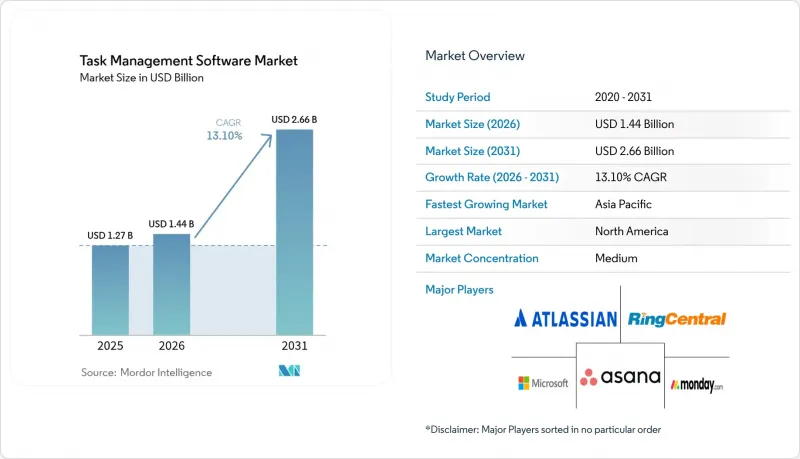
Mordor Intelligence에 의하면, 업무 관리 소프트웨어 시장 규모는 2025년에 12억 7,000만 달러, 2026년 14억 4,000만 달러에서 2031년까지 26억 6,000만 달러에 이를 것으로 예측되며, 예측 기간(2026년-2031년) CAGR은 13.1%를 기록할 전망입니다.
본 보고서는 구성 요소(소프트웨어 및 서비스), 조직 규모(중소기업 및 대기업), 도입 형태(클라우드 및 On-Premise), 최종 사용자 산업(은행, 금융서비스 및 보험(BFSI), 제조업 등), 업무 기능(마케팅 및 크리에이티브, 인사 및 채용 등), 그리고 지역(북미 등)별로 분류되어 있습니다. 시장 전망은 금액(달러) 기준으로 제시되어 있습니다.
세계 업무 관리 소프트웨어 시장 동향 및 인사이트
중소기업의 클라우드 도입 가속화
구독형 가격 책정으로 인해 설비 투자가 불필요해지고, 자동 갱신을 통해 기능의 일관성이 확보되며, 번들로 제공되는 모듈이 지출 비중을 확대함에 따라 중소기업의 대대적인 전환이 촉진되고 있습니다. 2024년 인도에서 실시된 조사에 따르면, 중소기업의 절반이 클라우드 인프라를 IT 분야의 최우선 과제로 꼽았습니다. Salesforce 보고서에 따르면, 중소기업의 52%가 이미 AI 지원 도구를 이용하고 있으며, 사용자 1인당월평균 비용은 29달러입니다. 이는 클라우드의 경제성이 고급 기능을 널리 보급시켰음을 보여주는 증거입니다. 각 벤더사는 현재 CRM, 인사, 회계 기능을 태스크 오케스트레이션과 묶어 제공함으로써 락인을 더욱 강화하고 있습니다. 레거시 시스템의 부담에 얽매이지 않는 신흥 시장의 중소기업들은 그린필드 환경에서 풀스택 클라우드 제품군을 도입하고 있습니다. 규제상의 장벽은 최소화되어 있지만, 각 제공업체들은 현지 개인정보 보호 규정을 준수하기 위해 지역별 데이터센터를 점점 더 많이 개설하고 있습니다.
하이브리드 및 원격 근무의 확대
세계 기업들은 현재 서로 다른 시간대와 기기를 넘나들며 협업하는 직원들을 관리하고 있으며, 이로 인해 업무 가시성을 일원화할 필요성이 더욱 커지고 있습니다. 도구들이 분산되어 있으면 업무 중복, 의존 관계의 간과, 불필요한 회의가 발생하여 생산성 향상에 차질을 빚게 됩니다. 최신 플랫폼은 프로젝트 피드, 채팅 스레드, 상태 표시기를 단일 화면에 통합하여 관리자의 관리 부담을 줄여줍니다. 실시간 대시보드는 워크로드의 균형과 위험 지표를 시각화하여, 사후 대응적인 ‘화재 진압’이 아닌, 미래를 내다보는 적극적인 개입을 가능하게 합니다. 내장된 앰비언트 인텔리전스가 업무 이벤트를 자동으로 포착하므로, 개별 담당자가 업데이트해야 할 항목은 줄어들고, 반면 경영진은 완벽한 감사 추적을 확보할 수 있습니다. 댓글 스레드나 자동 알림과 같은 비동기 협업 기능을 통해 업무 인계가 더욱 효율화됩니다.
SaaS의 무분별한 확장과 통합 피로
조직은 평균 50개 이상의 클라우드 애플리케이션를 운영하고 있으며, IT 리더의 60%는 여전히 매달 새로운 도구를 추가하고 있어, 성능 향상이라는 이점을 저해하는 분산된 생태계가 형성되고 있습니다. 이토록 많은 포인트 솔루션을 연동하려면 지속적인 API 유지 관리, 라이선싱 거버넌스, 보안 강화가 필요하며, 이는 귀중한 엔지니어링 시간을 소모하게 됩니다. 그 결과 발생하는 ‘통합 피로’로 인해 총 소유 비용(TCO) 절감을 약속하는 다중 모듈형 제품군으로의 벤더 통합이 진행되고 있습니다. 2024년, 기업들은 중복되는 SaaS 지출로 인해 연간 1,800만 달러를 낭비하고 있으며, CIO를 대상으로 한 설문조사 응답자 거의 전원이 차기 연도에 합리화 로드맵을 최우선 과제로 삼을 것을 촉구받고 있습니다. 채팅, 문서 관리, 분석 기능을 통합한 종합적인 업무 관리 제품군은 업무 간 이동을 통한 낭비를 줄이고, 데이터 계보를 일원화하여 관리합니다.
부문 분석
매니지드 서비스는 연평균 16.8%의 성장률을 기록하고 있으며, 기업들이 AI 기반 워크플로우 설계 및 최적화를 위한 턴키 솔루션을 요구함에 따라 업무 관리 소프트웨어 시장 전체의 성장률을 계속해서 상회할 것으로 예측됩니다. 소프트웨어 패키지는 디지털 기반을 제공하기 때문에 2025년에도 여전히 매출의 64.10%를 차지하고 있지만, 많은 구매 기업에는 고급 규칙 설정, 머신러닝 모델 훈련, 레거시 애플리케이션 통합을 수행할 사내 팀이 부족합니다. 서비스 전문가들은 가치 실현까지 걸리는 시간을 단축하는 플레이북을 제공하거나, 공급자의 인센티브와 생산성 향상을 연계하는 성과 기반 계약을 제안함으로써 이러한 격차를 해소하고 있습니다. 이러한 파트너십 모델에는 변화하는 인력 배치 패턴과 규정 준수 요건에 맞추어 오케스트레이션 엔진을 조정하는 지속적인 개선 프로그램이 포함되는 경우가 많습니다.
공급업체는 현재 변경 관리 교육, 거버넌스 감사, 보안 시정 조치를 연간 계약에 포함시켜 라이선스 구독에 필적하는 지속적인 수익원을 창출하고 있습니다. 이러한 서비스 주도형 도입 패턴을 통해 고객은 벤더의 자원을 운영 팀에 깊이 통합하게 되므로, 플랫폼에 대한 충성도도 높아질 것으로 예측됩니다. 참여 데이터를 새로운 제품 기능으로 원활하게 전환할 수 있는 벤더는 업무 관리 소프트웨어 시장에서 장기적인 경쟁 우위를 확보하게 될 것입니다.
대기업은 견고한 보고 기능, 싱글 사인온(SSO), 세밀한 권한 관리가 필요한 복잡한 프로그램 포트폴리오로 인해 2025년 매출의 54.60%를 차지했습니다. 그럼에도 불구하고, 직관적인 온보딩, 합리적인 사용자당 가격 책정, 그리고 로우코드(low-code)의 유연성으로 인해 경쟁 환경이 평준화됨에 따라, 중소기업 시장은 2031년까지 연평균 성장률(CAGR) 14.1%로 성장할 전망입니다. 클라우드 네이티브 아키텍처 덕분에 하드웨어 지출이 줄어들고 조달 주기가 단축되어, 중소기업도 분기 단위가 아닌 며칠 이내에 엔터프라이즈급 자동화를 도입할 수 있게 됩니다.
성장 중인 기업들이 신설 팀 전체에서 이용을 확대함에 따라, 중소기업 부문의 업무 관리 소프트웨어 시장 규모는 향후 10년 말 무렵에는 대기업 부문과 어깨를 나란히 할 수준에 도달할 것으로 예측됩니다. 프리미엄 및 단계별 요금 체계를 갖춘 벤더들은 초기 프로젝트를 조직 전체로의 도입으로 전환하여 예측 가능한 매출 성장을 이끌어낼 전망입니다. 커뮤니티 포럼, 템플릿 라이브러리, 현지 언어 지원 언어 팩은 신흥 경제국에서의 도입을 더욱 가속화할 것입니다.
지역별 분석
북미는 2025년 매출의 37.10%를 계속 차지했습니다. 이는 얼리 어답터들이 서벤스-옥슬리법의 감사 요건을 충족하고 인력 부족의 압박을 완화하기 위해 AI를 활용한 오케스트레이션에 의존하고 있기 때문입니다. 태스크 엔진과 기존 생산성 제품군 간의 긴밀한 통합으로 인해 도입이 가속화되고 있습니다. 이는 대부분의 기업이 이미 주요 벤더의 생태계에 깊이 통합되어 있기 때문입니다. 견조한 벤처 자금 조달과 활기찬 스타트업 환경 또한, 경쟁적 차별화를 추구하는 구매자들의 공감을 불러일으키는 신속한 제품 혁신 주기를 뒷받침하고 있습니다.
아시아태평양은 모바일 광대역 커버리지 향상, 정부의 클라우드 도입 촉진 정책, 중소기업을 위한 디지털화 프로그램이 맞물려 유리한 시장 환경이 조성되어 연평균 성장률(CAGR) 13.8%로 성장하고 있습니다. 인도나 인도네시아와 같은 국가에서는 가격 책정 및 언어를 현지화한 국내 SaaS 기업이 주도적인 역할을 하고 있는 반면, 중국의 규제 환경은 소버린 클라우드 옵션을 제공하는 공급업체를 우대하고 있습니다. 많은 지역 기업들은 기존의 On-Premise형 도입 단계를 완전히 건너뛰고, 동남아시아 전역에 지리적으로 분산된 공급망을 지원하는 클라우드 기반 또는 하이브리드형 태스크 엔진을 채택하고 있습니다.
유럽에서는 GDPR(EU 개인정보보호규정) 및 DORA, 나아가 도입의 복잡성을 가중시키는 새로운 인공지능(AI) 위험에 관한 지침에 대한 대응이 요구되는 가운데, 꾸준한 성장을 유지하고 있습니다. 이 지역에서 사업을 전개하는 벤더들은 엄격한 개인정보 보호 기준을 준수하는 데이터 거주지 관리, 고객 관리형 암호화 키, 지속적인 규정 준수 보고를 제공함으로써 이러한 과제에 대응하고 있습니다. 남유럽에서는 원격지에 위치한 자회사 전체의 업무 가시성을 요구하는 중견 수출 기업들 사이에서 도입이 가속화되고 있습니다. 그 밖의 지역에서는 라틴아메리카와 중동 및 아프리카가 여전히 발전 단계에 있지만, 클라우드 인프라의 확대와 공공 부문의 현대화 프로그램이 구조화된 프로젝트 모니터링에 대한 초기 수요를 견인하고 있어 미래가 기대되고 있습니다.
기타 혜택:
- 엑셀 형식 시장 예측(ME) 시트
- 3개월간의 애널리스트 지원
자주 묻는 질문
목차
제1장 서론
제2장 조사 방법
제3장 주요 요약
제4장 시장 구도
제5장 시장 규모와 성장 예측
제6장 경쟁 구도
제7장 시장 기회와 향후 전망
LSH 26.08.26According to Mordor Intelligence, the task management software market size was valued at USD 1.27 billion in 2025 and estimated to grow from USD 1.44 billion in 2026 to reach USD 2.66 billion by 2031, at a CAGR of 13.1% during the forecast period (2026-2031).
This report is Segmented by Component (Software, and Services), Organization Size (Small and Medium Enterprises, and Large Enterprises), Deployment Mode (Cloud, and On-Premises), End-User Industry (BFSI, Manufacturing, and More), Business Function (Marketing and Creative, HR and Recruiting, and More), and Geography (North America, and More). The Market Forecasts are Provided in Terms of Value (USD).
Global Task Management Software Market Trends and Insights
Rapid Adoption of Cloud by SMEs
Subscription pricing removes capital expense, automatic updates protect feature parity, and bundled modules increase wallet share, encouraging smaller firms to migrate en masse. A 2024 Indian survey showed half of SMEs ranking cloud infrastructure as the top IT priority. Salesforce reports that 52% of small businesses already use AI-enabled tools, paying a median USD 29 per user monthly, evidence that cloud economics have democratized advanced capabilities. Vendors now bundle CRM, HR, and accounting with task orchestration, deepening lock-in. Emerging-market SMEs, unburdened by legacy systems, adopt full-stack cloud suites in greenfield rollouts. Minimal regulatory friction exists, though providers increasingly open regional data centers to meet local privacy rules.
Expansion of Hybrid and Remote Workforces
Global firms now manage employees who collaborate across time zones and device types, which amplifies the need for unified task visibility. Fragmented tool stacks create duplicate work, missed dependencies, and unnecessary meetings that erode productivity gains. Modern platforms consolidate project feeds, chat threads, and status indicators into a single pane of glass that reduces administrative overhead for managers. Real-time dashboards surface workload balance and risk metrics, enabling proactive interventions rather than reactive fire-fighting. Embedded ambient intelligence captures work events automatically, so individual contributors update fewer fields while leadership still obtains complete audit trails. Asynchronous collaboration features such as comment threads and automated reminders further streamline hand-offs.
Persistent SaaS Sprawl and Integration Fatigue
Organizations juggle 50-plus cloud applications on average, and 60% of IT leaders still add new tools each month, creating sprawling ecosystems that drain performance gains. Connecting so many point solutions requires ongoing API maintenance, license governance, and security hardening that consume precious engineering hours. The resulting integration fatigue encourages vendor consolidation toward multi-module suites that promise lower total cost of ownership. Enterprises wasted USD 18 million annually on redundant SaaS spending in 2024, prompting nearly every CIO survey respondent to prioritize rationalization roadmaps over the next fiscal year. Comprehensive task management suites that incorporate chat, document management, and analytics reduce swivel-chair overhead and centralize data lineage.
Other drivers and restraints analyzed in the detailed report include:
- Vertical-Specific Task Suites for Regulated Industries
- Rise of Low-Code and No-Code Platforms
- Data-Residency and Sovereignty Regulations
For complete list of drivers and restraints, kindly check the Table Of Contents.
Segment Analysis
Managed services grew 16.8% annually and are expected to continue outpacing overall task management software market growth as enterprises seek turnkey delivery of AI-driven workflow design and optimization. Software packages still represented 64.10% revenue in 2025 because they provide the digital foundation, yet many buyers lack in-house teams to configure advanced rules, train machine learning models, and integrate legacy applications. Services specialists close this gap by offering playbooks that shorten time to value and outcome-based contracts that align provider incentives with productivity gains. The partnership model often includes continuous improvement programs that calibrate orchestration engines against evolving staffing patterns and compliance mandates.
Providers now bundle change-management training, governance audits, and security remediation into annual engagements, creating recurring revenue streams that rival license subscriptions. This service-led adoption pattern is expected to raise platform stickiness because clients embed vendor resources deep within operational teams. Vendors that can seamlessly convert engagement data into new product features will secure long-term competitive moats in the task management software market.
Large enterprises captured 54.60% 2025 revenue due to complex program portfolios that demand robust reporting, single sign-on, and granular permissions. Nonetheless, SMEs will expand at 14.1% CAGR through 2031 as intuitive onboarding, affordable per-seat pricing, and low-code flexibility level the competitive playing field. Cloud-native architectures eliminate hardware spend and shorten procurement cycles, helping smaller firms deploy enterprise-grade automation within days rather than quarters.
The task management software market size for the SME segment is projected to approach parity with the large-enterprise segment near the end of the decade as growing firms scale usage across newly formed teams. Vendors that nurture freemium or tiered offerings stand to convert initial projects into organization-wide deployments, driving predictable expansion revenue. Community forums, template libraries, and localized language packs further accelerate adoption in emerging economies.
Complete Report Scope:
- By Component
- Software
- Stand-alone Task Management Apps
- Integrated Project and Work-Management Suites
- Services
- Professional (Implementation, Consulting)
- Managed Services
- Software
- By Organization Size
- Small and Medium Enterprises
- Large Enterprises
- By Deployment Mode
- Cloud
- Public Cloud
- Private and Hybrid Cloud
- On-Premise
- Cloud
- By End-User Industry
- BFSI
- IT and Telecommunication
- Retail and eCommerce
- Manufacturing
- Healthcare and Life-Sciences
- Government and Public Sector
- Travel, Tourism and Hospitality
- Other End-User Industrys (Education, Media, etc.)
- By Business Function
- Marketing and Creative
- HR and Recruiting
- Finance and Accounting
- Sales and Customer Success
- By Geography
- North America
- United States
- Canada
- Mexico
- South America
- Brazil
- Argentina
- Chile
- Rest of South America
- Europe
- United Kingdom
- Germany
- France
- Italy
- Spain
- Rest of Europe
- Asia-Pacific
- China
- Japan
- India
- South Korea
- Australia and New Zealand
- Rest of Asia-Pacific
- Middle East and Africa
- Middle East
- United Arab Emirates
- Saudi Arabia
- Turkey
- Rest of Middle East
- Africa
- South Africa
- Kenya
- Nigeria
- Rest of Africa
- Middle East
- North America
Geography Analysis
North America retained 37.10% of 2025 revenue because early adopters rely on AI-augmented orchestration to satisfy Sarbanes-Oxley audit requirements and to mitigate worker shortage pressures. Tight integration between task engines and incumbent productivity suites accelerates rollout because most enterprises are already entrenched in large vendor ecosystems. Robust venture funding and a vibrant startup landscape also feed rapid product innovation cycles that resonate with buyers seeking competitive differentiation.
Asia Pacific is advancing at a 13.8% CAGR as improved mobile broadband coverage, government cloud incentives, and SME digitalization programs combine to create favorable market conditions. Countries such as India and Indonesia champion domestic SaaS champions that localize pricing and language, while China's regulatory environment favors providers with sovereign cloud options. Many regional businesses leapfrog legacy on-premise deployments altogether, adopting cloud or hybrid task engines that support geographically dispersed supply chains across Southeast Asia.
Europe maintains steady growth despite navigating GDPR, DORA, and emerging artificial-intelligence risk guidelines that raise implementation complexity. Vendors that operate within the region respond by offering data-residency controls, customer-managed encryption keys, and continuous compliance reporting that align with stringent privacy norms. Southern Europe is witnessing accelerated uptake among mid-market exporters who seek operational visibility across far-flung subsidiaries. Elsewhere, Latin America, the Middle East, and Africa remain nascent but promising as cloud infrastructure expands and public-sector modernization programs anchor early demand for structured project oversight.
- Microsoft Corporation
- Atlassian Corporation Plc
- Asana, Inc.
- monday.com Ltd.
- Smartsheet Inc.
- Adobe Inc. (Workfront)
- RingCentral, Inc.
- Citrix Systems, Inc. (Wrike)
- Basecamp LLC
- ClickUp Inc.
- Quickbase, Inc.
- Redbooth, Inc.
- Upland Software, Inc.
- SAP SE
- Oracle Corporation (NetSuite)
- ServiceNow Inc.
- Zoho Corporation Pvt Ltd. (Zoho Projects)
- Airtable, Inc.
- Notion Labs, Inc.
- ProofHub LLC
Additional Benefits:
- The market estimate (ME) sheet in Excel format
- 3 months of analyst support
TABLE OF CONTENTS
1 Introduction
- 1.1 Study Assumptions and Market Definition
- 1.2 Scope of the Study
2 Research Methodology
3 Executive Summary
4 Market Landscape
- 4.1 Market Overview
- 4.2 Market Drivers
- 4.2.1 Rapid Adoption of Cloud by SMEs
- 4.2.2 Explosion of Hybrid/Remote Workforces Requiring Unified Task Visibility
- 4.2.3 Vertical-Specific Task Suites for Regulated Industries
- 4.2.4 Rise of Low-Code/No-Code Platforms that Embed Task Engines
- 4.2.5 Bundling of Task Analytics into Employee-Experience (EX) Cloud Stacks
- 4.2.6 ESG Compliance and Audit-Trail Mandates Boosting Traceable Task Workflows
- 4.3 Market Restraints
- 4.3.1 Persistent Saas Sprawl Creating Integration Fatigue
- 4.3.2 Data-Residency and Sovereignty Regulations Slowing Multi-Tenant Adoption
- 4.3.3 Change-Management Inertia In Legacy-Heavy Verticals (Manufacturing, Public Sector)
- 4.3.4 AI-Generated Task Recommendations Facing Explainability Scrutiny
- 4.4 Industry Value / Supply-Chain Analysis
- 4.5 Regulatory Landscape
- 4.6 Technological Outlook
- 4.7 Impact of Macroeconomic Factors on the Market
- 4.8 Porter's Five Forces Analysis
- 4.8.1 Threat of New Entrants
- 4.8.2 Bargaining Power of Buyers
- 4.8.3 Bargaining Power of Suppliers
- 4.8.4 Threat of Substitutes
- 4.8.5 Competitive Rivalry
5 MARKET SIZE AND GROWTH FORECASTS (VALUE)
- 5.1 By Component
- 5.1.1 Software
- 5.1.1.1 Stand-alone Task Management Apps
- 5.1.1.2 Integrated Project and Work-Management Suites
- 5.1.2 Services
- 5.1.2.1 Professional (Implementation, Consulting)
- 5.1.2.2 Managed Services
- 5.1.1 Software
- 5.2 By Organization Size
- 5.2.1 Small and Medium Enterprises
- 5.2.2 Large Enterprises
- 5.3 By Deployment Mode
- 5.3.1 Cloud
- 5.3.1.1 Public Cloud
- 5.3.1.2 Private and Hybrid Cloud
- 5.3.2 On-Premise
- 5.3.1 Cloud
- 5.4 By End-User Industry
- 5.4.1 BFSI
- 5.4.2 IT and Telecommunication
- 5.4.3 Retail and eCommerce
- 5.4.4 Manufacturing
- 5.4.5 Healthcare and Life-Sciences
- 5.4.6 Government and Public Sector
- 5.4.7 Travel, Tourism and Hospitality
- 5.4.8 Other End-User Industrys (Education, Media, etc.)
- 5.5 By Business Function
- 5.5.1 Marketing and Creative
- 5.5.2 HR and Recruiting
- 5.5.3 Finance and Accounting
- 5.5.4 Sales and Customer Success
- 5.6 By Geography
- 5.6.1 North America
- 5.6.1.1 United States
- 5.6.1.2 Canada
- 5.6.1.3 Mexico
- 5.6.2 South America
- 5.6.2.1 Brazil
- 5.6.2.2 Argentina
- 5.6.2.3 Chile
- 5.6.2.4 Rest of South America
- 5.6.3 Europe
- 5.6.3.1 United Kingdom
- 5.6.3.2 Germany
- 5.6.3.3 France
- 5.6.3.4 Italy
- 5.6.3.5 Spain
- 5.6.3.6 Rest of Europe
- 5.6.4 Asia-Pacific
- 5.6.4.1 China
- 5.6.4.2 Japan
- 5.6.4.3 India
- 5.6.4.4 South Korea
- 5.6.4.5 Australia and New Zealand
- 5.6.4.6 Rest of Asia-Pacific
- 5.6.5 Middle East and Africa
- 5.6.5.1 Middle East
- 5.6.5.1.1 United Arab Emirates
- 5.6.5.1.2 Saudi Arabia
- 5.6.5.1.3 Turkey
- 5.6.5.1.4 Rest of Middle East
- 5.6.5.2 Africa
- 5.6.5.2.1 South Africa
- 5.6.5.2.2 Kenya
- 5.6.5.2.3 Nigeria
- 5.6.5.2.4 Rest of Africa
- 5.6.5.1 Middle East
- 5.6.1 North America
6 Competitive Landscape
- 6.1 Market Concentration
- 6.2 Market Share Analysis
- 6.3 Company Profiles (includes Global level Overview, Market level overview, Core Segments, Financials as available, Strategic Information, Market Rank/Share for key companies, Products and Services, and Recent Developments)
- 6.3.1 Microsoft Corporation
- 6.3.2 Atlassian Corporation Plc
- 6.3.3 Asana, Inc.
- 6.3.4 monday.com Ltd.
- 6.3.5 Smartsheet Inc.
- 6.3.6 Adobe Inc. (Workfront)
- 6.3.7 RingCentral, Inc.
- 6.3.8 Citrix Systems, Inc. (Wrike)
- 6.3.9 Basecamp LLC
- 6.3.10 ClickUp Inc.
- 6.3.11 Quickbase, Inc.
- 6.3.12 Redbooth, Inc.
- 6.3.13 Upland Software, Inc.
- 6.3.14 SAP SE
- 6.3.15 Oracle Corporation (NetSuite)
- 6.3.16 ServiceNow Inc.
- 6.3.17 Zoho Corporation Pvt Ltd. (Zoho Projects)
- 6.3.18 Airtable, Inc.
- 6.3.19 Notion Labs, Inc.
- 6.3.20 ProofHub LLC
7 MARKET OPPORTUNITIES AND FUTURE OUTLOOK
- 7.1 White-space and Unmet-Need Assessment


