

|
시장보고서
상품코드
2115790
폼페병 : 시장 점유율 분석, 업계 동향 및 통계, 성장 예측(2026-2031년)Pompe Disease - Market Share Analysis, Industry Trends & Statistics, Growth Forecasts (2026 - 2031) |
||||||
 Mordor Intelligence
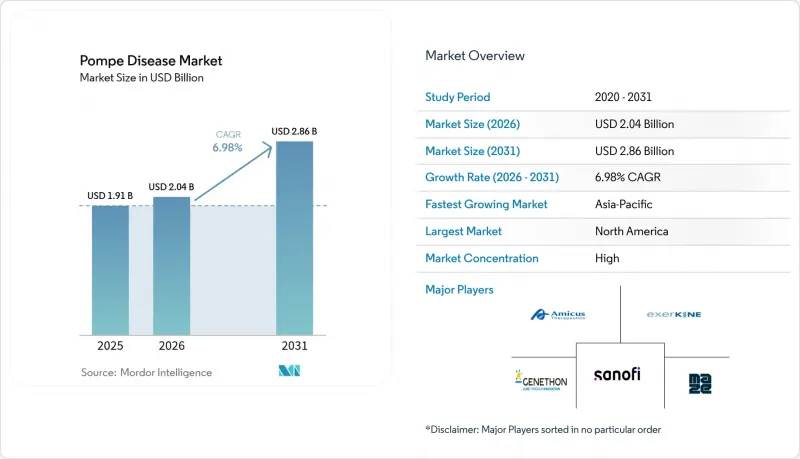
Mordor Intelligence에 의하면, 2026년 폼페병 시장 규모는 20억 4,000만 달러로 추정되고 있으며, 2025년 19억 1,000만 달러에서 2031년에는 28억 6,000만 달러에 달할 것으로 예측됩니다.
2026년부터 2031년까지의 연평균 성장률(CAGR)은 6.98%를 나타낼 것으로 전망됩니다.
본 보고서는 투여 경로(경구, 비경구), 치료법(효소 보충 요법(ERT), 병용 요법, 기타 치료법), 발병 유형별(영아 발병형 폼페병(IOPD), 지연 발병형 폼페병(LOPD)),유통 채널별(병원 약국, 소매 약국 등), 지역별(북미, 유럽, 아시아태평양 등)로 분류되어 있습니다.
전 세계 폼페병 시장 동향 및 인사이트
신규 2세대 ERT 출시
미글루스타트와 병용하여 출시된 시파글루코시다제 알파 등의 2세대 효소 제제는 만노스-6-인산의 표지화와 세포 내 흡수를 개선하고, 골격근의 글리코겐 제거율을 향상시켜,기존의 알글루코시다제 알파와 비교하여 환자 보고 결과에서 우수한 성과를 보이고 있습니다. 유럽에서 이 치료법이 지연형 질환을 앓는 성인 환자에 대한 권장 요법으로 조기에 지정된 것은 미국 이외의 지역에서도 주목을 받고 있음을 보여주며, 아미쿠스사는 2028년까지 누적 매출액이 10억 달러를 넘어설 것으로 예측했습니다. 시장 내 기대감은 심사 기간 단축 및 독점권 연장 등 희귀질환 의약품 제도에 기반한 규제상의 유연성으로 인해 더욱 고조되고 있으며, 다른 제약사들도 개선된 ERT 제제의 개발을 우선시하도록 촉진되고 있습니다.
신생아 선별검사 의무화 확대
중국, 일본 및 미국의 일부 주에서 시행되고 있는 유전체 우선 선별 검사 프로그램에서는 효소 활성 측정법에 비해 폼페병의 검출률이 현저히 높으며, 중국에서 실시된 시범 조사에서는 리소좀 질환의 전체 유병률이 출생아 1,512명당 1명인 것으로 보고되었습니다. 조기 발견을 통해 특히 증상이 나타나기 전에 치료가 가능해지며, 특히 영아기 발병 사례에서는 급격한 심장 기능 및 호흡 기능 저하를 예방할 수 있습니다. 각국 정부는 폼페병 검사 패널을 국가 선별 검사 항목에 포함시키고, 보험 적용 범위를 확대하는 한편, 장기적인 처방량 증가를 뒷받침할 수 있는 지속적인 도입을 촉진하고 있습니다.
고액의 치료비
독일에서 환자 1인당 연간 의료비는 48만 3,907유로에 달하며, 폼페병은 리소좀 질환 중 가장 비용이 많이 드는 질환입니다. 그 중 98.5%는 약제비에서 비롯됩니다. 희귀질환 의약품 정책에 따라 고가 책정이 허용되고 있지만, 지불 기관은 현재 전액 환급을 승인하기 전에 확실한 치료 성과 데이터의 제시를 요구하고 있어, 이로 인해 협상이 장기화되고 있으며, 특히 병용 요법이나 유전자 치료 분야의 신규 진입 제품의 경우 시장 출시 확대가 지연되고 있습니다.
부문 분석
2025년, 폼페병 시장의 90.88%를 비경구 제제가 차지했으며, 시장 규모는 17억 4,000만 달러, 연평균 성장률(CAGR)은 6.25%를 기록했습니다. 이는 개량된 효소 재조합체의 임상 적용이 진전된 것이 원동력이 되었습니다. 정맥 내 투여는 임상의들이 수십 년에 걸쳐 익숙하게 사용해 온 실적, 성숙한 전문 약국의 물류 체계, 그리고 호흡 기능 및 보행 기능의 안정화에 대한 입증된 임상적 유효성이라는 장점이 있습니다. 아발글루코시다제 알파는 제제 혁신을 상징하는 제품으로, 비스인산화 만노스-6-인산 태그를 도입하여 근육으로의 흡수를 촉진하고, 점적 간격을 연장할 수 있게 했습니다. 온도 관리 유통 체계의 발전으로 제품 폐기율은 1% 미만으로 억제되고, 정시 배송률은 98%를 유지하고 있어, 이를 통해 비경구 투여 모델이 더욱 확고해졌습니다.
경구 투여는 아직 발전 단계에 있지만, 전략적으로 중요한 접근 방식입니다. Maze Therapeutics사의 경구용 글리코겐 합성 효소 억제제 ‘MZE-001’은 사노피에 의한 7억 5,000만 달러 규모의 인수 및 시오노기 제약에 의한 1억 5,000만 달러 규모의 라이선스 계약의 기반이 되고 있으며,편리한 1일 1회 정제 투여가 격주 정맥 주사를 보완하고, 나아가 이를 대체할 가능성이 있다고 확신되고 있음을 반영하고 있습니다. 2상 임상시험 데이터를 통해 글리코겐 감소 바이오마커가 확인된다면, 폼페병 치료 분야에서는 환자가 비경구적 ERT에서 경구적 기질 감소 유지 요법으로 전환하는 양분된 치료 알고리즘이 확립될 가능성이 있으며, 이에 따라 수익 구성 및 물류상의 요건도 변화할 것입니다.
효소 보충 요법(ERT)은 2025년 매출의 89.75%를 차지하며, 폼페병 시장 규모는 17억 1,000만 달러에 달하지만, 병용 요법이 보급됨에 따라 그 점유율은 소폭 하락할 것으로 예측됩니다. 임상의들은 풍부한 장기 안전성 데이터와 보험 환급 제도에 대한 익숙함으로 인해 계속해서 알글루코시다제 알파 및 아바글루코시다제 알파에 의존하고 있습니다. 그러나 시파글루코시다제 알파와 미글루스타트의 병용 요법이 FDA 승인을 받은 것은 패러다임 전환의 시작을 시사합니다. 아미커스(Amicus)는 6분 보행 테스트 점수의 개선에 따라 치료 경험이 있는 환자들이 병용 요법으로 전환한 결과, 2025년 1분기에 전년 동기 대비 90%의 매출 성장을 보고했습니다.
유전자 치료 및 mRNA 치료는 ‘기타’ 범주에 분류되며, ERT(효소 보충 요법)의 우위를 좁힐 가능성이 있습니다. 단일 투여 AAV 벡터나월1회 mRNA 주사는 특히 젊은 층에서 약물 복용 순응도 패턴을 완전히 바꿀 가능성이 있습니다. 하지만 개발 기업들은 대규모 상용화에 앞서 제조 및 면역원성과 관련된 과제를 극복해야 합니다.
지역별 분석
북미는 2025년 매출의 46.20%(8억 8,000만 달러 상당)를 차지하고 있으며, 이는 견조한 보험 적용, 미국 각 주에서 시행되는 신생아 선별 검사, 그리고 신경근 질환 전문의들의 조기 도입 경향을 반영한 것입니다. 또한, 이 지역에서는 탄탄한 자본 시장과 경험이 풍부한 수탁 제조(CMO) 생태계의 지원을 받아 진행 중인 제3상 유전자 치료 임상시험의 대부분이 실시되고 있습니다. '인플레이션 억제법(Inflation Reduction Act)'에 따른 가격 협상 등의 정책 전환은 불확실성을 초래하지만, 생명을 위협하는 희귀질환에 대한 높은 임상적 가치 평가에 부정적인 영향을 미칠 가능성은 낮을 것으로 보입니다.
유럽은 두 번째로 큰 지역 블록으로, 유럽의약품청(EMA)에 의한 조화로운 규제 절차가 특징인 반면, 회원국 차원의 급여 결정은 분열되어 있습니다. 서유럽 국가에서는 일반적으로 판매 승인 후 3개월 이내에 폼페병 효소 보충 요법(ERT)에 대한 자금 지원이 이루어지지만, 중·동유럽의 많은 시장에서는 2년 이상 지연되어 지역 내 접근성 격차가 발생하고 있습니다. 로슈가 독일에 9,000만 유로를 투자해 건설한 유전자 치료 시설,UCB사가 벨기에에 2억 유로를 투자해 건설한 효소 제조 시설과 같은 산업계의 노력은 의료기술평가(HTA)의 심사가 엄격해지는 상황 속에서도 유럽이 계속해서 수익성 높은 시장으로 자리매김할 것이라는 확신이 높아지고 있음을 반영하고 있습니다.
아시아태평양은 연평균 성장률(CAGR) 9.02%로 가장 빠른 성장 궤적을 기록하고 있습니다. 중국에서 신생아 유전체 검사가 의무화됨에 따라 발병률 데이터가 확보되었고, 이로 인해 진단된 환자 수가 즉시 증가하여 ERT 지원이 포함된 정책 조치가 시행되었습니다. 일본의 의약품 및 의료기기 종합기구(PMDA)는 희귀질환 치료제에 대해 중앙값 9개월이라는 신속한 심사 주기를 유지하고 있으며, 7년간의 독점권을 부여함으로써 신청자가 전 세계 신청 서류를 조기에 제출하도록 장려하고 있습니다. 한편, 호주와 한국에서는 아발글루코시다제 알파가 국가 보험 적용 목록에 추가되어, 차세대 치료법의 지역적 통합이 더욱 진전될 조짐을 보이고 있습니다. 현지 충전 및 포장 능력을 포함한 공급망에 대한 투자로 인해 수입에 따른 지연이 완화되고, 배송 비용이 감소하며, 지속적인 판매량 증가가 촉진되고 있습니다.
기타 혜택:
- 엑셀 형식 시장 예측(ME) 시트
- 3개월간의 애널리스트 지원
자주 묻는 질문
목차
제1장 서론
제2장 조사 방법
제3장 주요 요약
제4장 시장 구도
제5장 시장 규모와 성장 예측
제6장 경쟁 구도
제7장 시장 기회와 향후 전망
LSH 26.08.26According to Mordor Intelligence, pompe disease market size in 2026 is estimated at USD 2.04 billion, growing from 2025 value of USD 1.91 billion with 2031 projections showing USD 2.86 billion, growing at 6.98% CAGR over 2026-2031.
This report is Segmented by Route of Administration (Oral, Parenteral), by Therapy Type (Enzyme Replacement Therapy (ERT), Combination Therapy, Other Therapies), by Disease Onset Type (Infantile-Onset Pompe Disease (IOPD), Late-Onset Pompe Disease (LOPD)), by Distribution Channel (Hospital Pharmacies, Retail Pharmacies, and More), by Geography (North America, Europe, Asia-Pacific, and More).
Global Pompe Disease Market Trends and Insights
Launch of Novel Second-Generation ERTs
Second-generation enzymes such as cipaglucosidase alfa, launched in combination with miglustat, improve mannose-6-phosphate tagging and cellular uptake, delivering greater glycogen clearance in skeletal muscle and demonstrating superior patient-reported outcomes versus legacy alglucosidase alfa. Europe's early designation of the regimen as preferred therapy for adults with late-onset disease signals traction beyond the United States, while Amicus projects more than USD 1 billion in cumulative revenue by 2028. Market enthusiasm is reinforced by regulatory flexibility under orphan-drug frameworks that shorten review cycles and extend exclusivity, encouraging other sponsors to prioritise enhanced ERT constructs.
Expanding Newborn Screening Mandates
Genomics-first screening programmes in China, Japan, and several US states detect Pompe disease at markedly higher rates than enzyme-activity assays, with Chinese pilots reporting overall lysosomal prevalence of 1 in 1,512 births. Earlier identification drives pre-symptomatic treatment, especially for infantile-onset cases where rapid cardiac and respiratory decline can be prevented. Governments are embedding Pompe panels into national screening catalogues, extending reimbursement and stimulating sustained uptake that underpins long-run prescription volume growth.
High Therapy Cost
Annual per-patient spending of EUR 483,907 in Germany positions Pompe as the costliest lysosomal disorder, with 98.5% attributable to drug acquisition. Although orphan-drug policy supports premium pricing, payers now demand hard outcomes data before granting full reimbursement, prolonging negotiations and delaying broad launch roll-outs, particularly for combination and gene-therapy entrants.
Other drivers and restraints analyzed in the detailed report include:
- mRNA-Based ERT Platforms in Clinical Trials
- Gene-Therapy Funding Surge
- Delayed Diagnosis & Low Awareness
For complete list of drivers and restraints, kindly check the Table Of Contents.
Segment Analysis
Parenteral products accounted for 90.88% of the Pompe disease market in 2025, resulting in a market size of USD 1.74 billion and a 6.25% CAGR, driven by the advancement of improved enzyme constructs into the clinic. Intravenous delivery benefits from decades of clinician familiarity, mature specialty-pharmacy logistics, and proven clinical benefit in stabilising respiratory and ambulatory function. Avalglucosidase alfa exemplifies formulation innovation, incorporating bis-phosphorylated mannose-6-phosphate tags that enhance muscle uptake and facilitate longer infusion intervals. Temperature-controlled distribution advances keep product wastage below 1% and maintain an on-time delivery rate of 98%, further solidifying the parenteral model.
Oral administration remains a nascent but strategically important approach. Maze Therapeutics' MZE-001, an oral glycogen-synthase inhibitor, underpins Sanofi's USD 750 million acquisition and Shionogi's USD 150 million licensing pact, reflecting the conviction that a convenient daily pill can complement or even displace biweekly infusions. If Phase II data confirm glycogen-reduction biomarkers, the Pompe disease industry could see a bifurcated treatment algorithm, wherein patients transition from parenteral ERT to oral substrate-reduction maintenance, altering the revenue mix and logistical demands.
Enzyme replacement therapy generated 89.75% of 2025 revenue, equal to a Pompe disease market size of USD 1.71 billion, but its share is projected to decline modestly as combination regimens scale. Clinicians continue to rely on alglucosidase alfa and avalglucosidase alfa due to extensive long-term safety data and reimbursement familiarity. However, the FDA approval of cipaglucosidase alfa plus miglustat heralds a paradigm shift: Amicus reported 90% year-over-year revenue growth in Q1 2025 as treatment-experienced patients switched to the combination following improved six-minute-walk test scores.
Gene and mRNA therapies populate the "other" category and may compress the ERT window of dominance. A single-administration AAV vector or once-monthly mRNA injection could reshape adherence patterns, particularly for younger cohorts. Developers must nonetheless clear manufacturing and immunogenicity hurdles before large-scale commercialisation.
Complete Report Scope:
- By Route of Administration
- Oral
- Parenteral
- By Therapy Type
- Enzyme Replacement Therapy (ERT)
- Combination Therapy
- Other Therapies
- By Disease Onset Type
- Infantile-Onset Pompe Disease (IOPD)
- Late-Onset Pompe Disease (LOPD)
- By Distribution Channel
- Hospital Pharmacies
- Retail Pharmacies
- Online Pharmacies
- Others
- Geography
- North America
- United States
- Canada
- Mexico
- Europe
- Germany
- United Kingdom
- France
- Italy
- Spain
- Rest of Europe
- Asia-Pacific
- China
- Japan
- India
- Australia
- South Korea
- Rest of Asia-Pacific
- Middle East and Africa
- GCC
- South Africa
- Rest of Middle East and Africa
- South America
- Brazil
- Argentina
- Rest of South America
- North America
Geography Analysis
North America anchored 46.20% of 2025 sales, equivalent to USD 0.88 billion, reflecting robust payer coverage, active newborn screening across all US states, and early-adopter behaviour among neuromuscular specialists. The region also captures the majority of ongoing phase III gene-therapy trials, supported by deep capital markets and an experienced contract-manufacturing ecosystem. Policy shifts such as Inflation Reduction Act price negotiations inject uncertainty but are unlikely to undermine high clinical value assessments for life-threatening rare diseases.
Europe constitutes the second-largest regional block, characterised by a harmonised regulatory pathway through the European Medicines Agency yet fragmented reimbursement decision-making at the member-state level. Western European nations generally fund Pompe ERT within three months of marketing authorisation, whereas many Central and Eastern European markets lag by more than two years, creating intra-regional access disparities. Industrial commitments such as Roche's EUR 90 million gene-therapy site in Germany and UCB's EUR 200 million enzyme facility in Belgium reflect growing confidence that Europe will remain a profitable launch region despite rising health-technology-assessment scrutiny.
Asia-Pacific registers the fastest trajectory at 9.02% CAGR. China's mandatory genomic newborn screening yielded incidence data that immediately expanded the diagnosed population and triggered policy moves to subsidise ERT. Japan's Pharmaceuticals and Medical Devices Agency maintains an expedited 9-month median review cycle for orphan drugs, with seven years of exclusivity, incentivising sponsors to submit global dossiers early. Meanwhile, Australia and South Korea have added avalglucosidase alfa to national reimbursement schedules, signalling broader regional integration of next-generation therapies. Supply-chain investments, including local fill-finish capacity, mitigate import-related delays and lower landed costs, fostering sustainable volume growth.
- Sanofi
- Amicus Therapeutics
- Astellas Pharma / Audentes
- Asklepios BioPharmaceutical (AskBio)
- Genethon
- Orchard Therapeutics
- Shionogi & Co., Ltd.
- Beijing GeneCradle Technology Co., Ltd.
- Maze Therapeutics, Inc.
- Exerkine Corporation
Additional Benefits:
- The market estimate (ME) sheet in Excel format
- 3 months of analyst support
TABLE OF CONTENTS
1 Introduction
- 1.1 Study Assumptions & Market Definition
- 1.2 Scope of the Study
2 Research Methodology
3 Executive Summary
4 Market Landscape
- 4.1 Market Overview
- 4.2 Market Drivers
- 4.2.1 Launch of novel second-generation ERTs
- 4.2.2 Expanding newborn screening mandates
- 4.2.3 mRNA-based ERT platforms in clinical trials
- 4.2.4 China's rare-disease reimbursement acceleration
- 4.2.5 Gene-therapy funding surge
- 4.2.6 Global orphan-drug incentives
- 4.3 Market Restraints
- 4.3.1 High therapy cost
- 4.3.2 Delayed diagnosis & low awareness
- 4.3.3 Viral-vector manufacturing bottlenecks
- 4.3.4 Value-based pricing pressure in US/EU
- 4.4 Value / Supply-Chain Analysis
- 4.5 Regulatory Landscape
- 4.6 Technological Outlook
- 4.7 Porter's Five Forces Analysis
- 4.7.1 Threat of New Entrants
- 4.7.2 Bargaining Power of Buyers/Consumers
- 4.7.3 Bargaining Power of Suppliers
- 4.7.4 Threat of Substitute Products
- 4.7.5 Intensity of Competitive Rivalry
5 Market Size & Growth Forecasts (Value)
- 5.1 By Route of Administration
- 5.1.1 Oral
- 5.1.2 Parenteral
- 5.2 By Therapy Type
- 5.2.1 Enzyme Replacement Therapy (ERT)
- 5.2.2 Combination Therapy
- 5.2.3 Other Therapies
- 5.3 By Disease Onset Type
- 5.3.1 Infantile-Onset Pompe Disease (IOPD)
- 5.3.2 Late-Onset Pompe Disease (LOPD)
- 5.4 By Distribution Channel
- 5.4.1 Hospital Pharmacies
- 5.4.2 Retail Pharmacies
- 5.4.3 Online Pharmacies
- 5.4.4 Others
- 5.5 Geography
- 5.5.1 North America
- 5.5.1.1 United States
- 5.5.1.2 Canada
- 5.5.1.3 Mexico
- 5.5.2 Europe
- 5.5.2.1 Germany
- 5.5.2.2 United Kingdom
- 5.5.2.3 France
- 5.5.2.4 Italy
- 5.5.2.5 Spain
- 5.5.2.6 Rest of Europe
- 5.5.3 Asia-Pacific
- 5.5.3.1 China
- 5.5.3.2 Japan
- 5.5.3.3 India
- 5.5.3.4 Australia
- 5.5.3.5 South Korea
- 5.5.3.6 Rest of Asia-Pacific
- 5.5.4 Middle East and Africa
- 5.5.4.1 GCC
- 5.5.4.2 South Africa
- 5.5.4.3 Rest of Middle East and Africa
- 5.5.5 South America
- 5.5.5.1 Brazil
- 5.5.5.2 Argentina
- 5.5.5.3 Rest of South America
- 5.5.1 North America
6 Competitive Landscape
- 6.1 Market Concentration
- 6.2 Market Share Analysis
- 6.3 Company Profiles (includes Global-level Overview, Market-level Overview, Core Segments, Financials as available, Strategic Information, Market Rank/Share, Products & Services, Recent Developments)
- 6.3.1 Sanofi
- 6.3.2 Amicus Therapeutics
- 6.3.3 Astellas Pharma / Audentes
- 6.3.4 Asklepios BioPharmaceutical (AskBio)
- 6.3.5 Genethon
- 6.3.6 Orchard Therapeutics
- 6.3.7 Shionogi & Co., Ltd.
- 6.3.8 Beijing GeneCradle Technology Co., Ltd.
- 6.3.9 Maze Therapeutics, Inc.
- 6.3.10 Exerkine Corporation
7 Market Opportunities & Future Outlook
- 7.1 White-space & Unmet-Need Assessment


