

|
시장보고서
상품코드
2115792
천골신경 자극 : 시장 점유율 분석, 업계 동향 및 통계, 성장 예측(2026-2031년)Sacral Nerve Stimulation - Market Share Analysis, Industry Trends & Statistics, Growth Forecasts (2026 - 2031) |
||||||
 Mordor Intelligence
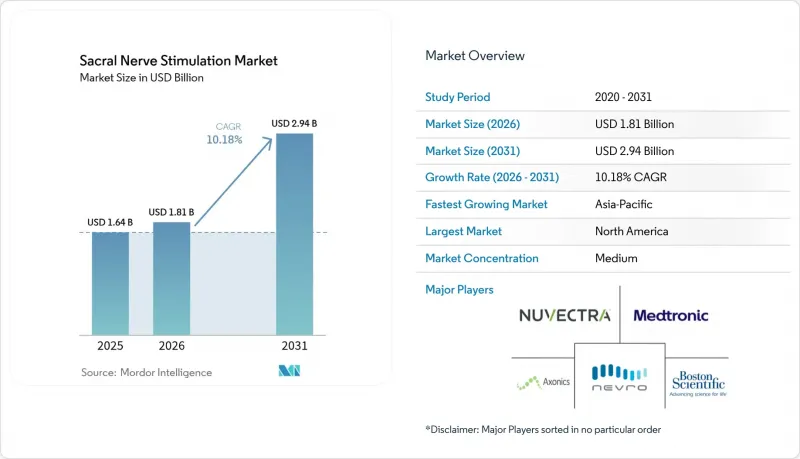
Mordor Intelligence에 의하면, 천골신경 자극 시장 규모는 2025년에 16억 4,000만 달러, 2026년 18억 1,000만 달러에서 2031년까지 29억 4,000만 달러에 이를 것으로 예측되며, 예측 기간(2026년-2031년) CAGR은 10.18%를 기록할 전망입니다.
본 보고서는 제품별(체외형 천골 신경 자극 시스템 및 이식형 천골 신경 자극 시스템), 용도별(긴급성 요실금, 요·대변 실금, 만성 항문열상 등), 최종 사용자별(병원, 외래수술센터(ASC) 등), 지역별(북미, 유럽 등)로 분류되어 있습니다. 시장 예측은 금액(달러) 기준으로 제시되어 있습니다.
전 세계 천골 신경 자극 시장 동향 및 인사이트
과활동성 방광 및 절박성 요실금·대변 실금의 유병률 증가
세계적인 고령화와 비만율의 상승으로 인해, 행동 요법이나 약물 요법에 반응하지 않는 환자의 임상 대상층은 지속적으로 확대되고 있습니다. 국민건강·영양조사 데이터에 따르면, 여성의 61.8%에서 요실금 증상이 나타나며, 이는 과거 조사와 비교하여 현저히 증가한 수치입니다. 최근의 횡단면 연구에 따르면, 과활동성 방광은 남녀 혼합 코호트의 27.4%에 영향을 미치고 있으며, 그중에서도 야간 빈뇨가 일상생활에 가장 큰 지장을 주는 증상으로 꼽히고 있습니다. 증상의 부담이 커지는 가운데, 1차 치료제인 항무스카린제나 B3 작용제가 효과를 보이지 않을 경우, 신경 조절 요법이 주목받고 있습니다. 현재 임상의들은 특히 항콜린 작용에 따른 부작용을 줄이고자 하는 환자를 대상으로, 치료 알고리즘의 초기 단계에서 천골 신경 자극 요법을 고려하고 있습니다. 이처럼 유병률 증가는 장기적으로 시술 건수의 지속적인 증가로 이어지고 있습니다.
유리한 환급 조건과 적용 범위 확대
미국 메디케어·메디케이드 서비스 센터(CMS)는 시험적 이식 및 영구적 이식 모두에 대해 명확한 HCPCS 코드를 도입하여 행정상의 모호함을 해소함과 동시에 의료기관 간 지급을 균일화했습니다. 2026년에 제안된 ASC 대상 시술 목록에는 수백 개의 코드가 추가되었으며, 이로 인해 시술 건수가 저비용 외래 센터로 더욱 이동할 가능성이 있습니다. 민간 보험사들도 이에 발맞추어, 시험 기간 중 증상이 50% 이상 개선된 경우 영구 이식을 일상적으로 보험 적용 대상으로 하고 있습니다. 미국 이외의 지역에서는 호주의 ‘보철물 목록’과 일본의 ‘신속 심사 제도’를 통해 차세대 충전식 시스템에 대한 보험 급여가 시작되었습니다. 이러한 조치로 인해 환자의 본인 부담금이 경감되어 병원 내 도입이 가속화되고 있습니다. 이러한 정책들이 맞물려 선진국과 신흥국 모두에서 치료를 받을 수 있는 환자층이 확대되고 있습니다.
의료기기와 관련된 유해 사건 및 높은 재수술률
155건의 이식 사례를 대상으로 한 단일 기관 감사에서 리드 변위, 통증 및 하드웨어 고장을 원인으로 5년 이내 재수술률이 38.2%인 것으로 확인되었습니다. 또한, 다기관 대장·직장 코호트 연구에 따르면, 치료 효과가 유지되고 있음에도 불구하고 35.5%에서 재수술 또는 제거가 이루어졌으며, 이는 치료 효과의 부족이 아니라 내구성 문제임을 시사합니다. 호주 규제 당국의 모니터링 데이터에 따르면, 척수 자극기 10대당 연간 약 4건의 제거 수술이 이루어지고 있으며, 이로 인해 의사들은 적응증 대상자에게 설명할 때 신중을 기하고 있습니다. 차세대 하드웨어로 인해 기계적 고장은 감소할 전망이지만, 단기적으로는 재수술 위험이 높다는 인식이 여전히 뿌리 깊게 남아 있어, 위험을 회피하려는 시장의 확산을 저해하고 있습니다.
부문 분석
2025년, 천골 신경 자극기 시장에서 이식형 시스템은 체외형 옵션에 비해 뛰어난 효능과 편의성을 바탕으로 85.92%의 점유율을 차지했습니다. 이 제품군은 10-15년에 걸친 중단 없는 치료를 보장하며, 체외형 시험에서 치료 성과를 저해할 가능성이 있는 순응도 부족 문제를 해소합니다. 현재 충전식 배터리는 한 달에 한 번, 약 60분 정도 충전하면 되므로, 배터리 교체를 위한 재수술과 비교할 때 대부분의 환자가 수용할 수 있는 타협점이 되고 있습니다. 병원 조달 위원회는 자본 비용을 장기적인 수명 주기에 분산시켜 투자 수익률(ROI)을 높일 수 있기 때문에 이식형 플랫폼을 선호하고 있습니다.
외부형 시스템은 2025년 매출에서 차지하는 비중은 미미하지만, 연평균 성장률(CAGR) 12.44%를 기록하며 환자 선별에 중요한 역할을 하고 있습니다. 스마트폰 연동형 컨트롤러와 클라우드 대시보드를 통해 임상의는 원격으로 증상 기록을 측정할 수 있게 되어, 적격 환자 선정의 정확도를 높이고 영구형 임플란트의 실패 사례를 줄일 수 있게 되었습니다. 규제 당국은 전용 환급 코드를 마련하여 이 워크플로우를 정착시키고, 지불 주체에게 진단부터 검사, 임플란트 식립에 이르기까지 감사 가능한 경로를 제공했습니다. 수술 예산이 빠듯한 신흥 시장에서도 외부 장치는 수술 비용 전액을 부담하기를 원치 않거나 감당할 수 없는 환자의 미충족 요구를 충족시키고 있습니다.
지역별 분석
북미는 2025년 매출의 45.58%를 차지하며, 30년 이상에 걸친 의료진의 익숙함과 시험 단계 및 영구 단계 모두를 아우르는 성숙한 보험 급여 체계를 통해 그 입지를 공고히 하고 있습니다. 미국 내 시술 건수 증가는 현재 신규 환자층의 확대가 아니라, 클리닉이 MRI 대응, 충전식 또는 폐쇄 루프형 플랫폼으로의 업그레이드와 같은 기술 갱신 주기를 중심으로 전개되고 있습니다. 캐나다도 유사한 성숙화 추세를 보이고 있으나, 주마다 자금 조달에 차이가 있어 인구가 적은 지역에서는 대기 목록이 발생하고 있습니다. 멕시코의 민간 병원 체인은 인바운드 의료 관광을 유치하기 위해 천골 신경 자극 요법 시장 도입을 시범적으로 실시하고 있어, 지역 시장 구성을 풍부하게 하고 있습니다.
유럽에서는 광범위한 공적 보험 적용과, 품질 기준을 높이는 한편 신청 절차를 장기화시키는 엄격한 의료기기 규정(MDR) 감사가 병행되고 있습니다. 독일과 프랑스는 고밀도의 전문센터와 요실금 발생 위험이 높은 고령 인구가 공존하는 치료 건수가 집중되는 중심지가 되고 있습니다. 영국에서는 적격 환자를 조기에 발견하기 위한 지역 밀착형 요실금 클리닉에 대한 투자가 진행되고 있으며, 이로 인해 신경 조절 요법의 시작이 치료 경로에서 더 이른 단계로 이동할 가능성이 있습니다.
아시아태평양은 연평균 성장률(CAGR) 12.29%로 성장의 견인차 역할을 하고 있으며, 그 원동력은 호주의 Axonics사 4세대 시스템에 대한 2024년 승인 및 일본의 획기적인 신경 조절 기기에 대한 신속 심사 지정입니다. 두 국가 모두 규제 유연성과 보험 환급을 결합하여 시술 건수 확대를 촉진하고 있습니다. 중국과 인도에서는 민간 병원이 우선 외부 시험용 시스템 도입을 선택하고 있습니다. 이는 비용 효율성이 뛰어난 접근 방식이며, 향후 이식형 기기에 대한 수요의 씨앗을 뿌리는 것입니다. 이 지역의 급속한 도시화와 중산층의 의료 예산 확대가 맞물리면서, 이러한 움직임은 천골 신경 자극 시장의 장기적인 성장을 뒷받침하고 있습니다.
라틴아메리카나 중동 등 세계 기타 지역에서는 시장이 아직 초기 단계이지만, 큰 잠재력을 지니고 있습니다. 일부 걸프 국가에서는 해외로 여행하는 자국민의 이식 수술 비용을 공적 자금으로 지원하고 있으며, 브라질과 사우디아라비아의 주요 대학 병원들은 기존 기술을 획기적으로 뛰어넘기 위해 다국적 폐쇄형 임상시험에 참여하고 있습니다. 전반적으로, 전 세계적인 보급 가속화와 각 지역에서의 보험 적용 확대가 맞물려 국제적인 사업 확장 전망을 더욱 공고히 하고 있습니다.
기타 혜택:
- 엑셀 형식 시장 예측(ME) 시트
- 3개월간의 애널리스트 지원
자주 묻는 질문
목차
제1장 서론
제2장 조사 방법
제3장 주요 요약
제4장 시장 구도
제5장 시장 규모와 성장 예측
제6장 경쟁 구도
제7장 시장 기회와 향후 전망
LSH 26.08.26According to Mordor Intelligence, the sacral nerve stimulation market size was valued at USD 1.64 billion in 2025 and estimated to grow from USD 1.81 billion in 2026 to reach USD 2.94 billion by 2031, at a CAGR of 10.18% during the forecast period (2026-2031).
This report is Segmented by Product (External Sacral Nerve Stimulation Systems and Implantable Sacral Nerve Stimulation Systems), Applications (Urge Urinary Incontinence, Urinary & Fecal Incontinence, Chronic Anal Fissure, and More), End-User (Hospitals, Ambulatory Surgical Centers, and More), and Geography (North America, Europe, and More). The Market Forecasts are Provided in Terms of Value (USD).
Global Sacral Nerve Stimulation Market Trends and Insights
Rising Prevalence Of Overactive Bladder & Urge/Fecal Incontinence
Global aging and rising obesity levels continue to enlarge the clinical pool of patients who do not respond to behavioral therapy or pharmacologics. National Health and Nutrition Examination Survey data show urinary incontinence symptoms in 61.8% of women, a marked uptick versus prior cycles. Overactive bladder affects 27.4% of mixed-gender cohorts according to recent cross-sectional studies, with nocturia singled out as the most disruptive symptom to daily living. As symptom burden rises, neuromodulation gains traction when first-line antimuscarinics or B3-agonists fail. Clinicians now position sacral nerve stimulation earlier in care algorithms, particularly for patients aiming to curb anticholinergic side effects. The mounting prevalence thus exerts a sustained pull on procedure volumes over the long term.
Favourable Reimbursement & Coverage Expansions
The U.S. Centers for Medicare & Medicaid Services introduced explicit HCPCS codes for both trial and permanent implants, narrowing administrative ambiguity and leveling payment across provider sites. The 2026 proposed ASC Covered Procedures List adds hundreds of codes that could further migrate volumes to lower-cost outpatient centers. Private payers are aligning, routinely covering permanent implants after >=50% symptom improvement during the trial. Outside the United States, Australia's Prostheses List and Japan's accelerated review channels now reimburse next-generation rechargeable systems, an approach that trims patient out-of-pocket spends and accelerates hospital adoption. Collectively, these policies raise the accessible patient pool in both developed and emerging economies.
Device-Related Adverse Events & High Revision Rates
Single-center audits of 155 implants documented 38.2% reoperation within five years, driven by lead migration, pain, and hardware failure. Multicenter colon-rectal cohorts noted 35.5% revision or explant despite preserved efficacy, pointing to durability rather than therapeutic failure issues. Australian regulator surveillance shows roughly 4 explants per 10 spinal cord stimulators annually, stoking clinician caution when counseling candidates. While next-generation hardware should trim mechanical failures, the near-term perception of high revision risk persists, dampening penetration in risk-averse markets.
Other drivers and restraints analyzed in the detailed report include:
- Miniaturised, MRI-Compatible, Rechargeable Implant Designs
- AI-Enabled Closed-Loop Neuromodulation Algorithms
- High Implant Costs & Limited Surgeon Training Outside Tier-1 Centres
For complete list of drivers and restraints, kindly check the Table Of Contents.
Segment Analysis
Implantable systems captured 85.92% of the sacral nerve stimulation market in 2025 on the back of superior efficacy and convenience over external options. This product class promises uninterrupted therapy for 10-15 years, eliminating compliance gaps that can erode outcomes in external trials. Rechargeable chemistries now deliver monthly charging routines of roughly 60 minutes, a compromise most patients accept when weighed against reoperations for battery replacement. Hospital procurement committees lean toward implantable platforms as they spread capital cost over extended life cycles, boosting return on investment.
External systems, though accounting for a modest slice of 2025 revenues, are logging a 12.44% CAGR and serve a critical role in patient screening. Smartphone-linked controllers and cloud dashboards enable clinicians to measure symptom logs remotely, refining candidate selection and cutting failed permanent implants. Regulatory bodies cemented this workflow by carving out dedicated reimbursement codes, giving payers an auditable pathway from diagnosis to trial to implant. In emerging markets where procedural budgets run tight, external devices also satisfy unmet need among patients unwilling or unable to fund full surgery.
Complete Report Scope:
- By Product Type
- External Sacral Nerve Stimulation Systems
- Implantable Sacral Nerve Stimulation Systems
- By Application
- Urge Urinary Incontinence
- Urinary & Fecal Incontinence (Mixed)
- Chronic Anal Fissure
- Other Neuromodulation-responsive Disorders
- By End-User
- Hospitals
- Ambulatory Surgical Centres
- Specialty Continence Clinics
- Others
- Geography
- North America
- United States
- Canada
- Mexico
- Europe
- Germany
- United Kingdom
- France
- Italy
- Spain
- Rest of Europe
- Asia-Pacific
- China
- Japan
- India
- South Korea
- Australia
- Rest of Asia-Pacific
- Middle East and Africa
- GCC
- South Africa
- Rest of Middle East and Africa
- South America
- Brazil
- Argentina
- Rest of South America
- North America
Geography Analysis
North America retained 45.58% of 2025 sales, cemented by three decades of physician familiarity and a mature reimbursement backbone that pays for both trial and permanent stages. U.S. procedure growth now revolves around technology refresh cycles-clinics upgrading to MRI-safe, rechargeable, or closed-loop platforms-as opposed to expanding the naive patient base. Canada mirrors these maturation dynamics but faces province-by-province funding variability that introduces waiting lists in less-populated regions. Mexico's private hospital chains are piloting sacral nerve stimulation market offerings to capture inbound medical tourism, enriching the regional mix.
Europe combines broad statutory coverage with stringent Medical Device Regulation audits that elevate quality thresholds yet elongate filings. Germany and France are the volume anchors where high-density specialist centers coexist with aging demographics prone to incontinence. The United Kingdom is investing in community continence clinics aimed at earlier identification of candidates, potentially shifting initiation of neuromodulation further upstream in the care pathway.
Asia-Pacific is the growth pacesetter at 12.29% CAGR, fueled by Australia's 2024 approval of Axonics' fourth-generation system and Japan's expedited review designations for breakthrough neuromodulation devices. Both countries pair regulatory agility with reimbursement, catalyzing procedure ramp-up. In China and India, private hospitals are opting for external trial systems first, a cost-savvy route that seeds future implant demand. Coupled with the region's swift urbanization and expanding middle class healthcare budgets, these moves underpin long-run upside for the sacral nerve stimulation market.
Rest-of-world jurisdictions such as Latin America and the Middle East remain nascent but opportunistic. Select Gulf states fund implants for nationals traveling abroad, while flagship academic hospitals in Brazil and Saudi Arabia are enrolling in multinational closed-loop trials to leapfrog legacy technology. Overall, accelerating global diffusion combined with local reimbursement gains fortifies the international expansion narrative.
- Medtronic
- Axonics Inc.
- Abbott Laboratories
- Boston Scientific
- Laborie Medical Technologies
- Nevro
- Johnson & Johnson
- LivaNova plc
- Neuspera Medical
- BlueWind Medical
- Valencia Technologies
- EBT Medical
- Synapse Biomedical
- Inspire Medical Systems
- Biomedical Life Systems
- Nuvectra Corp.
- NeuroPace
Additional Benefits:
- The market estimate (ME) sheet in Excel format
- 3 months of analyst support
TABLE OF CONTENTS
1 Introduction
- 1.1 Study Assumptions & Market Definition
- 1.2 Scope of the Study
2 Research Methodology
3 Executive Summary
4 Market Landscape
- 4.1 Market Overview
- 4.2 Market Drivers
- 4.2.1 Rising Prevalence Of Overactive Bladder & Urge/Fecal Incontinence
- 4.2.2 Favourable Reimbursement & Coverage Expansions
- 4.2.3 Miniaturised, MRI-Compatible, Rechargeable Implant Designs
- 4.2.4 AI-Enabled Closed-Loop Neuromodulation Algorithms
- 4.2.5 Growth Of Outpatient ASC-Based Implantation Pathways
- 4.2.6 Adjacent Tibial / Genital Nerve Stimulation Broadening Patient Pool
- 4.3 Market Restraints
- 4.3.1 Device-Related Adverse Events & High Revision Rates
- 4.3.2 High Implant Costs & Limited Surgeon Training Outside Tier-1 Centres
- 4.3.3 Rising Adoption Of Less-Invasive Tibial Nerve Stimulation Alternatives
- 4.3.4 Escalating Patent Litigation & Supply-Chain Disruption Risks
- 4.4 Technological Outlook
- 4.5 Porter's Five Forces
- 4.5.1 Threat of New Entrants
- 4.5.2 Bargaining Power of Buyers/Consumers
- 4.5.3 Bargaining Power of Suppliers
- 4.5.4 Threat of Substitute Products
- 4.5.5 Intensity of Competitive Rivalry
5 Market Size & Growth Forecasts (Value, USD)
- 5.1 By Product Type
- 5.1.1 External Sacral Nerve Stimulation Systems
- 5.1.2 Implantable Sacral Nerve Stimulation Systems
- 5.2 By Application
- 5.2.1 Urge Urinary Incontinence
- 5.2.2 Urinary & Fecal Incontinence (Mixed)
- 5.2.3 Chronic Anal Fissure
- 5.2.4 Other Neuromodulation-responsive Disorders
- 5.3 By End-User
- 5.3.1 Hospitals
- 5.3.2 Ambulatory Surgical Centres
- 5.3.3 Specialty Continence Clinics
- 5.3.4 Others
- 5.4 Geography
- 5.4.1 North America
- 5.4.1.1 United States
- 5.4.1.2 Canada
- 5.4.1.3 Mexico
- 5.4.2 Europe
- 5.4.2.1 Germany
- 5.4.2.2 United Kingdom
- 5.4.2.3 France
- 5.4.2.4 Italy
- 5.4.2.5 Spain
- 5.4.2.6 Rest of Europe
- 5.4.3 Asia-Pacific
- 5.4.3.1 China
- 5.4.3.2 Japan
- 5.4.3.3 India
- 5.4.3.4 South Korea
- 5.4.3.5 Australia
- 5.4.3.6 Rest of Asia-Pacific
- 5.4.4 Middle East and Africa
- 5.4.4.1 GCC
- 5.4.4.2 South Africa
- 5.4.4.3 Rest of Middle East and Africa
- 5.4.5 South America
- 5.4.5.1 Brazil
- 5.4.5.2 Argentina
- 5.4.5.3 Rest of South America
- 5.4.1 North America
6 Competitive Landscape
- 6.1 Market Concentration
- 6.2 Market Share Analysis
- 6.3 Company Profiles (includes Global level Overview, Market level overview, Core Segments, Financials as available, Strategic Information, Market Rank/Share for key companies, Products & Services, and Recent Developments)
- 6.3.1 Medtronic plc
- 6.3.2 Axonics Inc.
- 6.3.3 Abbott (St Jude Medical)
- 6.3.4 Boston Scientific Corp.
- 6.3.5 Laborie Medical Technologies
- 6.3.6 Nevro Corp.
- 6.3.7 Johnson & Johnson (Ethicon)
- 6.3.8 LivaNova plc
- 6.3.9 Neuspera Medical
- 6.3.10 BlueWind Medical
- 6.3.11 Valencia Technologies
- 6.3.12 EBT Medical
- 6.3.13 Synapse Biomedical
- 6.3.14 Inspire Medical Systems
- 6.3.15 Biomedical Life Systems
- 6.3.16 Nuvectra Corp.
- 6.3.17 NeuroPace Inc.
7 Market Opportunities & Future Outlook
- 7.1 White-space & Unmet-need Assessment


