

|
시장보고서
상품코드
2115799
동물 모델 : 시장 점유율 분석, 업계 동향 및 통계, 성장 예측(2026-2031년)Animal Model - Market Share Analysis, Industry Trends & Statistics, Growth Forecasts (2026 - 2031) |
||||||
 Mordor Intelligence
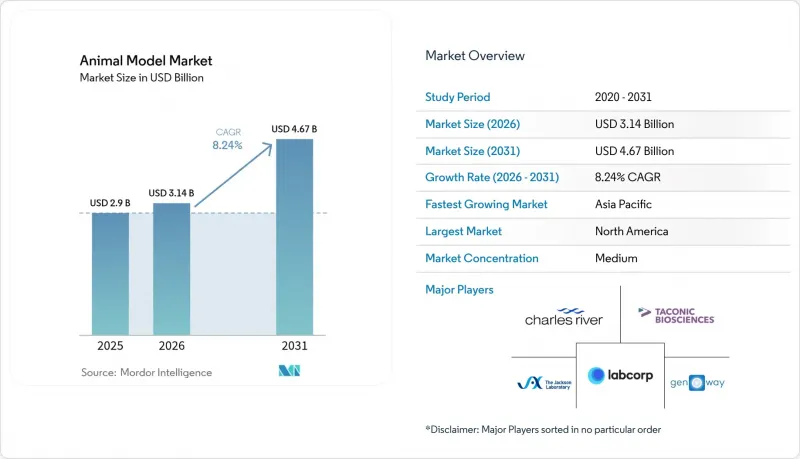
Mordor Intelligence에 의하면, 동물 모델 시장 규모는 2025년에 29억 달러, 2026년 31억 4,000만 달러에서 2031년까지 46억 7,000만 달러에 이를 것으로 예측되며, 예측 기간(2026년-2031년) CAGR은 8.24%를 기록할 전망입니다.
본 보고서에서는 업계를 동물 종(마우스, 조류 등), 서비스(번식, 동결보존 등), 기술(CRISPR/Cas9 등), 용도(종양학, 심혈관 연구 등), 최종 사용자(제약 및 바이오의약품 기업 등), 지역(북미, 유럽, 아시아태평양 등)별로 분류하고 있습니다. 시장 전망은 금액(달러) 기준으로 제시되어 있습니다.
전 세계 동물 모델 시장 동향 및 인사이트
CRISPR 및 기타 유전자 편집 도구의 채택 확대
CRISPR/Cas9의 도입으로 기존 모델 제작에 소요되는 기간이 절반으로 단축되었으며, 프로젝트당 비용도 약 40% 절감되었습니다. 이에 따라 이전에는 상업적 공급업체에 의존해야 했던 소규모 연구 기관에서도 고도의 녹인(knock-in)이 가능해졌습니다. 단순한 인델(삽입·결실)에 그치지 않고, 베이스 편집 및 프라임 편집 기술을 통해 이중 가닥 절단 없이 단일 염기 단위의 정밀도로 편집이 가능해짐에 따라, 대사, 면역, 신경퇴행성 질환 연구에서의 활용이 확대되고 있습니다. Cyagen이나 GenOway와 같은 벤더들은 표준화된 CRISPR 파이프라인과 견고한 품질 관리 체제를 통해 이러한 추세를 활용하여, 제약 기업 고객이 여러 유전자 구축체를 순차적으로가 아니라 병행하여 발주할 수 있도록 하고 있습니다. 그 결과, 복합 돌연변이체 수요는 기존의 콜로니 증식 능력을 능가하는 속도로 확대되고 있으며, 각 브리더 기업들은 배아 취급, 유전자형 판정 및 동결보존의 자동화를 추진하고 있습니다. 이러한 효율화가 시너지 효과를 가져옴에 따라, 동물 모델 시장은 규제상의 대체 수단에 의한 이익률 압박을 상쇄하는 지속 가능한 성장 동력을 확보하고 있습니다.
바이러스학 및 신종 감염병 분야에서의 동물 모델 활용 확대
2024년 이후, 감염병 대책 예산은 위기 대응에서 장기적인 인프라 구축으로 전환되고 있으며, 이에 따라 휴머나이즈드 마우스 계통 및 바이러스 수용체를 위해 유전자 변형된 비인간 영장류에 대한 주문이 사상 최고치를 기록하고 있습니다. 코로나19 유행 당시 극히 중요한 역할을 수행한 hACE2 마우스는 CRISPR 녹인(knock-in) 기술을 이용한 병원체 특이적 계통의 신속한 제작을 위한 템플릿이 되고 있습니다. 현재 미국 국립보건원(NIH) 컨소시엄은 전용 고격리 수준의 번식 시설에 자금을 지원하고 있으며, 조달 방식은 임시 수입에서 안전한 국내 공급망으로 전환되고 있습니다. 그 전략적 목표는 생물보안 규제로 인해 혼란이 발생할 가능성이 있는 국제 운송 경로에 의존하지 않고, 호흡기 바이러스, 필로바이러스, 플라비바이러스를 모델링할 수 있는 국내 역량을 유지하는 데 있습니다. 공급업체에게 있어 이러한 지속적인 바이러스학에 대한 집중은 면역 능력이 있는 계통 및 면역 결핍 계통에 대한 지속적인 수요를 의미하며, 예측 기간 동안 안정적인 연평균 성장률(CAGR) 기여를 뒷받침할 것입니다.
동물의 윤리적 이용에 관한 엄격한 규제
유럽 지침 2010/63/EU는 체계적인 대체 방법 검토, 대체 방법 확충 및 연간 동물 사용 통계 공개를 의무화함으로써 윤리 기준을 높였습니다. 이 모든 조치는 규정 준수 비용 증가로 이어집니다. 각 연구소는 실험 절차의 모든 개선 사항을 추적하는 기관 내 동물실험위원회(IACUC)의 승인을 받아야 하며, 일부 관할 구역에서는 프로젝트 리드타임이 수개월 연장될 수 있습니다. 평판 리스크를 우려하는 제약사 후원자들은 EU 규정을 전 세계적으로 반영하기 위해 북미 및 아시아의 시설들이 사육 환경, 진통 조치, 종점 모니터링을 업그레이드하도록 강요하고 있습니다. 소규모 학술 기관은 이러한 업그레이드 자금 조달에 어려움을 겪고 있어, 이미 높은 복지 기준을 충족하고 있는 대규모 상업적 공급자에 대한 수요가 더욱 증가하고 있습니다.
부문 분석
2025년, 생쥐는 동물 모델 시장 점유율의 54.62%를 유지했습니다. 이는 수십 년에 걸쳐 축적된 유전체 자원, 표준화된 사육 프로토콜, 그리고 충분히 검증된 행동 분석을 반영한 결과입니다. 이러한 우위는 종양학, 신경과학, 대사성 질환 각 분야에서 예측 가능한 기본 수요의 토대가 되고 있습니다. 그러나 이 부문의 성장률은 현재 동물 모델 시장 전체보다 낮으며, 이는 기존의 마우스를 활용한 워크플로가 성숙기에 접어들었음을 시사합니다.
대조적으로, 제브라피쉬 및 기타 수생 생물은 2031년까지 연평균 성장률(CAGR) 10.04%를 나타낼 것으로 전망됩니다. 투명한 유생에 대한 하이컨텐츠 이미징, 자동화에 적합한 플레이트 형식, 그리고 소량의 화합물만으로도 충분하다는 점 덕분에 비용 효율성이 향상되어 제약 기업의 고처리량 스크리닝 팀으로부터 큰 관심을 받고 있습니다. 그 결과, 자동 배아 선별 장치 및 마이크로 CT 이미징에 대한 기관 투자의 뒷받침을 받아 수생 생물 동물 모델 시장 규모는 급속히 확대될 것으로 예측됩니다. 경골어류의 시험 결과에 대한 규제 당국의 이해는 여전히 깊어지고 있는 단계이지만, 초기 도입자들로부터 포유류 연구와의 독성 등급에서 명확한 유사성이 지적되고 있으며, 이것이 수용을 뒷받침하고 있습니다.
2025년에는 번식 서비스가 동물 모델 시장 규모의 44.21%를 차지하며, 동물 모델 시장의 물류 측면에서 핵심적인 위치를 확고히할 것으로 보입니다. 수요 규모는 종양학의 이종 이식, 안전성 약리학 및 신경행동학의 파이프라인을 뒷받침하는 데 필요한 막대한 수의 콜로니에 기인합니다. 그럼에도 불구하고 성장의 초점은 부가가치가 높은 서비스로 이동하고 있으며, 후원사가 계통의 완전성을 검증하기 위해 필수적인 단일 염기 다형성(SNP) 패널의 채택을 추진함에 따라 유전자 인증은 연평균 성장률(CAGR) 10.72%로 성장을 지속하고, 있습니다.
유전자 검사 워크플로우용 동물 모델 시장 규모는 사육 시설 내 차세대 염기서열 분석 장치의 보급 확대에 힘입어 성장하고 있으며, CRISPR을 통한 유전자 편집 및 유전적 드리프트를 당일 내에 확인할 수 있게 되었습니다. 동결보존, 재유도 및 검역 서비스는 라이프사이클의 순환을 완성하고, 고객 시설 내 동물 사육 시설의 점유 면적을 줄이면서 건강 상태를 보장합니다. 이러한 통합 서비스 패키지는 고객 유지율을 높입니다. 이는 배아나 정자가 일단 은행에 보관되면, 공급업체를 변경하는 데 운영상의 위험이 따르고 시간도 걸리기 때문입니다.
지역별 분석
북미는 제약 기업의 본사, 벤처 캐피탈로부터 자금을 지원받은 생명공학 스타트업, 그리고 대학 부속 의료 센터가 밀집해 있는 것을 배경으로 2025년 매출의 46.25%를 차지했습니다. 2031년까지 이 지역의 연평균 성장률(CAGR) 7.77%는 거래량 확대가 아닌, 자동화된 케이지 교체 로봇, 디지털 콜로니 관리, AI를 활용한 행동 분석과 같은 기술 업데이트 주기에 의해 뒷받침되고 있습니다. FDA가 2025년에 단일클론 항체에 관한 동물 실험 요건을 단계적으로 폐지하겠다는 방침을 밝힌 데 따라, 가상 대조군 소프트웨어에 대한 투자도 동시에 활발해지고 있습니다. 이를 통해 공급업체는 핵심 수익을 지키면서 사업의 다각화를 도모할 수 있게 되었습니다.
유럽은 엄격한 동물 복지 지침 하에서도 연평균 성장률(CAGR) 8.01%로 그 뒤를 따르고 있습니다. 상업적 사육업자들은 유전자 인증을 받았으며 동물 복지가 최적화된 계통을 제공함으로써 프리미엄 가격을 실현하고 있으며, 이러한 계통은 추가적인 고객 감사 없이도 EU의 검사를 통과합니다. 동시에 유럽은 ‘오르간 온 칩(Organ-on-a-chip)’ 검증 분야에서 세계를 선도하고 있어, 공급업체에 대체 시험 플랫폼의 수출 기회를 제공합니다. 이러한 이중 역량 덕분에 EU 기업들은 현재 및 미래의 규제 패러다임이 교차하는 지점에 위치해 있습니다.
아시아태평양은 중국의 실험동물 과학 프로그램의 급속한 확장에 힘입어 연평균 성장률(CAGR) 8.98%로 가장 빠르게 성장하는 지역으로 두각을 나타내고 있습니다. 중국에서는 현재 약 2,000개의 연구 기관에 소속된 10만 명 이상의 전문가들에 의해 지원되며, 연간 1,900만 마리 이상의 연구용 동물이 생산되고 있습니다. 일본의 리켄 바이오리소스 센터(RIKEN BioResource Center)와 같은 지역 선도 기업들은 엄격한 건강 검진을 거친 1만 3,000종 이상의 정의된 마우스 계통을 공급하고 있으며, 그 생산은 국제적인 ‘우수 실험실 관리 기준(GLP)’을 준수하고 있습니다. 이러한 추세에 따라 해당 지역의 동물 모델 시장 규모는 급격히 확대되고 있으며, 중동 및 아프리카 및 남미 지역의 새로운 지출도 이를 뒷받침하고 있습니다. 이 지역들에서는 생명공학 분야가 초기 단계에서 점차 정착되고 있어, 모두 한 자릿수 후반대의 연평균 성장률(CAGR)을 기록하고 있습니다.
기타 혜택:
- 엑셀 형식 시장 예측(ME) 시트
- 3개월간의 애널리스트 지원
자주 묻는 질문
목차
제1장 서론
제2장 조사 방법
제3장 주요 요약
제4장 시장 구도
제5장 시장 규모와 성장 예측
제6장 경쟁 구도
제7장 시장 기회와 향후 전망
LSH 26.08.26According to Mordor Intelligence, the animal model market size was valued at USD 2.90 billion in 2025 and estimated to grow from USD 3.14 billion in 2026 to reach USD 4.67 billion by 2031, at a CAGR of 8.24% during the forecast period (2026-2031).
This report Segments the Industry Into by Animal Type (Mice, Birds, and More), Service (Breeding, Cryopreservation, and More), Technology (CRISPR/CAS9 and More), Application (Oncology, Cardiovascular Studies, and More), End-User (Pharmaceutical & Biopharmaceutical Companies and More), and Geography (North America, Europe, Asia-Pacific, and More). The Market Forecasts are Provided in Terms of Value (USD).
Global Animal Model Market Trends and Insights
Increased Adoption of CRISPR & Other Gene-Editing Tools
CRISPR/Cas9 has cut classical model-generation timelines in half and trimmed per-project costs by roughly 40%, making sophisticated knock-ins feasible for smaller research institutes that previously depended on commercial suppliers. Beyond simple indels, base- and prime-editing variants now deliver single-nucleotide precision without double-strand breaks, broadening use in metabolic, immunologic, and neurodegenerative investigations. Vendors such as Cyagen and GenOway have capitalized on the trend with standardized CRISPR pipelines and robust quality controls, allowing pharmaceutical clients to commission multi-gene constructs in parallel rather than sequentially. Demand for compound mutants is therefore scaling faster than classical colony-expansion capacity, prompting breeders to automate embryo handling, genotyping, and cryopreservation. As these efficiencies aggregate, the animal model market gains a durable growth engine that offsets margin pressure from regulatory alternatives.
Rising Use of Animal Models in Virology & Emerging Infectious Diseases
Since 2024, infectious-disease budgets have migrated from crisis response to long-term infrastructure, spurring record orders for humanized mouse strains and non-human primates engineered for viral receptors. The hACE2 mouse, pivotal during COVID-19, has become a template for rapid pathogen-specific line creation through CRISPR knock-ins. National Institutes of Health consortia now fund dedicated high-containment breeding sites, shifting procurement from ad-hoc imports to secure domestic pipelines. The strategic goal is to maintain on-shore capacity to model respiratory viruses, filoviruses, and flaviviruses without relying on global transportation corridors that can be disrupted by bio-security rules. For suppliers, this sustained virology focus means recurring demand for custom immunocompetent and immunodeficient backgrounds, supporting steady CAGR contribution across the forecast window.
Stringent Regulations on Ethical Use of Animals
European Directive 2010/63/EU tightened the ethical bar by requiring systematic replacement reviews, enhanced enrichment, and public disclosure of annual animal-use statistics, all of which raise compliance costs. Laboratories must secure approvals from Institutional Animal Care and Use Committees that track every procedural refinement, adding months to project lead-times in certain jurisdictions. Pharmaceutical sponsors, wary of reputational risk, often mirror EU rules globally, compelling North-American and Asian sites to upgrade housing, analgesia, and endpoint monitoring. Smaller academic centers struggle to finance these upgrades, pushing more demand toward large-scale commercial providers that already meet high-welfare thresholds.
Other drivers and restraints analyzed in the detailed report include:
- Growing Demand for Humanized Models in Precision Medicine
- Government R&D Funding Surge Post-Pandemic
- Rapid Advances in Organ-on-Chip & 3D-Organoid Alternatives
For complete list of drivers and restraints, kindly check the Table Of Contents.
Segment Analysis
Mice retained a 54.62% hold of the animal model market share in 2025, reflecting decades of accumulated genomic resources, standardized husbandry protocols, and well-validated behavioral assays. This dominance anchors predictable baseline demand across oncology, neuroscience, and metabolic disease. Yet the segment's growth rate is now trailing the broader animal model market, signaling maturity in traditional murine workflows.
By contrast, zebrafish and other aquatic species are set to log a 10.04% CAGR to 2031. High-content imaging of transparent larvae, automation-friendly plate formats, and lower compound requirements drive cost efficiencies that resonate with high-throughput screening teams at pharmaceutical firms. As a result, the animal model market size for aquatic species is projected to climb swiftly, supported by institutional investment in automated embryo sorters and micro-CT imaging. Although regulatory familiarity with teleost outcomes is still building, early adopters cite clear toxicity-ranking parallels with mammalian studies, bolstering acceptance.
Breeding services accounted for 44.21% of the animal model market size in 2025, underlining their status as the logistical backbone of the animal model market. Volume demand stems from the sheer number of colonies needed to support oncology xenografts, safety pharmacology, and neurobehavioral pipelines. Nevertheless, growth has shifted toward value-added offerings, with genetic authentication registering an 10.72% CAGR as sponsors adopt mandatory single-nucleotide polymorphism panels to verify strain integrity.
The animal model market size for genetic-testing workflows benefits from the broader rollout of next-generation sequencing benches within vivaria, enabling same-day confirmation of CRISPR edits or genetic drift. Cryopreservation, rederivation, and quarantine services complete a life-cycle loop that reduces vivarium footprint at client sites while guaranteeing health status. These integrated service bundles strengthen stickiness because once embryos or sperm are banked, switching providers becomes operationally risky and time-consuming.
Complete Report Scope:
- By Animal Type
- Mice
- Rats
- Fish
- Birds
- Cattle
- Other Animals
- By Service
- Breeding
- Cryopreservation
- Rederivation & Quarantine
- Genetic Testing
- Other Services
- By Technology
- CRISPR/Cas9
- Embryonic Stem Cell Injection
- Nuclear Transfer
- Microinjection
- Other Technologies
- By Application
- Oncology
- Cardiovascular & Metabolic Disorders
- Neurology & Psychiatry
- Immunology & Infectious Diseases
- Toxicology & Safety Assessment
- Others
- By End-User
- Pharmaceutical & Biopharmaceutical Companies
- Contract Research Organizations (CROs)
- Academic & Research Institutes
- Other End-Users
- By Geography
- North America
- United States
- Canada
- Mexico
- Europe
- Germany
- United Kingdom
- France
- Italy
- Spain
- Rest of Europe
- Asia-Pacific
- China
- India
- Japan
- Australia
- South Korea
- Rest of Asia-Pacific
- Middle East and Africa
- GCC
- South Africa
- Rest of Middle East and Africa
- South America
- Brazil
- Argentina
- Rest of South America
- North America
Geography Analysis
North America retained 46.25% of 2025 revenue, underpinned by a dense cluster of pharmaceutical headquarters, venture-funded biotech start-ups, and academic medical centers. The region's 7.77% CAGR to 2031 rests on technology refresh cycles-automated cage-change robotics, digital colony-management, and AI-driven behavior analytics-rather than volume expansion. The FDA's 2025 signal to sunset monoclonal antibody animal requirements has triggered parallel investment in virtual control-group software, allowing suppliers to diversify while shielding core revenue.
Europe follows with an 8.01% CAGR even under stringent welfare directives. Commercial breeders command premium pricing by offering genetically authenticated, welfare-optimized lines that pass EU inspections without additional client audits. Simultaneously, Europe leads global organ-on-chip validation, granting its suppliers export opportunities for alternative testing platforms; that dual capability positions EU firms at the intersection of current and future regulatory paradigms.
Asia-Pacific stands out as the fastest-growing territory at 8.98% CAGR, driven by China's rapid expansion of laboratory-animal science programs. China now produces more than 19 million research animals annually, supported by a workforce exceeding 100,000 specialists across roughly 2,000 institutes. Regional leaders such as Japan's RIKEN BioResource Center supply over 13,000 defined mouse strains with rigorous health-screening, aligning output with global Good Laboratory Practice standards. These developments raise the animal model market size for the region dramatically and are complemented by emerging spending in the Middle East, Africa, and South America, each logging high-single-digit CAGRs as nascent biotech sectors take hold.
- Aragen Bioscience
- Beijing Vital River Laboratory Animal Technology Co.
- Biocytogen Pharma
- Biomere
- Charles River
- CLEA Japan
- Crown BioScience Intl.
- Cyagen Biosciences.
- GemPharmatech
- GenOway
- Harbour BioMed
- Hera BioLabs
- Ingenious Targeting Laboratory
- Innovative Research
- Inotiv, Inc.
- Janvier Labs
- JSR
- Labcorp UK Ltd
- Melior Inc.
- Ozgene
- PolyGene AG
- Shanghai Model Organisms Center, Inc.
- Taconic Biosciences
- The Jackson Laboratory
- Trans Genic
Additional Benefits:
- The market estimate (ME) sheet in Excel format
- 3 months of analyst support
TABLE OF CONTENTS
1 Introduction
- 1.1 Study Assumptions & Market Definition
- 1.2 Scope of the Study
2 Research Methodology
3 Executive Summary
4 Market Landscape
- 4.1 Market Overview
- 4.2 Market Drivers
- 4.2.1 Increased adoption of CRISPR & other gene-editing tools
- 4.2.2 Rising use of animal models in virology & emerging infectious diseases
- 4.2.3 Growing demand for humanized models in precision medicine
- 4.2.4 Government R&D funding surge post-pandemic
- 4.2.5 AI-enabled high-throughput phenotyping accelerating adoption
- 4.2.6 Micro-gravity disease models from space-biology programs
- 4.3 Market Restraints
- 4.3.1 Rapid advances in organ-on-chip & 3D-organoid alternatives
- 4.3.2 Stringent regulations on ethical use of animals
- 4.3.3 Shareholder ESG pressure to reduce animal testing
- 4.3.4 High cost & long lead-times for complex transgenic lines
- 4.4 Supply Chain Analysis
- 4.5 Regulatory Landscape
- 4.6 Technological Outlook
- 4.7 Porter's Five Forces Analysis
- 4.7.1 Threat of New Entrants
- 4.7.2 Bargaining Power of Buyers
- 4.7.3 Bargaining Power of Suppliers
- 4.7.4 Threat of Substitutes
- 4.7.5 Intensity of Competitive Rivalry
5 Market Size & Growth Forecasts (Value)
- 5.1 By Animal Type
- 5.1.1 Mice
- 5.1.2 Rats
- 5.1.3 Fish
- 5.1.4 Birds
- 5.1.5 Cattle
- 5.1.6 Other Animals
- 5.2 By Service
- 5.2.1 Breeding
- 5.2.2 Cryopreservation
- 5.2.3 Rederivation & Quarantine
- 5.2.4 Genetic Testing
- 5.2.5 Other Services
- 5.3 By Technology
- 5.3.1 CRISPR/Cas9
- 5.3.2 Embryonic Stem Cell Injection
- 5.3.3 Nuclear Transfer
- 5.3.4 Microinjection
- 5.3.5 Other Technologies
- 5.4 By Application
- 5.4.1 Oncology
- 5.4.2 Cardiovascular & Metabolic Disorders
- 5.4.3 Neurology & Psychiatry
- 5.4.4 Immunology & Infectious Diseases
- 5.4.5 Toxicology & Safety Assessment
- 5.4.6 Others
- 5.5 By End-User
- 5.5.1 Pharmaceutical & Biopharmaceutical Companies
- 5.5.2 Contract Research Organizations (CROs)
- 5.5.3 Academic & Research Institutes
- 5.5.4 Other End-Users
- 5.6 By Geography
- 5.6.1 North America
- 5.6.1.1 United States
- 5.6.1.2 Canada
- 5.6.1.3 Mexico
- 5.6.2 Europe
- 5.6.2.1 Germany
- 5.6.2.2 United Kingdom
- 5.6.2.3 France
- 5.6.2.4 Italy
- 5.6.2.5 Spain
- 5.6.2.6 Rest of Europe
- 5.6.3 Asia-Pacific
- 5.6.3.1 China
- 5.6.3.2 India
- 5.6.3.3 Japan
- 5.6.3.4 Australia
- 5.6.3.5 South Korea
- 5.6.3.6 Rest of Asia-Pacific
- 5.6.4 Middle East and Africa
- 5.6.4.1 GCC
- 5.6.4.2 South Africa
- 5.6.4.3 Rest of Middle East and Africa
- 5.6.5 South America
- 5.6.5.1 Brazil
- 5.6.5.2 Argentina
- 5.6.5.3 Rest of South America
- 5.6.1 North America
6 Competitive Landscape
- 6.1 Market Concentration
- 6.2 Competitive Benchmarking
- 6.3 Market Share Analysis
- 6.4 Company Profiles (includes Global level Overview, Market level overview, Core Segments, Financials as available, Strategic Information, Market Rank/Share for key companies, Products & Services, and Recent Developments)
- 6.4.1 Aragen Bioscience
- 6.4.2 Beijing Vital River Laboratory Animal Technology Co.
- 6.4.3 Biocytogen Pharma
- 6.4.4 Biomere
- 6.4.5 Charles River Laboratories International Inc.
- 6.4.6 CLEA Japan
- 6.4.7 Crown BioScience Intl.
- 6.4.8 Cyagen Biosciences
- 6.4.9 GemPharmatech
- 6.4.10 GenOway
- 6.4.11 Harbour BioMed
- 6.4.12 Hera BioLabs
- 6.4.13 Ingenious Targeting Laboratory
- 6.4.14 Innovative Research
- 6.4.15 Inotiv, Inc.
- 6.4.16 Janvier Labs
- 6.4.17 JSR Corporation
- 6.4.18 Labcorp UK Ltd
- 6.4.19 Melior Inc.
- 6.4.20 Ozgene Pty Ltd
- 6.4.21 PolyGene AG
- 6.4.22 Shanghai Model Organisms Center, Inc.
- 6.4.23 Taconic Biosciences, Inc.
- 6.4.24 The Jackson Laboratory
- 6.4.25 Trans Genic Inc.
7 Market Opportunities & Future Outlook
- 7.1 White-space & Unmet-need Assessment


