|
시장보고서
상품코드
2115812
고성능 트럭 시장 : 점유율 분석, 업계 동향과 통계, 성장 예측(2026-2031년)Automotive High Performance Trucks - Market Share Analysis, Industry Trends & Statistics, Growth Forecasts (2026 - 2031) |
||||||
 Mordor Intelligence
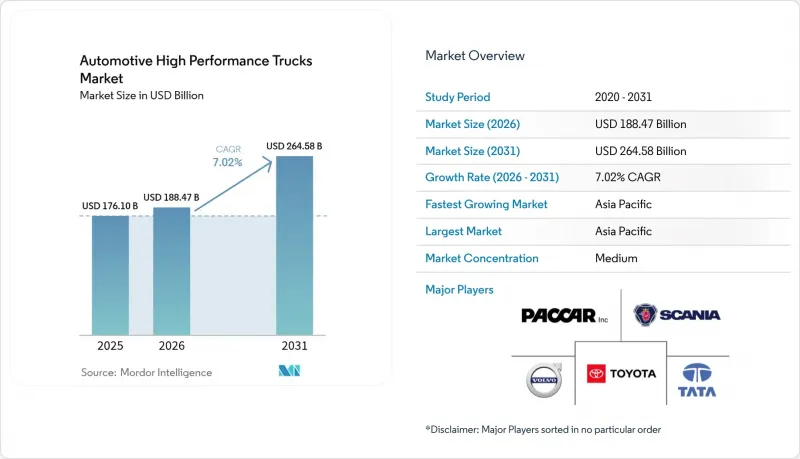
Mordor Intelligence에 의하면, 고성능 트럭 시장 규모는 2025년 1,761억 달러에서 2026년에는 1,884억 7,000만 달러로 확대되어 2026년부터 2031년까지 CAGR 7.02%로 성장을 지속하여, 2031년에는 2,645억 8,000만 달러에 이를 것으로 예측됩니다.
본 보고서는 트럭 등급(소형, 대형 등), 구동 방식(내연기관, 배터리식 전기차 등), 출력(250 HP 미만, 250-400 HP 등), 용도(장거리 화물 운송 등), 변속기(수동 등) 및 지역별로 분류되어 있습니다. 시장 전망은 금액(미 달러) 및 수량(대)으로 제시되어 있습니다.
전 세계 고성능 트럭 시장 동향 및 인사이트
배터리 가격의 급락으로 400 kWh를 초과하는 배터리 팩의 구현이 가능해졌습니다.
배터리 비용 절감으로 장거리 운송의 성능 요건을 충족하면서도 디젤 차량과의 총 소유 비용(TCO)을 동등한 수준으로 유지할 수 있는 대용량 배터리 팩의 채택이 가능해지면서, 전기 트럭의 보급이 가속화되고 있습니다. 배터리 가격은 지난 10년간 85% 이상 하락하여 현재 1kWh당 135달러이지만, 2025년부터 2030년까지 1kWh당 60달러에 도달할 것으로 예측됩니다. 이에 따라 2030년까지 전기 화물 트럭의 소유 비용은 디젤 차량에 비해 최대 50% 저렴해질 가능성이 있습니다. 미국 에너지부의 2025년 단계적 구매 비용 보고서에 따르면, 상용차 배터리 비용은 1kWh당 128-133달러로, 2022년의 1kWh당 150달러에서 하락했습니다. 이러한 추세에 따라, 주행 거리 375마일의 클래스 8 전기 트럭은 디젤 트럭에 비해 총 소유 비용을 13% 절감할 수 있으며, 투자 회수 기간은 약 3년이 될 것입니다. 2050년까지 배터리 팩 비용은 64%에서 75%까지 하락할 전망이며, 에너지 밀도 향상으로 인해 적재량을 희생하지 않고도 더 대형의 팩 구성이 가능해집니다. 이러한 비용 절감의 선순환을 통해 생산 규모 확대가 추가적인 비용 절감을 촉진하고, 시장 보급을 가속화할 것입니다.
장거리 전자상거래 화물량 증가
전자상거래 물류의 변혁으로 화물 밀도 및 배송 빈도에 대한 요구 사항이 높아지는 가운데, 고성능 트럭에 대한 지속적인 수요가 발생하고 있습니다. 전미트럭운송협회(ATA)의 예측에 따르면, 트럭 운송량은 2025년에 1.60% 증가하여,총 운송량은 2024년 112억 7,000만 톤에서 2035년까지 139억 9,000만 톤으로 증가할 것이며, 트럭 운송 시장 점유율은 76.80%를 유지할 것으로 전망됩니다. 이러한 성장 양상은 공급망 구조의 구조적 변화를 반영하고 있으며, 라스트 마일 배송 집하 센터에서는 적재량 최적화와 경로 유연성이 향상된 트럭이 요구되고 있습니다. 전자상거래의 영향은 운송량 증가에 그치지 않고 성능 사양에도 미치고 있으며, 물류 기업들은 배기가스를 줄이기 위해 전기차나 대체 연료 차량에 투자하는 한편, 보다 효율적인 경로 전략을 모색하고 있습니다. 소량·고빈도 운송으로 향하는 업계의 진화에 따라, 첨단 텔레매틱스 기능과 실시간 추적 기능을 갖춘 트럭이 필요해지고 있으며, 각 OEM 업체에게는 커넥티비티 기능을 통해 차별화를 꾀할 기회가 생겨나고 있습니다. 기존 화물 운송 네트워크의 운송 능력 제약으로 인해, 더욱 엄격한 환경 기준을 충족하면서도 가동률을 극대화하는 고성능 트럭에 대한 수요가 증가하고 있습니다.
메가와트급 충전 인프라의 격차
인프라 구축이 차량 보급 속도를 따라가지 못해 주행 거리에 대한 불안을 야기하고 있을 뿐만 아니라, 충전 시간과 충전소 확보가 여전히 중요한 운영상의 제약으로 작용하고 있는 장거리 운송 분야에서 전기 트럭의 도입을 제한하고 있습니다. 현재의 메가와트급 충전 시스템은 최대 3.75 MW의 전력을 공급할 수 있으며, 승용차용 충전 시스템의 상한선인 350 kW를 크게 상회합니다. 그러나 그 도입은 여전히 주요 화물 운송 회랑에서의 시범 프로젝트에 집중되어 있습니다. 캘리포니아주에 위치한 WattEV사의 25메가와트급 전기 트럭용 충전소는 인프라 구축의 초기 단계를 보여주는 사례인 반면, 다임러(Daimler)사가 충전 및 수소 네트워크에 6억 5,000만 달러를 투자한 것은 필요한 투자 규모가 얼마나 큰지를 보여줍니다. 인프라 문제는 충전소에 그치지 않고 송전망 용량 및 재생에너지 통합 문제까지 미치고 있으며, 캘리포니아주는 트럭의 전기화를 지원하기 위해 2035년까지 16만 기의 대형 차량용 충전기를 설치할 계획입니다. 충전 인프라의 부족은 특히 지방이나 개발도상 지역에 영향을 미치고 있으며, 그곳에서는 송전망의 용량 제한과 투자의 경제성이 도입의 장벽이 되고 있습니다. 업계 간 협력을 통해 공통된 메가와트급 충전 규격을 확립함으로써 인프라 구축을 가속화하는 것을 목표로 하고 있지만, 전력 회사, OEM, 그리고 차량 운영 업체 간의 조율 어려움이 그 진전을 늦추고 있습니다.
부문 분석
총 차량 중량(GVW)이 15톤을 초과하는 대형 트럭 부문은 2025년에 49.93%의 시장 점유율을 차지하며, 2031년까지 연평균 성장률(CAGR) 6.82%로 시장의 주도적 위치를 유지할 것으로 전망됩니다. 이는 적재량과 내구성이 중시되는 장거리 화물 운송 및 건설 분야에서 대형 차량이 중요한 역할을 하고 있음을 반영합니다. 이 부문이 주도적인 위치를 차지하는 배경에는 화물 운송에서의 경제적 우위가 있습니다. 대형 트럭일수록 톤마일당 효율이 높고, 단위당 운송 비용이 낮아지기 때문입니다. 중형 트럭(총중량 3.5-15톤)은 지역 배송 및 도시 내 배송 시장을 담당하고 있으며, 전자상거래 물류와 라스트 마일 배송 수요에 힘입어 성장을 거듭하고 있습니다. 총중량 3.5톤 미만의 소형 트럭은 서비스 차량이나 소규모 건설 현장 등 특수한 용도에 대응하고 있지만, 적재량 제약으로 인해 시장 점유율은 여전히 제한적입니다.
대형 트럭의 전동화를 향한 진화는 배터리 무게나 충전 인프라와 관련된 특유의 과제에 직면해 있으며, 각 제조업체는 배터리 교체나 메가와트급 충전 대응 등 전문적인 솔루션을 개발하고 있습니다. 클래스 8 트럭의 생산 대수는 인프라 투자와 관련된 업무용 수요에 힘입어 2024년에는 약 33만 168대에 달했으나, 과잉 재고가 성장을 제약했습니다. EPA의 2027년 규제를 포함한 규제적 압박으로 인해 2025년 및 2026년 모델 연식에 대한 선구매 기회가 생겨나고 있습니다. 2만-3만 달러의 가격 상승이 예상에 따라, 이는 차량 함대 구매 결정에 영향을 미치는 요인이 되고 있습니다. 이 부문의 기술적 진보는 점점 더 엄격해지는 배기가스 기준을 충족하면서 다양한 운행 조건에서 성능을 최적화하는 통합형 파워트레인 솔루션에 초점을 맞추었습니다.
2025년에는 확립된 인프라와 운영상의 익숙함을 반영하여 내연기관이 79.05%의 시장 점유율을 유지하는 한편, 비용 평준화가 다가오고 충전 인프라가 확대됨에 따라 배터리식 전기 시스템은 2031년까지 연평균 성장률(CAGR) 8.28%로 성장할 것으로 전망됩니다. 구동 방식의 전환은 총 소유 비용(TCO) 산정 방식의 근본적인 변화를 반영하며, 배터리 비용의 하락과 연료 가격의 상승으로 인해 특정 용도에서는 전기자동차가 유리해지고 있습니다. 하이브리드 시스템(PHEV/HEV)은 과도기적 기술로서, 주행 거리 제한 없이 배출량을 줄일 수 있기 때문에 특히 복합 주행 사이클에서 가치가 있습니다. 연료전지 전기차는 장거리 운송 용도에서 새로운 선택지가 되고 있으며, 스위스에서 운행 중인 현대자동차의 XCIENT 연료전지 트럭은 누적 주행 거리 1,000만 킬로미터를 달성했습니다.
배터리식 전기차의 도입은 충전 인프라 구축 현황과 운행 주기의 예측 가능성이 운영 요건을 뒷받침하는 도시 및 지방 지역에서의 용도에서 가속화되고 있습니다. 전환 일정은 용도에 따라 다르며, 도시 내 배송이나 단거리 운송에서는 도입이 진행되고 있는 반면, 장거리 화물 운송에서는 여전히 디젤 차량이 주류를 이루고 있습니다. 장거리 주행과 신속한 연료 보급이 요구되는 대형 차량 용도에서는 연료전지 기술이 주목받고 있습니다. PACCAR와 Toyota는 수소 연료전지 트럭의 공동 개발을 상용화 단계로 확대하고 있으며, 2024년에 첫 고객에게 납품할 예정입니다.
지역별 분석
아시아태평양은 2025년 매출의 43.12%를 차지하며 연평균 성장률(CAGR) 9.08%로 확대될 것으로 예측되며, 고성능 트럭 시장은 해당 지역의 제조 및 수출 규모에 힘입어 지속적으로 성장하고 있습니다. 2023년, 중국의 대형 트럭 수출 대수는 전년 대비 58% 증가한 27만 6,000대에 달했습니다. 국영 및 민간 OEM 기업들은 이미 1kWh당 100달러에 육박하는 저비용 배터리를 활용하고 있습니다. 인도, 인도네시아, 베트남에서는 더 낮은 축중량 기준이나 혼합 연료 로드맵에 맞춘 유사한 플랫폼이 채택되고 있습니다. 한편, 일본과 한국은 프리미엄 저배출 기술에 특화되어 있으며, 지역 조립 공장에 연료전지 스택과 첨단 ADAS 소프트웨어를 공급하고 있습니다.
북미에서는 과잉 재고 상황에도 불구하고 2024년에 33만 168대의 클래스 8 트럭이 생산되는 등 견조한 화물 수요가 유지되고 있습니다. EPA 3단계 규제로 인해 2025-26년형 모델을 대상으로 한 선구매 열풍이 일고 있으며, 연방 정부의 인프라 보조금이 특수 용도 트럭의 수주 잔고를 안정적으로 뒷받침하고 있습니다. 캐나다의 수소 시범 사업과 멕시코와의 국경을 넘는 물류를 통해, 캘리포니아주 항만의 배터리식 전기 드레이지용 트랙터부터 브리티시컬럼비아주의 연료전지 장거리 운송 노선에 이르기까지 다양한 기술 실증이 이루어지고 있습니다.
유럽의 상황은 2030년까지 CO2 배출량을 43% 감축하고, 2040년까지 90% 감축해야 한다는 의무 규정이 특징입니다. 이러한 목표는 차량 교체를 가속화하여 배터리식 전기차와 수소 연료전지 솔루션 모두를 촉진하고 있습니다. 유서 깊은 OEM 간의 합작 투자를 통해 소프트웨어 플랫폼과 네트워크화된 안전 시스템이 합리화되는 한편, 각국 정부는 주(州) 간의 격차를 해소하기 위한 충전 회랑 구축을 약속하고 있습니다. 경제적 역풍과 에너지 가격 변동은 여전히 과제로 남아 있지만, 규제 확실성이 OEM의 투자 결정을 뒷받침하고 있어 대륙 전체의 고성능 트럭 시장은 견조한 모습을 유지하고 있습니다.
기타 혜택:
- 엑셀 형식 시장 예측(ME) 시트
- 3개월간의 애널리스트 지원
자주 묻는 질문
목차
제1장 서론
제2장 조사 방법
제3장 주요 요약
제4장 시장 구도
제5장 시장 규모와 성장 예측
제6장 경쟁 구도
제7장 시장 기회와 향후 전망
JHS 26.09.03According to Mordor Intelligence, the automotive high-performance trucks market size in 2026 is estimated at USD 188.47 billion, growing from 2025 value of USD 176.10 billion with 2031 projections showing USD 264.58 billion, growing at 7.02% CAGR over 2026-2031.
This report is Segmented by Truck Class (Light-Duty, Heavy-Duty, and More), Drive Type (Internal-Combustion Engine, Battery-Electric, and More), Power Output (Less Than 250 HP, 250 To 400 HP, and More), Application (Long-Haul Freight and More), Transmission (Manual and More), and Geography. The Market Forecasts are Provided in Terms of Value (USD) and Volume (Units).
Global Automotive High Performance Trucks Market Trends and Insights
Rapid Battery-Price Decline Enabling More Than 400 kWh Packs
Battery cost reductions accelerate electric truck adoption by enabling larger battery packs that meet long-haul performance requirements while achieving total cost of ownership parity with diesel alternatives. Battery prices have declined over 85% in the past decade, with current costs at USD 135 per kWh expected to reach USD 60 per kWh by 2025-2030, making electric freight trucks potentially 50% cheaper to own than diesel by 2030. The Department of Energy's 2025 Incremental Purchase Cost Report shows battery costs for commercial vehicles at USD 128-133 per kWh, down from USD 150 per kWh in 2022. This trajectory enables Class 8 electric trucks with 375-mile range to achieve 13% lower total cost of ownership than diesel trucks, with payback periods of approximately 3 years. Battery pack costs could decline by 64% to 75% by 2050, while energy density improvements support larger pack configurations without compromising payload capacity. The cost reduction cycle creates positive feedback loops where increased production scale drives further cost improvements, accelerating market adoption.
Rise in Long-Haul E-Commerce Freight Volumes
E-commerce logistics transformation drives sustained demand for high-performance trucks with increased freight density and delivery frequency requirements. The American Trucking Associations projects truck volumes will grow 1.60% in 2025, with total tonnage rising from 11.27 billion tons in 2024 to 13.99 billion tons by 2035, maintaining trucking's 76.80% market share. This growth pattern reflects structural shifts in supply chain architecture, where last-mile delivery consolidation centers require trucks with enhanced payload optimization and route flexibility. E-commerce's impact extends beyond volume increases to performance specifications, with logistics companies investing in electric and alternative fuel vehicles to reduce emissions while exploring more efficient routing strategies. The sector's evolution toward smaller, frequent shipments necessitates trucks with advanced telematics and real-time tracking capabilities, creating opportunities for OEMs to differentiate through connectivity features. Capacity constraints in traditional freight networks amplify demand for high-performance trucks that maximize utilization rates while meeting stricter environmental standards.
Megawatt-Charging Infrastructure Gaps
Infrastructure deployment lags behind vehicle availability, creating range anxiety and limiting electric truck adoption in long-haul applications where charging time and availability remain critical operational constraints. Current megawatt charging systems can deliver up to 3.75 MW of power, significantly exceeding the 350 kW limit of passenger vehicle charging systems. Yet, deployment remains concentrated in pilot projects across major freight corridors. WattEV's 25-megawatt electric truck stop in California represents early infrastructure development, while Daimler's USD 650 million investment in charging and hydrogen networks demonstrates the scale of required investment. The infrastructure challenge extends beyond charging stations to grid capacity and renewable energy integration, with California planning 160,000 heavy-duty chargers by 2035 to support truck electrification. Charging infrastructure gaps particularly affect rural and developing regions, where grid capacity limitations and investment economics create deployment barriers. Establishing common megawatt charging standards through industry collaboration aims to accelerate infrastructure rollout, but coordination challenges between utilities, OEMs, and fleet operators slow progress.
Other drivers and restraints analyzed in the detailed report include:
- Fleet-Wide CO2 Caps in EU and China Phase-IV Norms
- Infrastructure-Stimulus Boosting Vocational Truck Demand
- Supply-Chain Crunch for Power-Electronics Grade SiC
For complete list of drivers and restraints, kindly check the Table Of Contents.
Segment Analysis
Heavy-duty trucks above 15 tons GVW command 49.93% market share in 2025 and maintain leadership with 6.82% CAGR through 2031, reflecting their critical role in long-haul freight and construction applications where payload capacity and durability requirements favor larger platforms. This segment's dominance stems from economic advantages in freight transportation, where larger trucks achieve better ton-mile efficiency and lower per-unit transport costs. Medium-duty trucks (3.5 to 15 tons GVW) serve regional distribution and urban delivery markets, experiencing growth driven by e-commerce logistics and last-mile delivery requirements. Light-duty trucks below 3.5 tons GVW address specialized applications including service vehicles and small-scale construction, though their market share remains limited by payload constraints.
The heavy-duty segment's evolution toward electrification faces unique challenges related to battery weight and charging infrastructure, with manufacturers developing specialized solutions including battery swapping and megawatt charging compatibility. Class 8 truck production reached approximately 330,168 units in 2024, driven by vocational demand linked to infrastructure investments, though inventory overhangs constrained growth. Regulatory pressures, including the EPA 2027 rules, create pre-buy opportunities for model years 2025 and 2026, with potential price increases of USD 20,000 to USD 30,000 driving fleet purchasing decisions. The segment's technological advancement focuses on integrated powertrain solutions that optimize performance across diverse operating conditions while meeting increasingly stringent emissions standards.
Internal combustion engines maintain 79.05% market share in 2025, reflecting established infrastructure and operational familiarity, while battery-electric systems lead growth projections at 8.28% CAGR through 2031 as cost parity approaches and charging infrastructure expands. The drive type transition reflects fundamental shifts in total cost of ownership calculations, where declining battery costs and rising fuel prices favor electric alternatives for specific applications. Hybrid systems (PHEV/HEV) serve as transitional technologies, offering reduced emissions without range limitations, which is particularly valuable for mixed-duty cycles. Fuel cell electric vehicles represent emerging alternatives for long-haul applications, with Hyundai's XCIENT fuel cell trucks achieving 10 million kilometers cumulative driving distance in Switzerland.
Battery-electric adoption accelerates in urban and regional applications where charging infrastructure availability and duty cycle predictability support operational requirements. The transition timeline varies by application, with urban delivery and drayage operations leading adoption while long-haul freight remains predominantly diesel-powered. Fuel cell technology gains traction for heavy-duty applications requiring long-range and fast refueling. PACCAR and Toyota expand their hydrogen fuel cell truck collaboration to include commercialization, with initial customer deliveries planned for 2024.
Complete Report Scope:
- By Truck Class
- Light-Duty (Less Than 3.5 t GVW)
- Medium-Duty (3.5 to 15 t GVW)
- Heavy-Duty (More Than 15 t GVW)
- By Drive Type
- Internal-Combustion Engine
- Battery-Electric
- Hybrid (PHEV / HEV)
- Fuel-Cell Electric
- By Power Output
- Less Than 250 HP
- 250 to 400 HP
- More Than 400 HP
- By Application
- Long-Haul Freight
- Construction and Mining
- Refrigerated and Cold-chain
- Emergency and Specialty Services
- By Transmission
- Manual
- Automatic
- Automated-Manual (AMT)
- By Geography
- North America
- United States
- Canada
- Mexico
- South America
- Brazil
- Argentina
- Rest of South America
- Europe
- Germany
- United Kingdom
- France
- Italy
- Russia
- Rest of Europe
- Asia-Pacific
- China
- India
- Japan
- South Korea
- Australia
- Rest of Asia-Pacific
- Middle East and Africa
- Saudi Arabia
- United Arab Emirates
- Egypt
- South Africa
- Rest of Middle East and Africa
- North America
Geography Analysis
Asia-Pacific accounted for 43.12% of 2025 revenue and is forecast to expand at 9.08% CAGR, keeping the automotive high-performance trucks market anchored in the region's manufacturing and export heft. China's heavy-truck exports jumped 58% year-on-year to 276,000 units in 2023, with state-owned and private OEMs leveraging low battery costs that already flirt with USD 100 /kWh. India, Indonesia, and Vietnam adopt similar platforms tailored to lower axle-load norms and mixed-fuel road maps. Japan and South Korea, meanwhile, specialize in premium low-emission technologies, supplying fuel-cell stacks and advanced ADAS software to regional assemblies.
North America maintains robust freight demand supported by a 330,168-unit Class 8 built in 2024, even amid inventory overhangs. EPA Phase 3 rules prompt pre-buy waves for 2025-26 models, while federal infrastructure grants underpin steady vocational-truck backlogs. Hydrogen pilots in Canada and cross-border logistics with Mexico ensure diverse technology trials, from battery-electric drayage tractors in California ports to fuel-cell long-haul lanes in British Columbia.
Europe's landscape is defined by a 43% CO2-reduction mandate for 2030 and a 90% cut by 2040. These targets accelerate fleet turnover and incentivize both battery-electric and hydrogen fuel-cell solutions. Joint ventures among legacy OEMs streamline software platforms and networked safety systems, while governments pledge charging corridors to bridge interstate gaps. Economic headwinds and energy-price volatility remain challenges, but regulatory certainty anchors OEM investment decisions, keeping the automotive high-performance trucks market resilient across the continent.
- Ford Motor Company
- General Motors Company
- Daimler Truck Holding AG
- Paccar Inc
- AB Volvo
- Toyota Motor Corporation
- Volkswagen AG (Traton and Scania)
- Tata Motors Ltd
- CNH Industrial NV
- Hyundai Motor Company
- BYD Auto Co.
- Isuzu Motors Ltd
- Navistar International
- Nikola Corporation
- Tesla Inc.
- Hino Motors Ltd
- FAW Jiefang Automotive
- Anhui JAC Auto
- Sinotruk Group
- Caterpillar Inc.
Additional Benefits:
- The market estimate (ME) sheet in Excel format
- 3 months of analyst support
TABLE OF CONTENTS
1 Introduction
- 1.1 Study Assumptions and Market Definition
- 1.2 Scope of the Study
2 Research Methodology
3 Executive Summary
4 Market Landscape
- 4.1 Market Overview
- 4.2 Market Drivers
- 4.2.1 Rapid battery-price decline enabling more than 400 kWh packs
- 4.2.2 Rise in long-haul e-commerce freight volumes
- 4.2.3 Fleet-wide CO2 caps in EU and China Phase-IV norms
- 4.2.4 Infrastructure-stimulus boosting vocational truck demand
- 4.2.5 Data-driven predictive maintenance lowering TCO
- 4.2.6 OEM direct-to-fleet subscription models
- 4.3 Market Restraints
- 4.3.1 Megawatt-charging infrastructure gaps
- 4.3.2 Supply-chain crunch for power-electronics grade SiC
- 4.3.3 Class-8 driver shortage curbing utilisation
- 4.3.4 High insurance premiums for more than 500 hp pickups
- 4.4 Value / Supply-Chain Analysis
- 4.5 Regulatory Landscape
- 4.6 Technological Outlook
- 4.7 Porter's Five Forces
- 4.7.1 Threat of New Entrants
- 4.7.2 Bargaining Power of Buyers
- 4.7.3 Bargaining Power of Suppliers
- 4.7.4 Threat of Substitutes
- 4.7.5 Intensity of Competitive Rivalry
5 Market Size and Growth Forecasts (Value (USD) and Volume (Units))
- 5.1 By Truck Class
- 5.1.1 Light-Duty (Less Than 3.5 t GVW)
- 5.1.2 Medium-Duty (3.5 to 15 t GVW)
- 5.1.3 Heavy-Duty (More Than 15 t GVW)
- 5.2 By Drive Type
- 5.2.1 Internal-Combustion Engine
- 5.2.2 Battery-Electric
- 5.2.3 Hybrid (PHEV / HEV)
- 5.2.4 Fuel-Cell Electric
- 5.3 By Power Output
- 5.3.1 Less Than 250 HP
- 5.3.2 250 to 400 HP
- 5.3.3 More Than 400 HP
- 5.4 By Application
- 5.4.1 Long-Haul Freight
- 5.4.2 Construction and Mining
- 5.4.3 Refrigerated and Cold-chain
- 5.4.4 Emergency and Specialty Services
- 5.5 By Transmission
- 5.5.1 Manual
- 5.5.2 Automatic
- 5.5.3 Automated-Manual (AMT)
- 5.6 By Geography
- 5.6.1 North America
- 5.6.1.1 United States
- 5.6.1.2 Canada
- 5.6.1.3 Mexico
- 5.6.2 South America
- 5.6.2.1 Brazil
- 5.6.2.2 Argentina
- 5.6.2.3 Rest of South America
- 5.6.3 Europe
- 5.6.3.1 Germany
- 5.6.3.2 United Kingdom
- 5.6.3.3 France
- 5.6.3.4 Italy
- 5.6.3.5 Russia
- 5.6.3.6 Rest of Europe
- 5.6.4 Asia-Pacific
- 5.6.4.1 China
- 5.6.4.2 India
- 5.6.4.3 Japan
- 5.6.4.4 South Korea
- 5.6.4.5 Australia
- 5.6.4.6 Rest of Asia-Pacific
- 5.6.5 Middle East and Africa
- 5.6.5.1 Saudi Arabia
- 5.6.5.2 United Arab Emirates
- 5.6.5.3 Egypt
- 5.6.5.4 South Africa
- 5.6.5.5 Rest of Middle East and Africa
- 5.6.1 North America
6 Competitive Landscape
- 6.1 Market Concentration
- 6.2 Strategic Moves
- 6.3 Market Share Analysis
- 6.4 Company Profiles (includes Global level Overview, Market level overview, Core Segments, Financials as available, Strategic Information, Market Rank/Share for key companies, Products and Services, and Recent Developments)
- 6.4.1 Ford Motor Company
- 6.4.2 General Motors Company
- 6.4.3 Daimler Truck Holding AG
- 6.4.4 Paccar Inc
- 6.4.5 AB Volvo
- 6.4.6 Toyota Motor Corporation
- 6.4.7 Volkswagen AG (Traton and Scania)
- 6.4.8 Tata Motors Ltd
- 6.4.9 CNH Industrial NV
- 6.4.10 Hyundai Motor Company
- 6.4.11 BYD Auto Co.
- 6.4.12 Isuzu Motors Ltd
- 6.4.13 Navistar International
- 6.4.14 Nikola Corporation
- 6.4.15 Tesla Inc.
- 6.4.16 Hino Motors Ltd
- 6.4.17 FAW Jiefang Automotive
- 6.4.18 Anhui JAC Auto
- 6.4.19 Sinotruk Group
- 6.4.20 Caterpillar Inc.
7 Market Opportunities and Future Outlook
- 7.1 White-space and Unmet-Need Assessment