
|
시장보고서
상품코드
2115816
가입자 데이터 관리 : 시장 점유율 분석, 업계 동향 및 통계, 성장 예측(2026-2031년)Subscriber Data Management - Market Share Analysis, Industry Trends & Statistics, Growth Forecasts (2026 - 2031) |
||||||
 Mordor Intelligence
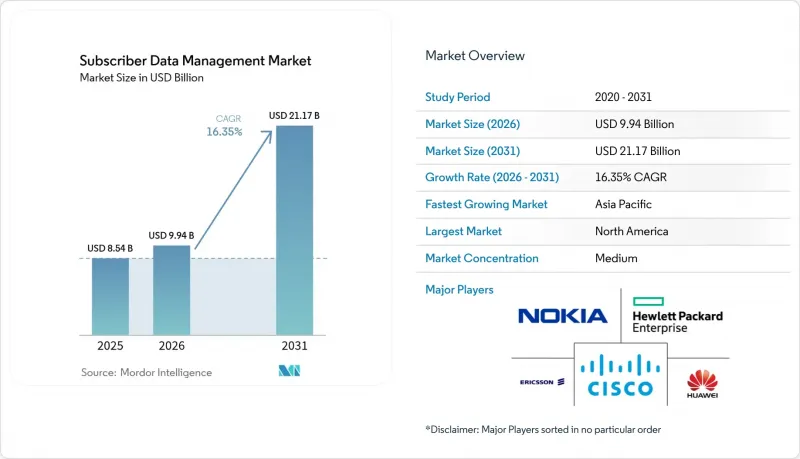
Mordor Intelligence에 의하면, 가입자 데이터 관리 시장 규모는 2025년에 85억 4,000만 달러로 평가되었습니다. 2026년 99억 4,000만 달러에서 2031년까지 211억 7,000만 달러에 이를 것으로 예상되며, 예측 기간(2026-2031년) CAGR은 16.35%를 나타낼 전망입니다.
본 보고서는 도입 형태(클라우드, On-Premise, 하이브리드), 조직 규모(대기업, 중소기업),솔루션 유형(가입자 데이터 저장소, 정책 관리 등), 네트워크 유형(2G/3G, 4G/LTE 등), 최종 사용자(모바일 네트워크 사업자, 모바일 가상 네트워크 사업자, 기업/IoT 서비스 제공업체), 그리고 지역별로 분류되어 있습니다.
세계의 가입자 데이터 관리 시장 동향 및 인사이트
5G 네트워크의 급속한 확산
상용 5G SA 코어는 현재 50개국 이상에서 가동 중이며, 중국에서만 2024년에 8억 건 이상의 5G 연결을 기록했습니다. SA 아키텍처는 제어 플레인을 클라우드 네이티브 기능에 통합하고 여러 액세스 방식을 아우르는 데이터를 중앙 집중화하기 때문에 가입자 데이터 관리는 네트워크 슬라이싱, 기업 SLA 및 마이크로초 단위의 정책 실행에 있어 핵심적인 역할을 합니다. 통신 사업자들이 견고한 가입자 데이터 계층이 미래 수익화의 기반이 될 것임을 인식한 결과, 2024년에는 모바일 코어에 대한 설비 투자가 32% 증가했습니다. 이는 소비자용과 기업용의 차별화된 슬라이스를 지원하는 에릭슨(Ericsson)의 SA 코어를 도입한 Bharti Airtel의 사례에서 여실히 드러납니다.
클라우드 네이티브 아키텍처로의 전환
모놀리식 HSS/UDM 스택에서 마이크로서비스로 전환한 통신 사업자는 총 소유 비용(TCO)이 최대 30% 절감되었을 뿐만 아니라, 트래픽에 따른 유연한 확장을 통해 지출을 트래픽에 연동시킬 수 있게 되었습니다. Three UK가 9 Tbps를 초과하는 클라우드 코어로의 전환을 실현한 것은 컨테이너화된 가입자 데이터 기능이 다운타임 없는 가동 중 업그레이드를 어떻게 지원하는지를 보여줍니다. 각 MVNO 업체들도 유사한 모델을 활용하여 Optiva의 Google Cloud 허브를 통해 AI 기반 고객 분석을 통합한 신속한 출시 주기를 실현하고 있습니다.
데이터 개인정보 보호 및 데이터 주권에 관한 규제
2024년 EU 데이터법은 클라우드 제공업체에 2027년까지 데이터 이관성을 보장할 것을 의무화하고, 해지 수수료를 금지하고 있습니다. 한편, 2025년 GDPR(EU 개인정보보호규정)은 데이터 유출 보고 요건과 국경을 넘는 데이터 전송의 장벽을 더욱 높이고 있습니다. 따라서 통신 사업자는 로밍 서비스가 국경을 넘을 경우에도 기밀성이 높은 가입자 속성이 국내에 머물 수 있도록 아키텍처를 재설계해야 하며, 이에 따라 규정 준수 예산은 최대 25% 증가하게 됩니다.
부문별 분석
하이브리드 구현은 규제 대상 식별자를 위한 On-Premise 데이터 스토어와 민첩성을 높이는 퍼블릭 클라우드 분석을 결합함으로써 전략적인 중간 지점을 찾아내고 있습니다. 수익 측면에서 이 부문은 이미 연평균 성장률(CAGR) 18.1%를 기록하며, 순수 클라우드 및 On-Premise의 성장 궤도를 상회하고 있습니다. 분산된 개인정보 보호 규제에 직면한 유럽의 다국적 기업들은 점차 하이브리드 UDM 토폴로지를 선택하고 있습니다. EU 시민의 데이터는 유럽 대륙 내 데이터센터에 저장하는 한편, 정책 분석 기능은 사용자 밀집 지역에 가까운 하이퍼스케일 클라우드에서 호스팅합니다. 이러한 설계는 법적 위험을 최소화하면서도 제품 팀이 중시하는 탄력적인 확장을 실현하고 있습니다. 각 하이퍼스케일러 기업이 소버린 클라우드 존을 구축함에 따라, 통신 사업자는 데이터 저장 위치를 미세 조정할 수 있는 추가 도구를 확보하게 되며, 이는 2031년까지 하이브리드형 수요를 견인할 것입니다. 두 번째 성장 동력은 레거시 BSS 환경 전반에 걸쳐 광대역 및 무선 가입자를 통합해야 하는 유선·모바일 융합 통신 사업자에서 비롯됩니다. 하이브리드 환경의 도입을 통해 브로드밴드 사용자 테이블을 단계적으로 이전하는 동시에, 5G SA 인증 정보를 첫날부터 운영할 수 있게 되어 대규모 일괄 전환을 피할 수 있습니다. 가입자 데이터 관리 시장에서는 각 벤더가 자동화된 데이터 배치 정책을 오케스트레이션 계층에 통합하고 있어, 지연 시간이나 규정 준수 트리거에 따라 레코드가 엣지와 코어 사이를 동적으로 이동하도록 되어 있습니다. 이러한 유동적인 데이터 플레인 아키텍처 덕분에, 지역별로 상이한 법규를 준수해야 하는 Tier 1 기업들에게 하이브리드 환경은 장기적인 표준 선택지가 될 것입니다.
전국 규모의 통신 사업자들이 멀티사이트 코어를 현대화하고 있기 때문에 여전히 대기업이 지출의 대부분을 차지하고 있지만, 비용 측면의 개선으로 중소기업(SME)도 고급 데이터 관리를 이용할 수 있게 되었습니다. 클라우드 네이티브 구독 모델은 자본 지출(Capex)을 운영 비용(OpEx)으로 전환하여, 지역 MVNO, 유틸리티 네트워크 또는 캠퍼스 내 5G 소유자와 같은 사업자의 현금 흐름 상황에 부합합니다. 스타트업은 레거시 시스템의 수 분기에 달하는 리드타임과 대조적으로, 수 주일 이내에 코어 기능을 가동할 수도 있습니다. 따라서 로우코드 프로비저닝 포털을 통해 기술적 장벽이 낮아짐에 따라, 중소기업과 관련된 가입자 데이터 관리 시장 규모는 수 배로 확대될 전망입니다. 또한, 각 벤더는 데이터 사이언스 팀이 없는 소규모 사업자를 대상으로 업셀링 기회를 파악할 수 있는 패키지화된 분석 도구를 제공합니다. 예를 들어, Google Cloud 기반의 MVNO 허브는 통화 상세 기록을 가져와 즉시 사용 가능한 해지 예측 모델을 실행하므로, 중소기업은 이전보다 한 분기나 더 빨리 고객 유지 캠페인을 전개할 수 있게 됩니다. 5G 기기 생태계가 다양해짐에 따라, 물류 차량이나 스마트 그리드 센서에 서비스를 제공하는 틈새 시장 공급업체의 확장이 예상되며, 중소기업은 성장세가 강한 고객 부문으로서의 입지를 공고히할 것입니다.
지역별 분석
2025년 매출에서 북미가 차지한 35.30%의 점유율은 제조업 및 창고업 분야의 프라이빗 5G 보급 확대와 더불어, 국내 데이터 저장 시설에 대한 수요를 높이는 엄격한 데이터 주권 규제를 반영했습니다. 버라이즌(Verizon)의 200억 달러 규모 광섬유 인수 열풍과 AT&T의 고정 무선 사업에 대한 집중은 이 지역의 인프라에 대한 활발한 수요를 상징하며, 코어 네트워크와 UDR(범용 데이터 저장소)에 대해 통합된 액세스 방식을 지원하기 위한 확장을 촉구하고 있습니다. 캐나다의 통신 사업자들도 유사한 기세를 보이고 있으며, 이는 중요 인프라의 트래픽을 국경 내에 유지하도록 의무화하는 연방 정부의 로드맵에 부합하는 움직임입니다.
아시아태평양은 18.2%라는 지역별 최고 연평균 성장률(CAGR)을 기록하고 있습니다. 중국에서는 8억 명을 넘는 5G 사용자 기반이 유례없는 규모를 만들어내고 있으며, 현지 통신 사업자들은 항만 및 산업 단지 전체에 걸친 대규모 IoT 오버레이를 계획하고 있는데, 이를 실현하기 위해서는 견고한 가입자 데이터 관리 시장의 역량이 필수적입니다. 인도에서는 공장이 사설 네트워크 라이선스를 취득할 수 있도록 주파수 대역 자유화가 진행되고 있으며, 중소기업을 위한 핵심 패키지가 촉진되고 있습니다. 한국과 일본은 계속해서 28GHz 대역 캠퍼스 네트워크의 선구자 역할을 하고 있으며, 각각 VR/AR 성능을 보장하기 위해 AI를 활용한 정책 분석 기능을 통합하고 있습니다.
유럽에서는 꾸준한 보급과 복잡한 규정 준수 부담 간의 균형이 이루어지고 있습니다. 2025년 GDPR(EU 개인정보보호규정) 개정 및 노르웨이 등의 선불 SIM에 관한 국내 신원 확인법으로 인해 다국적 기업 그룹은 시급한 현지화 압박을 받고 있습니다. 이에 대응하여 통신 사업자들은 가입자 데이터 관리 시장에서 소버린 클라우드 클러스터 및 사용 시 암호화 기술의 시범 운영을 통해 성능과 법적 요건을 모두 충족하고자 하고 있습니다. 초대용량 네트워크에 대한 EU의 자금 지원은 투자의 원동력이 되고 있지만, 구축 속도는 통합형 통신 사업자가 광섬유, 케이블, 모바일 각 가입자 스키마를 단일 UDR로 얼마나 신속하게 통합할 수 있는지에 달려 있습니다.
기타 혜택 :
- 엑셀 형식 시장 예측(ME) 시트
- 3개월간의 애널리스트 지원
자주 묻는 질문
목차
제1장 서론
제2장 조사 방법
제3장 개요
제4장 시장 구도
제5장 시장 규모 및 성장 예측
제6장 경쟁 구도
제7장 시장 기회 및 향후의 동향
KTH 26.08.31According to Mordor Intelligence, the subscriber data management market size was valued at USD 8.54 billion in 2025 and estimated to grow from USD 9.94 billion in 2026 to reach USD 21.17 billion by 2031, at a CAGR of 16.35% during the forecast period (2026-2031).
This report is Segmented by Deployment Mode (Cloud, On-Premise, and Hybrid), Organization Size (Large Enterprises and Small and Medium Enterprises), Solution Type (Subscriber Data Repository, Policy Management, and More), Network Type (2G/3G, 4G/LTE, and More), End-User (Mobile Network Operators, Mobile Virtual Network Operators, and Enterprises/IoT Service Providers), and Geography.
Global Subscriber Data Management Market Trends and Insights
Rapid rollout of 5G networks
Commercial 5G SA cores are now live in more than 50 nations, and China alone recorded over 800 million 5G connections in 2024. SA architecture collapses the control plane into cloud-native functions that centralize data across multiple access types, making subscriber data management the lynchpin for network slicing, enterprise SLAs, and micro-second policy execution. Mobile-core capex accelerated 32% in 2024 as operators recognized that a robust subscriber data layer underpins future monetization-illustrated by Bharti Airtel's Ericsson-powered SA core geared to differentiated consumer and enterprise slices.
Shift toward cloud-native architectures
Operators migrating from monolithic HSS/UDM stacks to microservices report up to 30% lower total cost of ownership, plus elastic scaling that aligns spend with traffic. Three UK's move to a cloud core that tops 9 Tbps demonstrates how containerized subscriber data functions support in-service upgrades without downtime. MVNOs exploit the same model, using Optiva's Google-Cloud hubs for fast launch cycles that fold in AI customer analytics.
Data-privacy and sovereignty mandates
The EU Data Act of 2024 compels cloud providers to guarantee data portability by 2027 and bars exit fees, while GDPR 2025 heightens breach-reporting and cross-border transfer hurdles. Operators must therefore redesign architectures so that sensitive subscriber attributes reside inside national borders even as roaming services traverse them, inflating compliance budgets by up to 25%.
Other drivers and restraints analyzed in the detailed report include:
- Surge in IoT/mMTC device counts
- AI-driven real-time policy control adoption
- Integration complexity with legacy OSS/BSS
For complete list of drivers and restraints, kindly check the Table Of Contents.
Segment Analysis
Hybrid implementations carve out a strategic middle ground, pairing on-premises data stores for regulated identifiers with public-cloud analytics that enhance agility. In revenue terms, the segment already commands 18.1% CAGR, exceeding both pure cloud and on-premise trajectories. European multinationals facing fragmented privacy regimes increasingly select hybrid UDM topologies, storing EU citizen data within continental data centers while hosting policy-analytics functions on hyperscale clouds situated closer to user clusters. That design minimizes legal exposure yet delivers the elastic scaling prized by product teams. As hyperscalers roll out sovereign-cloud zones, operators gain further tools to fine-tune residency, propelling hybrid demand through 2031.A second growth engine stems from converged fixed-mobile operators that must harmonize broadband and wireless subscribers across legacy BSS landscapes. Hybrid footprints allow them to migrate broadband user tables at a measured pace while running 5G SA credentials from day one, avoiding big-bang cutovers. The subscriber data management market sees vendors baking automated data-placement policies into their orchestration layers so records dynamically shift between edge and core depending on latency or compliance triggers. This fluid data-plane architecture positions hybrid as the long-term default for tier-1 groups navigating divergent regional statutes.
Large enterprises still dominate spending thanks to national-scale operators modernizing multi-site cores, but affordability improvements now open advanced data management to SMEs. Cloud-native subscription models turn capex into opex, matching the cash-flow realities of regional MVNOs, utility networks, or campus 5G owners. Start-ups can stand up core functions within weeks, contrasting with the multi-quarter lead times of legacy systems. The subscriber data management market size tied to SMEs is therefore set to multiply as low-code provisioning portals reduce skills barriers.Vendors also curate pre-packaged analytics that pinpoint upsell opportunities for small operators lacking data-science teams. For example, Google-Cloud-based MVNO hubs ingest call-detail records and run churn-prediction models out-of-the-box, letting SMEs target retention campaigns a full quarter sooner than before. As 5G device ecosystems diversify, niche providers serving logistics fleets or smart-grid sensors are expected to expand, cementing SMEs as a high-momentum customer segment.
Complete Report Scope:
- By Deployment Mode
- Cloud
- On-Premise
- Hybrid
- By Organization Size
- Large Enterprises
- Small and Medium Enterprises (SMEs)
- By Solution Type
- Subscriber Data Repository
- Policy Management
- Identity Management
- Location and Device Information
- By Network Type
- 2G/3G
- 4G/LTE
- 5G Stand-Alone
- Fixed/Wireline
- By End-user
- Mobile Network Operators (MNOs)
- Mobile Virtual Network Operators (MVNOs)
- Enterprises/IoT Service Providers
- By Geography
- North America
- United States
- Canada
- Mexico
- South America
- Brazil
- Argentina
- Chile
- Rest of South America
- Europe
- Germany
- United Kingdom
- France
- Italy
- Spain
- Russia
- Rest of Europe
- Asia-Pacific
- China
- India
- Japan
- South Korea
- Singapore
- Malaysia
- Australia
- Rest of Asia-Pacific
- Middle East and Africa
- Middle East
- United Arab Emirates
- Saudi Arabia
- Turkey
- Rest of Middle East
- Africa
- South Africa
- Nigeria
- Rest of Africa
- Middle East
- North America
Geography Analysis
North America's 35.30% slice of 2025 revenue reflects deep private-5G penetration across manufacturing and warehousing, plus strict sovereign-data rules that amplify demand for on-shore repositories. Verizon's USD 20 billion fiber acquisition spree and AT&T's fixed-wireless push exemplify the region's infrastructure appetite, forcing cores and UDRs to scale for converged access types. Canadian carriers show similar momentum, aligning with federal road maps that require critical-infrastructure traffic to stay within national borders.
Asia-Pacific posts the highest regional CAGR at 18.2%. China's 800-million-plus 5G user base delivers unmatched scale, and operators there plan vast IoT overlays across ports and industrial parks that hinge on robust subscriber data management market capabilities. India follows with spectrum liberalization that lets factories secure private-network licenses, spurring SME-friendly core packages. South-Korea and Japan continue to pioneer 28 GHz campus networks, each bundling AI-fueled policy analytics to assure VR/AR performance.
Europe balances solid uptake with complex compliance overhead. The GDPR 2025 revision and national prepaid-SIM identity laws, such as Norway's, place immediate localization pressures on multi-country groups. Carriers respond by piloting sovereign-cloud clusters and encrypt-in-use techniques within the subscriber data management market to meet both performance and legal thresholds. EU funding for very-high-capacity networks adds investment firepower, though rollout tempos depend on how quickly converged operators reconcile fiber, cable, and mobile subscriber schemas into a single UDR.
- Telefonaktiebolaget LM Ericsson
- Nokia Corporation
- Huawei Technologies Co. Ltd.
- Hewlett Packard Enterprise Co.
- Cisco Systems Inc.
- Oracle Communications
- Amdocs Ltd.
- ZTE Corporation
- Mavenir Systems Inc.
- Enea (Openwave Mobility)
- NetNumber Inc.
- Alepo Technologies Inc.
- Optiva Inc. (Redknee)
- Casa Systems Inc.
- Ribbon Communications Inc.
- BroadForward B.V.
- SigScale Inc.
- Affirmed Networks Inc.
- H3C Technologies Co. Ltd.
- Comba Telecom Systems Holdings Ltd.
- Parallel Wireless Inc.
- STC Solutions
- Kaleyra S.p.A.
- Lumine Group - Subex Ltd.
- Tata Communications Ltd.
Additional Benefits:
- The market estimate (ME) sheet in Excel format
- 3 months of analyst support
TABLE OF CONTENTS
1 INTRODUCTION
- 1.1 Study Assumptions and Market Definition
- 1.2 Scope of the Study
2 RESEARCH METHODOLOGY
3 EXECUTIVE SUMMARY
4 MARKET LANDSCAPE
- 4.1 Market Overview
- 4.2 Market Drivers
- 4.2.1 Rapid rollout of 5G networks
- 4.2.2 Shift toward cloud-native architectures
- 4.2.3 Surge in IoT/mMTC device counts
- 4.2.4 Regulatory push for unified subscriber identity
- 4.2.5 AI-driven real-time policy control adoption
- 4.2.6 Private 5G and edge micro-core deployments
- 4.3 Market Restraints
- 4.3.1 Data-privacy and sovereignty mandates
- 4.3.2 Integration complexity with legacy OSS/BSS
- 4.3.3 Scarcity of Diameter/HTTP-2 signalling talent
- 4.3.4 Proprietary UDR schema lock-in risk
- 4.4 Industry Value Chain Analysis
- 4.5 Regulatory Landscape
- 4.6 Technological Outlook
- 4.7 Industry Attractiveness - Porter's Five Forces Analysis
- 4.7.1 Threat of New Entrants
- 4.7.2 Bargaining Power of Buyers
- 4.7.3 Bargaining Power of Suppliers
- 4.7.4 Threat of Substitutes
- 4.7.5 Intensity of Competitive Rivalry
- 4.8 Impact of Macroeconomic Factors on the Market
5 MARKET SIZE AND GROWTH FORECASTS (VALUES)
- 5.1 By Deployment Mode
- 5.1.1 Cloud
- 5.1.2 On-Premise
- 5.1.3 Hybrid
- 5.2 By Organization Size
- 5.2.1 Large Enterprises
- 5.2.2 Small and Medium Enterprises (SMEs)
- 5.3 By Solution Type
- 5.3.1 Subscriber Data Repository
- 5.3.2 Policy Management
- 5.3.3 Identity Management
- 5.3.4 Location and Device Information
- 5.4 By Network Type
- 5.4.1 2G/3G
- 5.4.2 4G/LTE
- 5.4.3 5G Stand-Alone
- 5.4.4 Fixed/Wireline
- 5.5 By End-user
- 5.5.1 Mobile Network Operators (MNOs)
- 5.5.2 Mobile Virtual Network Operators (MVNOs)
- 5.5.3 Enterprises/IoT Service Providers
- 5.6 By Geography
- 5.6.1 North America
- 5.6.1.1 United States
- 5.6.1.2 Canada
- 5.6.1.3 Mexico
- 5.6.2 South America
- 5.6.2.1 Brazil
- 5.6.2.2 Argentina
- 5.6.2.3 Chile
- 5.6.2.4 Rest of South America
- 5.6.3 Europe
- 5.6.3.1 Germany
- 5.6.3.2 United Kingdom
- 5.6.3.3 France
- 5.6.3.4 Italy
- 5.6.3.5 Spain
- 5.6.3.6 Russia
- 5.6.3.7 Rest of Europe
- 5.6.4 Asia-Pacific
- 5.6.4.1 China
- 5.6.4.2 India
- 5.6.4.3 Japan
- 5.6.4.4 South Korea
- 5.6.4.5 Singapore
- 5.6.4.6 Malaysia
- 5.6.4.7 Australia
- 5.6.4.8 Rest of Asia-Pacific
- 5.6.5 Middle East and Africa
- 5.6.5.1 Middle East
- 5.6.5.1.1 United Arab Emirates
- 5.6.5.1.2 Saudi Arabia
- 5.6.5.1.3 Turkey
- 5.6.5.1.4 Rest of Middle East
- 5.6.5.2 Africa
- 5.6.5.2.1 South Africa
- 5.6.5.2.2 Nigeria
- 5.6.5.2.3 Rest of Africa
- 5.6.5.1 Middle East
- 5.6.1 North America
6 COMPETITIVE LANDSCAPE
- 6.1 Market Concentration
- 6.2 Strategic Moves
- 6.3 Market Share Analysis
- 6.4 Company Profiles (includes Global level Overview, Market level overview, Core Segments, Financials as available, Strategic Information, Market Rank/Share for key companies, Products and Services, and Recent Developments)
- 6.4.1 Telefonaktiebolaget LM Ericsson
- 6.4.2 Nokia Corporation
- 6.4.3 Huawei Technologies Co. Ltd.
- 6.4.4 Hewlett Packard Enterprise Co.
- 6.4.5 Cisco Systems Inc.
- 6.4.6 Oracle Communications
- 6.4.7 Amdocs Ltd.
- 6.4.8 ZTE Corporation
- 6.4.9 Mavenir Systems Inc.
- 6.4.10 Enea (Openwave Mobility)
- 6.4.11 NetNumber Inc.
- 6.4.12 Alepo Technologies Inc.
- 6.4.13 Optiva Inc. (Redknee)
- 6.4.14 Casa Systems Inc.
- 6.4.15 Ribbon Communications Inc.
- 6.4.16 BroadForward B.V.
- 6.4.17 SigScale Inc.
- 6.4.18 Affirmed Networks Inc.
- 6.4.19 H3C Technologies Co. Ltd.
- 6.4.20 Comba Telecom Systems Holdings Ltd.
- 6.4.21 Parallel Wireless Inc.
- 6.4.22 STC Solutions
- 6.4.23 Kaleyra S.p.A.
- 6.4.24 Lumine Group - Subex Ltd.
- 6.4.25 Tata Communications Ltd.
7 MARKET OPPORTUNITIES AND FUTURE TRENDS
- 7.1 White-Space and Unmet-Need Assessment