

|
시장보고서
상품코드
2115817
특수 임무 항공기 : 시장 점유율 분석, 업계 동향 및 통계, 성장 예측(2026-2031년)Special Mission Aircraft - Market Share Analysis, Industry Trends & Statistics, Growth Forecasts (2026 - 2031) |
||||||
 Mordor Intelligence
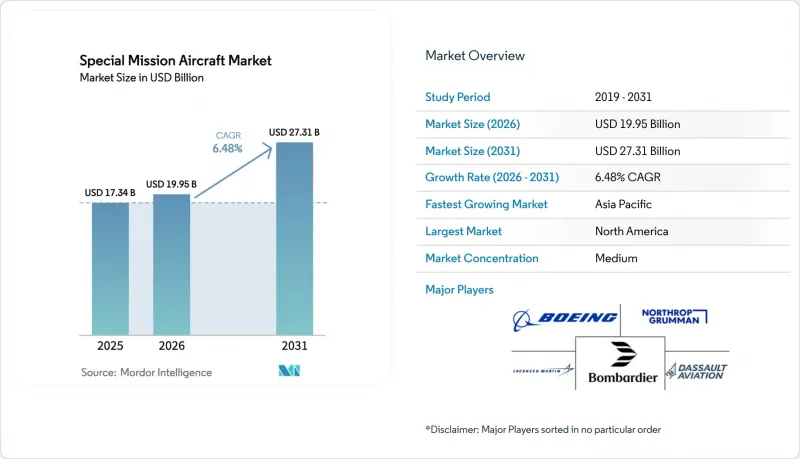
Mordor Intelligence에 의하면, 특수 임무용 항공기 시장 규모는 2025년 186억 6,000만 달러에서 2026년에는 199억 5,000만 달러에 이르고, 2026-2031년 CAGR 6.48%로 성장을 지속하여 2031년에는 273억 1,000만 달러에 달할 것으로 예측됩니다.
본 보고서는 플랫폼별(고정익, 회전익 등), 용도별(정보·감시·정찰(ISR), 전자전 및 신호정보(SIGINT) 등), 최종 사용자별(국방·국토안보/법 집행 기관 및 상업·민간), 지역별(북미, 유럽 등)로 분류되어 있습니다. 시장 예측은 금액(달러) 기준으로 제시되어 있습니다.
전 세계 특수 임무용 항공기 시장 동향 및 인사이트
다영역 ISR 예산 확대가 지출을 견인
NATO 및 인도-태평양 지역의 각국 국방부는 2025년에 ISR에 대한 예산 배정을 확대했습니다. 이는 특수 임무용 항공기 시장에서 실시간 교차 영역 상황 인식이 필수적임을 반영한 것입니다. 미국은 2025 회계연도에 항공기 탑재형 ISR 및 전자전(EW) 프로그램에 139억 달러를 배정했으며, 이는 자금 조달의 모멘텀이 지속되고 있음을 분명히 보여줍니다. 일본, 영국, 호주도 이러한 추세를 따르며, P-1, P-8A, E-7 웨지테일, MQ-4C 트리톤 각 기종에 대한 예산이 승인되었습니다. 이러한 예산 조치에 따라 신규 기체 발주 및 기체 수명 중반에 이루어지는 아비오닉스 개량이 착실히 진행되고 있습니다. 오픈 시스템 아키텍처 덕분에 다중 스펙트럼 데이터를 융합하는 AI 엔진의 도입이 용이해졌으며, 납품되는 모든 플랫폼의 가치 제안이 높아지고 있습니다. 예산을 통해 다년간의 조달 계획이 확정됨에 따라, 공급업체들은 미래 수익을 확보하고 확대되는 수요에 대응하기 위해 생산 라인을 확충하고 있습니다.
기체 교체 주기가 플랫폼 현대화를 가속화
냉전 시대의 초계기 및 수송기 기체는 2024년부터 2025년에 걸쳐 퇴역하게 되며, 운용사는 유지보수 부담이 적은 후속 기종을 선정할 수밖에 없게 되었습니다. 2024년 12월, 미 해군은 마지막 P-3C 오리온 비행대를 퇴역시켰으며, 이에 따라 임무 반경이 30% 확대된 제트기형인 P-8A 포세이돈으로의 완전한 전환이 완료되었습니다. 스페인과 캐나다는 CN-235 및 CP-140 기체군을 대체하기 위한 경쟁 입찰 및 계약 절차를 시작했으며, 모듈식 미션 베이와 개방형 아비오닉스를 우선시하고 있습니다. 운영 기관들은 현재 미래의 노후화를 방지하기 위해 VICTORY 표준 준수와 고대역폭 데이터 버스의 도입을 요구하고 있습니다. 이러한 현대화 프로젝트는 공급망 전반에 파급되어 센서, 데이터 링크 및 훈련 제공업체에 활력을 불어넣고 있습니다. 그 결과 발생하는 조달 붐은 향후 10년 동안 특수 임무기 시장을 지탱할 예측 가능한 수주 잔고의 기반이 될 것입니다.
고성능 A2/AD 시스템이 플랫폼 선정 추세를 변화시킴
장거리 지대공 미사일을 장착한 통합 방공 시스템으로 인해 유인 ISR 항공기의 안전한 작전 범위는 축소되고 있습니다. RAND의 시뮬레이션에 따르면, 고강도 시나리오에서 분쟁 지역 해안선으로부터 300해리 이내로 진입하는 유인 플랫폼의 손실 위험은 15%를 초과하는 것으로 나타났습니다. 현재 NATO의 장거리 작전 전술에서는 적의 미사일 사정권 밖에서 RC-135 및 E-7 웨지테일의 비행을 중시하며, 연안 부근의 지속적인 감시 임무는 MQ-4C 트리톤 무인기(UAV)에 맡겨지고 있습니다. 무인 자산의 광범위한 도입으로 조종사의 생존성에 대한 우려는 완화되지만, 한편으로는 위성 대역폭 및 사이버 보안이 확보된 지휘·통신 회선에 대한 새로운 요구 사항이 대두되고 있습니다. 특수 임무용 항공기 시장에서는 이러한 변화로 인해 유인 대형기 수요는 둔화되는 반면, 전자전용 호위기나 접근 거부 구역 밖에서 운용 가능한 저가시성 센서 포드의 수주가 촉진되고 있습니다.
부문 분석
가장 빠르게 성장하는 플랫폼군인 무인 항공기(UAV)는 2031년까지 연평균 성장률(CAGR) 12.21%를 나타낼 것으로 예측되며, 이는 해상 및 국경에서의 지속적인 감시 역할 확대를 반영한 것입니다. 2025년에는 고정익 항공기가 39.67%의 점유율로 최대 자리를 유지했습니다. 이는 다목적 운용 능력과 오랜 운용 실적을 자랑하는 P-8A 포세이돈 및 C-295 퍼슈에이터 기체군이 뒷받침하고 있습니다. 고정익 플랫폼 내 특수 임무용 항공기 시장 점유율은 해양 국가들 사이에서 기체 선정에 대한 뿌리 깊은 경향을 여실히 보여주고 있습니다. 그러나 UAV의 비용 면에서의 우위에 대한 관심이 높아짐에 따라 조달 계획은 원격 조종형 옵션으로 점차 전환되고 있습니다.
2024년 MQ-9B에 대해 영국 민간항공청(CAA)이 발급한 인증이 보여주듯이, 규제 당국이 비분리 공역에서의 운용을 승인함에 따라 UAV가 차지하는 특수 임무 항공기 시장 규모는 확대될 것으로 예측됩니다. 회전익 항공기는 수색 및 구조 및 함재 임무에서 틈새 시장으로서의 중요성을 유지하고 있는 반면, 하이브리드형 및 선택적 조종형 개념에는 국경 경비 기관으로부터 실증 자금이 지원되고 있습니다. G550 CAEW와 같은 비즈니스 제트기 개조 기종은 신형 기체 인증의 부담 없이 신속한 역량 제공이 가능하여, 보유 기수가 적고 훈련 체계가 제한적인 국가들에게 매력적입니다. 모듈식 객실이나 개방형 항공전자장비를 제공하는 공급업체들은 위협 환경의 진화에 따라 업그레이드 수요를 확보할 것으로 기대됩니다.
지역별 분석
북미는 플랫폼 확보와 막대한 국내 산업 오프셋을 결합한 미국 및 캐나다의 조달 정책에 힘입어 2025년 매출의 41.56%를 차지하며 선도적인 위치를 유지했습니다. 이 지역은 탄탄한 공급업체 생태계, 안정적인 자금 조달, 그리고 전용 군사 연구 자금의 혜택을 받고 있습니다. P-8A 포세이돈, E-7 웨지테일, RC-135의 각 파생형 기체 업데이트가 수요의 대부분을 차지하고 있지만, 미국 세관·국경수비국(CBP)의 무인항공기(UAV) 운용은 국토 안보 분야에서 그 역할이 확대되고 있음을 보여줍니다. 북미의 특수 임무용 항공기 시장 점유율은 해당 지역의 확고한 산업 기반과 신속한 배치 주기를 여실히 보여주고 있습니다.
아시아태평양은 연평균 성장률(CAGR) 8.51%로 예측되어 가장 역동적인 성장 전망을 보이고 있습니다. 그 요인으로는 인도의 P-8I 추가 발주, 한국의 P-8A 확충, 그리고 호주의 MQ-4C 트리톤과 P-8A를 결합한 부대 편성 등이 꼽힙니다. 일본은 개량형 소나 처리 시스템과 전자 지원 시스템을 통합하여 국산 P-1 기단의 강화를 지속하고 있습니다. 인도-태평양 지역 전체에서 고조되는 해양 분쟁은 동남아시아 국가들의 새로운 ISR(정보·감시·정찰) 요구 사항을 촉진하며, 유인 및 무인 항공기 양쪽의 조달을 뒷받침하고 있습니다. 유럽 수요는 영국, 독일, 노르웨이의 E-7 웨지테일 및 P-8A 포세이돈 구매 등 NATO의 공동 프로그램에 힘입어 보다 안정적인 속도로 확대되고 있습니다. 프랑스의 ‘아틀란틱 2’ 및 이탈리아의 ‘ATR 72MP’ 기단의 현대화를 통해 센서 및 임무 시스템 업그레이드로 인한 수익이 유지되고 있습니다. 중·동유럽 국가들은 터보프롭 수송기에 통합된 항공기 탑재형 신호정보 수집 패키지에 중점을 두고 있으며, 비용과 신속한 실전 배치 능력 간의 균형을 맞추고 있습니다.
중동 및 아프리카에서는 아랍에미리트(UAE)의 ‘세계 아이’ 기단이 대표하듯이, 단일 기체에 조기경보·관제(AEW&C), 해상 감시, 지상 이동 표적 감지 기능을 융합한 최첨단 플랫폼에 선택적으로 자금이 투입되고 있습니다. 사우디아라비아는 CN-235 해상 초계기의 보유 대수를 확대하여 연안 지역의 상황 파악과 밀수 대책을 최적화했습니다. 남미에서는 여전히 규모는 소규모이지만, 브라질의 C-390 밀레니엄 수색구조기 도입을 통해 엠브라에르공급망에 지역 내 생산 및 지원이 통합되면서, 국산 플랫폼의 중요성이 높아지고 있음을 보여주고 있습니다.
기타 혜택:
- 엑셀 형식 시장 예측(ME) 시트
- 3개월간의 애널리스트 지원
자주 묻는 질문
목차
제1장 서론
제2장 조사 방법
제3장 주요 요약
제4장 시장 구도
제5장 시장 규모와 성장 예측
제6장 경쟁 구도
제7장 시장 기회와 향후 전망
LSH 26.08.26According to Mordor Intelligence, the special mission aircraft market size is expected to grow from USD 18.66 billion in 2025 to USD 19.95 billion in 2026 and is forecasted to reach USD 27.31 billion by 2031 at a 6.48% CAGR over 2026-2031.
This report is Segmented by Platform (Fixed Wing, Rotary Wing, and More), Application (Intelligence, Surveillance and Reconnaissance (ISR), Electronic Warfare and Signals Intelligence (SIGINT), and More), End-User (Defense and Homeland Security/Law-Enforcement and Commercial and Civil), and Geography (North America, Europe, and More). The Market Forecasts are Provided in Terms of Value (USD).
Global Special Mission Aircraft Market Trends and Insights
Escalating Multi-Domain ISR Budgets Drive Spend
Defense ministries across the NATO and Indo-Pacific regions increased ISR allocations in 2025, reflecting the imperative for real-time cross-domain awareness in the Special Mission Aircraft Market. The US earmarked USD 13.9 billion for airborne ISR and EW programs in fiscal 2025, a clear signal of sustained funding momentum. Japan, the UK, and Australia mirrored this trend with budget approvals for P-1, P-8A, E-7 Wedgetail, and MQ-4C Triton fleets. These appropriations drive steady orders for new airframes and mid-life avionics retrofits. Open-system architectures make it easier to layer AI engines that fuse multi-spectral data, raising the value proposition of every delivered platform. As budgets lock in multi-year procurement lines, suppliers secure forward revenue and scale production lines to meet widened demand horizons.
Fleet Replacement Cycle Accelerates Platform Modernization
Cold War-era patrol and transport airframes entered retirement in 2024-2025, forcing operators to select lower-maintenance successors. The final P-3C Orion squadron was decommissioned by the US Navy in December 2024, marking the complete transition to the P-8A Poseidon, a jet variant with a 30% greater mission radius. Spain and Canada initiated competitions or awards to replace CN-235 and CP-140 fleets, prioritizing modular mission bays and open-architecture avionics. Operators now demand compliance with VICTORY standards and high-bandwidth data buses to avoid future obsolescence. Replacement projects ripple through supply chains, uplifting sensor, data-link, and training providers. The resulting procurement wave underpins a predictable backlog that supports the special mission aircraft market through the next decade.
High-End A2/AD Systems Shift Platform Preferences
Integrated air-defense systems equipped with long-range surface-to-air missiles shrink safe operating envelopes for crewed ISR aircraft. RAND modeling indicates that attrition risks exceed 15% for manned platforms that venture within 300 nautical miles of contested coastlines in a high-intensity scenario. NATO standoff tactics now emphasize RC-135 and E-7 Wedgetail flights beyond enemy missile arcs, delegating near-shore persistence to MQ-4C Triton UAVs. The broader adoption of crewless assets mitigates pilot survivability concerns, yet introduces new requirements for satellite bandwidth and cyber-secure command links. For the special mission aircraft market, the shift tempers demand for heavy crewed variants while stimulating orders for electronic-warfare escorts and low-observable sensor pods that can operate outside denial zones.
Other drivers and restraints analyzed in the detailed report include:
- Accelerated Uptake of HALE/MALE UAVs Transforms Economics
- AI-Ready Modular Mission Suites Slashing Integration Lead Times
- ITAR and Dual-Use Export Controls on Advanced Sensor Payloads
For complete list of drivers and restraints, kindly check the Table Of Contents.
Segment Analysis
Unmanned aerial vehicles (UAVs), the fastest-growing platform group, are forecasted to register a 12.21% CAGR to 2031, reflecting expanding roles in persistent maritime and border surveillance. Fixed-wing aircraft retained the largest share in 2025 at 39.67%, anchored by the P-8A Poseidon and C-295 Persuader fleets, which deliver multi-mission versatility and extended logistical pedigrees. The special mission aircraft market share for fixed-wing platforms highlights entrenched fleet preferences among maritime nations. Still, the growing appeal of UAV cost advantages is shifting procurement roadmaps in favor of remotely piloted options.
The special mission aircraft market size captured by UAVs is expected to expand as regulatory bodies approve unsegregated airspace operations, as evidenced by the Civil Aviation Authority certificate issued to the MQ-9B in 2024. Rotary-wing assets sustain niche relevance in search-and-rescue and shipboard roles, while hybrid and optionally piloted concepts gain exploratory funding from border agencies. Business-jet conversions such as the G550 CAEW deliver rapid capability without new-type certification burdens, appealing to countries with small fleets and limited training pipelines. Suppliers that offer modular cabins and open avionics stand to capture upgrade cycles as threat environments evolve.
Complete Report Scope:
- By Platform
- Fixed Wing
- Rotary Wing
- Unmanned Aerial Vehicle (UAV)
- Hybrid/Other Platforms
- By Application
- Intelligence, Surveillance and Reconnaissance (ISR)
- Maritime Patrol and Anti-Submarine Warfare (ASW)
- Electronic Warfare (EW) and Signals Intelligence (SIGINT)
- Airborne Early Warning & Control (AEW&C)
- Emergency Services (Medevac, Disaster Management, Search and Rescue, etc.)
- By End User
- Defense and Homeland Security/Law-Enforcement
- Commercial and Civil
- By Geography
- North America
- United States
- Canada
- Mexico
- Europe
- United Kingdom
- France
- Germany
- Russia
- Rest of Europe
- Asia-Pacific
- China
- India
- Japan
- Australia
- Rest of Asia-Pacific
- South America
- Brazil
- Rest of South America
- Middle East and Africa
- Middle East
- United Arab Emirates
- Turkey
- Rest of Middle East
- Africa
- South Africa
- Rest of Africa
- Middle East
- North America
Geography Analysis
North America retained leadership with 41.56% of 2025 revenue, supported by the US and Canadian procurement lines that bundle platform acquisition with substantial domestic industrial offsets. The region benefits from a deep vendor ecosystem, secure financing, and dedicated military research funding. Fleet modernization of the P-8A Poseidon, E-7 Wedgetail, and RC-135 variants dominates demand, while Customs and Border Protection's UAV operations illustrate expanding homeland security roles. The special mission aircraft market share in North America highlights the region's established industrial base and rapid fielding cycles.
Asia-Pacific delivers the most dynamic growth outlook, projected at an 8.51% CAGR. Drivers include India's additional P-8I orders, South Korea's expansion of the P-8A, and Australia's combined MQ-4C Triton and P-8A force structure. Japan continues to enhance its indigenous P-1 fleet, integrating upgraded sonar processing and electronic support suites. Rising maritime disputes across the Indo-Pacific catalyze new ISR requirements among Southeast Asian nations, spurring both manned and unmanned acquisitions. European demand advances at a steadier clip, buoyed by collaborative NATO programs such as the E-7 Wedgetail and P-8A Poseidon buys by the United Kingdom, Germany, and Norway. Modernization of France's Atlantique 2 and Italy's ATR 72MP fleets sustains revenue from sensor and mission-system upgrades. Central and Eastern European states focus on airborne signals-intelligence packages integrated onto turboprop transports, striking a balance between cost and rapid fieldability.
The Middle East and Africa channel selective capital into high-end platforms, typified by the United Arab Emirates' GlobalEye fleet, which fuses AEW&C, maritime surveillance, and ground-moving-target indication in a single airframe. Saudi Arabia expanded its CN-235 maritime-patrol inventory, optimizing littoral domain awareness and anti-smuggling efforts. South America remains modest in scale, but Brazil's C-390 Millennium search-and-rescue deliveries inject regional production and support into Embraer's supply chain, illustrating the rising prominence of domestic platforms.
- RTX Corporation
- Israel Aerospace Industries Ltd.
- Elbit Systems Ltd.
- The Boeing Company
- Dassault Aviation
- Northrop Grumman Corporation
- Lockheed Martin Corporation
- Textron Aviation Inc.
- General Dynamics Corporation
- Airbus
- Bombardier Inc.
- Pilatus Aircraft Ltd
- Leonardo S.p.A.
- Saab AB
- Gulfstream Aerospace Corporation
- Embraer S.A.
- L3Harris Technologies, Inc.
- Sierra Nevada Company, LLC.
- Thales Group
- General Atomics Aeronautical Systems Inc.
- BAE Systems plc
Additional Benefits:
- The market estimate (ME) sheet in Excel format
- 3 months of analyst support
TABLE OF CONTENTS
1 INTRODUCTION
- 1.1 Study Assumptions and Market Definition
- 1.2 Scope of the Study
2 RESEARCH METHODOLOGY
3 EXECUTIVE SUMMARY
4 MARKET LANDSCAPE
- 4.1 Market Overview
- 4.2 Market Drivers
- 4.2.1 Escalating multi-domain ISR budgets
- 4.2.2 Fleet-replacement cycle for legacy P-3/C-130 and CN-235 families
- 4.2.3 Accelerated uptake of HALE/MALE UAVs for cost-effective missions
- 4.2.4 AI-ready modular mission suites slashing integration lead-times
- 4.2.5 Expansion of business jet conversions lowering total cost of ownership
- 4.2.6 Turnkey leasing by specialist lessors enabling small nation entry
- 4.3 Market Restraints
- 4.3.1 Procurement deferrals amid fiscal tightening
- 4.3.2 High-end A2/AD bubbles reducing manned-platform survivability
- 4.3.3 LEO-satellite constellations substituting some airborne tasks
- 4.3.4 ITAR/dual-use export controls on advanced sensor payloads
- 4.4 Value Chain Analysis
- 4.5 Regulatory Landscape
- 4.6 Technological Outlook
- 4.7 Porter's Five Forces Analysis
- 4.7.1 Bargaining Power of Buyers
- 4.7.2 Bargaining Power of Suppliers
- 4.7.3 Threat of New Entrants
- 4.7.4 Threat of Substitutes
- 4.7.5 Intensity of Competitive Rivalry
5 MARKET SIZE AND GROWTH FORECASTS (VALUE)
- 5.1 By Platform
- 5.1.1 Fixed Wing
- 5.1.2 Rotary Wing
- 5.1.3 Unmanned Aerial Vehicle (UAV)
- 5.1.4 Hybrid/Other Platforms
- 5.2 By Application
- 5.2.1 Intelligence, Surveillance and Reconnaissance (ISR)
- 5.2.2 Maritime Patrol and Anti-Submarine Warfare (ASW)
- 5.2.3 Electronic Warfare (EW) and Signals Intelligence (SIGINT)
- 5.2.4 Airborne Early Warning & Control (AEW&C)
- 5.2.5 Emergency Services (Medevac, Disaster Management, Search and Rescue, etc.)
- 5.3 By End User
- 5.3.1 Defense and Homeland Security/Law-Enforcement
- 5.3.2 Commercial and Civil
- 5.4 By Geography
- 5.4.1 North America
- 5.4.1.1 United States
- 5.4.1.2 Canada
- 5.4.1.3 Mexico
- 5.4.2 Europe
- 5.4.2.1 United Kingdom
- 5.4.2.2 France
- 5.4.2.3 Germany
- 5.4.2.4 Russia
- 5.4.2.5 Rest of Europe
- 5.4.3 Asia-Pacific
- 5.4.3.1 China
- 5.4.3.2 India
- 5.4.3.3 Japan
- 5.4.3.4 Australia
- 5.4.3.5 Rest of Asia-Pacific
- 5.4.4 South America
- 5.4.4.1 Brazil
- 5.4.4.2 Rest of South America
- 5.4.5 Middle East and Africa
- 5.4.5.1 Middle East
- 5.4.5.1.1 United Arab Emirates
- 5.4.5.1.2 Turkey
- 5.4.5.1.3 Rest of Middle East
- 5.4.5.2 Africa
- 5.4.5.2.1 South Africa
- 5.4.5.2.2 Rest of Africa
- 5.4.5.1 Middle East
- 5.4.1 North America
6 COMPETITIVE LANDSCAPE
- 6.1 Market Concentration
- 6.2 Strategic Moves
- 6.3 Market Share Analysis
- 6.4 Company Profiles (includes Global level Overview, Market level overview, Core Segments, Financials as available, Strategic Information, Market Rank/Share for key companies, Products and Services, and Recent Developments)
- 6.4.1 RTX Corporation
- 6.4.2 Israel Aerospace Industries Ltd.
- 6.4.3 Elbit Systems Ltd.
- 6.4.4 The Boeing Company
- 6.4.5 Dassault Aviation
- 6.4.6 Northrop Grumman Corporation
- 6.4.7 Lockheed Martin Corporation
- 6.4.8 Textron Aviation Inc.
- 6.4.9 General Dynamics Corporation
- 6.4.10 Airbus
- 6.4.11 Bombardier Inc.
- 6.4.12 Pilatus Aircraft Ltd
- 6.4.13 Leonardo S.p.A.
- 6.4.14 Saab AB
- 6.4.15 Gulfstream Aerospace Corporation
- 6.4.16 Embraer S.A.
- 6.4.17 L3Harris Technologies, Inc.
- 6.4.18 Sierra Nevada Company, LLC.
- 6.4.19 Thales Group
- 6.4.20 General Atomics Aeronautical Systems Inc.
- 6.4.21 BAE Systems plc
7 MARKET OPPORTUNITIES AND FUTURE OUTLOOK
- 7.1 White-space and Unmet-need Assessment


