

|
시장보고서
상품코드
2115823
아조디카르본아미드 : 시장 점유율 분석, 업계 동향 및 통계, 성장 예측(2026-2031년)Azodicarbonamide - Market Share Analysis, Industry Trends & Statistics, Growth Forecasts (2026 - 2031) |
||||||
 Mordor Intelligence
Mordor Intelligence에 의하면, 아조디카르본아미드 시장 규모는 2025년에 376.26 킬로톤으로 평가되었습니다. 2026년 387.74 킬로톤에서 2031년까지 450.59 킬로톤에 이를 것으로 예상되며, 예측 기간(2026-2031년) CAGR은 3.05%를 나타낼 전망입니다.
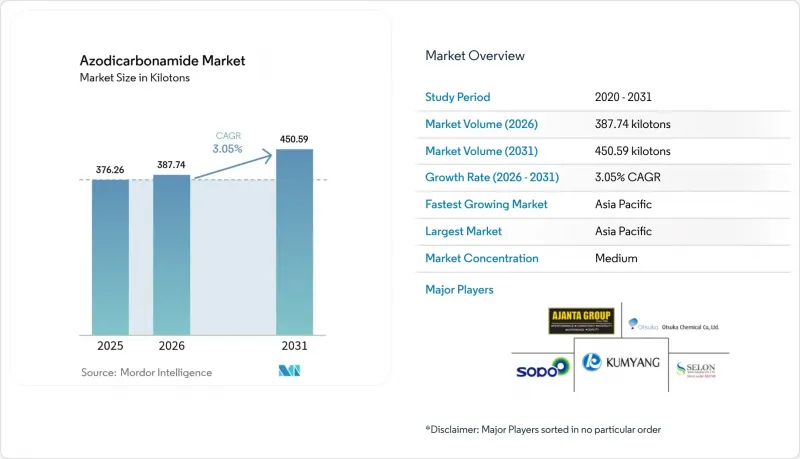
본 보고서는 등급(산업용 등급, 식품용 등급), 최종 사용자 산업(플라스틱 및 고무 산업, 식품 및 음료 산업, 가죽·섬유 산업, 기타), 지역(아시아태평양, 북미, 유럽, 남미, 중동 및 아프리카)별로 분류되어 있습니다. 시장 예측은 킬로톤 단위로 표시되어 있습니다.
세계의 아조디카르본아미드 시장 동향 및 인사이트력
플라스틱 및 고무 발포체 제조의 급속한 성장
아시아 전역의 산업화로 인해 폴리머 발포체의 생산 능력은 두 자릿수 성장을 유지하고 있습니다. 이러한 추세는 아조디카르본아미드 시장의 소비량 증가로 직결됩니다. 이는 이 발포제의 분해 온도 범위가 220-225°C로 좁기 때문에 자동차 충돌 흡수 패드나 건축 외피의 단열재에 필수적인 정밀한 밀도 제어가 가능하기 때문입니다. 중국의 화학 산업 클러스터에서는 범용 등급보다 부가가치가 높은 발포체 공급이 증가하고 있으며, 이를 통해 생산자들은 순수한 가격 경쟁에서 벗어나 이익률을 확보하고 있습니다. 북미의 가공업체들이 전기 SUV 및 트럭용 경량 부품으로 조달을 전환함에 따라 지역 간 수요 균형이 잡히며 특정 지역에 대한 의존도가 낮아지고 있습니다. 베트남과 인도네시아의 설비 업그레이드로 인해 중소규모 가공 업체들이 수출 지향적인 밸류체인에 진입하면서 아조디카르본아미드 시장의 기반이 더욱 확대되고 있습니다. 마지막으로, 초임계 유체 발포 기술에 대한 지속적인 혁신은 화학적 발포법을 대체하기보다는 보완하는 것이며, 기계적 기술로는 아직 재현할 수 없는 미세한 셀 구조에서 아조디카르본아미드는 여전히 필수적인 존재로 남아 있습니다.
비용 대비 효과가 뛰어나고 가스 수율이 높은 발포제의 경제성
아조디카르본아미드는 최대 230 ml/g의 가스를 방출합니다. 이는 일반적인 흡열성 발포제의 2배 이상으로, 이를 통해 가공업체는 사용하는 첨가제의 양을 줄이고 압출 주기를 단축하면서도 목표 발포 밀도를 달성할 수 있습니다. 중국과 한국의 일체형 생산 제조업체들은 히드라진에서 아조디카르본아미드로의 전환에 따른 시너지 효과를 활용하여 단위 비용을 절감하는 동시에, 원자재 가격 변동 시 이익률 하락을 완화하고 있습니다. 에너지 가격이 고공행진을 이어가고 있는 유럽에서는 발열성 대체품에 비해 이 화합물의 활성화 온도가 낮기 때문에 오븐 체류 시간과 전력 소비량이 줄어듭니다. 이러한 운영 비용 절감 효과는 스코프 3 배출량 감축을 목표로 하는 제조업체에게 큰 매력으로 작용하고 있습니다. 2025년 초 요소 가격이 안정화됨에 따라, 가공업체들은 장기 공급 계약을 체결하여 아조디카르본아미드 시장의 가격 하한선을 강화하는 한편, 생산 능력 확대 결정을 위한 전망을 명확히 했습니다. 또한, 하이드로플루오로카본(HFC)이나 하이드로플루오로올레핀(HFO) 계열과 달리 특수한 취급 설비가 필요하지 않은 점도, 막대한 설비 투자 예산을 보유하지 않은 중소규모 가공업체에게 비용 면에서 추가적인 우위를 제공합니다.
EU 및 호주에서의 식품 용도에 대한 엄격한 금지 조치
2025년, EU와 호주의 선행 금지 조치에 이어 중국의 GB 2760-2024 규격이 국가 식품 첨가물 목록에서 아조디카르본아미드를 삭제함에 따라 규제 흐름은 결정적으로 변화했습니다. 캘리포니아주, 뉴욕주, 펜실베이니아주에서는 2027년부터 주 전역에 걸쳐 금지 조치가 시행될 예정이며, 이로 인해 미국 최대의 3대 소비자 시장에서 제빵 수요가 사실상 사라지게 될 것입니다. 다국적 체인점들은 공급망의 복잡화를 피하기 위해 선제적으로 재고 배합을 재검토하여, 기존 전 세계 식품 등급 사용량의 15-20%를 감축했습니다. 소규모 지역 제과점은 효소 계열로 전환함에 따라 비용 증가에 직면하고 있지만, 아조디카르본아미드 사용을 지속함으로써 얻는 경제적 이익보다 법적 책임에 대한 우려가 더 크게 다가오고 있습니다. 이러한 누적된 영향으로 인해, 발포제 및 섬유 용도 등 산업 분야에서 아조디카르본아미드의 채택이 그 공백을 메울 때까지는 아조디카르본아미드 시장의 단기적인 성장이 억제될 전망입니다.
부문별 분석
2025년에는 산업용 등급이 총 공급량의 94.10%를 차지했으며, 2031년까지 연평균 성장률(CAGR) 3.17%로 성장함에 따라 그 우위는 더욱 확대될 것으로 예측됩니다. 각 제조업체는 이 등급의 불순물이 적다는 특성을 높이 평가하고 있으며, 이를 통해 PVC 및 EVA 가공 시 타는 위험을 최소화하고 자동차 내장재의 최종 용도 규정 준수를 가능하게 합니다. 대규모 컨버터는 아시아의 통합형 생산자와 직접 연간 계약을 체결하여 공급을 확보하는 한편, 소규모 구매자라면 얻을 수 없는 규모의 경제에 따른 할인을 누리고 있습니다. 베트남, 태국, 인도에서의 새로운 연속 발포 라인에 대한 설비 투자와 맞물려, 이러한 동향은 아조디카르본아미드 시장에서 산업용 등급의 우위를 확고히 하고 있습니다.
식품용 등급은 제빵 업계의 광범위한 사용 금지 조치로 인해 구조적인 감소 추세를 보이고 있지만, 금지 조치가 없는 지역, 특히 동남아시아와 중동 일부에서는 여전히 수요를 유지하고 있습니다. 다국적 식품 그룹은 품질 보증 프로토콜을 효율화하기 위해 전 세계적으로 효소만을 사용하는 레시피를 표준화하고 있으며, 그 결과 식품 등급 제품은 틈새 시장인 지역 제과점이나 전문 제과점 등의 형태로 제한되고 있습니다. 이러한 시장에서도 효소와 아조디카르본아미드의 가격 격차가 좁혀짐에 따라 판매량은 감소하고 있으며, 이로 인해 아조디카르본아미드의 가격 경쟁력이 약화되면서 아조디카르본아미드 시장 점유율은 더욱 축소되고 있습니다.
지역별 분석
2025년 판매량에서 아시아태평양이 73.08%를 차지했다는 사실은 이 지역이 원료의 근접성, 숙련된 노동력, 그리고 수직 통합된 가공 거점이라는 타의 추종을 불허하는 조합을 갖추고 있음을 반영합니다. 이 지역의 생산자들은 해안가의 화학 단지들과 광둥성, 절강성, 타밀나두주의 하류 가공업체들을 연결하는 효율적인 물류 회랑을 활용하고 있습니다. 장기적으로는 중국의 환경 규제 대응 강화에 따라 국내 공장을 저배출형 정밀화학 제조의 세계적 벤치마크로 재포지셔닝하고, 비용 경쟁력을 유지하면서 엄격해지는 ESG 공시 요건을 충족하는 것을 목표로 하고 있습니다.
북미 시장 점유율은 2027년 캘리포니아주의 식품 안전법이 시행된 후 축소되겠지만, 전기차(EV), 항공우주, 건축용 단열재 프로젝트가 본격화됨에 따라 회복될 것입니다. 캐나다에서 제로 배출 건축이 추진됨에 따라 폴리우레탄 폼의 개보수 수요가 증가하고 있습니다. 이 분야에서 아조디카르본아미드는 저밀도이면서도 필요한 R값을 실현하여, 자재 사용량과 설치 중량을 줄이고 있습니다. 이처럼 산업용 고객층에서 아조디카르본아미드 시장 규모는 제빵 업계에서의 철수분을 상쇄하고 있으며, 이 첨가제가 화학적 성질을 근본적으로 바꾸지 않으면서도 다양한 최종 시장에 걸쳐 적용될 수 있는 능력을 보여주고 있습니다.
식품 사용 금지 조치를 가장 먼저 도입한 유럽은 현재 테크니컬 등급 용도에 주력하고 있습니다. 독일과 프랑스의 컴파운더 각사는 스포츠 용품 브랜드를 위해 바이오 EVA 폼을 개발하고 있으며, 미세 셀 구조를 구현하기 위해 아조디카르본아미드를 활용하고 있습니다. EU 배출권 거래 제도(ETS) 하에서 CO₂ 가격 책정이 엄격해지는 가운데, 에너지 효율이 높은 반응제에 대한 연구가 활발해지고 있습니다. 아조디카르본아미드는 활성화 온도가 적당하여 공정상 이점이 있어, 유럽 공장에서의 사용이 유지되고 있습니다.
남미, 중동 및 아프리카는 절대량 면에서는 뒤처지고 있지만, 인프라 투자의 가속화에 따라 산업 부문의 연평균 성장률(CAGR)은 평균을 상회하고 있습니다. 브라질의 석유화학 분야 투자는 수입 발포체를 국내산으로 대체하기 위한 것이며, 한편 사우디아라비아의 ‘비전 2030’에 따른 다각화가 단열재 수요를 견인하고 있습니다.
기타 혜택 :
- 엑셀 형식 시장 예측(ME) 시트
- 3개월간의 애널리스트 지원
자주 묻는 질문
목차
제1장 서론
제2장 조사 방법
제3장 개요
제4장 시장 구도
제5장 시장 규모 및 성장 예측
제6장 경쟁 구도
제7장 시장 기회 및 향후 전망
KTH 26.08.31According to Mordor Intelligence, the azodicarbonamide market size was valued at 376.26 kilotons in 2025 and estimated to grow from 387.74 kilotons in 2026 to reach 450.59 kilotons by 2031, at a CAGR of 3.05% during the forecast period (2026-2031).
This report is Segmented by Grade (Industrial Grade and Food Grade), End-User Industry (Plastic and Rubber Industry, Food and Beverage Industry, Leather and Textile Industry, and Other End-User Industries), and Geography (Asia-Pacific, North America, Europe, South America, and Middle-East and Africa). The Market Forecasts are Provided in Terms of Volume (Kilo Tons).
Global Azodicarbonamide Market Trends and Insights
Rapid Growth in Plastic and Rubber Foam Manufacturing
Industrialization across Asia sustains double-digit expansion in polymer-foam capacity, a trend that translates directly into higher azodicarbonamide market consumption because the blowing agent's narrow 220-225 °C decomposition window allows precise density control essential for automotive crash-absorption pads and building-envelope insulation. Chinese chemical clusters increasingly supply value-added foams rather than commodity grades, capturing margins that insulate producers from purely price-based competition. As North American processors shift procurement toward lightweight parts for electric SUVs and trucks, cross-regional demand balances and reduces the sector's exposure to any single geography. Equipment upgrades in Vietnam and Indonesia further broaden the azodicarbonamide market base by bringing small and mid-size converters into export-oriented supply chains. Finally, ongoing innovation in supercritical-fluid foaming complements, rather than replaces, chemical blowing methods, keeping azodicarbonamide indispensable for fine-cell structures that mechanical techniques cannot yet replicate.
Cost-Effective, High-Gas-Yield Blowing-Agent Economics
Azodicarbonamide liberates up to 230 ml/g of gas, more than twice that of typical endothermic agents, which lets processors achieve target foam densities with fewer additive kilograms and shorter extrusion cycles. Integrated producers in China and South Korea capitalize on hydrazine-to-azodicarbonamide synergies, shaving unit costs and buffering margins during feedstock swings. In Europe, where energy prices remain elevated, the compound's lower activation temperature compared with exothermic alternatives reduces oven residence times and electricity consumption, an operational saving that resonates with manufacturers pursuing Scope 3 emission reductions. As urea prices stabilized in early 2025, converters locked in long-term supply agreements, reinforcing the azodicarbonamide market's pricing floor and improving visibility for capacity-expansion decisions. The absence of specialized handling equipment requirements-unlike hydrofluorocarbon or hydrofluoro-olefin systems-adds a further cost edge that favors small and medium processors lacking extensive capital budgets.
Stringent Food-Use Bans in EU and Australia
The regulatory tide turned decisively in 2025 when China's GB 2760-2024 standard deleted azodicarbonamide from the national food-additive list, following earlier prohibitions in the EU and Australia. California, New York, and Pennsylvania will enforce statewide bans from 2027, effectively erasing bakery demand across three of the largest U.S. consumer markets. Multinational chains pre-emptively reformulated inventories to avoid supply-chain complexity, removing 15-20% of pre-existing global food-grade volume. Smaller regional bakeries face higher costs when switching to enzyme systems, but liability considerations outweigh the economic benefits of continued azodicarbonamide use. The cumulative effect trims near-term growth in the azodicarbonamide market until industrial uptake in foam and textile applications fills the gap.
Other drivers and restraints analyzed in the detailed report include:
- Lightweight EV Insulation and Packaging Applications
- Vegan Leatherette Production for Fashion Industry
- Clean-Label Enzyme-Based Dough Improvers Gaining Share
For complete list of drivers and restraints, kindly check the Table Of Contents.
Segment Analysis
Industrial Grade represented 94.10% of total volume in 2025, a dominance expected to widen as the segment grows at a 3.17% CAGR through 2031. Manufacturers value the grade's low impurity profile, which minimizes scorch risk during PVC and EVA processing and supports end-use compliance in automotive interiors. Larger converters negotiate annual contracts directly with integrated Asian producers, locking in supply and reaping scale discounts that smaller buyers cannot match. Combined with capital investments in new continuous-foaming lines across Vietnam, Thailand, and India, the trend secures Industrial Grade's primacy in the azodicarbonamide market.
Food Grade continues a structural decline amid sweeping bakery bans, yet survives in regions lacking prohibitions, notably parts of Southeast Asia and the Middle East. Multinational food groups standardize enzyme-only recipes worldwide to streamline quality-assurance protocols, relegating Food Grade to niche local bakeries and specialty confectionery formats. Even here, volumes fall as cost parity between enzymes and azodicarbonamide narrows, eroding the compound's price advantage and further shrinking its share of the azodicarbonamide market size.
Complete Report Scope:
- By Grade
- Industrial Grade
- Food Grade
- By End-User Industry
- Plastic and Rubber Industry
- Food and Beverage Industry
- Leather and Textile Industry
- Other End-user Industries
- By Geography
- Asia-Pacific
- China
- India
- Japan
- South Korea
- Rest of Asia-Pacific
- North America
- United States
- Canada
- Mexico
- Europe
- United Kingdom
- France
- Germany
- Italy
- Rest of Europe
- South America
- Brazil
- Argentina
- Rest of South America
- Middle-East and Africa
- Saudi Arabia
- South Africa
- Rest of Middle-East and Africa
- Asia-Pacific
Geography Analysis
Asia-Pacific's 73.08% grip on 2025 volume reflects the region's unmatched combination of feedstock proximity, skilled labor, and vertically integrated processing hubs. Regional producers capitalize on efficient logistics corridors linking coastal chemical complexes to downstream converters in Guangdong, Zhejiang, and Tamil Nadu. Longer term, environmental-compliance upgrades in China aim to reposition national plants as global benchmarks for low-emission fine-chemicals manufacturing, preserving cost competitiveness while satisfying tightening ESG disclosure requirements.
North America's share contracts after California's Food Safety Act takes effect in 2027 but rebounds as EV, aerospace, and building-insulation projects ramp up. Canada's push for zero-emission buildings spurs polyurethane-foam retrofits where azodicarbonamide delivers necessary R-values at reduced density, lowering material usage and installation weight. The azodicarbonamide market size for industrial customers thus offsets bakery exits, illustrating the additive's ability to pivot across end-markets without fundamental chemistry changes.
Europe, an early mover on food bans, now focuses on technical-grade applications. German and French compounders develop bio-based EVA foams for sports-equipment brands relying on azodicarbonamide to achieve micro-cell structures. Stricter CO2 pricing under the EU Emissions Trading System intensifies the search for energy-efficient reagents; azodicarbonamide's moderate activation temperature provides a process advantage that sustains its presence in European factories.
South America and the Middle-East and Africa trail in absolute volume but post above-average industrial-sector CAGRs as infrastructure spending accelerates. Brazil's petrochemical investments target domestic substitution of imported foams, while Saudi Arabia's Vision 2030 diversification drives demand for thermal-insulation materials.
- Ajanta Group
- Guangzhou Longhi Rubber & Plastic Co. Ltd.
- Haihang Industry
- Haihong Group
- HPL Additives Limited
- Hubei Yuchuan New Materials Technology Co. Ltd
- Jiangsu SOPO (Group) Co. Ltd
- Jiangxi Selon Industrial Co. Ltd
- Kumyang Co., Ltd.
- Lautan Otsuka Chemical
- MLA Group of Industries
- Ningxia Risheng High-tech Industry Co. Ltd
- Otsuka Chemical Co.,Ltd.
- Quanzhou Haitai Chemical Co. Ltd
- Shanghai Exquisite Biochemical Co. Ltd
- Shivam Additives Pvt. Ltd (SPL Group)
- Sri Dwarikadheesh Polymers Pvt. Ltd
- Sundow Polymers Co. Ltd
- Weifang Yaxing Chemical Co. Ltd
Additional Benefits:
- The market estimate (ME) sheet in Excel format
- 3 months of analyst support
TABLE OF CONTENTS
1 Introduction
- 1.1 Study Assumptions and Market Definition
- 1.2 Scope of the Study
2 Research Methodology
3 Executive Summary
4 Market Landscape
- 4.1 Market Overview
- 4.2 Market Drivers
- 4.2.1 Rapid Growth in Plastic and Rubber Foam Manufacturing
- 4.2.2 Rising Bakery Demand for Dough-Conditioning Additives
- 4.2.3 Cost-Effective, High-Gas-Yield Blowing Agent Economics
- 4.2.4 Lightweight EV Insulation and Packaging Applications
- 4.2.5 Vegan Leatherette Production for Fashion Industry
- 4.3 Market Restraints
- 4.3.1 Stringent Food-Use Bans in EU And Australia
- 4.3.2 Raw-Material Price Volatility (Urea, Hydrazine)
- 4.3.3 Clean-Label Enzyme-Based Dough Improvers Gaining Share
- 4.4 Value Chain Analysis
- 4.5 Porter's Five Forces
- 4.5.1 Bargaining Power of Suppliers
- 4.5.2 Bargaining Power of Buyers
- 4.5.3 Threat of New Entrants
- 4.5.4 Threat of Substitutes
- 4.5.5 Degree of Competition
5 Market Size and Growth Forecasts (Value)
- 5.1 By Grade
- 5.1.1 Industrial Grade
- 5.1.2 Food Grade
- 5.2 By End-User Industry
- 5.2.1 Plastic and Rubber Industry
- 5.2.2 Food and Beverage Industry
- 5.2.3 Leather and Textile Industry
- 5.2.4 Other End-user Industries
- 5.3 By Geography
- 5.3.1 Asia-Pacific
- 5.3.1.1 China
- 5.3.1.2 India
- 5.3.1.3 Japan
- 5.3.1.4 South Korea
- 5.3.1.5 Rest of Asia-Pacific
- 5.3.2 North America
- 5.3.2.1 United States
- 5.3.2.2 Canada
- 5.3.2.3 Mexico
- 5.3.3 Europe
- 5.3.3.1 United Kingdom
- 5.3.3.2 France
- 5.3.3.3 Germany
- 5.3.3.4 Italy
- 5.3.3.5 Rest of Europe
- 5.3.4 South America
- 5.3.4.1 Brazil
- 5.3.4.2 Argentina
- 5.3.4.3 Rest of South America
- 5.3.5 Middle-East and Africa
- 5.3.5.1 Saudi Arabia
- 5.3.5.2 South Africa
- 5.3.5.3 Rest of Middle-East and Africa
- 5.3.1 Asia-Pacific
6 Competitive Landscape
- 6.1 Market Concentration
- 6.2 Strategic Moves
- 6.3 Market Share (%)/Ranking Analysis
- 6.4 Company Profiles (includes Global level Overview, Market level overview, Core Segments, Financials as available, Strategic Information, Market Rank/Share for key companies, Products and Services, and Recent Developments)
- 6.4.1 Ajanta Group
- 6.4.2 Guangzhou Longhi Rubber & Plastic Co. Ltd.
- 6.4.3 Haihang Industry
- 6.4.4 Haihong Group
- 6.4.5 HPL Additives Limited
- 6.4.6 Hubei Yuchuan New Materials Technology Co. Ltd
- 6.4.7 Jiangsu SOPO (Group) Co. Ltd
- 6.4.8 Jiangxi Selon Industrial Co. Ltd
- 6.4.9 Kumyang Co., Ltd.
- 6.4.10 Lautan Otsuka Chemical
- 6.4.11 MLA Group of Industries
- 6.4.12 Ningxia Risheng High-tech Industry Co. Ltd
- 6.4.13 Otsuka Chemical Co.,Ltd.
- 6.4.14 Quanzhou Haitai Chemical Co. Ltd
- 6.4.15 Shanghai Exquisite Biochemical Co. Ltd
- 6.4.16 Shivam Additives Pvt. Ltd (SPL Group)
- 6.4.17 Sri Dwarikadheesh Polymers Pvt. Ltd
- 6.4.18 Sundow Polymers Co. Ltd
- 6.4.19 Weifang Yaxing Chemical Co. Ltd
7 Market Opportunities and Future Outlook
- 7.1 White-space and Unmet-Need Assessment


